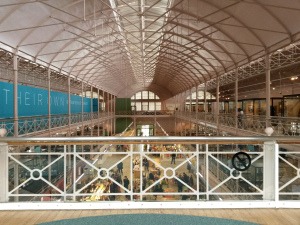
The V&A‘s latest long-running exhibition is Undressed: A Brief History of Underwear. As the name suggests, it follows the evolution of underwear design from the eighteenth century onwards. It features examples of underwear worn by both men and women, examining how underwear influenced, and was influenced by, ideas of gender, sex and morality, and how it affected outerwear.
I was interested to see the older underwear in particular, such as the examples of nineteenth-century corsets and their earlier counterparts ‘stays’, as well as early bras. The more modern cutting-edge styles were fascinating too. The exhibition runs until 12 March, costing £12, and is well worth seeing.
While I was at the Museum of Childhood to see the exhibition about Bagpuss and The Clangers, I took the opportunity to look around the museum as a whole. Though it is based in Bethnal Green, it is part of west London’s Victoria & Albert Museum: the building was opened as the Bethnal Green Museum in 1872 and in 1922, then-Head Curator Arthur Sabin decided to try and make it more child-friendly. The move was a popular one, and following this the Museum re-opened in 1974 as the Museum of Childhood. A refurbishment occurred in 2005-06 and the Museum continues to thrive.
The Museum is neither just for children nor solely for adults, but manages to successfully cater to both groups. Fun and educational events take place regularly for children, and adults can also get in on the act – for instance, there is a nostalgic children’s’ TV quiz taking place on the 21st of April. The Museum examines the history of childhood, which is interesting for people of all ages: adults can reminisce about their own childhoods, children can learn about how young people of the past occupied their time, and everyone can develop a greater understanding of the history of childhood as a concept.
The section devoted to the history of childhood was particularly interesting to me: it looked at how babies and young children were cared for from the sixteenth century onwards, with examples of clothing, cots and feeding equipment as well as toys. There was also a section on clothes, which showed how children went from wearing miniature versions of adult outfits to their own specially designed fashions.
There were special sections devoted to kinetic and electronic toys, and there were some cases devoted to particular themes, such as magic, with a 1950s magic set being displayed alongside Harry Potter merchandise from recent years. I enjoyed seeing some of the toys I used to play with myself, including Sylvanian Families and the original PlayStation. I have to admit I do feel rather old knowing that toys I played with as a child are now in a museum!
The Museum is currently showing a temporary exhibition called On Their Own: Britain’s Child Migrants. This is definitely aimed at adults rather than children as it explores the sensitive and distressing topic of the children who were sent to various British colonies from 1869-1970. These children were sent away with the promise of a better life, but for many this did not materialise, and several never saw their families again.
The Museum of Childhood is definitely worth a visit. It’s fascinating, and it’s free: though be warned, you may come out with a desire to relive your childhood.
The Julia Margaret Cameron exhibition at the V&A opened yesterday, and since I was meeting up with a friend in the museum café, I suggested that we pay it a visit, as she is also interested in Cameron’s work. The first thing we noticed on approaching the entrance to the free exhibition was the installation outside allowing you to take Victorian-style pictures. I’m not convinced my photo looks particularly authentic – the glittery pink bag strap is a bit of a giveaway – but I think this will be really popular with exhibition-goers. You can share your pictures on social media using the hashtag #VictorianMe.
#VictorianMe
The free exhibition, held in one room on the first floor, marks the bicentenary of Cameron’s birth, and is made up of over 100 photographs from the Museum’s collection. The V&A, then the South Kensington Museum, was the only museum to exhibit Cameron’s work during her lifetime: the founding director, Sir Henry Cole, presented her work in 1865. In 1868, the Museum offered Cameron the use of two rooms as a studio.
The photographs exhibited include portraits of the great and the good – among them Alfred, Lord Tennyson, and Charles Darwin – and Cameron’s own servants and family members, many of whom were posed as biblical, historical or allegorical characters.
Julia Margaret Cameron’s style was unique for the time, and wasn’t always appreciated. I personally love the out-of-focus technique she employed, which give her pictures an ethereal, dreamlike quality, which is unique in Victorian photography. Many contemporary critics were less than complimentary. One of the things that surprised me was seeing how confident Cameron grew as her career developed: in her letters she describes her own work as innovative and groundbreaking. On reflection, this lack of modesty probably helped her promote and establish herself in an industry dominated by men.
The most interesting thing about the exhibition, for me, was the inclusion of some “imperfect” works that Cameron herself did not want exhibited or sold. These show the issues that Cameron had in creating her work, including cracks in the images and damage to the negatives. Critics may have seen Cameron’s work as clumsy and flawed, but she had high standards of her own, knew what she wanted and how to achieve it, and was able to turn her mistakes to her advantage.
My auntie and my cousin love shoes even more than I do, so when they came down to London for a few days they were determined to visit the new Shoes: Pleasure and Pain exhibition at the V&A. They invited me along too, and I was happy to accept.
The exhibition contains weird and wonderful shoes from history, fashion and everyday life, spanning the globe and a period of centuries. It displays around 200 pairs of shoes, exhibited largely on boxes with mirrrors behind to showcase the entire shoe. The shoes belonged to both men and women and were worn for all sorts of different occasions, encompassing Seventies platform heels, eighteenth century Indian wedding shoes, Fifties stilettos, tiny shoes for bound or “lotus” feet in China and moccasins from Canada. It was interesting to see how historical styles influenced more modern designers and how shoes reflected wealth and social status: for instance, fragile shoes with high heels were generally worn by the rich who lived idle lifestyles. There was a section on fetish shoes and another one for famous shoes, including David Beckham’s football boots and the ballet shoes worn by Moira Shearer in The Red Shoes.
The second level of the exhibition contained information about how shoes are made, including some very modern 3D-printed sandals. This exhibition is an absolute must-see for anyone who loves shoes.
The Red Shoes. Image courtesy of quitecontinental.net
I visited the long-awaited Alexander McQueen: Savage Beauty exhibition at the V&A on Sunday, having luckily booked in advance for a late afternoon slot. The exhibition has sold very well, and in fact weekends have been sold out for a while, so I considered myself lucky to be able to get in.
Despite the popularity of the exhibition, I was impressed with how well it had been organised. I only had to queue for a couple of minutes, getting into the exhibition at the appointed time. The space was not too crowded: sometimes there is a tendency to cram as many people as possible into a space, even when an exhibition has limited entry, but that wasn’t the case here.
The exhibition was well set-up with strong design and themed rooms, reflecting the aesthetic of the clothes, which were displayed thematically and showcased to great effect. For instance, there was a darker mirrored room showing off the Gothic-influenced clothing, and a wood-panelled eighteenth century drawing room to display the Scottish-influenced garments.
I thought the exhibition provided a strong overview of McQueen’s work, with items from his significant collections including Widows of Culloden and Jack the Ripper Stalks His Victims, as well as his final fully-formed collection before his untimely death, Plato’s Atlantis. It explored how he used a variety of influences, including flowers, animals, other cultures and history, and emphasised the importance of tailoring in his garments. Looking at items such as the “bumster” trousers, the tailored suits and the dresses incorporating lace or tartan it’s possible to appreciate the thought and craftsmanship that went into each piece, even it’s something you wouldn’t necessarily wear yourself. Over time I’ve come to look at high fashion more as a form of art than as a representation of clothes you’d actually go out in, and this has led me to appreciate it much more. Alexander McQueen’s work is a particularly strong example of fashion-as-art as the designer used his clothes and catwalk shows to make political and cultural statements.
If you can still get a ticket, this is one exhibition which is a must see if you appreciate good design, whether or not you are into fashion.
I’ve always said I never want to get married, but that didn’t stop me from visiting the V&A‘s exhibition Wedding Dresses 1775–2014. Firstly, it was historical. Secondly, I do have a thing for gorgeous dresses.
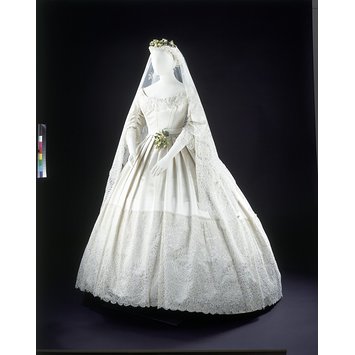
Silk-satin wedding dress from 1865 (Picture credit: V&A Collections)
There were plenty of those in the exhibition, but what really fascinated me was the history. From Georgian dresses that weren’t always white, but which tended to be “best” dresses then worn again later, through to Victorian white gowns with sprigs of orange blossom, to the development of the modern one-off white dress tradition during the twentieth century, the wedding dress has a rich and varied history. Upstairs, there were examples of more modern dresses from ordinary people and celebrities – I especially liked Dita Von Teese’s beautiful purple gown.
I popped into the Victoria & Albert Museum today to visit the Disobedient Objects exhibition, which is on until next weekend. This free exhibition looks at the role of objects used as tools for social change, beginning with the Suffragette teapots designed to promote the movement and ending with graffiti robots and protest banners.
The exhibition is inspiring, showing how people have come together over the years to protest against government decisions and instigate change. Quite different from the usual displays at the V&A, but well worth it.
Horst P. Horst (1906-99) has been described as “one of the twentieth century’s master photographers”, and the new exhibition at the V&A, Horst: Photographer of Style, explores his life and work. Horst was born in Germany in 1906, but joined Vogue in 1931 and became a US citizen in 1943.
His work encompasses much of the 20th century, ranging from 1930s haute couture, with beautiful, glamorous black and white prints with stunning models and atmospheric shadows, to Dali-inspired surrealism, pictures of nature and travel photographs. It’s an interesting and varied exhibition, a snapshot of a more glamorous time.
Constable: The Making of a Master is the new exhibition looking at how the great artist created his works. The exhibition, which is held at the V&A, examines his influences, inspirations and work processes. Much of this would, I think, be particularly interesting to those with an art background; however, there is still plenty for the non-expert to appreciate.
The perception of Constable is of a solely “natural painter”, however this interpretation does not stand up in his later paintings which mark more of a retreat from naturalism. The artist had a reverence for the Old Masters and was strongly influenced by them; artists he revered included Raphael, Reubens and Claude Lorrain. He made copies of their paintings, some of which are almost indistinguishable from the originals, and collected prints of other artists’ work throughout his life.
Constable’s most famous works such as The Hay Wain (1821), The Leaping Horse (1825) and my personal favourite Salisbury Cathedral From the Meadows (1831) are displayed, and it is fascinating to see how he worked on and developed these pictures. He would start with small black and white sketches, followed by large, full-size colour sketches, before attempting the finished painting.
Before I saw this exhibition I vaguely thought of John Constable as someone who painted slightly dull, traditional English landscapes. After seeing this exhibition I realise I need to revise my assessment somewhat.
The small display Shakespeare: Greatest Living Playwright is on in the Theatre & Performance area at the Victoria & Albert Museum until the 28th of September. It celebrates the 450th anniversary of Shakespeare’s birth, and consists of artefacts such as a copy of the First Folio and videos of several theatre practitioners currently involved with Shakespeare. These include Sinead Cusack, Cush Jumbo and Simon Russell Beale, and I really enjoyed hearing about their experiences, especially Cusack, as she played Cleopatra in the first ever RSC production I saw back in 2002.