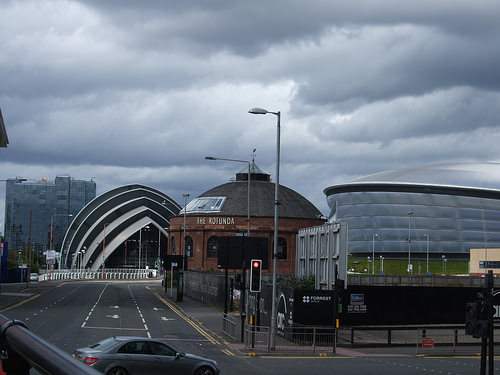
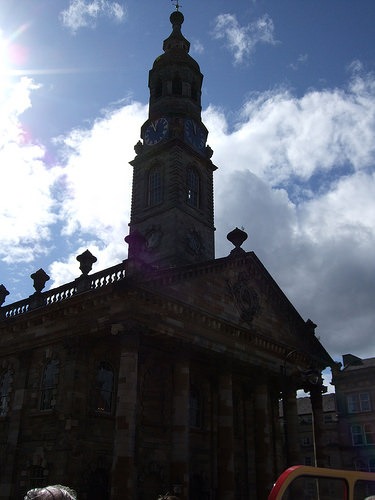
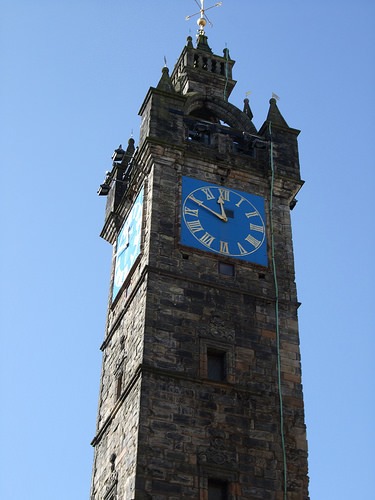
On Thursday we finally got around to getting on the tour bus. We were delighted to find that our bus was an old Routemaster, and we had an actual tour guide instead of a recorded commentary. The bus journey was great and it made us realise just how big Glasgow actually is, and how full of history.
Crossing the Clyde
The Victorian quarter
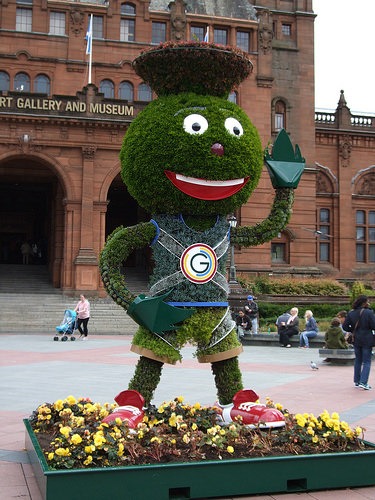
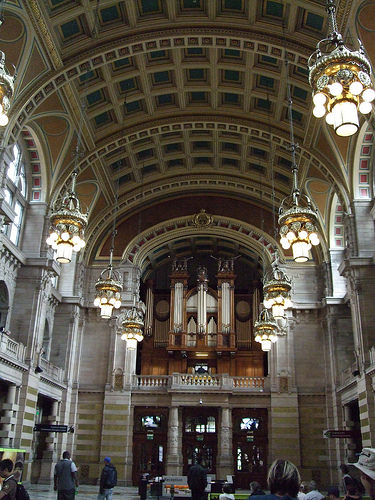
We got off the bus towards the end, at the Kelvingrove Art Gallery & Museum. This free museum opened in 1901 and is full of many fascinating things, including and related to stuffed animals, prehistory, clothes, the Scottish Colourists, Charles Rennie Mackintosh, the history of Scotland & Scottish identity and Ancient Egypt. There is also a Spitfire aeroplane hanging from the ceiling, and, famously, Salvador Dali’s seminal painting Christ of St John of the Cross.
Kelvingrove Museum & Art Gallery
Inside the Kelvingrove
After looking around the Museum – which took the rest of the day – we had a drink in the Brewdog pub across the street before getting back onto the bus.
In the evening we had tea at Ask, with a couple of glasses of wine to go with it!
Today we went on a trip to Loch Lomond, taking a boat trip into the middle of the Loch and spending some time in Luss, a small village on its banks. My mam absolutely loved it, and it was certainly a stunningly beautiful place. Luss itself was small, but we enjoyed looking around the graveyard (yes, another one) belonging to the local church: it had graves dating from the 6th and 7th centuries, including Viking burials.
Loch LomondLussChurchTea and whisky cake
We were both exhausted once we got back in the evening, so we went for a pub meal with some wine before going back and going to bed!
Our original plan was to spend our first full day in Glasgow on the sightseeing bus. However, by the time we’d had breakfast and made it to the bus stop, there was a huge queue and we decided just to walk to the Cathedral, which was Stop 2 on the bus route anyway.
Glasgow CathedralGates leading into the courtyardThe Bridge of Sighs
The first thing we did was to explore the Necropolis. Opened in 1833, this huge graveyard on the top of a hill overlooking the city was inspired by the Père Lachaise Cemetery in Paris, and was designed to provide a burial solution for the quickly growing population of Glasgow. It is reached via a “Bridge of Sighs” and it is stunning. My mam and I both loved it.
Looking at the Cathedral from the Necropolis
Afterwards we paused to take a look around the Cathedral, including the lower level where St Mungo is supposed to be buried. By this time we were completely exhausted so we stopped for a cup of tea at the St Mungo Museum next door.
Inside the Cathedral
On our way out Mam noticed an old-looking house called Provand’s Lordship across the road. We decided to go in, which proved a good decision. Entry to this house is free, and it is the oldest building in Glasgow, with a great deal of history.
Provand’s Lordship
We walked back into town and went to Buchanan Street to visit the Willow Tea Rooms. These are a reconstruction of the original Willow Tea Rooms designed by Charles Rennie Mackintosh. They consist of the White Tea Room and the Chinese, or Blue, Room, where we were seated. Our tea was yummy but we had to go for a lie down afterwards!
Willow Tea RoomsInside the Chinese RoomInside the Chinese Room
Our yummy afternoon tea
In the evening we visited Glasgow’s Theatre Royal to see a play called April in Paris. We both enjoyed it – I wrote a review here. Afterwards we went for a drink before heading back to the hotel.
I enjoyed my trip to Inverness last year so much that I decided to go back to Scotland this year. This time, however, I decided to go to Glasgow, as I’d never really explored the western part of Scotland. My mam came too, and we decided to travel up separately – me from London, she from Newcastle – and meet at the Travelodge.
Ruari the Reindeer on the train!
I had a ridiculously early train from King’s Cross, and I had to change at Edinburgh, but my journey was mostly uneventful. At Glasgow, I got a bit lost on the way to the Travelodge, but I managed to find it eventually.
Queen Street Station
After we’d unpacked, we went for a walk around Glasgow to try and get our bearings. It reminded me a bit of Newcastle, with streets laid out in an orderly fashion. We had tea in Wetherspoon’s and then went for a drink. We didn’t stay out long, though, as we wanted to get a good night’s sleep the better to enjoy the following day!
I’ve gone past The Musical Museum in Brentford a few times on the bus, but had never been until it was open for free for the 50th anniversary weekend. Though I was supposed to be packing for my holiday, I took a break in order to go down to Kew Bridge.
Inside the entranceInside the museum
The museum contains one of the world’s foremost collections of automatic musical instruments, including pianos, orchestrions, orchestrelles and violin players, among others. The star of the collection is the Wurlitzer organ, which is located in the hall. When I arrived, a tour was just going into the hall, so I tacked onto the end and enjoyed a quick performance from the tour guide. We also got to see the organ lowered down into the pit!
The Mighty WurlitzerOne of the museum’s instruments
As well as having a look around myself, I attended the beginning of the next tour, in which the enthusiastic guide played us some of the instruments. This was great fun and I found the ingenuity and cleverness of these machines fascinating. There were several children there and they seemed to be thoroughly enjoying themselves.
One of the museum’s instrumentsOne of the museum’s instruments
The museum normally costs £10 but as I mentioned, it was free on the anniversary weekend. The museum completely relies on entry fees to run and maintain the instruments, so I’d urge you to visit and check out this quirky and unusual museum.
Described as “the most comprehensive presentation of digital creativity ever to be staged in the UK”, Digital Revolution, an immersive exhibition of art, design, film, music and videogames at the Barbican, is one of the big exhibitions of the summer. I visited on Saturday afternoon, and thankfully my Barbican membership allowed me free entry without having to wait for an available timeslot – a definite perk of membership!
There were three main sections to the exhibition. The first, which took up the whole of the Curve and several feet outside of it, was by far the largest. The second was a small, fenced-off area in which participants could play some indie computer games. The third was Umbrellium’s Assemblance, a laser room installed in the Pit Theatre. There were other little bits dotted around the Barbican too, such as electronic “pet snakes” as part of Minimaform’s Petting Zoo, and another installation off-site in the Bloomberg Space which I didn’t get round to visiting.
The first bit was great fun, and I think my dad and brother would have loved it. It contained lots of retro computer games, including those I remember, such as Tomb Raider, Super Mario Bros and The Sims, and those that were before my time, like Pong and Tetris. I was sad not to see the NES classic Blades of Steel there, however!*
The Sims
This nostalgic section was followed by some more modern developments in the field of technology, including some “birds” made from old mobile phones, and an installation by pop star will.i.am. There was also a selection of cutting-edge fashion, including a 3D-printed dress worn by – who else? – Lady Gaga.
Birds of the futureLady Gaga’s printed dresswill.i.am
If I have a criticism of this part of the exhibition, it would be that it was just so crowded. I understand that it was timed, and the Barbican have genuinely made an effort to control numbers. However, in an interactive exhibition such as this it can be very difficult to play that game or experience that technology without queuing for a while.
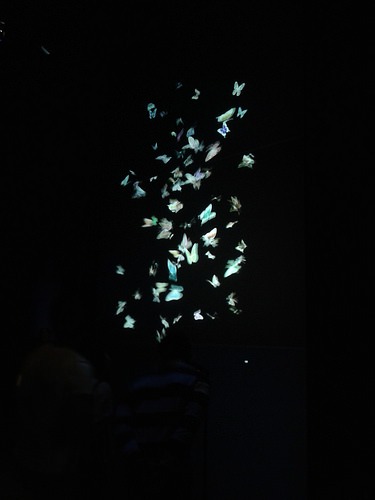
Magically transformed into angelsPretty butterflies
The indie-gaming section would probably be of most interest to serious gamers. I had a go, and recognised one of the games – my housemates have been talking about it for ages. You play an official on the immigration desk of a totalitarian East European state, and you have to decide whether to let people into the country or not. It’s a brilliant idea, but I couldn’t play it for too long as it traumatised me!
The laser room was fun, but I got bored after a few minutes. The exhibition took me around an hour and a half to explore in total. However, I didn’t spend too long in any one place. I am sure that someone who was really passionate about gaming and technology would be able to easily spend half a day or more here.
*Amazing graphics. Awesome music. All your friends will want it!
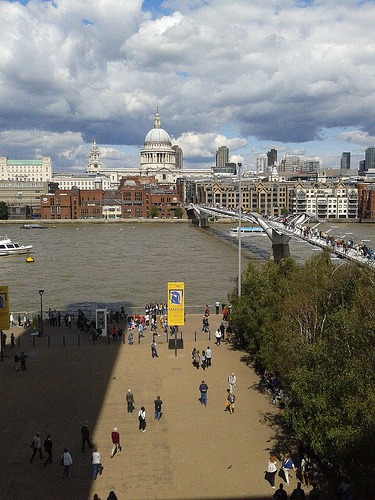
When I came out of the Tate Modern, I decided that as it was such a nice day I would walk along the Thames Path to the Southbank Centre. After a frozen yogurt from the pink Snog bus, I headed into the Hayward Gallery to see The Human Factor: The Figure in Contemporary Sculpture.
In general, I find that I tend to prefer older art (from the nineteenth century and earlier) to modern paintings and the like. However, I feel rather differently about sculpture. In my (completely uneducated) opinion, it gets a bit dull looking at yet another white marble figure, so the way in which modern sculptors use different materials to create imaginative and radical art is much more appealing to me. For this reason, I was looking forward to The Human Factor, which brings together new work from 25 international artists who use the human form in new and exciting ways.
There was an incredible array of sculpture on display, from Thomas Schütte Krieger’s huge statues, made of wood which has been coloured and oiled, battle scarred and contorted, to Paloma Varga Weisz’s double-headed “Falling Woman”. Cathy Wilkes’ untitled sculpture of 2011 shows a disturbing tableau of contorted figures surrounded by battle equipment, while Maurizio Cattelan has created a frighteningly lifelike representation of John F. Kennedy in his coffin. Figures have been cast from wax, formed from mannequins with added material, sculpted from bronze and given a beehive for a head (the latter is Pierre Huyghe’s 2012 creation – the first and, probably, only time I will ever see a sign warning that “The following exhibition contains live bees”). Jeff Hoons’ “Bear and Policeman” of 1988 shows a giant teddy bear towering over a rotund policeman, while Martin Honert’s unsettling sculpture of his former English teacher recreates the shadows of the black and white photo from which the image was taken. Other sculptures evoke living statues, of the kind you see in Covent Garden surrounded by tourists – it is surreal to view statues of people pretending to be statues. Mark Wallinger’s “Ecce Homo” of 1999 displays a man with a shorn head and a crown of thorns – an allegory of persecution.
Even with the breadth of sculpture on offer, I still managed to find favourites. One, entitled “Tell my mother not to worry”, is a marble sculpture of the artist’s four-year-old daughter disguised as a ghost. This is achieved by the sculpting of a white sheet which trails along the ground, with extremely realistic folds; it suggests that there really is something underneath.
This piece was by Ryan Gander, as was another of my favourites, a “re-imagining” of Degas’ Little Dancer. You see an empty plinth ahead, then turn to the right to see the dancer on tiptoe, staring out of the window. The sculpture is easily recognisable as the Degas character, and I liked the attempt to suggest that she had her own autonomy and views.
My final favourite piece probably made the strongest impact on me. Located in a small room by itself, Maurizio Cattelan’s “Him” is a kneeling schoolboy figure with his back to the entrance, hands clasped in an attitude of prayer. As you approach and turn to see the boy’s face, however, you see he is not a boy at all, but Hitler. This discovery raises more questions – what is Hitler praying for? Is he seeking forgiveness for his past actions? Or is he asking for help to continue his evil plans?
I loved this exhibition and I think there is something for everyone here. The Hayward Gallery always tries to show something different; it doesn’t always succeed, but it has done so here.
This is Kev. He is at the entrance to the Hayward Gallery and his clothes are changed every day of the exhibition!
On Saturday I attended a performance of Muse of Fire at the Globe. Afterwards I decided that, as I was right next to the Tate Modern, I would go in and see their new exhibition, Malevich: Revolutionary of Russian Art.
Kazimir Malevich (1879–1935) was an influential and radical artist whose work spanned one of the most eventful periods of Russian, and world, history. This retrospective examines his life’s work, which culminated in his most famous example of suprematism, the Black Square. I must admit I might not have seen the significance of this work, if I hadn’t discovered that it had been banned by the Soviet authorities. Anything deemed worthy of banning surely has some merit. In fact, when I actually saw the picture, I found it strangely compelling and unsettling, like a black tunnel, or a void. I could never have anticipated reacting like this to such a painting.
Suprematist work was, however, only one facet of Malevich’s work as an artist. Over the course of his life he explored landscape, religious painting and images of Russian workers, in both figurative and abstract styles. His range and versatility is clearly on show in this rich exhibition.
I took advantage of the National Portrait Gallery‘s late opening on Fridays to visit the Virginia Woolf: Art, Life and Vision exhibition. The exhibition, which runs until 26 October, looks at the acclaimed 20th century writer’s life and work through the mediums of photography, painting, illustration and archival material.
The exhibition begins with a display of Woolf’s diaries, rescued from her bombed-out house. They are shown alongside images of Woolf in the house at Tavistock Square before it was destroyed in the Blitz. There are several pictures of family members, many of them photographs by Julia Margaret Cameron, and many images of eminent men of art and letters who were family friends when Virginia was young.
Other pictures show the writer in the early days of her marriage to Leonard Woolf, as well as the other members of the Bloomsbury Group, including the artists Roger Fry and Vanessa Bell. The exhibition also explores the founding of the Hogarth Press in Hogarth House, Richmond, and Woolf’s relationship with Vita Sackville-West, as well as her suicide in 1941.
This is an interesting exhibition that explores not just the life of Virginia Woolf but the life of those around her, whether family, friends or other significant figures. A definite must-see for fans of her work.
I was surprised and intrigued to find a display about my own borough of Ealing at the National Portrait Gallery. Creative Connections is a series that looks at some of the well-known creative people with connections to a particular borough, as well as working with young people to explore creativity. This particular project based in Ealing partners Brentside High School, whose students have created a film installation with artist Eelyn Lee called An Ealing Trilogy.
Ealing has a rich history, growing in popularity since the extension of the Great Western Railway in the mid-1800s and the creation of Ealing Broadway station. Today it is home to people from all over the world, and its history encompasses Ealing Studios, the Ealing Music Club, and Ealing Art College (now part of the University of West London).
The exhibition has some great pictures of local landmarks including Pitzhanger Manor and Ealing Studios, as well as images of the students involved with the project. Famous figures with some connection to Ealing are pictured, with descriptions of their life and work. I knew about some of these people already: the architect Sir John Soane, who bought Pitzhanger Manor in 1801, and Ada Lovelace, daughter of Lord Byron, famed as the first computer programmer, who taught at the Ealing Grove Industrial School for underprivileged children which had been founded by Lady Byron.
Others, however, were new to me. Ballet dancer Margot Fonteyn was brought up in Ealing, while director Steve McQueen grew up near Ealing Studios. Inventors Trevor Baylis and Sir William Henry Perkin had Ealing connections: the latter (who invented the first synthetic dye, mauveine) opened a chemical factory in the area. Singer Dusty Springfield and actor Sid James also spent part of their childhoods in Ealing, while Pete Townshend went to Ealing Art School and The Who played Ealing Club, as did Freddie Mercury.
If you have any connection to the borough of Ealing, this is definitely worth a visit.