Unlocked Tour – Old Royal Naval College, Greenwich

I’ve spent a lot of time at the Old Royal Naval College in Greenwich over the last couple of years or so, taking tours, exploring and learning more about the area. I was excited to sign up for the Unlocked tour, which promised to showcase even more of the complex.

Former governors of Greenwich Hospital

Inside the Admiral's House

Inside the Admiral's House

Table on which Nelson's body was laid out

Meeting at the Old Brewery pub, we were taken first to the Admiral’s House, with its lists of former governors of Greenwich hospital, and its rich decoration. One corner was bombed during the Second World War and has since been rebuilt, but much of it is original. One particularly fancy room was used in disciplinary cases, so wouldn’t have been too pleasing to the average sailor’s eye. The most notable artefact in this building was probably the long table which is supposed to be the table on which Nelson’s body was laid out in the Painted Hall after it was returned to England after the Battle of Trafalgar.

Undercroft

Model of Greenwich palace

Former location of disco ball

Carved faces

Next, we headed into the building now used by Trinity Laban – I’ve been here several times before for concerts, but had never noticed this particular entrance, leading into a sixteenth-century undercroft fomerly part of Greenwich Palace. Over the years it has been used as a wine cellar, a coal hole, and a bar – a hook left over in the ceiling was used to hold a disco ball in the Seventies. The creepy face carvings were originally planned to cover one of the seventeenth-century buildings, but that plan was scrapped as being too expensive, and they ended up down here, where most of them have lost their noses thanks to Navy recruits practising their swordsmanship.

Skittle Alley

Skittle Alley

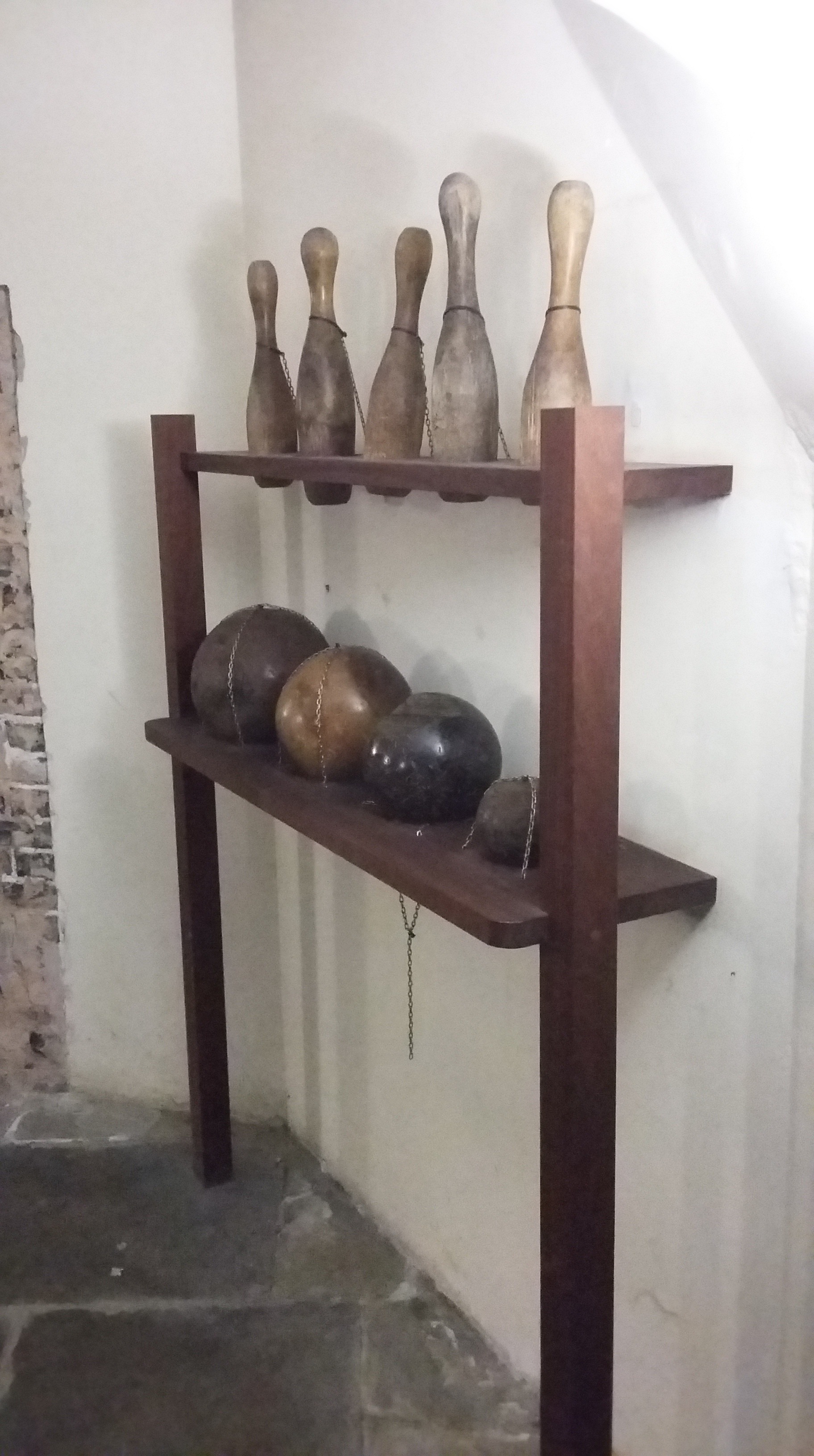
Finally, we headed beneath the Chapel to the Victorian skittle alley, somewhere I’ve wanted to visit ever since I heard about it. This space used to form part of the hospital, the underground location handily muffling the cries of patients undergoing operations. In the nineteenth century, the retired sailors living here, bored with the lack of entertainment, asked permission to construct a bowling alley down here. The balls used were practice cannon balls made from extremely heavy wood; it was not unknown for sailors to make bets with people they met in the pub and get them to use a ball that was ever so slightly rugby ball-shaped, thereby ensuring that they would never hit a strike. When it came to the sailors’ turn to have a go, they knew at what angle to throw the odd-shaped ball to ensure they were successful.

Looking out onto the Thames

There ended my Unlocked tour (except for a free drink waiting back at the pub). I’d definitely recommend the tour: my guide was really friendly and knowledgeable and I was very excited to finally get the chance to see the skittle alley.

Halloween 2018

It’s the most wonderful time of the year – no, not Christmas, Halloween. I’ve been distracted by work and my friend’s wedding recently, so I hadn’t planned as much as I would have liked, but I managed to squeeze in a few fun things to mark the occasion.
First up was a trip to the Royal Academy to check out the PsychoBarn, Cornelia Parker’s amazing creation inspired by the house in Psycho. I wore my Odd and the Sparkly brooch to visit, just because.

PsychoBarn

PsychoBarn

On Tuesday I attended a screening of a classic silent film Der Golem (it’s German) at Rich Mix in Shoreditch, complete with live musical soundtrack. Considering the film is almost one hundred years old I thought the special effects were pretty impressive. Sadly, they didn’t provide English translations of the text displayed between the scenes, so I had no idea what was going on.

On Halloween itself I went to see a play about a Victorian séance. It was promising but ultimately unsatisfying, and I began to wonder if I would have been better off having a night in with a horror film or a book of ghost stories.

Lord Halifaxs Ghost Book

Speaking of which, I spied a book on a friend’s Instagram with the most amazing cover that I immediately decided to track down myself. The book was Lord Halifax’s Ghost Book and was full of apparently true stories of ghostly experiences in houses all around the country. I might take these claims with a pinch of salt, but they were entertaining nevertheless.

VA Day of the Dead VA Day of the Dead

As well as Halloween, it was also Dias De Los Muertos – the Mexican Day of the Dead. The V&A held a late to mark the occasion and I went along with a friend. We made a beeline for the crafting area where I made a mask – now displayed on the wall at work – and painted a skull necklace. Despite my known lack of artistic talent, it wasn’t too bad.

Skull crafts

Jewellery brand of the month: Oh So Flamingo

My jewellery brand for October is the UK-based

OH SO FLAMINGO

So far, my only purchase from this brand has been the special poppy brooch made to commemorate the 100th anniversary of the end of World War I. All profits are donated to the Royal British Legion. I purchased the small brooch, the picture below shows the large.

Lone Soldier Poppy Appeal Brooch

What first drew me to the brand was a cute cupcake brooch I spied.

Cupcake O'Clock Brooch
Cupcake O’Clock Brooch

I also love the range of Hollywood-inspired brooches: this one was inspired by Elizabeth Taylor.

Lizzy Brooch
Lizzy Brooch

This squirrel brooch is super cute.

Squeaks the Squirrel Brooch

The brand doesn’t only produce brooches: I adore this rose necklace.

A Rose By Any Other Name Necklace

Oh So Flamingo can be found at:

Website: ohsoflamingoshop.co.uk

Etsy: etsy.com/uk/shop/OhSoFlamingo

Facebook: facebook.com/ohsoflamingo

Instagram: instagram.com/oh_so_flamingo

Carnation Collectables (UK-based stockist): carnationcollectables.com/oh-so-flamingo

Wandering the Wandle

Yeah, sorry about that title. Anyway, after my enjoyable if exhausting walk following the route of the Fleet, I decided to walk the course of another London river and fellow Thames tributary – the Wandle. This river flows from Croydon to Wandsworth, and I began my walk, as this Londonist article suggests, in Morden.

The Wandle in Morden Hall Park

The Wandle has in its time powered many working mills, despite its current appealing rural-lite setting. It has avoided the fate of becoming a covered sewer and instead is a haven for wildlife (although, with an exception of a few ducks and one perplexed-looking moorhen, I didn’t actually see any on my walk).

The Wetlands Boardwalk

I got off at Morden Tube station and headed towards Morden Hall Park, across the Wetlands Boardwalk which is now, apparently, home to newts, frogs and herons. Beyond the park, across the tram line, I walked past Deen City Farm, a working urban farm which introduces young city kids to farm animals – an excited pair I passed on my walk were being taken there by their dad.

The Wandle just beyond Deen City Farm

After a short walk taking in a housing estate I reconnected with the river as it flowed past Merton Abbey Mills.

Merton Abbey Mills
Merton Abbey Mills

Past Merton High Street, I ventured into Wandle Park, through which the river was diverted many years ago. Crossing the river I reached Wandle Meadow Nature Park, a former brickworks and sewage farm. This section of the walk was rather quiet and eerie, but I soon made it to the small River Graveney, passing numerous families out for a walk before reaching the Wandle once again.

The Wandle in Merton

I crossed Plough Lane, a busy road near the former Wimbledon Greyhound Stadium, and embarked upon a fairly long section of path on the left hand side of the river. I was surprised to see anglers fishing on its bank, while the electricity sub-station loomed in the background. After a while I reached Earlsfield, passing the familiar Tara Theatre before venturing towards King George’s Park.

The Wandle in Earlsfield

Once I’d reached the other side of the park, I found myself in Wandsworth.

The Wandle in Wandsworth

I walked through the busy town centre and past the old Ram Brewery buildings before reaching a sluice gate containing a bell, on which is inscribed ‘I AM RUNG BY THE TIDES’. Just a little further and I had reached the island in the middle of the river as it flows into the Thames.

Tidal bell
Tidal bell

I enjoyed my walk and it was a lovely day for it – clear and cool and crisp. I found the signposts and directions to be somewhat lacking, and had to open my trusty Google Maps at several points, but this may just be because I have a terrible sense of direction. In any case, I was pleased to feel as though I’d accomplished something.

The mouth of the Wandle and the Fulham shore beyond

Pottery and Wheelthrowing Workshop

I have no artistic ability whatsoever, but for some reason when my friend asked me if I fancied coming to a pottery class, I said yes. Despite being convinced that I couldn’t possibly create anything good, I turned up on Saturday morning ready to give it a go.

Potters' wheels in a row
Potters’ wheels in a row

The class took place in Banbury, where my friend lives, at the Banbury campus of Banbury and Bicester College. It was pouring with rain when we arrived, so we were glad to get inside and check out the equipment.

Potters' wheel
All fresh and clean… not for long

We were shown how to create a basic bowl on the wheel, which was operated by a foot pedal. Our instructor made it look so easy – but of course it wasn’t. The first time I threw a lump of clay down onto the wheel, it didn’t stick hard enough, so when the wheel began to go around the clay flew off at speed.

Plant pot
My first bowl plant pot, painted red

Over the course of the next few hours – with a break for tea and cake kindly brought in by another course attendee – I produced a number of ‘interesting’ pieces. What I realised is that you might have a particular bowl shape in mind, but the resulting piece won’t necessarily resemble the picture in your mind. My first ‘successful’ piece looked more like a plant pot. I was able to paint this piece too, and chose a nice bright red for it (no patterns – I’m far too inartistic for that!). Sadly we only had time to paint one piece, but the natural clay is still a nice earthy colour.

bowl
Successful bowl

I tried to make so many standard bowls, but they all collapsed, until finally – success! Towards the end of the session I decided to have a go at making some egg cups. Despite being a proper adult I still eat my boiled eggs out of shot glasses, so the thought of owning an actual egg cup was a pleasing one. I’m not convinced the first egg cup will be able to stand up on its own, but the second seems sturdier.

Egg cups
Egg cups

My creations will need to be fired in the kiln twice and then they will be ready for pickup. I had lots of fun in my pottery class and I would definitely recommend seeing if an FE college near you runs similar classes – it’s something different to do and you feel a real sense of achievement when you have created something.

Myddelton House Gardens

Myddelton House

I went out to explore north London on Sunday and discovered a wonderful little gem in Enfield. Myddelton House Gardens cover eight acres and have been restored to reflect their fascinating origins as the work of Edward Augustus Bowles, a self-taught gardener, artist and botanist.

The Gardens

Myddelton House was built in around 1812 and named after Sir Hugh Myddelton, an engineering ‘genius’ who created the New River, which flowed through the grounds between 1613 and 1968. The Bowles family lived in the house for many years. Edward Augustus Bowles was born in 1865 and, apart from a few years away, lived in Myddelton House until his death in 1954. His work on the Gardens brought him fame, and his philanthropic actions made him a beloved local figure.

The Gardens

I reached the Gardens via Turkey Street Overground station followed by a short walk. There were a few other visitors around, but the place was pleasantly quiet. The house is beautiful, but not open to the public; a small museum recounts Bowles’ life and work, displaying some interesting artefacts. There is also a small cafe, which I spent some time in after exploring the Gardens.

The Gardens

There is lots to see: ornate lawns give way to wildflower meadows, yew and pine trees can be seen, despite the lateness of the year crocuses flower sporadically. There is a ‘Tulip Lawn’, which I imagine is impressive in the summer, and the wisteria apparently flowers beautifully in May. One corner of the Gardens is dubbed the ‘Lunatic Asylum’ as it is dedicated to unusual plants.

A glasshouse

Bowles liked to collect random artefacts to decorate his gardens, including stones from London Bridge, pieces from the original St Paul’s Cathedral, and the Enfield Market Cross. There are some beautiful Victorian glasshouses which are still used to grow fruit and vegetables.

Enfield Market Cross

I was very impressed by the Gardens and I imagine they are even more beautiful in the spring and summer. I would like to go back, and I’d recommend them to anyone in the local area.

FACTS

Address: Bulls Cross, Enfield, EN2 9HG

Website: visitleevalley.org.uk/en/content/cms/nature/gardens-heritage/myddelton-house-gardens

Opening Hours: 10am-5pm (or dusk if earlier)

Prices: Free

Jewellery brand of the month: You Make Me Design

I can’t believe I haven’t chosen this brand as my brand of the month yet, as they’ve been around for a while and I own several of their pieces. The brand is:

YOU MAKE ME DESIGN

You Make Me Design is run by Emily, who is inspired by all things cute, vintage and kitsch. She makes all her pieces in her North East coastal studio (another reason to love this brand, as I am also from the North East!).

My absolute favourite item from this brand is my Scared Pumpkin Brooch, now available once again for a limited time for Halloween.

Scared Pumpkin Brooch

These Medusa Statement Earrings are new this year, and they’re on my wishlist.

Medusa Earrings

I love this super fun Monster Crunch Crisp Necklace, too.

Monster Crunch Necklace

This Party Tiger Statement Brooch comes with a detachable magnetic mask. (His friend the Party Cheetah comes with a detachable party hat!)

Party Tiger

The Pasta Statement Necklace is colourful and cheerful.

Pasta Statement Necklace

You Make Me Design can be found at:

Website: youmakemedesign.co.uk

Etsy: etsy.com/shop/YouMakeMeDesign

Not on the High Street: notonthehighstreet.com/youmakemedesign

Instagram: instagram.com/youmakeme_design

Restored Almshouse Tour – Geffrye Museum

Statue of Sir Robert Geffrye

The Geffrye Museum in Hoxton may be closed for refurbishment, but the tours of the restored almshouse are still going ahead. Previously, you had to turn up on the day and hope for the best, but now it’s possible to book in advance for some Tuesday and Wednesday tours. I took the day off work and signed up.

Restored almshouse
Restored almshouse

The almshouses were founded by Sir Robert Geffrye, chair of the Ironmongers’ Company. Most of the almshouses have now been converted into the museum, but one still remains, and has been restored to how it might have looked in the past.

Eighteenth-century room

On the ground floor, one room looks as it might have done in the eighteenth century, home to a poor pensioner who may have fallen on hard times. The fireplace is large and functional, as the inhabitant would have had to cook their own meals here. They also had to furnish their own room. The chairs here are very low because when their feet rotted – as they would often do in poorer houses – they were cut off and the rest of the chair preserved. Candles were usually made of tallow – the cheapest substance available – and were kept locked in an iron container so they were not eaten by mice. Pensioners got a pension that was roughly equivalent to £8,000 per annum, but they were subject to various rules and regulations, such as a 7pm curfew (9pm in summer), compulsory attendance at church or chapel, and a ban on swearing, fornication, adultery and other undesirable behaviours.

Nineteenth-century room

Upstairs, another room is set out as it might have looked during the late nineteenth century. By this time, some of the rules and regulations had been relaxed, and pensioners enjoyed a larger allowance – equivalent to approx £16,000 per annum. However, the owners of the almshouses looked for a “better class” of inhabitants, who had to prove they could supplement their pensions with a small income. Many inhabitants at this time were retired governesses, respectable spinsters with not much money who had no home of their own, having spent their lives in other peoples’.

These inhabitants did not have to cook their own food – and many did not know how to, anyway. Therefore, the fireplace here is much more decorative. Light was provided by oil lamps, though the flickering nature of the ‘fish-tail’ lamps meant that many people still preferred to read by candlelight. There are many more objects in this room than the other, a testament to the industrial revolution which ensured mass-produced furniture and decorative items were available at lower cost. The room is also filled with photographs, popular with Victorians, and with souvenirs of holidays, such as a booklet about Scarborough.

Adjacent to the two almshouse rooms are two small exhibition spaces, looking at the history of the almshouses. In the basement there is an indoor toilet, installed during the nineteenth century, and a laundry room, though many of the Victorian inhabitants would have sent their laundry out.

The almshouse tour is only £5 (plus booking fee if pre-booked via Eventbrite) and is run by knowledgeable volunteers. While the main Geffrye Museum is closed, it’s well worth checking out.

FACTS

Address: 136 Kingsland Road, London, E2 8EA

Website: geffrye-museum.org.uk/whatson/events/almshouse-tours

Opening Hours: Selected Tuesdays, Wednesdays and Saturdays – check website for details

Prices: £5

Wandsworth Prison Museum

Wandsworth Prison Museum

One of the places I was most excited about visiting during Open House London was Wandsworth Prison Museum, as it is so rarely open. This tiny, free museum in a small garage near the museum entrance is crammed with relics and artefacts relating to the history of Wandsworth Prison.

Inside the museum
Inside the museum

These include: examples of prison officer uniforms, an ‘escape board’ listing the names of inmates thought to be an escape risk, a selection of truncheons and handcuffs, and documents relating to the prison’s history. There is a photograph of ten-year-old Robert Davey, sentenced to three months in prison in 1874 for stealing rabbits, and and an Illustrated London News article about Kate Webster, the only woman to be executed at the prison: she was hanged in 1879 for killing her elderly employer, Julia Thomas. There is an original Victorian prison door, which was only replaced in the last few years. The hangman’s noose on display is actually a film prop, but the black cap which was worn by the judge pronouncing sentence of death is the real thing.

Black cap worn by the condemning judge

I had also been able to sign up for an architectural tour of the prison, which was a strange experience. The prison was built in 1851 as the Surrey House of Correction, laid out in a panopticon style, with wings radiating out from a central chamber. At the time it was built it was hailed as the prime example of a modern prison, designed to accommodate the increasing numbers of prisoners that the smaller London jails could not cope with. It originally held both male and female prisoners, though now it is a male-only prison. We passed the former location of the condemned cells and the gallows, a sobering experience, and also paid a visit to the prison’s medical centre, where Oscar Wilde, one of the prison’s most famous residents, spent some time. Other notorious prisoners over the years have included John Haigh, Ronnie Kray, Derek Bentley and escapee Ronnie Biggs.

Wandsworth Prison
Wandsworth Prison

The tour was unusual and worthwhile; the museum is fascinating and well worth a visit.

FACTS

Address: Heathfield Road, London, SW18 3HS

Website: capcollections.org.uk/organisation/wandsworth-prison-museum/

Opening Hours: Generally by written appointment only, but the museum sometimes opens on special weekends, such as Open House London weekend.

Prices: Free

Lancaster House – Open House London

Lancaster House

As part of the Open House London weekend I visited Lancaster House, a private palace now managed by the Foreign and Commonwealth Office. For many years known as Stafford House, it was the London home of the Dukes of Sutherland between 1830 and 1911, before the lease was bought by Lord Leverhulme. As a Lancastrian, he gave it its present name, and presented it to the nation: first as a home for the London Museum, then as a centre for Government hospitality.

Lancaster House

The House began as York House, home of the Duke of York, brother of George IV. It was begun by architect Benjamin Dean Wyatt, but the Duke soon died and the lease was sold to the second Marquess of Stafford. The Marquess himself, then the Duke of Sutherland, died only a few years later, and the second Duke decided to expand the house to accommodate his growing family. He employed architect Sir Robert Smirke, but Wyatt was still involved with the decoration of the state rooms, leading to a somewhat awkward situation. The decoration was eventually completed by Charles Barry.

Lancaster House

During the nineteenth century Stafford House was a centre of political life, playing the same role to the Whigs as Apsley House (residence of the Duke of Wellington) did to the Tories. The second Duchess, Harriet, was a friend of Queen Victoria and her Mistress of the Robes. Several famous people stayed in the house, notably Garibaldi in 1864, and Chopin in 1848. Nowadays, the house is often let out for filming; it makes a good stand-in for Buckingham Palace, as in Downton Abbey and The King’s Speech.

Lancaster House

I spent some time in the grand entrance hall before the tour began. We were taken around the house, beginning upstairs and later heading to the downstairs rooms. The rooms are ornately decorated and very grand, an appropriate setting for the national and international political meetings that often take place here. Downstairs, I was particularly excited by the library and its built-in bookshelves.

Lancaster House

Lancaster House

Lancaster House

Touring Lancaster House was a fascinating experience, and I’m glad I got the chance to do so.