William Booth College: Home of the Salvation Army

The Tower
The weekend just gone saw Open House London 2013. I didn’t really get involved with it, partly because I spent Friday night completing the Maggie’s Culture Crawl (a night-time charity walk around London) and didn’t get to bed until 9 am. This didn’t leave me with much time or inclination to stand in queues to enter buildings for hours. However, when I went to Denmark Hill station (in pursuit of my London Underground project) I saw that the Salvation Army’s William Booth College was right across the street and open to visitors. I thought, since I was there, I might as well pop in, though my only knowledge of the Salvation Army comes from two rather dubious sources: one, the ‘Sally Army’ weapon employed by the little wriggly soldiers in the computer game Worms, and two, Harold Bishop in Neighbours.

William Booth College

The College was founded in order to train cadets, both men and women, for service as officers. Built as a memorial to, and named after, the founder of the SA (statues of him and his wife Catherine are present outside), it was designed by Sir Giles Gilbert Scott, the architect of Liverpool Cathedral, opening in 1929.

Inside the College

I attended a short talk on the history of the Salvation Army, and then there was an opportunity to climb the tower, but since I’d just done a 15-mile walk and subsequently had only two hours’ sleep, I decided not to take this.
Byron and politics: ‘born for opposition’ – King’s College London

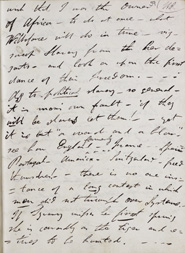
Manuscript of Byron’s ‘Detached Thoughts’, number 84, NLS Ms.43352

I managed to catch the King’s College exhibition about Byron just in time – it closes on Wednesday. The exhibition is displayed in the beautiful Weston Room, part of the Maughan Library, and was curated by the Foyle Special Collections Library of King’s College London and the John Murray Archive of the National Library of Scotland, for the 39th International Byron Conference in July (there’s an International Byron Conference! How awesome!).

I wanted to see the exhibition for two main reasons. One: it is full of manuscripts and rare books, which are always interesting. Two: it’s Byron! I have a bit of an obsession with the man, so there was no way I was going to miss this.

‘Byron and politics’ takes a slightly different look at the “mad, bad and dangerous to know” poet’s life, focusing on his political life and bringing together manuscripts, letters, printed editions and several of Byron’s personal possessions. The exhibition explores the contradictions in the poet’s thought and life: he hated the ruling Tory party but also disliked their opponents the Whigs; he was an aristocrat with a seat in the House of Lords, yet he spoke up for the poor and needy, notably in his Parliamentary speech in which he championed the cause of the Nottinghamshire Luddites; he was in love with the idea of democracy yet refused to admit the poor he knew to be capable of taking part in it. Byron greatly admired Napoleon and was overwhelmingly disappointed when he chose exile over  a ‘noble death’. He himself met his end in Missolonghi, Greece, fighting for the cause of Greek independence.

For someone whose reputation is of a wild, wicked, immoral and frivolous poet, Byron’s deep engagement with the political issues of the day are something of a revelation. This aspect of his life shows, perhaps, a deeper side to his character and a more serious one. He also seems to have had a strong sympathetic understanding of the less fortunate, though ultimately he refused to side with any one party or way of thinking, preferring to form his own views. I took a copy of the exhibition guide, so that I can revisit this aspect of Byron’s life in the future.

Extinction: Not the End of the World? – Natural History Museum

2019-03-11
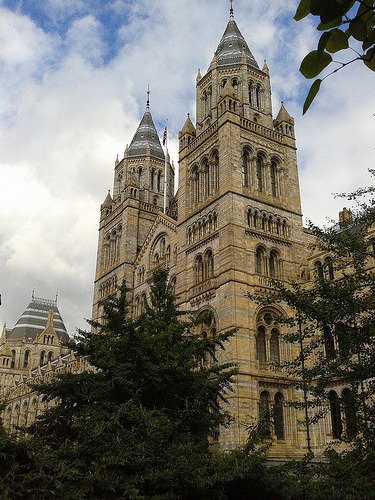
Natural History Museum

On my trip to the Natural History Museum last week, I also managed to fit in a visit to the summer exhibition, Extinction: Not the End of the World? I really enjoyed the exhibition, which was fascinating and thought-provoking.

Extinction is always thought of as a Bad Thing. However, this exhibition explores the idea that it is not always negative. Species have to die out to make way for others. We humans wouldn’t be here at all if it wasn’t for extinction.

This isn’t to say that we should become complacent about rare and endangered species, or simply shrug our shoulders and allow it to happen. If a species dies out this could disrupt the ecosystem, with lasting consequences. Human action is accelerating decline in many species and this could cause considerable problems.

This isn’t to say that humans are the only factor. Animals may die out for a variety of reasons: increased competition, changes in the environment, or slow breeding processes. The most famous of these is probably the asteroid that (likely) killed off the dinosaurs.

The exhibition offered lots of scope for interaction, and gave viewers the chance to vote on certain issues, such as whether we should make the effort to conserve all animals, or only those that benefit humans. I was pleased to see that most people took the unselfish route and believed that all animals are worth preserving, not just those that are of use to us.

This was a really interesting exhibition and well worth seeing. It’s on until the 8th of September so there’s still time to catch it.

Sebastião Salgado: Genesis – Natural History Museum

After I’d been to the Sensational Butterflies exhibition at the Natural History Museum, I went inside the museum proper to visit a photography exhibition I’d liked the sound of. Sebastião Salgado: Genesis includes black and white images of landscapes, people and wildlife. By focusing on the natural world, Salgado invites us to reflect on our own lifestyles and our impact on the Earth’s resources.

The exhibition was divided into several sections, relating to continents, themes or peoples. My favourite photographs, unsurprisingly, were the stunning Antarctic scenes, but I also liked the images of various communities and their homes. The photographs were beautiful and impressive, and left me in awe.

Sensational Butterflies – Natural History Museum

I visited the Natural History Museum‘s Sensational Butterflies exhibition on Sunday. I’d been meaning to go for a while, and was glad to finally get there. I chose to go in the morning, before the place overheated – though as it turned out, it was rather warm anyway.

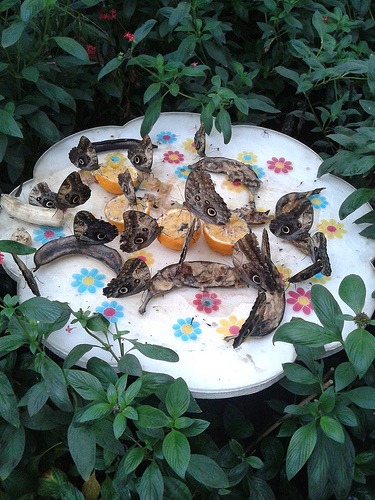
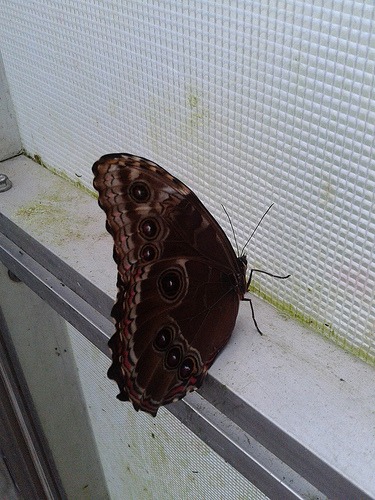
The climate inside the white tent has to be kept hot and humid, otherwise the tropical butterflies inside would die. Walking into the tent was like entering another world. Exotic green plants and coloured flowers abounded, and butterflies of all colours, shapes and sizes fluttered about. I took several photos, but they don’t do justice to these amazing creatures. Sadly, even though I wore red (as advised by a friend, who visited wearing her red coat and had butterflies landing all over her), I didn’t manage to attract any of them.

2019-03-11
This one was absolutely enormous.
2019-03-11
If you squint a little, these actually look like fish…


2019-03-11
2019-03-11

2019-03-11
2019-03-11

As well as the butterflies themselves, there was a glass-fronted cabinet containing chrysalises. Some of them were empty but others still contained their butterfly: I was able to watch one emerging from its cocoon.

2019-03-11
Emerging into the light

The exhibition is compact but well worth a visit. It closes on the 15th of September, so you still have a month to catch it.

Eastbury Manor House

Eastbury Manor House

At the weekend I visited Eastbury Manor House in Upney, east London. I’m a National Trust member so I get in for free, but an adult ticket is only £4 for non-members. There isn’t loads to see in the house, but there is some beautiful architecture and it’s fascinating to imagine how people lived in it years ago. The house is open Mondays to Thursdays in the summer months, as well as the first and second Saturday of the month.

front door
The front door

Built during the reign of Elizabeth I, completed by around 1573, Eastbury Manor House was originally situated in rural parkland but is now in the middle of a housing estate. The original owner was Clement Sysley, and over the years the house has changed hands several times. Though some of the rooms have been adapted or changed, the essential structure of the house has remained more or less the same.

Fireplace
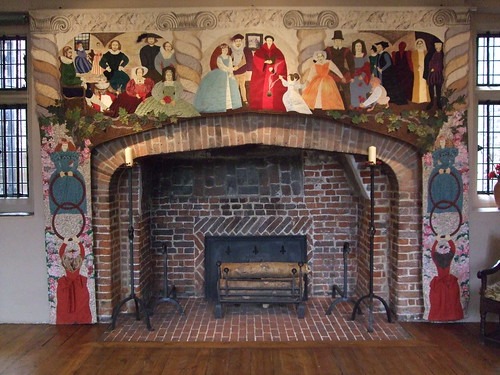
Fireplace with a modern surround

In the first room, an original fireplace has been complemented with a brightly coloured modern painting. This room is often used for weddings.

Ornate mirror
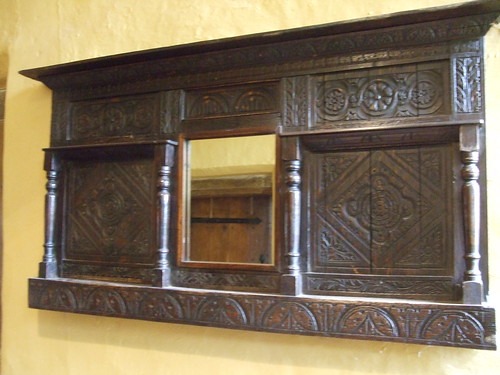
Ornate mirror

I love the ornately carved wood which is a hallmark of the Tudor style.

Remains of the mural

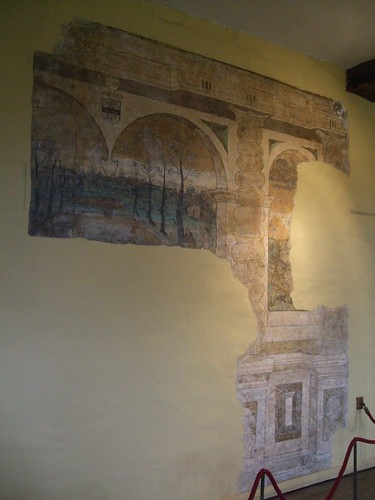
One room used to be decorated on all four walls with a beautiful mural, the remains of which are still visible.

Attic
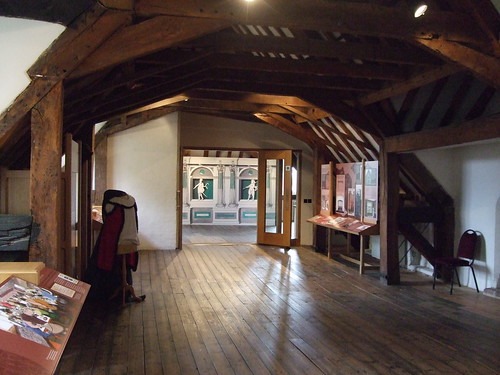
Attic

The attic was used by the family for exercise. Today it contains information boards and clothes for dressing up!

FACTS

Address: Eastbury Square, Barking, Essex, IG11 9SN

Website: nationaltrust.org.uk/eastbury-manor-house

Opening Hours: 10am-4pm Wed-Thurs; 12pm-5pm Sun

Prices: Adult £16, Concession £12.80, Child £8; under-5s free

Propaganda: Power and Persuasion – British Library

The other week I visited the British Library to see their latest exhibition, Propaganda: Power and Persuasion. Like all their exhibitions it was excellent: well laid-out, thought-provoking and fascinating.

The exhibition explored the idea and concept of propaganda, how it can be used to unify people and also how it can create divisions. It was divided into several sections, each of which looked at a different aspect of propaganda.

The first section, Origins, looked at the history of propaganda: Roman emperors plastered their images on coins and statues, while the advent of the printing press in the sixteenth century saw the spread of propaganda more widely than ever, particularly during the Reformation (the 1523 picture of ‘The Donkey-Pope of Rome’ is a particularly good example). Next, Nation explored how states establish their legitimacy via the use of symbols such as posters, stamps and flags, and through mass media.

Enemy examined the ways in which leaders demonise others to reinforce unity within their own people, creating a climate of fear and hatred. The most obvious example is the persecution of the Jews in Nazi Germany and occupied Europe during the twentieth century. Linked to this aspect, War showed how morale was maintained in societies engaged in conflict through emphasis on the rightness of the cause.

Health was one of the most amusing aspects of the exhibition, showing ways in which healthy behaviour has been promoted through the use of humour and even fear. Some of the campaign posters and videos displayed were hilarious. Finally, Today showed how the use of technology means that the volume and scale of propaganda is greater than ever, but criticism of it can also be spread more easily via social media.

I liked seeing the posters used to promote particular societies, and the other items on display such as books. One thing I found particularly interesting was the video about the London 2012 opening ceremony. Danny Boyle’s magnificent show became a brilliant example of propaganda, promoting a positive vision of modern Britain.

The exhibition is on until 17 September and I definitely recommend checking it out.

Geoffrey Farmer: The Surgeon and the Photographer – The Curve, Barbican

Geoffrey Farmer: The Surgeon and the Photographer is currently showing at the Barbican, a strange and unnerving modern work of art. It is displayed in the Curve, a long winding gallery that reflects its name, and consists of 365 puppets made up of faces, masks, limbs and accessories applied like a collage onto fabric bodies. Popular culture, the ancient world, history and fiction are all referenced. The title of the exhibition comes from an essay by Walter Benjamin, ‘The Work of Art in the Age of Mechanical Reproduction’, in which he compared the work of a magician to that of a painter and the role of a surgeon to that of a photographer. Both, Benjamin says, deal with fragments.

Creepy yet fascinating, these varied figures are rich in detail and personality. I was reminded of the song by the Doors, ‘People Are Strange’, as I wandered among them. Accompanying the exhibition was a montage of sounds, while at the end a series of pictures was presented as a film. I sat and watched these compelling images for a good few minutes.

I have ambivalent feelings towards modern art, but this is something that is worthwhile and rich in meaning. It closes on Sunday – visit beforehand if you can.

The Jewish Museum

Jewish Museum

London’s Jewish Museum opens late on Thursday evenings in July and August, so I headed there last week. The museum is located near Camden tube station, and is relatively easy to find. Entrance is free for Art Fund card holders; the normal entry price is £7.50.

The museum has four floors and each has something different. The ground floor has the cafe and the shop; upstairs on the first floor, the exhibition Judaism: A Living Faith looks at the Jewish religion and displays several artefacts relating to it. Above that, History: A British Story looks at the history of Jews in the UK, particularly in London.

Also here there is a Holocaust Gallery. I found this incredibly sad and moving. It is told through the story of Leon Greenman, an Auschwitz survivor. Though of British nationality, he was living in the Netherlands with his wife and son when the Nazis invaded and, unable to prove his nationality, he was deported along with his family. Sadly his wife and son were killed in the gas chambers, but Leon survived and spent the rest of his life raising awareness of the Holocaust and campaigning against racism.

The top floor hosts temporary exhibitions: the current exhibition is Amy Winehouse: A Family Portrait. Most of the items on display were loaned by the singer’s brother Alex, who also wrote the captions. The displays portray a normal girl who enjoyed music and clothes but dreamed of fame. The family photographs are warm and intimate. Particularly moving were the notes covering the board at the end of the exhibition, full of heartfelt messages from Amy’s fans.

FACTS

Address: Raymond Burton House, 129-131 Albert Street, London, NW1 7NB

Website: jewishmuseum.org.uk

Opening Hours: 10am-5pm (2pm on Fridays)

Prices: Adult £7.50, Concession £6.50, Child £3.50; under-5s free

Churchill War Rooms

Churchill War Rooms
Churchill War Rooms

Like HMS Belfast, which I visited earlier the same day, the Churchill War Rooms are part of the IWM, and I visited one Sunday to take advantage of my Tesco Clubcard free ticket. Located beneath the streets of Westminster, these are the original Cabinet War Rooms used to protect the Government from attack during the Second World War. Initially I was just thankful to get out of the heat (the rooms were lovely and cool), but I thoroughly enjoyed my visit for its own sake.

The first important room I came to was the Cabinet meeting room. Not all meetings during the war were held here, but over 100 were.

The War Cabinet meeting room

I then came across the weather guide, designed to let those underground know what it was like outdoors. Famously, the guide was changed to ‘windy’ during air raids.

Weather information
Weather information

There were a surprising amount of corridors, with random doors leading off them at various points.

Corridor
Corridor

About halfway through the tour there was a Churchill Museum, examining the wartime Prime Minister’s life and career. I learnt several interesting things – I was surprised to hear that he was so radical early in his career.

Door to 10 Downing Street

After the Cabinet and a number of staff began to use the underground War Rooms, the ceiling was reinforced to provide protection in case of air raids. However, the bunker was still not completely secure and a direct hit would have destroyed it. Luckily, this never happened.

Reinforced ceiling
Reinforced ceiling

Members of staff worked day and night underground, sometimes even sleeping here.

One of the Cabinet rooms

Churchill had his own room in the bunker, complete with wall maps. He didn’t often sleep here, however.

Churchill's room
Churchill’s room

The Churchill War Rooms are open seven days a week (except 24-26 December inclusive). I definitely recommend a visit – there is a surprising amount to see and take in, and the War Rooms are crucially important to the history of 20th century Britain.

FACTS

Address: Clive Steps, King Charles Street, London, SW1A 2AQ

Website: iwm.org.uk/visits/churchill-war-rooms

Opening Hours: 9.30am-6pm

Prices: Adult £18, Concession £14.40, Child £9; under-5s free