Ranger’s House

Ranger's House
Ranger’s House

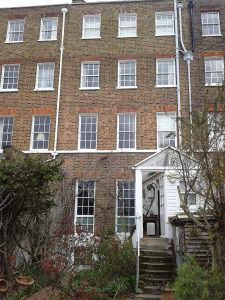
Having an English Heritage membership card means that I can visit all EH properties for free. I took advantage of this on Sunday when I visited Ranger’s House, located in Greenwich in south east London. Ranger’s House is home to the Wernher Collection, a number of works of art originally collected by Sir Julius Wernher (1850-1912).

The house is open for guided tours only, twice a day from Wednesdays to Sundays. Booking in advance isn’t necessary, though you might wish to telephone first to make sure the house isn’t closed for an event. I took a gamble and just turned up for the 11am tour, and the gamble paid off.

The house is a Georgian villa by Greenwich Park, and has no association with the Wernher family. The collection was moved here several years ago, after the previous collection of Jacobean paintings was moved out. It is a beautiful house and is a lovely setting for the rich collection of artefacts it holds.

Wernher was a diamond magnate who made his fortune in South Africa before turning his hand to collecting. He was especially fond of medieval art, and many of the objects in the house are religious paintings or artefacts from this era, although Wernher himself did not have a particularly strong religious faith. He also collected jewellery: his knowledge of diamonds enabled him to identify and appreciate quality pieces, and there are some beautiful examples on display, including cameos and intricate lockets.

Other items included pottery, household items and general ornaments. One of my favourite objects was an owl made from a coconut, with its head, feet and wings formed of silver. Downstairs, a number of rooms were laid out in the style of the rooms of Wernher’s house Luton Hoo: they reflected the different tastes of Julius and his wife ‘Birdie’, with a bright pink sitting room where the lady of the house entertained, to a deep green study which Julius preferred.

I enjoyed my visit to the house: it was something a bit different and unusual, and the objects on display were stunning. It isn’t too badly priced either, so it’s definitely somewhere worth a visit.

FACTS

Address: Chesterfield Walk, Blackheath, London, SE10 8QX

Website: english-heritage.org.uk/visit/places/rangers-house-the-wernher-collection

Opening Hours: Guided tours only, from March to September.

Prices: Adult £7.20, Concession £6.50, Child £4.30; under-5s free. English Heritage members free.

Hatfield House

Hatfield House
Hatfield House

On Saturday, I visited Hatfield House with some friends. We had been meaning to go there for ages as it’s only twenty minutes out of London, but these things always end up taking a long time to organise. We weren’t sure about the weather as there were some ominous black clouds hanging in the sky. However, we luckily managed to avoid the rain, if not the wind.

Hatfield House is famous as the place where Elizabeth I grew up. In fact she was told that she was the Queen of England beneath an oak tree in the grounds. The house she lived in, however, is in fact the Old Palace; the current house was built by Robert Cecil, the first Earl of Salisbury, in 1611. The whole estate remains in the hands of the Cecil family.

Hatfield House
Hatfield House

We arrived at eleven and the house didn’t open until midday, so we went for a walk in the gardens. We wandered through the formal mazes and  planned gardens, peeped in at the window of the Old Palace, and walked through the meadow. Round the back of the house, we could see a herd of deer.

The house itself was magnificent and imposing. It is finely decorated in the Jacobean style with dark wood – I loved the richly detailed staircase. As we all studied the Tudors for A Level History, we were excited to find several original paintings of Elizabeth I, including the famous Rainbow Portrait. My favourite room was the Library, which was filled with books from floor to ceiling. It had stairs and a balcony, and a comfortable-looking window seat. At the end of the tour, we visited the kitchen which proudly displayed lots of random utensils.

The tour took a lot less time than we thought – it was only half past one when we came out – so we decided to go to the pub. The pub we found seems to be a notable one in the literary world.

The Eight Bells
The Eight Bells
Dickens plaque
Dickens plaque

Hatfield House was fun, but I don’t know if it’s worth the full price (around £15). I took Tesco vouchers which made it much more reasonable. I think they should open more rooms, as the tour didn’t really take that long. However, the rooms that were on display were beautiful. I’m pleased, anyway, to have finally visited this place.

FACTS

Address: Hatfield, AL9 5NQ

Website: hatfield-house.co.uk

Opening Hours: Approx. 11am-4.30pm

Prices: Adult £16, Senior £15, Child £8; under-5s free.

Life and Death in Pompeii and Herculaneum – British Museum

The other week I visited the British Museum to see the long-awaited exhibition, Life and Death in Pompeii and Herculaneum. I’d booked in advance to visit after work on a Friday afternoon, and a good thing too, as it was completely sold out.

It’s unsurprising that the exhibition is so popular, as the destruction of the city of Pompeii by the eruption of Vesuvius in AD 79 is legendary. Less well-known, perhaps, is the similar destruction of the nearby city of Herculaneum at the same time. The exhibition explores the lives of people living in these two cities, and also their deaths.

Entering the exhibition, a handful of artefacts – a stool and a painting, preserved by the eruption – are displayed, retrieved from the wreckage of the cities. Alongside these sits a cast of a dog, one of the most famous items from the area, forever fixed at the moment of its death.

Following this introductory scene, there is a short video looking at the lives of those individuals who lived in the cities. This consists of videos of modern inhabitants of the Bay of Naples, many of whom live lives not dissimilar to their forebears. The exhibition takes pains to emphasise the similarities between us and the citizens of AD 79 Pompeii and Herculaneum, while not discounting the many differences.

The ‘life’ aspect of the exhibition was the biggest, and I liked the way it was laid out – like a house, with rooms such as the bedroom, kitchen and atrium. It began with a street scene: the objects displayed here had been taken from the streets and public areas in which they were originally placed.  These included signs, shop fronts, and tavern murals. The latter were among my favourites in the exhibition. They were humorous pictures of ordinary people engaging in normal tavern-based activities, such as drinking, gambling and a little romance. Latin inscriptions narrated the tales, helpfully translated in captions underneath. One particularly amusing scene showed two men arguing over the game they were playing, with one calling the other ‘c*cksucker’.

Continuing in that vein, I was surprised to discover that several ornaments and fixtures used by the citizens were decorated with penises (peni??). They were not the rude, slightly indecent symbols they are today: rather, they were lighthearted cultural symbols representing fecundity and fertility. These decorations suggest that however similar these people were to us, they were very different in several other ways. Another stark reminder of this was a statue, displayed in a corner of the ‘garden’ area, with a sign to warn parents of small children that they might want to keep them away. This statue showed the god Pan enjoying, shall we say, an ‘intimate’ moment with a goat, and presented the prudish archaeologists of yesteryear who discovered it with a quandary – was this really the sort of thing that the literate, civilised, cultured Romans were into?

Other artefacts, presented in the exhibition rooms corresponding to those which they would have belonged in Italy, were more mundane: decorative tiles, a small stool, a bed, jewellery, shells containing makeup that still bore traces of cosmetics. And yet, the mundane nature of these objects make the highly unusual and sudden death of their owners all the more shocking and tragic. One particular item I found the saddest of all: a wooden cradle. Empty on display, it had been found with its tiny occupant still inside.

The exhibition illustrates how the different conditions in Pompeii and Herculaneum have allowed archaeologists and scientists to build up a fuller picture of life at the time. The larger industrial city of Pompeii was engulfed by a pyroclastic cloud, killing its inhabitants and burying the city under a massive layer of ash. This allowed the shape of the bodies to be preserved once they rotted away, as they left behind their shape inside the ash. In the smaller seaside town of Herculaneum, the pyroclastic cloud was even hotter, reducing bodies to nothing and turning wooden artefacts to charcoal.

The people of Pompeii and Herculaneum were getting on with their lives, going about their day to day business, when they were overtaken by tragedy. Towards the end of the exhibition there are displays of meals, prepared but never eaten, which illustrate just how sudden the eruption was. Finally, we see some of the individuals discovered by archaeologists when the sites were first explored. One lady was cast in resin, more durable than the traditional plaster of Paris; she had been found lying down, accompanied by jewellery. Four family casts are displayed together, frozen at the moment of death. One child throws its head back against a wall. The other cuddles close to its parents. It is truly heartbreaking to see these casts, and imagine the pain and fear that these people must have felt all those years ago.

This is truly a fantastic exhibition – not that I would have expected anything less from the British Museum. Booking in advance is essential, unless you want to take the risk of turning up early in the hope of day tickets. The exhibition runs until the 29th of September and I certainly recommend it.

London Transport Museum Depot Open Weekend – We Love Steam!

As a bit of a tube geek, I clearly wasn’t going to pass up the chance to visit the London Transport Museum‘s Acton depot on their annual spring Open Weekend. The depot is crammed full of all the things that won’t fit in the museum proper in Covent Garden, and there are plenty of gems to discover, such as this ornate arch:

The depot is basically a giant warehouse and it takes a good while to explore. I liked this rather sweet model of a steam train, and this fascinating cross-section of Westminster station.

There were countless maps, including this one from 1910, showing how the Underground network has changed over the years.


Several corridors were lined with old Tube signs, including those from now-defunct stations such as Ongar and Aldwych.

The largest part of the depot was filled with vehicles: examples of Tube trains and carriages from various eras, as well as several styles of buses.

My trip to the depot was fascinating and I’m glad I went along. London Transport Museum host a couple of these weekends a year, as well as various activities, which are displayed on their events page. I definitely recommend taking a look.

7 Hammersmith Terrace

2013 0413 Emery Walker House 02

The front of 7 Hammersmith Terrace

The other weekend I visited 7 Hammersmith Terrace, former home of Emery Walker and boasting an original Arts & Crafts interior. The house is only open at certain times via guided tour, so I booked my visit online and turned up at the house just before eleven. 7 Hammersmith Terrace is on the north bank of the Thames, near Stamford Brook tube station on the District line.

2013 0413 Emery Walker House 01

Emery Walker (1851-1933) was a printer and was a great friend to William Morris, who lived nearby at Kelmscott House. He also had contact with many of the other leading cultural and political figures of the period, including Philip Webb and George Bernard Shaw. His house is filled with authentic furniture and decorations from the period: William Morris wallpaper, furniture left to Walker by Webb, photographs, artefacts and personal items such as a lock of hair, as well as items he and his daughter Dorothy picked up on their travels.

2013 0413 Emery Walker House 03

Back of the house, seen from the garden

This is a beautiful house and well worth a visit – I definitely recommend booking a tour.

FACTS

Address: 7 Hammersmith Terrace, London, W6 9TS

Website: emerywalker.org.uk

Opening Hours: Guided tour only; visit emerywalker.org.uk/booking.

Freud Museum

2013 0324 Freud Museum

As well as the huge, famous museums in the centre, London has a number of smaller museums dotted around the city. One place I’d never heard of until fairly recently was the Freud Museum, located near Finchley Road.

Most people will have heard of the ‘Father of Psychoanalysis’ Sigmund Freud. Though he lived and worked in Vienna for many years, his Jewish background meant that he and his family were vulnerable to persecution from the Nazis when they annexed Austria in 1938. He emigrated to England along with several members of his household, and spent the last year of his life in this house at 20 Maresfield Gardens in Hampstead, where he died in 1939. His daughter Anna, herself an influential and respected child psychoanalyst, lived in the house until her death in 1982.

The house is large, comfortable and welcoming, and I imagine it would be a very pleasant place to spend time in. Letters and documents belonging to and relating to both Sigmund and Anna, including Sigmund’s suit, are displayed. I thought the study was the most interesting room: it was where Freud saw his patients, but it seems more like a library, with shelves of books and archaeological artefacts. Sigmund Freud apparently had a strong interest in archaeology, which he compared to the study of the human mind.

I loved the landing in between the two floors, where there was a table next to the large window. The upstairs rooms also had some interesting information, including a Freud family tree, photos and books relating to Anna Freud and a temporary art exhibition.

FACTS

Address: 20 Maresfield Gardens, London, NW3 5SX

Website: freud.org.uk

Opening Hours: Wed-Sun 12pm-5pm

Prices: Adult £7, Senior Citizen £5, Concession £4; under-12s free.

The Fan Museum

2013 0323 Fan Museum 01

Yesterday I visited the Fan Museum in Greenwich, and found out more information than I ever thought existed about fans. It’s the UK’s only museum dedicated solely to fans, and has more than 4,000 fans in its collection. It opened in 1991 in a restored 18th century Grade II listed building in Greenwich town centre.

The permanent collection displays notable and interesting fans and fan-related paraphernalia, as well as information about the different kinds of fans in existence and the materials and techniques used in their construction. Interesting items include a fan painting by Paul Gaugin and a ceremonial Chinese fixed fan.

2013 0323 Fan Museum 03

The museum has a programme of temporary exhibitions and the current exhibition is called The Fan in Europe: 1800-1850. Most fans in this period were relatively small and there are some absolutely exquisite examples of fans on display. This is one of them.

2013 0323 Fan Museum 05

If you’re in Greenwich, it’s worth taking a break from the big attractions and paying a visit to this little specialist museum.

FACTS

Address: 12 Crooms Hill, Greenwich, London, SE10 8ER

Website: thefanmuseum.org.uk

Opening Hours: 11am-5pm Tues-Sat; 12pm-5pm Sun

Prices: Adults £4, concessions and children £3

Murder in the Library: An A-Z of Crime Fiction – British Library

The British Library is open late on Tuesday evenings, and I took advantage of this to pay a visit to the small, free exhibition Murder in the Library: An A-Z of Crime Fiction in the Folio Gallery. The exhibition looks at crime fiction throughout the ages, from the first crime novels in the nineteenth century, through the genteel mysteries of the early to mid twentieth century and ending with the ‘Nordic Noir’ craze of modern times. The exhibition was made up of manuscripts and early editions of some interesting crime novels, including the first book to feature a professional lady detective, The Female Detective by Andrew Forrester, first published in 1864, and a manuscript of one of Sir Arthur Conan Doyle’s Sherlock Holmes stories.  I read lots of Enid Blyton as a child and was pleased to see some of her books included too, such as the Five Find-Outers series. I was also interested to see one of Andrea Camilleri’s Inspector Montalbano novels – after watching the TV series I wouldn’t mind reading some of the books.

Manet: Portraying Life – Royal Academy of Arts

Manet: Portraying Life at the Royal Academy of Arts was the last exhibition I saw on Sunday. I had originally planned to visit on Friday night a couple of weeks ago, but like so many exhibitions recently, it was sold out so I decided to book in advance for a later date.

2013 0310 Royal Academy

This is the first major exhibition in the UK dedicated to the work of Eduoard Manet (1832-1883). It focuses on his career as a portrait painter. Although I was aware of Manet before the exhibition, I always imagined him as a landscape painter, so this aspect was interesting to me.

Manet came from a wealthy family and didn’t have to live by his art, but he still sought approval from the Paris Salon, which was, however, often rejected. He used elements of the Old Masters and the new Impressionists, creating an art that was different from both with an unique style. Though photographic portraits were growing in popularity during the time in which he worked, Manet still believed that painting offered opportunities that photographs didn’t in evoking the personality of the individuals painted.

Manet painted several portraits, including pictures of his friends and family: his wife, Suzanne Leenhoff, and stepson, Léon, appear frequently, as do a number of studies of friends including Antonin Proust (no relation to Marcel). Some of his pictures are status portraits of political or other celebrity figures; several of these are unfinished as their sitters could not offer the time that Manet required to model for them. Some of my favourite pictures are those of the writers and artists who were Manet’s friends, including Stéphane Mallarmé and Emile Zola.

My favourite Manet pictures, however, were those which included models rather than important or celebrity figures, particularly those of Victorine Meurent, who appears in the fascinating painting The Railway (1873), in which a red-haired woman gazes at the viewer while the child beside her stands facing the other way, watching the approaching steam train whose presence is indicated by a cloud of smoke. Manet’s style is modern but influenced by older painters, striking and memorable.

Manet: Portraying Life is on until the 14th of April.

Ice Age Art: Arrival of the Modern Mind – British Museum

I’d originally planned to see Ice Age Art: Arrival of the Modern Mind on Friday night a few weeks ago, but when I went along to the British Museum after work I found that the exhibition was completely sold out. I ended up buying an advance ticket for the 10th of March, so that I could visit before going to the Manet exhibition a bit later on.

Although timed entry was in operation, the exhibition hall was still really full and there was a bit of queuing and waiting around. I was surprised at how popular this exhibition was. What struck me about most of the exhibits was how small they were: some of them were only as big as a finger, very few larger than my fist. I suppose it would be easier to transport these smaller pieces from wherever they are held permanently, but I also found myself wondering if they were made so small to make them easier to carry around at the time, whether as pieces of jewellery or amulets, or just because smaller items were easier to transport in a nomadic society.

The first half of the exhibition displayed art from 40, 000 to 20, 000 years ago, the majority of it from Siberian Russia or central Europe. Several pieces stood out for me: the ‘Lion Man’, which, in its representation of something that does not exist in reality, reveals the creative and imaginative capabilities of Ice Age humans, and a flute, which shows that they enjoyed playing music. Several animals, such as bison, lions or mammoths, are depicted, a reflection of the world in which these people lived, and in fact many of the sculptures are made of mammoth ivory.

Images of nude women abound in Ice Age art, and it’s unclear whether these represent real women or a symbol. Their nudity clearly indicates an artistic convention – in Ice Age society, clothes were a necessity – but were they made for and by women, perhaps to protect them in pregnancy and childbirth, or did they serve some other purpose?

Later in the exhibition, art from the later time of 20, 000 to 10, 000 years ago is displayed. The sheer number of horse sculptures and pictures are astounding, and some of them are really beautiful. The exhibition questions whether these pictures are designed to represent individual horses, or the horse, a symbolic creature. Horses were undoubtedly hugely important to Ice Age people, and it is possible that they worshipped a deity that took the form of a horse. Perhaps we’ll never know.

The reasons for and meanings behind many of the sculptures and artworks here are shrouded in mystery. We can only speculate as to the purpose they served and the role they played in the lives of Ice Age society. However, we can certainly appreciate the artistic ability of their creators, and if it is true that the ability to make art is what distinguishes modern humanity from the animals, then these artworks are crucially important in helping us understand how we evolved.

Alongside the ancient artworks, several modern pieces from the 20th century are displayed. I don’t feel these are really necessary, but they do seem to illustrate that in some ways art has come full circle – the representations of the body, for instance, in several modern sculptures and images closely resembles those of the Ice Age.

Ice Age Art: Arrival of the Modern Mind is on at the British Museum until 26th May.