Treasures of the Royal Courts: Tudors, Stuarts and the Russian Tsars – V&A

I was at the V&A yesterday in order to buy advance tickets for the Bowie exhibition (my parents are coming down at the end of May and my dad in particular really wants to see it), and while I was there I thought I might as well visit the new exhibition Treasures of the Royal Courts: Tudors, Stuarts and the Russian Tsars. I am very interested in history – I have a degree in the subject and actually studied the Tudors at A Level – and I am fascinated by anything to do with Russia, so this exhibition sounded ideal for me.

The background to the exhibition is that the Tudor era was when relations with Muscovy – now Russia – began to be established. The explorer Richard Chancellor reached Muscovy in 1553, while looking for the north east passage – his route took him over Norway and Sweden rather than via the Baltic – and this kick-started the diplomatic and economic relationship between the two powers. In 1556 the English Court House was founded in Moscow and from then until the end of the reign of Charles I, English ambassadors were a regular presence in the city. Relations soured during Oliver Cromwell’s rule – Russian powers were appalled that the English had executed their monarch (understandably, given what would happen in 1918!) – but were reinstated at the Restoration of Charles II.

The exhibition attempts to convey the nature of the treasures of the Tudor and Stuart courts via displays of armour (including an impressive suit worn by the portly Henry VIII), beautifully wrought jewels and miniatures, and impressive pictures. As soon as you enter you see a pair of magnificent stone leopards that once graced one of Henry VIII’s palaces – they reminded me of the two living leopards that attend Aslan in The Lion, the Witch and the Wardrobe. Just beyond are four large animal heralds belonging to the Dacre family – Thomas, Lord Dacre, fought for Henry Tudor at the Battle of Bosworth. Impressive as these riches all were, I did wonder what they had to do with the Russian Tsars (other than the fact that they were from the same time period) – I thought the exhibition title was slightly misleading. Maybe that was just me?

Eventually, I came to a selection of displays that did have a clear connection to Russia, including diplomatic gifts that have been kept in the Kremlin in Moscow for years. Interestingly, their presence in Russia ensured their survival during the English Civil War – had they remained in this country, they would almost certainly have been destroyed. Some beautiful silver was on display, and a small replica – alongside video footage – of a magnificent carriage given to the Tsar Boris Godunov (immortalised in Alexander Pushkin’s play). I also enjoyed looking at the manuscript records and sources, including a record that Shakespeare’s Twelfth Night was performed – possibly for the first time – on Twelfth Night 1601 in honour of the Russian ambassador Gregory Mikolin.

The exhibition didn’t take very long to go round, which in a way was a good thing as it meant there wasn’t too much to take in. Although I was disappointed that the connection of some of the displays to Russia was tenuous, I did enjoy it and I don’t regret going.

Treasures of the Royal Courts: Tudors, Stuarts and the Russian Tsars is on until 14 July.

Light Show – The Hayward Gallery

Light Show, the current exhibition at the Hayward Gallery on the South Bank, has been enjoying enormous popularity since it opened on 30 January. Tickets are selling out well in advance, so I decided to buy my ticket a couple of weeks ago in order to visit the exhibition yesterday. Setting my alarm for 8 am on a Sunday morning was torturous, but certainly worth it.

2013 0310 Hayward Gallery

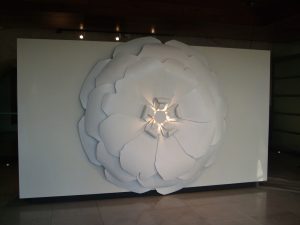
The exhibition explores the use of light to shape space and experiment with different forms. Installations encompassed clear and coloured lights, fluorescent strip lighting, bulbs (including one designed to represent moonlight), mini LED lights, sparkling effects and continuous illumination. Some of the installations were enclosed in different rooms. I was amazed, impressed and enlightened (excuse the pun) by the exhibition.

I had a number of favourite exhibits. One was the very first one I saw – Cylinder II (2012) by Leo Villareal. This consists of strips of LED lights (19,600 in total) arranged in a cylinder, which move in hypnotic and evocative ways. The lights are actually controlled by a computer programme, but they are stunning. Another was Anthony McCall’s You and I, Horizontal (2005). This is in a room of its own and a projector throws out a beam of light – essentially a light sculpture that you can walk through.

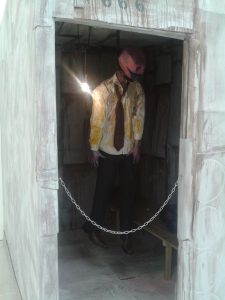
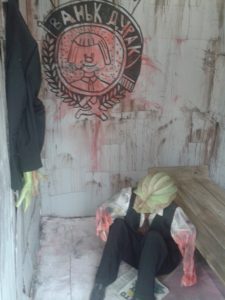
Another favourite was Ivan Navarro’s Reality Show (Silver) (2010). This is a small room with four doors, around the size of a telephone box. When you are inside you can look up or down and see mirrors reflecting rows of light endlessly, as if you are in a long column or pipe. You can see yourself in the doors, but outside the sculpture, others can see you inside – a claustrophobic and unsettling experience. Navarro grew up in Chile during Pinochet’s dictatorship and the installation echoes the surveillance and control inherent in the system.

One thing that both surprised and impressed me was the extent to which children seemed to be enjoying themselves. Personally it wouldn’t occur to me to take a small child to a modern art exhibition, but there were loads there on this Sunday morning and they were fascinated by the exhibits – from the small baby amazed by the twinkling lights to the little boys excited by the rooms of coloured light.

Light Show is on until 28th April. You will almost certainly have to book in advance, and I also recommend booking the first slot available and turning up as soon as possible – in theory you can arrive at any time during the hour stated on your ticket, but even with visitor limits the space can get very crowded and early arrival gives you the best chance of beating the crowds. I’m so glad I came here – I wasn’t sure if I was going to enjoy it, but I really did.

Two Temple Place

Having a National Art Pass, I hear about lots of places to visit that I wouldn’t otherwise have heard of. One of these is Two Temple Place. Located on the bank of the Thames near Temple Station, it is a little-known gem, a beautiful house that was originally built by William Waldorf Astor in the late nineteenth century.

2013 0306 Two Temple Place 01

The house hosts free exhibitions of publicly-owned art during the first quarter of each year. The current exhibition is called Amongst Heroes: the artist in working Cornwall, and is a significant exhibition exploring the themes and images represented in Cornish art of the late nineteenth and early twentieth centuries. There are some fascinating paintings in the exhibition: some of them are historically significant, showing the way people on the Cornish coast lived (with a strong focus on fishing, mining and other forms of work) and many of them are beautiful, showing the impressive nature of the Cornish landscape.

2013 0306 Two Temple Place 05

Even more than the exhibition, I loved the house itself. Though it was designed and built just over a hundred years ago, it has the look of a medieval mansion with lots of panelled wood and ornate fireplaces. Astor clearly loved literature – the staircase is dotted with figures from Alexander Dumas’ The Three Musketeers and scenes from Shakespeare decorate the panels along the top of the wall.

2013 0306 Two Temple Place 06

The house is open until 14 April for the duration of the exhibition, after which it will close until next year. I definitely recommend a visit – it’s an unusual and beautiful place.

FACTS

Address: London, WC2R 3BD

Website: twotempleplace.org

Opening Hours: 10am-4.30pm (9pm on Wednesdays) January-April during exhibitions

Prices: Free

Gaiety is the Most Outstanding Feature of the Soviet Union – Saatchi Gallery

The bizarre title of this exhibition drew me to the Saatchi Gallery on Sunday, as did the fact that it consists of new art from Russia – I am fascinated by anything Russian so Gaiety is the Most Outstanding Feature of the Soviet Union was on my must-see list.

This despite the fact that modern art is certainly not my forte. Still, I enjoyed my previous visit to the Gallery – rather to my surprise – and resolved to keep an open mind. Some of the exhibitions were lost on me, such as odd sculptures; some weren’t to my taste, but I could appreciate the thought that went into them and the humanity that lay behind them, such as Sergei Vasiliev’s photographs of tattooed prisoners and Boris Mikhailov’s pictures of the homeless in Ukraine, illustrating the disintegration of society in a post-Soviet world.

One of my favourite displays was this piece by Daria Krotova, bringing to mind the works of Dostoyevsky and Gogol and seemingly concerned with the recession and the culpability of those in positions of power.

2013 0303 Saatchi Gallery 02

2013 0303 Saatchi Gallery 01
2013 0303 Saatchi Gallery 03

I also loved these pictures by Valery Koshlyakov – made from cardboard and roughly-applied paint, they are striking and beautiful.

2013 0303 Saatchi Gallery 04

Grand Opera, Paris
2013 0303 Saatchi Gallery 06

Notre Dame, Paris and High-rise on Raushskaya Embankment

The exhibition is running until the 9th of June.

Breaking the Ice: Moscow Art, 1960-80s
While I was at the Gallery I also dropped in on the exhibition upstairs, which continued the Russian theme by displaying Moscow art from an earlier period. I found this harder to get into, but I did like this image which juxtaposed Lenin’s face with an easily recognisable advertising logo.

2013 0303 Saatchi Gallery 08

This exhibition is on until the 28th of March.

Constable, Gainsborough, Turner and the Making of Landscape – Royal Academy of Arts

On Friday night I paid a visit to the Royal Academy of Arts to see the Constable, Gainsborough, Turner and the Making of Landscape exhibition. I love Turner and this was the main reason for my visit. In the end there wasn’t a great deal of his work on display, or that of the other named artists. A lot of the space was devoted to artists who paved the way or who were inspired by these three giants, so I felt the title of the exhibition was slightly misleading. Still, the paintings and artefacts displayed were well-chosen and the exhibition as a whole was small enough to be enjoyed without fatigue. Highlights for me included Turner’s Dolbadern Castle, while paintings by Gainsborough and Constable, artists I’d never paid much attention to in the past, appeared in a new light for me and I think I’d like to find out more about their work.

Forty Hall and Estate

Forty Hall

Forty Hall is an estate in Enfield, north London, a Grade I listed Jacobean mansion set in a Grade II listed estate. The hall and estate was fully restored in 2012 so I thought it would be the perfect time to make a visit.

It was slightly tricky to reach the house, as the journey involved a bit of walking. However it was worth it as it really is beautiful. Outside, the mansion is situated in some gorgeous parkland, while on the inside, the restoration has been carefully done with an engaging exhibition telling the story of Sir Nicholas Rainton, the 17th century owner of Forty Hall.

Being tired and/or lazy (delete as appropriate), I didn’t explore in detail the 273-acre 18th century landscaped estate, which boasts an ornamental lake, medieval fishing ponds and streams, and a walled garden. I think this would be a lovely venue to return to for a picnic. Events for all ages, including children, take place all year round and the residents of Enfield are pretty lucky to have such a gorgeous estate on their doorstep.

FACTS

Address: Forty Hill, Enfield, EN2 9HA

Website: fortyhallestate.co.uk

Opening Hours: Tues-Fri 11am-5pm, Sat-Sun 12pm-5pm. Closes at 4pm in winter.

Prices: Free

Doctors, Dissection and Resurrection Men – Museum of London

2012-12-09-14-57-33

On Sunday I visited an exhibition at the Museum of London, entitled Doctors, Dissection and Resurrection Men. It explores the relationship between the trade in dead bodies and the study of anatomy in the early 19th century, and was inspired by the 2006 excavation of a burial ground at the Royal London Hospital, in which evidence of dissection, amputation and anatomical examination was found. I am rather squeamish and was worried that the exhibition would be a bit gruesome for me, but despite a few icky bits I was fine. The exhibition was sensitively arranged and the bones and anatomical models on display were generally presented from a scientific point of view.

Surgery during this period was difficult and dangerous, made even more risky by the lack of anaesthetic. Surgeons needed to develop their knowledge of anatomy and disease, and the best way to do this was by examining and dissecting real bodies. However, demand far outstripped supply. Religious beliefs, superstitions and personal feelings meant that the vast majority of people were terrified at the prospect of their bodies being cut up after death. In addition, they did not want to be equated with murderers, whose corpses were habitually donated after being hanged.

The ‘resurrection men’, or ‘body snatchers’, stepped in, raiding churchyards to provide the surgeons with the corpses they required. They were feared by the population at large: the exhibition displayed an iron coffin used to protect its inhabitant from being removed, and other artefacts designed to prevent grave robbery. This fear is understandable, especially given the publicity surrounding those body snatchers who did not stop short at robbing graves, but actually resorted to murder. Still, the bodies were necessary to the surgeons in order to broaden their knowledge of anatomy, and thus enable them to save lives.

I was interested and surprised to learn, at the end of the exhibition, that there is still a shortage of bodies for dissection at the beginning of the 21st century. Maybe there needs to be some sort of campaign?

Valentino, Tim Walker and Peter Lely at Somerset House

I had the day off on Friday and spent the afternoon checking out the exhibitions at Somerset House. This place, on the north bank of the Thames near Temple station, has a lot going on, most famously – at this time of year – the ice rink. I’ve never been ice skating in my life, but it does look fun, and the surroundings are beautiful.

2012 1207 Somersethouse 03

I arrived via the Embankment and the first exhibition I came across was Valentino: Master of Couture, in the Embankment Galleries. This exhibition displayed personal letters and other items from the designer’s personal archives, as well as outfits spanning over fifty years. These were interesting and extremely varied: I had my own favourites, which were generally the fifties-style outfits, but there should be something here to appeal to everyone. The exhibition concluded with  the wedding dress of Princess Marie Chantal of Greece, which was beautiful, but not as nice as Kate Middleton’s wedding dress as far as I am concerned. There was also a small section looking at how different design effects are achieved, including the famous Valentino rose.

2012 1207 Somersethouse 02

I enjoyed the exhibition, but I think it was quite expensive (£12.50) and would be of greatest interest to design students or those with a strong interest in fashion. I would have liked to learn more about the context of the items on display. However, I did enjoy looking at them.

The next exhibition was free, and I actually enjoyed this one more. Tim Walker: Storyteller displayed the photographer’s unusual, fantastical and dreamlike pictures, many of which are fashion photographs taken to promote a specific brand. There were also celebrity pictures including striking images of Helena Bonham Carter, the Pythons and Tilda Swinton. Props used in several of the photographs, including a giant skeleton, an enormous and rather creepy doll and jelly-mould hats, are shown alongside the images in which they appear. I thought the photographs were beautiful and unusual, often with narrative, nightmarish or bizarre undertones.

Finally, I revisited the Courtauld Gallery (for free, with my National Art Pass) to look at the small one-room exhibition Peter Lely: A Lyrical Vision. Lely is most famous for his portraits of the beauties of the court of Charles II, so it was interesting to see landscapes and paintings on Biblical and classical themes, completed before he began to concentrate entirely on portraits.

After visiting all of the exhibitions I popped into the Christmas shopping gallery, but I didn’t buy anything as it was all a bit expensive.

The Bank of England Museum

After my trip up the Monument I walked up to the Bank of England. Here I visited the Bank of England Museum.

2012 1205 Museumofthebankofengland

Bank of England Museum

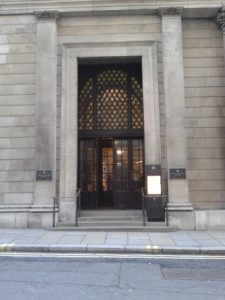
This is a small, free museum at the back of the Bank. It is free to enter and is open Monday to Friday. When you go in you have to go through airport-style security – understandable I guess, given the proximity to the Bank.

For a free museum, there is quite a lot to see. Exhibitions explore the history of the Bank of England, which was founded in 1694. The inside of the museum has been designed to resemble Sir John Soane’s original design for the vestibule area. Sadly his building was demolished in the mid-20th century to enable a new, multi-storey building to be constructed. I liked looking at the different images of the Bank throughout the years, as well as examples of the different bank notes and coins produced over time.

The most surprising section of the museum was a small display devoted to Kenneth Grahame, author of The Wind In the Willows. He worked at the Bank for many years and wrote his famous novel during this time. A first edition of the book is on display.

The Bank of England Museum is well worth a visit if you are in the area. It is informative and interesting and best of all free.

FACTS

Address: Bank of England, Threadneedle Street, London, EC2R 8AH

Website: bankofengland.co.uk/education/Pages/museum/visiting

Opening Hours: Mon-Fri 10am-5pm

Prices: Free

The Monument

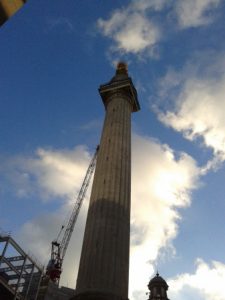
As mentioned in my previous post, I had the day off work on Wednesday. I managed to pack quite a lot into my day. After leaving the Queen’s Gallery I headed east on the District Line and got off at Monument station. I’d been meaning to look at the Monument itself, erected to commemorate the Great Fire of London, for some time.

2012 1205 Monument 01

2012 1205 Monument 03

The plaque on the side of the column explains more about how and why it was built.

2012 1205 Monument 04

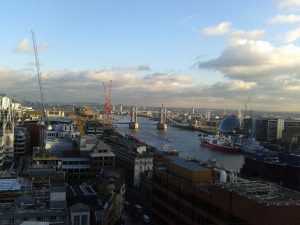
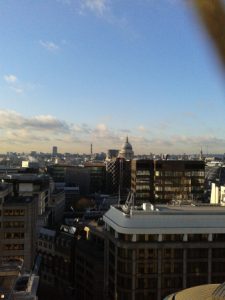
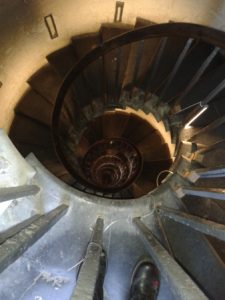
What I didn’t know was that you can actually climb up the Monument. For the grand sum of £3 you can struggle up a winding staircase inside the column, emerging to a series of stunning views over London.

2012 1205 Monument 08

The Shard
2012 1205 Monument 09

Tower Bridge
2012 1205 Monument 10

St Paul’s Cathedral
2012 1205 Monument 13

It’s a long way down…

It was a windy day, but the top is covered with netting so there’s no chance of falling off the edge. Though it was cold, it was bright and sunny and I found I could see pretty far.