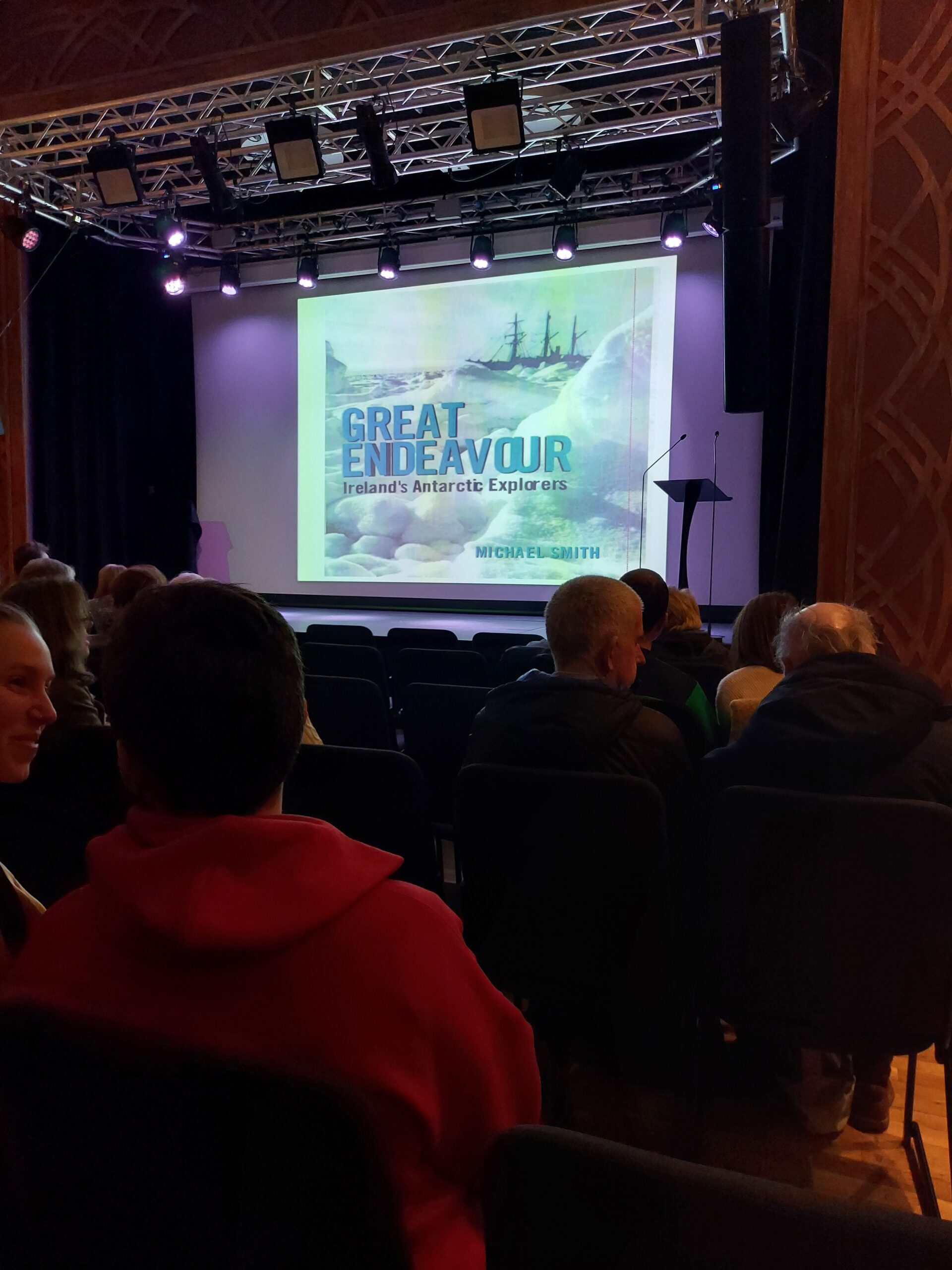
I went along to the Irish Cultural Centre in Hammersmith to attend a talk by author Michael Smith on Irish polar explorers. I have read a couple of his books, on Ernest Shackleton and Tom Crean, and hoped the talk would extend my knowledge.
I thoroughly enjoyed the talk and Smith proved a superbly entertaining speaker. As well as the characters above I learned more about Francis Crozier, Patrick Keohane, Robert Forde and the McCarthy brothers. One of the saddest things about the Irish explorers of the ‘Heroic Age’ is that they were almost forced to be quiet about their accomplishments owing to the Irish fight for independence and a distrust of alliance with British causes.
I never tire of learning more about polar exploration, and this talk was an excellent experience.
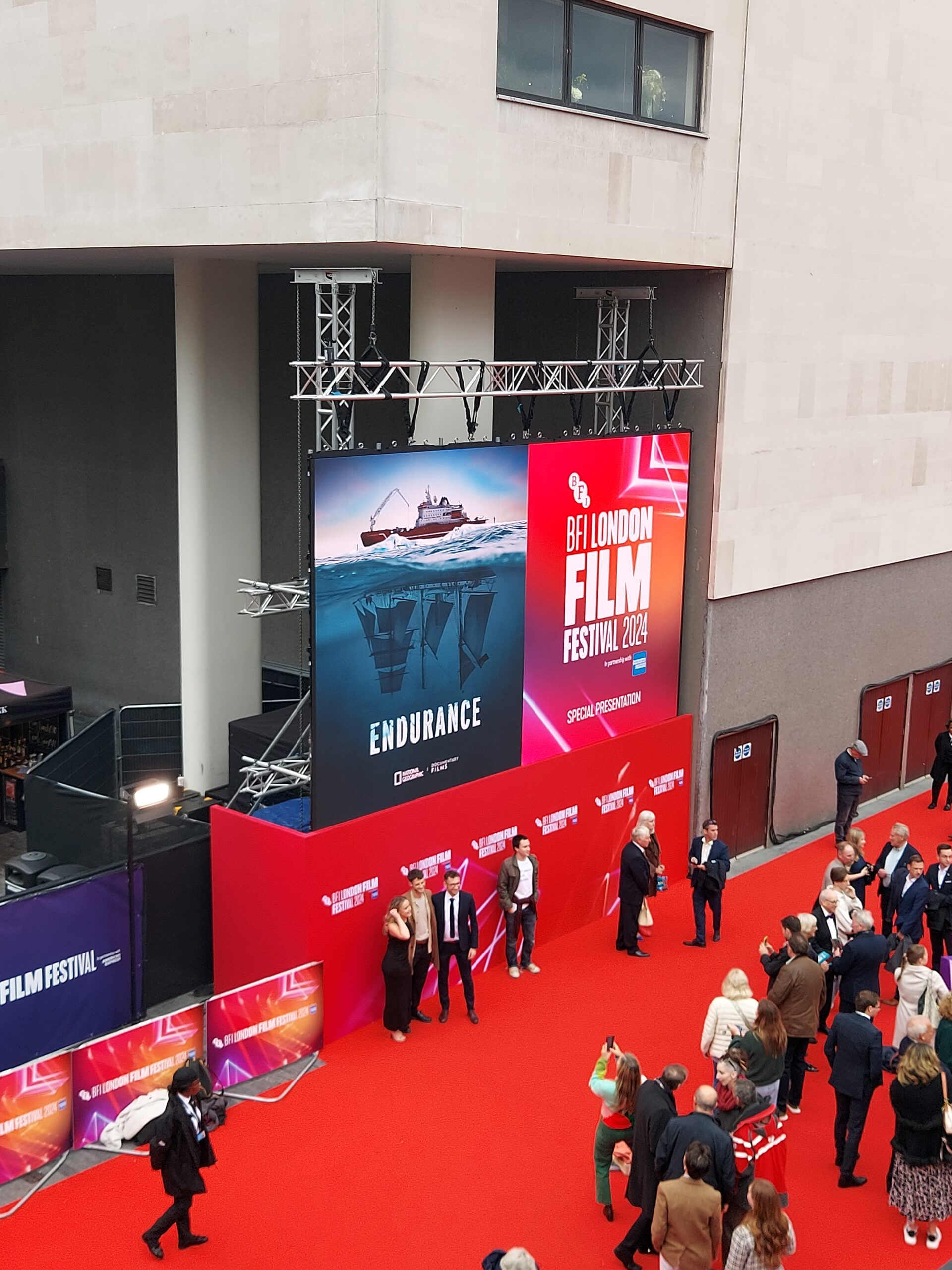
I attended the premiere screening of the new Endurance documentary on Saturday, as part of the BFI London Film Festival. Directed by Elizabeth Chai Vasarhelyi, Jimmy Chin and Natalie Hewit for National Geographic, the film tells the story of the hunt for Shackleton’s lost ship Endurance in the icy Weddell Sea. Interspersed with footage of the 2022 search is filmed footage, photographs and re-enactments of the original Imperial Transantarctic Expedition, that failed to achieve its objectives but ended up as one of the most glorious tales of survival in history. Once the ship became trapped in ice and crushed, Shackleton got his crew to dry land and along with five other men embarked on an incredibly dangerous voyage – in one of the lifeboats – to South Georgia in order to alert the whalers to their plight. Not a man was lost.
The film footage has been colourised, which really brings it to life on the big screen. The words of the members of the expedition, as recorded in their diaries, are read out loud, their voices recreated by AI. The effect is incredibly powerful.
It’s fascinating to see the sailors and scientists searching for the wreck of the Endurance, in a race against time before the colder season hits. Even knowing the outcome of their hunt, it’s still nerve-wracking to watch them wait, and heartwarming to see their excitement once all their hard work pays off. The film ends with stupendous underwater images and scans of the surprisingly complete wreck, which are worth the ticket price alone.
5 January 2022 marks the 100th anniversary of the death of Sir Ernest Shackleton, who died while embarking on another expedition. His death in 1922 is said to mark the end of the “heroic age” of Antarctic exploration. 2022 is also the centenary of Britain’s first attempt to summit Mount Everest. The BFI’s To the Ends of the Earth season explores tales of human hardship and endurance focusing on extreme environments such as the poles and high altitudes. I spent my Sunday at the BFI Southbank watching two films from this season.
South: Sir Ernest Shackleton’s Glorious Epic of the Antarctic (1919)
South is the film, photographed and filmed by Frank Hurley, of Shackleton’s famous Endurance expedition of 1914-1916, during which the ship was crushed by ice, leaving Shackleton and five of his men to embark on a risky journey to South Georgia in a lifeboat. Today it is considered the world’s first documentary feature, and has been restored for the centenary with a new score by Neil Brand.
The film is engrossing and rather magical, with moving footage of the key players in the expedition, the journey to Antarctica, exercising the dogs and life on the ice. Once the men have to abandon the ship there is no more video footage until Shackleton reaches South Georgia, but vivid photographs take their place. Watching this film, I feel incredibly glad that Hurley insisted the negatives be saved when so much else was abandoned.
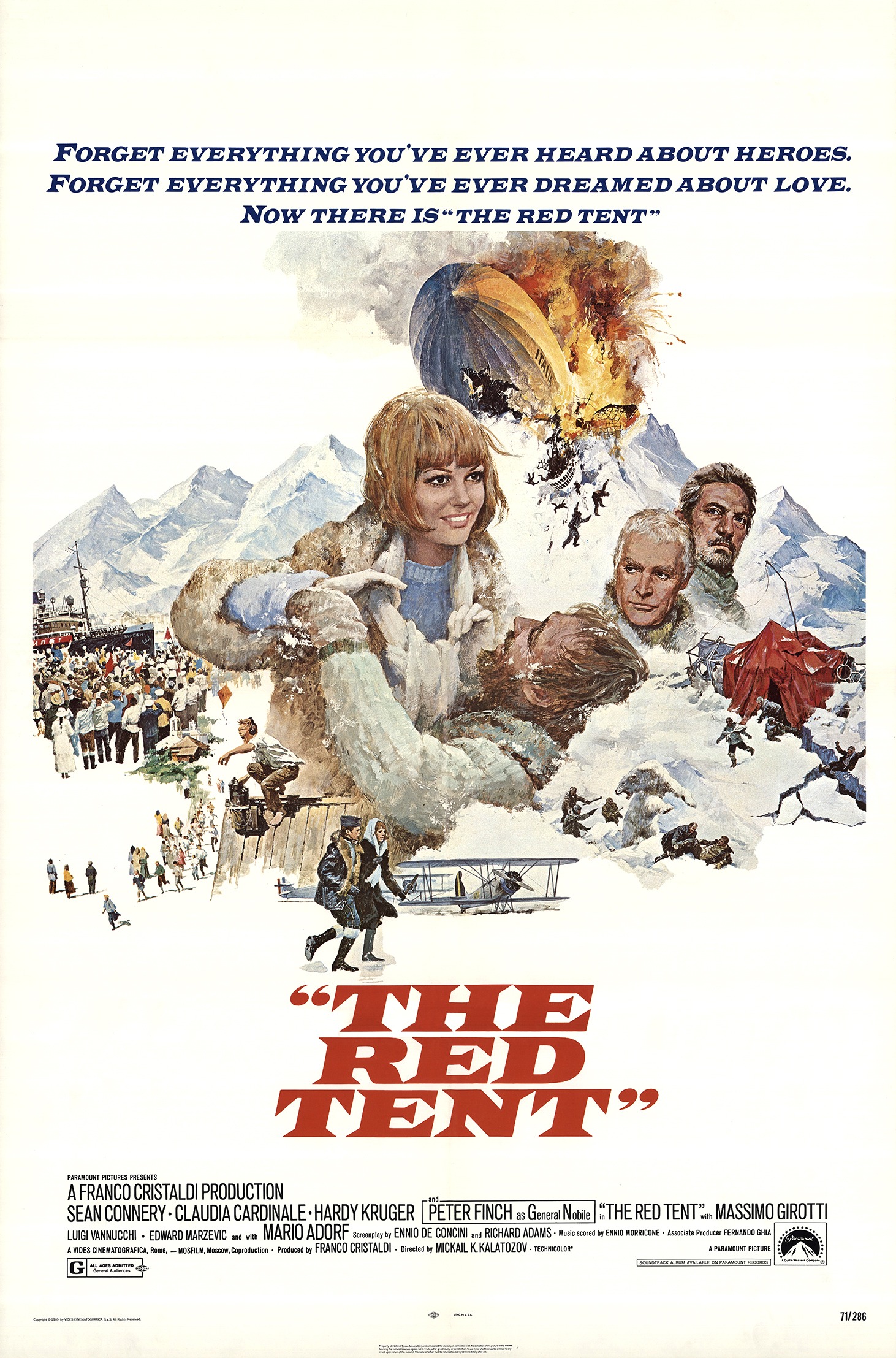
The Red Tent (Krasnaya palatka) (1969)
I’d never heard of this intriguing film, which looks at the 1928 Italia airship disaster by means of a series of ghosts haunting Commander Nobile, the leader of the expedition, later in life. Peter Finch plays Nobile and none other than Sean Connery plays Roald Amundsen, who went missing trying to rescue the stranded crew. The film was gripping and very well-made – it really evoked the frozen wastes of the Arctic. There was definitely some artistic licence taken in the reenactment of events, but it was broadly based on fact, and was an interesting examination of what makes a leader.
The auction house Spink held an exhibition entitled 200 Years of Polar Exploration recently, featuring artefacts that have never been on display before, including photographs, equipment, medals and other memorabilia, from the expeditions of Scott and Shackleton, to 21st century explorations led by figures such as Sir Ranulph Fiennes and the late Henry Worsley.
The exhibition was staged in aid of The Endeavour Fund, which aims to help wounded, injured and sick service personnel and veterans use outdoor challenges and sport as part of their recovery and rehabilitation. This was the charity promoted by Worsley, who took part in several Antarctic expeditions before tragically dying of peritonitis during his 2016 attempt to make the world’s first unaided Antarctic crossing. One of the items on display was his pair of skis, decorated before their use by his children – a moving and poignant sight.
Other items included medals, and photographs from the Heroic Age and later. As always, I loved the opportunity to explore artefacts re;ated to Antarctic exploration and its history.
As part of Open House London, I was able to sign up to visit Dulwich College. This public school has a long and fascinating history, and there is a particular reason I wanted to visit, which I will discuss below.
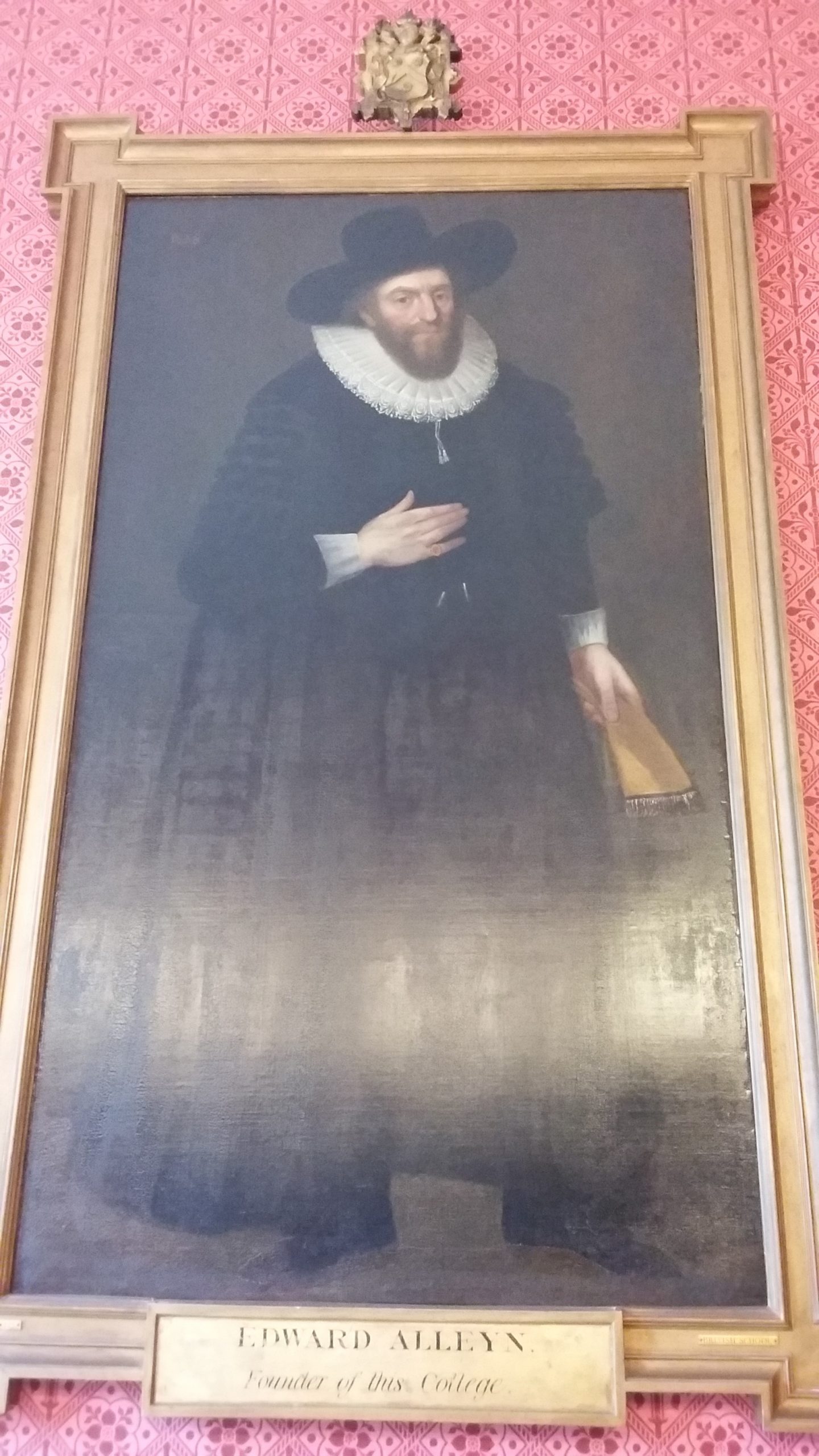
History It was founded in 1619 as the ‘College of God’s Gift’ by Elizabethan actor Edward Alleyn, who had performed in Christopher Marlowe’s plays at the Rose Theatre on Bankside. Alleyn possessed great wealth, and had owned the manorial estate of Dulwich since 1605. He decided to found an establishment originally intended for the education of poor boys. Over time the exact location and the purpose of the school changed, and it wasn’t known formally as Dulwich College until 1882. Notable alumni include Ernest Shackleton, P. G. Wodehouse, Raymond Chandler and Chiwetel Ejiofor.
Edward Alleyn, the school’s founder
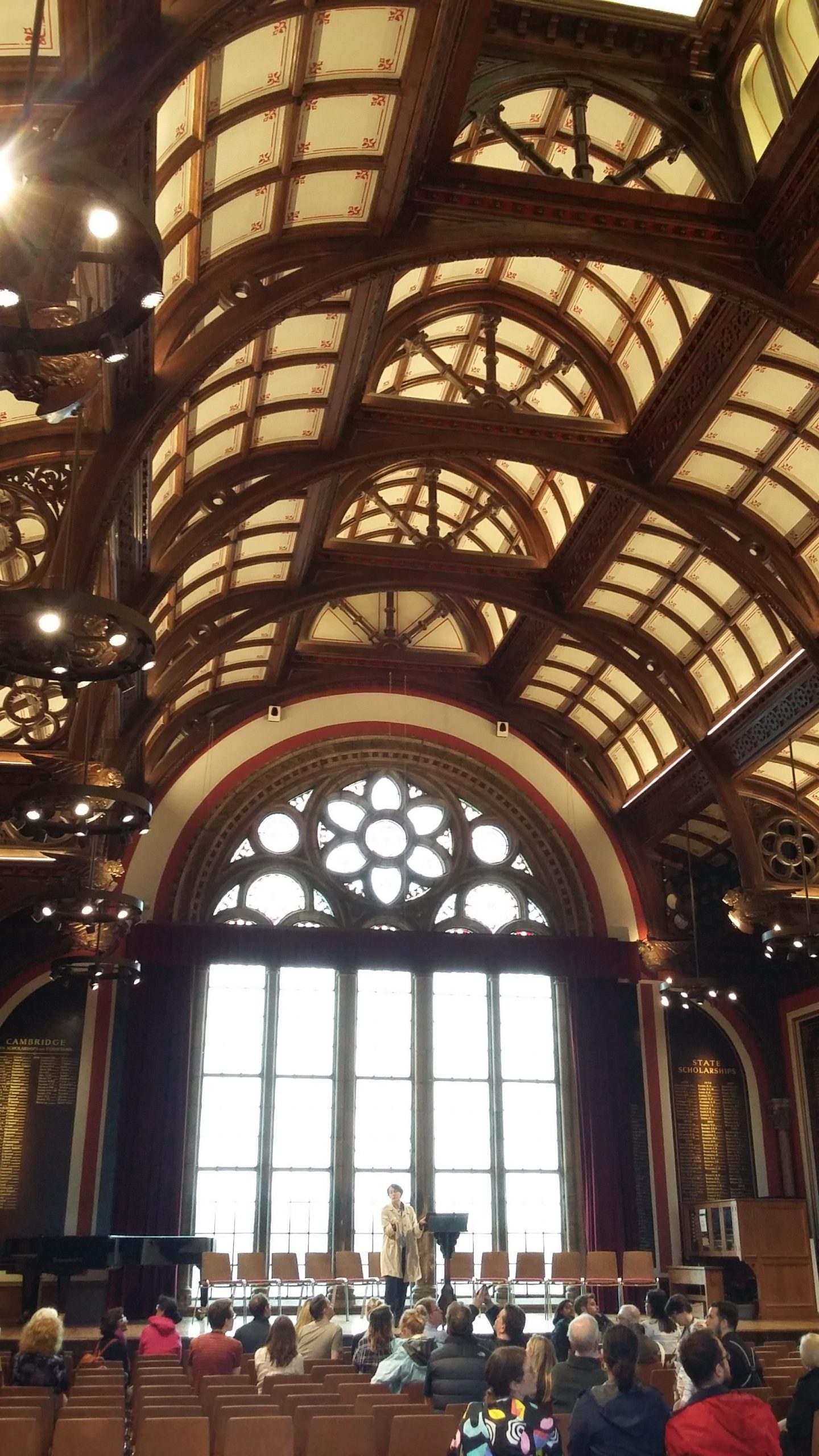
Dulwich College Now The current site was established in the 1870s; the main building, New College, was designed by Charles Barry Junior (son of the architect of the Houses of Parliament). Loosely based on Palladian architecture, it makes use of features such as triangular gables, turrets and cupolas. Interestingly, Dulwich was the first public school with a dedicated hall for assemblies, with all teaching taking place in the classrooms.
Assembly Hall
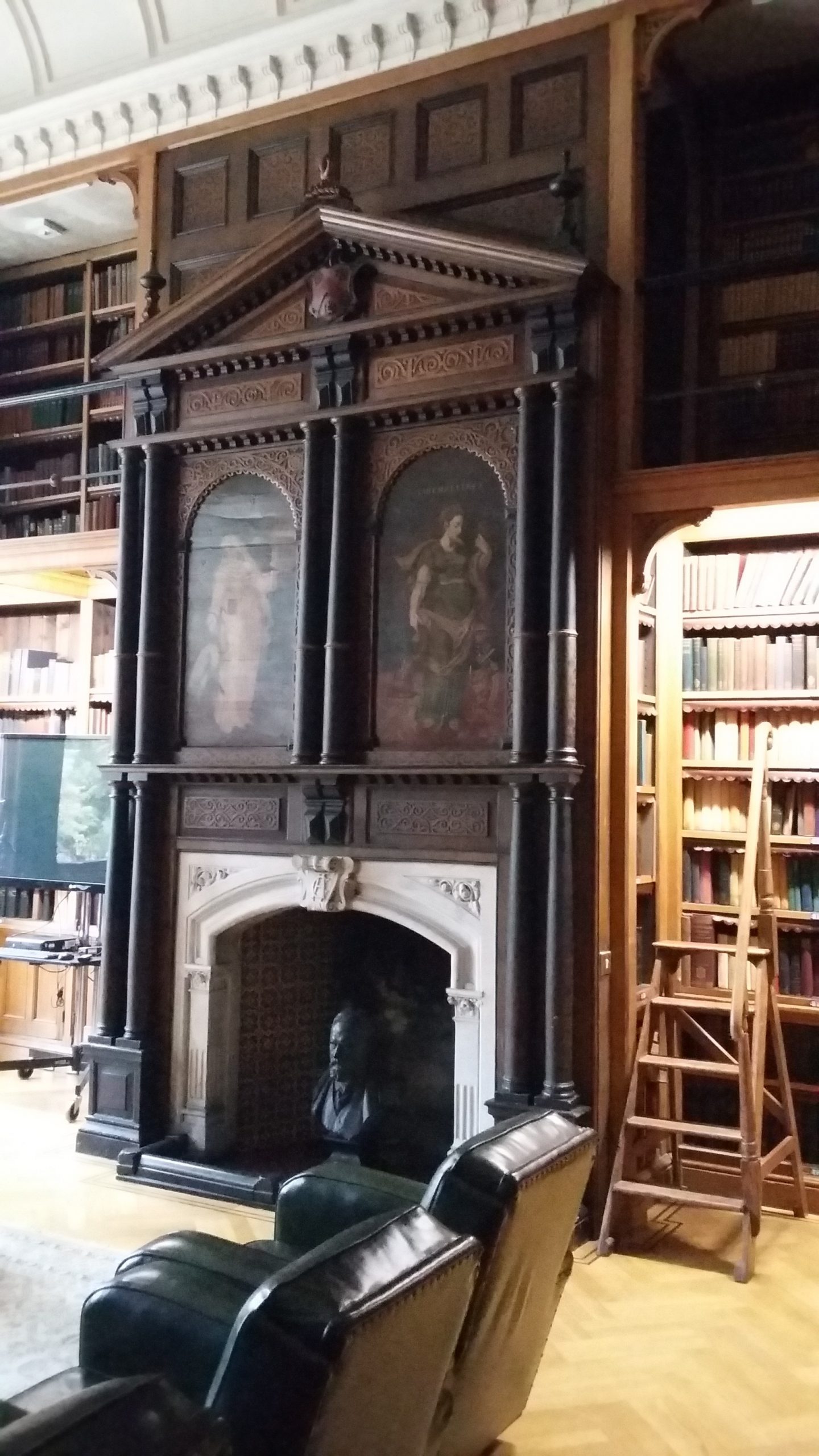
The College holds some impressive archival material, much of which came from Edward Alleyn’s own library, and focuses on drama and the arts. Material includes diaries, two of the three volumes of Shakespeare’s First Folio, a Mercator Atlas, first editions of poetry by John Donne, Edmund Spenser and Dryden. Above the fire in the Masters’ Library are two panels depicting pietas (Duty) and liberalitas (Generosity), which came from Elizabeth I’s state barge. They may have originally come from Francis Drake’s Golden Hinde.
Masters’ Library
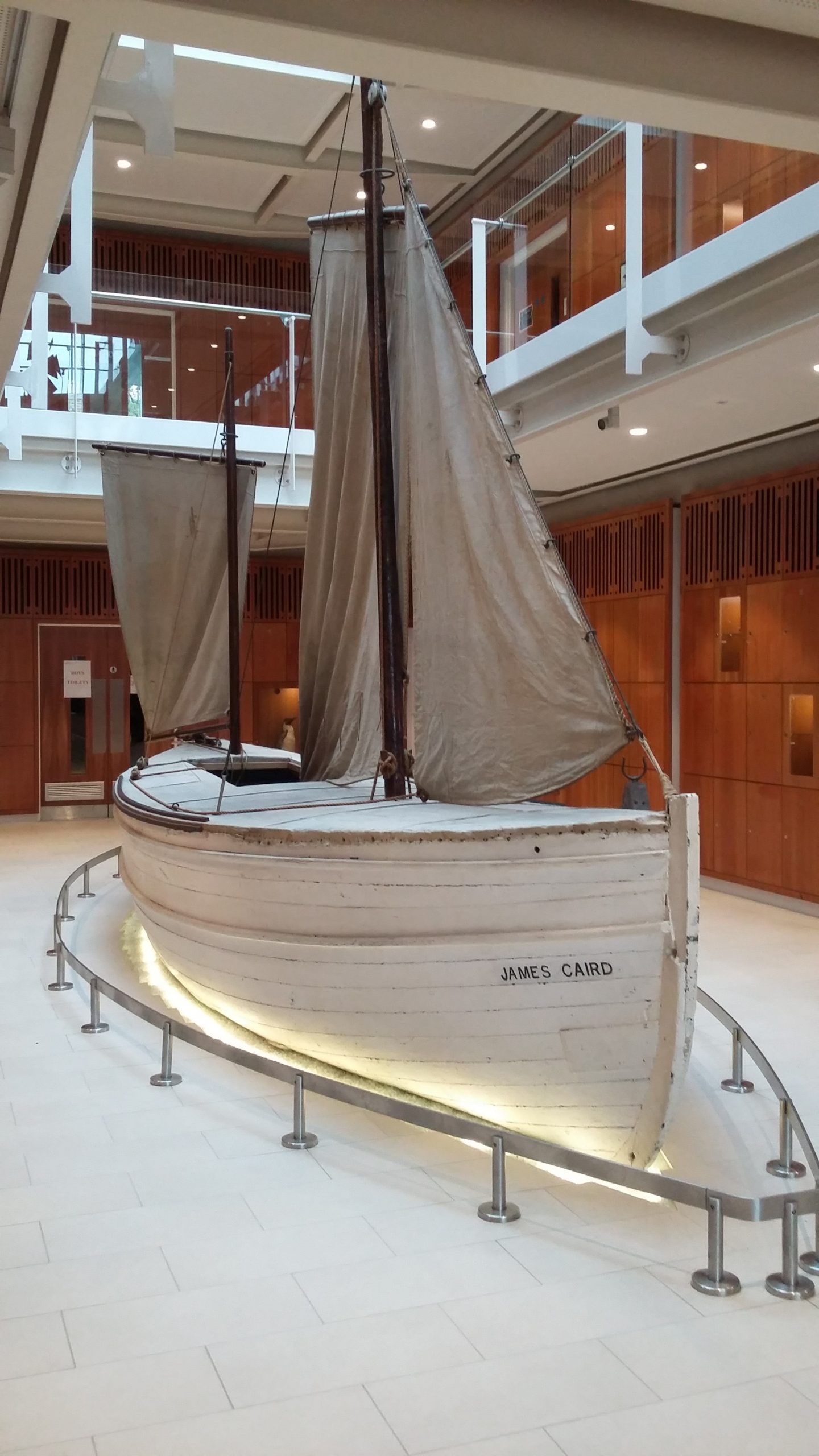
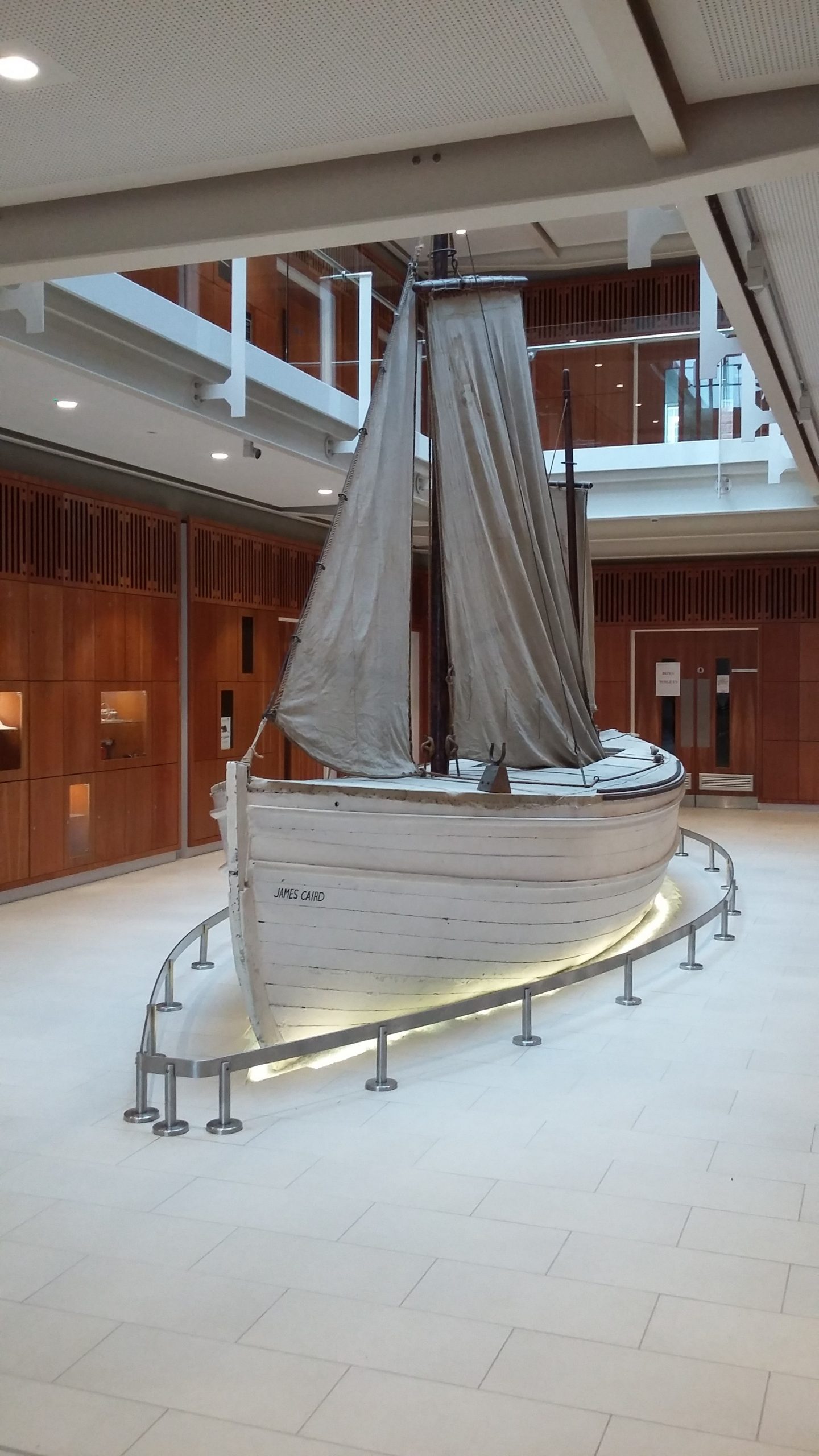
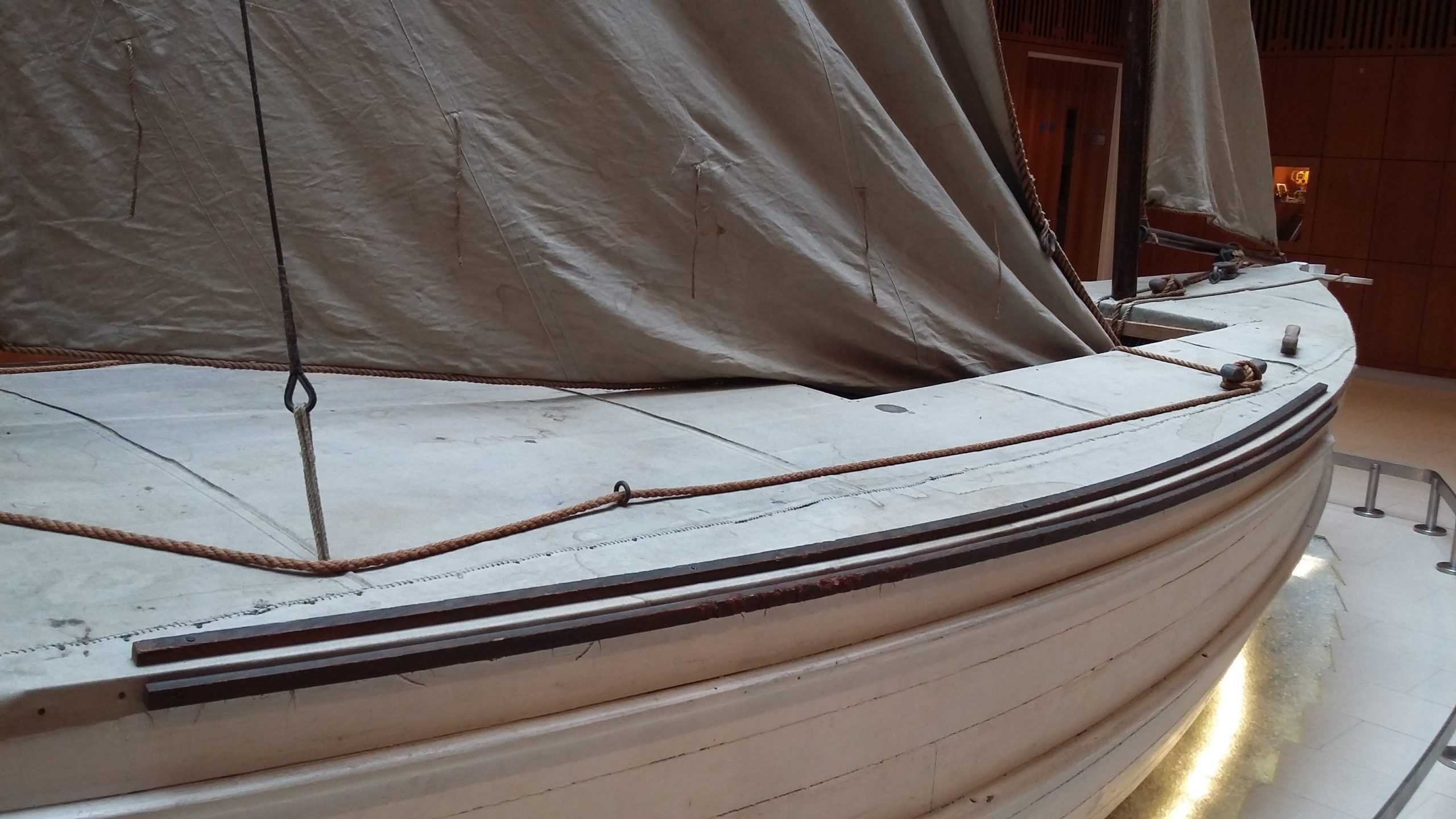
The James Caird And so to the reason why I wanted to come here in the first place: The James Caird. Donated to his alma mater by Shackleton, this famous lifeboat was the very boat in which Shackleton and five other men made their incredible voyage to South Georgia from Elephant Island in 1916. As someone with a deep interest in polar history, I’ve long wanted to see the boat for myself. It is housed in the purpose-built James Caird Hall, surrounded by other polar artefacts including items from Shackleton’s Nimrod expedition. Now white and gleaming, it’s hard to imagine six tired, hungry, filthy men ensconced in this 23-foot whaler, struggling through treacherous seas for over 800 miles during the Antarctic winter. What is apparent, though, is the superb workmanship of carpenter Harry ‘Chippy’ McNish who made the boat seaworthy enough to withstand the voyage: even Shackleton later admitted they could not have reached South Georgia without his efforts. McNish used wood from packing cases and sledge runners to build up the sides of the boat, caulking it using a mixture of seal blood and flour. The whole was then covered with canvas to protect the men from the elements as much as possible. I won’t lie: I felt quite emotional seeing this boat close up.
I went to a fascinating talk at the British Library, entitled What Does the Antarctic Mean?, part of the Cook’s voyages exhibition season. The talk was chaired by journalist Julia Wheeler, who has written books on both the Antarctic and the Arctic, and featured Jane Francis (Director of the British Antarctic Survey), Damon Stanwell-Smith (Executive Director of the International Association of Antarctica Tour Operators), Jane Rumble (Head of the Polar Regions at the Foreign and Commonwealth Office) and Klaus Dodds (Royal Holloway University of London).
The talk began with a discussion on the significance of Antarctica. Jane Francis emphasised the importance of Antarctica to science, and explained how the continent influences the world: the climate, sea level rises and tides. Klaus Dodds said that 200 years ago, people tended to see as ice as sublime, awesome, terrifying, and now that relationship has been flipped on its head as we have become aware of the human power over ice. He also talked about the imaginative aspect of Antarctica, and mentioned the Antarctic Treaty, which inspired other treaties including those involving space.
Jane Rumble pointed out that 200 years ago no one knew Antarctica existed: its importance has increased in a very short space of time. It is the only place in the world with no wars, no territorial claims. Damon Stanwell-Smith confessed to amazement that a continent larger than North America hasn’t been colonised, and talked about how Antarctica is something you feel – there is nothing like being there.
The group then discussed the Antarctic Treaty. Dodds explained that this treaty was negotiated over 6 weeks in 1959, and involved the 12 parties who had participated in the International Geophysical Year 1957-58. This was during the middle of the Cold War – there was a worry that such collaboration would not continue.
There were many issues. The UK, Argentina and Chile claimed the same territory – could they come to blows? The Australian president was convinced that Russian communists wanted to establish bases in Antarctica, while the USA had seriously considered nuclear testing. The treaty nearly didn’t happen – especially thanks to Australia, France and Argentina. The treaty would only happen if all 12 countries passed it; there was a deliberate decision to avoid mention of mineral resources or there would have been no agreement.
Rumble then discussed the UK’s territorial claims in more detail, starting with the 1908 claim to the Antarctic peninsula region. There was some discussion on whether the UK should claim the whole thing; in the end they didn’t, but they did cajole the Commonwealth nations Australia and new Zealand to claim. France joined in, then Germany tried in the 1930s, following which the British supported Norway’s rival claim. As a Norwegian, Roald Amundsen, was first to the South Pole, that country’s claim should really have been considered earlier, but at the time Norway was a small newly-independent nation and nobody really took them seriously.
Chile and Argentina placed their own claims during World War II. In 1943 the UK set up the first permanent presence in Antarctica – Operation Tabarin. The US put their base at the South Pole, while Russia put theirs in the Australian bit and refused to move. Despite all this, there is still one unclaimed sector, the most remote.
Rumble discussed the huge amounts of scientific collaboration taking place in Antarctica among scientists, who tend to ignore politics. Shared science programmes abound, including a new joint UK/US project investigating a glacier. If it melts, there will be a sea level rise of over 5 metres. Francis pointed out that when the climate changes, it changes at the Poles first, so Antarctica is the perfect place for this research.
Stanwell-Smith talked about the sometimes-controversial business of modern commercial tourism. This began in the late 1960s and has gone from strength to strength ever since. Most visitors are from North America and other anglophone countries, but there has been an increase in Chinese visitors. In the last year there have been more than 50,000 visitors (of whom 9,000 were on cruises – and did not get off the ship), a rise of 17% from the previous year.
Stanwell-Smith argued that allowing visitors is important, albeit in an appropriate way. Most people who visit have a fascination with Antarctica; perhaps they are older and have a long-held ambition to go. Visiting Antarctica also allows the importance of the continent to be emphasised. Francis pointed out that far more than these visitors, the main problem is people who treat the continent like an adventure playground: such as Guirec Soudee, a French man who is travelling around the world with his pet chicken, Monique. It sounds like a fun story, but there was a very real risk that the chicken could have passed on avian flu to the native penguin population.
Dodds spoke about the challenging relationship between tourists and scientists: some scientists see tourists as a distraction, but public outreach is now recognised as an important part of a scientist’s role. Dodds also pointed out that Antarctica still has a very small number of visitors for such a large place.
Finally, Rumble was asked about the most important aspect of Antarctica to the UK government, and responded, ‘Peace and stability.’ A strong treaty system is very important and science is a clear priority.
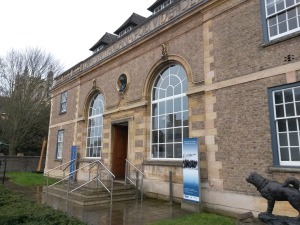
Just before Easter I went to Cambridge for work-related reasons. While I was there, I had some spare time so decided to visit the Polar Museum. This is located in the Scott Polar Research Institute, which is a centre for the study of the polar regions and is of international importance. The SPRI was founded in 1920 as a memorial to Scott and his men, who died on their return from the South Pole. It is the oldest international centre for Polar Research within a university.
I originally visited the SPRI several years ago when I was living in Cambridge. In fact, it originally inspired my interest in polar history, as I found the stories of exploration fascinating. I vividly remember viewing the original letters penned by Scott and his companions as they lay in their tent, surrounded by a blizzard, knowing they were going to die. Back then, I was on a work visit and we had a tour of the extensive library, but today I was here as a normal visitor, and stuck to the free Polar Museum.
The Museum contains information about both the Arctic and Antarctic. It encompasses the history of exploration in both regions, including the quests for the North and South Poles. My personal interests have always leaned towards Antarctica, and there is a great deal of interest here, including the history of Scott’s last expedition on the Terra Nova. However, I also enjoyed reading about the search for the North West Passage, including Franklin’s infamous expedition of the mid-nineteenth century in which he and all his crew disappeared; despite several search parties being dispatched to look for him, the mystery was never solved. The Museum also contains information about survival in these cold regions of the earth, and displays about the people who live in the Arctic (the Antarctic does not have an indigenous population).
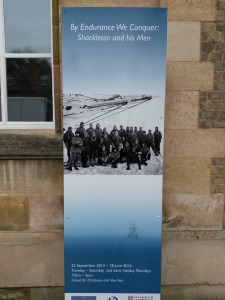
By Endurance We Conquer
The current temporary exhibition is By Endurance We Conquer: Shackleton and His Men, and it is the major centenary exhibition commemorating Sir Ernest Shackleton’s Imperial Trans-Antarctic Expedition 1914–17. I’ve written about this expedition on this blog before, including my post about the recent Royal Geographical Society exhibition, so I won’t repeat the same facts. This expedition makes use of diaries and artefacts in the SPRI’s collections, including navigation instruments used on the JamesCaird on the voyage to South Georgia, the cooking pot used by the three men on the overland crossing of South Georgia, and Ernest Shackleton’s pannikin marked with his initials. There are also archival materials including letters, diaries, and a memory map drawn by Frank Worsley showing the route taken during the South Georgia crossing. What I liked about the exhibition was its focus on the 28 individuals of the Weddell Sea Party (not to mention Mrs Chippy the cat), with written summaries describing each person, whether they went with Shackleton to South Georgia or remained behind awaiting rescue.
This free exhibition runs until 18 June, and will be followed by a display on the Ross Sea party, commemorating the centenary of Shackleton’s arrival at Cape Evans to rescue the survivors in January 1917. It’s well worth a visit, especially as it’s free, and the museum as a whole is a superb resource for the study of polar history.
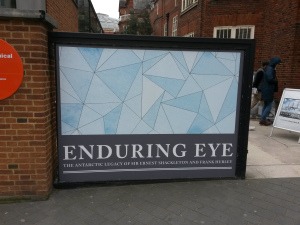
I only found out about this exhibition a couple of weeks ago, after reading an article in Londonist. Luckily I was in time to visit, though as it was the final weekend the display was pretty crowded. I braved the hordes anyway, as I am a bit obsessed by Antarctica and the Imperial Trans-Antarctic Expedition, which this exhibition commemorates, is one of the most important and memorable expeditions in history. Enduring Eye: The Antarctic Legacy of Sir Ernest Shackleton and Frank Hurley marks the 100th anniversary of the conclusion of the expedition: it did not achieve its stated aims, but it is deservedly admired nevertheless.
The Royal Geographical Society has a collection of original glass plate and celluloid negatives created by Frank Hurley, the official photographer and cinematographer on the expedition. This collection has been ditigised as part of the centenary celebrations, and much of it is presented here.
The Imperial Trans-Antarctic Expedition was established by Ernest Shackleton, who aimed to be the first to cross Antarctica. On the ship Endurance, which left Britain on 1 August 1914, he and his crew headed south. After stops in Buenos Aires and South Georgia, the ship made it to the Weddell Sea, where it was trapped in the pack ice.
Despite the best efforts of the entire crew, and after several months of entrapment, the Endurance was eventually crushed by the ice and destroyed. What followed was one of the greatest feats in the history of Antarctic exploration. I’ve read a great deal about the expedition, I’ve seen more than one exhibition about it, but I never tire of hearing more. The crew sailed in the lifeboats to Elephant Island, from where Shackleton, Worsley and four others departed in one of the lifeboats, the James Caird, to fetch help. In a hugely impressive feat of navigation, they safely reached South Georgia, only to be faced with a further trek over mountains and glaciers to reach the whaling station on the other side.
A rescue ship finally arrived at Elephant Island on 30 August. Every single one of the men from the Endurance survived (the men on the other ship, the Aurora, which had the job of laying supplies for the expected trans-Antarctic party on the other side of the continent, did not fare so well, losing three of the ten men left on the ice over the winter). Some of the artefacts from the expedition survived, and are on display here, including the Union flag presented to Shackleton by King George V, a knife carved from a tent peg by ship’s carpenter Harry McNish, and sketches and notes made by Reginald James, one of the men marooned on Elephant Island.
The exhibition covers the history of the exhibition from the first departure of the Endurance, following everyday life on board the ship as the crew get used to their routine. As the ship became trapped in the pack ice, photographer Frank Hurley took the opportunity to take detailed shots of the ship and of the region, by all accounts completely dedicated to getting the perfect shot, even willing to risk his own life by climbing up to the top of the ship’s rigging to take pictures from up high. Hurley was able to develop the photographs despite the incredibly cold temperatures and less than perfect conditions, so it is extremely impressive that his pictures are as wonderful as they are. In particular, I love his shots of the ship Endurance, trapped in the ice; the famous night-time shot with the ship looming out of the dark, the rigging glowing in a ghostly manner, is a masterpiece by any standards.
When the decision was made to abandon ship, Hurley had to leave behind many of his beloved negatives, selecting only the best to take with him to Elephant Island. On the way he managed to take more photographs, capturing the dramatic journey as well as life on the island as the crew waited for Shackleton’s return.
Hurley’s pictures helped to popularise the expedition both immediately after it took place and well into the future. These pictures are magnificent: even a century later they still have incredible power. The achievements of Shackleton, leading the expedition, and Hurley, capturing it on film, are still awe inspiring today.
Statue of Shackleton on the side of the RGS building
In Durham, my mam and I paid a visit to the Palace Green Library, part of Durham University, at my request to visit the Antarctica exhibitions being held there. Antarctica: Explorers Heroes Scientists includes two exhibitions on loan from the Royal Geographical Society, alongside displays exploring how men and women from the North East of England have contributed to our understanding of Antarctica.
With Scott to the Pole and Antarctic Witness contained photographs from Scott and Shackleton’s respective trips in the early twentieth century, telling the story of their adventures in Antarctica. I was familiar with these stories and some of the photographs from an exhibition I previously visited in London, but I still enjoyed seeing the pictures again. The third exhibition, Antarctic Science Today, looked at how scientists from Durham are working to understand Antarctica and the progress of global warming.
I’m glad we made the effort to visit this exhibition: it was really interesting and informative.
This year, 2012, marks the 100th anniversary of Robert F. Scott’s ill-fated expedition to the South Pole. For those who are unaware, Scott and four companions reached the Pole on 17th January – having been beaten by the Norwegian, Amundsen, and his team a little over a month before – and died three months later on their way back to their base camp.
To mark the occasion, an exhibition of Antarctic photography is taking place in The Queen’s Gallery, Buckingham Palace, London. This exhibition includes photographs from Scott’s expedition (known as the ‘Terra Nova’) and Ernest Shackleton’s ‘Endurance’ expedition of 1914-17. I’ve developed a bit of an interest in Antarctica, and particularly this period in its history (known as the ‘Golden Age’ of Antarctic exploration), after reading a novel, Antarctic Navigation by Elizabeth Arthur, last year. I thought this exhibition looked very interesting and decided to pay it a visit, managing to persuade two friends to accompany me.
Photographs were very important to the explorers on these expeditions. They acted as proof of their achievements and evidence of the breathtaking environment they were surrounded by. They recorded scientific findings, the beauty of Antarctica, and the hardships of the journey. They also helped to raise the profile of the expeditions in the public eye, provided material for subsequent exhibitions, and could be sold as prints to raise money to pay debts.
A penguin, by Ponting
The photographs were donated to the reigning monarch at the time, hence their appearance in the Royal Collection. I will write about the exhibition itself first and the Queen’s Gallery later.
***The Heart of the Great Alone: Scott, Shackleton and Antarctic Photography***
The exhibition takes place in two large rooms in the Queen’s Gallery. As well as pictures, editions of books about the expeditions are on display alongside a map of Antarctica and a timeline. Also displayed are the British flags used on both the ‘Endurance’ and ‘Terra Nova’ expeditions, the last recovered from the tent containing the bodies of Scott, Wilson and Bowers.
*Scott*
The first part of the exhibition covers Robert F. Scott’s ‘Terra Nova’ expedition of 1910-12. It takes place in one large room with two smaller rooms alongside. The majority of these photographs were taken by official photographer Herbert Ponting.
Heart of the Great Alone
These photographs are incredibly beautiful, stunning and dramatic. Looking at them I got a sense of the excitement Ponting must have felt at the strangeness of this new world. Several scenes involve tiny figures standing beneath huge ice sculptures (‘Castle Berg’, a picture of an iceberg that resembled a medieval castle, is a notable example). Another shot shows the ship, the ‘Terra Nova’, taken through an overhang of ice. Two pictures of amusing, adorable Adelie penguins hang on opposite sides of the wall (as postcards, these became bestsellers after the original exhibition). A number of photographs show the members of the expedition in and outside the hut (which still stands to this day). The explorers look happy and optimistic about the future. One shot of Scott’s birthday party is particularly poignant, as it was to be his last.
In a side room are photographs of the five members of the polar party (the rest of the group remained behind): Edgar Evans, Edward Wilson, Robert Falcon Scott, Henry Robertson Bowers, Lawrence ‘Titus’ Oates. All of these men reached the South Pole and died on their return. Ponting did not form part of the polar party, so the photographs from this stage of the exhibition were taken by Henry Bowers, to whom Ponting taught photography while in Antarctica. When the photographs were originally exhibited, these photographs were displayed in the centre of the room with Ponting’s around the outside. This exhibition has replicated that and these central photos detail the party on the move, pulling their sledges, and their achievement of reaching the South Pole. The men look exhausted and dejected – perhaps unsurprising as they had travelled all that way only to be beaten in the race to be first. The final photograph is of the cairn built over the tent containing the bodies of Scott, Wilson and Bowers, located in November after a search party was sent out to look for the men.
*Shackleton*
Shackleton’s ‘Endurance’ expedition of 1914-17 is the other expedition covered in this exhibition. Originally aiming to cross the polar continent, it became apparent that it was appropriately named, as the ship ‘Endurance’ became trapped in pack ice and eventually crushed. Without a ship, the only hope the crew had of escape was to use the lifeboats. The explorers made it to dry land, and Shackleton and a number of his men set off on a risky and uncertain trip to South Georgia in order to get help, leaving the remainder to wait and hope.
Photographer Frank Hurley was responsible for the photographs in this section of the exhibition. He documented the adventures of the ship as it became trapped in the ice and eventually crushed. His pictures also have a strong narrative quality which makes them particularly interesting. They capture the beauty of the ice and the smallness and relative fragility of the ‘Endurance’ surrounded by this beautiful but lethal stuff. Several photographs detail the men going about their day to day business, playing chess, exercising the dogs or carrying out scientific experiments.
I do wish a bit more information had been provided. For example, several pictures referred to the ‘Welsh stowaway’ – I would have liked to know more about him and how he ended up on the ship! Hurley was not chosen to accompany Shackleton on his quest for help. Therefore his later pictures show the life he lived for four months with the other men left behind, waiting for Shackleton to return, living in a hut made of the two remaining lifeboats and living off penguin meat. This is fascinating in itself.
Heart of the Great Alone
I found it interesting that some of the photographs were renamed to give the impression that they were images of a different event. For example, the photograph that Hurley claimed was of Shackleton’s return to rescue the men was actually his departure in search of help. This adds to the narrative quality of the pictures but not their authenticity!
**Conclusion**
I found the whole exhibition fascinating and managed to spend nearly two hours in there, which was impressive considering there were only two large rooms. I thought that the photographs were well presented and the accompanying objects were well chosen. The map and timeline provided made it possible to understand the pictures in context. The two sets of photographs provided an interesting contrast, with Ponting’s pictures that were largely made up of beautiful shots of interesting landmarks, and Hurley’s photographs that generally told a story. One of my friends preferred the latter, as she said that she found them more interesting. I however preferred the former, as I thought that they really captured the beauty and fascination of Antarctica. Overall, though, both sets of photographs were beautiful, informative and fascinating and credit must go to both photographers for taking such care with their work in such harsh and hostile conditions. They must have felt frustrated at not being able to record what they saw in colour, but their black and white shots are stunning and dramatic.
As a slight aside, I found the exhibition made me think about the nature of success. On the way back one of my friends said that Shackleton had seemed to be more successful. But was he? I pointed out that he didn’t actually achieve his aim of crossing Antarctica. However, he and his crew demonstrated great courage and all of his men survived against the odds. Scott, on the other hand, succeeded in his aim of reaching the South Pole (albeit too late to be the first) – but his polar team all died. Who was the most successful? I am still pondering this!
***Overall Conclusion***
I thoroughly enjoyed my visit to this exhibition and my experience of the Gallery as a whole was very positive. My friends thought that £7.50 was a good price for a year’s admission, but felt that it was a bit steep for one exhibition alone. I would personally have been happy to pay just for this exhibition as I feel it was worth it – however I do have an interest in the subject matter.
I would highly recommend ‘The Heart of the Great Alone’ which is on until 15th April 2012. However if you can’t make it or aren’t interested I would recommend the Queen’s Gallery in general as it is well worth a visit. The next exhibition is ‘Leonardo da Vinci: Anatomist’ from 4 May to 7 October 2012.
The website for the exhibition is available at http://www.royalcollection.org.uk/microsites/HOTGA/ and a number of photographs are available to view there. If you are interested in this topic, I would wholeheartedly recommend the novel Antarctic Navigation by Elizabeth Arthur, a fictional account of one woman’s quest to visit Antarctica and recreate Scott’s ill-fated expedition (I want to write a proper review on this at some point). Also, if you live in or near Cambridge, the Scott Polar Research Institute has an exhibition about Scott and the ‘Terra Nova’ expedition at the moment. A book made up of photographs from the exhibition has been released to coincide with it. Entitled, like the exhibition, The Heart of the Great Alone: Scott, Shackleton and Antarctic Photography, it is available from the Queen’s Gallery gift shop and from Amazon.