The usual stereotypes – queueing, drinking tea, sitting on the beach – were present, but there were many quirky and unusual shots. Most people photographed were ordinary people going about their day-to-day lives: even the pictures taken during the Coronation of George VI concentrated on the crowds rather than the royals. The exhibition is going to Manchester later this year, and it’s worth catching it if you can.
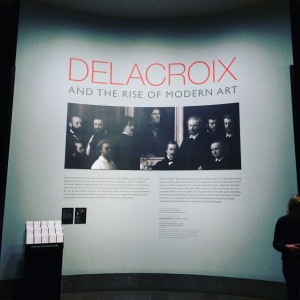
I quite fancied the Delacroix exhibition at the National Gallery, as though I can’t claim to know a great deal about the artist, what I do know I generally like. The exhibition, entitled Delacroix and the Rise of Modern Art, ended on 22 May so I only just managed to catch it.
The exhibition looked at the art of Eugène Delacroix in the context of his influence on later artists. Paintings of his were displayed alongside works by other artists, including Paul Cézanne, Vincent van Gogh and Henri Matisse, to show how he influenced them; these works included landscapes, still lives and portraiture. Interestingly, one of Cézanne’s works directly references Delacroix’ heroic status among artists: his The Apotheosis of Delacroix (1890-1904) shows artists praying to Delacroix, who is being transported heavenwards. Other works displayed included Henri Fantin-Latour’s Immortality, which also paid homage to Delacroix. Some impressive Delacroix paintings were included, such as his 1858 Tangier from the Shore, but sadly his greatest paintings were absent, so I didn’t get the full sense of how impressive he was.
While I did enjoy the exhibition and found it illuminating, I would have liked to see more of Delacroix’ own work, and was slightly disappointed that it was not more closely concerned with him. Apart from that though, it was obviously well planned and thoughtfully organised.
The Dulwich Picture Gallery in leafy south London does have some interesting exhibitions, and the most recent was Painting Norway by the Norwegian artist Nikolai Astrup (1880-1928). Many of these paintings are being shown for the first time outside Scandinavia.
Astrup grew up in Ålhus in Jølster, where his father was a priest. A sickly child, Astrup spent a lot of time indoors but most of his pictures are concerned with the landscape outside, though he also painted places and buildings that were important to him, such as the parsonage where he grew up and his farmstead at Sandalstrand (later named Astruptunet after him).
I was drawn to the unusual, almost mystical landscapes, the colours and the representations of Norwegian culture. My favourite pictures were Astrup’s depictions of Midsummer’s Eve bonfires, the fires bright and almost otherworldly amid the landscape of the fjords. He painted many scenes of his home town in south west Norway, in all seasons and weathers, fields covered in marsh marigolds, midnight skies glowing purple, mountains which take on human qualities.
Astrup is little-known outside his native Norway, but this really needs to change: his work is superb, unusual and really worth exploring.
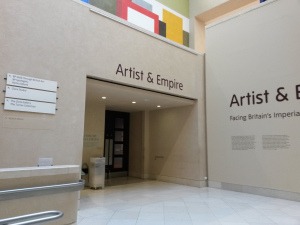
On Saturday I had a bit of time to spare so I popped into Tate Britain to check out their latest exhibition, Artist and Empire. The exhibition encompasses art from the past five hundred years or so, concerned with the British Empire. It includes works by diverse artists, both oppressors and oppressed, conquerors and the conquered, from different perspectives.
The exhibition acknowledges that the issue of ’empire’ is a difficult one to explore and come to terms with these days. However, remnants of the British Empire are all around us, and the exhibition attempts to face these head on in order to explore the issues they raise. I really like the way exhibitions at Tate Britain tend to mix old and new works and all different kinds of art, and this one is no exception.
The exhibition is divided into themes, with one room containing maps, one about heroics, one focused on costume and portraiture, and so on. Maps in particular were often used to denote conquest, while naming places implied ownership over that place. Portraits were often used as symbols of power, and the clothes worn by the sitter were often suggestive: Western dress worn by Indian royalty and Native American dress worn by the British, for example, implied a receptivity to other cultures. Having said that, the power balance was hardly equal: many works painted (pun intended) the British as morally correct, honourable conquerors. One section of the exhibition looked at trophies: collections of plants, animals and birds, drawings and paintings of them, and artefacts created by humans.
The latter part of the exhibition looks at the work of modern artists examining the legacy of empire in often-provocative ways. The exhibition is a thought-provoking one: for me, it wasn’t so much about viewing and enjoying art for its own sake, but using it as a lens through which to view beliefs and attitudes concerning empire.
I began by visiting Masters of the Everyday, which looked at Dutch art of the seventeenth century, mainly focused on everyday life: families, children, music, food. One of the highlights was Vermeer’s ‘A Lady at the Virginal with a Gentleman’, but my personal favourites were the Rembrandts: seemingly simple but demonstrating incredible skill – I almost felt as if the figures in the paintings were going to step out of the frames and speak to me.
High Spirits
The second exhibition, High Spirits, focused on the work of Thomas Rowlandson (1757–1827), the English caricaturist, whose satirical work was popular in his time and remains significant today. His cartoons offer political commentary and observations on contemporary society. I liked this exhibition too: the crisp colours and sharp lines belied the age of the works, and their content was a fascinating and often amusing look into the life of the era.
Both exhibitions close on 14 February, so there’s still time to see them if you want to.
The House of Illustration is a relatively new gallery in the recently redeveloped Granary Square in King’s Cross. It is home to changing exhibitions covering the history of illustration in all its forms: recent exhibitions have included images from Ladybird books and the work of Quentin Blake.
I visited in order to see the Main Gallery exhibition, E. H. Shepard: An Illustrator’s War. Shepard is perhaps best known for his classic illustrations of A. A. Milne’s Winnie-the-Pooh stories, probably as well-known as the books themselves. I had no idea until very recently that he also produced a great deal of work while serving in the trenches of the First World War.
Shepard’s distinctive style is evident in these wartime artworks, but the subject matter is very different. His pictures include humorous images of soldiers trying to make the best of life in the trenches, stark pictures of bare landscapes, and even topographical works used for strategic purposes. Many of his cartoons were sent to Punch and other publications. Shepard also spent time in Italy towards the end of the war, producing fascinating drawings of the scenes he witnessed, and meeting none other than the author Ernest Hemingway. Some of his work was more personal: he drew pictures in his diaries and in letters to his wife, which are on display for the first time. It was fascinating to see this different side to the familiar illustrator.
While in the building I also visited the exhibition in the South Gallery, Lauren Child’s Dolls’ House. Childs is an author and illustrator most famous for the Charlie and Lola books – I’ve heard of these books even though I don’t have anything to do with small children, which suggests that they are pretty successful. Childs has been working on her own dolls’ house for over 30 years, and it is beautiful – extremely detailed. Alongside the house, sets from the author’s works are displayed: the book The Princess and the Pea was made with photographs of three-dimensional miniature sets.
The House of Illustration is well worth a visit, possibly more than one, as the constantly changing exhibitions ensure that you are likely to go back again and again.
The Ben Uri Gallery is an art museum focusing on the work of artists of Jewish descent. It also focuses on the universal themes within these artists’ work, such as identity and migration. The Gallery displays its materials in a programme of temporary exhibitions; the exhibition I saw, which has just ended, was entitled Rothenstein’s Relevance: Sir William Rothenstein and His Circle. It contained impressive works, many of which looked at the concept of Jewish religious worship; others were more traditional portraits or drawing room scenes.
I was surprised at how small the Gallery actually is: it consists of one small ground floor room and another, larger, basement space. Still, with free entry it is certainly worth popping in.
I’ve admired the work of artist M. C. Escher for a long time; his pictures are unique, and have influenced popular culture to a significant degree. In particular, a major scene from the film Labyrinth was inspired by an Escher work, and Mick Jagger even tried to commission a picture from the artist for a Rolling Stones album cover, though Escher, having never heard of Jagger or the band, turned him down.
It’s rare to have several Escher works collected together for an exhibition in the UK, so I was very excited to hear about The Amazing World of M. C. Escher, which runs at Dulwich Picture Gallery in south London until 17 January. The exhibition has been organised by the Scottish National Gallery of Modern Art, Edinburgh, and showcases nearly 100 works from the collection of the Gemeentemuseum Den Haag in the Netherlands.
Dulwich Picture Gallery
I had heard that the exhibition was rather busy, so I decided to book online in advance and choose an early time slot. I arrived in time for my 10.15 slot which was ideal – the exhibition was very quiet, with no queues as yet! Tickets cost £14 for adults and £7.50 for concessions/Art Fund members; children and Dulwich Picture Gallery Friends get free entry.
The exhibition follows a chronological timeline, beginning with Escher’s early landscape prints and tracing his development as an artist as he grew interested in perspective and developed knowledge of the mathematical principles that would inform his later work. The first major UK show of his work, it includes woodcuts, lithographs, drawings, watercolours and mezzotints, as well as exclusive archive material such as initial concept drawings and correspondence with mathematicians such as Roger Penrose, who assisted him in the execution of some of his later designs.
Dutch artist Maurits Cornelis Escher (1898–1972) started out by training as an architect. In 1918, he was studying at the School of Architecture and Decorative Arts in Haarlem, Holland, when a teacher noticed his talent as a draughtsman and printmaker. He was advised to move into the Graphic Art department, and his career as a printmaker dates from this moment.
Escher spent several years moving around Europe, and this is reflected in his earlier prints which include Italian townscapes, Netherlands landscapes, and influences including the Islamic tiles he saw on a visit to Moorish Spain. His early work consists of distinctive woodcuts, lithographs and drawings which are more straightforward in design, before he began playing with perspective. Though his work bears some resemblance to Surrealism, he had no contact with the Surrealist group.
I loved all the pictures, but one of my favourites was the still life that transformed seamlessly into a street scene. I also loved the picture showing lizards crawling out of a two-dimensional tessellation to become three-dimensional creatures. In fact, all the tessellated pictures were fascinating and extremely clever. Later in the exhibition, I loved the “impossible pictures” showing monks climbing neverending stairs and water flowing in impossible ways.
Escher’s career spanned two world wars and his work increased in popularity as the century wore on. His work was so different from that of any other artist and by the time of his death he was truly acclaimed. Today, his work is still appreciated and admired. I’m so glad I was able to see this exhibition and I left with an even greater appreciation of Escher’s work.
As a nice touch, the exhibition ended with the opportunity to take a selfie in an Escher-like pose!
I paid a visit to the Jean Etienne Liotard exhibition at the Royal Academy of Arts, which is on until 31 January in the Sackler Wing, Burlington House. Liotard (1702-89) worked largely as a portraitist across Enlightenment Europe. Born in Geneva, he travelled widely, working at times for the British, French and Austrian royal families. More unusually, his exploration of the Near East and the Ottoman Empire gave him a fascination with Oriental costume and a nickname, “the Turk”. This is the first sole exhibition of Liotard’s work in the UK, and includes over 70 works.
Liotard worked largely in pastels, which makes him very different from other artists that I am familiar with. His portraits have fantastic detail and he was clearly a very accomplished artist, but to my eye there is something slightly flat about them: I missed the depth that oil paintings have. The exceptions are Liotard’s self-portraits and the pictures of his family and friends, which reveal sensitivity and depth. I particularly liked the unusual Self-Portrait Laughing from c. 1770.
I did notice that the pictures included a lot of blue, and I wondered why. Perhaps blue was just a common colour of the clothes of the period, or perhaps Liotard wanted to make the pictures look expensive: I know that in terms of oil paint, blue shades were particularly expensive, so perhaps using pastel was a way to get this effect without the cost. However, this is just conjecture.
This was an interesting and unusual exhibition, well worth seeing, and rather enlightening.
I’d heard of the Spanish artist Francisco José de Goya y Lucientes, more commonly known as Goya, because of his powerful war paintings, but this new exhibition at the National Gallery shows another side to him. Goya: The Portraits encompasses the artist’s career in portraiture, from his earliest work to his final years. The exhibition contains 70 works, made up of paintings, drawings and miniatures.
I enjoyed the exhibition: I thought some works were better than others, but they all had Goya’s unique style and power. I was particularly interested in the self-portraits, most notably the “Self Portrait with Doctor Arrieta” (1820) in which Goya pays tribute to the medical man who saved his life when he was stricken with a serious illness. The picture shows an ill-looking Goya prostrate in bed, attended by the doctor, while shadowy figures – possibly harbingers of death, or waiting to give the last rites – lurk in the shadows. I also thought that the artist’s family pictures, including the sensitive portrait of his wife, Josefa Bayeu de Goya and his final portrait, an image of his beloved grandson Mariano Goya y Goicoechea, were rather touching.
I thought it very impressive how Goya managed to stay in favour for so much of his life, given the tumults within Spanish society. From an established portrait painter to the Spanish aristocracy, he became the official portrait painter to the Spanish court, and yet when the 1808 popular uprising led to conflict between the existing royal family and the French emperor Napoleon, he managed to keep his position, painting all sorts of powerful figures. I hadn’t previously known that a serious illness in his mid-40s left him almost totally deaf: his portraits became a way for him to communicate with his sitters.
I sometimes find looking at portraits to be a bit boring – there’s only so many times you can gaze with interest at powerful figures posing in beautiful outfits – but Goya’s grasp of psychology and his unusual style made these pictures genuinely fascinating for me. The exhibition runs in the Sainsbury Wing until 10 January.