Ai Weiwei – Royal Academy of Arts

2015_1023AiWeiwei01

I was interested to see the Ai Weiwei exhibition at the Royal Academy of Arts: despite not being the biggest fan of modern art in general, this particular artist is well known for his commentary on censorship, the Chinese government and human rights. He first became well-known in Britain in 2010 when his sunflower seeds installation was present in Tate Modern’s Turbine Hall, but this is the first major survey in the UK.

The exhibition was curated in collaboration with Weiwei, and covers the period from 1993, when he returned to China, until the present day. Some works have been created specifically for the RA.

I genuinely wasn’t sure what I would make of this exhibition, but I found it a worthwhile experience, getting me to think about the issues Weiwei raises in his work. I liked the way that contemporary Chinese society was juxtaposed with ancient culture.

Consisting largely of big installation pieces, on a first glance there isn’t a whole lot to look at in the exhibition, but in fact I thought the works had a surprising depth. The free audio guide definitely helped me find my way through the pieces. This n represents a map of China.

2015_1023AiWeiwei02

Another consisted of leftover wood arranged incredibly neatly, with pieces of ancient temple buried among the pile.

2015_1023AiWeiwei03

I was impressed by this stool sculpture. These works are apparently useful objects intentionally made useless, ancient artefacts modified by modern craftsmen, commenting on China’s past and present.
2015_1023AiWeiwei04

These tables were bizarre – quirky, but interesting. The craftsmanship is clearly evident, both in the pieces themselves and in the way they have been reshaped.
2015_1023AiWeiwei05
2015_1023AiWeiwei06

This work, consisting of material from collapsed buildings, represents the Szechuan earthquake of 2008, and the panels on the wall bear the names of those who died. Many of these were children, the details suppressed by the authorities as they did not want to admit that the materials for building schools had been skimped on.
2015_1023AiWeiwei08

This sculpture is made from material taken from an arts centre that Weiwei built, and that was forcibly demolished shortly afterwards.
2015_1023AiWeiwei10

This impressive sculpture also represents China.
2015_1023AiWeiwei11

This field is made of marble.
2015_1023AiWeiwei12

The marble buggy was created after Weiwei had an unpleasant experience of surveillance while he was out walking his son in his buggy.
2015_1023AiWeiwei13

I liked the room of cubes. This crystal one took a long time to create.
2015_1023AiWeiwei14

This one was based on a traditional kind of Chinese box.
2015_1023AiWeiwei15

This cube is made entirely of tea leaves.
2015_1023AiWeiwei16

This one is solid metal.
2015_1023AiWeiwei17

This map of China is made of porcelain.
2015_1023AiWeiwei18

These handcuffs are made of jade.
2015_1023AiWeiwei19

These bones might look real, but they are actually porcelain.
2015_1023AiWeiwei20

I really liked this wallpaper, which looks ornate and pretty but actually consists of handcuffs, CCTV cameras and the Twitter logo.
2015_1023AiWeiwei21

This set of boxes contain scale models of Ai Weiwei’s rooms while he was under house arrest and being watched constantly by two soldiers. Each has a window in the side and an opening on the top.
2015_1023AiWeiwei22

Weiwei has modelled himself and two soldiers in each model.
2015_1023AiWeiwei23

Finally, this chandelier looks fairly traditional from a distance, but close up you realise that it is, in fact, made of bicycles.
2015_1023AiWeiwei24

As I said, I wasn’t sure if I would be impressed by this exhibition but I really was. In all honesty, I was probably swayed by the knowledge that Weiwei had been placed under house arrest and come under scrutiny from the Chinese authorities – his art must be important for them to act in this way. Wrong or right, I did find myself thinking seriously about all of these works and they are still on my mind now.

The exhibition runs until 13 December. The Royal Academy is open every day, including late opening on Friday.

Painting Paradise: The Art of the Garden – Queen’s Gallery

2015_1003PaintingParadise01
The Queen’s Gallery

This weekend I visited the Queen’s Gallery at Buckingham Palace in order to see the exhibition Painting Paradise: The Art of the Garden. Described in the introduction as “where man and nature meet”, gardens have existed in many different forms over the years: public and private, open and closed, reflecting the owner’s status and approach to life. The exhibition looks at the many different ways in which artists have looked at gardens between 1500 and the early 20th century.

The very first picture on display was an example of a garden as paradise: Mir ‘Ali Sir Neva’i’s Seven couples in a garden (c. 1510). From then on, the exhibition was divided into themes, following a roughly chronological order.

The Sacred Garden explored the use of gardens to represent symbolic meaning, for instance in Rembrandt’s Christ and St Mary Magdalene at the Tomb (1638). These pictures often show religious scenes and include objects such as the fountain of life. It was only in the 16th century when real gardens started to appear in art: Jan Brueghel the Elder’s Adam and Eve in the Garden of Eden (1615) includes lots of different animals, including parrots, horses and lions. I enjoyed trying to spot all the different animals in this picture.

The Renaissance Garden shows how from the late fifteenth century, formal, classical and literary-influenced gardens were common, with such features as mazes and topiary. Pozzoserrato’s Pleasure Garden with a Maze (1579-84) features a Venetian setting and is a very grand garden. Around this time, books about gardens by figures such as John Evelyn and Gervase Markham were common. On display is Henry VIII’s copy of the first and most important garden manual of the Renaissance, the Ruralia Commoda (c. 1490-95) by Petrus de Crescentiis.

From the 16th and 17th centuries, new kinds of flowers and plants were brought over from Africa, Asia and the New World and cultivated in Europe: The Botanic Garden looks at the growth of the science of botany and the ‘florilegium’ or flower book during this period. Still lives became more common: I particularly liked Maria van Oosterwyck’s Still Life with Flowers and Butterflies (1686), a beautiful picture. Some of Da Vinci’s drawings of plants are on display, as well as a painting from around 1677 showing Charles II being presented with a pineapple cultivated in England – impossible as pineapples were not grown in this country at that time.

2015_1003PaintingParadise02
Still Life with Flowers and Butterflies (1686), Maria van Oosterwyck

The small room between two of the gallery rooms is given over to elaborate china and some exquisite Fabergé flowers from around 1900. The next section, The Baroque Garden, explores how water features, aviaries and urns became popular in ever more elaborate gardens. Large scale, aerial views were common in art as people wanted to show off their gardens. This section includes pictures of London palaces, including Kensington and Buckingham, as well as Windsor Castle’s garden and William III’s gardens at Hampton Court, shown in Leonard Knyff’s painting from around 1703. Other works include Jacob Wauters’ A pergola (c. 1650) and Jakob Bogdani’s Birds in a landscape (c. 1691-1714).

The Landscape Garden looks at what was apparently England’s greatest cultural export of the eighteenth century, in which nature and rolling views were seen as ideal. William Hogarth’s The Family of George III (c. 1731-2) shows the royal family in the beautiful Richmond palace gardens. Other pictures show St James’s Park and the Mall as well as Kew Gardens, emphasising the people walking around enjoying them. This section also includes the beautiful Sunflower Clock (c. 1752), made by the Vincennes Porcelain Factory.

2015_1003PaintingParadise03
The Sunflower Clock

The Horticultural Garden examines the growth of horticultural expertise, the emphasis of nurture over nature and the language of flowers, showing how plants were moved indoors and cultivated. The royal family were increasingly seen in a garden setting in both real life and art: Laurits Regner Tuxen’s The Garden Party at Buckingham Palace 28 June 1897 (1897-1900) illustrates the party that took place to celebrate Queen Victoria’s diamond jubilee. The exhibition ends with a display of some beautiful fans decorated with flowers, as well as some garden-inspired jewellery given by Prince Albert to Queen Victoria.

I really enjoyed this exhibition: it was interesting to see how the representation of gardens in art has evolved through time. I would recommend it to anyone interested in art, and also to those fascinated by gardening.

Daniel Maclise: The Waterloo Cartoon – Royal Academy of Arts

When I visited the Royal Academy in order to see the Joseph Cornell exhibition, I also popped into Burlington House’s Weston Rooms to see the smaller exhibition entitled Daniel Maclise: The Waterloo Cartoon. This exhibition, which runs until 3 January, marks the 200th anniversary of the Battle of Waterloo and is free with a ticket to one of the other major exhibitions at the RA.

The cartoon was made by Daniel Maclise, an Irish painter and illustrator, in 1858-59 in preparation for a commission at the Houses of Parliament (the finished wall art is still there), The Meeting of Wellington and Blücher After the Battle of Waterloo. The cartoon, which has recently undergone conservation treatment, is one of the largest surviving cartoons in the UK and shows the meeting of the two generals after their victory over Napoleon. Accompanied by staff and soldiers, the work showcases the intensive research Maclise undertook during his preparation, which included eyewitness accounts of the battle. The result is not always 100% accurate but is fairly close nevertheless. The size of the drawing makes an impact, as does the representation of soldiers in all states, including severely injured. The work seems to be trying to evoke an awareness of the heroism of the soldiers involved in the battle, even as it celebrates victory.

Alongside the cartoon, there are a selection of French and Italian prints representing the battle as viewed from the “other side”. Including satirical prints of British soldiers and less flattering images of the generals, they provide an interesting contrast. The exhibition is certainly worth popping into if you’re visiting the RA for Joseph Cornell or Ai Weiwei

Joseph Cornell: Wanderlust – Royal Academy of Arts

The Joseph Cornell: Wanderlust exhibition at the Royal Academy of Arts explores the life’s work of a New York-based eccentric who rarely left his home state but travelled widely in his mind. In later life, once his art had brought him success, he was offered the chance to visit Europe but declined, on the basis that he would lose the state of yearning that had helped him to produce the thoughtful, delicate works that he put together in the basement of the house he shared with his mother and brother.

The exhibition encompasses the works he created over a decades-long career. He collected photos, archives and other bits and bobs and used them to make collages and boxes, many built around particular themes. Tiny drawings and maps, place names, cutout pictures, and delicate pieces of wood and fabric are all used in his works. Some of my favourites included the box of parrots and the case in which a picture of a Victorian girl floats into the air, attached to an unseen balloon by tiny strings. The works have the air of cabinets of curiosities; they reflect Cornell’s wide interests (space, travel, history, stories of all kinds) and each one is unique.

This art is unlike any I’ve seen before, and I’m glad I made the effort to go and see the exhibition before it closed.

Carsten Höller: Decision – Hayward Gallery

2015_0831CarstenHoller01

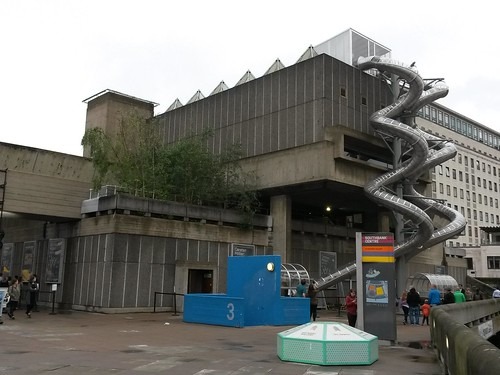
Carsten Höller: Decision is this summer’s blockbuster at the Hayward Gallery, an experimental and interactive exhibition with slides – slides! – coming out of the gallery’s roof. Intrigued, I booked a ticket for the Bank Holiday weekend.

The show is structured around the theme of “decisions”, allowing the participant the chance to choose for themselves how they will approach a particular work, and experience mind-altering sensations.

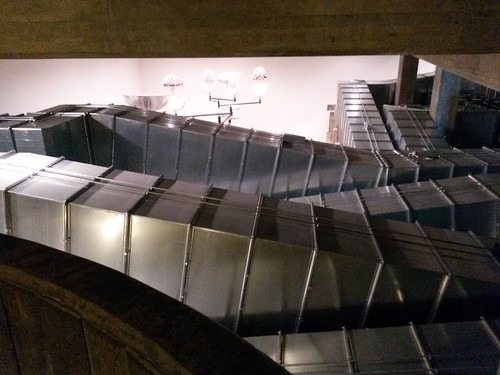
The first work, Decision Corridors, apparently had different entrances but I didn’t notice, being too concerned with getting inside. It was formed of numerous tunnels, pitch-dark inside with only occasional pinpricks of light to show the way. The photo I took later on shows just how winding these corridors are. Walking through them, with no way of seeing where I was going, was incredibly surreal.

2015_0831CarstenHoller07
Decision Corridors, seen from above

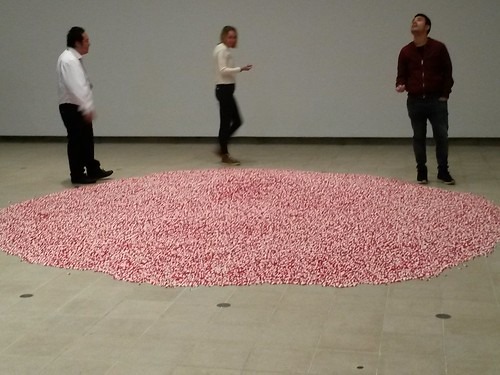
Later works included Half Clock, “the most complicated clock in existence”, and the Pill Clock, which drops a single red and white capsule onto the gallery floor every three seconds. As you can imagine, a considerable pile has sprung up by now. You are offered the chance to swallow your pill and I did so, Alice-in-Wonderland style, not really expecting anything to happen (it didn’t).

2015_0831CarstenHoller03
Pill Clock

Another work, Flying Mushrooms, incorporated models of Amanita muscaria (fly agaric mushrooms) which are red and white hallucinogenic mushrooms, famous in folklore. Here, the models have been halved and placed back together the wrong way round, and you have to push the sculpture around to move it.

2015_0831CarstenHoller02
Flying Mushrooms

The Forests was a dual-screen video with a 3D headseat and earphones, with which you could experience a snow-covered forest at night. It was surprisingly calming. In the same room were Two Roaming Beds (Grey), which sounded brilliant: “These robotic twin beds roam the lower floor of the exhibition like a pair of restless, insomniac twins.” However, hiring them for the night costs £500, so I think I’ll give them a miss.

2015_0831CarstenHoller04
Two Roaming Beds

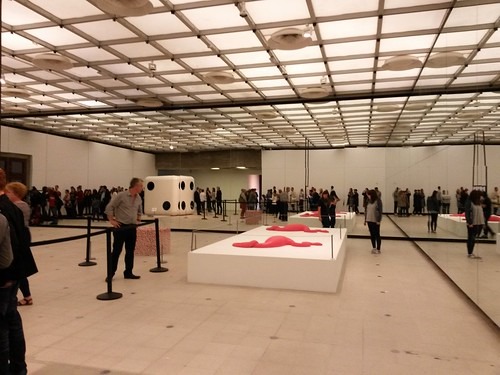
Upstairs, The Pinocchio Effect was something I didn’t look at but as it seemed to involve two people at a time, and Two Flying Machines looked like the most fun exhibition but as the queue was an hour and a half long, I didn’t bother. The Half Mirror Room and giant dice (or die) was disorientating.

2015_0831CarstenHoller06
Half Mirror Room

The Upside Down Goggles in the same room were bizarre to say the least. Without a friend to hold on to I felt odd walking around.

The final part of the exhibition – and the highlight for me – were the Isomeric Slides, “a sculpture you can travel inside and a device for experiencing a condition somewhere between delight and madness” according to Höller. Whatever the theory, it was a lot of fun to slide down to the bottom of the gallery.

I had a great time here, although I was disappointed at the number of exhibits where it seemed to be expected that you had someone else with you – what about us solo exhibition-goers? Nevertheless, it was good fun.


Revelations: Experiments in Photography – Science Museum

Revelations: Experiments in Photography is an exhibition at the Science Museum which looks at photography with a science theme over the last two centuries. Scientific photography influenced art, but was also valuable in its own right, as it was able to capture images and phenomena invisible to the naked eye.

My favourite work was Ori Gersht’s Blow Up (2007), which captured a still life in the act of exploding, a magnificent and beautiful work. However, the one with the best title was undoubtedly Chickens, scared by a torpedo (c. 1878), a picture by the photography of movement pioneer Eadweard Muybridge. Early images by photographers such as William Henry Fox Talbot were shown, alongside works by modern artists such as Harold Edgerton and Hiroshi Sugimoto; I particularly liked the former’s dynamic Bullet Through Lemon (c. 1955). However, overall I preferred the older photographs, and was sorry to see that most of the pictures in the exhibition were comparatively modern. Admittedly this is a personal preference, and the exhibition is certainly worth seeing if you have an interest in the subject matter.

Defining Beauty: The Body in Ancient Greek Art – British Museum

On Sunday I headed to the British Museum to visit the Defining Beauty: The Body in Ancient Greek Art exhibition. I got to the front gate to find a massive queue of people waiting to have their bags checked before going into the museum, so I nipped round the back and went in through the Montague Place entrance instead. Ha.

The exhibition itself was fascinating. In an era when the definition of “beauty” is constantly being challenged and debated, it is interesting to see where our beauty ideals originally stemmed from, and to be reminded that these ideals are always subject to change.

The introduction to the exhibition examined the concept that the Greeks, unlike the Egyptians and the peoples of Mesopotamia, saw nudity as both beautiful and moral. Athens in the 5th century BC was the world’s first democracy, and there was a focus on the human self in art and thought that strongly influenced conceptions of beauty. The Greeks later influenced the Romans, who admired the Greeks and often copied them.

In early Greek society there was a strong focus on the young, athletic male as the chief personification of beauty. Three students training as sculptors in Argos represented these figures; the work of Myron, Polykleitos and Pheidias showed how beauty was exemplified by order and symmetry, balance and even the use of mathematics to calculate perfect ratios. The exhibition looked at the use of colour and other materials to adorn statues: contrary to the belief that Greek statues were stark white, many had elaborate decoration.

Greek society was unique in that its gods were portrayed in human form. This led to many representations of gods and demigods reflecting an ideal human body. Herakles was one example: the son of Zeus forced to complete twelve labours in penance after killing his family was often portrayed in Greek art and sculpture, and was seen to have an ideal physique.

What of women in all this? As in countless societies throughout history, women did not enjoy equality in Greek society and were seen as passionate and out of control: it was believed that their bodies had to be hidden as they threatened the stability of male society. Therefore, nude statues of women are rarer than those of men, and statues that do exist often show drapes covering the female form. Having said that, the drapes offered opportunities for talented sculptors to show off their abilities: the draped torsos on display were incredibly detailed and superbly carved. Sometimes statues did show off the nude female body, particularly statues of the goddess Aphrodite who was often shown as though bathing. Centuries later, Roman women were inspired by Greek statues of women to commission their own versions: on display here was a statue showing the head of a Roman woman – which was probably taken from the life – on an idealised Greek body, lending the statue a somewhat incongruous appearance. This statue was actually one of my favourites as it made the ancients appear really human – the classical equivalent of PhotoShop.

Other aspects of the exhibition looked at the representation of animals and creatures, such as the Sphinx, nymphs and satires, as well as how the portrayal of children evolved from the images of them as tiny adults to individuals with particular proportions. Famous literary and philosophical figures such as Homer and Sophokles were portrayed as similar “intellectual” types, while more individual portrayals increased in popularity, such as the detailed and memorable statue of a fisherman.

Later Greek society celebrated a wider diversity of body shapes: there were statues of the old, the young, “types” belonging to the theatre and “grotesque” characters. The influence of the Ancient Greeks was spread by Alexander the Great: it can be seen in contemporary statues of Buddha in the east, wearing typically Greek drapery. The Italian Renaissance revived interest in Greek depictions of the body, though Roman copies were by then more common than Greek originals. Two statues in particular helped to influence early modern ideas about the Greek body: the Belvedere Torso (thought to represent Herakles, or possibly Ajax) and the statue of Dionysos from the school of Pheidias.

The comprehensive exhibition is open until 5 July and is well worth a visit if you can catch it before it closes. Despite only having a layman’s knowledge of Ancient Greece I got a lot out of the exhibition – it is really well thought out and displayed.

Shoes: Pleasure and Pain – V&A

My auntie and my cousin love shoes even more than I do, so when they came down to London for a few days they were determined to visit the new Shoes: Pleasure and Pain exhibition at the V&A. They invited me along too, and I was happy to accept.

The exhibition contains weird and wonderful shoes from history, fashion and everyday life, spanning the globe and a period of centuries. It displays around 200 pairs of shoes, exhibited largely on boxes with mirrrors behind to showcase the entire shoe. The shoes belonged to both men and women and were worn for all sorts of different occasions, encompassing Seventies platform heels, eighteenth century Indian wedding shoes, Fifties stilettos, tiny shoes for bound or “lotus” feet in China and moccasins from Canada. It was interesting to see how historical styles influenced more modern designers and how shoes reflected wealth and social status: for instance, fragile shoes with high heels were generally worn by the rich who lived idle lifestyles. There was a section on fetish shoes and another one for famous shoes, including David Beckham’s football boots and the ballet shoes worn by Moira Shearer in The Red Shoes.

The second level of the exhibition contained information about how shoes are made, including some very modern 3D-printed sandals. This exhibition is an absolute must-see for anyone who loves shoes.

The Red Shoes. Image courtesy of quitecontinental.net

Alexander McQueen: Savage Beauty – V&A

I visited the long-awaited Alexander McQueen: Savage Beauty exhibition at the V&A on Sunday, having luckily booked in advance for a late afternoon slot. The exhibition has sold very well, and in fact weekends have been sold out for a while, so I considered myself lucky to be able to get in.

Despite the popularity of the exhibition, I was impressed with how well it had been organised. I only had to queue for a couple of minutes, getting into the exhibition at the appointed time. The space was not too crowded: sometimes there is a tendency to cram as many people as possible into a space, even when an exhibition has limited entry, but that wasn’t the case here.

The exhibition was well set-up with strong design and themed rooms, reflecting the aesthetic of the clothes, which were displayed thematically and showcased to great effect. For instance, there was a darker mirrored room showing off the Gothic-influenced clothing, and a wood-panelled eighteenth century drawing room to display the Scottish-influenced garments.

I thought the exhibition provided a strong overview of McQueen’s work, with items from his significant collections including Widows of Culloden and Jack the Ripper Stalks His Victims, as well as his final fully-formed collection before his untimely death, Plato’s Atlantis. It explored how he used a variety of influences, including flowers, animals, other cultures and history, and emphasised the importance of tailoring in his garments. Looking at items such as the “bumster” trousers, the tailored suits and the dresses incorporating lace or tartan it’s possible to appreciate the thought and craftsmanship that went into each piece, even it’s something you wouldn’t necessarily wear yourself. Over time I’ve come to look at high fashion more as a form of art than as a representation of clothes you’d actually go out in, and this has led me to appreciate it much more. Alexander McQueen’s work is a particularly strong example of fashion-as-art as the designer used his clothes and catwalk shows to make political and cultural statements.

If you can still get a ticket, this is one exhibition which is a must see if you appreciate good design, whether or not you are into fashion.


Inventing Impressionism – National Gallery

I visited the Inventing Impressionism exhibition at the National Gallery on Sunday. Subtitled Paul Durand-Ruel and the Modern Art Market, the exhibition looks at the role of Parisian art dealer Durand-Ruel in championing and promoting the Impressionist painters. Though Impressionism is now well-respected and loved, this was not always the case – when this new kind of art first began to emerge, most critics and members of the public shunned and mocked it. Monet himself suggested that if it wasn’t for Durand-Ruel, his work and that of his contemporaries would not have flourished.

Filled with works by Renoir, Monet, Manet and Degas, as well as Rodin, Rousseau and Millet, the exhibition is incredibly impressive and it’s hard to imagine how and why contemporary critics rejected the work. Anyone attending the exhibition will surely find themselves feeling extremely grateful to this entrepreneurial art dealer.