Giovanni Battista Moroni – Royal Academy of Arts

The second exhibition I saw on Sunday was Giovanni Battista Moroni at the Royal Academy. I had never heard of this Renaissance artist before, but I found myself admiring his pictures greatly.

Moroni was the son of a stonemason and was born in Albino, north Italy, in the 1520s. During his lifetime he was acclaimed as the leading painter in Bergamo, but his reputation has fluctuated over the centuries.

Moroni preferred to paint with a representation of reality rather than create artificial, idealised portraits. As a result his pictures have insight and presence. Some portraitists of the era produced what, to me, appear as not-very-interesting pictures of the nobility, but Moroni’s paintings are different. I particularly liked his Portrait of a Lateran Canon (c. 1558) – the canon looks at the viewer with a wry smile, which led me to wonder what he was thinking! Another interesting picture is the Portrait of a Tailor (c. 1570), in which the tailor in question is full of personality.

This is a really fascinating exhibition which is definitely worth seeing. It runs until the 25th of January.

Late Turner: Painting Set Free – Tate Britain

I was supposed to be meeting a friend on Sunday, but she couldn’t make it, so I decided to go to a couple of exhibitions instead. The first was Late Turner: Painting Set Free at Tate Britain.

The exhibition covers J.M.W. Turner’s work between 1835 and his death in 1851. I adore Turner and thoroughly enjoyed looking at his later works, which give the lie to the concept that old age automatically has to mean settling down into a reactionary retirement. Turner continued to experiment and push the boundaries well into his last years, despite derision and misunderstanding from his contemporaries.

One of my favourite paintings is Rain, Steam and Speed: The Great Western Railway (1844), which is just incredible, with the train rushing towards you, the sense of movement clear within the picture. I loved seeing it here. I also loved the Roman and classical-inspired pictures with their beautiful landscapes, as well as the watercolours of the burning of the Houses of Lords and Commons. Another favourite was Peace: Burial at Sea (1842) – I thought the light on the water was beautiful.

This exhibition is brilliant, and strongly recommended – but it can get crowded, so I would suggest trying to go at a quiet time if possible.

Anarchy & Beauty: William Morris and his Legacy – National Portrait Gallery

I went to see Anarchy & Beauty: William Morris and his Legacy at the National Portrait Gallery last Friday after work. This exhibition aims to explore the life and ideas of Morris, who was an artist, writer, socialist and visionary thinker.

The exhibition was interesting, but I thought it focused too little on Morris himself and too much on his contemporaries and those whom he inspired. Books, ceramics and artworks by people such as Eric Gill, Terence Conran and Dante Gabriel Rossetti were interesting in their own right but moved the focus away from Morris. I did like how the exhibition highlighted Morris’ concept of “art for the people” and his Socialist sympathies.

Overall, a good exhibition to visit if you want an overview of William Morris’s life, contemporaries and followers, but not if you are particularly interested in Morris himself.

Bridge – Museum of London Docklands

Bridge is a free exhibition at the Museum of London Docklands, exploring the history of London’s bridges in art and photography. I loved looking at the black and white Victorian photos, the Sixties images full of miniskirts and retro cars, and the more modern video in which an artist travelled by boat right down the Thames, going under each bridge in turn.

Dennis Hopper: The Lost Album – Royal Academy of Arts

Dennis Hopper: The Lost Album is the exhibition that opens the Royal Academy of Art‘s new Burlington Gardens space. It includes photographs by Dennis Hopper, an actor who shot to fame with roles in films such as Apocalypse Now, Easy Rider and Blue Velvet. I have to admit that I had never heard of him – either as an actor or as a photographer – but I thought that the exhibition, covering the life of the star in the 1960s, would be an interesting one.

It certainly is fascinating to explore the world of American life and culture in the 1960s, one of the most momentous decades for social and political change in history. The pictures capture the worlds of Hell’s Angels and hippies, the Civil Rights movement, stars of film, fashion and music, and the urban landscapes of the US.

Unfortunately though, the exhibition was incredibly expensive and I don’t honestly feel that it was worth it. RA exhibitions are expensive anyway, but I normally feel as if a lot of work has gone into them. These photographs were presented with little explanation and few captions. I don’t feel that the exhibition was worth the price paid, even though I did enjoy it. If you do think you might be interested, the exhibition closes this weekend so hurry.

The Queen’s Gallery

The Queen’s Gallery, an art gallery I have visited many times over the years, is part of Buckingham Palace and can be visited in conjunction with the State Rooms and the Royal Mews (stables). However you can also choose to visit the Gallery alone. It puts on around three exhibitions a year and is open all year round unlike the State Rooms and the Royal Mews which are open during the summer season only.

If you buy your ticket direct (either online or in person) you can get it stamped at the end of your visit which makes it valid for a whole year. This is great value as it means you can go back to subsequent exhibitions at the Gallery. It’s worth noting that the summer months are very crowded and it might be difficult to visit with your ticket at these times, as timed tickets are normally on sale for this period.

This year-long validation does not apply if you buy your ticket from a third party. This may not matter to you if, for instance, you are coming from a different part of the country on a trip as you may not be able to return within a year. For someone like me, however, who lives in London, this is ideal.

*Location*

The Queen’s Gallery is located on Buckingham Palace Road next to Buckingham Palace itself. If visiting by tube, Green Park station (near Piccadilly Circus) is a short walk away and the route through the park is very scenic. If you are coming from the other direction, Victoria Underground and National Rail station is almost directly south from the Gallery. Tour buses and normal red buses also stop outside. The Gallery is clearly signposted and is next to the Royal Mews.

*Security*

As might be expected, security is very tight here owing to its proximity to Buckingham Palace. You have to undergo a bag search and walk through an airport-style scanner. However all the staff are very friendly and cheerful and didn’t make me feel uncomfortable during this process. The gift shop is right next to the ticket desk so you can visit without paying for admission. After buying your ticket and walking through security you get to the gallery itself. There is a free cloakroom where coats and heavy bags can be left – we took full advantage of this. Toilets are available too and these are clean and smart.

Audio guides are available, but I didn’t bother with one. Photography for non-commercial purposes is permitted, but not flash photography.

*Gift Shop*

The shop is well-stocked and sells the usual Royal memorabilia, some of it tat and some of it in rather better taste. A number of items relating to this particular exhibition were available, ranging from cuddly penguins to a glossy photography book. I bought some postcards, which I rather regret as they were quite expensive – £5.95 for a pack of ten – but then I was very interested in the subject matter and I have a mind to frame them and put them on my wall!

*The First Georgians*

The exhibition I visited on this occasion was The First Georgians: Art and Monarchy 1714-1760, marking 300 years since the accession of George Ludwig, Elector of Hanover in Germany, to the British throne as George I. He was the first constitutional monarch, and began a long-enduring dynasty which lent its name to the Georgian era. The first room of the exhibition puts faces to names with paintings of the key players in the royal family, such as the three Georges and Queen Caroline.

The exhibition goes on to look at some of the things for which the age was noted, such as the art of William Hogarth, china, silverware and trinkets from “toy-shops”, as well as furniture, sculpture and paintings by the Old Masters. There were plenty of architectural designs and plans for royal residences including St James’s Palace, Windsor Castle, Kensington Palace and Hampton Court, as well as artefacts from less savoury aspects of the age, including military maps and items to do with Culloden and other Jacobite risings.

FACTS

Address: Buckingham Palace, London, SW1A 1AA

Website: royalcollection.org.uk/visit/the-queens-gallery-buckingham-palace

Opening Hours: Approx 10am-5.30pm during exhibitions

Prices: £10 adult, £5.20 child

Constable: The Making of a Master – V&A

Constable: The Making of a Master is the new exhibition looking at how the great artist created his works. The exhibition, which is held at the V&A, examines his influences, inspirations and work processes. Much of this would, I think, be particularly interesting to those with an art background; however, there is still plenty for the non-expert to appreciate.

The perception of Constable is of a solely “natural painter”, however this interpretation does not stand up in his later paintings which mark more of a retreat from naturalism. The artist had a reverence for the Old Masters and was strongly influenced by them; artists he revered included Raphael, Reubens and Claude Lorrain. He made copies of their paintings, some of which are almost indistinguishable from the originals, and collected prints of other artists’ work throughout his life.

Constable’s most famous works such as The Hay Wain (1821), The Leaping Horse (1825) and my personal favourite Salisbury Cathedral From the Meadows (1831) are displayed, and it is fascinating to see how he worked on and developed these pictures. He would start with small black and white sketches, followed by large, full-size colour sketches, before attempting the finished painting.

Before I saw this exhibition I vaguely thought of John Constable as someone who painted slightly dull, traditional English landscapes. After seeing this exhibition I realise I need to revise my assessment somewhat.


Anselm Kiefer – Royal Academy of Arts

At the weekend I attended the Anselm Kiefer exhibition at the Royal Academy of Arts. The German artist has been described as a “colossus of contemporary art”, and I decided to go and see for myself.

The exhibition really begins before you even enter the RA, with “Velimir Khlebnikov: Fates of Nations: The New Theory of War” on display in the courtyard. It consists of two large glass vitrines containing model submarines. It’s a melancholy, imposing work, inspired by the Russian Futurist figure Khlebnikov, who came to the somewhat bizarre conclusion that a major sea battle took place every 317 years (or multiples thereof).

2014_0928AnselmKiefer02

2014_0928AnselmKiefer01

Inside, another of Kiefer’s sculptures is on display before you reach the exhibition: “Language of the Birds” (2013) is made up of books, folder chairs and a pair of wings. It looks like it is about to take off. The sculptures (including “Ages of the World” in the exhibition itself) were in fact my favourite thing about the exhibition: they have an impressive looming quality about them.

The rest of the work I wasn’t so sure about. I admired Kiefer’s attempt to confront the reality of Germany’s history; his early work involved painting himself wearing his father’s German army uniform in a series ironically entitled “Heroic symbols”. He aimed to reclaim the idea of the artist from the Nazis, a concept which had been tainted by the emphasis on Hitler as an artist. I also liked a painting which re-enacted a Nazi naval attack inside a standard-issue tin bath, a commentary of the ludicrousness of the war.

Other works included watercolours, books, three-dimensional pictures and installations, using materials as diverse as greenery, lead, diamonds and wood. Paintings made use of myths, symbols, landscapes and architecture. The exhibition was varied in subject, but there was a recognisable style running through all of Kiefer’s work.

Overall I don’t think that this art is really for me, however I feel I learned something from it – I certainly wouldn’t call it a wasted experience.

The Human Factor: The Figure in Contemporary Sculpture – Hayward Gallery

When I came out of the Tate Modern, I decided that as it was such a nice day I would walk along the Thames Path to the Southbank Centre. After a frozen yogurt from the pink Snog bus, I headed into the Hayward Gallery to see The Human Factor: The Figure in Contemporary Sculpture.

In general, I find that I tend to prefer older art (from the nineteenth century and earlier) to modern paintings and the like. However, I feel rather differently about sculpture. In my (completely uneducated) opinion, it gets a bit dull looking at yet another white marble figure, so the way in which modern sculptors use different materials to create imaginative and radical art is much more appealing to me. For this reason, I was looking forward to The Human Factor, which brings together new work from 25 international artists who use the human form in new and exciting ways.

There was an incredible array of sculpture on display, from Thomas Schütte Krieger’s huge statues, made of wood which has been coloured and oiled, battle scarred and contorted, to Paloma Varga Weisz’s double-headed “Falling Woman”. Cathy Wilkes’ untitled sculpture of 2011 shows a disturbing tableau of contorted figures surrounded by battle equipment, while Maurizio Cattelan has created a frighteningly lifelike representation of John F. Kennedy in his coffin. Figures have been cast from wax, formed from mannequins with added material, sculpted from bronze and given a beehive for a head (the latter is Pierre Huyghe’s 2012 creation – the first and, probably, only time I will ever see a sign warning that “The following exhibition contains live bees”). Jeff Hoons’ “Bear and Policeman” of 1988 shows a giant teddy bear towering over a rotund policeman, while Martin Honert’s unsettling sculpture of his former English teacher recreates the shadows of the black and white photo from which the image was taken. Other sculptures evoke living statues, of the kind you see in Covent Garden surrounded by tourists – it is surreal to view statues of people pretending to be statues. Mark Wallinger’s “Ecce Homo” of 1999 displays a man with a shorn head and a crown of thorns – an allegory of persecution.

Even with the breadth of sculpture on offer, I still managed to find favourites. One, entitled “Tell my mother not to worry”, is a marble sculpture of the artist’s four-year-old daughter disguised as a ghost. This is achieved by the sculpting of a white sheet which trails along the ground, with extremely realistic folds; it suggests that there really is something underneath.

This piece was by Ryan Gander, as was another of my favourites, a “re-imagining” of Degas’ Little Dancer. You see an empty plinth ahead, then turn to the right to see the dancer on tiptoe, staring out of the window. The sculpture is easily recognisable as the Degas character, and I liked the attempt to suggest that she had her own autonomy and views.

My final favourite piece probably made the strongest impact on me. Located in a small room by itself, Maurizio Cattelan’s “Him” is a kneeling schoolboy figure with his back to the entrance, hands clasped in an attitude of prayer. As you approach and turn to see the boy’s face, however, you see he is not a boy at all, but Hitler. This discovery raises more questions – what is Hitler praying for? Is he seeking forgiveness for his past actions? Or is he asking for help to continue his evil plans?

I loved this exhibition and I think there is something for everyone here. The Hayward Gallery always tries to show something different; it doesn’t always succeed, but it has done so here.

2014_0823HaywardGallery
This is Kev. He is at the entrance to the Hayward Gallery and his clothes are changed every day of the exhibition!

Malevich: Revolutionary of Russian Art – Tate Modern

2014_0823Tate01
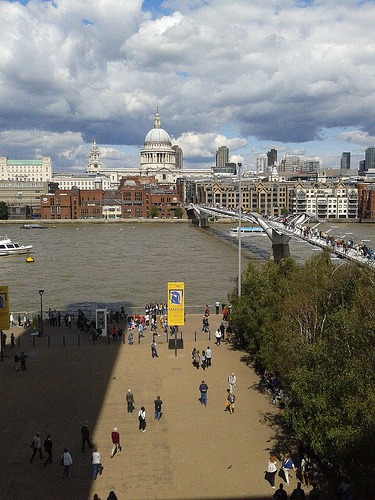
View of the Thames from the Tate Modern

On Saturday I attended a performance of Muse of Fire at the Globe. Afterwards I decided that, as I was right next to the Tate Modern, I would go in and see their new exhibition, Malevich: Revolutionary of Russian Art.

Kazimir Malevich (1879–1935) was an influential and radical artist whose work spanned one of the most eventful periods of Russian, and world, history. This retrospective examines his life’s work, which culminated in his most famous example of suprematism, the Black Square. I must admit I might not have seen the significance of this work, if I hadn’t discovered that it had been banned by the Soviet authorities. Anything deemed worthy of banning surely has some merit. In fact, when I actually saw the picture, I found it strangely compelling and unsettling, like a black tunnel, or a void. I could never have anticipated reacting like this to such a painting.

Suprematist work was, however, only one facet of Malevich’s work as an artist. Over the course of his life he explored landscape, religious painting and images of Russian workers, in both figurative and abstract styles. His range and versatility is clearly on show in this rich exhibition.

The exhibition runs until 26 October.

2014_0823Tate02
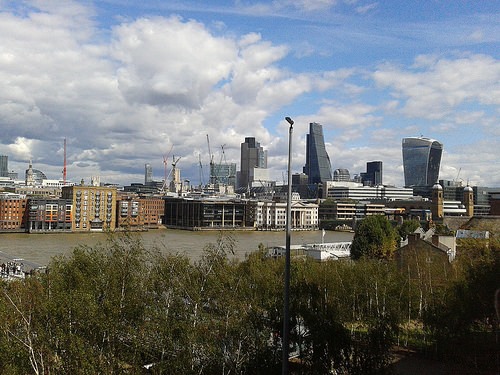
View of the Thames from the Tate Modern