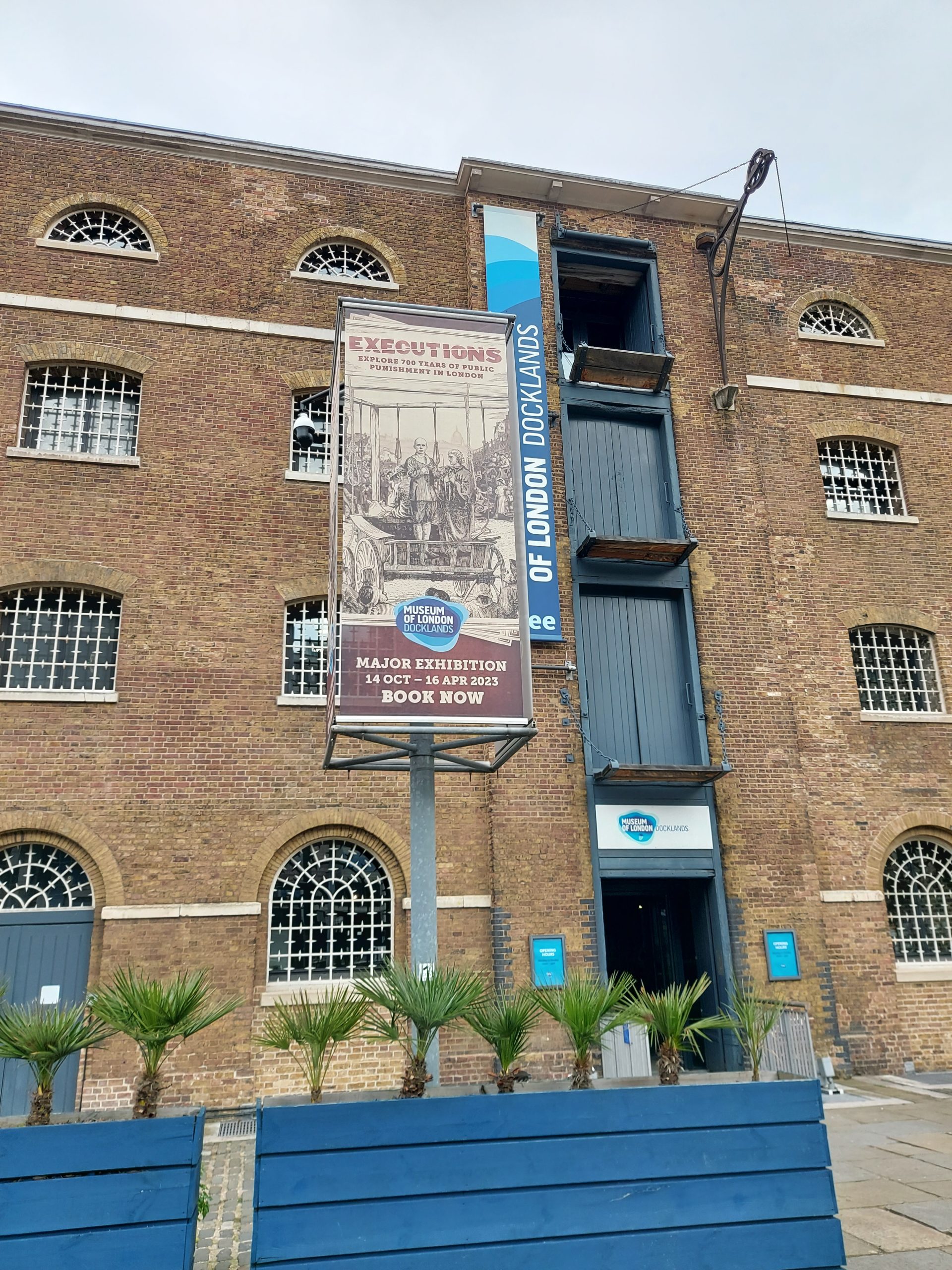
Executions – Museum of London Docklands

Museum of London Docklands

I visited the Museum of London Docklands to check out the Executions exhibition before it closed. The exhibition looked at the impact that capital punishment had on the history and landscape of London over the last few centuries.

The first public execution took place in 1196, the last in 1868. During this time, these killings – supposedly meant to act as a deterrent to crime – were watched by huge crowds of people. An ‘execution economy’ developed, which was often bloodthirsty and rather chilling. As one map shows, executions became built into the very fabric of London. One of the most famous prisons, from which many prisoners were executed, was Newgate, relics from which are interspersed throughout the museum.
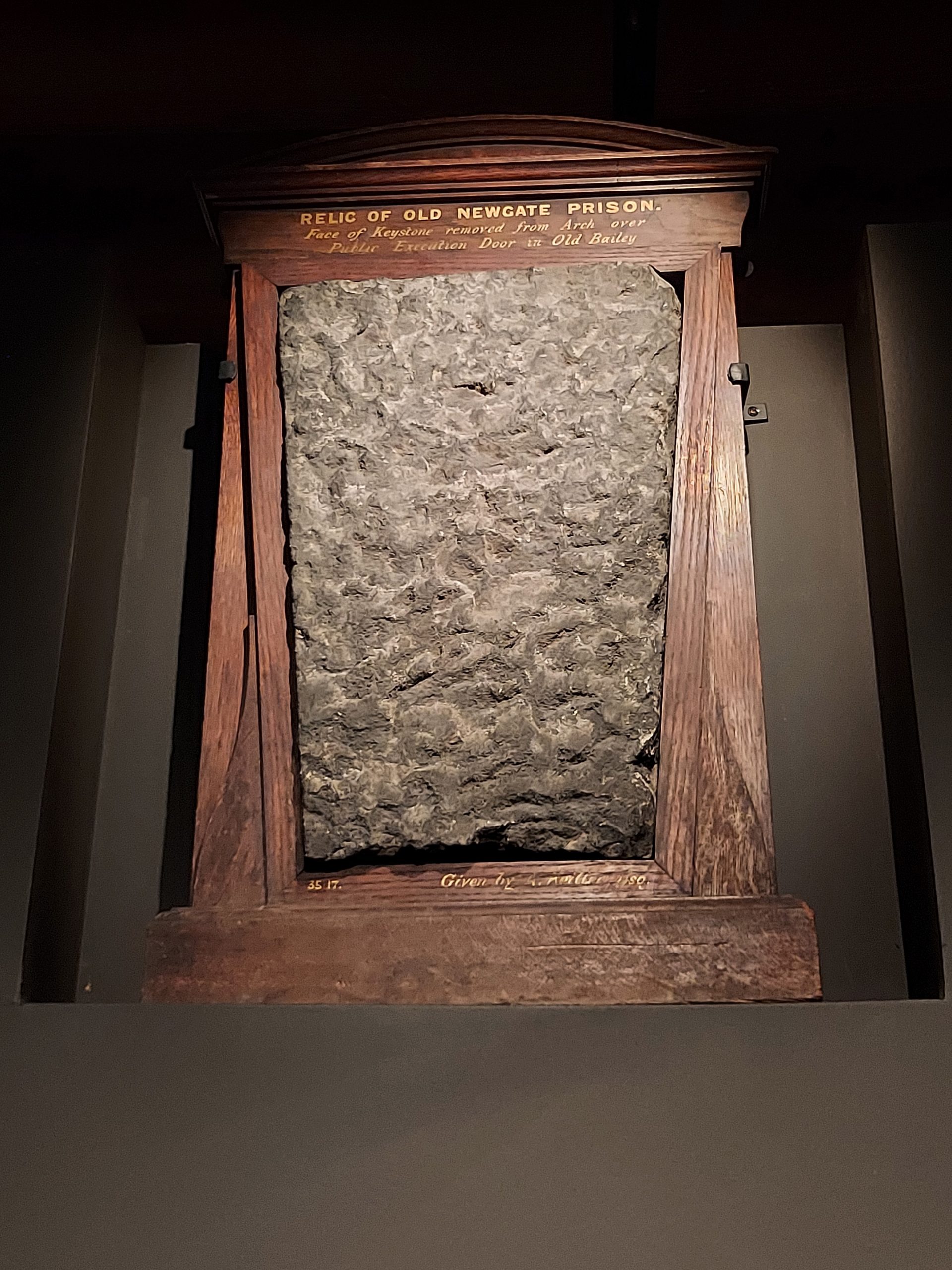
Stone from Newgate Prison

By the end of the eighteenth century, more than 200 crimes were punishable by death. Deaths were ordered in London’s courts more often than the courts of the rest of the country combined. Ballads were written about condemned criminals, papers detailing their horrific crimes did a roaring trade, and puppet shows made fun of executions.
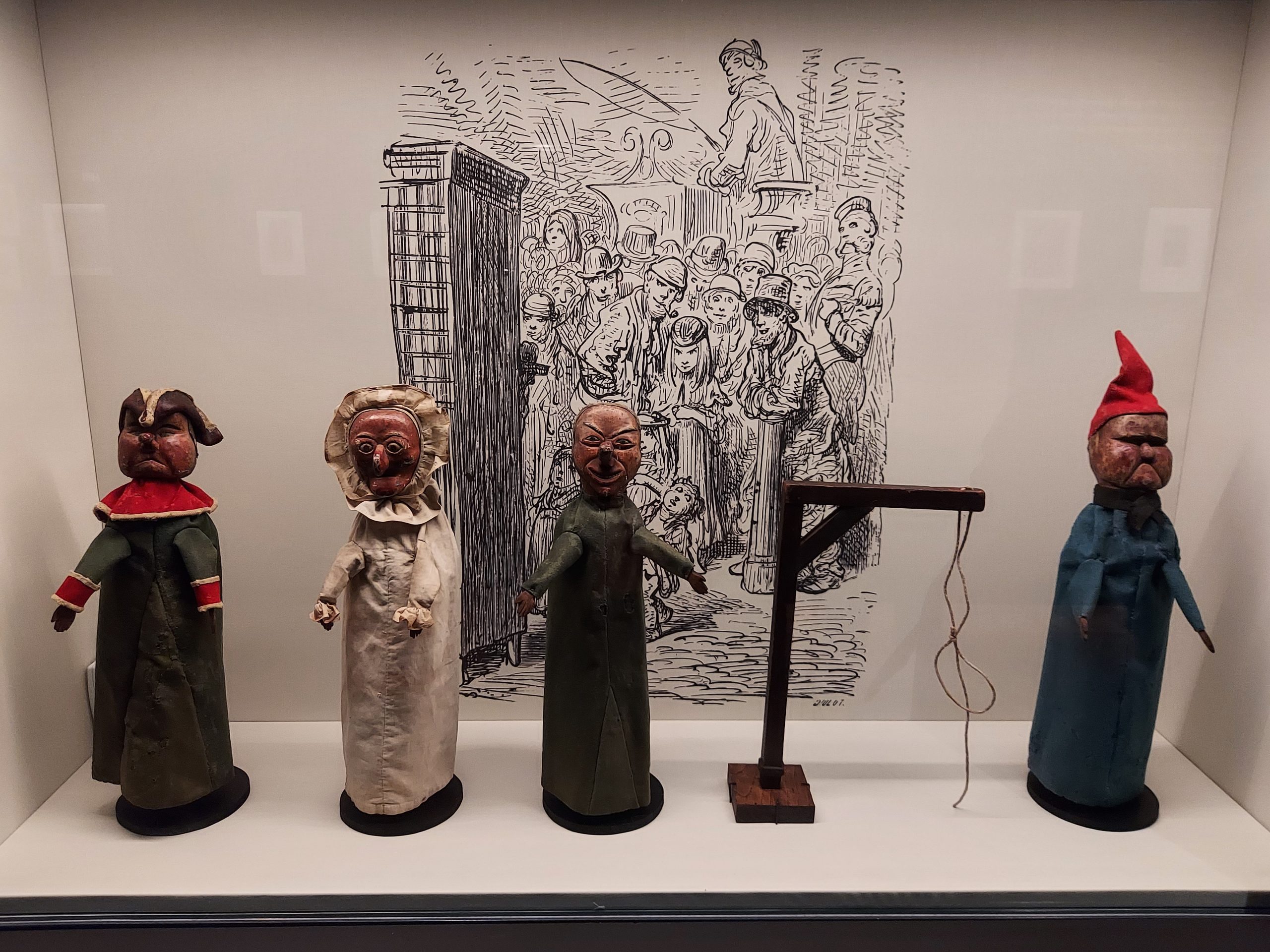
Execution-themed puppets

Methods of execution were not limited to hanging. Traitors were hung, drawn and quartered. Members of the nobility were usually beheaded, while heretics were often burnt at the stake. The exhibition included many letters and pleas for clemency from criminals, which brought home the human aspect to this grisly history.

Possibly the most famous execution in London took place when Charles I was beheaded in 1649. The exhibition displayed one of the shirts he supposedly wore at his execution.
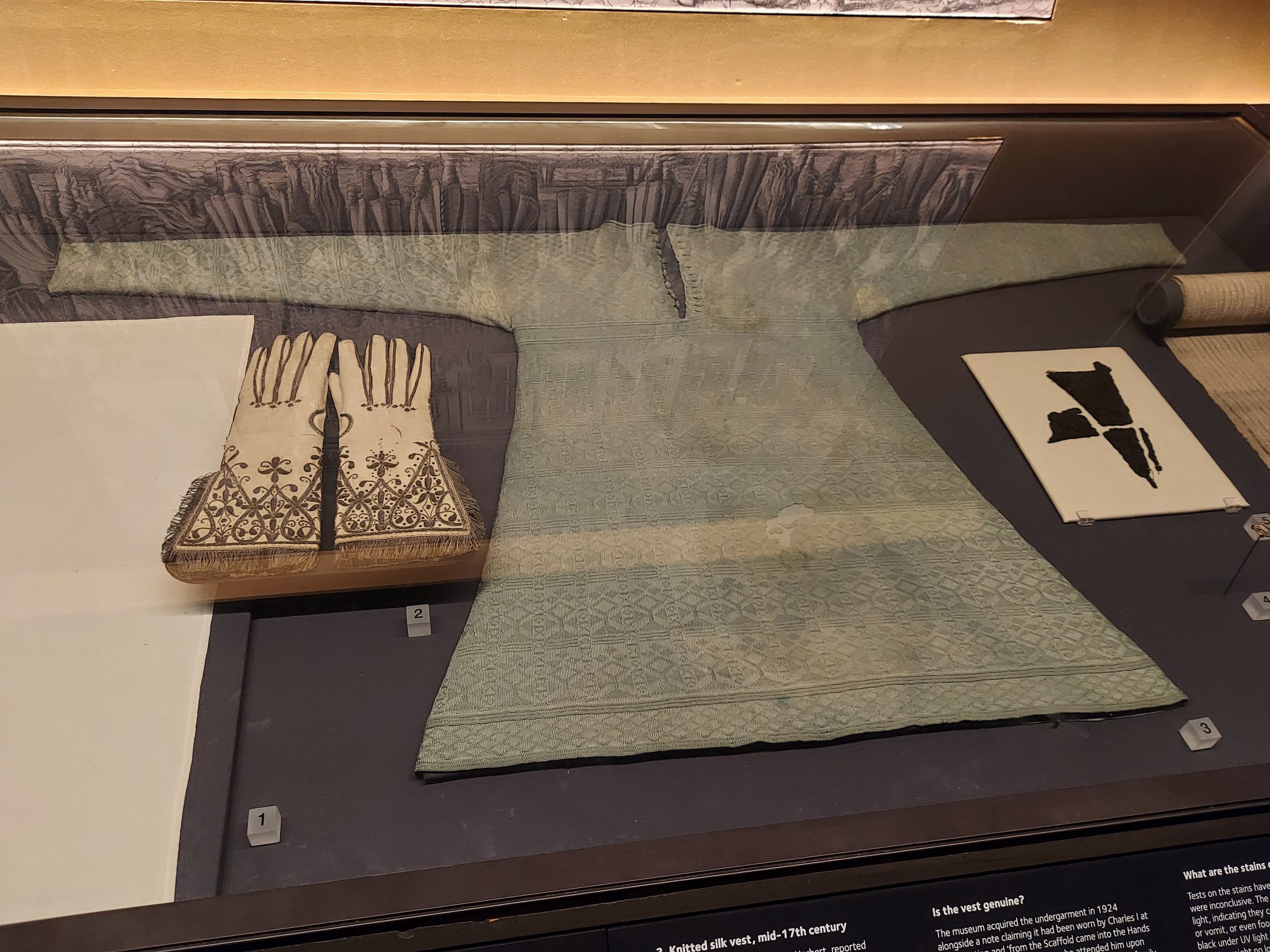
Charles I's supposed execution clothes

The exhibition was possibly not for the faint-hearted, but it was sensitively done and certainly worth seeing. It’s important that we confront the most unsavoury and difficult aspects of our past, and the exhibition certainly managed that.
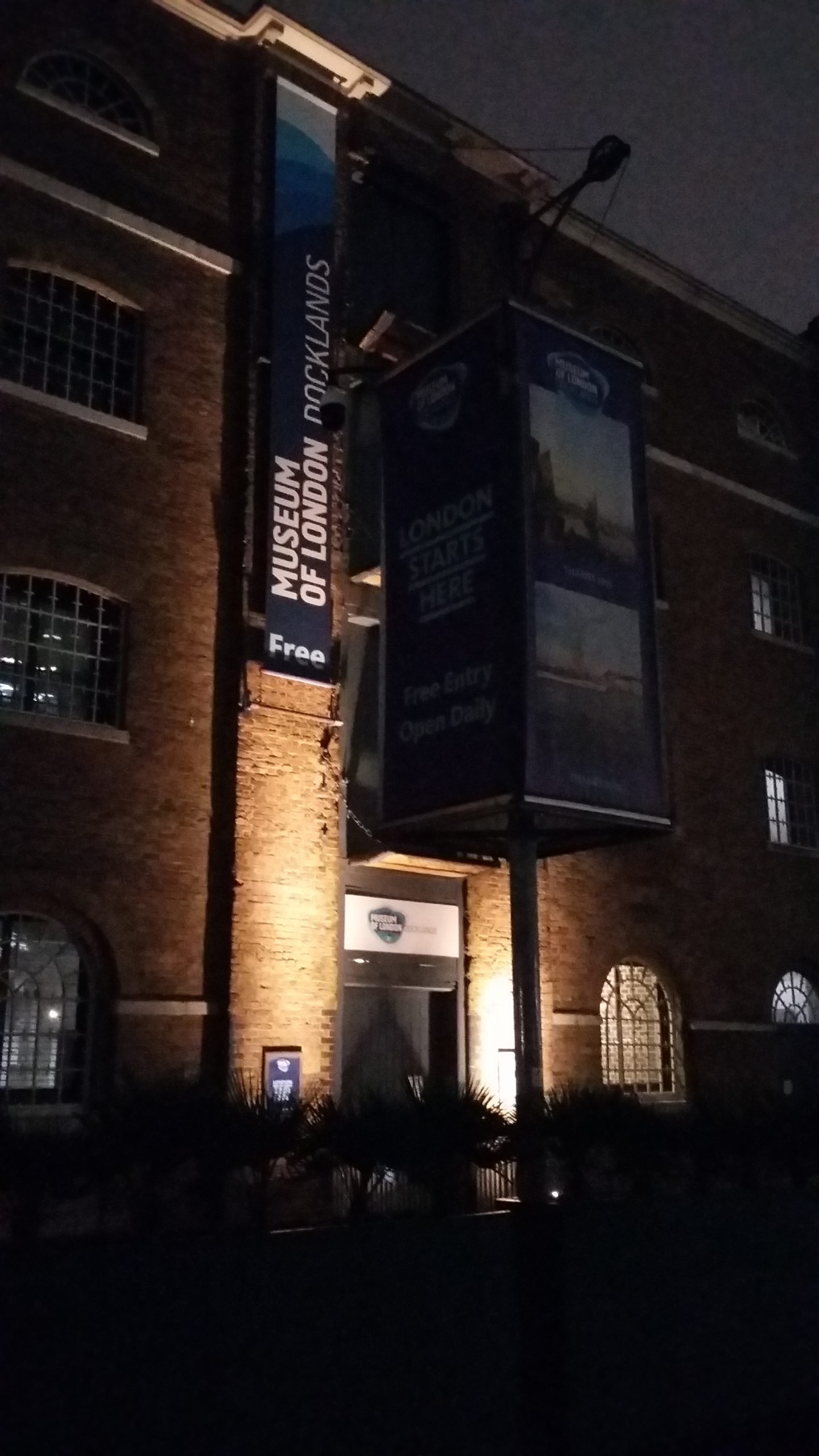
Docks After Dark – Museum of London Docklands

Museum of London Docklands entrance

The Museum of London Docklands hosts, during the winter months, after-hours ghost tours, known as Docks After Dark. I signed up for one of these taking place in February, and despite the pouring rain, was excited to arrive.

The museum is contained within a former shipping warehouse and therefore has a rich history. After dark, with so few people around, it is especially atmospheric. After a short wait in the foyer with a glass of wine and nibbles, we were taken round the museum to be regaled with stories of the ghosts that are supposed to inhabit this place, starting with the staircase, on which security guards and other museum workers are supposed to have heard ghostly footsteps, and ending on the top floor where unexplained faces have been seen. The most memorable part of the visit was when we were taken into the cramped recreation of the infamous Ratcliffe Highway, and told stories of things that happened on this notorious street, such as the murders of 1811.

I don’t want to give away too many of the stories told this evening, but I would definitely recommend signing up for one of the tours when they return.

Secret Rivers – Museum of London Docklands

Secret Rivers exhibition

I managed to catch the Secret Rivers exhibition at the Museum of London Docklands on its very last day. The exhibition looks at the history of several of London’s hidden rivers, many of which have been covered over, re-routed or used for other purposes.

First to be examined was the Walbrook, which flowed through the heart of the City of London. This river was often used for ritual (the Temple of Mithras, which I’ve previously visited, was nearby), and the items found in it bear witness to its role at the centre of life in Roman times.

Secondly, the most famous lost river, the Fleet, was explored. This river was located outside of the City, and as such originally played a role at the heart of rural life, before an increasingly dense population helped to pollute the river (during the fourteenth century, people used to build houses with toilets extending out over the river, so that waste would drop directly into it – one of the items recovered from the river was a three-seat medieval toilet). Eventually it was covered and used as a sewer, though you can still swim in the Fleet up at Hampstead, where the outdoor pools are filled with water from this river.

From here, the exhibition explored the contrasting ways in which rivers were used. The Neckinger in Bermondsey, for instance, was heavily polluted and had several mills along its banks, while the Westbourne in west London was used to create the ponds in Hyde Park. The Tyburn, now covered over, has been the subject of a campaign to restore it and use it for fishing, while the Wandle has been uncovered at several points, making it a haven for wildlife. There is also the Lea, still used for recreational activities and transformed towards central London by the construction of the Olympic Park.

Finally, the exhibition looked at the works of art that have been inspired by the hidden rivers. Of particular interest to me were the various books, which I plan to seek out in the future.

Tunnel: The Archaeology of Crossrail – Museum of London Docklands

When my mam came to visit me in London, I decided to take her to visit the Tunnel: The Archaeology of Crossrail exhibition at the Museum of London Docklands. The Crossrail tunnel, due to open in 2018, is the largest engineering project in Europe and its construction has provided archaeologists with a unique opportunity to excavate a huge stretch of London, encompassing thousands of years of the capital’s history. Curator Jackie Kelly has described it as the “biggest piece of London archaeology ever” in terms of the project’s sheer scale. The initial results of the excavation are being presented in Tunnel.

The objects on display in the exhibition range from reindeer bones gnawed by wolves 68,000 years ago to flakes chipped from a flint axe 8,000 years ago, from victims of the Black Death to Victorian chamber pots and Crosse & Blackwell marmalade and pickle jars. One skeleton is particularly poignant as it is of a Roman woman whose skull was buried between her legs. A large pot, full of cremated human bones, dropped out of the roof of one of the tunnels, but was luckily caught by a member of the tunnelling team.
Another fascinating item is a leather shoe dating from the fifteenth or sixteenth century.

My favourite items from the exhibition came right at the beginning and right at the end. As you enter the exhibition, you see a statue of St Barbara, patron saint of artillery, explosives and mining. She was originally installed at the entrance to the tunnel and workers liked to touch her as they ventured underground at the start of a shift. I like her because my mam’s name is Barbara. I like to think that my dad married her because on some subconscious level he knew about St Barbara and felt that my mam would be good luck (he comes from a mining family). I’m sure this is a load of rubbish really, but its a nice story!

The second thing I loved was the book of photographs at the end of the exhibition, showing the corner of Charing Cross Road, Oxford Street and Tottenham Court Road before the Crossrail work began. I work near this area and so I’m really interested in it, but I don’t remember what it was like before the work began. These pictures display the old streets in all their glory, along with the famous music venue the Astoria which I don’t remember at all but which I can’t help regretting the loss of.

The exhibition, which is thoughtfully put together, is free to enter and runs until 3 September 2017 at the Museum of London Docklands.

Bridge – Museum of London Docklands

Bridge is a free exhibition at the Museum of London Docklands, exploring the history of London’s bridges in art and photography. I loved looking at the black and white Victorian photos, the Sixties images full of miniskirts and retro cars, and the more modern video in which an artist travelled by boat right down the Thames, going under each bridge in turn.