Samuel Pepys: Plague, Fire, Revolution – National Maritime Museum

Samuel Pepys (1633-1703) lived through some of the most dramatic events of the seventeenth century. He witnessed at a young age the beheading of a king, followed by a republic, then the Restoration and two coronations; not to mention the Great Plague of 1665 and the Fire of London in 1666. A republican who served under the monarchy, a lover of wine, women and song who nevertheless condemned the licentiousness of the royal court, a President of the Royal Society who admitted that he often did not understand science, and a naval administrator who, when he joined, knew nothing about the sea, Pepys strikes me as a sympathetic character, an ordinary man who to a large extent made it up as he went along and was able to succeed by adapting himself to circumstance and making an effort to learn.

The Samuel Pepys: Plague, Fire, Revolution exhibition, which uses the witty hashtag #PepysShow, explores the history of Pepys’ time in his own words, alongside artefacts and records from the period. He has been called the greatest diarist in the English language; his diary is notable for recording everyday details as well as major events, which have allowed historians to understand what daily life in the seventeenth century was like. Pepys actually kept his diary for ten years only, between 1660 and 1669; he stopped because he feared his eyesight was being affected. However, we have other ways of learning about his life, such as his letters.

The exhibition follows a largely chronological format, beginning with the beheading of King Charles I, witnessed by a young Pepys. We learn about the life-threatening and excruciatingly painful operation he underwent to remove a bladder stone, and his marriage to Elisabeth de St Michel. Pepys’ everyday life is explored in displays relating to music and theatre, both of which he enjoyed, especially after the Restoration when theatre was once again permitted and encouraged.
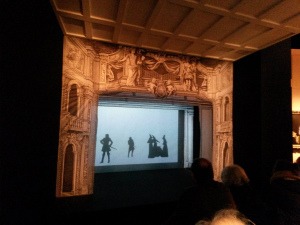
2016_0312PepysShow
Representation of the Restoration theatre

We learn about the Great Fire from Pepys’ detailed account, as well as his wife’s illness and death. Later, Pepys was active in the Royal Society and became its President; interestingly, I learned here that Newton’s seminal Principia Mathematica was only published thanks to a donation from Edmund Halley, as the Royal Society had just spent its entire book budget on a History of Fishes.

One of the most impressive items in the exhibition is the eighteenth century court dress, which is in fantastic condition especially given its age. I also enjoyed looking at other artefacts from the period, including early editions of books. The last part of the exhibition explores the publication history of Pepy’s diary: several individuals transcribed them into plain English (from the shorthand in which they were written) during the nineteenth century but it wasn’t until the 1970s that the full, unexpurgated edition – containing references to Pepys’ various liaisons – was published.

The exhibition runs at the National Maritime Museum until 28 March, and it is well worth visiting if you are at all interested in this period of history.

Black Georgians: The Shock of the Familiar – Black Cultural Archives

2016_0227BCA01 2016_0227BCA02

The Black Cultural Archives were founded in 1981 and a dedicated heritage centre in Brixton was opened in 2014. I visited in order to attend the latest exhibition, Black Georgians: The Shock of the Familiar.

This free exhibition looks at the lives of black people during the Georgian period (1714-1830). I have to admit that although I love history, and have a history degree, I don’t really have any knowledge or understanding of the lives of black people in Britain. The exhibition shows that people of African origin, who had lived in Britain for centuries, were growing in number and were starting to establish a distinct presence in society.

The exhibition looks at the lives of black people who lived in Britain under different circumstances: some were enslaved and worked as servants, others were free and were either born in Britain or chose to settle here. A few even had private incomes, and became the first black bourgeois. In many ways their circumstances mirrored those of white Britons, with members of all social classes carving out lives for themselves, although black people had to contend with racism and oppression in addition to any other problems they might face. The picture is much more complex than my limited knowledge had previously led me to understand.

Evidence for these lives comes from various documentation, including pictures, letters and other writings. Phillis Wheatley is one individual whose life is explored in the exhibition: sold as a servant in Boston aged seven, she was recognised as having particular intelligence and given an education; she subsequently became the first African-American woman to publish poetry, and was treated as a celebrity when she first visited London in 1773. Ignatius Sancho was a writer and composer, the first known black Briton to vote in an election, while Tom ‘The Moor’ Molineaux was a famous sportsman. Evidence for the existence of “ordinary” black people is found in census records, on gravestones, even in art: the inclusion of a black man in one of Hogarth’s pictures suggests that the presence of black people on London’s streets was a normal occurrence.

This is an important exhibition for anyone wanting to understand the lives of black people in Britain during the Georgian period, and anyone interested in social history as a whole.

FACTS

Address: Windrush Square, Brixton, London, SW2 1EF

Website: bcaheritage.org.uk

Opening Hours: Tues-Sat, 10am-6pm. Late opening until 7pm, every second Thursday of the month.

Prices: Free

The Lost World of the Georgian Chocolate House – Guildhall Library

I love history and I love chocolate, so deciding to attend The Lost World of the Georgian Chocolate House was a no-brainer. This talk, which took place at Guildhall Library, was delivered by Dr Matthew Green, whose book London: A Travel Guide Through Time was released before Christmas and whose company, Unreal City Audio, organises immersive historical tours around London.

The talk covered the beginnings of chocolate’s popularity in the Western world: Spanish explorer Hernan Cortes found hot, spicy chocolate being drunk by South Americans and the popularity of the drink extended to Baroque Spain, and later Italy. Cosimo de Medici, an Italian nobleman, was possibly the first chocoholic, and the drink retained its aristocratic connotations as it travelled first to France, then to England. Chocolate at this time contained several unfamiliar ingredients: in South America it was often mixed with blood, but luckily this practice did not survive the journey across the ocean. In Europe, it often contained musk or ambergris; sometimes even gold.

Chocolate houses in London were heavily influenced by coffee houses and tobacco houses – in fact the first chocolate was sold in coffee houses. The first chocolate house in London was established either in Vine Court, Holborn, in 1652 (as evidenced in a contemporary tract, Chocolate, or An Indian Drinke) or on Bishopsgate Street in June 1657 (as advertised in the Publick Advertiser).

The popularity of chocolate in London is largely tied up with the St James area. St James’s Square was laid out by Henry Jermyn, and several chocolate houses were located there or nearby: Cocoa Tree, Ozinda’s and White’s. Chocolate houses became associated with gambling, with aristocrats losing fortunes in games of Hazard. Hogarth’s Rake’s Progess contains a scene in a chocolate house, showing the artist’s disapproval of such dissolute practices. There is an account of a man who collapsed in the street outside of White’s chocolate house: he was taken inside, but instead of seeking medical help, the chocolate drinkers began to place bets on whether he was dead or alive. Betting on all sorts of outcomes was common in chocolate houses: this period sees the beginnings of life insurance, as people would bet on how long they – and others – had left to live. Chocolate houses were largely the preserve of men: women would send their children into the houses to seek out their husbands and tell them to come home, but this backfired on at least one occasion, when a small child ran into the chocolate house, fell into a vat of chocolate, and drowned.

Like coffee houses, chocolate houses were connected with political activity. Cocoa Tree in particular was known as a Tory stronghold and a Jacobite centre. It was often raided, and even had an underground passage to a Piccadilly tavern to allow members to escape. Ozinda’s was known for its art auctions, but White’s, the most famous chocolate house, was the most notorious. It burned down in 1733, and White’s Club is now on the site. From the middle of the eighteenth century, most chocolate houses did evolve into private members’ clubs. To date, most British prime ministers have been members.

After our talk, we were given a chance to sample some eighteenth-century style chocolate. I’m not sure exactly what ingredients were used (although I’m pretty certain blood wasn’t one of them), but the chocolate was delicious, if not quite sweet enough for my taste, being thick, rich and full of flavour.

The talk was fascinating and I definitely want to go on the Chocolate House Tour, as well as other tours organised by Unreal City Audio!


Havering Museum

2016_0123HaveringMuseum02

On the same day as I visited Redbridge Museum, I headed further east along the TfL Rail line (soon to be Crossrail) and ended up in Romford, where I popped into Havering Museum. This museum opened in 2010, on the site of the old Romford Brewery, and seems to be popular: a map in the foyer shows the location of various visitors, some of whom have visited from all over the world, including Russia and Indonesia.

The museum explores the history of the London borough of Havering, with the main exhibition spread across two rooms. Rather than being arranged in chronological order, the displays are divided by town: so Romford, Havering-atte-Bower, Rainham, Hornchurch and Upminster all get their own section. This is a different but interesting way to arrange the displays. Each section also has its own information sheet, so rather than being overwhelmed with information during your visit, you can take home the sheet and read it at your leisure.

I learned some interesting things during my visit: Romford was originally a Roman staging post called Durolitum, on the road from London to Colchester. The Golden Lion pub by the marketplace has existed since 1440, and is said to have been visited by Dick Turpin. The museum has an interesting selection of artefacts associated with the town.

When I visited, the temporary exhibition room was hosting paintings by a local artist, and there was also a travelling exhibition, Pop It In the Post by the National Postal Museum, including two examples of early pillar boxes.

I was very impressed with my visit to Havering Museum, which struck me as being a cut above most local museums, well laid out and with very friendly and enthusiastic staff. Definitely worth a visit if you’re in the area.

FACTS

Address: 19-21 High Street, Romford, RM1 1JU

Website: haveringmuseum.org.uk

Opening Hours: 11-5 Wed-Sat

Prices: £2.50 adults, £2 senior citizens; children free

Celts: Art and Identity – British Museum

The Celts: Art and Identity exhibition at the British Museum looked at the history of the Celtic identity and what it means to be Celtic today. I was interested to learn that the name “Celts” was originally used by the ancient Greeks to refer to the “barbarians” in the north: it was a cultural label rather than an ethnic identity, and was adopted by the people of the modern Celtic nations.

The exhibition has been organised in partnership with National Museums Scotland, and traces the history of the Celts from 2,500 years ago to the present day. I was interested in the art and culture of the early Celts: helmets, shields and other artefacts are decorated with distinctive patterns, stylised as opposed to the increasingly realistic artworks of the Greeks and Romans. Many of the artefacts uncovered (some of which have come from the Thames, while others have been excavated from mainland Europe) have patterns relating to possibly mythical figures, though what they symbolise exactly is sadly lost to history. This is particularly apparent in the gorgeous Gundestrup cauldron, a breathtakingly detailed item on loan from the National Museum of Denmark.

Celtic culture survived throughout the Iron Age and the Roman conquest. Celtic art was influenced by Roman traditions, although it remained distinctive. As Christianity spread throughout Europe and Britain, Irish, Welsh and Scottish monasteries adopted many Celtic styles, in particular leading to the Celtic crosses that have become such a strong emblem for Celtic culture.

By the Victorian era, the Industrial Revolution made the lives of the Celts seem like very long ago indeed. Victorians were fascinated by Celtic culture, and reinvented it in literature and art: the poems of the supposed Celtic bard Ossian, and the Celtic-influenced designs of Rennie Mackintosh and the Glasgow School of Art, were particularly popular. I especially liked the statue meant to represent a noble Celtic warrior, standing proud in a kilt, but sporting a suspiciously Victorian moustache!

The exhibition ended in the modern day, looking at how Celtic culture is celebrated today, with clips from parades, football shirts and comic books. I really enjoyed this comprehensive and interesting exhibition.


Clockmakers’ Museum

2016_0116ClockmakersMuseum01

Originally assembled by the Worshipful Company of Clockmakers, the Clockmakers’ Museum is the world’s oldest clock and watch collection. Once located at the Guildhall, it can now be seen on the second floor of the Science Museum in South Kensington. It looks good in its new home, with chronological (naturally) displays of the history of clock and watch-making in London.

The Clockmakers’ Company (a Guild) was founded in London in 1620, with a Royal Charter granted in 1631. The museum contains many beautiful clocks and watches, demonstrating the fine workmanship and beautiful design that helped to make London the centre of the timepiece-making world for several centuries, until it lost out to the cheaper countries of continental Europe.

2016_0116ClockmakersMuseum02
One of the museum’s stunning clocks

I liked looking at the beautiful watches and clocks, still working after hundreds of years, and was impressed with the earliest examples of the clockmaker’s craft. There were even sundials! I was particularly fond of the eighteenth and nineteenth century ladies’ pocket watches, beautifully decorated, and was also very interested to see a clock which belonged to the Discovery and was taken to Antarctica.

2016_0116ClockmakersMuseum03
One of the earliest examples of clockmaking

It was interesting to see how timepieces developed over time, starting out as rather large objects but gradually becoming smaller and smaller, eventually leading to the wristwatch that we know today, although larger clocks have not yet gone out of fashion. The museum ended with a look at current cutting-edge watch technology and design – despite the proliferation of smartphones it doesn’t look as though more traditional timepieces are going to die out any time soon.

FACTS

Address: Science Museum, Exhibition Road, London, SW7 2DD

Website: sciencemuseum.org.uk/visitmuseum/plan_your_visit/exhibitions/clockmakers-museum

Opening Hours: 10-6 Mon-Sat

Prices: Free

Egypt: Faith After the Pharaohs – British Museum

I’m lucky enough to work close enough to the British Museum that I am able to pop in on my lunch break, and on Friday I did just that, choosing to visit the current exhibition Egypt: Faith After the Pharaohs. The exhibition traces the history of Egypt from the death of Cleopatra and Mark Antony in 30 BC, when Egypt became a province of the Roman Empire, until AD 1171, when the rule of the Islamic Fatimid dynasty ended. It explores how Christians, Muslims and Jews lives alongside each other in the centuries after Pharaonic Egypt, and displays impressive artefacts to illustrate this, many of which have been uniquely preserved thanks to Egypt’s arid climate.

The issue of religious tolerance is a supremely important one in our present-day world and I was fascinated to learn about how members of different faiths lived together, sometimes peacefully, sometimes with periods of violence. The exhibition runs chronologically, showing that in the beginning there was still considerable influence from the old Egyptian gods – for instance, one statue from the first or second century BC shows the Egyptian god Horus – a falcon – dressed in Roman armour. Later Jewish, Christian and Muslim artefacts reveal the influence of Egypt’s history and culture; they were also influenced by one another. What impressed me the most was that, for all their differences, members of all religious communities still had plenty in common – some wooden toys on display are particularly poignant, well-made and preserved, and there are even some items of clothing on display – these tunics were worn by followers of all religions and I was very impressed to see that they have survived for over a thousand years.

This is definitely a worthwhile exhibition, educational and enlightening with plenty of interesting things to see.


The Wiener Library

Although I’ve worked close to The Wiener Library for the Study of the Holocaust and Genocide for several years now, I’d never actually visited. It wasn’t until a colleague told me about the weekly library tours, which take place every Tuesday lunchtime, that I thought to visit. We ended up making it a bit of a work thing: three of us went one lunchtime, to be followed by the other two a week later.

The Library, formed in 1933 by Alfred Wiener, is Britain’s Holocaust library and the oldest collection of its kind in the world. It holds over one million items, including illustrated and rare books, press cuttings, photographs and eyewitness testimonies.

Our tour included the main Library reading room, with considerable collections available on open access for the use of readers. Items stored elsewhere in the building, including photographs and fragile items, can be requested. Members of the public can use the Library, open on weekdays, free of charge, though first-time visitors do need to bring some ID. You need to become a member if you want to borrow books.

We were taken downstairs to view the stacks, and were able to see several fascinating items which our guide brought out to show us. One was a Nazi colouring book and another was a book of photographs of Hitler and assorted small children: both were bizarre and rather chilling. There were also some documents relating to Jewish refugees who came to the UK.

The Library runs a programme of temporary exhibitions on the ground floor. The current exhibition is Fragments of a Lost Homeland: Remembering the Armenian Genocide which is on until 25 February. This exhibition focuses on one particular family around 1915 who recorded their experiences before, during and after the genocide in letters, diaries and photographs.

The Wiener Library is well worth a visit, even if you don’t need to use the research facilities. Tours run on Tuesdays at 1pm, and you can visit the temporary exhibitions during regular opening hours.

FACTS

Address: 29 Russell Square, London, WC1B 5DP

Website: wienerlibrary.co.uk

Opening Hours: Mon-Fri 10am-5pm (Tuesdays until 7.30pm)

Prices: Free

West Africa: Word, Symbol, Song – British Library

I visited the British Library for a tour recently and while I was there I decided to visit the new exhibition, West Africa: Word, Symbol, Song. Running until 16 February next year, the exhibition looks at the history of the region’s 17 nations and their use of words: spoken, written and sung.

I’m afraid to say I knew very little about West African culture and history before I visited the exhibition, and I found it very enlightening. The exhibition began with an examination of the myth of the founding of ancient Mali and went on to explore the myths and legends of the various peoples of the area, the history of the various nations and the effects of colonialism. In the modern day, it looked at writers, artists and human rights activists.

The exhibition consisted of manuscripts, film and sound recordings, clothes and textiles, books and photographs. It was very different from the exhibitions I usually go and see but I really enjoyed it.


British Optical Association Museum

I visited the small British Optical Association Museum (also known as the musEYEum – see what they did there?!) and was surprised that it was so central: just round the corner from Charing Cross, within the College of Optometrists building on Craven Street. Curator Neil Handley who showed me round suggested that it was the most “centrally located museum in London”. The museum has the world’s oldest collection of spectacles and vision aids.

2015_1124BOAMuseum

An optometrist is someone who specialises in eyes: they undertake eye examination and sight testing, advise on visual problems, prescribe glasses and contact lenses, and dispense certain ophthalmic drugs. The College of Optometrists is a membership organisation which aims to raise the standards of optometric education and support members in their professional development.

The British Optical Association Museum was founded in 1901 by J.H. Sutcliffe (1867-1941), an optician and administrator who ran the Museum for the first forty years. In common with other medical professionals in the nineteenth century, optometrists sought to be respected as the educated and skilled practitioners they were, and founded the British Optical Association in 1895. The Museum was created to emphasise the long and distinguished history of the profession, and became part of the College of Optometrists when the BOA was disbanded.

The museum has a rich and varied collection consisting of anything and everything to do with eyes, glasses and contact lenses. It has a pair of glasses belonging to Dr Johnson, and another from the Coronation Street character Deirdre Barlow; pairs made for Johnny Depp and Angelina Jolie for the film The Tourist, as well as contact lenses worn by Leonardo Di Caprio (The Beach) and Matt Le Blanc (Lost In Space); not to mention other assorted bits and bobs including a miniature opticians’ shop from a model village, and a Halifax money box featuring Howard Brown, the bespectacled one-time face of a major ad campaign. One of my favourite things was a little pair of “pecktacles” designed for chickens.

One of the oldest items in the collection is a statue of Saint Odilia, in which eyes are carried on a Bible: churchgoers would pray to the statue in hope of relief from eye disease. Another is a small statue showing a wearer of early glasses. The history of spectacle design is a fascinating one: they began as two lenses pinched on the bridge of the nose (as shown in the old statue) and did not get side pieces until the early eighteenth century. The oldest pair of glasses in the Museum’s collection dates from 1550-1650, and the earliest pair with sides dates from 1728-30. Glasses aficionados can find much to interest them in the museum: lots of different styles fashionable throughout the ages are on display, including the notorious NHS glasses that seem to have made a comeback in recent years. Some modern glasses even have 3D-printed frames.

At one time tortoiseshell (or turtleshell) was a particularly popular material for spectacle frames: it was flexible but reasonably sturdy, and it was also attractive (not so good for the poor turtles though). As opticians didn’t want to be seen as retailers, they disliked displaying glasses frames in their windows, so stuffed turtles were often used instead (at least until the turtle became a protected species) and turtles became a kind of symbol for the optician. I wonder if this is why my contact lens solution from Specsavers has a picture of some turtles on the front?

There is an interesting display on how glasses are designed and made, and another section featuring various bits of eye testing equipment used over the years. I didn’t find these as frightening as the old equipment from the British Dental Association Museum – in fact, variations of the alphabet displays used to test eyesight are still in use today.

As well as the usual vision-correction spectacles, there are other kinds of glasses on display, including Eskimo snow glasses designed to protect eyes from the glare of the sun on snow, and different kinds of sunglasses. Interestingly, early sunglasses used green or blue glass, never black, as this shade was associated with the glasses worn by the blind. “Make-up glasses”, designed so that one lens can be lowered to allow the wearer to apply mascara, are also displayed, as are false eyelashes and even eye make-up.

Other things on display include telescopes, opera glasses, spy glasses and binoculars, as well as some very interesting fans with tiny telescopic lenses in the centre. Early contact lenses are also included: fascinating to me as a contact lens wearer, they made me feel incredibly thankful that I live in the twenty-first century. The earliest contact lenses were huge, covering the entire eye, and they could only be worn for two hours at a time.

Sometimes eyes became diseased, and had to be treated: eye baths were designed to allow the user to wash out the eye with water or another solution, and there are several examples here. If the worst came to the worst and the eye had to be removed, one could wear an eye patch (like a pirate – there is a pirate mug on display) or choose a glass eye. The earliest artificial eyes were Egyptian, and were given to the dead to allow them to “see” in the afterlife; centuries later, the living could choose from a “chocolate box” of glass eyes, selecting the most appropriate match. Nowadays, of course, an artificial eye is individually made for each person.

The British Optical Association Museum is fascinating and it’s well worth making an appointment to visit. If you wear glasses or contact lenses it’s particularly interesting, and I for one am extremely thankful for optometrists and all the work that they do, and have done in the past. If you are unable to visit, or want to get a feel for the kind of objects they have, you can view the collection online.

FACTS

Address: The College of Optometrists, 42 Craven Street, London, WC2N 5NG

Website: college-optometrists.org/en/college/museyeum

Opening Hours: By appointment only, during the week: book via phone or email

Prices: Free