1816: The Year Without A Summer – Introductory Talk – King’s Place

Kings Place is an arts and conference venue just north of King’s Cross. It only opened a few years ago, but has already gained a reputation for hosting high quality music, spoken word and arts events. Recently, a weekend of events took place entitled 1816: The Year Without A Summer. It consisted of two concerts and a study day exploring the events of this momentous year, the result of the 1815 eruption of Mount Tambora in Indonesia.

Before the Friday evening concert Beethoven and Schubert in Vienna, which I reviewed on my theatre blog Loitering in the Theatre, I attended the introductory talk, delivered by curator of the programme Ian Ritchie. He summarised the exceptional climatic, cultural and historical contexts in which Beethoven and Schubert were living in 1816 and explored how their work might have been affected.

Ritchie explained that all of the music in the evening’s concert had been composed in 1816 by either Beethoven or Schubert, both of whom were living in Vienna at the time. The period was already a time of great change, with the growth of Romanticism after the Enlightenment and the recent defeat of Napoleon at Waterloo. Prometheus, inspiration for Mary Shelley’s Frankenstein, was a popular cultural figure: Beethoven wrote a piece of music on the subject, initially dedicating it to Napoleon, but after becoming disillusioned with the French leader he crossed out the dedication (Byron was another figure who wrote in praise of Napoleon – composing an Ode to Napoleon – but who later became disillusioned). Inventors, such as George Stephenson, Humphrey Davy, and Michael Faraday, were making new scientific discoveries, and Luigi Galvani was attempting to reanimate corpses using electricity (from whence we get the term “galvanise”.

The Mount Tambora eruption of April 1815 was the biggest volcanic eruption for hundreds of years. It caused a shifting ash cloud leading to crop failures from Ireland to the east coast of the USA, the coldest winter since medieval times, and the development of a new strain of cholera in India. When Byron decided to go into exile from the UK, he arrived in Switzerland to find a country suffering from crop failure and famine. Along with Percy Shelley, Mary Godwin (later Mary Shelley) and Doctor Polidori, he spent the summer in the Villa Diodati, experiencing terrible weather instead of the glorious summer he had hoped for. Byron wrote a poem about the experience, called Darkness:

I had a dream, which was not all a dream,
The bright sun was extinguish’d, and the stars
Did wander darkling in the eternal space,
Rayless, and pathless; and the icy earth
Swung blind and blackening in the moonless air
To be continued…

As meterological science was in its infancy, people didn’t know why the weather was so bad: some predicted the end of the world. In such circumstances Beethoven and Schubert wrote music in Vienna.

Schubert was only 19 at the time, compelled to write even though he had only one paid commission this year (a cantata, now lost, coincidentally also called Prometheus), composing over 100 lieder in 1816. Unable to marry his fiancée as he couldn’t support her, he was also rejected by his hero Goethe, so it is understandable that his work from this period sounded rather melancholy. His lieder from this period rarely use poems relating to summer, and his music is often sad and reflective.

Beethoven also faced disappointment at this time, partly owing to the death of his brother. Though this was a fallow period for him, he did produce the first recognised song cycle. Did the pair of composers ever meet? Possibly not – Beethoven was an established composer at this time,  and moved in higher circles, while Schubert was still a student and relatively unknown at this stage.

The short talk was really enlightening, and whetted my appetite for the evening concert and the next day’s events… on which more in the next post.

Digging Shakespeare’s Shoreditch: Excavating London’s First Theatreland

St Botolph's Church Hall
St Botolph’s Church Hall

Fascinated as I am by the theatre of Shakespeare’s day, I signed up for a talk by MOLA (Museum of London Archaeology) who are responsible for excavating the Elizabethan and Jacobean theatres in Shoreditch. The talk was given by Heather Knight, who is in charge of the excavations, and was incredibly interesting. The location for the talk was St Botolph’s Hall on Bishopsgate, near Liverpool Street station: this was an appropriate location, given that the site of the Curtain Theatre is nearby; also, member of the Lord Chamberlain’s Men William Kemp was supposed to have begun his ‘Nine Days’ Wonder’ (he morris-danced from London to Norwich) from St Botolph’s Church. Ironically, the rector of the church was not impressed with the theatrical goings on of the day, and wrote a critique denouncing such activities.

Knight, whose team’s excavation of the Curtain Theatre is ongoing, spoke about what archaeology can add to our understanding of Shakespeare and the theatrical environment in which he worked. Unlike many significant cultural figures, we know relatively little about Shakespeare’s life and don’t have much in the way of items belonging to him. It was in the nineteenth century that research first began into his life and the Elizabethan theatre. We know that Shakespeare lived at different times on both Silver Street and Bishopsgate; we know that Shoreditch had a reputation as a place of fun; and we know that theatres were concentrated in two different areas surrounding the City of London: the north, Shoreditch (the Theatre and the Curtain), and the south, Southwark (the Rose and the Globe).

Archaeological research has already taken place at the Rose, part of the Globe and part of the Hope, all south of the river. However, research into theatre in the Shoreditch area began less than a decade ago, when a desk investigation was commissioned in 2007. Sample trenches dug revealed part of the Theatre, which was the headquarters of the Chamberlain’s Men managed by Richard Burbage. They discovered that the Theatre was 22m in diameter, with 14 sides and a tiled roof, not unlike the Globe, though the Theatre building also made use of the old medieval bakehouse and bathhouse that used to be part of the monastery.

Props were found on the site: bells and other costume ornaments and props, such as the end of a scabbard. At this time there was a law against people wearing clothes above their station, but this was waived in the case of actors belonging to a licensed troupe. Going to plays, therefore, was often the only way ordinary people could get to see these beautiful clothes close up. Hampshire border ware was found frequently, though one piece was particularly unusual, having the face of a bearded gentleman complete with a ruff (he looks a bit like Shakespeare). A cannonball was also found, several years after a similar one was found at the Rose – these are believed to have been used for sound effects such as thunder. The discovery implies a kind of “theatrical arms race”, as Knight put it, between Philip Henslowe, owner of the Rose, and Richard Burbage, owner of the Theatre, as they sought to introduce the most cutting edge special effects. The team also discovered something else about the site of the Theatre: after the playhouse closed it may have been taken over by an alchemist, as assorted seeds were found on site, and an upturned jug was discovered in the floor, as well as a piece of pottery in the walls symbolising good and evil in the defence of witchcraft.

The Curtain theatre, named after Curtain Place on which it stood, was nearby, owned by Henry Longman in the 1580s; he was still running it in the 1620s. A desk assessment was carried out on a portion of the supposed site as late as 2011; trenches were dug and walls discovered. Recently it has been confirmed that the theatre, 30m by 22m, was rectangular in shape, rather than the rounder shape of the Theatre, the Globe and the Rose. This is exciting news, but not as out of the ordinary as it might seem: the first Fortune Theatre in London was square, and some Spanish playhouses of the period were also rectangular or square. However, the news sheds a new light on the play Henry V. If, as is believed, that play premiered at the Curtain, then the prologue (“can this cockpit hold/The vasty fields of France? or may we cram/Within this wooden O the very casques/That did affright the air at Agincourt?) makes no sense, so perhaps it was added later, when the play was performed at the Globe. Interestingly, a 1578 French visitor to London wrote about the differences between the Curtain and the Theatre, remarking that one was particularly magnificent. Unfortunately, he didn’t actually state which one, but Knight suspects that he was referring to the Theatre, as it had what would have been a more unusual polygonal shape, with the Curtain being more of a traditional European theatre type.

At the Curtain site, fragments of a bird whistle have been found, which may have been used to emulate the lark in Romeo and Juliet. In later years the building was adapted, with a floor of animal bones in place around 1630. Excavations are still ongoing, but the absence of evidence can be as interesting as its presence. For instance, no money pots have been found, as were discovered at the Rose, suggesting that perhaps the Curtain was a building for hire rather than the home of a company.

The site of the excavation is now called The Stage, and there are plans to build a visitor centre around the remains of the theatre. It may be the last playhouse MOLA get to excavate, which in many ways is sad, but at the same time they have done some brilliant work that they can really be proud of. Work on the Curtain and Theatre has hugely added to our understanding of the theatrical world of Shakespeare’s time, and I feel very lucky to have attended this talk and heard about it first hand. I look forward to hearing more about these groundbreaking excavations.

Scholar, courtier, magician: the lost library of John Dee – Royal College of Physicians

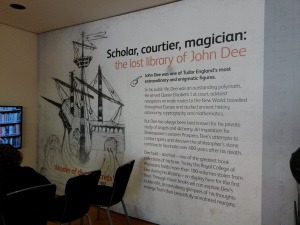
On my day off this week I visited the most recent exhibition at the Royal College of Physicians: Scholar, courtier, magician: the lost library of John Dee. John Dee, or Dr Dee as he is often known (though he was not a doctor in the commonly understood sense of the word, and had no formal medical training), was an Elizabethan polymath, a lover of learning who collected a huge library of books, travelled throughout Europe and was rumoured to have been a spy for Queen Elizabeth I.

2016_0525Dee

Dee was born in London to Rowland Dee and Johanna Wild. He studied at St John’s College, Cambridge, and became an Original Fellow of the newly-founded Trinity College, but he spent most of his adult life at Mortlake, just south of London, where his mother owned property. The way in which the Royal College of Physicians ended up with Dee’s books is rather sad. While Dee was on a trip to Europe, he entrusted his library to his brother-in-law Nicholas Fromond, who sold it off. Many of the books ended up in the possession of Nicholas Saunder, a former pupil of Dee’s, who tried to remove Dee’s name from the front of the books by repeatedly overwriting it with his own. Saunders’ books later passed to Henry Pierrepont, the 1st Marquis of Dorchester, and ended up at the RCP via a family bequest in 1680.

The exhibition explores different facets of Dee’s life: his role as a scholar, his experience as a courtier, his travels abroad and his life as a mathematician. Within each section, books from the Royal College’s collections that used to or were believed to belong to Dee are displayed, to illustrate the different aspects of his life. Dee annotated his books throughout his life with his signature and other notes about the contents of the books. He also had a habit of doodling in his books: the pages are littered with small bearded faces, and in one case a ship.

I liked the anecdotes relating to Dee: in Cambridge he devised a moving dung beetle for a theatrical production, which led some who saw it to claim that it was done by magic. On a more serious note, Dee’s alchemical experiments and attempts to converse with angels got him in trouble throughout his life: he was arrested for casting Mary I’s horoscope, though he was later approached by the Earl of Leicester on Elizabeth I’s accession in order to determine the most favourable day for her coronation. There are several items used by Dee on display, including a scrying glass and a crystal ball. There is also a painting by Henry Gillard Glindoni in which it is just possible to make out a ring of skulls around Dee that has been painted over.

Upstairs, the exhibition continues with a display exploring the way Dee and his story have been represented over the years, in literature, graphic novel and, most recently, opera. There are also books exploring his attempts to contact angels. The exhibition runs until July and is well worth seeing, a fascinating exploration of the life of one of Elizabethan England’s most enigmatic figures.

Sir John Soane’s Museum

2016_0430Soane01

It’s a long time since I visited Sir John Soane’s Museum, so I decided to pop in on Saturday. As usual there was a bit of a queue to get in, but considering it’s free, I was happy to wait – I only had to hang around for a few minutes, anyway.

Sir John Soane was a distinguished 19th century architect who turned his Lincoln’s Inn Fields townhouse into a museum full of famous artworks, sculptures, artefacts and furniture, most of it relating to the classical world. It was fairly famous during Soane’s lifetime, and has remained largely untouched since his death almost two centuries ago.

You start in the library, then head to the back of the house, which is covered from head to foot with classical artefacts. The basement is possibly the most exciting space, particularly the Monks’ Parlour and the huge sarcophagus. Back upstairs, there are more beautiful eighteenth century rooms to look around. Whatever your level of interest in history, there is something to see and enthuse over here.

A temporary exhibition, Charlotte Brontë at the Soane, is currently taking place. Though the museum existed when the writer of Jane Eyre visited London, there is no evidence that she ever went. Curator Charlotte Cory has decided to bring her to the Soane for her 200th birthday, and on display are some of Brontë’s possessions, including the beautiful blue and white dress she wore to attend a dinner with Thackeray, as well as some less authentic artefacts.

Another temporary exhibition refers to Soane’s relationship to the works of Shakespeare, and displays, among other things, the first four folios: it’s incredibly rare to see all four displayed together.

The Museum is open for occasional evening tours, and every so often the top floor – Soane’s private apartments – opens for tours (the latter do charge for entry). It’s a lovely, unique little museum that is well worth visiting.

FACTS

Address: 13 Lincoln’s Inn Fields, London, WC2A 3BP

Website: soane.org

Opening Hours: 10-5 Tues-Sat

Prices: Free

Artist and Empire – Tate Britain

2016_0402TateBritain

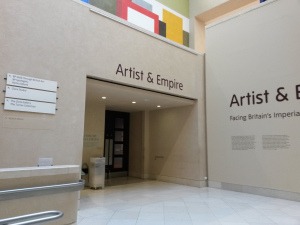
On Saturday I had a bit of time to spare so I popped into Tate Britain to check out their latest exhibition, Artist and Empire. The exhibition encompasses art from the past five hundred years or so, concerned with the British Empire. It includes works by diverse artists, both oppressors and oppressed, conquerors and the conquered, from different perspectives.

The exhibition acknowledges that the issue of ’empire’ is a difficult one to explore and come to terms with these days. However, remnants of the British Empire are all around us, and the exhibition attempts to face these head on in order to explore the issues they raise. I really like the way exhibitions at Tate Britain tend to mix old and new works and all different kinds of art, and this one is no exception.

The exhibition is divided into themes, with one room containing maps, one about heroics, one focused on costume and portraiture, and so on. Maps in particular were often used to denote conquest, while naming places implied ownership over that place. Portraits were often used as symbols of power, and the clothes worn by the sitter were often suggestive: Western dress worn by Indian royalty and Native American dress worn by the British, for example, implied a receptivity to other cultures. Having said that, the power balance was hardly equal: many works painted (pun intended) the British as morally correct, honourable conquerors. One section of the exhibition looked at trophies: collections of plants, animals and birds, drawings and paintings of them, and artefacts created by humans.

The latter part of the exhibition looks at the work of modern artists examining the legacy of empire in often-provocative ways. The exhibition is a thought-provoking one: for me, it wasn’t so much about viewing and enjoying art for its own sake, but using it as a lens through which to view beliefs and attitudes concerning empire.

Shakespeare’s London – Museum of London Archaeological Archive

This year marks the 400th anniversary of the death of William Shakespeare, and as such there are several special events going on. One such event, Shakespeare’s London, taking place at the Museum of London Archaeological Archive in Hackney, is a tour of the archive which includes a look at artefacts discovered at London’s Elizabethan theatres. I booked this pretty much as soon as I heard about it, as I love both history and Shakespeare.

2016_0402MoLArchives
Mortimer Wheeler House

The Archive is held at Mortimer Wheeler House; I looked up how to find it and I’m glad that I did, as it isn’t the easiest building to find. It’s located in east London, north of Old Street, just below the canal. We waited in the foyer for the tour to begin; there were quite a few of us, so we were taken around in two separate groups. As we explored the Archive, we were able to learn more about it, as well as the history of theatres in Shakespeare’s day.

The Museum of London Archaeological Archive is part of the museum’s Department of Archaeological Collections and Archive. Over the past century, nearly 8,500 archaeological sites have been investigated in Greater London: this archive holds information relating to all of these, with full archives for over 3,500 of them. There is also an archaeological library collection. It has been officially recognised as the largest archaeological archive in the world.

The Archive is of international significance, the primary source of evidence for early London. As archaeology itself is a destructive process – accessing one layer usually involves removing another – the only evidence of its existence is in the archive. There is an online catalogue containing information about object collections and archive records, and the Archive can also be visited for research purposes. This is free, but you need to make an appointment.

Early in the tour we got to play “archive lottery” – choosing a number and taking the relevant box off the shelf to see what it contained. Our box wasn’t particularly exciting, containing bits of pottery – however, as our tour guide (one of the Archive’s volunteers) explained, pottery is actually a really valuable tool for dating a site. We were subsequently introduced to some very special artefacts relating to the theatre.

Theatres like the Globe, the Rose and the Curtain, popular in Shakespeare’s day, were actually known as playhouses: the term “theatre” tended to refer to indoor, private theatres located in houses (similar to the Globe’s new Sam Wanamaker Playhouse). However, for the purposes of the tour they were referred to as theatres. We saw a cannonball that was found on a theatre site, once used to help create the sound of thunder (a similar item from the Rose Theatre is about to go on display at the British Library as part of their Shakespeare exhibition). Some of the smaller artefacts that we got to handle included copper pins, seals for rolls of cloth, and fragments of tobacco pipes. We also saw – but because of its fragility, understandably weren’t allowed to touch – an almost complete leather boot from the Elizabethan period: an incredible sight.

Many of the small items recovered were things which could have been dropped easily in the tightly packed, busy atmosphere of the playhouse. Gambling dice and makeup brushes were also found, as were tokens used to gain admittance into the playhouse. Money boxes were used to collect payment; when they were full, they were smashed, and the contents counted. They were kept in the money box office – what would later become the box office.

The area around Southwark where most of the theatres were situated was also known for bear-baiting, and the skull and bones of a bear and of a dog, possible rivals in the ring, are testament to this. The bear bone that we saw had tooth marks on it – possibly chewed by a dog after the poor dead or dying bear was discarded.

In a small room with a table, we were able to look at newspaper cuttings and letters related to the discovery and excavation of the Rose Theatre in 1988. When an archaeological excavation began on this site, no one had any idea just what an incredible find would be unearthed. The discovery sparked a campaign to retain and restore the site (the original developers just wanted to cover it over), and inspired a change in the law, meaning that excavations are now required when developers take over a site in London.

It was once thought that the hazelnut shells found at the Rose site indicated that theatregoers ate hazelnuts during performances, in the same way we might eat sweets or popcorn today. However, it is now thought that the thick layer of hazelnut shells would have provided cheap and effective flooring – especially as, with long performances and no toilets, groundlings would often just go where they stood – it makes me cringe to imagine walking over a spongy, urine-soaked floor of shells, but I guess they would have been used to it!

Finally, we ended up in a ceramics room, looking at some of the Shakespeare-related items held in the Archive. These included whole, and nearly whole, money boxes (which were always green, seemingly), and a figurine of Othello and Iago. We got to have a look around the room for a while before leaving, at some of the impressive collections which ranged from Roman amphorae to Victorian hot water bottles.

I absolutely loved my trip to the Archive and would recommend it for all those interested in London’s history. The Shakespeare tours are taking place again on 16 April, so it’s not too late if you want to take part.

A.G. Leventis Gallery, Institute of Archaeology

2016_0316InstituteofArchaeology01

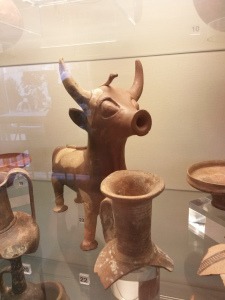
I visited the A.G. Leventis Gallery at the Institute of Archaeology, part of UCL Museums & Collections. The A.G. Leventis Gallery of Cypriot and Eastern Mediterranean Archaeology displays the IoA’s rich collection of objects from ancient Cyprus, Greece, Crete, Egypt and the Levant. It is fascinating to explore the resources and learn about how diverse the region has been during five thousand years of history.

2016_0316InstituteofArchaeology03
My favourite object in the Gallery

There is also a temporary exhibition, We Need To Talk: Connecting Through Technology, which has been created by students on the MA Museum Studies to explore the different technologies we have used to communicate in different periods of time. The exhibition contains such varied items as typewriters, coins, papyrus and computers, and it’s highly informative.

A visit to this interesting gallery doesn’t take long, but it’s certainly worthwhile.

FACTS

Address: Institute of Archaeology, 31-34 Gordon Square, London, WC1H 0PY

Website: ucl.ac.uk/museums/archaeology

Opening Hours: 9-5 Mon-Fri during term time

Prices: Free

The Petrie Museum of Egyptian Archaeology

2016_0316PetrieMuseum01 2016_0316PetrieMuseum02

The Petrie Museum in London, which is part of UCL Museums & Collections, contains around 80,000 objects relating to Egyptian and Sudanese archaeology, making it one of the greatest such collections in the world. The museum looks at life in the Nile Valley from prehistoric times, through to the time of the Pharaohs, the Ptolemaic, Roman and Coptic periods, right up to the Islamic period.

The museum was originally set up in 1892 as a teaching museum for the Department of Egyptian Archaeology and Philology at University College London. It was created thanks to a bequest from the writer Amelia Edwards (1831-1892) who donated her large collection of Egyptian antiquities, but it was the work of Professor William Flinders Petrie (1853-1942) that propelled the museum into international significance.

It can be found hidden away behind several University buildings in central London: it’s difficult to find at first but once you get there, the entrance is apparent. Once inside, the compact museum contains a wealth of treasures: there are so many items it’s easy to be overwhelmed, but with patience it’s possible to track down some of the highlights, including the earliest ‘cylinder seal’ in Egypt, the oldest wills on papyrus, and even some incredibly rare and fragile Egyptian costumes.

The museum has the world’s largest collection of Roman period mummy portraits (first to second centuries AD), in which you can trace the development of a society caught between two cultures. In addition, it has many works of art from famous emperor Akhenaten’s city at Amarna, including tiles, carvings and frescoes. Also, the wider collection is largely taken from documented excavations, ensuring that it can offer profound insight into the everyday lives of people living at the time.

Whether you are an expert in Ancient Egypt or a casual visitor, there should be something to appeal to you in this small but rich museum. Special events regularly take place, so it’s worth checking the website regularly.

FACTS

Address: University College London, Malet Place, London, WC1E 6BT

Website: ucl.ac.uk/museums/petrie

Opening Hours: 1-5 Tues-Sat

Prices: Free

Crime Museum Uncovered – Museum of London

The infamous ‘Black Museum‘ of Scotland Yard, officially known as the Crime Museum, is a collection of criminal memorabilia kept at the headquarters of the Metropolitan Police Service at New Scotland Yard. Founded in around 1874, it has been used for over a century to help the police in their study of crime and criminals. While the existence of the museum is widely known, it is not generally open to the public.

2016_0313CrimeMuseum

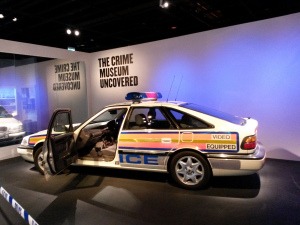
This all changed a few months ago when the Crime Museum Uncovered exhibition opened at the Museum of London. The exhibition was instigated by the Crime Museum itself, which has wanted to open up to the public for a while, but was concerned about the sensitive nature of the exhibits. Throughout the exhibition we are invited to question the ethics of putting such items on display, and to think about what they can teach us. As part of this sensitivity, the series of displays about specific crimes only go back as far as the 1970s.

The exhibition begins with a room which has been reconstructed from the original museum. It contains court sketches, Victorian-era mugshots and death masks, reflecting the nineteenth century obsession with phrenology – the belief that the shape of a person’s head could reveal their personality and character. This room is fascinating as it reveals how the Victorians thought about crime. There is also a disturbing selection of hangman’s nooses which were used on famous criminals.

The major part of the exhibition is laid out chronologically, with each case devoted to a different crime. Some of these cases are famous – Crippen, Christie, Ellis – others, less so. This section could easily be sensationalist, but instead it is informative and well-presented. The descriptions on the cases give prominence to the victims, not just the criminals, and the role of detectives and the police is emphasised: many of the cases have been chosen because of their significance in the history of detection and evidence, such as the first case in which a conviction was secured thanks to the use of fingerprints.

Sure, some of the exhibits are a bit gruesome: Crippen’s spade, the acid bath murderer’s gloves, a selection of masks made from stockings to hide the wearer’s face. However, all of them are informative, and some are even funny – such as the “false footprint makers” used by a would-be burglar to leave footprints around the crime scene. His cunning plan failed after he left his own footprints alongside the fake ones.

As well as displays focusing on individual crimes, there are themed displays containing fascinating artefacts, such as weapons confiscated from criminals, concealed weapons (including a pair of binoculars containing concealed eye spikes), and abortion pills and implements (from the days when abortion was illegal). Some items relate to modern-day crimes. These include the fake jewel used by the police in the attempted theft of the Millennium Star diamond from the Dome in 2000, and a selection of IRA mortars fired on Downing Street and MI6. There is also an unexploded nail bomb.

At the end of the exhibition there is the opportunity to watch a short video exploring how appropriate it is to open up these collections to the public. My friend and I spent a good couple of hours in here, in this informative and fascinating exhibition. It is thoughtfully put together, sensitively curated and hugely worthwhile – one of the best exhibitions I have ever seen.

Museum of Croydon

2016_0312MuseumofCroydon01
Croydon Town Hall

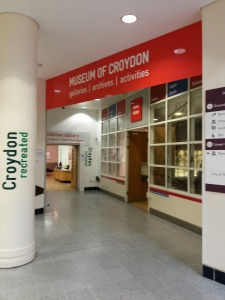
The Museum of Croydon is located in the former town hall, next to the library and other civic offices. There are two galleries on the ground floor. The Exhibition Gallery showcases temporary exhibitions of works from the Borough’s art collection; the current exhibition is Croydon Recreated, a collection of paintings by a local artist, E.A. Phipson. These pictures of Croydon from the turn of the 20th century are displayed alongside photographs and historic maps to explore how Croydon has changed. The gallery is situated alongside the Research Room, where genealogical researchers and others with cause to use Croydon’s local archives can work.

The other gallery is the Riesco Gallery, which showcases some of the original exhibits in the museum from the Riesco Collection. I thought that these exhibits were a cut above most similar displays in local museums, with some extremely impressive Chinese grave goods, beautiful small statues, fascinating Anglo-Saxon finds and others.

2016_0312MuseumofCroydon02
Riesco Gallery and Research Room

The main part of the museum is upstairs, and the entrance is designed so that you can start at either end: “Croydon Then” and “Croydon Now”, or vice versa. I chose to start “then” and work my way up to the present day.

The space is a bit dark, but generally well laid out. Rather than a junkyard of random exhibits, a selection of items has been carefully chosen to be on show in individual square cases. Judging by their names: “Mary’s doll”, “Ted’s train”, I would guess that they have been donated by Croydon residents. The items range from the personally significant – toys, sewing kits, tools – to those with wider significance, including a relic of the borough’s first mayor, who was initially respected but who was later found to be a fraudster, conning people out of their life savings with his insurance company.

Moving forward through history, the museum has the usual section on World War II, explaining that Croydon was a major target for German bombers. During the second half of the twentieth century, Croydon welcomed many immigrants and also became an important centre for art and design.

There is a section on current Croydon residents who have been invited to contribute something of their own to the exhibition. This was an interesting chance to see what different people hold significant and explores the culture of the town.

2016_0312MuseumofCroydon03
Moving to London

There is a small temporary exhibition called Moving to London, marking the 50th anniversary of the borough becoming a part of London. This also had items in various cases telling the story of this change.

Overall, the Museum of Croydon is a well put together exploration of the borough’s past. Definitely worth a visit if you’re in the area.

FACTS

Address: Croydon Clocktower, Katharine Street, Croydon, CR9 1ET

Website: museumofcroydon.com

Opening Hours: 10.30-5 Tues-Sat

Prices: Free