Russian Revolution: Hope, Tragedy, Myths – British Library

These days I always seem to go to exhibitions towards the end of their run, but I ended up seeing Russian Revolution: Hope, Tragedy, Myths at the British Library fairly early, owing to the fact that some friends wanted to go too. We booked for Saturday afternoon and were surprised to find the exhibition so quiet. Marking the centenary of the Russian Revolution, it uses documents, books, letters, photographs and film footage to explore how the revolution began and developed and the impact it made.

I’m vaguely familiar with what happened, as I am very interested in Russian history anyway, but the exhibition helped to clarify events for me, and I think I left with a greater understanding of what was going on. The exhibition followed a largely chronological path, which I personally found very helpful. It looked at the structure of Russian society at the time of the Tsars before examining how and why the revolution was sparked.

My favourite section was actually the final one, ‘Writing the Revolution’, as it looked at some books which are my favourites, including Boris Pasternak’s Dr Zhivago. I also enjoyed the look at film at the end, including clips from famous Soviet films.

The exhibition runs until 29 August and it’s definitely worth taking some time out to see it this summer.

Sunken Cities: Egypt’s Lost Worlds – British Museum

2016_1125bm

On one of my days off I headed to the British Museum to see their exhibition, Sunken Cities: Egypt’s Lost Worlds. The exhibition was about the lost cities of Thonis-Heracleion and Canopus, which lay at the mouth of the Nile. Thonis-Heracleion in particular was an incredibly important commercial centre for trade with the Mediterranean world.

The exhibition contained many fascinating exhibits revealing the link between Egyptian and Greek culture and architecture. I particularly liked the fascinating videos showing divers recovering statues and other treasures from the sea.

Maps and the 20th Century: Drawing the Line – British Library

2016_1119maps

Maps and the 20th Century is the latest exhibition at the British Library, exploring the 20th century via the medium of maps. Maps were widely used before this period, of course, but it wasn’t until the last century that map use became more or less universal.

The exhibition covers themes such as war, peace, movement and the market. The war section was one of the most memorable, being full of the kind of propaganda maps that were so common in school textbooks, featuring images like Hitler as a spider spreading his spindly legs over Europe. My personal favourite maps were the original Underground map sketch by Harry Beck, the map of Antarctica, and the map of the shopping centre of Sunderland, my home city.

The exhibition runs until the first of March next year, and it’s well worth seeing for any map fans out there.

Sarah Bernhardt and Alphonse Mucha: Friends and Fellow Travellers – Victoria and Albert Museum

Art Nouveau posters in the V&A

I had lots of Art Nouveau posters on my wall in my student days, and my love of this art form has persisted for several years. Since childhood, even, as my parents had a mirror featuring the Alphonse Mucha design La Dame aux Camélias on their wall. Mucha is one of the most significant proponents of this art form, so I was interested to go along to this day-long event at the V&A discussing the relationship between Mucha and the actress Sarah Bernhardt.


‘I predict fame for you’: meetings and inventions – Dr Justine Hopkins

The first talk, delivered by Dr Justine Hopkins,  explored the relationship between these two figures. Sarah Bernhardt was born Rosina Bernard, but took the name Sarah to celebrate her Jewish heritage and added letters to her surname. She was brought up in a convent, but pursued an acting career.

In the mid-1870s Bernhardt was told that she had been overdoing it and must not act for six months. With time on her hands, she decided to take up art, creating sculptures including ‘After the Tempest’ (1876), ‘The Fool & Death’ (1877) and ‘Fantastic Inkwell’, a self portrait as a sphinx (1880). She also wrote at least one novel, and penned an account of a trip over Paris in a balloon.

Mucha, who was sixteen years younger than Bernhardt, grew up in a tiny village in what is now the Czech Republic. He had a choir scholarship, so spent much time in the Cathedral of Saints Peter and Paul, Brno, built in 1738-48. Determined to become an artist, when he was turned away by art school in Prague he moved to Vienna and worked as a theatre designer. He began to paint portraits and moved to Paris in 1887, when he was 27.

The pair met when Mucha turned to illustration and designed the poster for Gismonda, in which Bernhardt was starring. This was the beginning of a long and fruitful relationship, in which Mucha designed many more posters for Bernhardt and also designed jewellery for her.

Sarah Bernhardt and Alphonse Mucha were seen as “kindred spirits”: photos and paintings exist of both working in their respective studios. Both understood that art nouveau challenged what fine art could be; both believed that art had the ability and duty to communicate; and both knew what would sell, but raised art above the merely commercial.


Posters for Posterity: Alphonse Mucha and the V&A Collections – Margaret Timmers

Mucha helped to establish the reputation of French poster artists. He initially took up posters for financial reasons, but became glad of this later on as the art form began to be appreciated. He designed for many clients after Sarah Bernhardt, and created several designs for drinks manufacturers.

The Victoria & Albert Museum has been collecting posters since the late nineteenth century, with the collection formed to represent style, method and design. An 1894 exhibition of posters was held at the Royal Aquarium, while the museum received one of the Gismonda posters in March 1895, very soon after publication.

In 1963, a Mucha poster exhibition helped to renew the popularity of the art nouveau style in the public consciousness. The style was huge in the fashion and art of the time and helped to create the pop art style.


Bernhardt in Performance

After a break for lunch, we came back to something very exciting: video and audio clips of Sarah Bernhardt. A 1900 clip of the star as Hamlet, showing the duet with Laertes, was fascinating. Bernhardt was the first major stage actress to appear in a motion picture: in Daniel, in 1921, when she was nearly eighty.


‘My two hands in yours my dear friend’: continuations and developments – Dr Justine Hopkins

The second talk by Dr Justine Hopkins focused on the later years of Bernhardt and Mucha. Bernhardt visited America in 1880 and made several visits in later years, including several “farewell tours” of America. Mucha also became involved with the US: in the New York Daily News in 1904 he was described as “the greatest decorative artist alive in the world”. He produced a poster for the St Louis World’s Fair that same year. A good teacher, he wanted to encourage US students to find their own American art.

Closer to home, he became more involved in patriotic projects from 1910, and wanted to produce an epic relating to the Moravian people. He produced a poster in 1912 for a gymnastics festival which was really a political rally where the people plotted revolution. He also produced a poster for the Lottery of National Unity, which donated fees to teach children Czech, as well as a bank note in 1923. From 1912 onwards he mostly worked on his ‘Slav Epic’.

Sarah Bernhardt died in March 1923. Alphonse Mucha died in 1939, 16 years later: called in by the Gestapo in Prague, he was released after two days but caught pneumonia.

A close up of La Dame aux Camélias at the V&A

I thoroughly enjoyed my day at the V&A, and I learned a great deal.

Undressed: A Brief History of Underwear – V&A

The V&A‘s latest long-running exhibition is Undressed: A Brief History of Underwear. As the name suggests, it follows the evolution of underwear design from the eighteenth century onwards. It features examples of underwear worn by both men and women, examining how underwear influenced, and was influenced by, ideas of gender, sex and morality, and how it affected outerwear.

I was interested to see the older underwear in particular, such as the examples of nineteenth-century corsets and their earlier counterparts ‘stays’, as well as early bras. The more modern cutting-edge styles were fascinating too. The exhibition runs until 12 March, costing £12, and is well worth seeing.

St Pancras Chambers – Open House London

St Pancras Chambers
St Pancras Chambers

My next Open House London tour was of St Pancras Chambers – the building above St Pancras Station. The station, originally constructed in 1868, was refurbished between 2001 and 2007, the threat of demolition narrowly averted thanks to the efforts of a passionate group of people including the poet John Betjeman.

Station entrance (former goods entrance)

At the time of original construction, the East Midlands Railway wanted to surpass the recently built King’s Cross Station, so commissioned George Gilbert Scott to create the beautiful, opulent Gothic Revival style building. The money ran out partway through construction, leaving no money for the planned extra storey or for the statues supposed to be dotted around the building – the empty niches are still visible.

Wyvern
Wyvern

On the tour we saw some fascinating details: the theme of the wyvern (a mythical creature) runs through all of the architecture, and the materials used in the building come from the various towns and cities served by the East Midlands Railway, such as Sheffield steel and stone from Nottingham.

Former station entrance (now hotel entrance)

The original entrances to the station still exist but are now more commonly used as the entrances to the apartments and hotel. The Hansom Hall is the current name for the hotel lounge, as it was originally where travellers were dropped off outside the ticket hall.

'Spice Girls' staircase
‘Spice Girls’ staircase

We then got to go inside the building. The most exciting part for me, I must admit, was seeing the very staircase that featured in the Spice Girls’ video for “Wannabe”.

Stairwell
Stairwell

We got to go all the way up to the top floor: this part of the building has been converted into flats. You can see from the staircase that originally, the more prestigious rooms were on the lower floors: the design becomes less ornate as you go up the building. Nowadays, of course, the best flats are at the top, where it’s still possible to see the former servants’ quarters above your head (the original floor has been removed. My tour was given by the man who actually lives in one of the apartments – the one with the bell tower – so we got to look in there too – a fascinating experience.

In the corridor
In the corridor
Former servants' quarters
Former servants’ quarters
Inside the bell tower

55 Broadway – Open House London

55 Broadway
55 Broadway

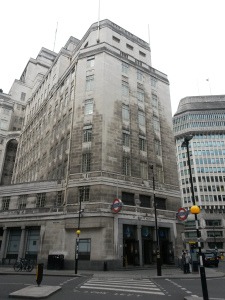
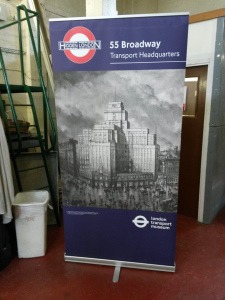
I always make a habit of visiting some interesting buildings when Open House London comes around. This year I was lucky enough to visit 55 Broadway, the former headquarters of London Underground, near St James. The Underground Group was formed from a group including the Tube railways, London General Bus company, tram operators and electrical supply companies, and in 1927 when they decided they wanted their new headquarters to reflect its bold vision of the future, they hired architects Adams, Holden and Pearson for the job.

55 Broadway
55 Broadway

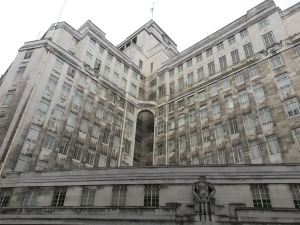
It was a challenging job from the start. With its irregular shape and depth (St James’s Park station sitting just 7.3 metres below the site) Adams, Holden and Pearson’s job was a difficult one. They managed to get around it, however, by incorporating the cruciform layout into their design.

Epstein's controversial sculpture
Epstein’s controversial sculpture

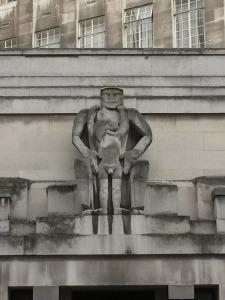
Charles Holden, later known for his work on the Northern and Piccadilly Line extensions, used Portland stone and added bronze features to the building. Carvings by Eric Gill, Henry Moore and Jacob Epstein (who’s “Night and Day” caused controversy) adorn the outside of the building, which is now Grade 1 listed.

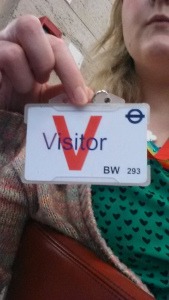
Visitor pass
Visitor pass

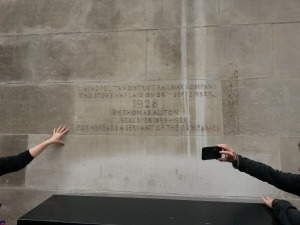
We started off outside, where we were introduced to the history of the building and got to see the original foundation stone.

Foundation stone
Foundation stone

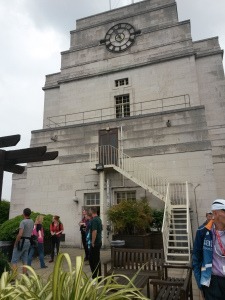
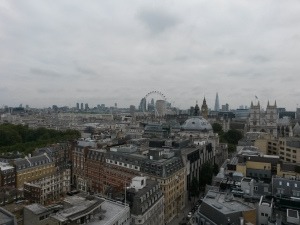
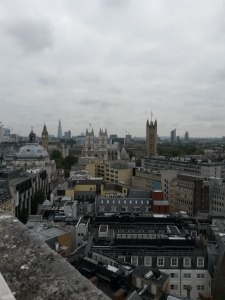
The tour took us up several floors, including the seventh floor with its original management rooms, outside to see the roof gardens, and right up to the flagpole.

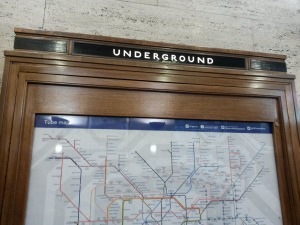
Map in the foyer
Map in the foyer
Lord Ashfield plaque
Roundel design in the building
Early tube map
Early tube map
Inside the building
Inside the building
Management rooms
Management rooms
Management rooms
Management rooms
In the garden
In the garden
View from the roof
View from the roof
View from the roof
View from the roof
55 Broadway
55 Broadway

The Lost Palace – Banqueting House

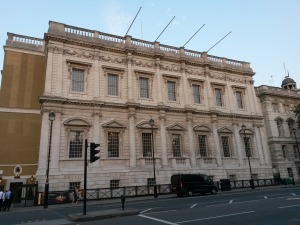
The Banqueting House

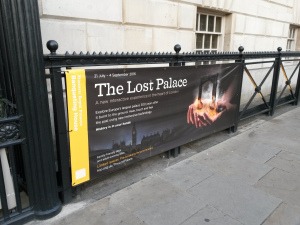
This summer, a new visitor experience launched at the Banqueting House, part of Historic Royal Palaces, in London. The Lost Palace was described as “a unique combination of immersive audio theatre, interactive technology and architectural installations”, and was an innovative way to explore the history of Whitehall Palace, of which the Banqueting House is the only remaining part.

The Lost Palace
The Lost Palace

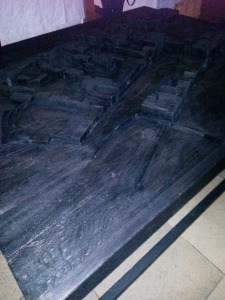
I signed up to go after work and arrived in Westminster on a warm day. I entered the basement of the House and settled down to wait until it started, trying to familiarise myself with my headphones as I did so. I didn’t have long to wait, as we were soon called to stand round a model of the old Whitehall Palace and hear a disembodied-sounding voice tell us about the fire that destroyed it. I had no idea just how big the Palace used to be – it encompassed a vast area from Northumberland Avenue to Downing Street, consisting of 1,500 rooms spread over 23 acres. The Palace was the largest royal residence for the Tudor and Stuart courts.

Model of Whitehall Palace

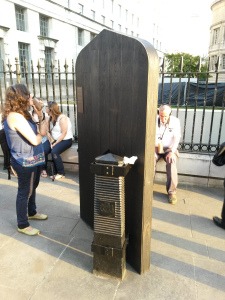
The audio tour-slash-digital guide took us round the neighbouring streets, pointing out places of significance and allowing us to hear stories of those who used to live here. At one gate we touched our audio guides on the archway and heard about the first performance of King Lear; at the other side of the palace, we heard stories about parties and carousing at the location of King Charles II’s sundial.

Partaking in King Lear

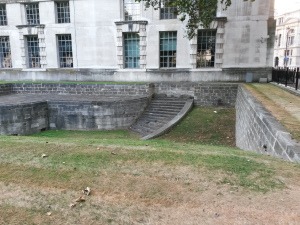
The Palace used to be closer to the Thames than it is now and Queen Mary’s Steps, designed in 1691 by Sir Christopher Wren, are still visible overlooking the river. They were designed to give access from the Royal Apartments to the State Barge.

Queen Mary's Steps
Queen Mary’s Steps

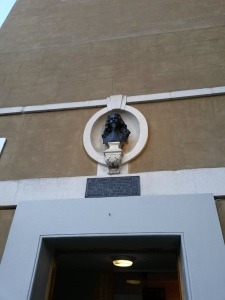
The tour took us to Horse Guards Parade to witness jousts, and allowed us to overhear Guy Fawkes before he was sent to the Tower of London. One of my favourite parts required us to pretend our audio guide was a bird in order to partake of a spot of cock fighting. After listening in on the first encounter between Henry VIII and Anne Boleyn, the last part of the tour had us listening to Charles I’s hearbeat as he walked to the gallows, the location of which is now marked by a statue above the Banqueting House doorway.

Charles I
Charles I

Finally, we had a chance to sit inside the Banqueting House and take it all in. This was much needed after an intense and engrossing experience which is much recommended.

The Banqueting House

1816: The Year Without A Summer – Study Day

year without a summer

It might not be the conventional way to spend a Saturday, but I really enjoyed my experience at the 1816: The Year Without A Summer Study Day. Following on from my Friday evening talk and concert, I turned up bright and early to enjoy a day of talks around the consequences of the 1815 eruption of Mount Tambora in Indonesia.

The world’s biggest volcanic eruption caused severe climate change and led to poverty, famine, disease and migration, as well as influencing creativity. The talks were delivered by experts from the various fields of science, medicine, neurology, culture and history, and culminated in a panel discussion.


Atmospheric Effects of the Mt. Tambora Eruption
Prof Giles Harrison (Professor of Atmospheric Physics, University of Reading)

In this first talk, Professor Harrison gave us a bit of insight into the context of the eruption and what it meant for the atmosphere. Tambora, on Sumbawa Island, Indonesia, had a history of rare but major eruptions. One took place in around 3910 BC. In 1815, there was an initial eruption on 5 April before the ‘proper’ eruption on 10 April.

The immediate consequences of the eruption included whirlwinds, ashfall, a pyroclastic flow and a tsunami. Rock was expelled from the volcano, burying a nearby village. 71,000 people died in the nearby area, 12,000 directly and the rest by starvation in subsequent weeks. The Volcanic Explosivity Index lists the Mount Tambora eruption as 7 out of 8, the largest known historic eruption.

In the wider atmosphere, small particles of sulphur influenced sunlight and temperature. In recent years, ice cores taken from Greenland show that air samples from the time of the eruption contain volcanic dust and sulphur. It has been suggested that the art of the time, such as paintings by Constable and Turner, reflect the condition of the air and the presence of dust, but then again we don’t always know how the paints have aged over time.

At the time of the eruption, a sparse temperature measurement network was developing. Early measurements were usually taken by educated individuals who viewed such observations as a hobby, but their diaries enable us to make deductions about the weather of the period. The evidence suggests that the summer of 1816 was the coldest of the 1810s and the third coldest since 1659. Eastern Europe wasn’t so badly affected, but Western Europe did suffer with the cold and wet. The effects spread as far as North America, with, for instance, snow recorded in New York. Back in the UK, one diarist reported that their cucumbers froze.


Frankenstein’s Weather!
Prof Gillen D’Arcy Wood (Professor of English, University of Illinois)

Professor Wood was a particularly engaging speaker and his talk was probably my favourite of the day. He referenced the artistic works mentioned by Professor Harrison in the previous talk, mentioning Constable’s Weymouth Bay of 1816, painted on the artist’s honeymoon, which revealed the state of the sky. Most of his talk was concerned with the myths that built up around the summer at the Villa Diodati.

The summer of 1816 marked the return of British tourists to Europe after the Napoleonic wars. It was Mary Godwin’s stepsister, Claire Clairmont, who persuaded Mary and Shelley to visit Lord Byron in Geneva. Along with Byron’s physician Dr Polidori, they spent a legendary summer by the lake. Dreaming of a summer of picnics, walks and mountain climbing, they were instead faced with the coldest, wettest summer in Geneva for 450 years. Surrounded by starving refugees, the group spent the summer holed up in the Villa Diodati, telling ghost stories to pass the time: Byron’s reading of Coleridge’s Christabel had Shelley running screaming from the room.

Professor Wood drew parallels with modern-day climate change, citing a phenomenon called “climate shock”. He discussed the stages of response to climate shock: creative sympathy, political violence, and the “flight into hell”. Mary Shelley’s Frankenstein, Byron’s Darkness and other works can be read as creative sympathy, but there were other, less obvious consequences: the first bicycle prototype was invented to replace horses, many of which had died, while in a bid to deal with the problem of starvation Robert Peel established the group which would evolve to become the British Board of Health. Still, unrest was common. In Britain in 1816, there were riots and protests by starving peasants. Rural communities all over Europe experienced starvation, leaving their homes and seeking shelter and food elsewhere: hence the “descent into hell”. One wealthy figure gathered 25,000 refugees, travelling around Europe, setting up soup kitchens and preaching the imminent apocalypse. ‘Starvation medallions’ were produced as mementoes of the occasion.


‘Not yet saved’: Europe after the fall of Napoleon
Prof Robert Tombs (Professor of French History, University of Cambridge)

Professor Tombs talked about Napoleon, defeated at Waterloo in 1815. Admired by Byron, Beethoven, Shelley and Goethe, he was exiled to St Helena where he acquired much sympathy. His carriage was brought to London, where 100,000 people visited it. Byron bought it and used it to travel around Europe. Wellington, rather oddly, acquired Canova’s statue of the nude Napoleon. It can still be seen in Apsley House. He also “took over” Napoleon’s mistress.

Contemporary cartoons by the French show the English in a bad light, and many of Balzac’s novels featured English characters who were ‘bad’. Back in England, Napoleon was burned in effigy. A ‘geopolitical revolution’ was set in motion.

The fast growth of populations and cities, as well as the influx of newly unemployed soldiers, meant that famine and unrest were common problems. The ‘Bread or blood’ riots in Ely in May 1816 led to the hanging of 83 individuals – an unusually high number. Poor relief was eventually increased, but the consequences of these events lasted many years.


Lightness, Darkness and the Creative Brain
Prof Michael Trimble (Emeritus Professor of Behavioural Neurology, UCL)

This was another talk which I found especially interesting, exploring the connection between the weather (of 1816 in particular) and mental health. Professor Trimble started with a brief history, going back to Greek ideas about the four humours, a Platonic theory promoted by Hippocrates. Galen referred to a “Darkening of the mind”, and in later years a number of books on the theme of melancholy were published: Thomas Horclewe’s My Compleint (1420), Robert Burton’s The Anatomy of Melancholy (1621) and An English Malady (1733) by George Cheyne.

News reports indicated a wider spate of melancholy during 1816, but was the weather responsible? Esquirol’s French Maladies of 1845 suggested that climates and seasons can have an effect on melancholy, while Henry Morselli’s study of suicide in 1881 suggested that the dreariness of the northern climate might be more likely to influence such actions. Weather was seen as a proxy for the human condition.

The influence of the weather on mental state declined as the science of meteorology advanced. However, Seasonal Affective Disorder was first described in 1984. A recent study suggests there is no association between seasons, sunlight and latitude, but a recent review of psychiatric hospitalisations confirms a seasonal pattern, especially for bipolar patients. A literature review from 1979-2009 suggests that the highest number of suicides occurs in the spring and early summer.

Professor Trimble moved on to speak particularly about Beethoven and Schubert. Beethoven’s father and grandmother were alcoholics, his mother a melancholic. A lonely child with few friends, he hated authority and suffered greatly when his mother died. He suffered from depressive episodes in 1812-13 and 1816-17 when his productivity vastly decreased. He may well have been bipolar.

Schubert might have suffered from cyclothymia, being possessed of a bright side that coexisted with a morbid aspect. He tended to experience increased productivity during the spring and autumn, composing very little during the summer. Evidence seems to suggest that while there is no direct link between mood and weather, those already suffering from a condition such as bipolar might be more likely to be affected by it.

The day ended with a panel discussion featuring Judith Bingham, one of the composers featured in that evening’s Byron in Switzerland concert, and chaired by Ian Ritchie. The day as a whole was incredibly interesting, and if I felt like I was back at university again, this is all to the good. I enjoyed the chance to stretch my brain properly.

1816: The Year Without A Summer – Introductory Talk – King’s Place

Kings Place is an arts and conference venue just north of King’s Cross. It only opened a few years ago, but has already gained a reputation for hosting high quality music, spoken word and arts events. Recently, a weekend of events took place entitled 1816: The Year Without A Summer. It consisted of two concerts and a study day exploring the events of this momentous year, the result of the 1815 eruption of Mount Tambora in Indonesia.

Before the Friday evening concert Beethoven and Schubert in Vienna, which I reviewed on my theatre blog Loitering in the Theatre, I attended the introductory talk, delivered by curator of the programme Ian Ritchie. He summarised the exceptional climatic, cultural and historical contexts in which Beethoven and Schubert were living in 1816 and explored how their work might have been affected.

Ritchie explained that all of the music in the evening’s concert had been composed in 1816 by either Beethoven or Schubert, both of whom were living in Vienna at the time. The period was already a time of great change, with the growth of Romanticism after the Enlightenment and the recent defeat of Napoleon at Waterloo. Prometheus, inspiration for Mary Shelley’s Frankenstein, was a popular cultural figure: Beethoven wrote a piece of music on the subject, initially dedicating it to Napoleon, but after becoming disillusioned with the French leader he crossed out the dedication (Byron was another figure who wrote in praise of Napoleon – composing an Ode to Napoleon – but who later became disillusioned). Inventors, such as George Stephenson, Humphrey Davy, and Michael Faraday, were making new scientific discoveries, and Luigi Galvani was attempting to reanimate corpses using electricity (from whence we get the term “galvanise”.

The Mount Tambora eruption of April 1815 was the biggest volcanic eruption for hundreds of years. It caused a shifting ash cloud leading to crop failures from Ireland to the east coast of the USA, the coldest winter since medieval times, and the development of a new strain of cholera in India. When Byron decided to go into exile from the UK, he arrived in Switzerland to find a country suffering from crop failure and famine. Along with Percy Shelley, Mary Godwin (later Mary Shelley) and Doctor Polidori, he spent the summer in the Villa Diodati, experiencing terrible weather instead of the glorious summer he had hoped for. Byron wrote a poem about the experience, called Darkness:

I had a dream, which was not all a dream,
The bright sun was extinguish’d, and the stars
Did wander darkling in the eternal space,
Rayless, and pathless; and the icy earth
Swung blind and blackening in the moonless air
To be continued…

As meterological science was in its infancy, people didn’t know why the weather was so bad: some predicted the end of the world. In such circumstances Beethoven and Schubert wrote music in Vienna.

Schubert was only 19 at the time, compelled to write even though he had only one paid commission this year (a cantata, now lost, coincidentally also called Prometheus), composing over 100 lieder in 1816. Unable to marry his fiancée as he couldn’t support her, he was also rejected by his hero Goethe, so it is understandable that his work from this period sounded rather melancholy. His lieder from this period rarely use poems relating to summer, and his music is often sad and reflective.
Beethoven also faced disappointment at this time, partly owing to the death of his brother. Though this was a fallow period for him, he did produce the first recognised song cycle. Did the pair of composers ever meet? Possibly not – Beethoven was an established composer at this time,  and moved in higher circles, while Schubert was still a student and relatively unknown at this stage.

The short talk was really enlightening, and whetted my appetite for the evening concert and the next day’s events… on which more in the next post.