Charles I: King and Collector – Royal Academy of Arts and Charles II: Art and Power – Queen’s Gallery

The Royal Academy and the Queen’s Gallery are both playing host to seventeenth-century royalty-related exhibitions this year. I don’t know if they planned it this way or not, but they certainly made the most of it, offering a joint weekend ticket including tea and cake. I’ll admit the cake swung it for me.

Royal Academy of Art

The Royal Academy exhibition, Charles I: King and Collector, was actually due to end on the day I visited, so it was very busy. This didn’t stop me from getting a good look at the works on display, however. Works are categorised by theme, with the Italian Renaissance, the Northern Renaissance and Van Dyck and Reubens in England grouped in separate rooms, or else their former location: pictures that were hung in the Queen’s House can be found in one room, and those from the Whitehall Cabinet in another. The Mortlake Tapestries adorn one room, while images of Charles I in the hunting field hang in the Central Hall.

The exhibition consists of works that were accumulated by Charles I before and after he became king. He loved art and was a keen collector, but after his execution his collection was broken up and sold off (some of the catalogues can be seen here). This exhibition reunites these works after several centuries. Some didn’t have far to come, having got back into the Royal family’s hands after the Restoration, or else having been sold to wealthy collectors in the UK. Others, however, ended up in Europe or the US, and have been loaned for the purposes of this exhibition.

I must admit that in themselves, I didn’t fall in love with many of the works on display here (though I did enjoy seeing the full-length portrait of Holy Roman Emperor Charles V, an image I recognised from A level History). However, I was impressed by the collection as a whole, and the way in which it reflects Charles’ impact on the art world.

Queen's Gallery

After my restoring cup of tea and piece of cake I walked through Green Park to the Queen’s Gallery, where Charles II: Art and Power is currently being hosted until 15 May. This exhibition follows on from and complements the Charles I exhibition, focusing on Charles II and how he made use of art to convey his power. It began with a small display of items relating to the Civil War, the execution of Charles I, and the Protectorate, and went on to focus on the art that he collected and that was produced during his reign. Some of this was originally part of his father’s collection and had been brought back; others were new acquisitions.

In terms of the historical interest, I think I preferred this exhibition, partly as it was much quieter and much easier to see the artworks. There were surprises too: for instance, I had no idea that the famous painting of Erasmus was once part of a pair, and the two paintings were attached together.

The most dramatic work in this exhibition is the huge portrait of Charles II (the one that adorns all the publicity material) that dominates the last room. In its display of power and authority it is reminiscent of the painting of Charles I on horseback displayed at the Royal Academy; knowing what happened to the first Charles, I wonder if the second Charles drew this comparison and wondered; or if he just didn’t care.

Regardless, these are a fascinating pair of exhibitions, well put together and worthwhile for their historical context as much as their artistic context.

Living with Gods: Peoples, Places and Worlds Beyond – British Museum

Living with Gods exhibition sign

Before it closed I visited the Living with Gods: Peoples, Places and Worlds Beyond exhibition at the British Museum. The exhibition was timed to coincide with a Radio 4 show on the same theme, but as I never listen to the radio, I can’t comment on that. I did enjoy the exhibition – even if I didn’t always agree with it.

Medieval skeleton relic

This fascinating exhibition looks at how people over time have represented their religious beliefs. Christianity, Islam, Judaism are all represented, are as lesser-known and older religions from all corners of the globe. The exhibits are arranged by theme, with seemingly different artefacts displayed alongside one another as they are said to reflect similar aspects of belief. I particularly liked the inclusion of cheaper everyday items alongside valuable and unique artefacts.

Lion Man
Lion Man

The exhibition begins with the Lion Man, the oldest known figurative sculpture in the world that dates back 40,000 years. However, does it necessarily reflect religious belief as the exhibition claims? Regardless, it’s a fascinating talking point.

Judas-devil figure
Judas-devil figure

There is an impressive Judas-devil figure used in Mexican Day of the Dead processions. Masks from the Congo, Jewish prayer caps and Japanese phalluses linked with fertility prayers are among the varied items displayed. One of the most moving is a cross carved in 2014 from a wrecked refugee boat that carried 500 refugees; at least 360 are known to have drowned. Towards the end of the exhibition, we see how Communist regimes in China and Russia directed religious feeling towards the regime leaders and away from traditional religion. The exhibition is incredibly interesting and thought-provoking, and I’m glad I made the effort to go before it closed.

Twinings Tea Museum

Twinings Tea Shop

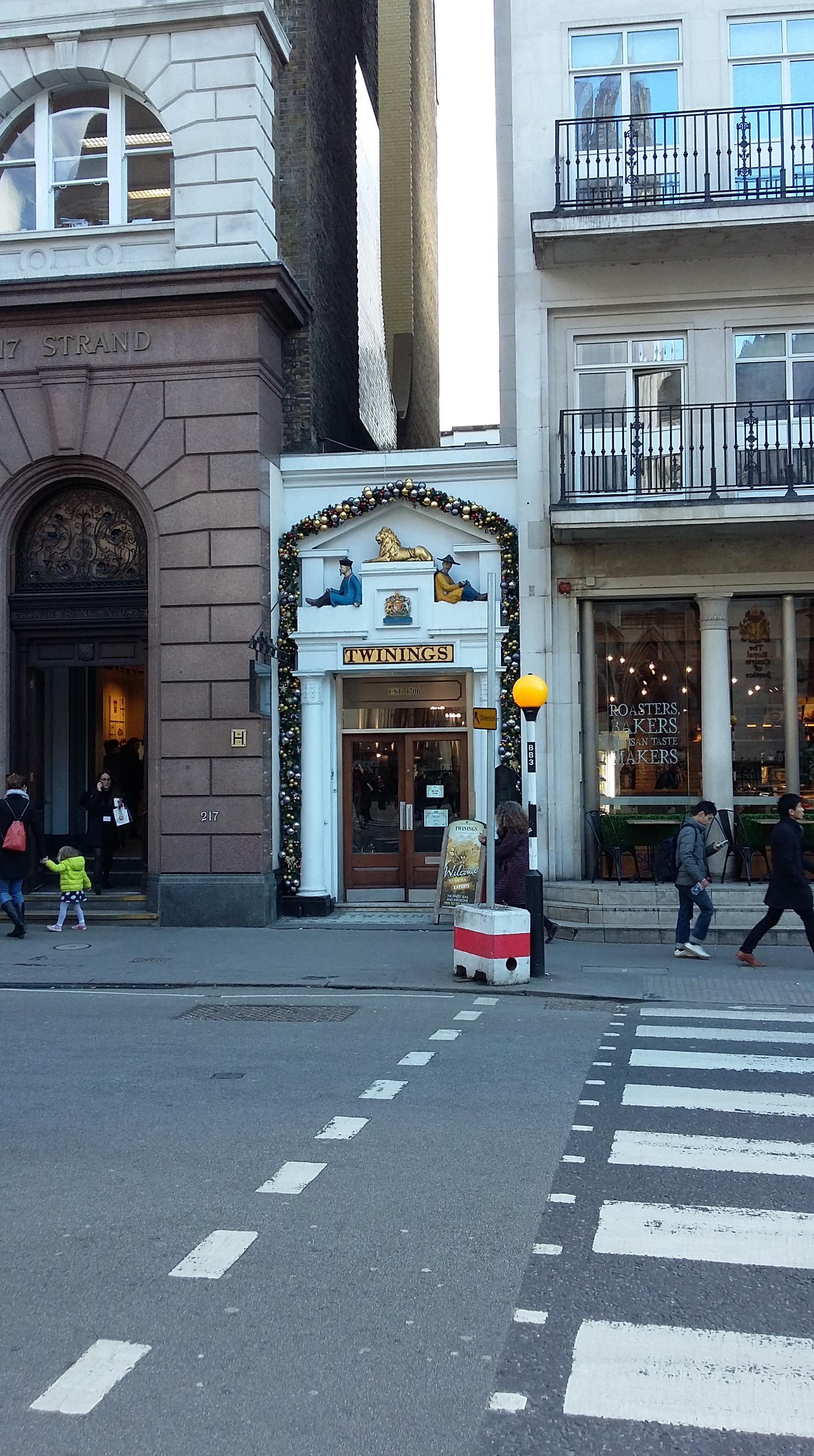
I wandered past the Twinings Tea Shop and Museum quite by chance on my day off; it’s located on the Strand, a busy street in the heart of London, and still retains its old-fashioned look. Inside, it sells more kinds of tea than you can shake a stick at: from black tea like good old English Breakfast and Earl Grey, to fruit teas and green teas, as well as rather more bizarre flavours like Salted Caramel Green Tea (not recommended). It’s possible to buy a Twinings-branded wooden box (like the kind you get in posh hotels) and fill it with teabags of your choice. I made a mental note of this for future reference.

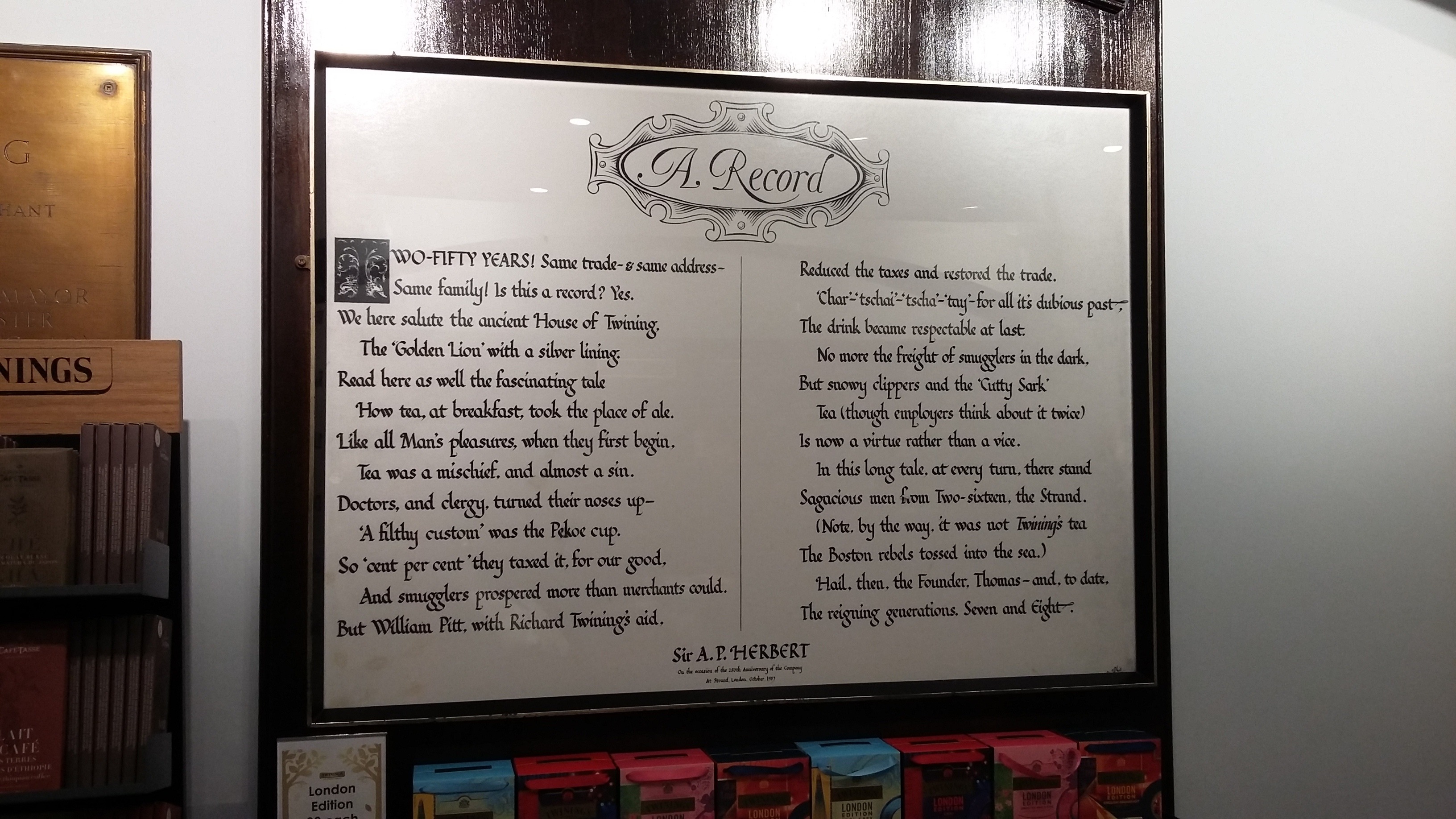
Plaque

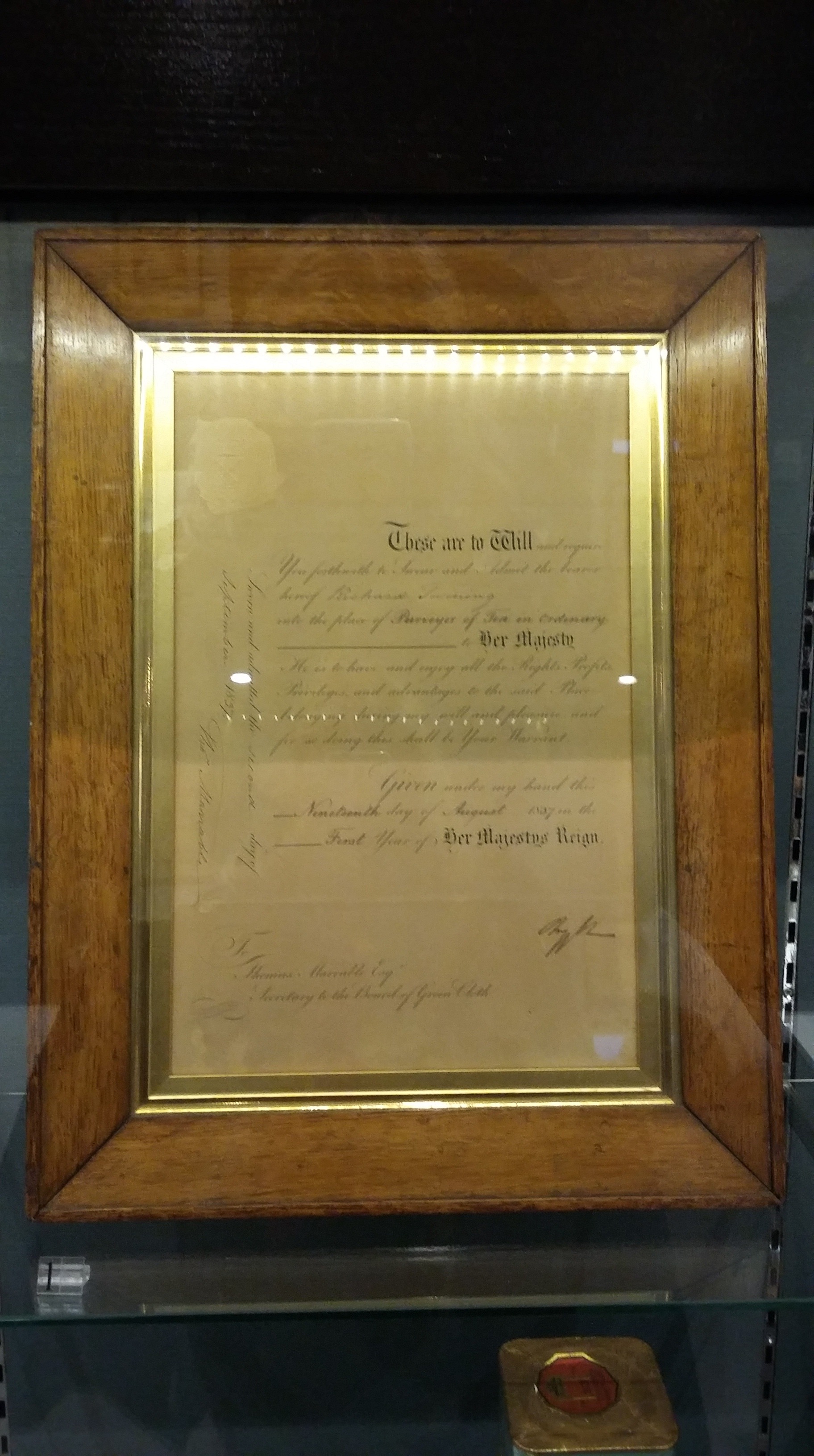
The ‘museum’, which is right at the back of the narrow shop, has artefacts from Twinings rich history, which dates back 300 years, founded by Thomas Twining who helped to ensure tea became a rival drink to coffee which was then popular in London’s coffee houses. Tea’s popularity rose dramatically, and Twinings was later granted a royal warrant.

Royal warrant

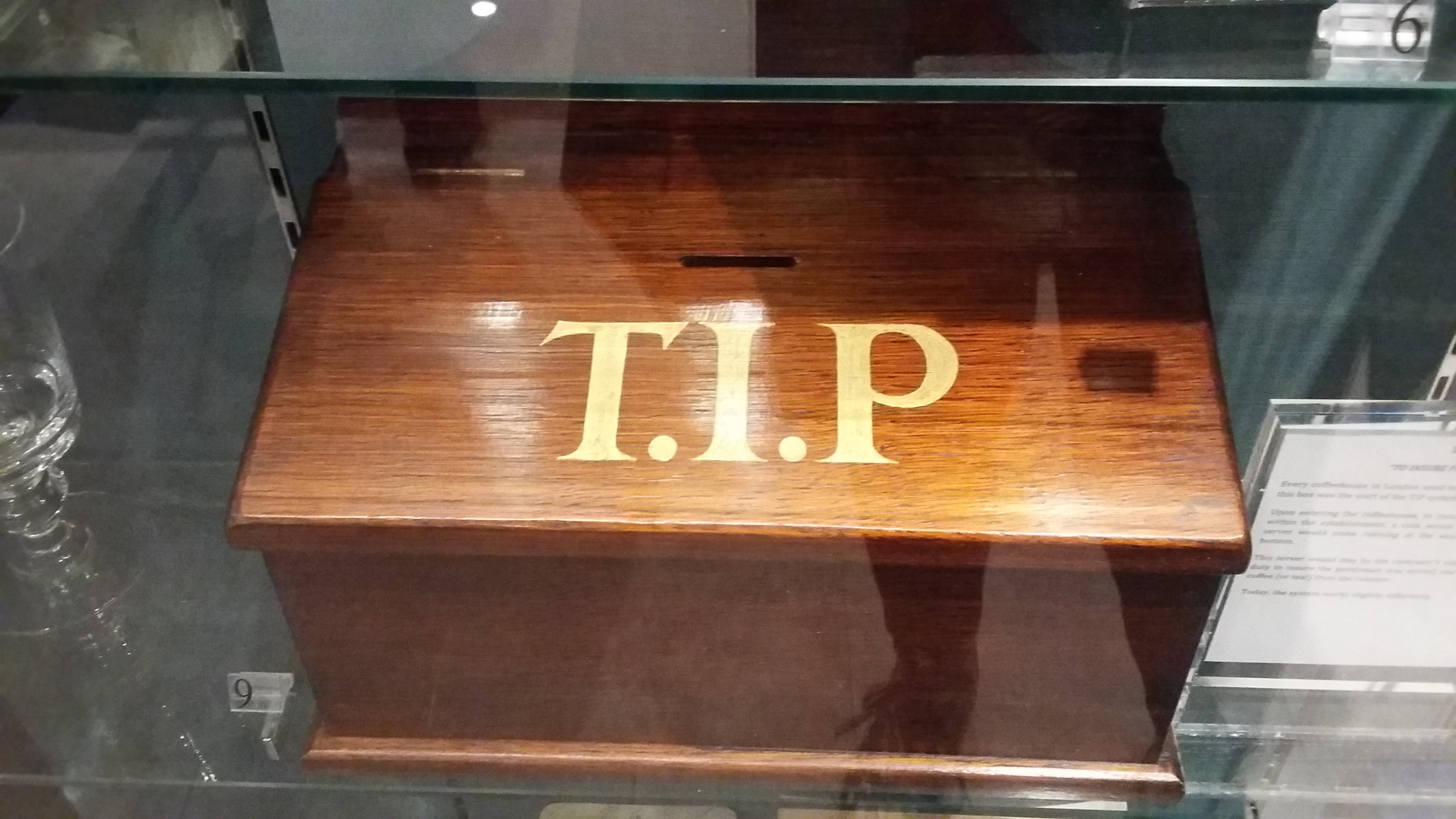
TIP box

There is also a ‘tea bar’ where you can sample different varieties of tea.

Tea bar

The shop is a really worthwhile place to visit, whether you want to stock up on tea, look round the museum, or just sample a few different brews.

FACTS

Address: 216 Strand, London, WC2R 1AP

Website: twinings.co.uk/about-twinings/flagship-store-london-216-strand

Opening Hours: 9.30–7 Mon-Fri, 10.30–5.30 Sat, 11-5 Sun

Price: Free

Winnie-the-Pooh: Exploring a Classic – V&A

Winnie-the-Pooh poster

As a lifelong Winnie-the-Pooh fan, I was delighted to be able to visit the V&A‘s new exhibition, Winnie-the-Pooh: Exploring a Classic. Themed around the world of the books, it welcomed visitors with a greeting and the themed decor made you really feel part of the Hundred Acre Wood. There was a slide and assorted activities for children – but I couldn’t help being glad that during my visit, on a Friday evening, there weren’t many kids around.

Hallo

Pooh-themed toys
Pooh-themed toys

The exhibition began with a display of the various Pooh-themed toys, games and accessories that have been created over the years. I was particularly pleased to see a cuddly toy version of the Soviet Pooh, which I love, but was gutted to spy a gorgeous Cath Kidston dress that I obviously missed when it was in store.

Soviet Pooh
Soviet Pooh
Cath Kidston dress
Cath Kidston dress

The exhibition explored the writer, A. A. Milne, and the illustrator, E. H. Shepard, and the history of the Pooh stories. Particularly fascinating were the sections on how the two worked together to produce stories that seamlessly blended words and pictures, strongly appealing to little ones (as well as grown-ups like me!).

North Pole

I found the exhibition completely fascinating, and it really reignited my love for Winnie-the-Pooh and his friends. (I’ve always felt a particular affinity for Piglet).

Goodbye

Friendly with Bears

Whales: Beneath the Surface – Natural History Museum

Whales exhibition

I’d been meaning to visit the Whales: Beneath the Surface exhibition for a while, and finally made it on its last weekend. As befits an exhibition at the Natural History Museum, it was superb: informative, fascinating and fun.

The exhibition began by looking at where whales began. Now, I’m sure I learned this at school, but I’ve certainly forgotten it in the intervening years, so I was surprised to find that the earliest cetaceans, 50 million years ago, were actually land mammals with legs and hooves. Pakicetus hunted small land animals, as well as fish. Ten million years later, these cetaceans had adapted to life in the water: the Dorudon had flippers instead of front legs, its back legs had all but disappeared, and it gave birth and fed its calves in the sea.

Pakicetus
Pakicetus
Dorudon
Dorudon

Around 34 million years ago some cetaceans evolved new way of eating – baleen plates. These baleen whales became known as mysticetes, while those that continued to use teeth – toothed whales, dolphins and porpoises – became known as odontocetes. Scientists worked out that mysticetes and odontocetes shared a common ancestor from watching growth in the womb – baby mysticetes were growing teeth which disappeared before birth.

Baleen plates
Baleen plates

Today, there are around 90 species of cetacean – 23 of which are found in British waters. 12 million years ago there were many more. Their ancestry is evident in the modern whale skeletons on display: tiny back leg bones, remnants of their land mammal past, and flippers that resemble hands. On display also is the skeleton of the ‘Thames whale’ – a northern bottlenose whale that ended up in the Thames in 2006 and died despite a rescue operation. Modern-day cetaceans have powerful tail muscles to help propel themselves forward. They move their tails up and down, whereas fish move their tails from side to side.

The 'Thames whale'
The ‘Thames whale’

The exhibition explored the differences between species of whale. Blue whales, for instance, have smaller flippers to help them travel long distances, whereas humpback flippers are bigger with grooves and bumps to help them twist and turn in the ocean. Baleen whales live alone, but toothed whales are sociable and live in groups. Toothed cetaceans use echolocation to find their food, whereas baleen whales gulp seawater and filter it out, keeping in the prey. A fantastic game, loved by the children in the exhibition, involved jumping on electronic pads to ‘track’ prey using echolocation.

Later on, the exhibition explored how whales hear and create sound, as well as how these incredibly intelligent creatures interact with one another, caring for each other, playing, and even singing ‘songs’. It also explored a possible future for whales: different killer whale skulls showed how groups of these whales ended up with different kinds of tooth marks from hunting very different prey, and may one day diverge into different species.

Killer Whale skulls
Killer Whale skulls

I loved this exhibition, not least because I was able to match my Erstwilder Wesley Whale brooch to the theme.

Exhibition selfie

London Mithraeum

Bloomberg SPACE Entrance

I read about the London Mithraeum on the London’s Museums blog, and immediately put it on my list of places to visit. You have to book in advance, but entry is free, and I signed up to visit in the morning of the best Saturday of the year so far. It was bright, sunny and not too cold, and as I arrived at Bank station well before my entry time, I spent a few minutes just wandering around the area and enjoying the outdoors (something which is highly unusual for me).

'Forgotten Streams' by Cristina Iglesias
‘Forgotten Streams’ by Cristina Iglesias

History

The Mithraeum is located in the basement of Bloomberg SPACE, which is on Walbrook, just next to Bank station. The street was named after the Walbrook river which used to flow over this very spot; I also spied an artwork by Cristina Iglesias marking this lost river. The river is important to the Mithraeum, as it was the soggy conditions of the soil in this spot that allowed the preservation of so many incredible Roman artefacts.

The Roman settlement of Londinium was founded nearly 2,000 years ago. Almost two centuries later, a resident built a temple to the god Mithras on the banks of the Walbrook. Eventually covered over and forgotten, it was rediscovered in 1954, its purpose only uncovered on the last day of excavations when a head of Mithras was found. The discovery sparked great public interest, with more than 30,000 people queuing up to see the site on some days. The Temple was dismantled and reconstructed elsewhere, opening in 1962.

Bloomberg acquired the site in 2010, and worked with the City of London and conservation specialists to restore the Temple to its original location and allow the public to access it.

Display of Roman artefacts found during the excavation

My Visit

I entered the building at the appropriate time, had my ticket scanned, and was immediately confronted by a very un-Roman scene: a work by Isabel Nolan, Another View from Nowhen, comprising a colourful tapestry and a large open sculpture. before heading towards the display case at the back of the building. Gazing in awe at the huge range of archaeological finds I was offered an electronic tablet to help make sense of them. As previously mentioned, the damp earth allowed for many objects to be preserved that would ordinarily have decayed long before, including a door, sandals, and writing tablets. There were the usual pottery fragments and decorative acessories, including a striking bull ornament supposed to represent Taurus.

Heading down the stairs to the next level, a timeline on the wall leads you back through time via significant events in London’s history. At the bottom, models of important discoveries with interactive displays help you to understand the significance of Mithras and the Temple before you head into the Temple itself.

Writing tablet featuring the first recorded mention of 'Londinium'
Writing tablet featuring the first recorded mention of ‘Londinium’

Who was Mithras?

Scholars have been studying the cult of Mithras for two hundred years, but even so not a lot is known. Most of what we know is down to interpretation. The central icon of the cult, an reconstruction of which is displayed here, is an image of Mithras killing a bull, which may be a battle or a sacrifice. It has been interpreted as a creation myth and possibly a vision of the universe, owing to the Zodiac symbols surrounding one of the models. Other Mithras icons have been found all over Europe, and they and the archeological sites from which they come have helped scholars to deduct what a Mithraic ritual might have been like.

The Mithraeum
The Mithraeum

Inside the Temple

Temple ‘experiences’ take place every twenty minutes. You enter a long dark room, with a walkway around the edge of the wall and jutting out slightly into the centre. Audio and lighting effects create a spooky atmosphere, as if Romans were walking into the Temple to worship. It’s hugely atmospheric and effective, and you get a sense of what the Temple might have looked like and how it all fits together. A metal frame at the end shows where the model of Mithras would have been.

Mithras
Mithras

To sum up…

The Mithraeum is amazing and well worth a visit. The display is great and well-organised, and the temple itself is very atmospheric. Don’t miss if you have any interest at all in the Roman history of London.

FACTS

Address: 12 Walbrook, London, EC4N 8AA

Website: londonmithraeum.com

Opening Hours: 10-6 Tues-Sat, 11-5 Sun (advance booking recommended)

Price: Free

Royal Academy of Music Museum

Museum entrance
Museum entrance

Getting back into museum visiting mode, I paid a visit this weekend to a place I’ve been meaning to go for a long time: the Royal Academy of Music Museum. I’ve attended a few concerts at the Royal Academy of Music and often walked past the free museum, but I’ve never had the chance to go as it’s only open during the day. I headed down on Saturday afternoon, turning left out of Baker Street station and passing the queue of expectant tourists waiting to go into Madam Tussaud’s.

The museum is located in the RAM’s premises on Marylebone Road. It has an entrance area with a gift shop (not to mention a well-stocked selection of music books) and displays on three floors.

Stradivari violin
Stradivari violin

The ground floor covers the history of the RAM, which was founded in 1822 by a group of aristocrats. The Academy’s first premises were on Tenterden Street; the first pupils were youngsters aged 10-15 and the President was former child prodigy William Crotch. Eventually the Academy attracted royal patronage, with George IV signing the Royal Charter in 1830.

Early piano
Early piano

The rest of the ground floor is given over to special exhibitions; the current exhibition focuses on the Spencer Collection, which came to the Academy from the estate of Robert ‘Bob’ Spencer, professor of Early English Song at the Academy for many years. Spencer was a former librarian, and loved tracking down and collecting the rare manuscripts and instruments that form the backbone of his fascinating collection, which was instrumental (pun intended) in igniting the study of early music in England.

Steinway piano
Steinway piano

The first floor is the home of the Strings Gallery, which has some fine examples of harps, violins, violas, a cello and a double bass. One violin is a Stradivari. The Piano Gallery is located on the second floor, with a number of fine examples of instruments from several centuries, including Georgian square pianos, early nineteenth century Broadwood instruments (one of these was gifted to Beethoven) and a Steinway grand.

The gallery is a very pleasant place to visit for anyone with an interest in music and instruments; it’s full of fascinating historical information.

FACTS

Address: 1–5 York Gate, Marylebone Road, London, NW1 5HT

Website: ram.ac.uk/museum

Opening Hours: 11.30am–5.30pm Monday to Friday, 12pm–4pm Saturday

Price: Free

Ramin Karimloo Back from Broadway

Another year, another Ramin Karimloo gig – something I’ve been looking forward to for months. After spending time on Broadway performing in the musical Anastasia, he has come back to the UK for a bit. His last Royal Festival Hall gig was back in 2012 – I don’t know where the time’s gone since then!

I can’t find a setlist, but Ramin sang songs from the musicals he is known for, like Phantom and Les Miserables – Music of the Night, Till I Hear You Sing, Bring Him Home – and tunes from other musicals like Oklahoma!, The Greatest Showman and Finding Neverland – Oh What A Beautiful Morning, From Now On and Neverland. He also included songs he has written himself and released previously, as well as a number of new songs. One of the reasons I love seeing Ramin live is that I am always being introduced to new types and genres of music.

It was such a good night and I only hope I don’t have to wait for another year to see Ramin live again.

London Sewing Machine Museum

Entrance to the store/museum on Balham High Road

It’s the start of a fresh new year and I really want to get on to visiting some of the many, many museums in and around London. With that in mind, on the first Saturday of 2018 I headed down to the London Sewing Machine Museum, located near Tooting Bec Station in south London.

Industrial machines
Industrial machines
Industrial machine close-up

The Museum is on the top floor of the premises of the Sewing and Craft Superstore, just round the corner of the station. You go through the front entrance and up the stairs to be confronted with – unsurprising given the name of the museum – sewing machines. There is a room full of them, in fact, all of which are examples of those used in industry (the museum owner supplied all of the machines used in the film Made in Dagenham). In a room just beyond are the machines designed for domestic use, including several miniatures, a number designed to be folded away after use, and one that can be disguised as a lion when not in use. The shop front in the museum is from the original branch of the Wimbledon Sewing Machine Co. Ltd, founded by the grandfather of the present company director, Ray Rushton. He inherited his grandfather’s passion for sewing machines and is responsible for many of the collection’s gems.

Original shop front
Original shop front
Barthélemy Thimonnier's 1829 sewing machine
Barthélemy Thimonnier’s 1829 sewing machine
Victorian sewing machine

I’ve never used a sewing machine myself – I’ve always found them to be a bit scary – but I was fascinated by the museum, in no small part thanks to the enthusiastic volunteer who gave us a short guided tour of the space. If it hadn’t been for her I would certainly have missed Barthélemy Thimonnier’s unobtrusive wooden machine, the first widely-used and practical machine, invented in 1829. More obvious was the ornate Victorian machine gifted to Queen Victoria’s eldest daughter and used by her nurse for many years.

Charlie Chaplin's mother's sewing machine
Charlie Chaplin’s mother’s sewing machine
Boy George alongside the model that helped create his costumes

I certainly hadn’t expected to come across Charlie Chaplin and Boy George in the museum. Machines associated with both entertainers can be found here: the original sewing machine belonging to Chaplin’s mother, and an identical model to that used by Boy George’s mother to sew many of his early costumes.

The museum is surprisingly interesting even for those who aren’t massively into sewing machines, and it’s free too. Well worth visiting if you have a free Saturday afternoon.

FACTS

Address: 308 Balham High Road, London, SW17 7AA

Website: craftysewer.com/acatalog/London_Sewing_Machine_Museum

Opening Hours: 2am-5pm on the first Saturday of the month

Price: Free (donations welcomed)

A Moomin Winter’s Eve / Tove Jansson (1914-2001) – Dulwich Picture Gallery

exhibition poster

This year I read the Moomin books for the first time, and I also visited the Adventures in Moominland exhibition at the Southbank Centre. Continuing the theme, Dulwich Picture Gallery announced a Tove Jansson exhibition for 2017-2018, covering her artwork and illustrations from self-portraits to the Moomins and beyond.

Some friends and I booked to attend the special December event, A Moomin Winter’s Eve. This was an after-hours event that offered activities as well as a chance to look around the exhibition. When we arrived – after spending a while waiting for a bus at Brixton – we headed straight into the exhibition before it got too busy.

Tove Jansson (1914-2001) begins with the artist’s early work, striking self-portraits sitting alongside magazine illustration and magical landscapes. Her later work incorporates more traditional painting, before she turned to illustration in a bigger way. I had no idea Jansson was responsible for illustrating Swedish versions of The Lord of The Rings and Alice’s Adventures in Wonderland – her work is distinctively her own but also clearly captures the atmosphere of the stories.

Then comes her Moomin work, which forms around half of the exhibition. I love her wonderfully expressive drawings of these fantastical creatures, and it was fascinating to see them close up. As the daughter of two painters, Jansson saw herself primarily as a painter even while the world revered her for her work as a writer and illustrator, but while this exhibition helps to paint a wider picture of the artist, she is likely to remain best known for the Moomins. And why not? Her illustrations are certainly classifiable as art, and her books are children’s classics.

pom pom table

After the exhibition, we decided to check out some of the activities. First we went to make flower garlands in a Pom Pom Blossom workshop, run by Pom Pom Factory. We ended up wearing them for the rest of the evening.

My Moomin masterpiece

We then went to join the table drawing Moomin self-portraits. I am certainly no artist, but having a framework of a Moomin silhouette to work on, I managed to produce something passable.

Moomin collage

Finally we went down to the Moominvalley Photobooth, the idea here being to create a collage inspired by Moominvalley and have your photo taken, then superimposed onto your background. Sadly the camera battery ran out while we were making our collage, but it was still great fun.

The exhibition and the evening were lovely and a nice relaxing way to spend a Friday night.