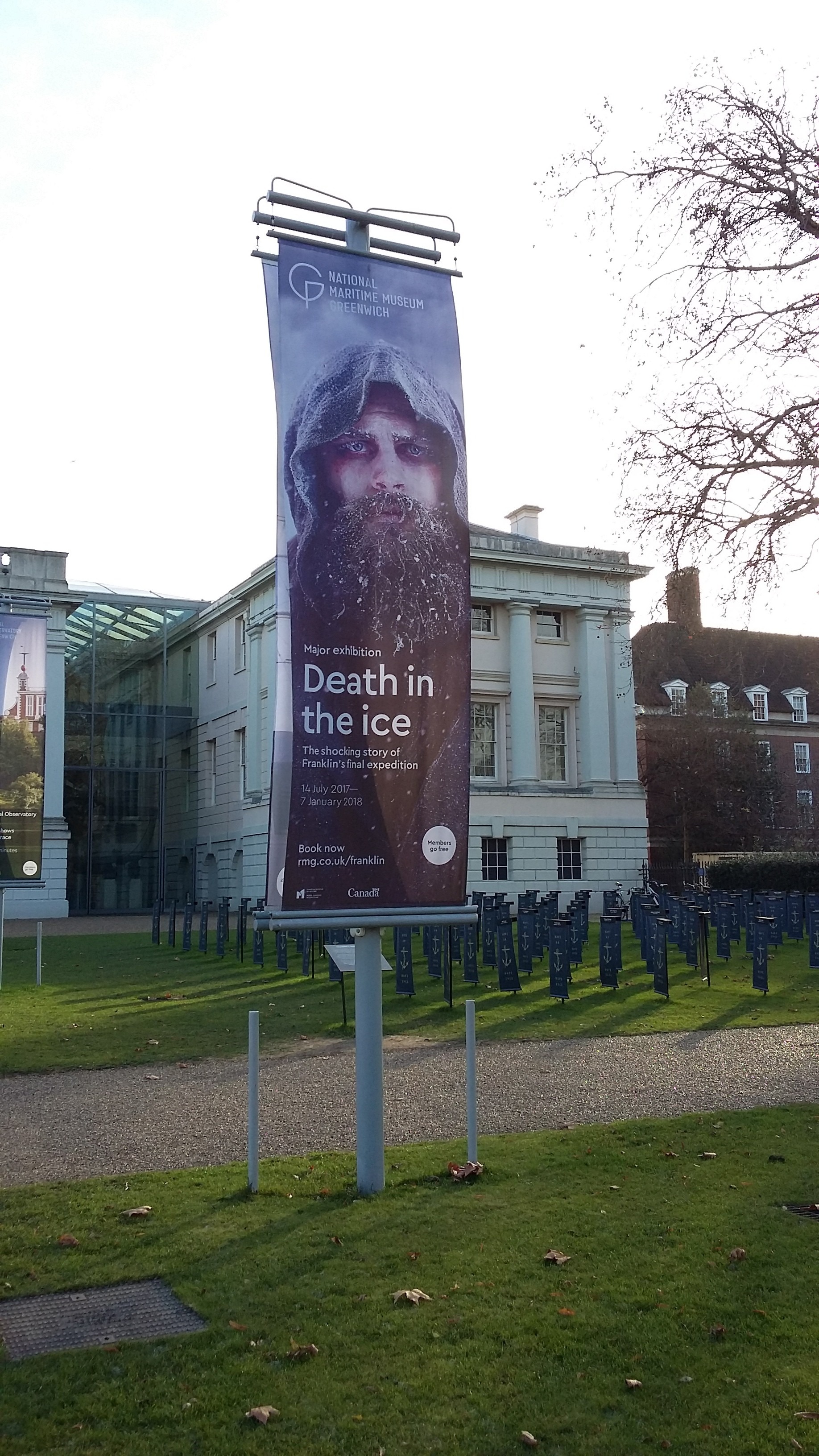
Death in the Ice: The Shocking Story Of Franklin’s Final Expedition – National Maritime Museum

National Maritime MuseumIn 1845, a Royal Navy expedition commanded by Sir John Franklin to discover and chart the North West Passage set off on its journey. None of the 129 men on the expedition were ever seen alive again. Death in the Ice: The Shocking Story Of Franklin’s Final Expedition has been developed by the Canadian Museum of History (Gatineau, Canada), in partnership with Parks Canada Agency and with the National Maritime Museum, and in collaboration with the Government of Nunavut and the Inuit Heritage Trust.

The fate of Franklin’s expedition has been a mystery for over a century: despite numerous searches, many instigated by Franklin’s wife Jane, few traces were ever found. A handful of artefacts and some human remains have been discovered, but it is only in the last couple of years that the wrecks of the flagship, Erebus, and its companion vessel, Terror, have been discovered. The ultimate reason why the expedition ended in tragedy has never been established. Approaching the National Maritime Museum, you are confronted by a sea of flags; each one represents a man lost on the expedition.

The exhibition starts with an exploration of the Arctic environment and how Inuit peoples live and thrive in such harsh conditions. Centring the Inuit experience is important for two reasons – firstly because their way of life could have – but didn’t – inspire the various British expeditions that tried to survive in the Arctic in the nineteenth century, and secondly because Inuit testimony was frequently ignored when searchers were trying to find out what had happened to the crews of Erebus and Terror.

The exhibition continues with a look at life on board ship, the role of the different crew members, and brief biographies of key figures on the expedition. It explores the route the expedition took, past Beechey Island and round to King William Island, before the trail grew cold. The expedition spent several winters on the ice, in the dark and cold, with little food other than what they had brought with them from England.

Later the focus turns to the many search parties sent out by Lady Franklin and others, before the ships were finally given up for lost. I must say that to someone like me who knows this topic quite well, much of the exhibition up until now was already known to me, and I didn’t really learn anything new. The exciting part comes towards the end, when I got to view several artefacts, recently recovered from the wrecks, including the bell from Erebus, cast at the Whitechapel Foundry specially for the voyage. It’s still possible to read the date stamp on the side. Videos allow you to watch the divers at work underwater, exploring the wreckage of the ships.

No one really knows exactly why the crew all perished, but various theories are put forward: scurvy, lead poisoning, starvation, disease and more. Two crew members who died fairly early on in the journey have been exhumed, and the evidence in their case points to tuberculosis, but this probably did not infect the others on board. Evidence of cannibalism has been found, but it’s impossible to say for certain whether starving crew members killed and ate their fellows out of desperation, or only ate the flesh of those who had already died.

The exhibition is a fantastic introduction to the Franklin expedition for those who don’t know a great deal about it, and for those already fascinated by the topic it allows you to see some incredible artefacts. What will stick in my memory is the single shoe, preserved in the ice, from an unknown crew member – a poignant reminder of the expedition’s human cost.

Death in the Ice runs until 7 January at the National Maritime Museum
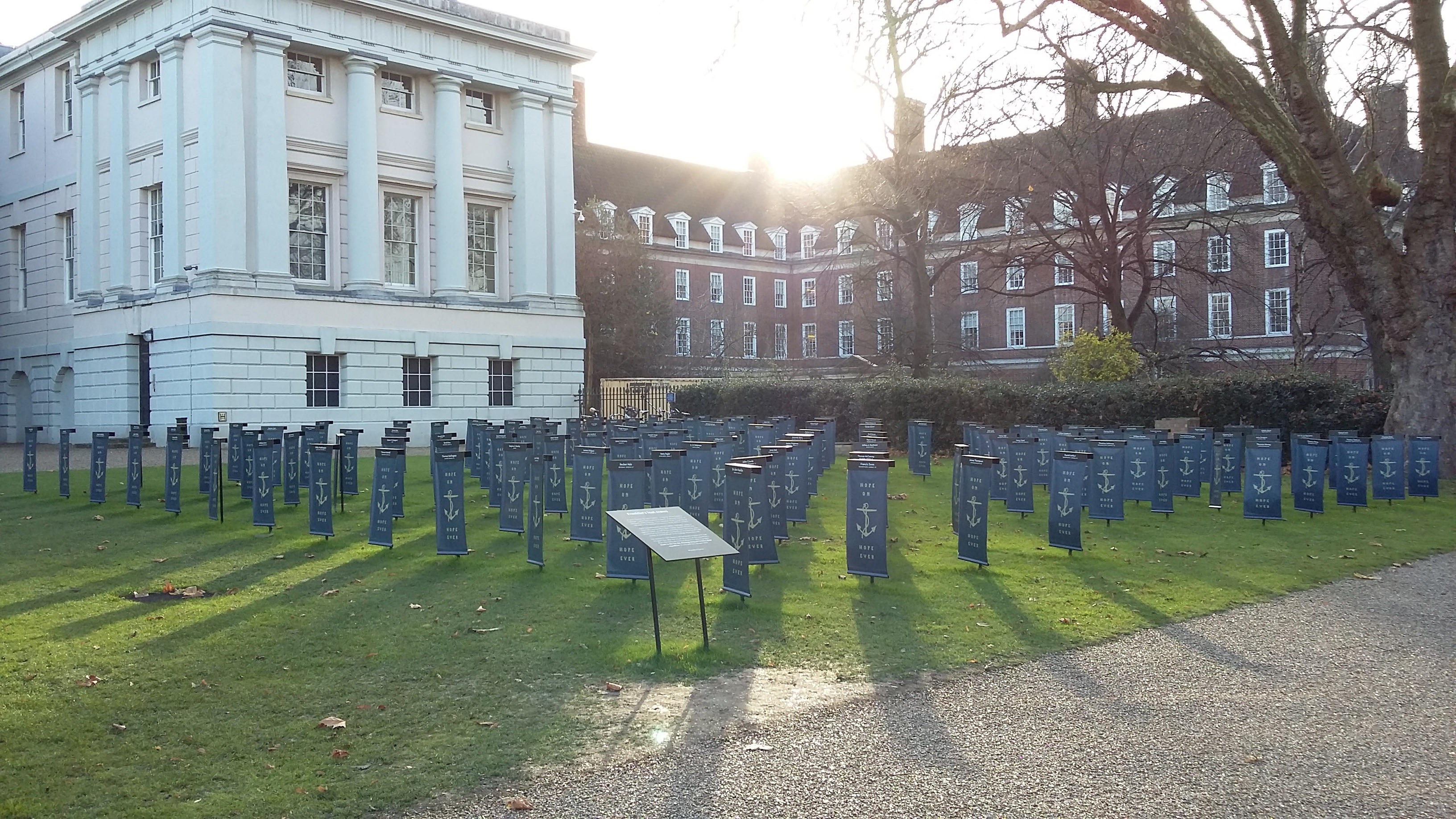
Flags marking the dead

Painted Hall Ceiling Tour – Old Royal Naval College, Greenwich

Painted Hall
Outside the Painted Hall

The Old Royal Naval College in Greenwich is currently restoring the famous Painted Hall. The Hall is not, however, closed to visitors during this time: it is possible to book tours of the ceiling, climbing up on the scaffolding to get close to the ceiling and get a close-up view.

Inside the Hall
Inside the Hall

We put on our high-visibility jackets and hard hats in the room at the end of the hall, where we heard a little about the history. The Painted Hall is one of the most spectacular and important baroque interiors in Europe. Its ceiling and wall decorations were conceived and executed by the British artist Sir James Thornhill between 1707 and 1726, the period when the United Kingdom was created and became a dominant power in Europe. The end wall mural, which has already been restored, shows King George I and his large family, alongside symbols of wealth and plenty. The artist himself is in the bottom right corner of the painting.

Sir James Thornhill
Sir James Thornhill
Full mural
Full mural

We headed up the stairs to where a makeshift floor has been built with scaffolding, giving the appearance of a low-ceilinged room. Our guide talked us through the various murals and highlighted some of the key figures on the ceiling, as well as discussing the restoration work.

At the ceiling
On the scaffold(ing)

Among the figures represented are Greek and Roman gods, monarchs, and even one of the Greenwich pensioners, John Worley, who served at sea for 70 years. He is depicted with a long white beard and painted to represent the season of Winter. Over the past few centuries there have been several restorations, and many workers have left their mark on the ceiling, mostly in the corners where they have daubed their initials. One cheeky person, however, added his name and date right in the middle of Queen Anne’s chest. I did take a picture, but it doesn’t show up very well.

Queen Anne
Queen Anne
John Worley
John Worley

The tour is fascinating and well worth the effort. Tours can be booked online for days throughout the week and are due to continue for the duration of the building work.

The National Portrait Gallery

National Portrait Gallery

On the same day I visited the Supreme Court, I decided to pop into the National Portrait Gallery. I’ve been there a few times in the past, but it’s been a while since I’ve gone through it thoroughly.

The NPG was founded in 1856 and was the first portrait gallery in the world. It moved to its current site in 1896. As the name suggests, it contains portraits of the great and the good from the late medieval period onwards – the pictures have been chosen for the significance of the sitter, not the artist. It’s interesting to see how this changes over time: in the sixteenth century it’s mainly monarchs, with the odd courtier; later on the litany includes scientists, artists and poets, and the modern day portraits include celebrities: singers, actors and sports people.

The Gallery is arranged chronologically from the top to the bottom, so I headed to the top floor via the escalator. The first things you see are casts from the tombs of medieval kings, this from a time before portraits were common. From then it’s straight into the Tudor era, starting with a few Tudor-era portraits of medieval kings. I still remember the first time I saw this part of the Gallery: I was fresh from studying the Tudors at A Level, and it was amazing to see the paintings I’d only ever seen in textbooks in the flesh. Queen Elizabeth has a strong presence but there are also famous pictures of Henry VIII and Mary, Queen of Scots.

Paintings dating from the Jacobean period onwards cover monarchs as well as famous scientists, writers and artists, including the famous Chandos portrait of Shakespeare and one of my favourites – a dramatic painting of poet John Donne. I naturally gravitate towards the writers – I love the picture of Lord Byron towards the end of these galleries.

Statue of Victoria and Albert

Works from the Victorian era can be found on the floor below; these are very, well, Victorian. There is a room for politicians and a corridor for famous public faces, plus many representations of Queen Victoria herself. My favourite room here is the writers’ room, which contains Branwell Brontë’s painting of his three famous sisters, as well as a picture of another of my favourite authors, Thomas Hardy. Another of my favourites is the dashing portrait of a young Lord Tennyson.

The early twentieth-century gallery has recently been refurbished, and it was good to see it looking refreshed. In general this isn’t my favourite artistic period, but there are some interesting portraits here of the likes of Virginia Woolf, Sir Ernest Shackleton and Sir Winston Churchill.

The Gallery hosts regular special exhibitions (for which a charge is made) and offers late-night opening on Thursdays and Fridays. It’s smaller and a bit less daunting than the nearby National Gallery, but it’s well worth a visit.

FACTS

Address: St Martin’s Place, London, WC2H 0HE

Website: npg.org.uk

Opening Hours: Daily 10am-6pm, open until 9pm Thurs & Fri

Price: Free (charge for special exhibitions)

The Supreme Court

Supreme Court

Not so long ago I found out that you could book tours of the Supreme Court, which take place on Friday afternoons. I had some holiday to use up, so I booked the day off and booked myself onto a tour. I arrived at Parliament Square in plenty of time, and got through security in time to have a look around the exhibition before going off on my tour.

History

I’d assumed that the Supreme Court had been around for ages, but that isn’t the case at all: in fact, it’s a fairly modern institution. It was established in 2009, taking over judicial authority from the House of Lords. It is the final court of appeal for all United Kingdom civil cases, and criminal cases from England, Wales and Northern Ireland. The most famous case in its short history occurred last year, when Gina Miller and other campaigners challenged the government, arguing that Parliament should have a vote on Article 50. The public are able to watch cases as they are heard; this particular case was the busiest ever, with queues forming outside the building.

The Supreme Court is housed in what was once the Middlesex Guildhall, designed by J. S. Gibson in 1912-1913. It is Grade II* listed, but has been renovated to fit in with what it’s now used for.

Exhibition

This is housed in the basement, in an area which used to be taken up by prisoners’ cells when the building was a Crown Court. It has information about the history and role of the Supreme Court, as well as the Judicial Committee of the Privy Council, and how the two courts fit into the legal systems of the countries they serve.

Tour

The tour took us round all three courtrooms and the library. The first courtroom is the largest and in some ways the grandest; it still has many of the original features. The second is very different, with a much more modern appearance. Curtains and carpets have been designed specially for the building, showcasing the emblem which is displayed on the wall. This reflects the four nations which make up the United Kingdom: a rose for England, a thistle for Scotland, leek leaves for Wales and a flax flower for Northern Ireland.

Courtroom 1
Courtroom 1
Courtroom 1
Courtroom 1
Supreme Court logo
Supreme Court logo
Courtroom 2
Courtroom 2

The third courtroom is generally reserved for the Judicial Committee of the Privy Council, which is the highest court of appeal for many independent Commonwealth nations or Crown dependencies which are too small to have their own.

Courtroom 3
Courtroom 3
Courtroom 3
Courtroom 3

The library is impressive, with a large array of books and walls covered with quotes relevant to law.

Library
Library
Library
Library

I really enjoyed my tour, and would definitely recommend it.

FACTS

Address: Parliament Square, Little George Street, Westminster, London, SW1P 3BD

Website: supremecourt.uk

Opening Hours: Mon-Fri 9.30-4.30. Tours take place on Fridays.

Price: Entry free; tours £7 (£5 concessions)

All Hallow’s Eve by Lamplight – Tower Hamlets Cemetery

Hallowe’en is the perfect time to visit a cemetery; besides, I never did get to go on a proper tour of Tower Hamlets. So I was happy to book a place on the All Hallow’s Eve by Lamplight tour, run by the Cemetery Club.

Tower Hamlets Cemetery

We gathered at the entrance by the war memorial and collected some lanterns to take with us on our walk. And we needed them – there are no other lights in the cemetery, and even with the lanterns it was pretty dark. (I apologise for the poor quality of these photographs – I tried with and without flash and they were both pretty dire). Our guides escorted us round the cemetery, stopping at various points to tell us about various notable people buried here.

Towards the end of the tour we enjoyed some soul cakes of the kind eaten at Victorian Hallowe’en – they were baked to an original Victorian recipe and were yummy – spicy and delicious. We learned about nineteenth century Hallowe’en traditions and superstitions.

Finally, we were treated to an original Victorian music hall song, originally sung by Alexander Hurley, and based on a real event involving a strongman defeated by a daring rival.

Sadly I didn’t see any bats on the walk – perhaps because they were all frightened off by the fireworks. However it was a fascinating and atmospheric walk.

Tower Hamlets Cemetery

Harry Potter: A History Of Magic – British Library

I booked my exhibition ticket for Harry Potter: A History of Magic back in April, and it’s just as well, as many dates for this groundbreaking exhibition are already sold out. It’s the first British Library exhibition to focus on the work of a living author, and I couldn’t imagine a better subject. The exhibition will fascinate any Harry Potter fan, but there’s much here to interest those who have never read a word about the famous boy wizard.

J.K. Rowling took inspiration from myths, legends and history to write about the magic in her books, and the exhibition looks at how magic as it has been seen in our world helped to inspire her. It’s divided up into sections based on the subjects Harry studies at Hogwarts: Potions, Divination, Charms, Care of Magical Creatures, and so on, and there is also a section on alchemy, relating to the Philosopher’s Stone which is so important in the first book.

We see many rare books and historical artefacts: the Ripley Scroll, purporting to explain how to make the philosopher’s stone, alongside Nicholas Flamel’s gravestone (apparently discovered being used as a chopping board in Paris). The Potions section has rare books describing the various potions and their antidotes – there is also a bezoar displayed – and Herbology displays a copy of Culpeper’s Herbal, of which Rowling had her own copy that she used to refer to when writing the books. We see a cauldron and a broomstick from the Museum of Witchcraft in Boscastle, and possibly my favourite exhibit of all: the ‘Invisibility Cloak’.

Throughout the exhibition, illustrations by Jim Kay bring the characters to life, and we also see sketches by Rowling, which are fascinating as they show the characters as she originally imagined them. My favourite parts were the handwritten or typed early drafts of various chapters, showing the Harry Potter stories as they might have existed, and offering insights into how Rowling changed and adapted her stories.

I loved this exhibition – it runs until February, so there’s plenty of time to see it, but I definitely recommend booking in advance.

Scythians: Warriors of Ancient Siberia – British Museum

This exhibition at the British Museum intrigued me: I’d never heard of the Scythians, but I’ve always been interested in Siberia. Scythians: Warriors of Ancient Siberia is a co-exhibition with the Hermitage Museum, St Petersburg, and many of the artefacts in the exhibition are on loan from that museum.

The Scythians were a nomadic group of tribes who endured for about 600 years, around 600BC, herding cattle and goats on the steppe, and the exhibition sheds light on their lives and culture. There is an abundance of beautiful jewellery, including belt buckles and neck ornaments depicting scenes mixing real animals with mythical ones which, experts have theorised, point to their religion and culture. Their warrior culture is alluded to by the prevalence of helmets and head ornaments, hugely elaborate and detailed. The Scythians spanned southern Siberia from west to east and evidence suggests they had contact with other groups from Africa, Europe and China. For several centuries, the only record of the Scythians came from the writings of Herodotus, who travelled in the area around 440BC. Many of these artefacts were later dug up by archaeologists sponsored by Peter the Great, who ordered them to be sent to St Petersburg for his new museum. As a result, they are well organised and well-catalogued, and some of the original eighteenth-century drawings of the ornaments are on display beside the originals. On the walls of the exhibition are quotations from contemporaries, including Herodotus, about the Scythians: their fearsomeness in battle, their wild drinking. As the Scythians themselves did not have a written culture, these ornaments and other excavated artefacts take on an even greater significance.

What really took my breath away were the wonderfully preserved things that by rights should have disintegrated long ago, saved by their preservation in Siberia’s permafrost. These include fleeces, squirrel fur coats, even a pair of boots, as well as the tattooed skin of a Scythian warrior on which the marks still show up clearly. A giant coffin, constructed of wood, looks as though it was built yesterday, and one bag, containing food to accompany a deceased chief to the afterlife, has yielded lumps of preserved cheese.

Most of the artefacts on display are from wealthier people, which is not surprising since these are more likely to have been preserved. However, there are some objects relating to more ordinary Scythians, including weapons, ornaments and cooking equipment. Several preserved heads have been found, enabling scientists to try and reconstruct the face of a Scythian.

What could have been another run-of-the-mill exhibition about an ancient people is brought to vivid life by the beauty of the incredibly well-preserved objects on display. I was fascinated by it and loved learning more about this ancient society.

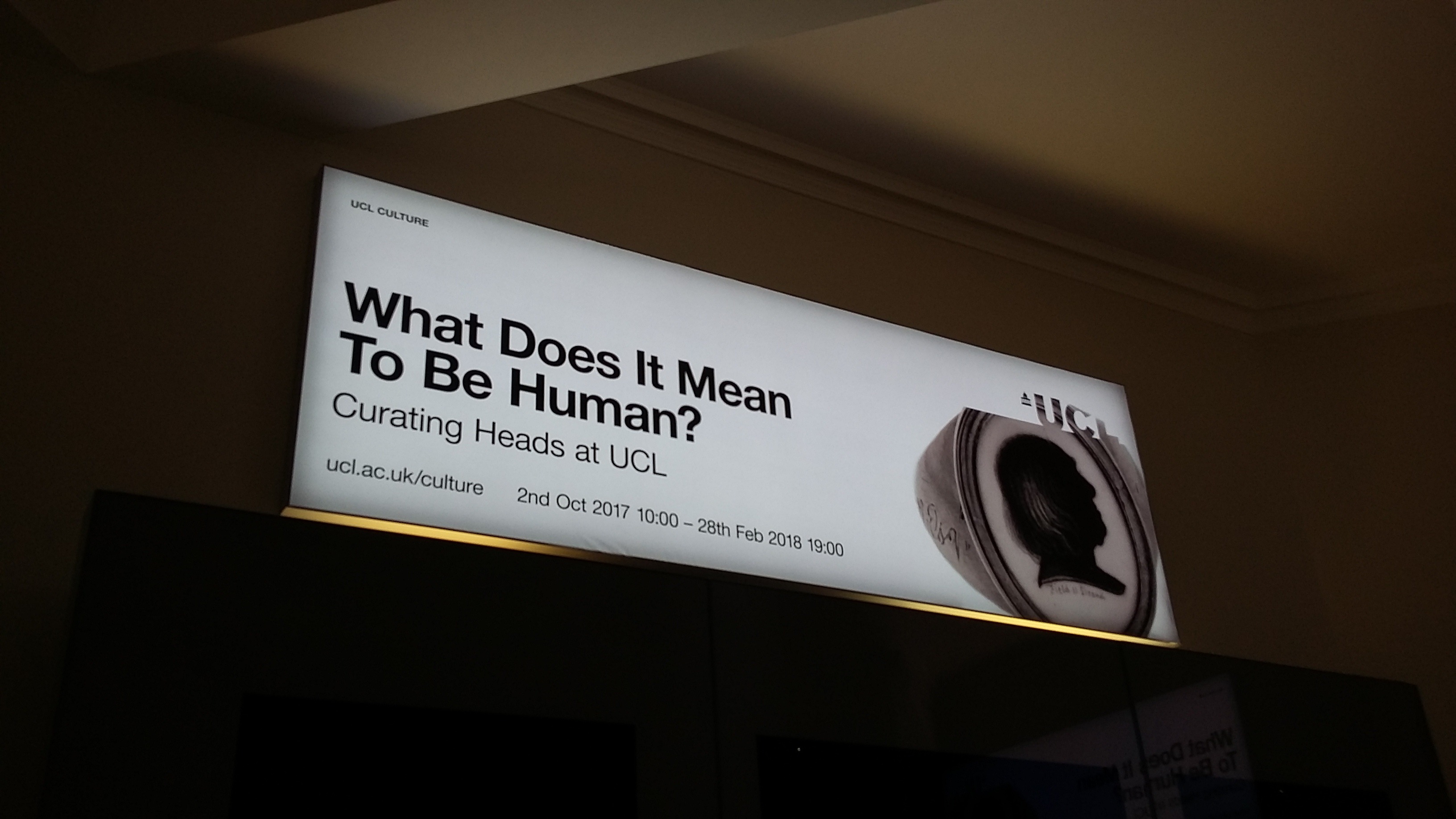
What Does It Mean To Be Human? Curating Heads at UCL – Octagon Gallery, University College London

I read about What Does It Mean To Be Human? Curating Heads at UCL online and went to check it out after work; it’s a tiny exhibition, covering the walls in the Octagon space within UCL’s Wilkins Building (entrance via Gower Street).

For several decades, the preserved heads of Jeremy Bentham and Flinders Petrie – two intellectuals related to UCL – have been hidden from view. Following on from a project to extract their DNA, this exhibition asks: what does the scientific interrogation of our dead bodies tell us about how we think about ourselves?

There are four cases: one concerning the archaeologist Flinders Petrie, one on cultural views on death and commemoration, one focusing on Jeremy Bentham, and the last case focused on DNA sequencing.

It’s a rather brief exhibition, but worth glancing at if you’re in the area.

I didn’t take any pictures of the preserved heads, feeling that this would somehow be inappropriate. I did, however, walk down the corridor and take a picture of Jeremy Bentham’s auto-icon. (Yes, that is his actual, preserved body; the head, however, is wax).

Bentham auto-icon

An evening in conversation with Arne Dahl – North Finchley Library

Just a quick note on an event I went to at North Finchley Library – a talk by Swedish author Arne Dahl (real name Jan Arnald). I love a bit of Nordic noir and I’ve enjoyed several of Dahl’s books as well as the TV series they are based on.

Dahl spoke a bit about his most popular series, the Intercrime books, as well as his upcoming work. At the end there was a question and answer session, which I didn’t contribute to (I never do, to be honest). It was definitely worth the trek to North London after work, though.

Garrick’s Temple to Shakespeare – Open House London

Garrick's Temple to Shakespeare
Garrick’s Temple to Shakespeare

On the Sunday of the Open House London weekend, I headed south again to visit Garrick’s Temple to Shakespeare, created by David Garrick for his hero William Shakespeare. Born in Hereford and raised in Lichfield, Garrick moved to London and became the most well-known and acclaimed actor of the age. In 1754 he purchased Hampton House, now Garrick’s Villa, overlooking the Thames at Hampton.

Garrick's Villa
Garrick’s Villa

His riverside garden was laid out by Lancelot ‘Capability’ Brown, and this octagonal Palladian temple was built in 1756. The temple has a dome and eight Ionic columns, making it similar in style to the temple at Chiswick House.

Bust of Garrick
Bust of Garrick

From the temple, Garrick gave money and cakes to poor children every year on May Day. He also used it for entertaining friends such as Dr Johnson, as well as for writing and storing relics to Shakespeare. Eventually he had a tunnel constructed to enable him to reach the temple from his house.

Inside the temple
Inside the temple

In 1758 Garrick commissioned a life-size marble statue of Shakespeare from the eminent Huguenot sculptor, Louis François Roubiliac *Garrick may have posed for this himself). The original version had ‘veins’ across the face, a characteristic of the marble; Garrick insisted the head was replaced. The original statue is now in the British Library; this version was given to the Trust by the British Museum.

Shakespeare sculpture

The temple eventually fell into disrepair until the late 20th century when the local council and several charities raised funds to restore the building and lay out the gardens again. It is now managed by the Garrick’s Temple to Shakespeare Trust, and contains copies of paintings from major galleries plus original 18th century prints and engravings about Garrick. It’s open on Sunday afternoons throughout the summer months and occasionally you can attend concerts here, too.

Garrick on stage
Garrick on stage

FACTS

Address: Hampton, Middlesex, TW12 2EJ

Website: garrickstemple.org.uk

Opening Hours: Sundays 2-5 March-Oct (check the website for exact dates/times)

Price: Free