Hendrick’s Gin Ministry of Marginally Superior Transport

2016_0723Hendricks00

I’m rather fond of gin, and when I found out via Showfilmfirst about a special event involving gin, London, and a rather special bus I knew I had to go. The Hendrick’s Gin Ministry of Marginally Superior Transport was obviously designed as a way to promote the Hendrick’s brand, but to be honest as the tickets were only £2.50 this really didn’t bother me.

2016_0723Hendricks01 2016_0723Hendricks03

The event involved a bus journey around London in which we were served G&Ts and delicious gin cocktails with a bonus gin macaron. The bus was beautifully decorated with bizarre mock-Victorian wallpaper and we got a few freebies including a rather awesome fan, which I’m sure I’m going to make plenty of use of during the summer.

2016_0723Hendricks12

During the journey we were entertained by bearded bartenders and challenged to complete a number of tasks including writing a poem: I’m rather proud of my brief effort, considering I haven’t written a poem since school.

I had an identical twin,
Who had a grand passion for gin.
At the hint of a frolic,
She’d pour gin and tonic,
And begin her descent into sin.

2016_0723Hendricks04 2016_0723Hendricks10 2016_0723Hendricks11 2016_0723Hendricks13

The Cartoon Museum

2016_0721CartoonMuseum01

I visited the Cartoon Museum one lunchtime to check out their temporary exhibition, The Great British Graphic Novel. Running from 20 April to 24 July, the exhibition examined the development of the graphic novel in the UK over the last few decades, while also looking back to the beginning of graphic storytelling, which dates from the eighteenth century. For instance, Hogarth’s A Harlot’s Progress, a series of illustrations demonstrating the downfall of a young woman in sinful London, was created in 1732.

In the nineteenth century, magazines such as Punch and Ally Sloper’s Half-Holiday became the forerunners of graphic novels, telling stories via panels. In the twentieth century, many graphic tales appeared in newspapers and several were serialised before being combined in book form. Some of the graphic novels examined in the exhibition included Watchmen, Gemma Bovery and From Hell.

2016_0721CartoonMuseum02

I’ve heard graphic novels labelled as “inferior” to standard novels, but this has always struck me as ridiculous. For one thing, I don’t think they can be directly compared to written novels: they are a different medium. For another, I love reading but I actually find reading graphic novels much more difficult than reading written novels: my instinct is to just read the words, but graphic novels need to be read taking into account the illustrations and the text. I can’t imagine the skill needed to be able to create a good graphic novel.

Previously, I’ve only read a very few graphic novels: Alice in Sunderland by Bryan Talbot, Maus by Art Spiegelman, and I’ve got Neil Gaiman’s Sandman at home although I haven’t begun it yet. The exhibition gave me lots of ideas about what I might like to read next.

2016_0721CartoonMuseum03

The Cartoon Museum itself was formed in 1988 when a group of cartoonists, collectors and lovers of the art form came together as The Cartoon Art Trust with the aim of founding a museum dedicated to collecting, exhibiting, promoting and preserving the best of British cartoon art. The current central London home was opened in 2006.

In 1988 a group of cartoonists, collectors and lovers of the art form came together as The Cartoon Art Trust with the aim of founding a museum dedicated to collecting, exhibiting, promoting and preserving the best of British cartoon art. After a decade of exhibiting in smaller venues, in February 2006 the Cartoon Museum opened to the public at its current home in central London, very near the British Museum. As well as regular temporary exhibitions, the museum has a range of permanent displays encompassing the history of British cartoons and comics. There is work by James Gillray and Thomas Rowlandson, who are supposed to have founded the British cartoon tradition, and art by Victorian cartoonists including George Cruikshank, George Du Maurier and John Tenniel. Twentieth-century cartoonists such as William Heath Robinson and H.M. Bateman are also present in the permanent collection, while the upstairs gallery has cartoons by artists such as David Law (Dennis the Menace, Beryl the Peril), Leo Baxendale (Bash St. Kids, Minnie the Minx), Posy Simmonds and Sarah MacIntyre.

The Cartoon Museum is well worth a visit: it’s very close to the British Museum, so you could pop in after visiting the more famous attraction.

FACTS

Address: 35 Little Russell Street, London, WC1A 2HH

Website: cartoonmuseum.org

Opening Hours: 10.30-5.30 Tues-Sun

Prices: Adult £7, concession £5, student £3; under 18 and Art Fund free

Othello: The Curator’s Room – Room 101, Senate House Library

2016_0718Metamorphosis16

After attending the Shakespeare: Metamorphosis exhibition at Senate House Library, I waited around to go into the infamous Room 101 in order to attend a special event, Othello: The Curator’s Room. Here, I got to view Giraldi Cinthio’s Hecatommithi and other works relating particularly to Othello, as well as a Shakespeare First Folio. It was fascinating to see these texts and learn more about them.

Shakespeare: Metamorphosis – Senate House Library

2016_0718Metamorphosis01
Senate House Library

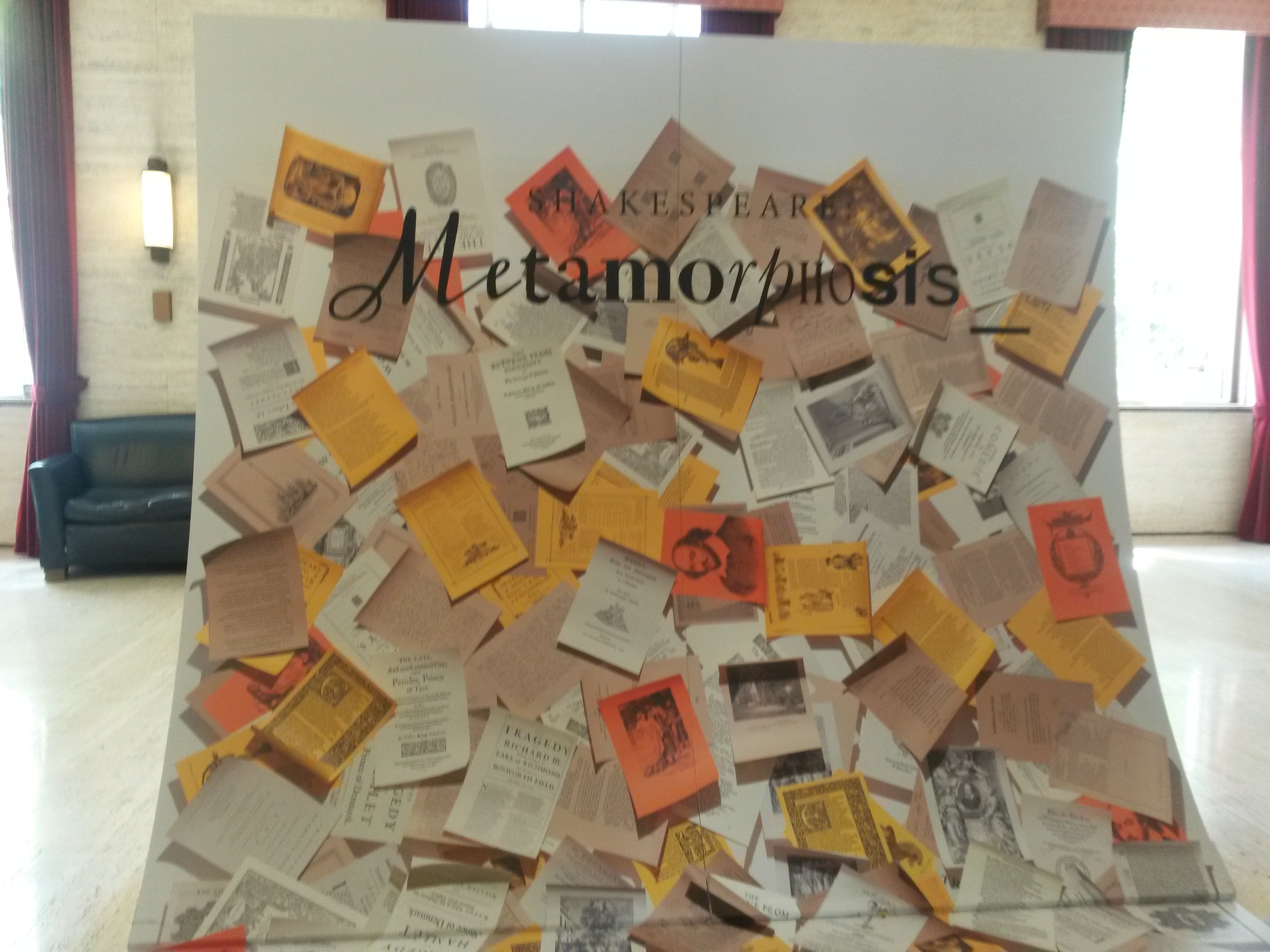
On my day off I headed to Senate House Library for their contribution to the Shakespeare 400th anniversary celebrations: Shakespeare: Metamorphosis, an exhibition which uses the famous “Seven Ages” speech from As You Like It to explore how Shakespearean scholarship has changed over the years. As a librarian, Shakespeare-lover and bibliophile I was very happy to see that the exhibition consisted of several rare and beautiful volumes.

2016_0718Metamorphosis03

2016_0718Metamorphosis05

2016_0718Metamorphosis06

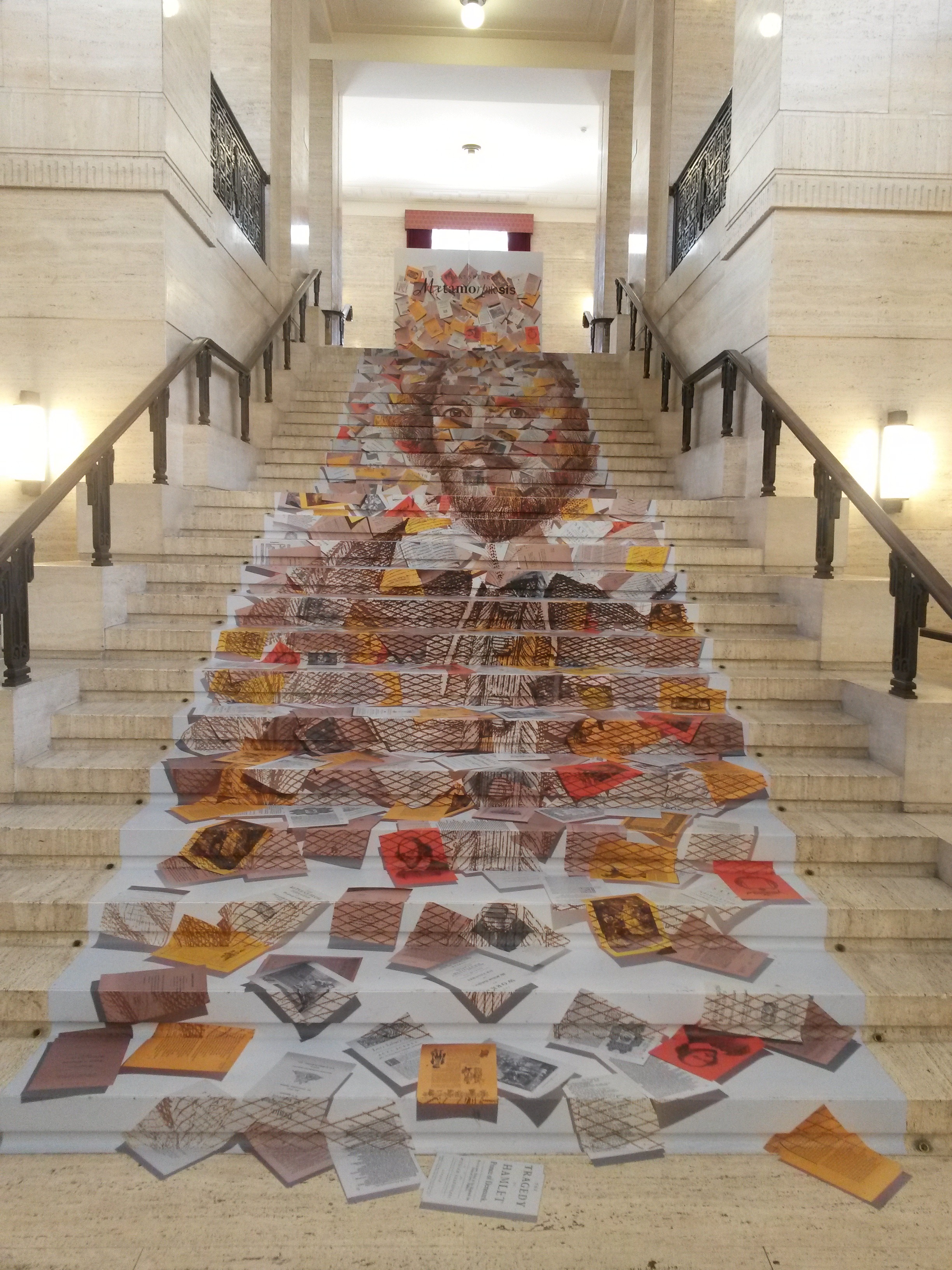
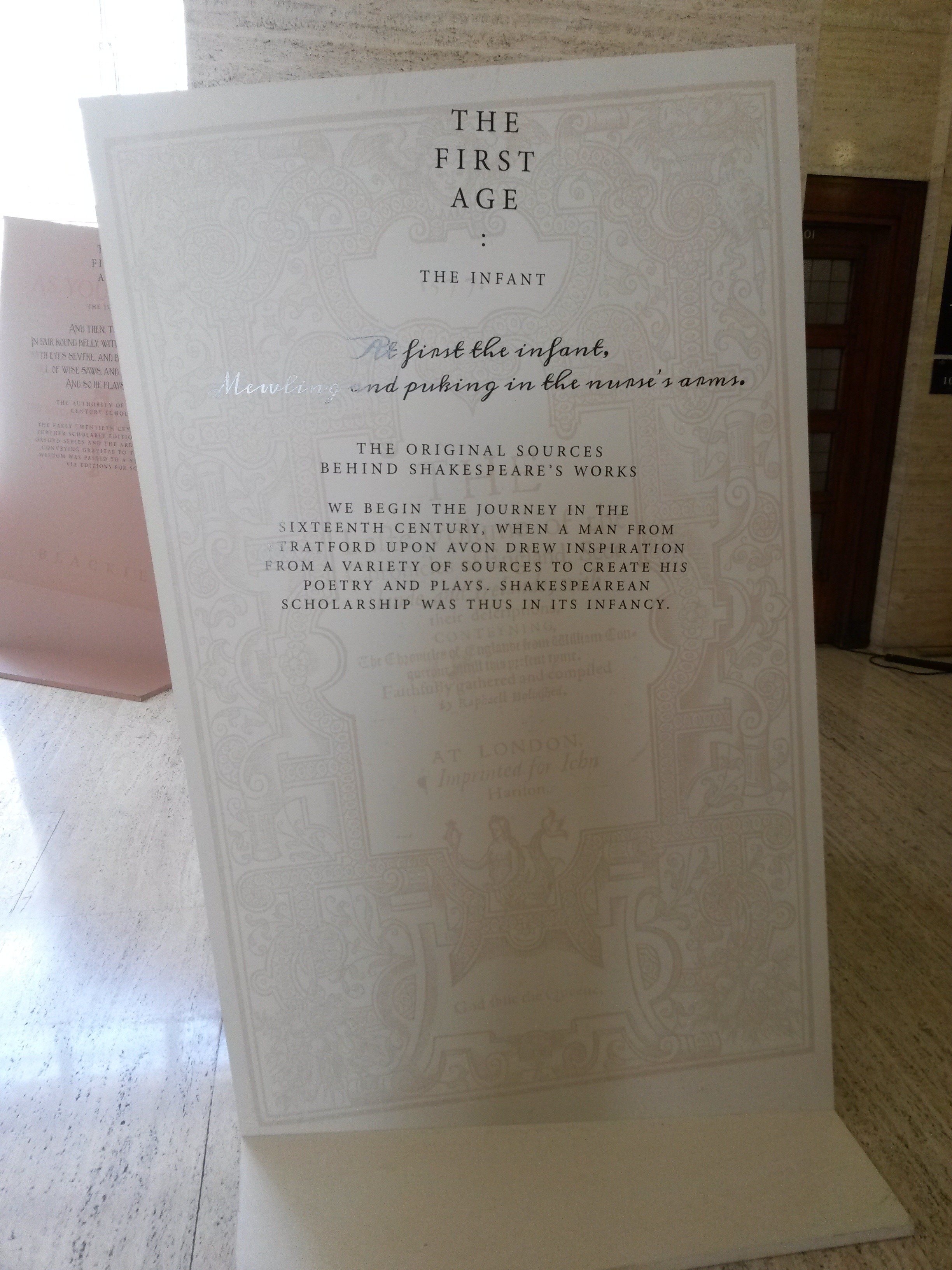
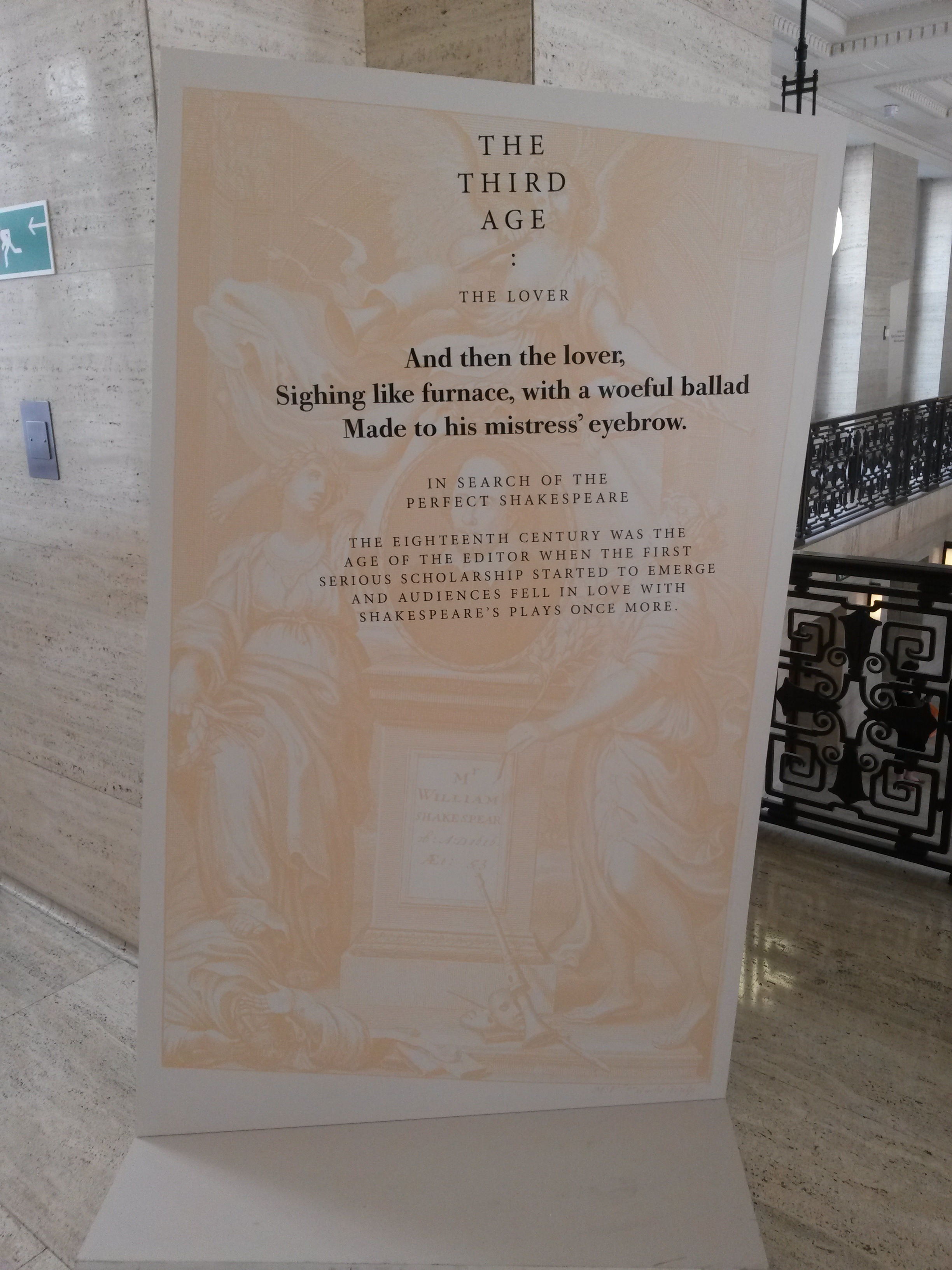
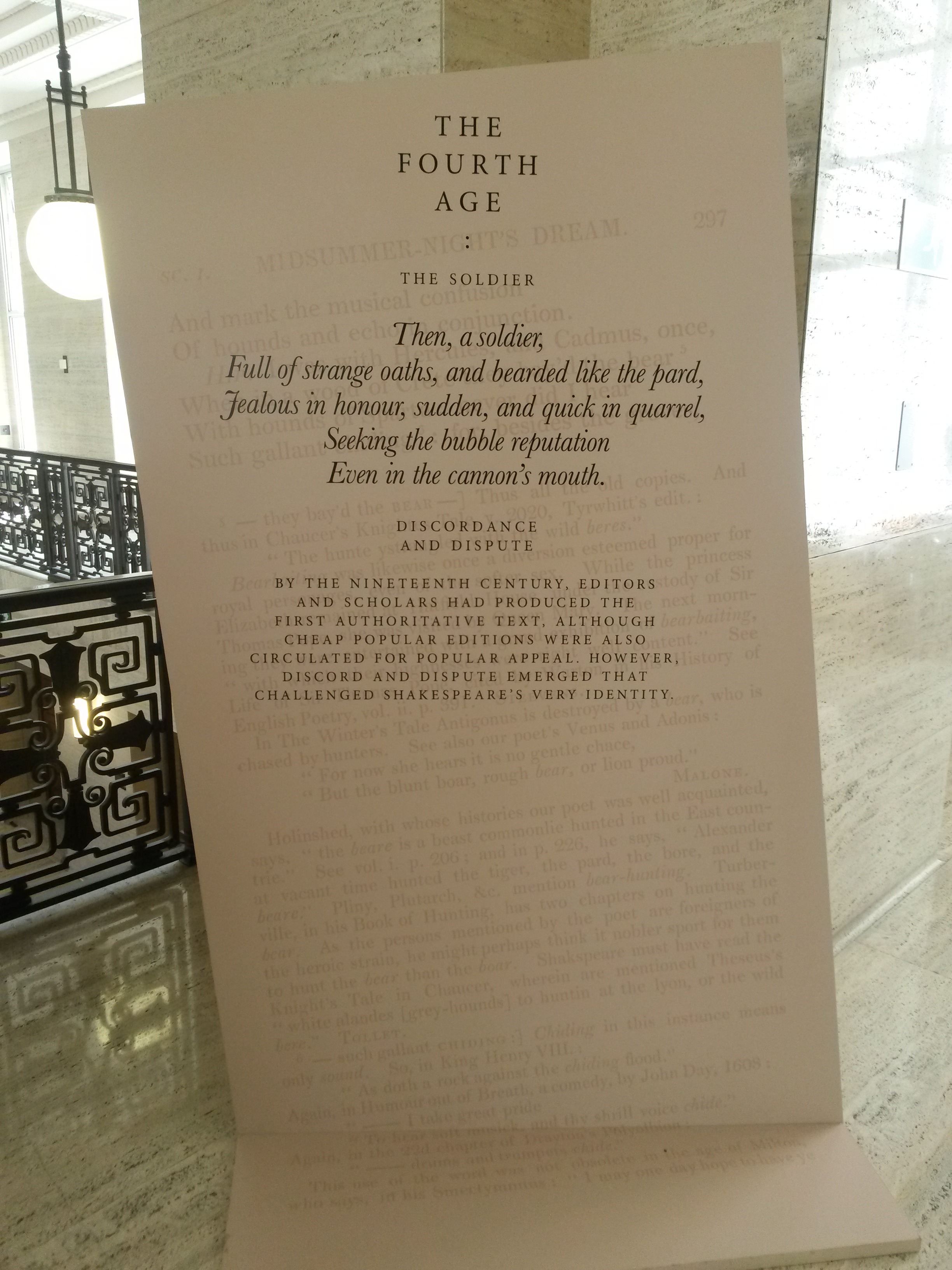
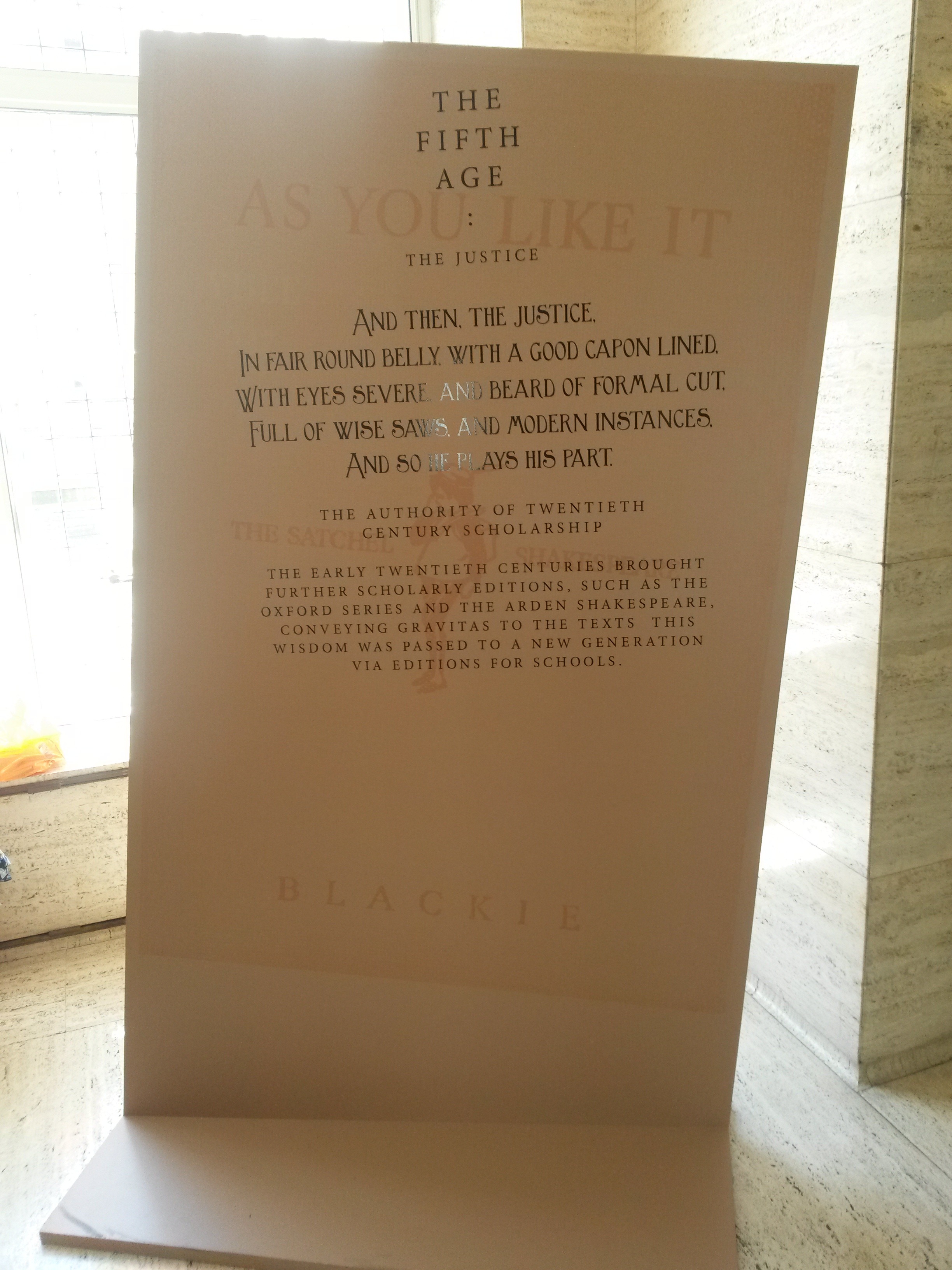
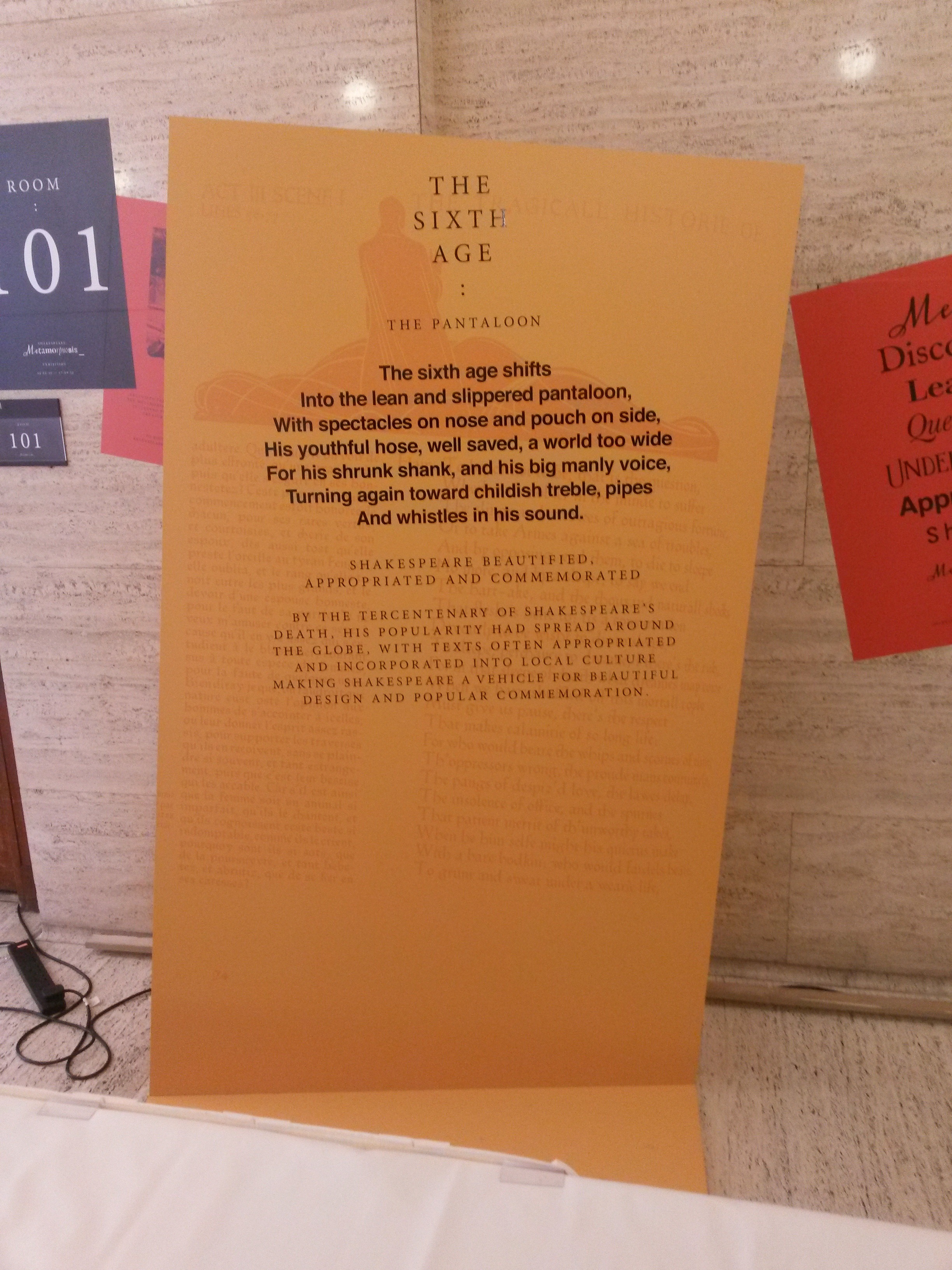
The entrance to Senate House Library has been transformed for the occasion, with a Shakespeare design adorning the steps. Before you even reach the exhibition, there are posters all around, each exploring a different aspect of the history of Shakespearean scholarship.

2016_0718Metamorphosis07 2016_0718Metamorphosis08 2016_0718Metamorphosis09 2016_0718Metamorphosis10 2016_0718Metamorphosis11 2016_0718Metamorphosis12 2016_0718Metamorphosis13

Once you get up to the exhibition, there are some fascinating works to see. Gallery One, ‘The Infant’, explores the influences on Shakespeare and features Holinshed’s Chronicles and the works of Chaucer. Gallery Two, ‘The Schoolboy’, features early quarto editions of some of the plays, including Othello. Other galleries explore the history of Shakespearean scholarship and performance, including the adaptations performed by actors such as David Garrick. In the search to create an authoritative text various sources were used and there were conflicts between scholars. The twentieth century was especially good for academic Shakespeare studies: the first Oxford Complete Works was produced in 1891 by William James Craig, a forerunner of the modern Oxford Shakespeare series edited by Stanley Wells and Gary Taylor from 1986.

2016_0718Metamorphosis14

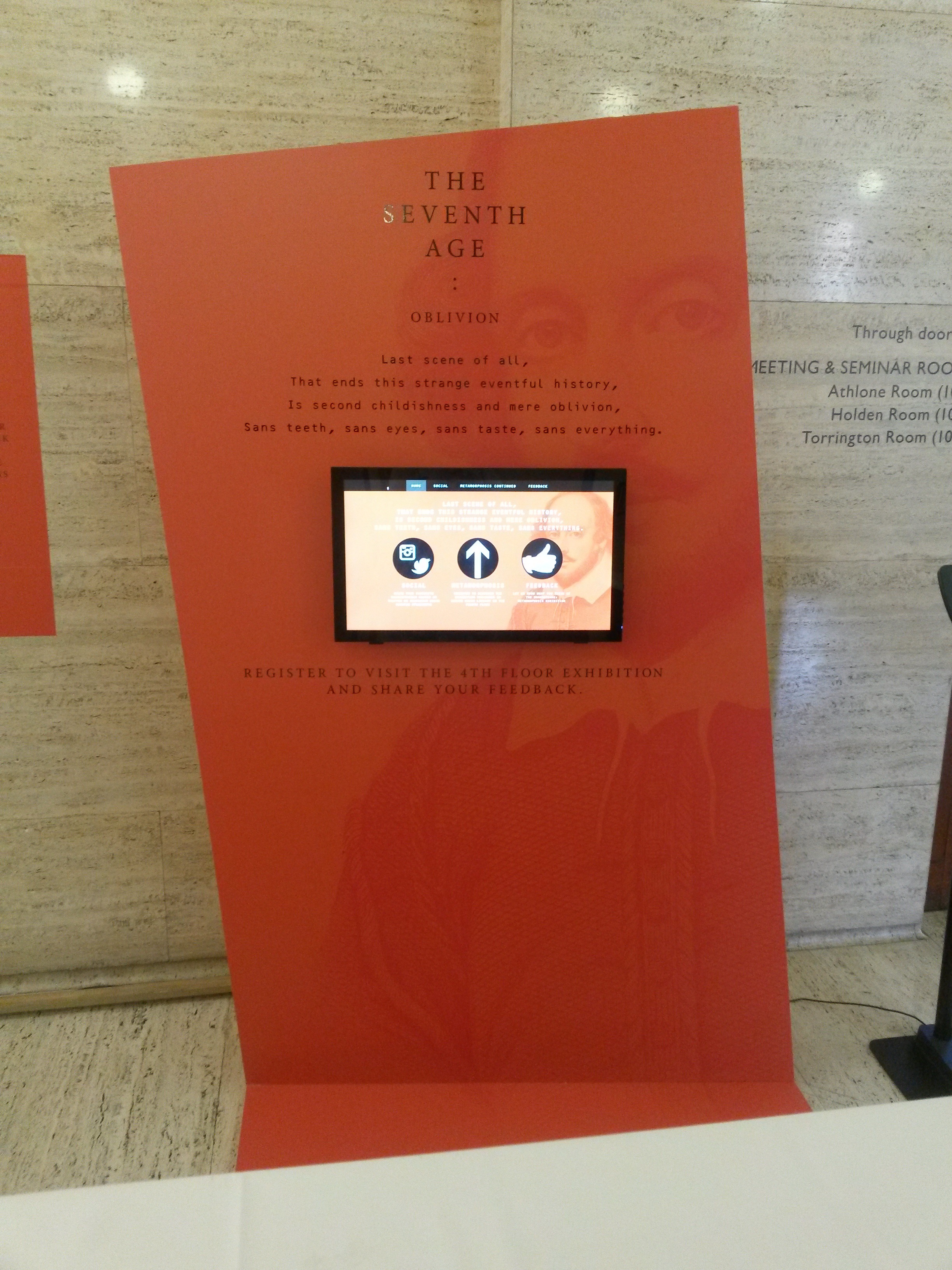
The final gallery, ‘The Superstar’, looks at Shakespeare in the digital world and invites exhibition attendees to make their own contribution, sharing on Instagram or Twitter.

2016_0718Metamorphosis15

Shakespeare: Metamorphosis runs until mid-September, but if you can’t get to London, or want to explore the topic further, you can view an online version. The University of London’s Shakespeare microsite will remain up for the foreseeable future, a valuable resource for fans and students of the Bard.

2016_0718Metamorphosis17

It’s my birthday, and I’ll eat a massive pot of frozen yoghurt if I want to

So, the day after my friend’s wedding was my birthday. I’d expected to be a little the worse for wear, but for some reason I wasn’t too bad. Still, I went out for brunch with a couple of friends and the Bloody Marys were particularly welcome (as well as being extremely spicy).

2016_0717Birthday01

Most of the day was spent in the pub, but I did make a detour to West Brompton Cemetery. I’ve visited West Brompton before, but today was their annual Open Day, with the chance to tour the catacombs. I didn’t want to pass up this chance, so joined the last tour of the day.

2016_0717Birthday04

The catacombs were dark and cool, in many ways not much different from other catacombs I’ve visited. Some of the spaces had plaques placed in front of them, but in most of them the coffins were still visible, albeit in varying stages of decay. We saw one “fish-tail” coffin, where the base of the coffin splays out instead of narrowing, and different kinds of ornate embellishments. The most eerie thing was that the floral wreaths placed by mourners over one hundred years ago were still present: much decayed, but the moss and the basic structure were in place.

Then it was off to the South Bank for a massive pot of frozen yoghurt from the Snog bus.

2016_0717Birthday06

I’d arranged to meet a friend outside the Udderbelly and we were planning to see Knightmare Live. If you didn’t see Knightmare as a child, you seriously missed out. It was an amazing game show in which a bunch of kids directed one of their friends, wearing a giant helmet that covered their eyes, around a fantasy world. The graphics look terrible today, but it still has a unique charm. Lots of episodes are available on YouTube should you wish to inspect them. The best thing about the live show was that they actually brought on the original Dungeon Master, Treguard (Hugo Myatt).

2016_0717Birthday08

Finally we decided to go on a carousel outside the South Bank, because carousels are awesome. My horse was called Stephanie. I have decided that I should go on carousels more often – it was so much fun.

2016_0717Birthday12 2016_0717Birthday14 2016_0717Birthday15

I always get choked up at weddings

(The title of this post comes from the AWESOME Game of Thrones-themed wedding card I got from TheOneCreativeBird)

I love weddings. I love other people’s weddings, so I can enjoy nice food and lovely drinks and heartwarming speeches and a disco without having to make any of the effort myself. I know it’s hugely selfish of me, but there it is. This particular wedding was special because one of my best friends was getting married. The day involved a boat on the Thames and a Routemaster bus.

2016_0716Houghberg09
MUCH EXCITE

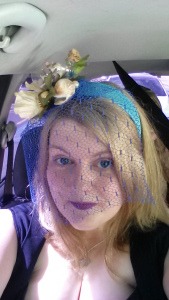
I started putting my wedding guest outfit together several years before the wedding was actually arranged. By this, I mean that I found the amazing Ship in a Bottle Fascinator on the Candy Candy website and purchased it in the hope that one day I’d actually have an occasion to wear it. That day finally arrived – and the fascinator went rather well with the boat. If you can’t wear a ridiculous fascinator to a wedding, when can you wear a ridiculous fascinator?

2016_0716Houghberg20
I’M ON A BOAT

The rest of the outfit I put together in the last few weeks. The Miusol 1950s Vintage Party Dress in Navy Blue was an absolute bargain from Amazon. It fits really well and is made of a slightly stretchy fabric. It’s the sort of dress that I’ll be able to wear again in the future, dressed up or down as I please. On the day I wore it with a black petticoat but I think it would also look nice without one.

2016_0716Houghberg26
I’M ON A BOAT

Shoes: ASOS Spectrum Heels. I love glitter, but while I own three pairs of red glitter shoes (two pairs in London and one in Durham at my parent’s – you never know when you might need them) I didn’t own any silver ones. These are nice and simple, with a low heel that that I thought I would be able to walk in all day without being crippled. I’m pleased to report that they remained comfortable all day.

2016_0716Houghberg27
EVERYBODY LOOK AT ME CAUSE I’M SAILING ON A BOAT

Finding an appropriate bag proved tricky. First of all I got a lovely shell bag from Vintage Styler, but, beautiful as it was, it was far too small for all my things, so I had to send it back. I ended up with this Skinnydip Mermaid Shell Bag in Silver. This one was quite a bit roomier and I was able to fit everything in it except my camera.

2016_0716Houghberg30
‘Wedding Special’!

Special mention to my lipstick, which was MAC Heroine. I would normally wear red on special occasions but I didn’t think it would look right with my outfit. This was the first time I’d ever worn purple lipstick, but I’m really pleased with it.

2016_0716Houghberg43
Thumbs up for the veggie option

It was a brilliant day and I had a fantastic time. I got to spend time with my friends and meet up with people I hadn’t seen for a while. I also chatted to people I’d never met before, which is pretty unusual for me. On the boat I talked to one elderly lady, a friend of the groom’s family, who had actually seen The Mousetrap in London back when it first opened and Richard Attenborough was starring in it. She was so elegantly dressed in a black fascinator, Victorian-style blouse and floral two-piece and I have decided that I want to BE her when I am old.

2016_0716Houghberg34
‘The Houghberg’ – specially brewed wedding ale

A great day was had by all – most importantly the bride and groom. Seeing my friends getting married makes me feel pretty old, but it’s lovely to see them so happy. Also, free champagne is always welcome.

Fox Talbot: Dawn of the Photograph – Science Museum

2016_0710FoxTalbot

I visited the exhibition Fox Talbot: Dawn of the Photograph, held at the Science Museum. Often called the “father of the photograph”, William Henry Fox Talbot pioneered the negative-positive process, a technique that formed the basis of photography around the world for over 150 years. The exhibition contains many photographs taken by him, as well as by those whom he inspired. Many of Talbot’s photos feature his home, Lacock Abbey, in Wiltshire. Though the subjects are often mundane: a door, a tree, a broom leaning against the wall – they are exciting because they are among the first photographic representations of such things.

The exhibition did take a fairly scientific slant (unsurprisingly, it’s the Science Museum after all), which went over my head at times. However, there were snippets of fascinating information, too. In France, another photographic pioneer, Hippolyte Bayard, was so annoyed that his contemporary Louis Daguerre seemed to be getting all the credit that he created a photograph of himself as a drowned man with a suicide note on the back. Pretty dramatic. Ultimately, it was the pictures that were the fascinating things for me.

The exhibition runs until 11 September, so there’s still time to catch it.

Russia and the Arts: The Age of Tolstoy and Tchaikovsky – National Portrait Gallery

I’m hugely interested in Russian culture, and so the National Portrait Gallery‘s exhibition Russia and the Arts: The Age of Tolstoy and Tchaikovsky was an absolute must-see for me. The exhibition features pictures loaned from the State Tretyakov Gallery in Moscow, paintings of some of the greatest cultural figures Russia has produced, including writers, artists, actors, composers and patrons. It’s also possible to trace the development of Russian art through the exhibition, as it covers the period 1867 to 1914, and features Realism, Impressionism and Cubism.

This relatively small exhibition had several highlights for me. Ilya Repin’s portrait of composer Modest Mussorgsky, painted in 1881 just a few days before Mussorgsky died of alcoholism, is powerfully unnerving. The picture Tolstoy shows the great writer relaxing at his home, while the portrait of Turgenev is urbane and smart. The 1872 portrait of Dostoyevsky by Vasily Perov is familiar to me from the cover of the author’s works, and portrays the author as pensive and gaunt. I think my favourite, however, was the 1898 portrait of Anton Chekhov by Iosif Braz. Intellectual and intelligent, the writer stares out of the painting as if challenging the viewer. I kept returning to this picture as I was going round the exhibition. The show was small in size, but contained more cultural giants than any other I’ve seen.

Translating Bulgakov: New Perspectives on a Russian Master – Pushkin House

Pushkin House is a Russian cultural centre in Bloomsbury which regularly hosts events related to Russian art, literature, history and so on. I attended a talk, Translating Bulgakov: New Perspectives on a Russian Master, which discussed the life of the Russian writer. It was chaired by publisher Alessandro Gallenzi and featured Hugh Aplin, translator of The Master and Margarita, and Roger Cockrell, translator of Bulgakov’s Diaries and Selected Letters.

The library at Pushkin House

I’m a huge fan of Bulgakov and The Master and Margarita is one of my favourite novels, so I was really interested to attend this discussion. If you haven’t read it, the book it is about what happens when the devil turns up in Soviet Moscow with a motley retinue including a talking cat – read it, it’s wonderful.

The talk began with Hugh Aplin exploring why The Master and Margarita was not published, or even submitted for publication. Bulgakov was well aware of the censorship issues in the Soviet Union during the mid-20th century. He was able to publish during the 1920s as that was a much more relaxed era, with satire and other forms of writing permitted. The Master and Margarita featured both a highly non-realistic storyline and the presence of Christ – neither of which were advisable in the stricter climate.

Roger Cockrell focused on the trials and tribulations Bulgakov endured. He managed to establish his reputation against all odds, gave up medicine to focus on writing, and kept going even in the face of constant rejection and censorship. He found it tough to earn a living, having a complicated relationship with the Soviet government and with the theatre, particularly Stanislavsky’s Moscow Arts Theatre. His play about Molière was never produced.

During his lifetime Bulgakov was known primarily as a playwright; his last prose works published in Soviet Russia came out in 1925, but his plays enjoyed greater success. In 1928, he had three plays running and another in production; one of the three was The Days of the Turbins, based on his novel The White Guard, inexplicably a favourite of Stalin’s (it was about a family of White Russians).

Bulgakov’s widow worked to ensure his fame, and by the 1960s some of his works had at last been published. Today, he is popular in Russia, but in Putin’s modern nation some artists are still regarded with disfavour, and Bulgakov has not escaped censure. The idea of erecting a monument to the author at Patriarch Ponds in Moscow has met with a lot of resistance.

Hugh Aplin was asked about the challenges of translating The Master and Margarita, and if there was anything still left to translate. He commented that regardless of the quality of the source material, the translator must always act as an interpreter. There are some inconsistencies in the text, which he mentions in his notes. In Russia, a number of different editions of the work have been produced based on the various versions Bulgakov worked on throughout his life, such as The Great Chancellor and The Prince of Darkness.

Roger Cockrell was asked how Bulgakov could physically manage to survive in the circumstances in which he found himself. He said that though the writer found it very difficult – he was often wracked with self-doubt, and was continually denied a visa when he begged the government to let him go abroad – he believed in the importance of writing and of literature, and this helped to sustain him. I admire Bulgakov so much – he achieved a great deal in incredibly difficult circumstances and I truly admire his commitment to literature.

By Me William Shakespeare – Inigo Rooms, Somerset House

I went to see the exhibition By Me William Shakespeare, held at the Inigo Rooms, Somerset House, part of King’s College London, before it closed. The exhibition was an opportunity to view Shakespeare’s will, as well as other documents relating to his life. It incorporated research, scientific analysis and a digital installation, with the nine “most nationally important” documents selected by academics from the London Shakespeare Centre at King’s and specialists from the National Archives.

Although the exhibition doesn’t sound like much, consisting as it does of nine documents, the curators have done a great job illuminating what they all mean and exploring the context. Documents on display include Shakespeare’s Last Will and Testament (he famously left his wife the “second best bed”, though the exhibition does make clear this was not necessarily the snub it is thought to be), as well as those that include four of his six known signatures. One document refers to the infamous incident when Richard Burbage and Shakespeare dismantled the Theatre in Shoreditch and rowed it across the Thames, where they rebuilt it as the Globe. Another concerns the dowry dispute in which Shakespeare was involved because he lodged in the house of the family concerned.

As a lover of Shakespeare, this exhibition was a real treat for me and I enjoyed it, although non-fans may find it a bit dry.