Digging Shakespeare’s Shoreditch: Excavating London’s First Theatreland

St Botolph's Church Hall
St Botolph’s Church Hall

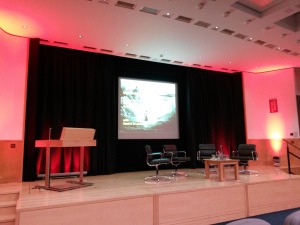
Fascinated as I am by the theatre of Shakespeare’s day, I signed up for a talk by MOLA (Museum of London Archaeology) who are responsible for excavating the Elizabethan and Jacobean theatres in Shoreditch. The talk was given by Heather Knight, who is in charge of the excavations, and was incredibly interesting. The location for the talk was St Botolph’s Hall on Bishopsgate, near Liverpool Street station: this was an appropriate location, given that the site of the Curtain Theatre is nearby; also, member of the Lord Chamberlain’s Men William Kemp was supposed to have begun his ‘Nine Days’ Wonder’ (he morris-danced from London to Norwich) from St Botolph’s Church. Ironically, the rector of the church was not impressed with the theatrical goings on of the day, and wrote a critique denouncing such activities.

Knight, whose team’s excavation of the Curtain Theatre is ongoing, spoke about what archaeology can add to our understanding of Shakespeare and the theatrical environment in which he worked. Unlike many significant cultural figures, we know relatively little about Shakespeare’s life and don’t have much in the way of items belonging to him. It was in the nineteenth century that research first began into his life and the Elizabethan theatre. We know that Shakespeare lived at different times on both Silver Street and Bishopsgate; we know that Shoreditch had a reputation as a place of fun; and we know that theatres were concentrated in two different areas surrounding the City of London: the north, Shoreditch (the Theatre and the Curtain), and the south, Southwark (the Rose and the Globe).

Archaeological research has already taken place at the Rose, part of the Globe and part of the Hope, all south of the river. However, research into theatre in the Shoreditch area began less than a decade ago, when a desk investigation was commissioned in 2007. Sample trenches dug revealed part of the Theatre, which was the headquarters of the Chamberlain’s Men managed by Richard Burbage. They discovered that the Theatre was 22m in diameter, with 14 sides and a tiled roof, not unlike the Globe, though the Theatre building also made use of the old medieval bakehouse and bathhouse that used to be part of the monastery.

Props were found on the site: bells and other costume ornaments and props, such as the end of a scabbard. At this time there was a law against people wearing clothes above their station, but this was waived in the case of actors belonging to a licensed troupe. Going to plays, therefore, was often the only way ordinary people could get to see these beautiful clothes close up. Hampshire border ware was found frequently, though one piece was particularly unusual, having the face of a bearded gentleman complete with a ruff (he looks a bit like Shakespeare). A cannonball was also found, several years after a similar one was found at the Rose – these are believed to have been used for sound effects such as thunder. The discovery implies a kind of “theatrical arms race”, as Knight put it, between Philip Henslowe, owner of the Rose, and Richard Burbage, owner of the Theatre, as they sought to introduce the most cutting edge special effects. The team also discovered something else about the site of the Theatre: after the playhouse closed it may have been taken over by an alchemist, as assorted seeds were found on site, and an upturned jug was discovered in the floor, as well as a piece of pottery in the walls symbolising good and evil in the defence of witchcraft.

The Curtain theatre, named after Curtain Place on which it stood, was nearby, owned by Henry Longman in the 1580s; he was still running it in the 1620s. A desk assessment was carried out on a portion of the supposed site as late as 2011; trenches were dug and walls discovered. Recently it has been confirmed that the theatre, 30m by 22m, was rectangular in shape, rather than the rounder shape of the Theatre, the Globe and the Rose. This is exciting news, but not as out of the ordinary as it might seem: the first Fortune Theatre in London was square, and some Spanish playhouses of the period were also rectangular or square. However, the news sheds a new light on the play Henry V. If, as is believed, that play premiered at the Curtain, then the prologue (“can this cockpit hold/The vasty fields of France? or may we cram/Within this wooden O the very casques/That did affright the air at Agincourt?) makes no sense, so perhaps it was added later, when the play was performed at the Globe. Interestingly, a 1578 French visitor to London wrote about the differences between the Curtain and the Theatre, remarking that one was particularly magnificent. Unfortunately, he didn’t actually state which one, but Knight suspects that he was referring to the Theatre, as it had what would have been a more unusual polygonal shape, with the Curtain being more of a traditional European theatre type.

At the Curtain site, fragments of a bird whistle have been found, which may have been used to emulate the lark in Romeo and Juliet. In later years the building was adapted, with a floor of animal bones in place around 1630. Excavations are still ongoing, but the absence of evidence can be as interesting as its presence. For instance, no money pots have been found, as were discovered at the Rose, suggesting that perhaps the Curtain was a building for hire rather than the home of a company.

The site of the excavation is now called The Stage, and there are plans to build a visitor centre around the remains of the theatre. It may be the last playhouse MOLA get to excavate, which in many ways is sad, but at the same time they have done some brilliant work that they can really be proud of. Work on the Curtain and Theatre has hugely added to our understanding of the theatrical world of Shakespeare’s time, and I feel very lucky to have attended this talk and heard about it first hand. I look forward to hearing more about these groundbreaking excavations.
Scholar, courtier, magician: the lost library of John Dee – Royal College of Physicians

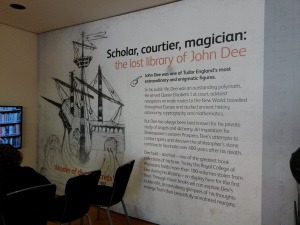
On my day off this week I visited the most recent exhibition at the Royal College of Physicians: Scholar, courtier, magician: the lost library of John Dee. John Dee, or Dr Dee as he is often known (though he was not a doctor in the commonly understood sense of the word, and had no formal medical training), was an Elizabethan polymath, a lover of learning who collected a huge library of books, travelled throughout Europe and was rumoured to have been a spy for Queen Elizabeth I.

2016_0525Dee

Dee was born in London to Rowland Dee and Johanna Wild. He studied at St John’s College, Cambridge, and became an Original Fellow of the newly-founded Trinity College, but he spent most of his adult life at Mortlake, just south of London, where his mother owned property. The way in which the Royal College of Physicians ended up with Dee’s books is rather sad. While Dee was on a trip to Europe, he entrusted his library to his brother-in-law Nicholas Fromond, who sold it off. Many of the books ended up in the possession of Nicholas Saunder, a former pupil of Dee’s, who tried to remove Dee’s name from the front of the books by repeatedly overwriting it with his own. Saunders’ books later passed to Henry Pierrepont, the 1st Marquis of Dorchester, and ended up at the RCP via a family bequest in 1680.

The exhibition explores different facets of Dee’s life: his role as a scholar, his experience as a courtier, his travels abroad and his life as a mathematician. Within each section, books from the Royal College’s collections that used to or were believed to belong to Dee are displayed, to illustrate the different aspects of his life. Dee annotated his books throughout his life with his signature and other notes about the contents of the books. He also had a habit of doodling in his books: the pages are littered with small bearded faces, and in one case a ship.

I liked the anecdotes relating to Dee: in Cambridge he devised a moving dung beetle for a theatrical production, which led some who saw it to claim that it was done by magic. On a more serious note, Dee’s alchemical experiments and attempts to converse with angels got him in trouble throughout his life: he was arrested for casting Mary I’s horoscope, though he was later approached by the Earl of Leicester on Elizabeth I’s accession in order to determine the most favourable day for her coronation. There are several items used by Dee on display, including a scrying glass and a crystal ball. There is also a painting by Henry Gillard Glindoni in which it is just possible to make out a ring of skulls around Dee that has been painted over.

Upstairs, the exhibition continues with a display exploring the way Dee and his story have been represented over the years, in literature, graphic novel and, most recently, opera. There are also books exploring his attempts to contact angels. The exhibition runs until July and is well worth seeing, a fascinating exploration of the life of one of Elizabethan England’s most enigmatic figures.

Delacroix and the Rise of Modern Art – National Gallery

IMG_20160522_111707

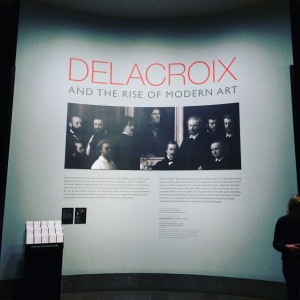
I quite fancied the Delacroix exhibition at the National Gallery, as though I can’t claim to know a great deal about the artist, what I do know I generally like. The exhibition, entitled Delacroix and the Rise of Modern Art, ended on 22 May so I only just managed to catch it.

The exhibition looked at the art of Eugène Delacroix in the context of his influence on later artists. Paintings of his were displayed alongside works by other artists, including Paul Cézanne, Vincent van Gogh and Henri Matisse, to show how he influenced them; these works included landscapes, still lives and portraiture. Interestingly, one of Cézanne’s works directly references Delacroix’ heroic status among artists: his The Apotheosis of Delacroix (1890-1904) shows artists praying to Delacroix, who is being transported heavenwards. Other works displayed included Henri Fantin-Latour’s Immortality, which also paid homage to Delacroix. Some impressive Delacroix paintings were included, such as his 1858 Tangier from the Shore, but sadly his greatest paintings were absent, so I didn’t get the full sense of how impressive he was.

While I did enjoy the exhibition and found it illuminating, I would have liked to see more of Delacroix’ own work, and was slightly disappointed that it was not more closely concerned with him. Apart from that though, it was obviously well planned and thoughtfully organised.

Utopia: Then and Now – King’s Place

The other day I went to King’s Place for an interesting talk about Sir Thomas More’s Utopia. Entitled Utopia: Then and Now, the talk featured Michael Caines chairing a discussion between Matthew Beaumont and Chloë Houston, academics who have worked on the book.

I originally read Utopia as a history undergraduate and although I’ve forgotten most of the details, I do remember finding it an interesting read. The talk looked at the concept of a Utopian society, which reaches back to the classical period, and whether or not there is a universal “utopian impulse” in many societies around the world. The talk also discussed the idea of a dystopia in relation to an utopia, and how one could be related to the other. The discussion also mentioned other ideas of utopia throughout the years, including critical (such as Voltaire’s Candide) and mocking (such as Swift’s).

Ultimately, the talk made me realise that my original understanding of Utopia is actually rather simplistic, and it would definitely be worth me going back and exploring this hugely important text.

Markfield Beam Engine and Museum

I visited the Markfield Beam Engine and Museum on Bank Holiday Monday, drawn by the promise of one of the “steam days” advertised on the website. Located in Markfield Park near Seven Sisters, in the South Tottenham area, the museum is small but inviting and there was quite a crowd when I turned up.

Markfield Road Pumping Station was originally opened in 1864. The beam engine was built in 1886 to pump sewage from Tottenham towards the Beckton Works. The engine stopped running frequently in 1905 and was closed for good in 1964. In recent years the park, building and engine have reopened for public access, with the help of various grants and many volunteers.

The building now contains a small museum exploring the history of the site. You can go into the room next door to view the beam engine, a masterpiece of Victorian engineering with ornate decoration. The highlight of the museum is being able to watch it work – demonstrations take place on “steam days” throughout the year. You can check these dates on the website – the next is the Spring Bank Holiday Monday. Check out my short video below. It’s rather hypnotic!

The Markfield Beam Engine and Museum is a worthwhile place to visit. It’s small, but good fun, and there’s a cafe next door, not to mention the large park, if you wanted to make an afternoon of it.

FACTS

Address: Markfield Road, London, N15 4RB

Website: mbeam.org

Opening Hours: Second and fourth Sundays of each month (April-September), second Sunday of each month (October-March), 11am-5pm. See website for “steam days”

Prices: Free

Painting Norway: Nikolai Astrup (1880-1928) – Dulwich Picture Gallery

The Dulwich Picture Gallery in leafy south London does have some interesting exhibitions, and the most recent was Painting Norway by the Norwegian artist Nikolai Astrup (1880-1928). Many of these paintings are being shown for the first time outside Scandinavia.

Astrup grew up in Ålhus in Jølster, where his father was a priest. A sickly child, Astrup spent a lot of time indoors but most of his pictures are concerned with the landscape outside, though he also painted places and buildings that were important to him, such as the parsonage where he grew up and his farmstead at Sandalstrand (later named Astruptunet after him).

I was drawn to the unusual, almost mystical landscapes, the colours and the representations of Norwegian culture. My favourite pictures were Astrup’s depictions of Midsummer’s Eve bonfires, the fires bright and almost otherworldly amid the landscape of the fjords. He painted many scenes of his home town in south west Norway, in all seasons and weathers, fields covered in marsh marigolds, midnight skies glowing purple, mountains which take on human qualities.

Astrup is little-known outside his native Norway, but this really needs to change: his work is superb, unusual and really worth exploring.

Sir John Soane’s Museum

2016_0430Soane01

It’s a long time since I visited Sir John Soane’s Museum, so I decided to pop in on Saturday. As usual there was a bit of a queue to get in, but considering it’s free, I was happy to wait – I only had to hang around for a few minutes, anyway.

Sir John Soane was a distinguished 19th century architect who turned his Lincoln’s Inn Fields townhouse into a museum full of famous artworks, sculptures, artefacts and furniture, most of it relating to the classical world. It was fairly famous during Soane’s lifetime, and has remained largely untouched since his death almost two centuries ago.

You start in the library, then head to the back of the house, which is covered from head to foot with classical artefacts. The basement is possibly the most exciting space, particularly the Monks’ Parlour and the huge sarcophagus. Back upstairs, there are more beautiful eighteenth century rooms to look around. Whatever your level of interest in history, there is something to see and enthuse over here.

A temporary exhibition, Charlotte Brontë at the Soane, is currently taking place. Though the museum existed when the writer of Jane Eyre visited London, there is no evidence that she ever went. Curator Charlotte Cory has decided to bring her to the Soane for her 200th birthday, and on display are some of Brontë’s possessions, including the beautiful blue and white dress she wore to attend a dinner with Thackeray, as well as some less authentic artefacts.

Another temporary exhibition refers to Soane’s relationship to the works of Shakespeare, and displays, among other things, the first four folios: it’s incredibly rare to see all four displayed together.

The Museum is open for occasional evening tours, and every so often the top floor – Soane’s private apartments – opens for tours (the latter do charge for entry). It’s a lovely, unique little museum that is well worth visiting.

FACTS

Address: 13 Lincoln’s Inn Fields, London, WC2A 3BP

Website: soane.org

Opening Hours: 10-5 Tues-Sat

Prices: Free

Shakespeare400: Shakespeare’s London/Beaumont’s London – Guildhall Library

The other day I went to a talk at Guildhall Library given by by Dr Lucy Munro from King’s College London. The talk was about the London of Shakespeare and Beaumont, marking the 400th anniversary of the death of both writers. William Shakespeare of course died on 23 April 1616, but Francis Beaumont also died that year (on 6 March, aged only 31): he has been rather overshadowed by Shakespeare over the past four centuries, but his life is worth celebrating too.

Munro began her talk by showing us a 1572 map of London, revealing a much smaller-scale city than the one we are familiar with today. Playhouses were growing up all over London. One of the first such houses Shakespeare wrote for was “The Theatre” – not such an unimaginative name as it sounds, as the term “theatre” was usually used for private indoor spaces. The name harks back to the classical world of Greek and Roman drama.

Shakespeare lived on Silver Street for a time; he also, in 1613, bought a gatehouse on Blackfriars (the road on which another playhouse for which he wrote was located). Beaumont was born in Leicestershire in 1584, his father a judge, his mother a recusant Catholic. His wife may have been Roman Catholic too, which would have marked out Beaumont as an outsider. He entered the Inner Temple in 1600 after studying at Oxford, and began his collaboration with the writer John Fletcher in 1605.

The pair’s first play The Woman Hater was written for the Children of St Paul’s, though the pair also wrote for the Children of the Queen’s Revels at the Blackfriars Theatre. Beaumont and Fletcher lodged together on Bankside: an anecdote from John Aubrey, found in his Brief Lives, suggests the closeness of their relationship, as they lived together and shared everything. When Beaumont died he was buried in London, in Westminster Abbey.

Whereas Shakespeare set most of his plays in fairly exotic locations (excepting the histories, which mention such landmarks as the Tower of London, Westminster, and the Boar’s Head Tavern at Eastcheap), Francis Beaumont wrote regularly about specific London locations including the Mermaid Tavern (mentioned in a poem to Ben Jonson). A painting by the nineteenth-century artist John Ford imagines what poets’ meetings at the Mermaid might have looked like, although it is not particularly accurate: it is not known that Shakespeare was involved in these meetings, but he has a central place in Ford’s painting.

Beaumont’s writing makes reference to the London streets, their smells and sights; locations reflect the social, moral and economic circumstances of the characters. The Knight of the Burning Pestle, his significant solo play, mentions London locations, transforming them from real-life places into fantastical locations for his knight’s Quixotic journey.

I really enjoyed this talk: I think Beaumont is a vastly underrated writer (The Knight of the Burning Pestle, which I saw at the Sam Wanamaker Playhouse, is a masterpiece) and I enjoyed learning about how he uses London in his work and his relationship to the city.

Happy Birthday Charlotte – British Library

Charlotte Brontë has to be my all-time favourite author. Jane Eyre was the first ‘classic’ that I ever read, and it is still my favourite book: I find something new in it every time I read it, and I adore Charlotte’s vivid prose.

Yesterday, 21 April 2016, marked the 200th anniversary of Charlotte’s birth, and to celebrate the British Library hosted an event with some guest speakers. Facilitated by Xanthe Arvanitakis, curator at the Soane Museum (where an exhibition about Charlotte’s time in London is currently taking place), it featured Charlotte Cory, Ann Dinsdale and Dame Jacqueline Wilson.

2016_0421CharlotteBronte01

Charlotte Cory is an artist whose series, Charlotte Brontë in Babylon, was recently broadcast on BBC Radio 4. She is the curator of the aforementioned Charlotte Brontë at the Soane exhibition, which sounds fascinating (Charlotte B never visited the Soane, but it was certainly around when she visited London – and hasn’t changed much since – and Charlotte C has tried to present a “what if?” scenario, giving her in a way the chance to visit after her death). Ann Dinsdale is the Collections Manager at the Brontë Parsonage Museum in Haworth: she has worked for the Brontë Society for over 25 years and has written many books on the Brontës and Haworth. Dame Jacqueline Wilson is a bestselling children’s author, and was appointed Ambassador for Charlotte by the Brontë Society recently.

It was lovely to be in a room full of people who are as enthusiastic about Jane Eyre and Charlotte Brontë as I am. In particular I had no idea that Jacqueline Wilson – whose books I read as a child – was such a big fan. Ann Dinsdale and Charlotte Cory also love the book and it was interesting to hear them compare notes about their first introduction to Jane Eyre. All seemed to agree that it was the opening chapters of the novel featuring the young Jane that initially attracted them to the book, which is something that rings true with my own experience.

Even more fascinating if possible were the anecdotes which all of the speakers regaled us with. Charlotte Cory told us a ghost story about a friend who travelled back to London with the manuscript of Jane Eyre (usually kept in the British Library), which had been lent to Haworth for an exhibition. On getting out of the taxi at the British Museum (where the Library was then housed), the taxi driver insisted that there was another passenger in the cab with them: a small woman, who had inexplicably vanished. I also liked the story of the same friend telling off Princess Margaret for turning the pages of the fragile manuscript!

We got to hear about Charlotte’s time in London, in which she spent lots of time visiting tourist sites as well as some time visiting Bedlam – about which she was, uncharacteristically, silent. We were treated to a performance of the “Hippapotamus Polka” which was a popular work at the time, inspired by a hippo which had recently been introduced to London Zoo.

Afterwards, we were treated to a G&T and a slice of birthday cake to celebrate the 200th anniversary of my favourite author.

2016_0421CharlotteBronte04 2016_0421CharlotteBronte03

Museum of Childhood

2016_0409MoC01

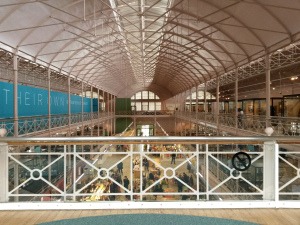
While I was at the Museum of Childhood to see the exhibition about Bagpuss and The Clangers, I took the opportunity to look around the museum as a whole. Though it is based in Bethnal Green, it is part of west London’s Victoria & Albert Museum: the building was opened as the Bethnal Green Museum in 1872 and in 1922, then-Head Curator Arthur Sabin decided to try and make it more child-friendly. The move was a popular one, and following this the Museum re-opened in 1974 as the Museum of Childhood. A refurbishment occurred in 2005-06 and the Museum continues to thrive.

The Museum is neither just for children nor solely for adults, but manages to successfully cater to both groups. Fun and educational events take place regularly for children, and adults can also get in on the act – for instance, there is a nostalgic children’s’ TV quiz taking place on the 21st of April. The Museum examines the history of childhood, which is interesting for people of all ages: adults can reminisce about their own childhoods, children can learn about how young people of the past occupied their time, and everyone can develop a greater understanding of the history of childhood as a concept.

The section devoted to the history of childhood was particularly interesting to me: it looked at how babies and young children were cared for from the sixteenth century onwards, with examples of clothing, cots and feeding equipment as well as toys. There was also a section on clothes, which showed how children went from wearing miniature versions of adult outfits to their own specially designed fashions.

There were special sections devoted to kinetic and electronic toys, and there were some cases devoted to particular themes, such as magic, with a 1950s magic set being displayed alongside Harry Potter merchandise from recent years. I enjoyed seeing some of the toys I used to play with myself, including Sylvanian Families and the original PlayStation. I have to admit I do feel rather old knowing that toys I played with as a child are now in a museum!

The Museum is currently showing a temporary exhibition called On Their Own: Britain’s Child Migrants. This is definitely aimed at adults rather than children as it explores the sensitive and distressing topic of the children who were sent to various British colonies from 1869-1970. These children were sent away with the promise of a better life, but for many this did not materialise, and several never saw their families again.

The Museum of Childhood is definitely worth a visit. It’s fascinating, and it’s free: though be warned, you may come out with a desire to relive your childhood.

2016_0409MoC03

FACTS

Address: Cambridge Heath Road, London, E2 9PA

Website: vam.ac.uk/moc

Opening Hours: 10-5.45 daily

Prices: Free