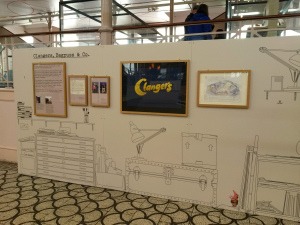
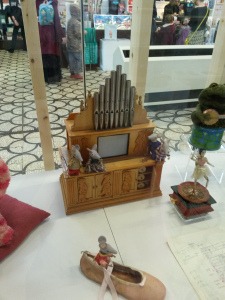
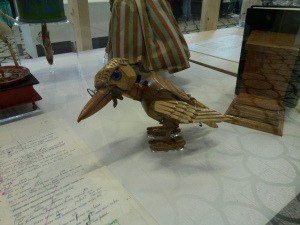
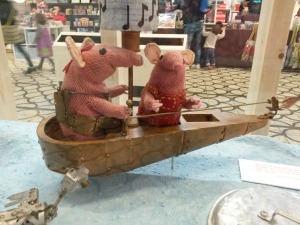
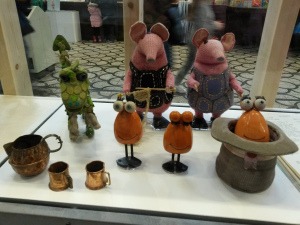
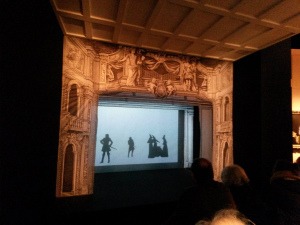
I loved Bagpuss and The Clangers as a child, so I was excited when I found out that there was going to be a free exhibition about Oliver Postgate and Peter Firmin’s work with Smallfilms at the Museum of Childhood, exploring the creation of these shows as well as others including Noggin the Nog and Ivor the Engine.
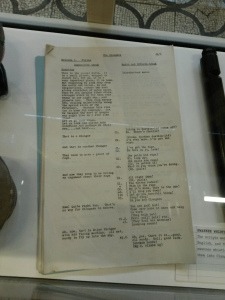
Clangers, Bagpuss & Co is small, but extremely worthwhile for fans, with original puppets, filming equipment and other documents on display. I particularly enjoyed seeing a script from The Clangers, which confirmed what I have always suspected: that the high-pitched squeaks of the characters are reflections of actual speech.
The exhibition runs until 9 October, so there is plenty of time to see it.
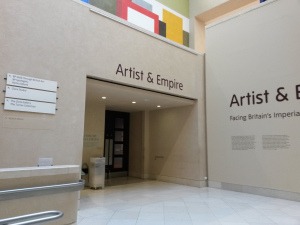
On Saturday I had a bit of time to spare so I popped into Tate Britain to check out their latest exhibition, Artist and Empire. The exhibition encompasses art from the past five hundred years or so, concerned with the British Empire. It includes works by diverse artists, both oppressors and oppressed, conquerors and the conquered, from different perspectives.
The exhibition acknowledges that the issue of ’empire’ is a difficult one to explore and come to terms with these days. However, remnants of the British Empire are all around us, and the exhibition attempts to face these head on in order to explore the issues they raise. I really like the way exhibitions at Tate Britain tend to mix old and new works and all different kinds of art, and this one is no exception.
The exhibition is divided into themes, with one room containing maps, one about heroics, one focused on costume and portraiture, and so on. Maps in particular were often used to denote conquest, while naming places implied ownership over that place. Portraits were often used as symbols of power, and the clothes worn by the sitter were often suggestive: Western dress worn by Indian royalty and Native American dress worn by the British, for example, implied a receptivity to other cultures. Having said that, the power balance was hardly equal: many works painted (pun intended) the British as morally correct, honourable conquerors. One section of the exhibition looked at trophies: collections of plants, animals and birds, drawings and paintings of them, and artefacts created by humans.
The latter part of the exhibition looks at the work of modern artists examining the legacy of empire in often-provocative ways. The exhibition is a thought-provoking one: for me, it wasn’t so much about viewing and enjoying art for its own sake, but using it as a lens through which to view beliefs and attitudes concerning empire.
This year marks the 400th anniversary of the death of William Shakespeare, and as such there are several special events going on. One such event, Shakespeare’s London, taking place at the Museum of London Archaeological Archive in Hackney, is a tour of the archive which includes a look at artefacts discovered at London’s Elizabethan theatres. I booked this pretty much as soon as I heard about it, as I love both history and Shakespeare.
Mortimer Wheeler House
The Archive is held at Mortimer Wheeler House; I looked up how to find it and I’m glad that I did, as it isn’t the easiest building to find. It’s located in east London, north of Old Street, just below the canal. We waited in the foyer for the tour to begin; there were quite a few of us, so we were taken around in two separate groups. As we explored the Archive, we were able to learn more about it, as well as the history of theatres in Shakespeare’s day.
The Museum of London Archaeological Archive is part of the museum’s Department of Archaeological Collections and Archive. Over the past century, nearly 8,500 archaeological sites have been investigated in Greater London: this archive holds information relating to all of these, with full archives for over 3,500 of them. There is also an archaeological library collection. It has been officially recognised as the largest archaeological archive in the world.
The Archive is of international significance, the primary source of evidence for early London. As archaeology itself is a destructive process – accessing one layer usually involves removing another – the only evidence of its existence is in the archive. There is an online catalogue containing information about object collections and archive records, and the Archive can also be visited for research purposes. This is free, but you need to make an appointment.
Early in the tour we got to play “archive lottery” – choosing a number and taking the relevant box off the shelf to see what it contained. Our box wasn’t particularly exciting, containing bits of pottery – however, as our tour guide (one of the Archive’s volunteers) explained, pottery is actually a really valuable tool for dating a site. We were subsequently introduced to some very special artefacts relating to the theatre.
Theatres like the Globe, the Rose and the Curtain, popular in Shakespeare’s day, were actually known as playhouses: the term “theatre” tended to refer to indoor, private theatres located in houses (similar to the Globe’s new Sam Wanamaker Playhouse). However, for the purposes of the tour they were referred to as theatres. We saw a cannonball that was found on a theatre site, once used to help create the sound of thunder (a similar item from the Rose Theatre is about to go on display at the British Library as part of their Shakespeare exhibition). Some of the smaller artefacts that we got to handle included copper pins, seals for rolls of cloth, and fragments of tobacco pipes. We also saw – but because of its fragility, understandably weren’t allowed to touch – an almost complete leather boot from the Elizabethan period: an incredible sight.
Many of the small items recovered were things which could have been dropped easily in the tightly packed, busy atmosphere of the playhouse. Gambling dice and makeup brushes were also found, as were tokens used to gain admittance into the playhouse. Money boxes were used to collect payment; when they were full, they were smashed, and the contents counted. They were kept in the money box office – what would later become the box office.
The area around Southwark where most of the theatres were situated was also known for bear-baiting, and the skull and bones of a bear and of a dog, possible rivals in the ring, are testament to this. The bear bone that we saw had tooth marks on it – possibly chewed by a dog after the poor dead or dying bear was discarded.
In a small room with a table, we were able to look at newspaper cuttings and letters related to the discovery and excavation of the Rose Theatre in 1988. When an archaeological excavation began on this site, no one had any idea just what an incredible find would be unearthed. The discovery sparked a campaign to retain and restore the site (the original developers just wanted to cover it over), and inspired a change in the law, meaning that excavations are now required when developers take over a site in London.
It was once thought that the hazelnut shells found at the Rose site indicated that theatregoers ate hazelnuts during performances, in the same way we might eat sweets or popcorn today. However, it is now thought that the thick layer of hazelnut shells would have provided cheap and effective flooring – especially as, with long performances and no toilets, groundlings would often just go where they stood – it makes me cringe to imagine walking over a spongy, urine-soaked floor of shells, but I guess they would have been used to it!
Finally, we ended up in a ceramics room, looking at some of the Shakespeare-related items held in the Archive. These included whole, and nearly whole, money boxes (which were always green, seemingly), and a figurine of Othello and Iago. We got to have a look around the room for a while before leaving, at some of the impressive collections which ranged from Roman amphorae to Victorian hot water bottles.
I absolutely loved my trip to the Archive and would recommend it for all those interested in London’s history. The Shakespeare tours are taking place again on 16 April, so it’s not too late if you want to take part.
2016 not only marks 400 years since the death of England’s national poet Shakespeare, but also 400 years since the death of Spain’s national writer Miguel de Cervantes. On April Fool’s Day I attended an event at the British Library exploring the impact of Cervantes’ Don Quixote across four centuries. Don Quixote in Words Pictures and Film featured broadcaster and art historian Andrew Graham-Dixon, Oxford University academic Edwin Williamson, and University of Birmingham academic Rob Stone (it was also supposed to feature graphic novelist Rob Davis, but he was ill).
Andrew Graham-Dixon spoke about the character of Don Quixote, remarking that he is one of the greatest comic characters in literature. He also talked about the character’s influence on later writers and artists, including Picasso, Dali and possibly Jane Austen (Northanger Abbey is a novel in which the protagonist is heavily influenced by a fictional fantasy world). Don Quixote is apparently the second most illustrated book in the world, after the Bible.
Edwin Williamson explored how the novel was created and its impact on literature. It has been regarded as the first modern novel, and has had a huge influence on subsequent fiction. As a Catholic in the Spain of the Inquisition, Cervantes was taking a risk writing the novel, but the madness and delusion of the central character helped him to get away with it.
Cervantes wrote the novel as a parody and a burlesque in order to criticise books of chivalry. His target was not the original books, which gained popularity during the medieval period, but later sixteenth century versions, which were extremely popular in Cervantes’ time and which were simplistic and poorly written. While the first book, in which Don Quixote goes in search of adventure after reading dozens of books of chivalry, was a superb achievement, the second, written several years later, was even better: as Don Quixote journeys on he meets several characters who have read the original book, an interesting twist which takes the story to another level.
Rob Stone discussed the films which have been made about Don Quixote, of which there have been around fifty: the book is a compelling and retellable story, and it is impressive how many different kinds of films have been made all over the world, including a Western version, Don Quickshot of the Rio Grande, a soft porn musical version, and a recent Chinese version with incredible special effects. I was intrigued by how many Russian films have been made, reshaping the Quixote tale into different aspects of Russian culture. The Russian equivalent of Spitting Image even portrayed Boris Yeltsin as an alcoholic Quixote. Some of the most fascinating Don Quixote films are the ones that never got made: we were shown the one surviving scene from the unfinished Orson Welles version, and heard about Terry Gilliam’s more recent failed version.
I really enjoyed the evening and it’s left me with the desire to read Don Quixote again: I originally read it over a decade ago, so I’d like to give it another go and see if I feel any differently about it.
When my mam came to London recently, she came with my auntie and several other relatives, one of whom was celebrating her birthday, so the plan was to do something exciting. We ended up booking on a bus tour of London with a difference – a tour that includes afternoon tea.
Our bus
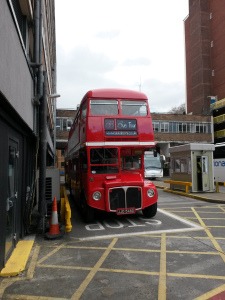
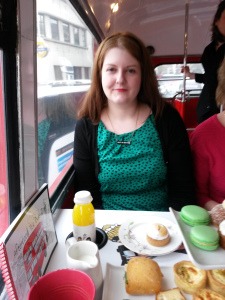
The tours are run by BB Bakery, a traditional French bakery which is based in Covent Garden. We arrived at Victoria Coach Station on Sunday afternoon in plenty of time to board our bus, which was one of those awesome heritage Routemasters. We headed upstairs where our tables had been set out for us (we were a party of six, so we actually took up two tables).
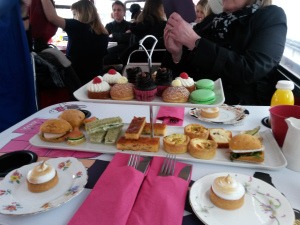
The afternoon tea consists of sandwiches, scones and cakes, as well as orange juice and, of course, tea. They do cater for different dietary requirements: as a vegetarian this is very important to me, and I’m happy to report that my veggie selection was utterly delicious (the standard sandwiches were pretty nice too, according to the rest of my family). I enjoyed my scone, and the cakes in particular were incredible. If you get too full, you are given a little box to take any uneaten cake away with you.
Yummy afternoon tea
I had been curious as to how you avoid spilling hot drinks all down yourself on a moving bus. Not to worry, you are actually given a solid takeaway-style cup with a lid which fits into a hollow on the table (you are able to take this cup home with you). The cake stand is fixed securely to the table, and the cutlery, while it looks metal, is actually plastic – all health and safety bases have been covered!
Wearing my highly appropriate, London bus-themed, Tatty Devine “Not In Service” necklace
The bus takes a roundabout route through central London, passing Buckingham Palace, Trafalgar Square and other notable landmarks. It should be noted that you don’t get actual commentary, as you would with a “normal” tour bus. However, the staff – who are very friendly, helpful and chatty – do provide random commentary which is often quite funny. As a London resident, I didn’t feel the need for a proper commentary anyway, particularly as I was enjoying my food too much to care!
The tour takes a good hour and a half, so make sure you go to the loo before it starts! Tours cost from £45 for adults and £35 for children, which sounds pricey but it really is a fantastic experience and the food is yummy. I definitely recommend this for a special occasion, and I’ll be heading to Covent Garden to check out the bakery in the near future.
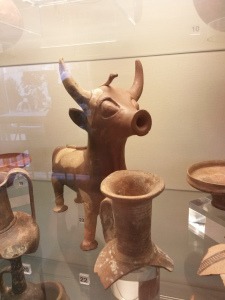
I visited the A.G. Leventis Gallery at the Institute of Archaeology, part of UCL Museums & Collections. The A.G. Leventis Gallery of Cypriot and Eastern Mediterranean Archaeology displays the IoA’s rich collection of objects from ancient Cyprus, Greece, Crete, Egypt and the Levant. It is fascinating to explore the resources and learn about how diverse the region has been during five thousand years of history.
My favourite object in the Gallery
There is also a temporary exhibition, We Need To Talk: Connecting Through Technology, which has been created by students on the MA Museum Studies to explore the different technologies we have used to communicate in different periods of time. The exhibition contains such varied items as typewriters, coins, papyrus and computers, and it’s highly informative.
A visit to this interesting gallery doesn’t take long, but it’s certainly worthwhile.
FACTS
Address: Institute of Archaeology, 31-34 Gordon Square, London, WC1H 0PY
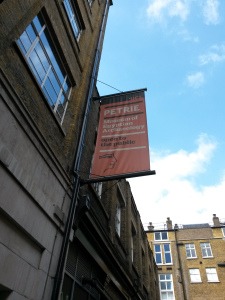
The Petrie Museum in London, which is part of UCL Museums & Collections, contains around 80,000 objects relating to Egyptian and Sudanese archaeology, making it one of the greatest such collections in the world. The museum looks at life in the Nile Valley from prehistoric times, through to the time of the Pharaohs, the Ptolemaic, Roman and Coptic periods, right up to the Islamic period.
The museum was originally set up in 1892 as a teaching museum for the Department of Egyptian Archaeology and Philology at University College London. It was created thanks to a bequest from the writer Amelia Edwards (1831-1892) who donated her large collection of Egyptian antiquities, but it was the work of Professor William Flinders Petrie (1853-1942) that propelled the museum into international significance.
It can be found hidden away behind several University buildings in central London: it’s difficult to find at first but once you get there, the entrance is apparent. Once inside, the compact museum contains a wealth of treasures: there are so many items it’s easy to be overwhelmed, but with patience it’s possible to track down some of the highlights, including the earliest ‘cylinder seal’ in Egypt, the oldest wills on papyrus, and even some incredibly rare and fragile Egyptian costumes.
The museum has the world’s largest collection of Roman period mummy portraits (first to second centuries AD), in which you can trace the development of a society caught between two cultures. In addition, it has many works of art from famous emperor Akhenaten’s city at Amarna, including tiles, carvings and frescoes. Also, the wider collection is largely taken from documented excavations, ensuring that it can offer profound insight into the everyday lives of people living at the time.
Whether you are an expert in Ancient Egypt or a casual visitor, there should be something to appeal to you in this small but rich museum. Special events regularly take place, so it’s worth checking the website regularly.
FACTS
Address: University College London, Malet Place, London, WC1E 6BT
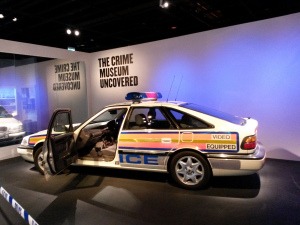
The infamous ‘Black Museum‘ of Scotland Yard, officially known as the Crime Museum, is a collection of criminal memorabilia kept at the headquarters of the Metropolitan Police Service at New Scotland Yard. Founded in around 1874, it has been used for over a century to help the police in their study of crime and criminals. While the existence of the museum is widely known, it is not generally open to the public.
This all changed a few months ago when the Crime Museum Uncovered exhibition opened at the Museum of London. The exhibition was instigated by the Crime Museum itself, which has wanted to open up to the public for a while, but was concerned about the sensitive nature of the exhibits. Throughout the exhibition we are invited to question the ethics of putting such items on display, and to think about what they can teach us. As part of this sensitivity, the series of displays about specific crimes only go back as far as the 1970s.
The exhibition begins with a room which has been reconstructed from the original museum. It contains court sketches, Victorian-era mugshots and death masks, reflecting the nineteenth century obsession with phrenology – the belief that the shape of a person’s head could reveal their personality and character. This room is fascinating as it reveals how the Victorians thought about crime. There is also a disturbing selection of hangman’s nooses which were used on famous criminals.
The major part of the exhibition is laid out chronologically, with each case devoted to a different crime. Some of these cases are famous – Crippen, Christie, Ellis – others, less so. This section could easily be sensationalist, but instead it is informative and well-presented. The descriptions on the cases give prominence to the victims, not just the criminals, and the role of detectives and the police is emphasised: many of the cases have been chosen because of their significance in the history of detection and evidence, such as the first case in which a conviction was secured thanks to the use of fingerprints.
Sure, some of the exhibits are a bit gruesome: Crippen’s spade, the acid bath murderer’s gloves, a selection of masks made from stockings to hide the wearer’s face. However, all of them are informative, and some are even funny – such as the “false footprint makers” used by a would-be burglar to leave footprints around the crime scene. His cunning plan failed after he left his own footprints alongside the fake ones.
As well as displays focusing on individual crimes, there are themed displays containing fascinating artefacts, such as weapons confiscated from criminals, concealed weapons (including a pair of binoculars containing concealed eye spikes), and abortion pills and implements (from the days when abortion was illegal). Some items relate to modern-day crimes. These include the fake jewel used by the police in the attempted theft of the Millennium Star diamond from the Dome in 2000, and a selection of IRA mortars fired on Downing Street and MI6. There is also an unexploded nail bomb.
At the end of the exhibition there is the opportunity to watch a short video exploring how appropriate it is to open up these collections to the public. My friend and I spent a good couple of hours in here, in this informative and fascinating exhibition. It is thoughtfully put together, sensitively curated and hugely worthwhile – one of the best exhibitions I have ever seen.
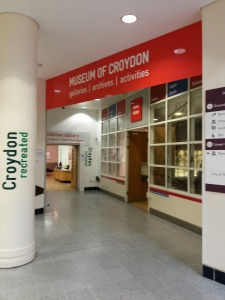
The Museum of Croydon is located in the former town hall, next to the library and other civic offices. There are two galleries on the ground floor. The Exhibition Gallery showcases temporary exhibitions of works from the Borough’s art collection; the current exhibition is Croydon Recreated, a collection of paintings by a local artist, E.A. Phipson. These pictures of Croydon from the turn of the 20th century are displayed alongside photographs and historic maps to explore how Croydon has changed. The gallery is situated alongside the Research Room, where genealogical researchers and others with cause to use Croydon’s local archives can work.
The other gallery is the Riesco Gallery, which showcases some of the original exhibits in the museum from the Riesco Collection. I thought that these exhibits were a cut above most similar displays in local museums, with some extremely impressive Chinese grave goods, beautiful small statues, fascinating Anglo-Saxon finds and others.
Riesco Gallery and Research Room
The main part of the museum is upstairs, and the entrance is designed so that you can start at either end: “Croydon Then” and “Croydon Now”, or vice versa. I chose to start “then” and work my way up to the present day.
The space is a bit dark, but generally well laid out. Rather than a junkyard of random exhibits, a selection of items has been carefully chosen to be on show in individual square cases. Judging by their names: “Mary’s doll”, “Ted’s train”, I would guess that they have been donated by Croydon residents. The items range from the personally significant – toys, sewing kits, tools – to those with wider significance, including a relic of the borough’s first mayor, who was initially respected but who was later found to be a fraudster, conning people out of their life savings with his insurance company.
Moving forward through history, the museum has the usual section on World War II, explaining that Croydon was a major target for German bombers. During the second half of the twentieth century, Croydon welcomed many immigrants and also became an important centre for art and design.
There is a section on current Croydon residents who have been invited to contribute something of their own to the exhibition. This was an interesting chance to see what different people hold significant and explores the culture of the town.
Moving to London
There is a small temporary exhibition called Moving to London, marking the 50th anniversary of the borough becoming a part of London. This also had items in various cases telling the story of this change.
Overall, the Museum of Croydon is a well put together exploration of the borough’s past. Definitely worth a visit if you’re in the area.
Samuel Pepys (1633-1703) lived through some of the most dramatic events of the seventeenth century. He witnessed at a young age the beheading of a king, followed by a republic, then the Restoration and two coronations; not to mention the Great Plague of 1665 and the Fire of London in 1666. A republican who served under the monarchy, a lover of wine, women and song who nevertheless condemned the licentiousness of the royal court, a President of the Royal Society who admitted that he often did not understand science, and a naval administrator who, when he joined, knew nothing about the sea, Pepys strikes me as a sympathetic character, an ordinary man who to a large extent made it up as he went along and was able to succeed by adapting himself to circumstance and making an effort to learn.
The Samuel Pepys: Plague, Fire, Revolution exhibition, which uses the witty hashtag #PepysShow, explores the history of Pepys’ time in his own words, alongside artefacts and records from the period. He has been called the greatest diarist in the English language; his diary is notable for recording everyday details as well as major events, which have allowed historians to understand what daily life in the seventeenth century was like. Pepys actually kept his diary for ten years only, between 1660 and 1669; he stopped because he feared his eyesight was being affected. However, we have other ways of learning about his life, such as his letters.
The exhibition follows a largely chronological format, beginning with the beheading of King Charles I, witnessed by a young Pepys. We learn about the life-threatening and excruciatingly painful operation he underwent to remove a bladder stone, and his marriage to Elisabeth de St Michel. Pepys’ everyday life is explored in displays relating to music and theatre, both of which he enjoyed, especially after the Restoration when theatre was once again permitted and encouraged.
Representation of the Restoration theatre
We learn about the Great Fire from Pepys’ detailed account, as well as his wife’s illness and death. Later, Pepys was active in the Royal Society and became its President; interestingly, I learned here that Newton’s seminal Principia Mathematica was only published thanks to a donation from Edmund Halley, as the Royal Society had just spent its entire book budget on a History of Fishes.
One of the most impressive items in the exhibition is the eighteenth century court dress, which is in fantastic condition especially given its age. I also enjoyed looking at other artefacts from the period, including early editions of books. The last part of the exhibition explores the publication history of Pepy’s diary: several individuals transcribed them into plain English (from the shorthand in which they were written) during the nineteenth century but it wasn’t until the 1970s that the full, unexpurgated edition – containing references to Pepys’ various liaisons – was published.
The exhibition runs at the National Maritime Museum until 28 March, and it is well worth visiting if you are at all interested in this period of history.