Anarchy & Beauty: William Morris and his Legacy – National Portrait Gallery

I went to see Anarchy & Beauty: William Morris and his Legacy at the National Portrait Gallery last Friday after work. This exhibition aims to explore the life and ideas of Morris, who was an artist, writer, socialist and visionary thinker.

The exhibition was interesting, but I thought it focused too little on Morris himself and too much on his contemporaries and those whom he inspired. Books, ceramics and artworks by people such as Eric Gill, Terence Conran and Dante Gabriel Rossetti were interesting in their own right but moved the focus away from Morris. I did like how the exhibition highlighted Morris’ concept of “art for the people” and his Socialist sympathies.

Overall, a good exhibition to visit if you want an overview of William Morris’s life, contemporaries and followers, but not if you are particularly interested in Morris himself.

Germany: memories of a nation – British Museum

Germany: memories of a nation is another exhibition at the British Museum; I visited after I went to see the museum’s exhibition on China. The exhibition is billed as a 600-year history in objects, but it is more than that: each object reveals something about the culture and history of the nation that has only existed in its current form since the fall of the Berlin Wall 25 years ago. Germany has an incredibly complex political history – it used to be divided into regions under the umbrella of the Holy Roman Empire, and was not unified until 1870, after which two World Wars and the division between East and West further shaped the Germany we know today.

The exhibition began with a superb display of the contrast between England and Germany during the eighteenth century. When England was developing a standardised system of coinage – represented by the single coin bearing an image of Queen Anne – Germany had several different currencies and monetary systems. I was fascinated by the objects on display, including art by Dürer and Holbein, a beautiful and ornate model of a ship holding several Electors and the Holy Roman Emperor, and an amazing Bauhaus cradle. More poignantly, a (replica) gate from a World War II concentration camp was displayed, and no exhibition inspired by the fall of the Berlin Wall would be complete without a piece of the Wall itself. I really enjoyed this exhibition – it tells a fascinating and complex story through the medium of objects, and there should be something here to appeal to everybody.

Ming: 50 years that changed China – British Museum

Ming: 50 years that changed China is an exhibition at the British Museum which explores the years between 1400 and 1450 and how, during this time, China’s Ming dynasty established Beijing as the country’s capital and encouraged developments in culture and trade. It began by exploring the five emperors to rule in this period, and went on to look at the innovations of the period including architecture (the famous Forbidden City was constructed during this time), painting, sculpture and travel. I was amazed at the beautiful objects on display, particularly the stunning Cloisonné jar that has appeared on all the promotional material, and the hanging scroll with a picture of the Imperial palace.

Blood Swept Lands and Seas of Red

As today, 11 November, is Remembrance Day, I thought this post would be appropriate.

2014_1110BloodSweptLands01

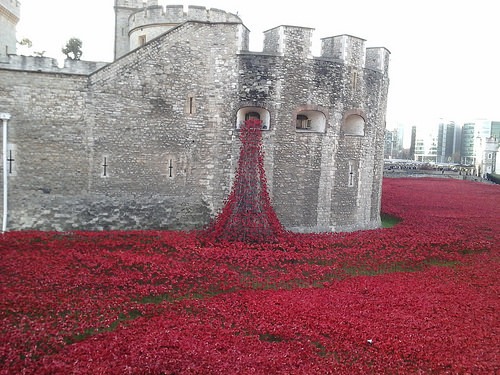
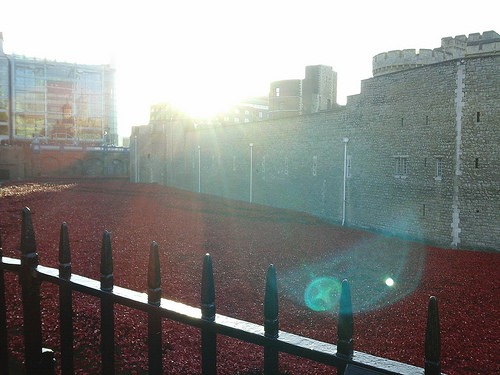
Blood Swept Lands and Seas of Red is the now-famous installation in the Tower of London’s moat. It has been created by ceramic artist Paul Cummins, with setting by stage designer Tom Piper, and consists of 888, 246 ceramic poppies, each of which has been individually hand made, which have been planted in the moat by volunteers over the last couple of months. The first poppy was planted on 17 July and the installation officially opened on 5 August – the date of Britain’s entry into World War I. The last was planted this morning – Armistice Day. The number of poppies is significant – each one represents the death of a British or Commonwealth soldier during the war.

2014_1110BloodSweptLands04

In an attempt to avoid the crowds, I got up super early on Monday morning and headed to the Tower before work. A surprising number of people had had the same idea, though things had apparently much improved from the weekend, when, so my friend told me, there were queues to get down to the walkway and some footpaths had to be closed. Though it was far from quiet, I still managed to get to the front and see everything I wanted to.

Though I had seen many photographs of the installation, pictures are no substitute for seeing it in real life – it makes even more of an impact. Looking at the sea of poppies and knowing that every single one represents a person, each with their own life and with family and friends who were left behind to mourn, is breathtakingly sad.

The installation is beautiful, but I don’t think this detracts from the seriousness of the subject. In many respects it is a very simple idea, but it works wonderfully: the poppy is a well-known symbol of Remembrance Day and is widely associated with the First World War, while the arrangement of poppies “spilling” out of the tower and into the moat represents the blood that was shed by those who died.

2014_1110BloodSweptLands10

There have been criticisms levelled at the installation, notably this Guardian piece by Jonathan Jones. I think it makes some good points – for instance, he asks why we should only memorialise our own dead and not the casualties of all countries, and suggests that the poppy has become a political symbol rather than a focus on the dead of World War I. However, I think it’s understandable that a British commemoration based at the Tower of London would focus on national casualties, just as a village or town might choose to focus on the local dead. In practical terms, the moat is pretty full – there wouldn’t be any room for more poppies to represent the horrendously high number of the dead beyond Britain. I also think that by focusing on a precise number of World War I dead, the installation brings the focus of the poppy back to the 1914-18 conflict.

From today, the installation will slowly begin to be taken down. I highly recommend trying to visit before it goes – it’s an unforgettable experience. However, go early in the morning if you can, to avoid the crowds!

2014_1110BloodSweptLands02

Bridge – Museum of London Docklands

Bridge is a free exhibition at the Museum of London Docklands, exploring the history of London’s bridges in art and photography. I loved looking at the black and white Victorian photos, the Sixties images full of miniskirts and retro cars, and the more modern video in which an artist travelled by boat right down the Thames, going under each bridge in turn.

Katy B at the Roundhouse

The other night I went to see singer Katy B at the Roundhouse in north London. I booked my ticket ages ago and I nearly didn’t make it – I’d arranged to meet a friend I hadn’t seen for ages on the same night and had decided to miss the gig, but as it happened our evening ended earlier than I’d anticipated, and I had time to get to Chalk Farm before Katy was on stage at 9.

Now although I do like Katy’s music (or else there wouldn’t have been much point in me booking this show at all), I wasn’t really expecting great things. The ticket was cheap (under £20 for a gig – I’m not used to these prices!) and I thought it might be a nice night out. However, I really enjoyed myself. Katy has a great voice and gave an impressively good performance, singing loads of her hits and really playing to the crowd.

I was also pleasantly surprised by how good the view from my seat was. I got the last ticket remaining, and the seat was in the circle, right at the end. However I could see everything really well and the atmosphere was still great. I also found myself admiring the architecture in the building – the Roundhouse is a former railway shed and many of the original features are still present and visible.

2014_1023KatyB
Even up in the circle, the view is good

Dylan Thomas in Fitzrovia

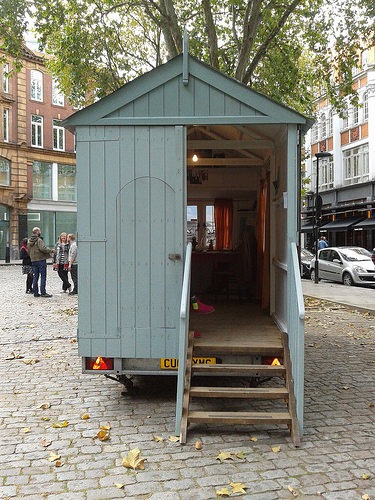
This week has seen the Dylan Thomas in Fitzrovia festival happening in central London, based around the part of Bloomsbury where the writer used to hang out in the middle of the century. Talks, readings and performances have all been taking place, and I have booked to see Clown in the Moon, a performance about Dylan, tomorrow. Yesterday I took advantage of the fact that I work incredibly close to the area where the festival is taking place, and popped out to see Dylan’s writing shed, which is on tour around the country.

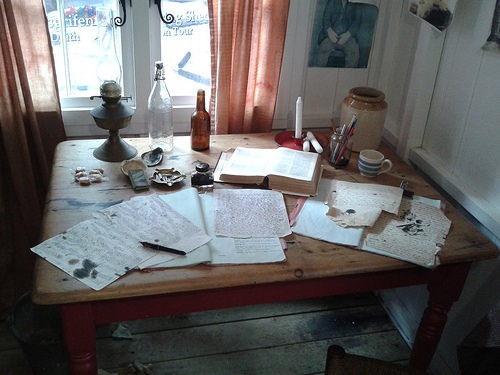
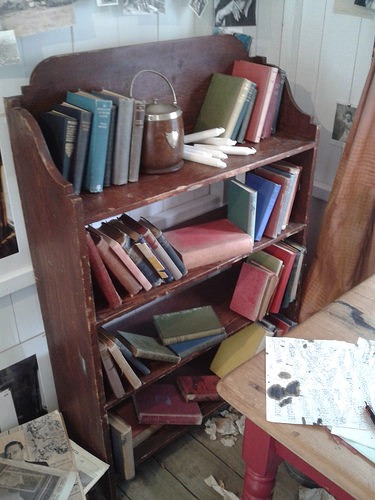
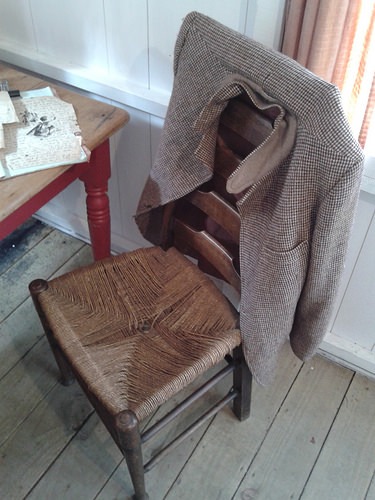
The shed is a near-exact replica (it has been scaled down slightly to allow it to be transported around the country on a trailer) of Thomas’ real writing shed in Laugharne. It is full of bookshelves, papers and other odds and ends, with Dylan’s coat draped over the back of the chair – just as if the poet himself could come inside at any moment.

2014_1023DylanShed01
The shed
2014_1023DylanShed02
Words, words, words
2014_1023DylanShed03
The desk
2014_1023DylanShed04
Bookshelves
2014_1023DylanShed05
Coat

Dennis Hopper: The Lost Album – Royal Academy of Arts

Dennis Hopper: The Lost Album is the exhibition that opens the Royal Academy of Art‘s new Burlington Gardens space. It includes photographs by Dennis Hopper, an actor who shot to fame with roles in films such as Apocalypse Now, Easy Rider and Blue Velvet. I have to admit that I had never heard of him – either as an actor or as a photographer – but I thought that the exhibition, covering the life of the star in the 1960s, would be an interesting one.

It certainly is fascinating to explore the world of American life and culture in the 1960s, one of the most momentous decades for social and political change in history. The pictures capture the worlds of Hell’s Angels and hippies, the Civil Rights movement, stars of film, fashion and music, and the urban landscapes of the US.

Unfortunately though, the exhibition was incredibly expensive and I don’t honestly feel that it was worth it. RA exhibitions are expensive anyway, but I normally feel as if a lot of work has gone into them. These photographs were presented with little explanation and few captions. I don’t feel that the exhibition was worth the price paid, even though I did enjoy it. If you do think you might be interested, the exhibition closes this weekend so hurry.

Ancient lives, new discoveries: eight mummies, eight lives, eight stories – British Museum

The Ancient lives, new discoveries exhibition at the British Museum is a brilliant exploration of eight different mummies, each with their own story. It uses the latest technology to show how we can learn from these individuals and find out more about their lives.

These people were found in ancient Egypt and Sudan, and between them they span 4,000 years of history. Some were embalmed deliberately, others were preserved naturally.

A young man preserved in the sand (Gebelein Man B)

This mummy dates from about 3500 BC and was discovered in Gebelein, Egypt, along with several other individuals. He died as a relatively young man (20-35) and was preserved naturally in the sand. What I found amazing about this individual was that the contents of his stomach were preserved too!

A man embalmed for the afterlife (Linen man)

This older man was discovered in Thebes and dates from around 600 BC. He was bound in linen and had suffered dental abscesses, tooth loss and tooth decay, which would have caused him a great deal of pain. Intriguingly, he was found in a woman’s coffin, though whether this happened at the time of his death or at the time of his discovery in the 19th century is unclear. My personal, rather outlandish theory is that he was put in the wrong coffin on purpose, perhaps to cover up his death – this is probably ridiculous but I think it sounds rather exciting!

Tamut: a high-ranking priest’s daughter

Tayesmutengebtiu, or Tamut, was the daughter of a priest, known as Lady of the House or the Chantress of Amun. Found in Thebes, she was aged at least thirty-five when she died, and as well as dental abscesses (common among the ancient Egyptians because of their consumption of sugar) she suffered from atheroscleriosis (plaque in the arteries). Dating from around 900 BC, the hieroglyphic inscriptions on her mummy case show that she was married when she died, and as a lady of high status she was mummified very carefully. CT scans have identified many amulets on her body beneath the bandages. Incredibly, 3D printing has been used to turn the CT scans into three-dimensional models, meaning that we can see the amulets without unwrapping the bandages.

Padiamenet: a Temple Doorkeeper

Padiamenet was discovered in Thebes and his mummy dates from around 700 BC. He was middle-aged when he died, and also suffered from dental abscesses and atherosclerosis during his life. Padiamenet was a temple doorkeeper, responsible for deciding who was able to enter the most sacred parts of the temple. He also worked as a barber, as all the priests had to have all their body hair removed before going into the temple. There were mistakes made during his mummification: his head came off and had to be fixed back on, and when his mummified body was laid in his case it was found to be too short so the embalmers had to improvise an extension! Padiamenet was buried with his family, and his wife and son were found with him; after his death, his post had passed to his son.

Tjayasetimu: a young temple singer

I found Tjayasetimu one of the most poignant mummies in the exhibition simply because she was only around seven when she died. Again, she was discovered in Thebes, and lived around 800 BC. Her case is small, but scans have shown that her body inside was even smaller. The case shows her as a grown woman, perhaps suggesting her anticipated status in the next life.

In general, few child mummies have been discovered: death in childhood was very common, and it was probably too expensive to have all your children mummified. Tjayasetimu probably had the honour because of her status as a temple singer.

An unusual mummy from the Roman period

This mummy, dating from after 30 BC (though also from Thebes), was one I found a bit spooky. He is wrapped up so that all his limbs are wrapped separately, and his painted face makes him look quite lifelike. Experts aren’t sure why this is – he even has a beard painted, but he also has breasts painted on.

During the early Roman period, Egyptian customs were still common, and the practice of embalming was used by Romans as well as Egyptians.

A young child from the Roman period

This young male child, approximately 2 years old, dates from AD 40-60 and was found in Hawara, Egypt. His tiny body is contained in an elaborate case. He has been treated like an adult mummy in many respects, so perhaps there was more of a focus on treating children like adults in terms of mummification during this later period. I found this really sad – the whole exhibition was brilliant in terms of getting me to see the mummies as real people who actually lived, but this makes the deaths of the young children in particular seem so much more tragic.

A Christian woman from Sudan

The final mummy was a Christian woman found in Sudan, dating from around 700 AD – she is the youngest mummy in the exhibition. She was found when the Sudanese government decided to build a dam near the Fourth Cataract: a number of museums including the British Museum were invited to carry out archaeological work, and this body was found naturally preserved in a small cemetery. Amazingly, the body has a tattoo which is still visible – it is a tattoo signifying the Archangel Michael, the patron saint of her area.

This exhibition has just been extended until the 19th of April 2015 and I’m not surprised. It really is wonderful and allows you to learn so much about these individuals and the times in which they lived. I highly recommend visiting.

Primrose: Early Colour Photography in Russia – The Photographers’ Gallery

Primrose: Early Colour Photography in Russia is an exhibition currently taking place at the Photographers’ Gallery just off Oxford Street. Being fascinated by Russia, I visited the Gallery on Thursday evening when it opens late. I was pleasantly surprised to see that entry is free – I am sure I had to pay last time I visited, so this was nice to see.

The exhibition looks at the development of colour photography in Russia from the 1860s to the 1970s. As well as the history of photography in Russia it is also concerned with the history of Russia in photography. This period was a time of turbulent change and the photographs really showcase this.

Arranged in chronological order, the exhibition begins with early hand-tinted images, moving to more developed photographs and eventually to photomontage and colour film. Societ authorities restricted the use of photography during the mid-20th century and it wasn’t until the 1970s, when inexpensive colour film was available to the general public via unofficial routes, that ordinary people could really exercise free choice over their photographs – even then they normally had to be shown in secret.

I was fascinated by the early tinted colour photographs, making me think of characters from Anna Karenina. They were not unlike our Victorians, though many, particularly children, were dressed in traditional Russian costume. At the turn of the century, the pictures started to remind me of Chekhov characters, as the clothes worn by the subjects of the images were very like those I have seen on stage. One standout image for me was the photograph of Tolstoy – he looks like a grumpy old man (which, in a very basic way, I suppose he was). Colour photographs – even those which have been hand-coloured – bring their subjects to life like black and white pictures can’t, and make their subjects seem much closer to us today.

Images from the following century made the Soviet era seem much more “real”. They were so vivid and clear – I loved looking not only at the people themselves, but at their surroundings, how they lived and what their spaces looked like.

This exhibition is on until the 19th of October – even if you’re not particularly interested in Russian history, I recommend a visit.