I popped into GRAD (Gallery for Russian Art and Design), located near Oxford Street, last night. The current exhibition, BOLT, is about Dmitri Shostakovich’s 1931 ballet The Bolt, and includes rarely seen designs, photographs and costumes. The exhibition is organised in collaboration with the St Petersburg State Museum of Theatre and Music.
The ballet is described as the last Constructivist ballet, and judging by the costumes and photographs on display it is unique among ballets I have seen. The story, written by Victor Smirnov, is one of industrial sabotage and the innovative choreography by Fedor Lopukhov includes such pieces as the “Dance of the Cyclists” – a bit different from Sleeping Beauty!
The Bolt was pulled after its first performance at the Leningrad Academic Theatre of Opera and Ballet, after a backlash from critics and a perception that it was a threat to the Soviet authorities. It was not seen again until the Bolshoi Ballet performed it 74 years later. After seeing this exhibition, I am curious to see the ballet for myself.
Last Thursday I went to the Leighton House Museum near Holland Park in order to visit the latest exhibition, A Victorian Obsession. Leighton House is the former home and studio of Frederic, Lord Leighton (1830-1896), a leading exponent of nineteenth-century classical art and one-time President of the Royal Academy. I’ve visited the house, designed and built to Leighton’s requirements by George Aitchison RA, before, and it’s beautiful: a Moroccan-style fountain court and a blue-tiled hallway are just two of the marvellous rooms inside.
Currently the house is home to part of the collection of Juan Antonio Pérez Simón, a Mexican businessman and art collector who holds the largest collection of Victorian and Edwardian art outside Britain. The pictures cover the period from around 1860 until the start of World War I, and the unifying theme is “representations of female beauty”. It’s easy to be somewhat cynical about this theme, but in fairness all of the artists represented were superb painters and their work encompasses a huge diversity in such representation, from the inspiration of the Greco-Roman period to Arthurian legend. The paintings are displayed throughout the main rooms of the house, which is a perfect setting considering that many of their artists knew this house and its owner well.
The paintings encompass late Victorian art in many forms, including historical painting and Pre-Raphaelite imagery. This kind of art is very much to my taste, so I greatly enjoyed the exhibition. There were paintings by artists with whom I am familiar, including Dante Gabriel Rossetti and Edward Burne-Jones. I particularly like the work of John Everett Millais: his The Crown of Love (1875) was on display here, and I also loved The Crystal Ball (1902), a magical work by another of my favourites, John William Waterhouse. Some of house owner Frederic Leighton’s work made an appearance, several paintings returning to the house for the first time since they were created. Leighton’s Antigone (1882) is impressive, as is Crenaia, The Nymph of the Dargle (1880), modelled by Leighton’s favourite muse Dorothy Dene.
Throughout the exhibition I was introduced to other artists I hadn’t previously been aware of, including Henry Arthur Payne, Arthur Hughes and John Melhuish Strudwick, whose Passing Days (1878) is an allegorical representation of the passage of time. His Elaine (c.1891) is a gorgeously detailed representation of the woman of Arthurian legend who pined away for love of Lancelot.
One artist seemed to dominate the exhibition – Lawrence Alma-Tadema. Famous for painting historical scenes, particularly those inspired by Ancient Rome, he painted several of the works on display, including An Earthly Paradise (1891), a rather sweet picture of a Roman woman with her young child. Alma-Tadema’s couch – the only object in the exhibition which is not a picture – sits underneath this painting. The artist designed the couch himself to use as a prop in his historical scenes, and it even has differently-designed legs – one side of the couch represents Egyptian style, the other, Roman. It’s rather fun to play “spot the couch” with Alma-Tadema’s pictures – it appears in several.
Alma-Tadema’s famous work The Roses of Heliogabalus (1888) is the highlight of the exhibition, presented in a room of its own which has been scented with roses courtesy of Jo Malone. The picture shows the young, wicked Emperor Heliogabalus suffocating his guests under a shower of rose petals, and it is beautifully detailed, although I can’t help but concur with the contemporary critics who felt that the victims hardly seemed frightened enough.
This superb exhibition is a must-see for any fans of late Victorian art. It runs until the 29th of March and normally costs £10, or £5 with a National Art Pass. Special late evening openings allow free entry for Art Pass holders between 5.30 and 8.30 on 19 February and 26 March.
I popped into the Victoria & Albert Museum today to visit the Disobedient Objects exhibition, which is on until next weekend. This free exhibition looks at the role of objects used as tools for social change, beginning with the Suffragette teapots designed to promote the movement and ending with graffiti robots and protest banners.
The exhibition is inspiring, showing how people have come together over the years to protest against government decisions and instigate change. Quite different from the usual displays at the V&A, but well worth it.
After a tense few days during which I feared I’d missed my chance – only a phone call to inquire about tickets saved me – I managed to get a ticket to the National Gallery‘s exhibition Rembrandt: The Late Works on its last day. My efforts proved to be well worth it: the exhibition was very well laid-out and organised, and I really appreciated the fact that information about the pictures was set out in a booklet rather than presented on labels beside the paintings – this meant that though the exhibition was very busy, it was still manageable because you weren’t faced with hordes of people crowded round the pictures trying to read the captions.
Of course, it goes without saying that the actual content – Rembrandt’s work – was stunning. I particularly liked the five self-portraits on display at the beginning: full of variety, they captured the painter in different moods and at different stages. The most affecting was the portrait painted in the year of his death (1669), which shows him as visibly frail, but I also liked the 1659 portrait in which he wears a quizzical expression.
The exhibition focuses on the later years of Rembrandt van Rijn (1606-1669), and like the Late Turner exhibition at Tate Britain that I visited last year, it shows that the artist did not become complacent or enter into a decline during his last years, but continued to experiment and develop as an artist. In particular, The Conspiracy of the Batavians under Claudius Civilis (c.1661) shows a profound mastery of the creation of darkness and light in painting, while his two versions of the Roman heroine Lucretia (1664 and 1666) are extremely powerful.
Less outwardly grand, but equally masterful, is his picture of his son Titus at his desk (1655), an affectionate and intimate portrait. Fully finished paintings sit alongside sketches and drawings in the exhibition, showing the developments of Rembrandt’s ideas and style, and several of these are exquisite, although their role in the development of the artist’s work will likely appeal more to other artists or art students.
This exhibition was well worth the visit and I am glad I managed to make it before the end.
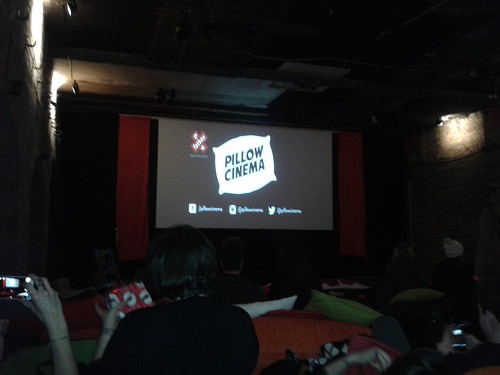
This post should probably be about Pillow Cinema, the east London phenomenon dreamed up by the same people who founded Hot Tub Cinema. The idea of sitting in a hot tub surrounded by strangers has never particularly appealed to me, but the Pillow Cinema idea is much better-sounding – sprawl out on a giant bean bag, pillow behind your head, and relax while watching a classic movie. I saw Billy Elliot on Saturday, and the experience was a great one – but that’s not why I wanted to write this post, and it isn’t why I wanted to go in the first place. After all, I could probably have recreated the experience much more cheaply in my front room with a couple of duvets and a pile of cushions.
No, it was the location of Pillow Cinema that appealed to me, much more than the concept itself. Screenings are held in the former Shoreditch Underground station, and being the Tube obsessive that I am – particularly when it comes to disused or “ghost” stations – I was certain that I wanted to get inside.
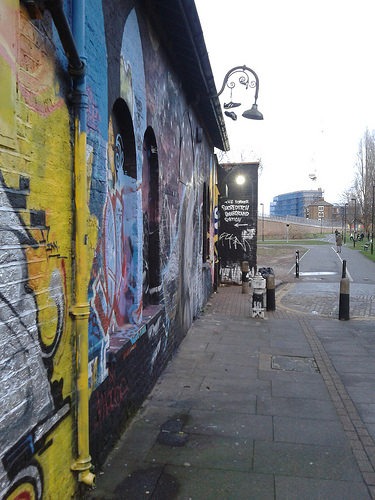
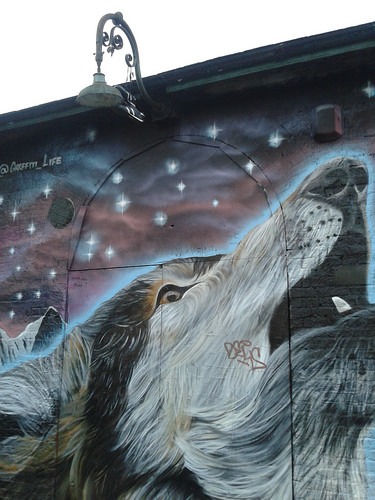
Shoreditch Underground Station is located near Brick Lane, at the end of Code Street. It’s covered in graffiti so it’s not hard to spot. The station used to be the northern terminus of the East London Line, and it closed in 2006 in preparation for the development of the Overground network, which now runs through Shoreditch High Street station.
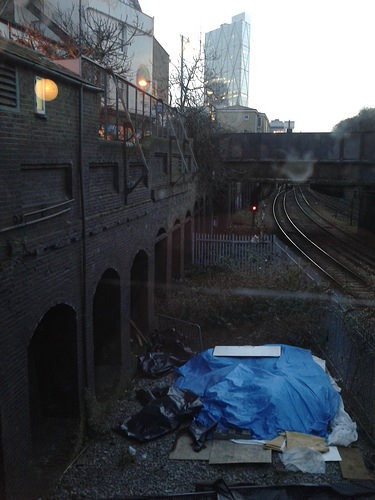
Approaching the station from Brick LaneSideways viewView from Code StreetThe original entranceInside the buildingLooking westTrains still run past the station towards Liverpool Street
Originally opened in 1876, the station had only one platform and track in use towards the end of its life. It had low passenger footfall, and when it was closed, the platform and track area was filled in.
Inside the cinemaThe archesThe opposite wall
The cinema is located where the platform and the track used to be. You can see the walls with their filled-in arches, and the hooks on the side designed to hold the cables. I’m probably the only person who got excited by this, but I kept imagining ghostly trains moving through the space where we were sitting, one era layered upon another like Russian dolls. Pretty impressive to me.
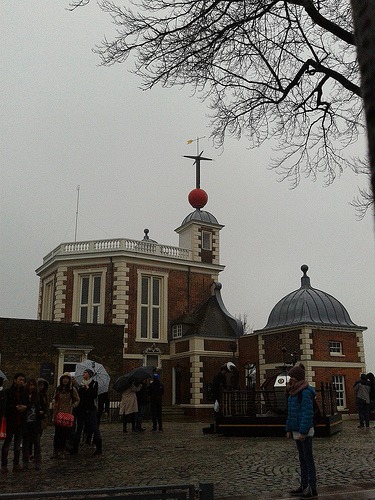
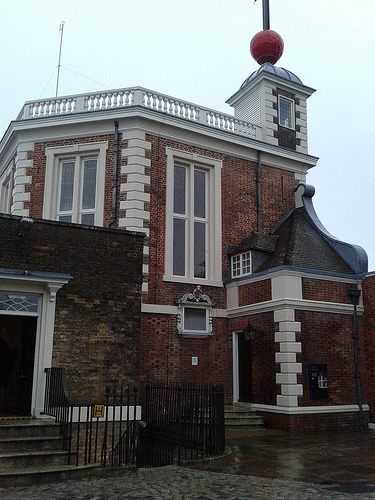
I had a joint ticket for an exhibition, the Planetarium and the Observatory (an Astro ticket), so after I left the National Maritime Museum where Ships, Clocks & Stars was located, I struggled up the massive hill to the Royal Observatory, just in time to see the red Time Ball drop at 1 pm. This was first used in 1833 and was a way for ships’ crew and ordinary Londoners to set the time accurately.
Ball goes up……ball comes down.
The first thing I did was go to the Astronomy Centre, where I attended a Planetarium show called Dark Universe. This was great fun and it was an awesome experience – we sat in chairs looking up at the domed ceiling and it felt as though we were flying through the stars. The show is about what we know, and don’t know, about the universe and it is narrated by astrophysicist and author Neil deGrasse Tyson. I came out with my head spinning as I tried to comprehend how vast space is. After that I wandered around the Astronomy Centre building, looking at the exhibitions and the Astronomy Photographer of the Year competition, which had some amazing entries.
PlanetariumAstronomy Centre
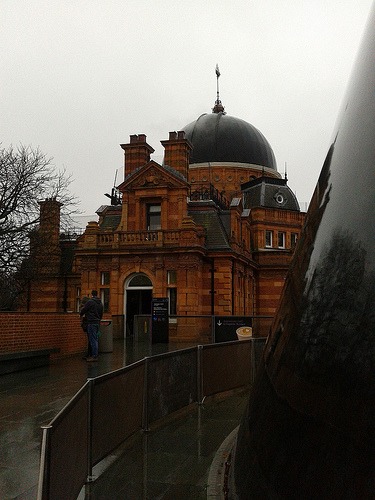
Next I went to the Royal Observatory proper. Flamsteed House was the first building of the Observatory, designed by Sir Christopher Wren in 1675 and built on the site of Greenwich Castle. The House contains the Astronomer Royal’s apartments, where the Astronomers Royal from John Flamsteed onwards lived and worked, and the Octagon Room, designed as the perfect spot from which to observe planetary motions, but which was actually not used for this purpose as it wasn’t positioned properly.
Flamsteed House
When I visited, the House was home to Longitude Punk’d, an exhibition complementing that at the NMM and consisting of responses to the “Longitude Problem” by a variety of steampunk artists. The artists worked together to create a kind of ‘alternate history’ and designed products relating to this, which were very inventive and impressive.
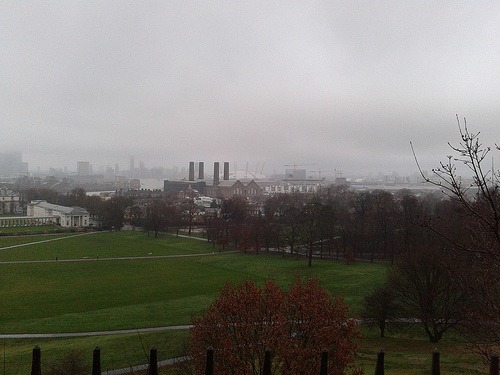
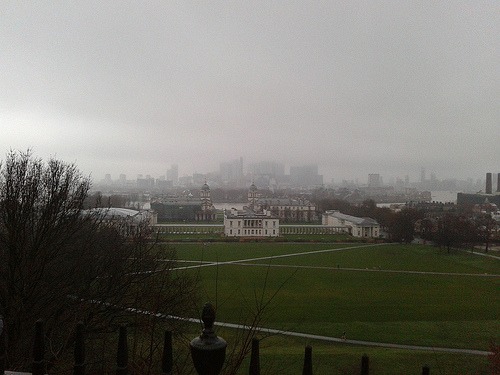
I visited the ‘Time and Greenwich’, ‘Time for the Navy’ and ‘Time and Society’ galleries which were all about the role of time in different aspects of human history (The ‘Time and Longitude’ gallery had mostly been taken to the NMM for the Longitude exhibition). There were some interesting things on display, particularly an inordinate number of clocks. I tried to take advantage of the hilltop site of the Observatory by looking out over London, but unfortunately it was a bit of a rubbish day so I couldn’t see much.
Looking towards the Thames and the O2The National Maritime Museum
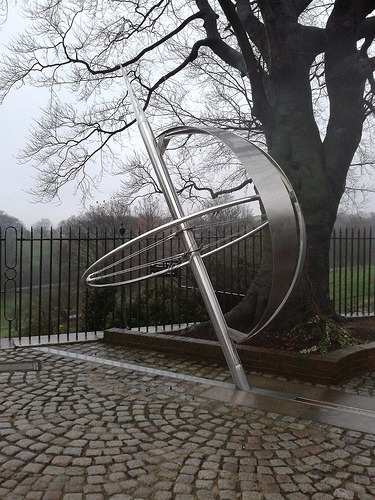
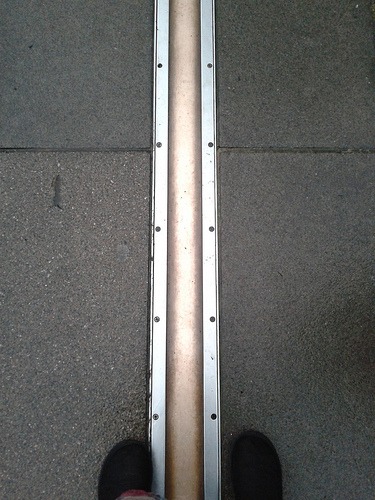
Outside in the courtyard, I watched people taking pictures on the Meridian Line – the Prime Meridian of the world, Longitude 0°. I had a go myself but I only got my feet in as I wasn’t going to faff about with selfies in front of so many people!
The Meridian CourtyardThe Meridian LineLongitude 0°
Despite the bad weather I had an enjoyable day out in Greenwich. One day I will go back and see the National Maritime Museum properly.
Christmas is over, so what to do? I thought it was time to blow away the cobwebs and get out of the house, so I spent my first weekend of the New Year doing something constructive. I was back in London so I decided to go to Greenwich, as there were a couple of exhibitions there I wanted to see.
Ships, Clocks & Stars: The Quest for Longitude commemorated the 300th anniversary of the passing of the Longitude Act in July 1714. This Act was aimed at encouraging a solution to be found for the longitude problem – essentially, working out whereabouts you are when you are at sea. In these days of accurate maps and GPS systems it’s probably hard to imagine what it would have been like to be in the middle of the ocean not knowing where you were.
Finding latitude – your position relative to the equator – was comparatively simple, as this could be done by looking at the position of the sun. Working out your longitude – how far east or west you were – was much trickier.
The exhibition looked at the concept of longitude, doing a good job of explaining it to someone like me who honestly wasn’t quite sure what it was. It discussed the Longitude Act and those responsible for judging it, as well as various theories put forward by different individuals – some particularly outlandish!
It then went on to look at the two main theories that gained dominance – one involving clocks and one involving the Moon (apologies for the generalisations – my lack of scientific expertise is to blame!). It turned out that both theories would work, and proved effective in different ways. The exhibition then examined how travel by sea developed in later years.
I liked the interactive parts of the exhibition – there was a “coffee house” where you could read news articles about the Act, and towards the end there was a large table with an interactive surface where you could hear the judges discuss the different proposals. I did think some of it could have been laid out differently – at certain points there were long queues to look in some of the glass cases. However, overall the exhibition was really good.
‘HMS Assistance and Pioneer in Winter Quarters’ [Shelfmark: 1781.a.23] – See more at: http://britishlibrary.typepad.co.uk/americas/2014/08/coming-up-lines-in-the-ice.html#sthash.vtgbSXaQ.dpuf
Recently I attended a talk at the British Library, The Search for Franklin’s Lost Ships, an event designed to coincide with the current exhibition Lines in the Ice: Seeking the Northwest Passage which runs until 29 March 2015. The talk involved Ryan Harris, a marine archaeologist, in conversation with Robin McKie from The Observer: the original subject of the talk was the search itself, but after the talk was scheduled, it emerged that one of the ships had actually been found – tremendously exciting news. Harris actually introduced his presentation by apologising for the slight change in tack – though I don’t suppose for a minute that anyone actually minded!
HMS Erebus and HMS Terror, under the command of explorer and Royal Navy officer Captain Sir John Franklin, left Greenhithe on 19 May 1845, setting sail for Canada in a bid to find the last stretch of the fabled Northwest Passage. Both ships became trapped in ice in Victoria Strait near King William Island, in the Canadian Arctic. The entire crew was lost, and their ultimate fate became one of the Victorian age’s greatest mysteries. Franklin’s wife, Jane, and others launched numerous expeditions to try and find out what had happened to them, but none were successful, though rumours of cannibalism, poisoning and scurvy abounded. Oral history and Inuit testimony was collected during the nineteenth century, suggesting that at least one ship had sunk, but their testimony was distrusted.
HMS Erebus and HMS Terror, as they appeared in Illustrated London News. Source: Getty Images via BBC News
Earlier this year, the Canadian Government initiated the biggest search yet to find the lost ships. As Canada has the largest coastline in the world, this would be no light undertaking. A previous “Project Franklin” run by the Department of National Defence ended in failure in 1967 when the divers performing the search had to be evacuated owing to hypothermia. However, modern technology has enabled new methods of searching.
Marine archeologist Ryan Harris, who took part in the search, explained how the ship – later determined to be HMS Erebus – was found. On 1 September, a piece of iron and a piece of wood were found: cross-section plans of Erebus provided by the National Maritime Museum proved that these artefacts came from that ship. Erebus itself was discovered with sonar imaging, relatively intact on the sea floor: it was possible to match up the plan of the ship with the undersea image to prove it was what they were looking for. Exciting as the discovery was, it was kept under wraps for a while so the “right” people could be informed first – the Canadian and British governments, for instance. The find was formally announced on 9 September.
The most exciting part of Harris’s talk was hearing about, and seeing pictures of, dives to the near-intact ship. Despite the covering of kelp, archaeologists were able to find cannons, anchors, decking and beams, and a table leg that, judging by a picture of Franklin’s cabin published in the Illustrated London News, came from a table belonging to Franklin himself. Particularly exciting was the discovery of the ship’s bell, still with the year ‘1845’ embossed on it. The plan is for the bell, probably made at the Whitechapel foundry, to be conserved and displayed publicly while further archaeological work continues at the site.
Further examination of the ship could lead to some important questions being answered. For instance, who were the last survivors of the crew, and when did discipline break down? How was the ship rigged – for sail, or for steam propulsion? The discovery should prompt a re-examination of the Inuit testimony which was distrusted at the time, and could shed new light on the technology of nineteenth-century British polar exploration.
A question and answer session at the end of the talk offered further insight into what might happen with the ship in the future. It seems certain that the project will go on for years, uncovering further details about the ship and the expedition as a whole. In reply to one question, Harris said that they are “optimistic” about finding some documents on board – linen-based paper can survive for centuries underwater, and it is possible that records may be found inside. The aim is to get into the middle of the ship: it is possible that it could be raised, as although it is generally preferred to leave things in situ, the significance of this one could mean that it is removed from the water at some point. Artefacts will be removed from the wreck so that they can be conserved and learned from, and in the meantime, the search for the other ship, HMS Terror, will continue.
I thoroughly enjoyed this fascinating talk and intend to keep an eye out for more news relating to the search and the Franklin expedition. I also intend to visit the exhibition at the British Library early next year.
The second exhibition I saw on Sunday was Giovanni Battista Moroni at the Royal Academy. I had never heard of this Renaissance artist before, but I found myself admiring his pictures greatly.
Moroni was the son of a stonemason and was born in Albino, north Italy, in the 1520s. During his lifetime he was acclaimed as the leading painter in Bergamo, but his reputation has fluctuated over the centuries.
Moroni preferred to paint with a representation of reality rather than create artificial, idealised portraits. As a result his pictures have insight and presence. Some portraitists of the era produced what, to me, appear as not-very-interesting pictures of the nobility, but Moroni’s paintings are different. I particularly liked his Portrait of a Lateran Canon (c. 1558) – the canon looks at the viewer with a wry smile, which led me to wonder what he was thinking! Another interesting picture is the Portrait of a Tailor (c. 1570), in which the tailor in question is full of personality.
This is a really fascinating exhibition which is definitely worth seeing. It runs until the 25th of January.
I was supposed to be meeting a friend on Sunday, but she couldn’t make it, so I decided to go to a couple of exhibitions instead. The first was Late Turner: Painting Set Free at Tate Britain.
The exhibition covers J.M.W. Turner’s work between 1835 and his death in 1851. I adore Turner and thoroughly enjoyed looking at his later works, which give the lie to the concept that old age automatically has to mean settling down into a reactionary retirement. Turner continued to experiment and push the boundaries well into his last years, despite derision and misunderstanding from his contemporaries.
One of my favourite paintings is Rain, Steam and Speed: The Great Western Railway (1844), which is just incredible, with the train rushing towards you, the sense of movement clear within the picture. I loved seeing it here. I also loved the Roman and classical-inspired pictures with their beautiful landscapes, as well as the watercolours of the burning of the Houses of Lords and Commons. Another favourite was Peace: Burial at Sea (1842) – I thought the light on the water was beautiful.
This exhibition is brilliant, and strongly recommended – but it can get crowded, so I would suggest trying to go at a quiet time if possible.