The artist Peter Paul Reubens (1577-1640) was often called the “Homer of Painting”. He has been described as the most inimitable and influential painter of the Low Countries, influencing different generations and nationalities of painters over the years. The exhibition has been organised by theme.
Poetry
Natural Landscapes
The first section looks at the natural landscapes inherent in Reubens’ work and how it impacted other artists. Reubens studied natural landscapes on his estate, resulting in pictures including the Landscape with Rainbows (c. 1630) and the Evening Landscape with Timber Wagon (1630-40), which can be said to have influenced J.M.W. Turner’s The Forest of Bere (1808). Reuben also influenced British artists such as Thomas Gainsborough and John Constable.
Poetry
The Garden of Love
While landscapes inspired British artists, Reubens’ lyrical exoticism, evident in works such as The Garden of Love (c. 1635), struck a particular chord with early eighteenth century French artists. Jean-Antoine Watteau’s La Surprise (1718-19) drew inspiration from the earlier artist’s Château in a Park (c. 1632-35).
Elegance
Reubens’ portraits of Genoese high society in Italy, such as his Portrait of a Woman (c. 1625-30), impressed Anthony van Dyck and inspired painters such as Joshua Reynolds, Gainsborough and Sir Thomas Lawrence, whose Princess Mary, Duchess of Gloucester (1824) shows Reubens’ influence.
Power
Reubens worked as a propagandist and diplomat at courts through his art, including his Cycle for Marie de Médicis (1621): he painted two series of twenty-four paintings for the galleries at her new residence. He also worked on the ceiling of the Banqueting House in London. His work inspired The Triumph of Apollo, a ceiling decoration at the Louvre painted by Eugène Delacroix.
Compassion
Reubens is best known in Belgium as a religious painter, with altarpieces in Flemish and northern French churches. This aspect of his work was popular with Spanish painters, and some, which was displayed in the Louvre, inspired Romantic art such as the Sketch After Descent from the Cross (1766-69) and copies by the likes of Delacroix and Van Gogh. Claudio Coello’s Virgin and Child Adored by St Louis, King of France (1665-68) was influenced by Reubens’ Virgin and Child Enthroned with Saints. The earlier painter’s St Cecilia (1620), showing the saint playing an organ, inspired Gustav Klimt’s St Cecilia (1885).
Violence
A different side of Reubens can be seen in the works that demonstrate horror and atrocity, including some gruesome details, not least scenes of people descending into Hell and the abduction of women, which frequently inspired the Romantics. Reubens’ The Fall of the Damned (1620) inspired Charles Le Brun’s The Fall of the Angels (1685), while his The Battle of the Amazons (1617-18) inspired Arnold Böcklin’s The Battle on the Bridge (1892).
Lust
The final section of the exhibition was about lust. Reubens is probably best known for his buxom nudes, such as his work with Jan Breughel the Elder, Pan and Syrinx (c. 1617). While I can definitely see the point of those who say his pictures can be sexist, I can also appreciate the quality of his work, which influenced paintings such as Paul Cézanne’s The Bathers (c. 1875) and Auguste Renoir’s Bather with Long Hair (c. 1895).
Overall, I found this to be an interesting exhibition and I did learn a lot. It emphasised the extent of Reubens’ influence over other artists and left me more aware of his impact.
My parents and their friends came to London over Easter, and on Good Friday we went to the Sherlock Holmes exhibition at the Museum of London. We were excited by the entrance to the exhibition, which was in the form of a bookcase in which, so the assistant told us, we had to find the secret door. Unfortunately, we all felt that the exhibition itself failed to live up to this.
There were certainly many fascinating and relevant items on display, from film posters from the detective’s various incarnations over the years to original manuscripts, including Sir Arthur Conan Doyle’s 1886 A Study in Scarlet notebook, containing the first ever lines of a Sherlock Holmes story, and the manuscript of Edgar Allan Poe’s The Murders in the Rue Morgue. There were also a couple of costumes – including a traditional outfit from Holmes’s mid-20th century incarnation as well as the Belstaff coat worn by Benedict Cumberbatch in the most recent BBC series.
Overall, though, I thought that there was too little that was actually related to Sherlock Holmes, and too much context and setting the scene. For instance, there were many paintings and photographs of late nineteenth century London, which helped to put Doyle’s work in context and picture Holmes’s London, but which was not directly connected to Holmes. There were also objects on display that related to the novels and adaptations, such as Victorian ephemera like typewriters and costumes, not directly associated with Holmes.
It would be wrong to say that I did not enjoy the exhibition – I found it very interesting – but I thought it had been mis-advertised. If it had been marketed as an exhibition about nineteenth-century London, I would have been quite happy.
Costume from the exhibition
Benedict Cumberbatch’s coat from the modern Sherlock
Nunhead Cemetery, looking towards the Anglican chapel
My visit to Nunhead Cemetery marked the mid-point of my “Magnificent Seven” tour. I very nearly didn’t visit on Sunday – I lost an hour of sleep to the clock change, and when I woke up all I could hear was the sound of the wind and the rain hitting my window, which didn’t exactly make me want to leap out of bed and spend time out of doors. However, I forced myself to make the effort, and luckily by the time I reached the Cemetery the wind had died down and the rain had stopped.
Getting There
Nunhead is one of only two of the seven cemeteries to be located south of the river, the other being West Norwood. Its address is Linden Grove, London SE15 3LP, and the closest railway station is Nunhead, which can be reached from Victoria or London Bridge stations. Peckham Rye station is a little further away but as more trains stop at this station than at Nunhead (including Overground trains), it is sometimes the better option.
Approaching the Cemetery along Linden Grove
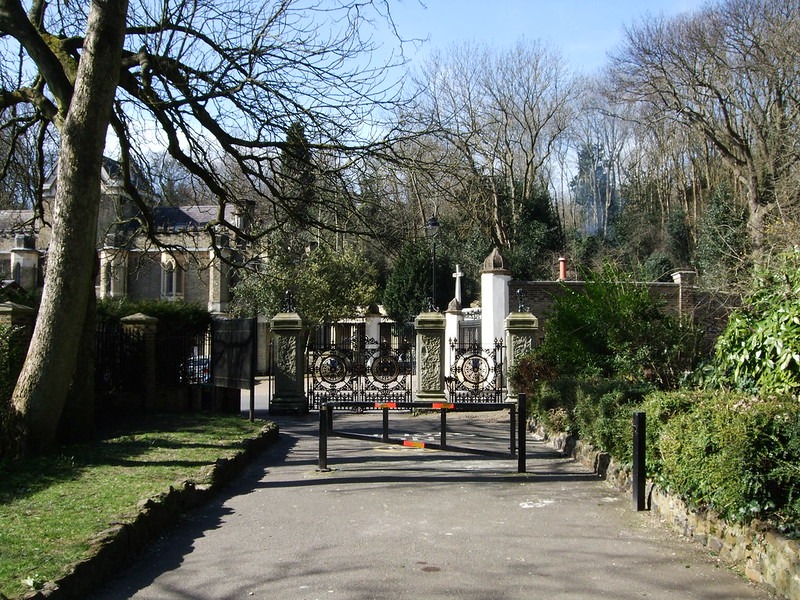
The cemetery is located very close to Nunhead station, and it is easy to reach, though you do come upon it suddenly as you step out of a housing estate. The railings are reproductions, the originals having been removed during World War II, but the neoclassical gates are original, although they have been restored. The upturned torches, which symbolise life extinguished, are common symbols in Victorian cemeteries.
The restored Cemetery gates
I was due to participate in the tour, the meeting place for which is beside the Anglican chapel.
Approaching the Anglican chapel
History
The fourth of the Magnificent Seven cemeteries to be built, in response to an overcrowding problem in central London burial grounds, Nunhead was founded in 1840 by the London Cemetery Company. It was originally called All Saints Cemetery, Nunhead. The first person to be buried here was a man called Charles Abbott, a 101 year old Ipswich grocer. The cemetery was popular, becoming nearly full by the middle of the 20th century, but was never as prestigious as Kensal Green or nearby West Norwood.
Abandoned by the company, the Cemetery fell into a state of disrepair and neglect, exacerbated by vandalism. In the early 1980s, the Friends of Nunhead Cemetery were formed to renovate and protect the Cemetery. Nunhead is now owned by the London Borough of Southwark and is a Local Nature Reserve, forming a habitat for many animals and birds. It was reopened in 2001, having been restored with funds from Southwark Council and the Heritage Lottery Fund. Nunhead is listed Grade II*.
Blue plaque
The neoclassical lodges were designed by James Bunstone Bunning, who was also responsible for the entrance gates and the landscaping. One is now occupied as a private house, while the other is sadly derelict.
One of the neoclassical lodges, now derelict, with catacombs underneath
The Gothic-style Anglican chapel was designed by Thomas Little. It fell victim to arson, but has been partially restored.
Close-up of the chapelSide view of the chapel
Tour
Looking towards the Cemetery gates from the chapel
I attended a tour run by the Friends of Nunhead Cemetery. The tour began at the Anglican chapel, and we learnt about the history of the Cemetery. I was impressed with the height of the landscape, and the wonderful views that were apparent even on such a dull day.
One of the first graves we saw was that of Henry Daniel, a mason employed by the London Cemetery Company, buried surrounded by many of the memorials that he built.
Family vault of Henry and Charlotte DanielClose-up of the tomb with anchor and serpent decoration
An interesting part of the Cemetery was the Muslim section, something I had not expected to come across.
Muslim area
We noted the tomb of Bryan Donkin (d. 1855), the inventor of the tin can. His son, another Bryan, also buried here, opened a banknote factory in Russia.
Tomb of Bryan Donkin
On our way up the hill, our guide pointed out the silver granite memorial to the ship owner John Allen (d. 1865).
Heading up the hill with Allen’s tomb on the right
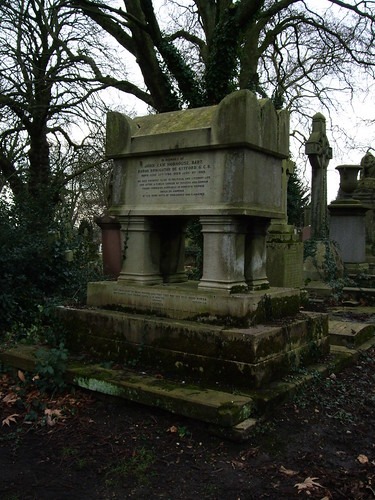
The tomb is a reworking of an ancient monument brought to Britain from Egypt.
Memorial of John AllenMemorial of John Allen
Some parts of the memorial are in excellent condition, but others have decayed: the two angels that formerly flanked the head of the monument are no longer in position.
A fallen weeping angel
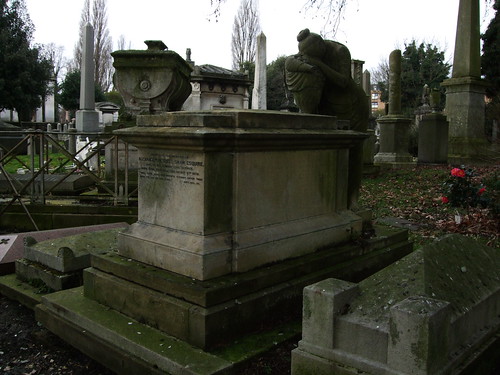
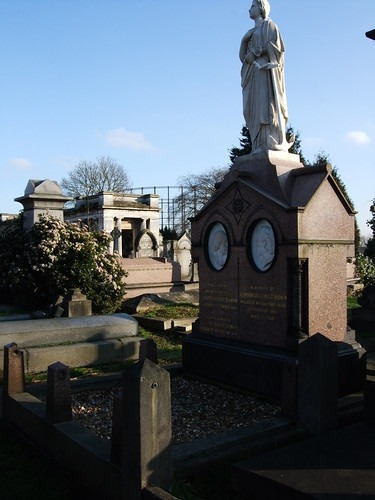
The Stearns family mausoleum was built in 1902 by the Doulton firm. It is similar to monuments at West Norwood.
Stearns family mausoleum
Our walk eventually brought us to the top of the hill. It was considered more prestigious to be buried at the top, because you were thought to be closer to God.
Approaching the top of the hill
However, being at the top does mean that your memorial is more exposed to the weather. This one is looking a bit wonky.
An unusually carved tomb
It is possible to see St Paul’s Cathedral from this point on the hill – a stunning view.
View of London from the very top of the Cemetery
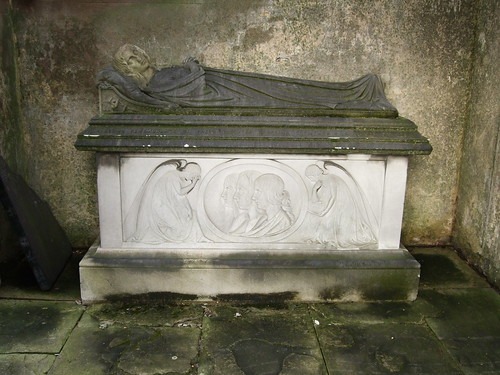
Near the top is buried John Moritz Oppenheim, a skin and fur merchant who died in 1864 and was a generous patron of the arts, despite being blind for 20 years. His stone shows an angel touching his eyes.
Grave of John Moritz Oppenheim
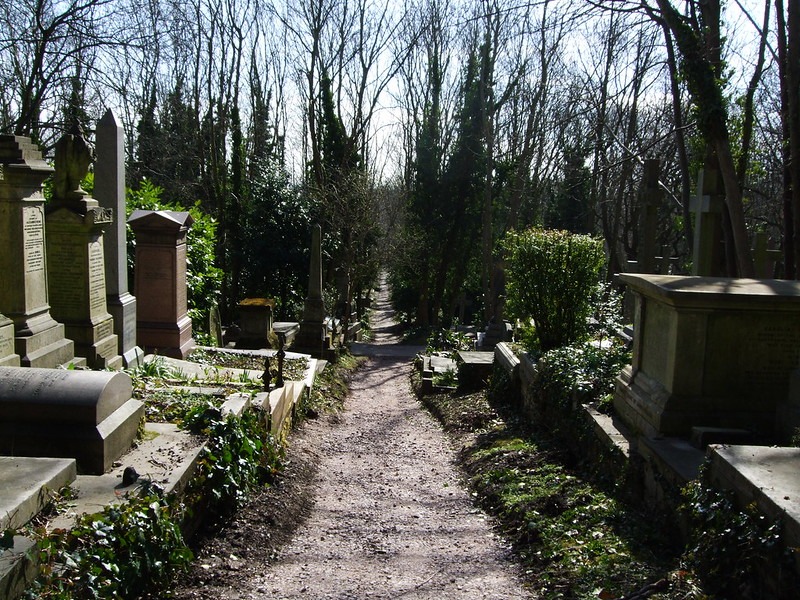
The Cemetery is overgrown in parts and could do with some restoration, although I did think that this unkempt look made it more atmospheric.
Many of the graves are overgrown
The Cemetery is an important nature reserve: this pond, for example, is very important for wildlife.
Pond for wildlife
We headed back down the hill towards the entrance.
The way downA winding path flanked by graves
The location of the former Dissenters’ chapel is marked by a clearing. The unconsecrated ground surrounding it contains graves of people belonging to non-Anglican denominations.
Location of the former Dissenters’ chapel
In the area you can see the Cemetery’s only gravestone with a Welsh inscription.
Welsh grave
Finally, we were shown the Scottish Martyrs obelisk, a memorial to 5 lowland Scots sentenced to transportation for advocating parliamentary reform.
Scottish Martyrs obelisk
Scouts
The Scouts memorial
The Scouts memorial commemorates a tragic accident that occurred in 1912. On the 4th of August, nine boys were drowned at Leysdown after their boat overturned. The tragedy resulted in huge public mourning, and a bronze life-size Scout was designed by Sir Giles Gilbert Scott and erected here in 1914. Sadly stolen in 1969, it was replaced by this marble stone in 1992.
Some Commonwealth war graves are located in the same area, soldiers who died in a nearby hospital after returning from the Front in World War I.
Commonwealth War Graves
Architecture
As with the other cemeteries I have visited so far, the architecture is varied and impressive. Many of the usual symbols are present, including angels, broken columns and crosses.
A stone angel decorating a graveTomb with a scroll carvingBroken column with rose design
This unusual anchor does not actually belong to the grave on which it rests. It was discovered after a period of bad weather destroyed the vegetation covering it, and bears an intriguing message.
Anchor-shaped stoneA crossA cross covered with ivy
Nunhead is one of the least-known of the Magnificent Seven cemeteries, and its lack of fame and location south of the river might put people off visiting. However, it is a little gem: a lovely site on a hill, romantically overgrown, and a haven for wildlife.
Would I go back?
Yes – Nunhead would be a lovely place for a quiet walk. I also want to do a tour of the crypt, chapel and viewing tower, run by the Friends on various dates throughout the year.
There is an Open Day each year: in 2015 this will be the 16th of May. You can view details here.
Facts
Address: Linden Grove, London SE15 3LP
Founded: 1840
Size: 53 acres
Still in operation?: Yes
Official website: http://www.southwark.gov.uk/info/461/a_to_z_of_parks/660/nunhead_cemetery
Owners: London Borough of Southwark
Friends group: Friends of Nunhead Cemetery (FONC) (http://www.fonc.org.uk/)
Tours: General tours on the last Sunday of every month, free, 2.15 pm at the Linden Grove entrance. Special interest tours on certain dates – see the FONC website for details.
I made my third visit to Windsor Castle at the weekend in order to get the most out of my 1-year pass. It was a lovely sunny day and the Round Tower was looking smart. The Royal Standard was flying to show that the Queen was in residence.
I went on one of the Precinct Tours which I hadn’t done before. Our guide was very interesting and told us lots of things, some of which I hadn’t known before. We stopped briefly to see this Order of the Garter symbol which I hadn’t noticed previously.
Inside the Castle, I visited the Semi-State Rooms which are only open during the winter months, between September and March. These were created for George IV, completed in 1830, and are decorated lavishly. They were almost destroyed during the 1992 fire but have been thoroughly restored; luckily, the objects inside the rooms had been moved elsewhere at the time.
Another interesting and relaxed visit. I wonder if I will get the chance to go again before my pass runs out in June.
Highgate Cemetery is probably the most famous cemetery in London – I had heard of Highgate before any of the other Magnificent Seven. It is the burial place of some of the most famous figures ever to have graced London, and is well-known in popular culture, having appeared in novels such as Falling Angels by Tracy Chevalier and Her Fearful Symmetry by Audrey Niffenegger. I’m not quite sure how I’ve managed to live in London for four years without visiting.
Getting There
Highgate has a lovely setting on a hill in North London. The nearest tube station is actually Archway, not Highgate. From Archway, take the 210,143 or 271 bus up Highgate Hill to Waterlow Park (you can walk, but it’s better to save your energy for exploring the cemetery). You have to walk through the park, which is lovely, to reach the cemetery.
Approaching Swain’s Lane from Waterlow Park
History
The English Heritage Grade 1* listed Highgate Cemetery originally opened in 1839, the third of the “Magnificent Seven” after Kensal Green and West Norwood, part of a ring of garden cemeteries around the outskirts of central London designed to draw burials away from the overcrowded and unhygienic inner-city cemeteries. An 1836 Act of Parliament created the London Cemetery Company, which bought seventeen acres of land on the steep hillside near Highgate Village for the sum of £3,500. The original design was by architect and entrepreneur Stephen Geary whose Tudor-Gothic style is evident in the entrance and chapels, and the Cemetery was dedicated to St. James by the Right Reverend Charles Blomfield, Lord Bishop of London, on 20 May 1839. The original Cemetery is now known as the West Cemetery; the East Cemetery was an extension established in 1854 thanks to the huge popularity of Highgate.
The Cemetery was built in the grounds of the Ashurst estate, evidence of which is the presence of a magnificent Cedar of Lebanon dating from the late seventeenth century. Sadly, Highgate’s profitability declined in the twentieth century and it began to decay, with vandalism and overgrown weeds prevalent until the Friends of Highgate Cemetery Trust, set up in 1975, took over in 1981. The Friends are still responsible for the upkeep of the Cemetery and run the guided tours which are the only way to see the West Cemetery (you can walk around the East Cemetery alone but you do have to pay).
East Cemetery
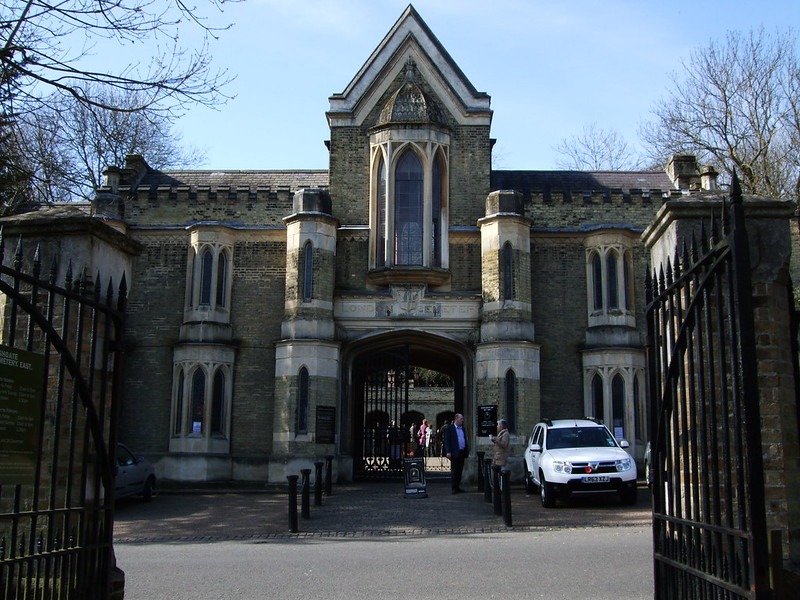
Entrance to the East Cemetery
On Saturdays, you can’t book tours in advance: you just turn up. I had a bit of time to wait until my West Cemetery tour so I decided to have a look around the East Cemetery first (entry is included in the price of your West Cemetery tour ticket). The Eastern part was built later than the original West Cemetery, but it is still worth seeing. In fact, the lady at the entrance selling tickets to other visitors summed it up nicely when she said that the West Cemetery has the famous monuments, the East Cemetery has the famous people.
Inside the East CemeteryInside the East Cemetery
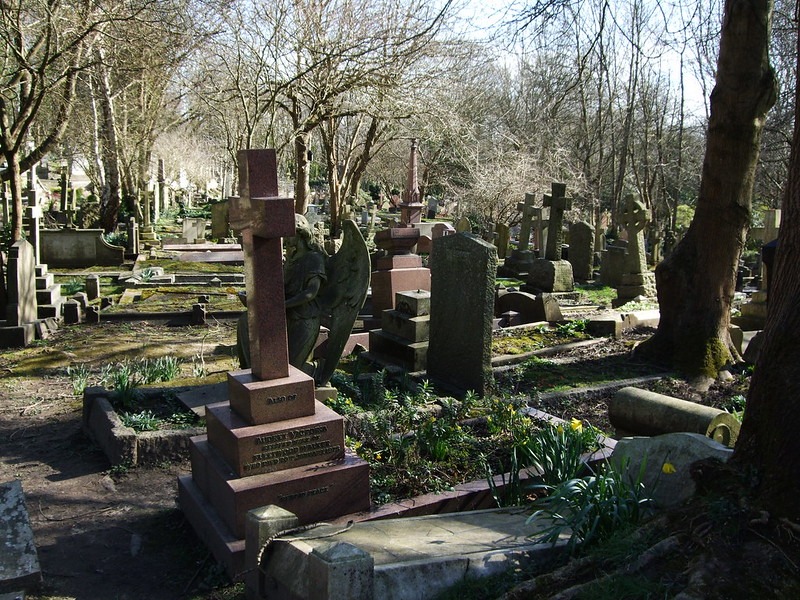
It was a lovely sunny day – warm enough to walk around without a coat – and I enjoyed exploring the beautiful Cemetery and the landscape of gravestones, with a couple of mausoleums thrown in.
Pocklington mausoleum
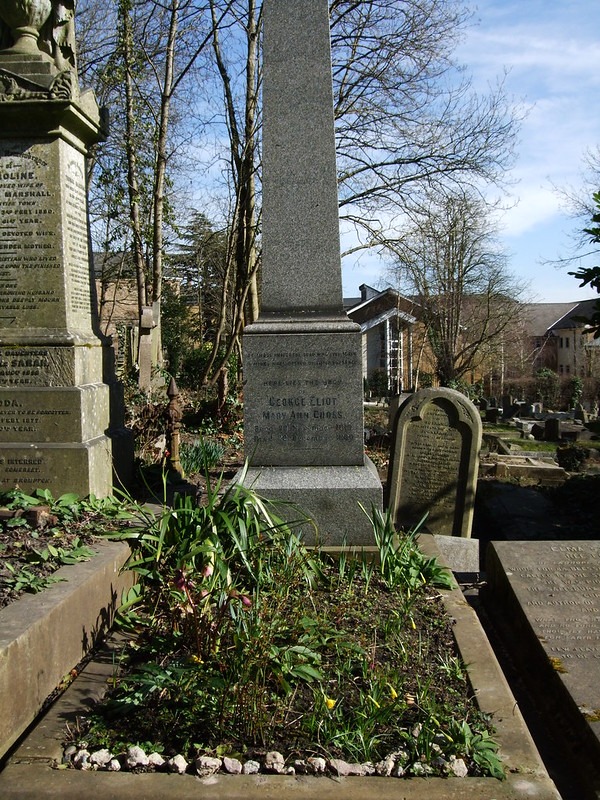
I had a good time finding significant graves, including that of one of my favourite Victorian writers, George Eliot, author of Middlemarch. Her real name of Mary Ann Cross is also on her tombstone.
Grave of George Eliot
A more recent but equally loved writer, Douglas Adams, famed for the Hitchhiker’s Guide to the Galaxy books, was buried here in 2001. His grave is often marked with pens.
Grave of Douglas Adams
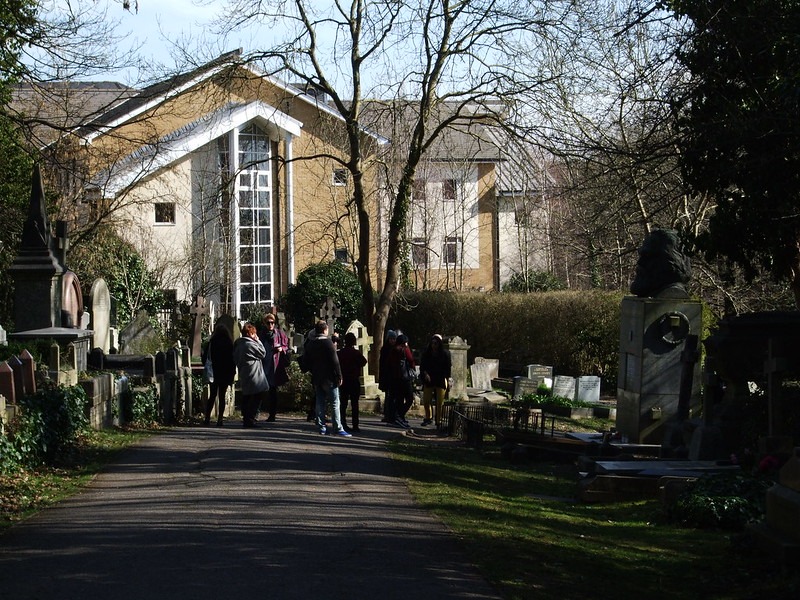
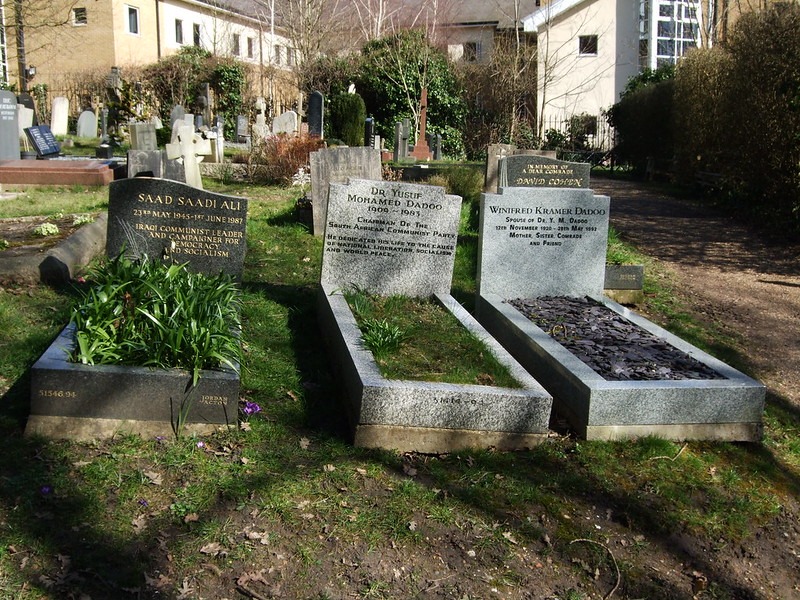
Karl Marx is probably the most famous person buried at Highgate. His grave is easy to spot because there are lots of people milling around it.
Approaching Karl Marx’s tomb
The original gravestone, which is embedded within the newer structure, is plain and simple; the impressive tombstone, with the carved message “WORKERS OF ALL LANDS UNITE”, was erected by the Communist Party of Great Britain in 1954. The portrait bust is by Laurence Bradshaw. In 1970 there was an attempt to blow up the monument with a homemade bomb.
Marx’s tomb
A number of other Communists and revolutionaries are buried near Marx, as is the Marxist historian Eric Hobsbawm.
Socialist leaders and thinkersEric Hobsbawm’s grave
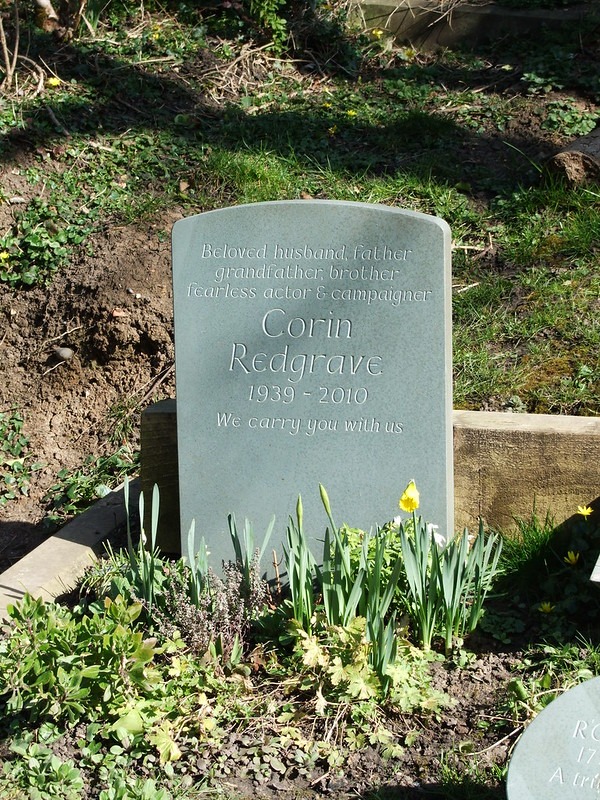
Actor Corin Redgrave is buried at Highgate.
Burial place of Corin Redgrave
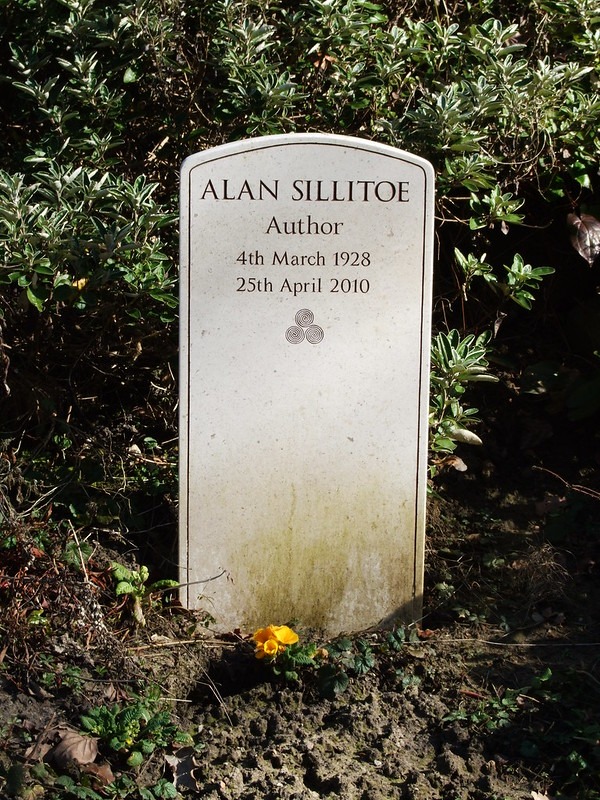
Writer Alan Sillitoe (author of Saturday Night and Sunday Morning) also rests here.
Alan Sillitoe’s grave
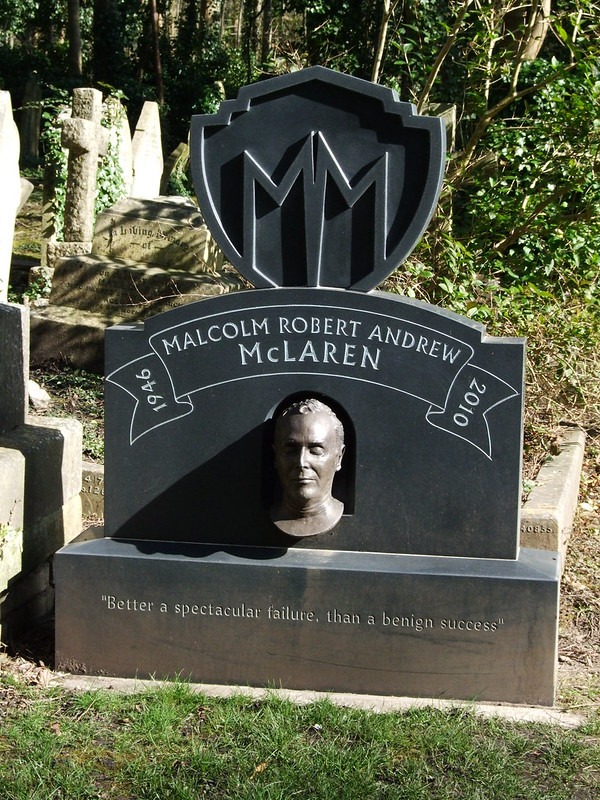
Malcolm MacLaren, manager of the Sex Pistols, musician and fashion designer, is buried in an unique grave.
Malcolm McLaren’s grave
The artist Patrick Caulfield’s gravestone, dramatically reading “DEAD”, is one of my favourites.
Patrick Caulfield’s tombstone
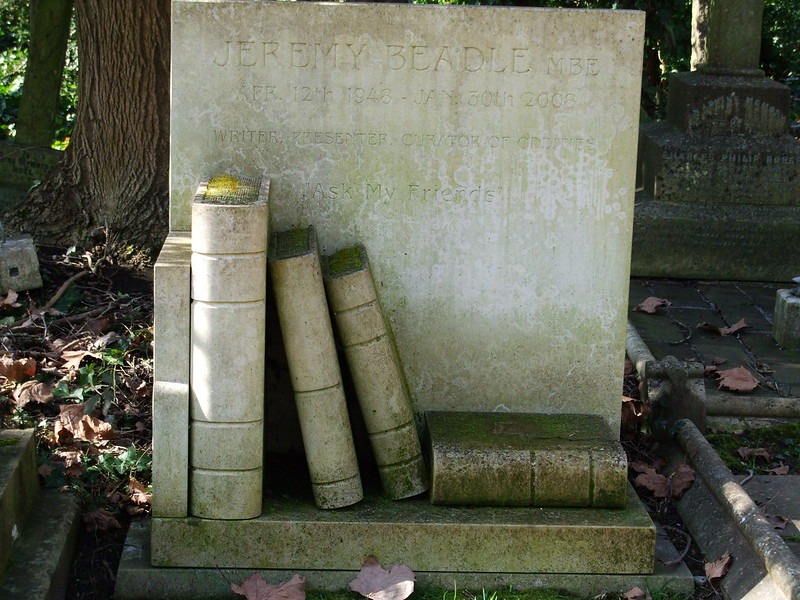
One of my most surprising finds was the grave of TV personality and presenter (of Beadle’s About and You’ve Been Framed!)Jeremy Beadle. I really liked his gravestone, which looks like a bookshelf.
Jeremy Beadle’s grave
Aside from the famous individuals buried here, there are plenty of graves noteworthy for their architecture. A variety of styles are in evidence, including Victorian:
Grave of Caroline Tucker
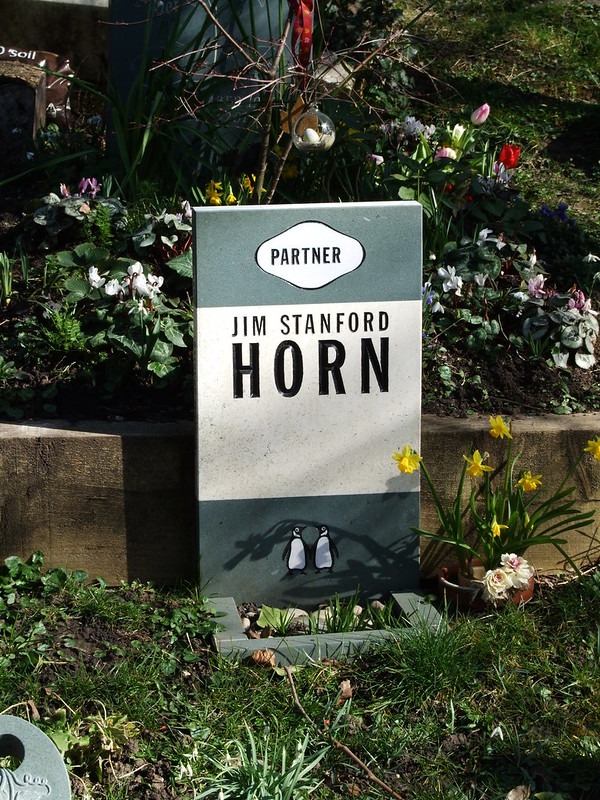
…and modern. I love this Penguin Books-themed stone.
Jim Stanford Horn’s gravestone
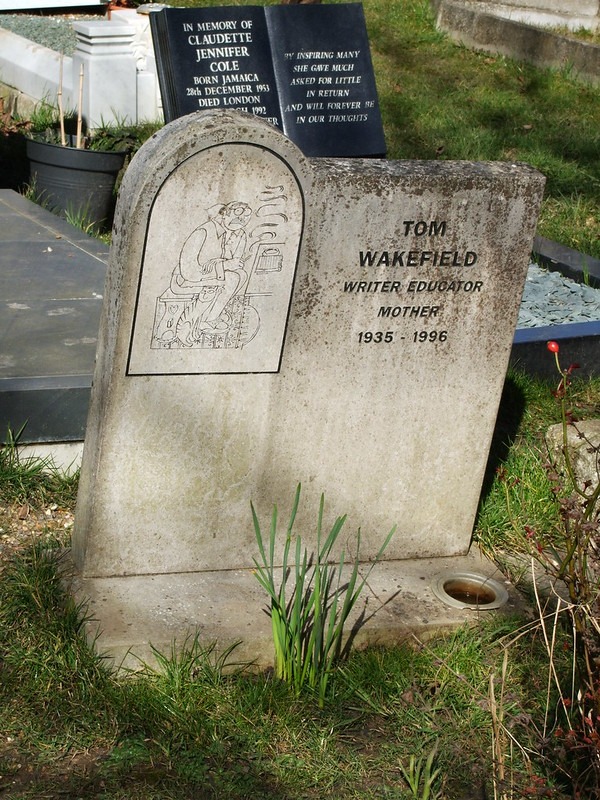
I was intrigued by this picture and description.
Tom Wakefield’s grave
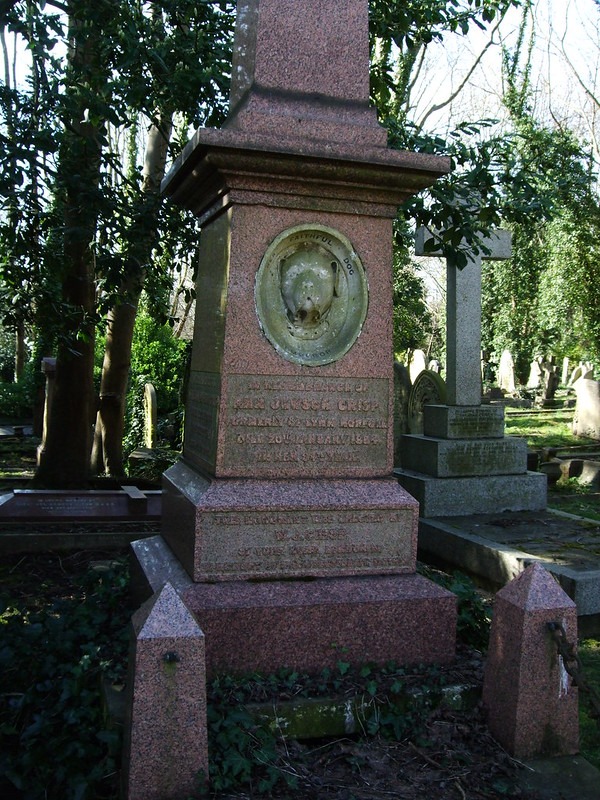
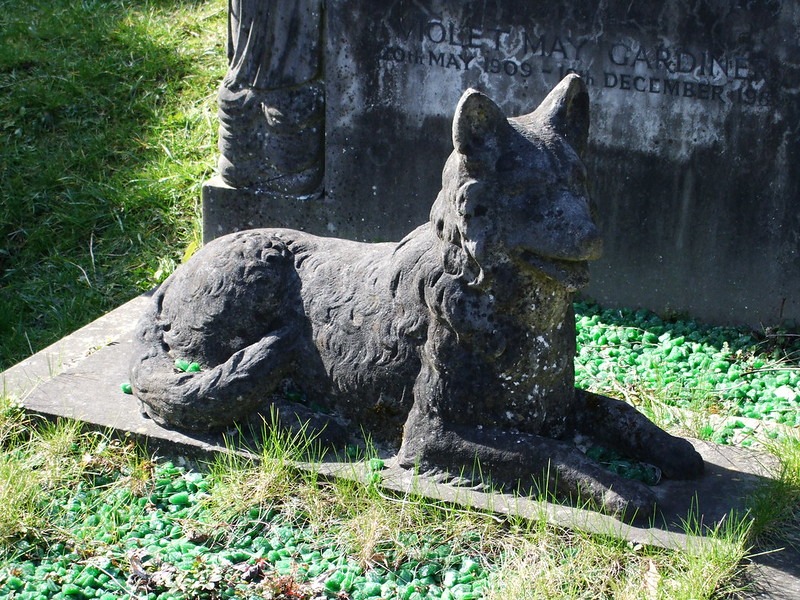
This person obviously loved their dog very much.
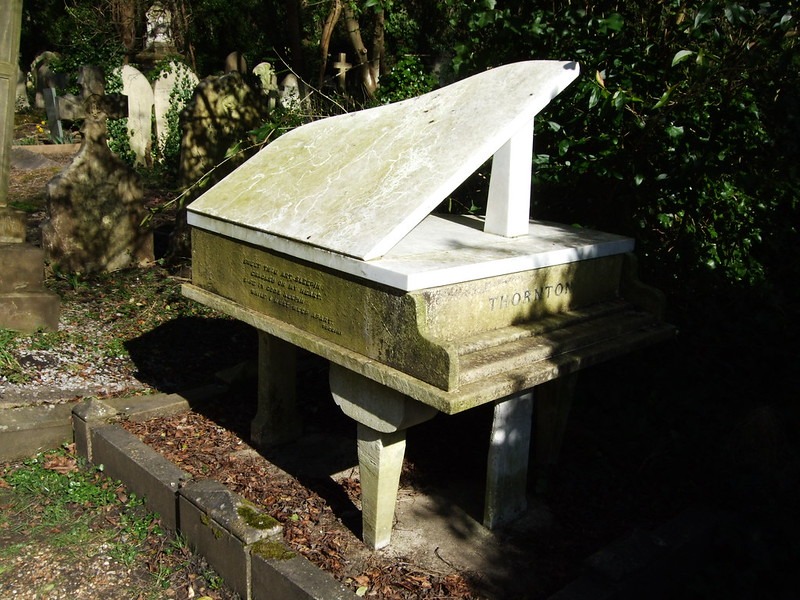
This piano is amazing.
Tomb of Thornton
The East Cemetery is beautiful and I could wander around for hours.
However it was time to leave this side and head over to the West Cemetery for my tour.
West Cemetery
Entrance to the West Cemetery
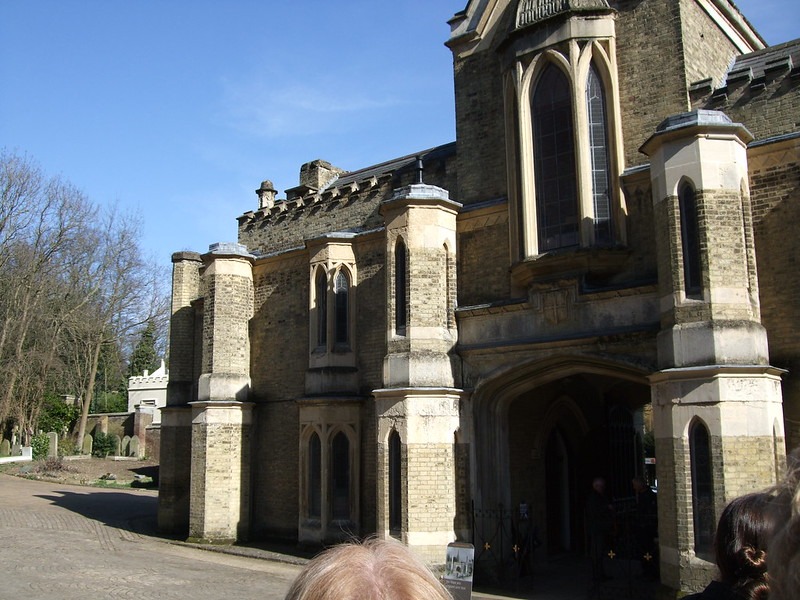
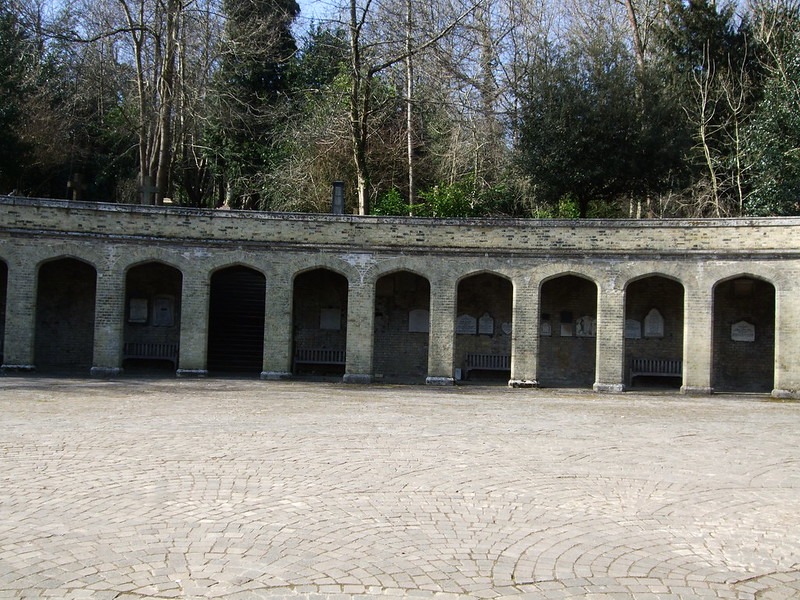
After waiting in the chapel for our tour guide, we were taken outside to the courtyard and arcade.
The Chapel
The smaller part of the chapel on the left, formerly the Dissenters’ Chapel, is now the private area for staff. The larger part on the right was the Anglican chapel: it is now the visitor centre and gift shop and has been recently restored.
The courtyard and arcade: the area was designed to be big enough for a coach and horses to turn around
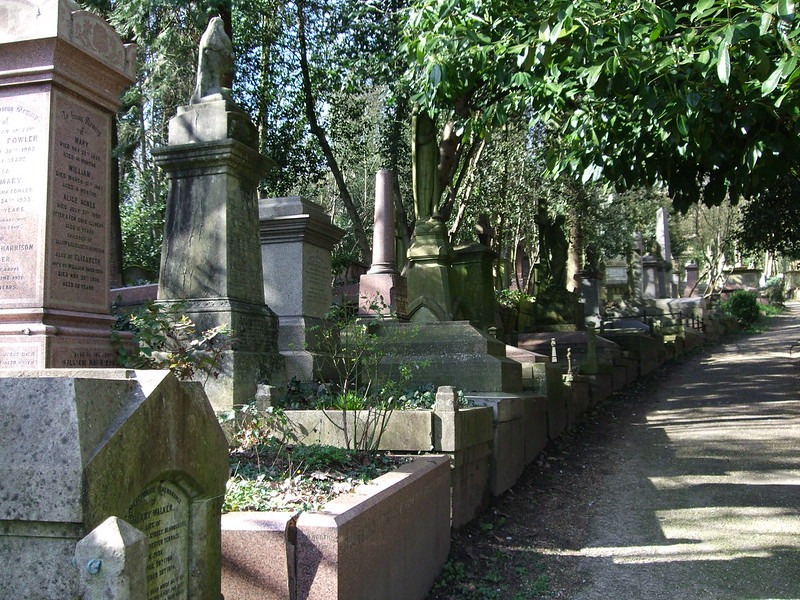
Our guide explained the history of the site as we began our tour. Stephen Geary, the architect (and founder of the London Cemetery Company), appointed a surveyor (James Bunstone Bunning) and a garden designer/landscape architect (David Ramsey) who laid out the beautiful, winding paths. It’s a gloriously peaceful place.
The Chapel, seen from our route into the Cemetery
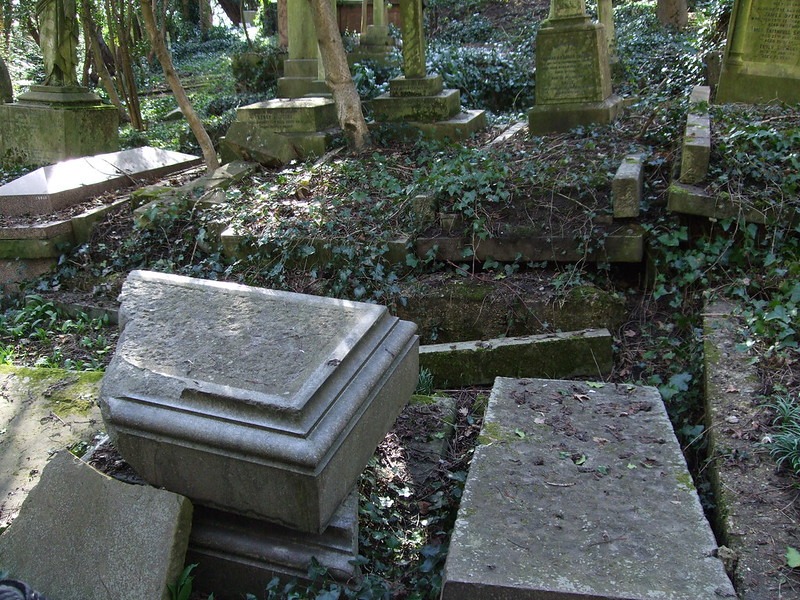
Things weren’t always so quiet: some parts of the Cemetery suffered bomb damage during World War II. The damage has been purposely left as a memorial.
Bomb damage
In more recent history, Alexander Litvinenko, the Russian poisoned in London in 2006, was buried here.
Alexander Litvinenko
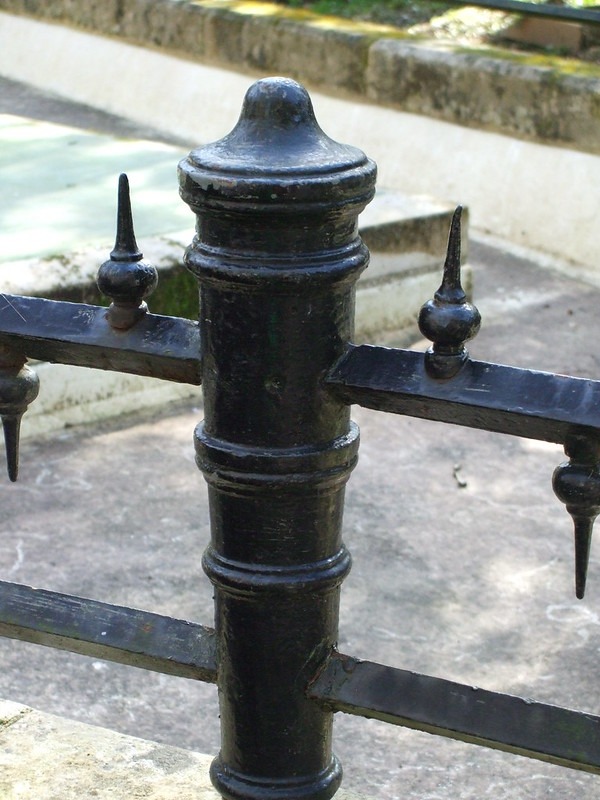
The largest plot in Highgate belongs to a military man, and the railings around his tomb are miniature cannons.
The oldest grave in the Cemetery belongs to Elizabeth Jackson of Little Windmill Street, Soho, who died aged thirty-six and was buried on 26 May 1839.
Grave of Elizabeth Jackson
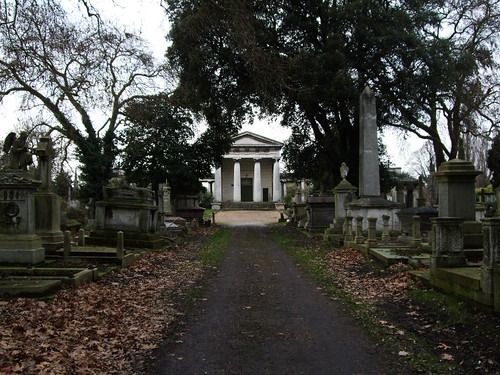
The Egyptian Avenue, a gorgeous structure with vaults – rather like above-ground catacombs – is located towards the top of the Cemetery. At first these vaults didn’t sell very well, as they were seen to be too “pagan” in tone, but after Queen Victoria popularised an interest in Egypt this changed.
Leading up to the Egyptian Avenue
In recent years a colony of rare orb weaver spiders has been discovered living inside the vaults of the Egyptian Avenue. The cold, dark conditions of the vaults are perfect for the spiders. This is no doubt a good thing in terms of ecological diversity, but I for one will be staying well away from the vaults!
Inside the Avenue
The Avenue leads to the Circle of Lebanon, which consists of twenty vaults around an inner circle; sixteen were added to an outer circle in the 1870s. The Circle was made by excavating earth from around the Cedar of Lebanon which had been present since the land was part of the Ashurst Estate. Above the Circle, a Gothic-style catacomb, known as the Terrace Catacombs as it was built on the site of the original terrace of Ashurst House, was constructed in 1842. We were able to visit the catacombs and they were fascinating, though sadly (but understandably) we were not allowed to take photos.
Inside the Circle of LebanonClose-up of some of the vaults in the Circle
Author Radclyffe Hall lies in one of the vaults.
Resting place of Radclyffe HallThe magnificent Cedar of LebanonLooking down into the Circle of LebanonLooking down into the Circle of Lebanon
Coming out of the Circle of Lebanon and the Terrace Catacombs, we moved into the main Cemetery once again. Our first stop was the tomb of George Wombwell, the menagerie owner, who owned several exotic animals and raised the first lion in captivity in Britain.
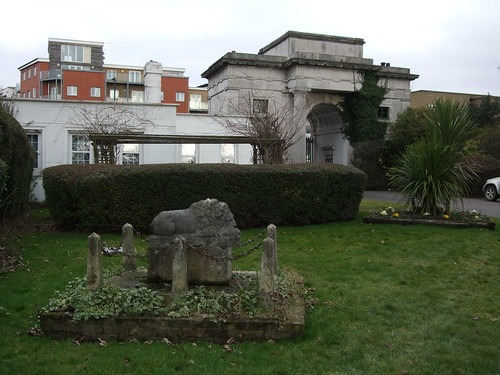
Wombwell’s tomb with a statue of his lion, Nero
We saw the tiny stone of Adam Worth, a well-mannered and pleasant criminal mastermind who was apparently the inspiration behind Moriarty in the Sherlock Holmes stories.
Adam Worth’s grave
The mausoleum of millionaire newspaper magnate Julius Beer is one of the most impressive in the Cemetery. Sadly, though, he originally constructed it for his daughter Ada, who died aged eight. Apparently when the tomb was first reopened after many years, the Friends were unable to get the door open and had to send someone in through the broken top of the mausoleum. Once inside, they discovered why the door wouldn’t open – the floor was thick with bird poo. Lovely! Thankfully the structure has since been restored, although we couldn’t go inside as there was a problem with the door.
Mausoleum of Julius Beer
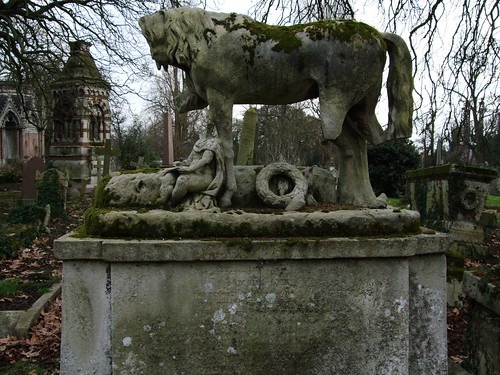
Thomas Sayers was a famous English bare-knuckle fighter during the Victorian period, a time when such fighting was in fact illegal. His final fight, against US champion John Camel Heenan, took place in Hampshire and ended in chaos when the spectating public invaded the ring and the police had to get involved. A public subscription raised a retirement fund for him and he never fought again, although he died aged only 39 in 1865. Thousands of people turned out on the streets of Highgate to see his funeral, although the chief mourner was his dog, Lion, who guards his tomb in effigy.
Grave of Thomas Sayers
Michael Faraday, the well-known scientist most famous for his work in electromagnetism and electrochemistry, is buried in the Dissenters’ area of the Cemetery.
Michael Faraday’s grave
Charles Dickens himself is buried in Poets’ Corner at Westminster Abbey, but he was familiar with Highgate and has family connections there. His sister Frances (Fanny) Burnett is buried there along with her son Henry (Harry) Augustus, supposedly the inspiration for Tiny Tim in A Christmas Carol.
Grave of Dickens’ sister
Dickens’ parents, John and Elizabeth, also rest in Highgate.
Burial place of Charles Dickens’ parents
Continuing the writers’ theme, I spied the grave of author Beryl Bainbridge.
Beryl Bainbridge’s grave
Highgate Cemetery is an absolutely fascinating place. It’s a shame about the entry charge, as it would be a wonderful place to visit again and again. Having said that, the Friends do a fantastic job of keeping everything going and the money is certainly put to good use.
I had heard horror stories about rude and grumpy staff, but I didn’t see any evidence of this at all: everyone seemed lovely and my tour guide was informative and friendly.
I really enjoyed my visit but was sad not to have been able to see the grave of Elizabeth Siddall (pre-Raphaelite muse, artist and wife of Dante Gabriel Rossetti); apparently it is in a part of the Cemetery closed to visitors.
Would I go back?
Despite the cost, yes. It’s a hugely interesting place, with lots to see. A cheaper trip could take in the East Cemetery only; this would only cost £4. I would be back like a shot if I could have a chance to see Lizzie Siddall’s grave.
FACTS
Address: Swain’s Lane, London N6 6PJ
Founded: 1839 (Eastern extension opened 1854)
Size: 37 acres
Still in operation?: Yes
Official website: http://highgatecemetery.org
Owners: Friends of Highgate Cemetery Trust (registered charity)
Tours: West Cemetery – weekdays at 2.45 pm (book online via website); weekends every half hour 11-3: £12 adults, £6 children. East Cemetery – Saturdays at 2 pm: £8 adults, £4 children (normal admission £4 adults, children free).
Entrance to West Norwood Cemetery with the war memorial and inner gates visible
At the weekend I made a visit to the second of the “Magnificent Seven” commercial cemeteries in London, West Norwood Cemetery. Once again I was lucky with the weather: it was a dry and sunny day, though a cold wind made me shiver on occasion.
Getting There
West Norwood Cemetery is, as the name suggests, in West Norwood, south London. The address is Norwood Road, London SE27 9JU and the closest railway station is West Norwood, which can be reached from Victoria or London Bridge stations.
History
Initially known as The South Metropolitan Cemetery, the cemetery was founded by its own Act of Parliament in 1836 and the first burial took place a year later. The South Metropolitan Cemetery Company purchased land from the estate of the late Lord Thurlow to create the cemetery, which was consecrated by the Bishop of Winchester.
The Gothic inner gates designed by Sir William TiteClose-up of the archMain office, which was rebuilt after the original was damaged in the war
In contrast to Kensal Green, which was built in the classical style, the South Metropolitan Cemetery was the first to be designed throughout in the Gothic style. The landscaping and some monuments, including the catacombs and the entrance gateway, were designed by architect Sir William Tite (1798-1873), who was eventually buried here himself. The cemetery later became known as the “Millionaires’ Cemetery” owing to the number of eminent Victorians buried here, including around 300 people with entries in the Dictionary of National Biography.
Looking into the cemetery with the entrance gates at my back
Sadly, the 40-acre cemetery suffered bomb damage during World War II and Lambeth Council, following a compulsory purchase order in 1965, proceeded to clear thousands of monuments. Luckily, the Friends group, the Archdeacon of Lambeth and others joined to prevent this. Many monuments are listed Grade II by English Heritage. The original consecrated chapel was also damaged by a bomb during the war and was later pulled down; the Dissenters’ chapel remains and has been converted into a crematorium.
Tour
Our guide told us a little about the history of the cemetery, and took us on a fascinating walk around it, pointing out some of the more notable features. One memorial that stood out is that of James Gilbart, founder of the London and Westminster Bank (now known as NatWest).
The J.W. Gilbart memorial, which is Grade II listedSpire view of the memorial
We also saw the grave of Sir Hiram Maxim, of Maxim Gun fame – the American inventor, who moved to England aged 41, holds the dubious honour of being the inventor of the first portable, fully automatic machine gun.
The Maxim family grave
The grave of Joe Hunte, the anti-racism campaigner, rests here.
Burial place of Joe Hunte
I particularly liked this gravestone with its striking image of an old-fashioned diving helmet. Augustus Siebe was an inventor and engineer whose contributions to diving technology earned him fame. His stone was replaced without the cemetery’s permission a few decades ago, but I don’t feel I can object as I really like this interesting design.
Augustus Siebe’s grave
The most famous person to be buried in West Norwood is probably Isabella Beeton, of Mrs Beeton’s Book of Household Management fame. She died at 28 after contracting puerperal fever following the birth of her fourth child. I had always thought she was older, but then she did have 20 younger siblings, so she had plenty of time to gain ample experience in cooking and household management.
Mrs Beeton’s unassuming burial place
The Reverend Charles Spurgeon was a Baptist preacher and he is still well-known and admired by Baptists around the world. Our guide told us about the time a coachload of American tourists came to the cemetery, surrounded Spurgeon’s tomb to take pictures and then left, without looking at anything else in the cemetery.
Charles Spurgeon’s tomb just outside the crematorium (formerly the Dissenters’ Chapel)
Mrs Beeton might be better-known, but for me the most exciting person to be buried in West Norwood is Charles Pearson. He was a solicitor and a reforming campaigner who campaigned for an underground railway system and was instrumental in promoting and establishing the Metropolitan Railway, the forerunner to the London Underground. I’m a great admirer of Pearson, whose encouragement of the railway system stemmed from a sense of social justice and a belief that it would improve the lives of the working poor.
Charles Pearson, buried in his son-in-law’s plot
Two lovely large red brick mausoleums stand out: the first belongs to Sir Henry Tate, the sugar magnate who also founded the Tate Gallery (now Tate Britain).
Henry Tate’s mausoleum
The second is the burial place of Sir Henry Doulton, the pottery manufacturer who was instrumental in developing his family firm into the famous Royal Doulton brand.
Tomb of Henry Doulton
Architecture
The cemetery is interesting because of the people buried here, but also because of the examples of cemetery architecture in evidence. This draped urn was typical of the period.
Draped urn
Lucy Gallup’s grave is unusual because of the presence of a photograph of the deceased.
Lucy Gallup’s photograph
The English antiquary John Britton designed his monument to be as permanent as Stonehenge. In fact, it looks just like a Stonehenge stone.
John Britton’s unusual monument
Seaman John Wimble’s beautiful and intricate tomb, with its detailed carvings of ships, lent its name to Ship Path.
A beautifully carved ship on Wimble’s monument
The tomb of Alexander Berens, designed by E.M. Barry, is one of the most impressive in West Norwood and sits in a prime spot on the top of the hill.
Alexander Berens’ elaborate mausoleum
Here is an example of a heart plaque sometimes used in the sentimental Victorian period.
Heart plaque
Greek Necropolis
Looking towards the Greek Necropolis
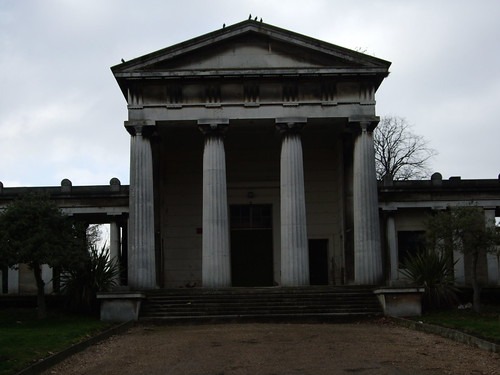
Our final stop on the tour was the Greek Necropolis, complete with an imposing Chapel of St Stephen (architect unknown but sometimes thought to have been John Oldrid Scott). This section of the cemetery was acquired by the Greek community in London in 1842, and is filled with Greek Orthodox mausoleums and monuments commemorating members of the Anglo-Hellenic community. The Necropolis is overseen by the trustees of the Cathedral of Saint Sophia.
St Stephen’s ChapelGreek monuments
The end point of our tour was the elaborate mausoleum of Edmund Distin Maddick, which had been opened up to form a little shop.
Mausoleum of Edmund Distin Maddick
It’s not as famous as Kensal Green or Highgate, and it’s a little out of the way, but West Norwood Cemetery is well worth a visit. There are some interesting monuments to see, and the cemetery’s location on a hill is an attractive one: and there are a couple of famous graves.
Would I go back?
Yes – it’s a decent-sized site with plenty to see, and I would like to be able to take a leisurely walk around it. Visiting the cemetery is free, so well worth it. In addition, if you join the Friends group for £5 per year you get a chance to take a tour of the catacombs – which is something I definitely intend to do at some point.
Facts
Address: Norwood Road, London SE27 9JU
Founded: 1836
Size: 40 acres
Still in operation?: Cremation plots are still available but the cemetery is closed to new burials, at least for now
Official website: http://www.lambeth.gov.uk/places/west-norwood-crematorium-and-cemetery
Owners: Lambeth Council
Friends group: Friends of West Norwood Cemetery (FOWNC) (http://www.fownc.org/)
Tours: The first Sunday of every month, 11 am November-March, 2.30 pm April-October. Free, but donations appreciated.
I really like going to see exhibitions at the Queen’s Gallery at Buckingham Palace: they are always interesting and well-curated, and the one-year pass system – by which you buy a ticket on your first visit, get it stamped at the end, and gain free admission to the site for a year – means that you can see three different exhibitions for under £10. I visited on the last day of two smaller exhibitions that have been running since last autumn.
Cairo to Constantinople: Early Photographs of the Middle East
The first exhibition was Cairo to Constantinople: Early Photographs of the Middle East, which examined the Middle Eastern journey of the Prince of Wales (the later King Edward VII) in 1862, encompassing Egypt, Palestine, the Holy Land, Syria, Lebanon, Turkey and Greece. The exhibition mainly consisted of photographs taken by Francis Bedford (1815-94), which are evocative and beautiful. They had originally been exhibited immediately after the tour, when they fascinated Victorian audiences, particularly as many of the pictures were of sites it was very difficult to visit in person. I loved the pictures, although I was slightly concerned at the amount of heritage the Prince of Wales was seemingly allowed to keep for himself, like the statue of Queen Senet.
Pyramids of Cheops and Cephrenes [The Great Pyramid and the Pyramid of Khafre, Giza], 1862Queen Senet, XII Dynasty (c.1985-1785 BC)View from the Seraskier Tower [The Golden Horn, Istanbul (then Constantinople)], 1862
Gold
The second exhibition was Gold, which explored “the beauty and symbolism of gold, from the Early Bronze Age to the 20th century”. A fascinating range of items from the Royal Collection were displayed. I particularly liked the 18th-century tiger’s head from Mysore, India, and I also loved the painting The Misers which illustrated the evils of a love of gold and a miserly nature.
Order of the Golden Fleece; Badge of Prince Albert. Might have belonged to George IV. c.1820Impressive tiger’s headThe Misers, Follower of Marinus van Reymerswaele (c.1490/95-c.1567), 1548-51
I began my tour of all seven garden cemeteries in London – the “Magnificent Seven” – with a trip to the first of them to be established, Kensal Green Cemetery. It was a lovely day: dry and warm, cloudy at first but the sun came out later.
Inside the cemetery, with the Anglican Chapel in the distance
Getting There
The cemetery is located in North West London; the address is Harrow Road, London, W10 4RA. Nearby Kensal Green tube station is on the Bakerloo Line.
History
A rapidly increasing population in London meant that parish graveyards were becoming dangerously overcrowded, and new solutions were sought for the burial of the dead. In 1830 George Carden, a barrister, formed the General Cemetery Company (which still owns the cemetery); an Act of Parliament in 1832 enabled the company to establish a cemetery on land beside the Grand Union Canal. It was originally known as the General Cemetery of All Souls, Kensal Green.
An architectural competition was launched in 1831 to find a design for the Anglican Chapel in the centre of the cemetery. Henry Edward Kendall’s Gothic Revival design won the competition, but the owners – who preferred the classical style – overturned the decision (at least Kendall still got his prize money). The cemetery gateway and the two chapels were eventually completed to designs by John William Griffith, a company shareholder.
Main entrance on Harrow Road
Originally there was a division between the Anglican section of the cemetery, comprising 39 acres, and the smaller Dissenters’ area of 15 acres. This distinction was very important at the time.
Looking towards the entrance from the inside, with the Anglican burial ground on the left and the Dissenters area on the right
Exploring
Inside the cemeteryView of the cemetery including the former gas towers, which are due to be demolished
I had been to Kensal Green cemetery before, but only for a quick look round. The place is so huge that I had only managed to see a relatively small part of it. I decided to go back for a proper tour, getting there a bit early to have another look round by myself. Completely by accident I came across the grave of John Cam Hobhouse, close friend of my favourite poet Lord Byron.
Approaching the Anglican chapelInteresting, if damaged, monumentWeeping statueThe way this woman has turned to look at you is quite creepyThe Anglican Chapel from the backMemorial plaque commemorating the damage done in World War IIThe grave of John Cam Hobhouse
Tours, which are run by the cemetery’s Friends group, start at the steps of the Anglican Chapel.
The Anglican Chapel
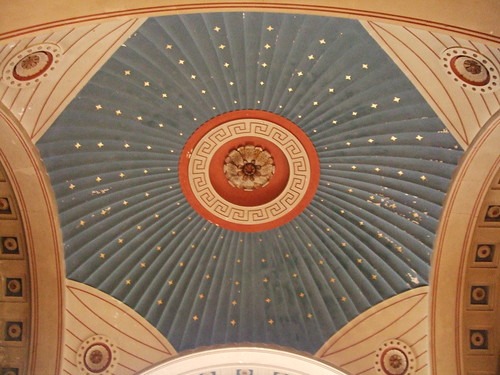
After a quick background introduction to the cemetery and London’s garden cemeteries in general, we got to go into the chapel, which is cold and in need of some repair. The ceiling is still beautiful, though.
Ceiling of the Anglican ChapelInside the Anglican chapelInside the Anglican chapel
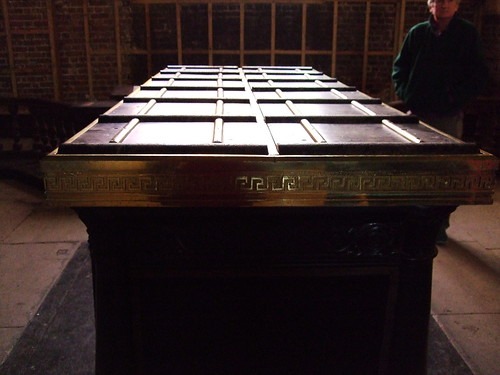
The raised platform is where the coffins are placed, and rollers help the bearers to slide it on. The platform turns around so that coffins can be taken out head first, as is custom.
Catafalque with rollers
The raised structure also happens to be a hydraulic catafalque for lowering coffins into the catacombs. Sadly we couldn’t go into the catacombs because of Health & Safety risks (mould, apparently), but we could see the entrance from outside the chapel.
Looking down into the catacombs
We had a comprehensive tour of the cemetery which took over two hours. The time went very quickly, however, and our guide was very knowledgeable. Even then, we didn’t see all of the notable tombs here: it is so big and there are so many significant people buried in Kensal Green.
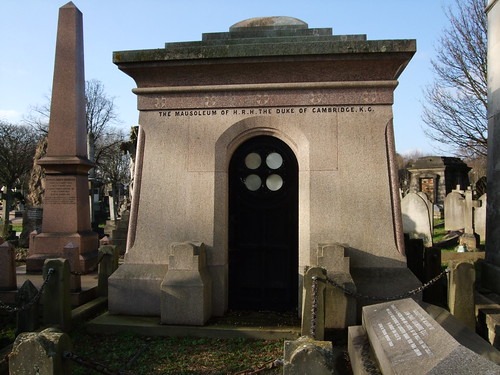
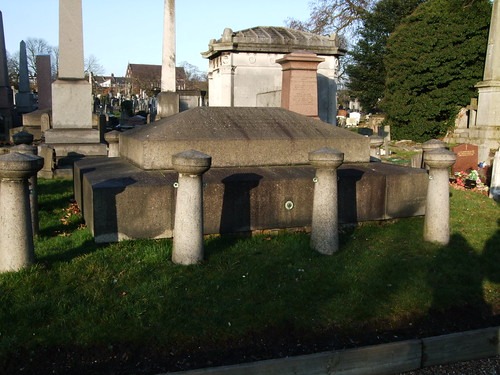
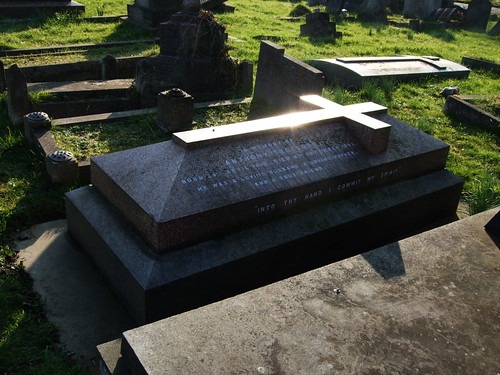
Uniquely for a public cemetery, three members of the Royal Family have been buried here: Prince Augustus Frederick and Princess Sophia, children of George III, and Prince George, Duke of Cambridge, grandson of George III and commander-in-chief of the British Army. Royal burials helped to make Kensal Green a popular and fashionable place to be buried.
Mausoleum of Prince George, Duke of CambridgeTomb of Prince Augustus FrederickGrave of Princess Sophia
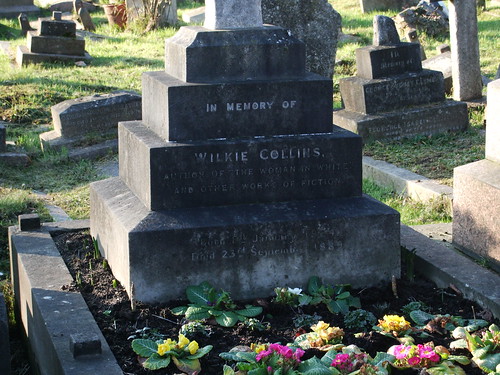
A significant number of important authors have been buried at Kensal Green, including Anthony Trollope, Wilkie Collins, Thomas Hood, Harold Pinter and William Makepeace Thackeray. As a lover of nineteenth-century literature (and twentieth-century theatre) I was thrilled to see these. My favourite was Anthony Trollope’s. I don’t know if he chose his inscription himself or if a family member selected it after his death, but either way it is astoundingly modest and deeply moving. It simply reads, “He was a loving husband, a loving father, and a true friend” – no mention of his (hugely underrated, in my opinion) forty-seven novels, written alongside his full-time job in the Post Office (he is credited with introducing the red pillar box to Great Britain).
Grave of Anthony TrollopeGrave of Wilkie CollinsBurial place of Harold PinterThe grave with the flowers belongs to William Makepeace Thackeray
I’d already heard of many of the famous figures buried in Kensal Green, but one person new to me was Jean-François Gravelet Blondin. Blondin, who is buried with his wife, was a French tightrope walker and acrobat. His most famous and impressive feat was crossing the Niagara Falls, not once but repeatedly. On different occasions he crossed blindfolded; in a sack; and carrying a man on his back. Once, he even carried a small stove: halfway across, he stopped, lit the stove and proceeded to cook an omelette.
Tomb of Blondin and his wife
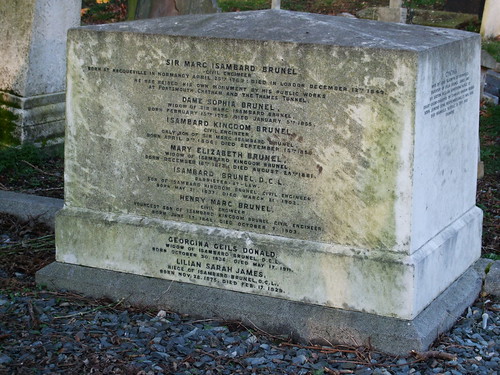
Charles Babbage, the polymath who created the concept of a programmable computer, is buried in the cemetery, as are Marc Brunel and his son Isambard, two of the most important and prolific engineers in British history. One of Marc’s great achievements was the Thames tunnel between Rotherhithe and Wapping, while Isambard’s accomplishments include the Great Western Railway and the designs for the Clifton Suspension Bridge in Bristol.
Grave of Charles BabbageBurial place of Sir Marc Isambard Brunel, Isambard Kingdom Brunel, and other family members
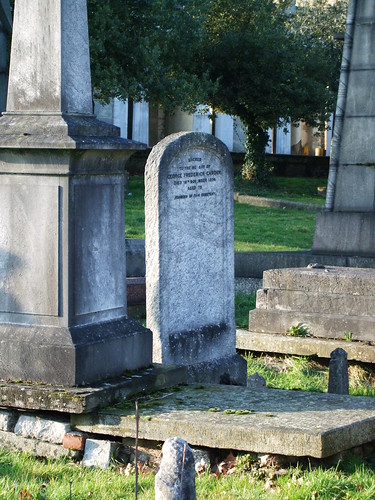
George Carden, founder of the cemetery, rests inside it.
Grave of George Carden, founder of the cemetery
Architecture
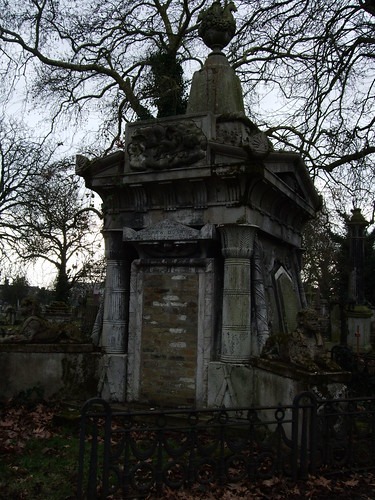
The cemetery is of interest not just because of the individuals buried here, but because of the varied and rich architecture of the different tombs and mausoleums. One of the most significant graves in this respect is that of circus performer Andrew Ducrow.
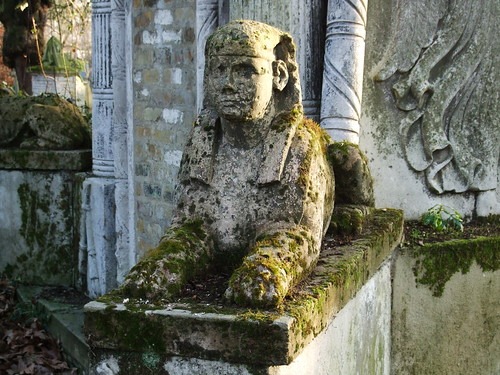
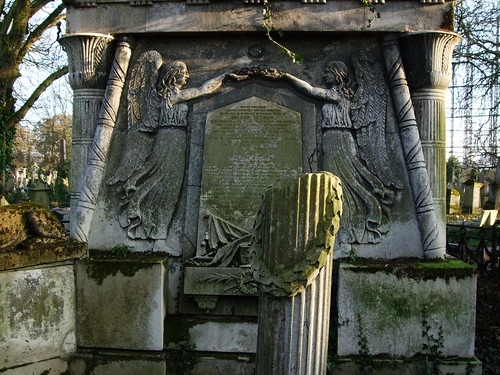
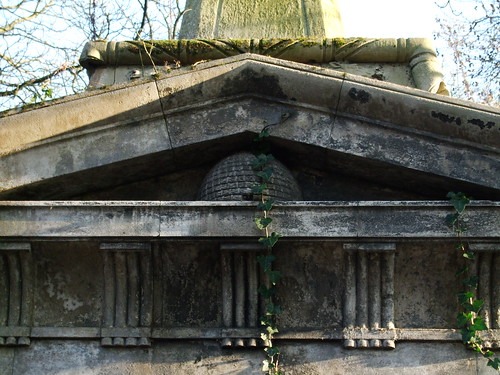
Andrew Ducrow’s elaborate memorialEgyptian symbolism, like this sphinx, was popular in the nineteenth centuryAngels and broken-off columns, symbolising life cut short, were also popularThe beehive represents industriousnessBeautifully carved hat and gloves
Dissenters’ Chapel
Our tour ended at the other end of the cemetery, with a visit to the Dissenters’ Chapel. We didn’t spend much time in this part of the graveyard, though it is interesting to me because my ancestors on my dad’s side, as Methodists, would have been classed as Dissenters, and if they had lived in London and been buried here, this is the area of the cemetery where they would have ended up. The chapel is similar in design to the larger Anglican chapel at the centre of the cemetery, but it has been restored more recently, with facilities for us to view displays and enjoy a hot cup of tea and some biscuits.
The Dissenters’ ChapelInside the chapel
Finally we were allowed to look inside the catacombs. They are smaller than those beneath the Anglican chapel, and the coffins there have been moved, but the space was still atmospheric. Plans are afoot to put on exhibitions and other events down here, which I think would be quite exciting.
We were let out of a side gate leading to Ladbroke Grove, and I made my way home.
A visit to Kensal Green cemetery is a must for anyone interested in cemeteries and the history of burials in London. It’s also a beautiful and peaceful space for a walk. Entry is free (unless you take a tour) and there is so much to see – it would be easy to go back again and again.
Would I go back?
Yes – it’s a lovely place for a relaxing walk, and I would particularly like to see Lady Byron’s grave and Terence Rattigan’s memorial stone, neither of which we had time to see on the tour. A booklet produced by the Friends, which I purchased for £2, has a map with the locations of significant graves, and this would be useful to take with me when I return.
Facts
Address: Harrow Road, London, W10 4RA
Founded: 1832
Size: 72 acres
Still in operation?: Yes Official website: http://www.kensalgreencemetery.com Owners: The General Cemetery Company Friends group: Friends of Kensal Green Cemetery (http://www.kensalgreen.co.uk) Tours: 2 pm every Sunday March to October and the first and third Sundays of the month November to February. Cost £7 (£5 for concessions/English Heritage members)
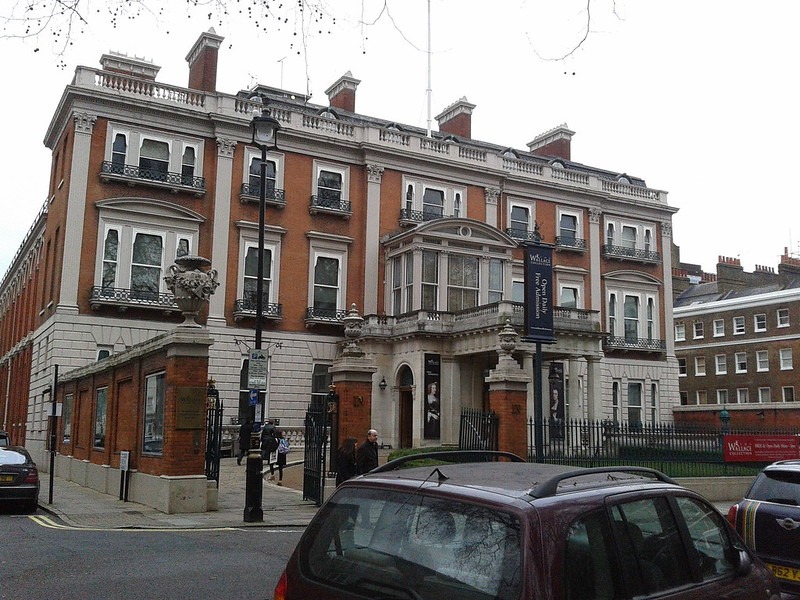
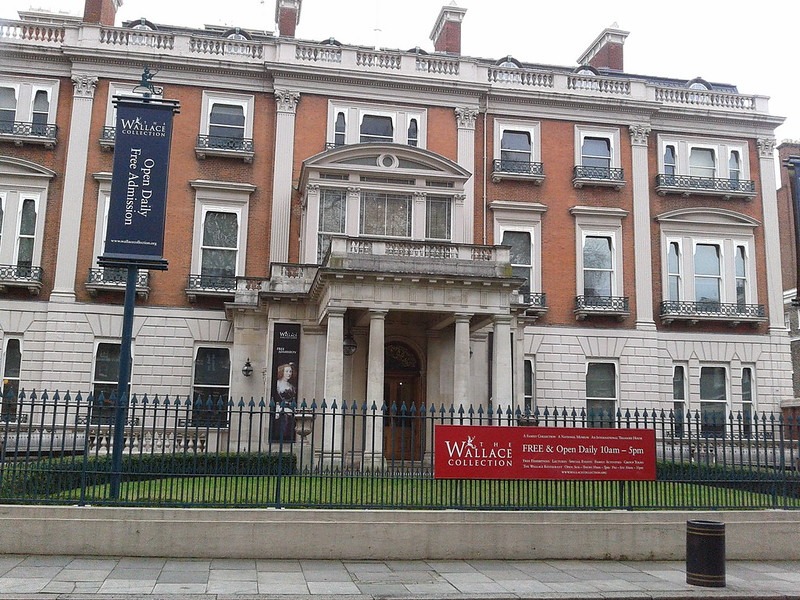
On Saturday I finally got round to visiting the Wallace Collection, a unique free museum based in Hertford House, Manchester Square near Oxford Street. The collection was accumulated in the 18th and 19th centuries by the first four Marquesses of Hertford and Sir Richard Wallace, the fourth Marquess’s son. Lady Wallace, Sir Richard’s widow, bequeathed the collection to the nation in 1897. Under the terms of the bequest the main collection cannot be added to, however museum staff do continue to seek out objects and archives relating to the family.
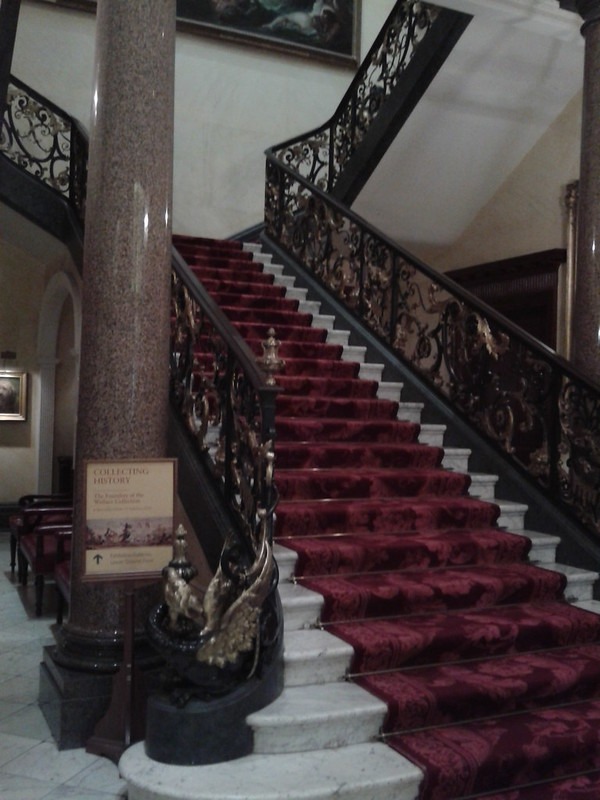
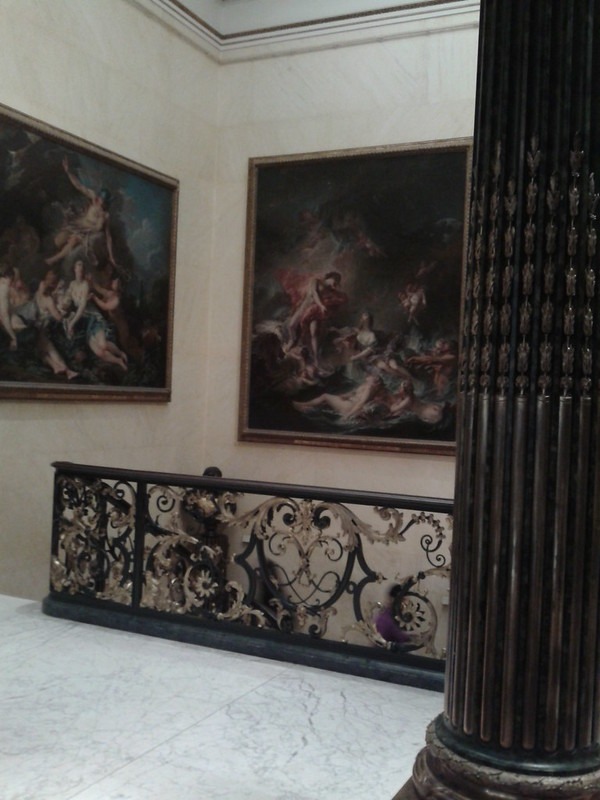
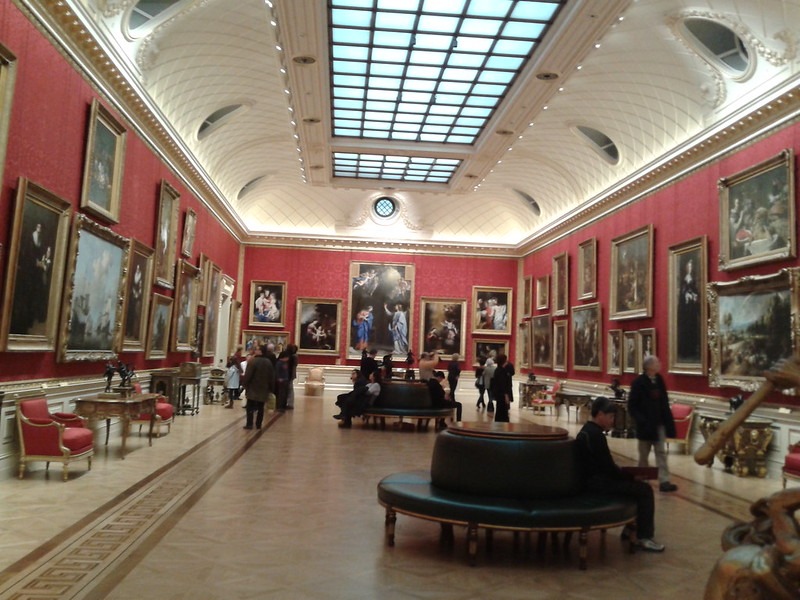
The house is situated in an impressive but quiet square, and opens into a lovely hallway. There is a posh-looking restaurant out the back (which I’d love to go to for Prosecco one day) and a gift shop, in addition to the 25 galleries. Eighteenth century French painting, works by the Old Masters and some rather famous works (including Frans Hals’ The Laughing Cavalier (1624)) sit alongside ancient furniture, small religious mementoes and an extensive armoury. I also saw the temporary exhibition, Collecting History: The Founders of the Wallace Collection.
I enjoyed looking around, although there was an overwhelming amount of art and I certainly couldn’t take it all in. I enjoyed the sumptuous interior of the house itself, however, and I would like to make a return journey or two to explore further.
FACTS
Address: Hertford House, Manchester Square, London, W1U 3BN
The original entrance to Ealing Studios, with blue plaque dedicated to Michael Balcon
On Friday I was lucky enough to be able to go on a tour of Ealing Studios as part of the Ealing Music & Film Festival. The studios are the oldest continuously working film studios in the world, and have played a huge part in the British film industry for over a century, encompassing silent film, the onset of the “talkies”, the upheaval of two world wars and technological developments such as motion capture.
The site was originally occupied by Will Barker Studios from 1902, later becoming Associated Talking Pictures Ltd. Ealing Studios was built in 1931 and in 1938 Michael Balcon (who gave his name to the local branch of Wetherspoon’s) from MGM took over, issuing films under the Ealing Studios name. Many memorable films were produced in the 1930s and 40s, including documentary war films, but the studio’s heyday was during the post-war 1940s and the 1950s when celebrated Ealing comedies, including Kind Hearts and Coronets and The Ladykillers, were produced.
The studios were purchased by the BBC in 1955, leading to nearly half a century of location filming for television dramas and serials. After a transitional period late in the century, the studios entered new ownership in 2001. The five original sound stages are present, and are now listed. As well as offices and bases for modern production and related companies, the studios produce films and television shows: recent films include The Importance of Being Earnest (2002) and St. Trinian’s (2007), as well as the hugely popular Downton Abbey. In addition, the Imaginarium, a performance capture studio set up by Andy Serkis and Jonathan Cavendish, is based in one of the sound stages: famously it was used to create Gollum in The Lord of the Rings and The Hobbit.
Inside the complex, looking towards reception
To reach the tour meeting point, which was the reception area, I had to go through the security point. There were several of us on the tour and we were taken to see the white building which was the original studio entrance in the 1950s. Famous figures including Michael Balcon and Alfred Hitchcock had offices here. It is looking slightly shabby these days but they are hoping to get the funds to restore it shortly. We were taken around the large complex and saw some of the modern companies, including a casting company and a hair and makeup studio, present on-site. One of the buildings, which includes the original sound stages, is listed but the newer building in front of it is due to be demolished and replaced with up-to-the-minute production facilities.
The original entrance, seen from the back
The most exciting part of the tour was being able to go on to the sound stages. On one, we saw a set being built, consisting of a theatre foyer and a staircase. This set is for a remake of the 1983 film The Dresser, and will star Anthony Hopkins and Ian McKellen. The top of the staircase leads to nowhere: a real theatre is being used for the auditorium (Hackney Empire). Thanks to a question from another person on the tour, I found out that this was the sound stage on which Scott of the Antarctic was shot. It was huge and still had some of the old safety notices on the walls.
Listed building containing sound stages
The second sound stage was even more exciting: crew members and carpenters were preparing for the filming of Downton Abbey. Much of this popular show is filmed at Highclere Castle, but a significant proportion is filmed at Ealing Studios. As they were busy creating the set, we couldn’t see much but I could see into Lady Mary’s bedroom – which was in the process of having wooden “fireplaces” fitted – and had a peek into the servants’ corridor. We also saw the large backdrops used behind the windows, to give the illusion that it is a real room in a real house with a view. I also had a very brief glance into the Dower House sitting room.
Plaque commemorating famous films made here
The tour was fairly short – it is a working studio after all – but very interesting. I was thrilled to have had the opportunity to visit.