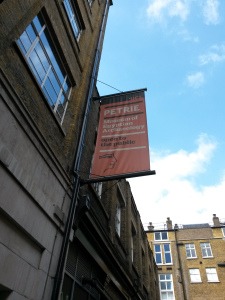
The Petrie Museum of Egyptian Archaeology

2016_0316PetrieMuseum01 2016_0316PetrieMuseum02

The Petrie Museum in London, which is part of UCL Museums & Collections, contains around 80,000 objects relating to Egyptian and Sudanese archaeology, making it one of the greatest such collections in the world. The museum looks at life in the Nile Valley from prehistoric times, through to the time of the Pharaohs, the Ptolemaic, Roman and Coptic periods, right up to the Islamic period.

The museum was originally set up in 1892 as a teaching museum for the Department of Egyptian Archaeology and Philology at University College London. It was created thanks to a bequest from the writer Amelia Edwards (1831-1892) who donated her large collection of Egyptian antiquities, but it was the work of Professor William Flinders Petrie (1853-1942) that propelled the museum into international significance.

It can be found hidden away behind several University buildings in central London: it’s difficult to find at first but once you get there, the entrance is apparent. Once inside, the compact museum contains a wealth of treasures: there are so many items it’s easy to be overwhelmed, but with patience it’s possible to track down some of the highlights, including the earliest ‘cylinder seal’ in Egypt, the oldest wills on papyrus, and even some incredibly rare and fragile Egyptian costumes.

The museum has the world’s largest collection of Roman period mummy portraits (first to second centuries AD), in which you can trace the development of a society caught between two cultures. In addition, it has many works of art from famous emperor Akhenaten’s city at Amarna, including tiles, carvings and frescoes. Also, the wider collection is largely taken from documented excavations, ensuring that it can offer profound insight into the everyday lives of people living at the time.

Whether you are an expert in Ancient Egypt or a casual visitor, there should be something to appeal to you in this small but rich museum. Special events regularly take place, so it’s worth checking the website regularly.

FACTS

Address: University College London, Malet Place, London, WC1E 6BT

Website: ucl.ac.uk/museums/petrie

Opening Hours: 1-5 Tues-Sat

Prices: Free

Liberty in Fashion – Fashion & Textile Museum

2016_0219Liberty01

I love Liberty prints, so I was obviously going to find the time to visit the Fashion & Textile Museum‘s most recent exhibition, Liberty in Fashion. The exhibition marks 140 years since the company was founded by Arthur Lasenby Liberty, originally a warehouse supplying goods from the Far East which grew to become one of the most distinctive British companies in history, and which is still going strong today.

2016_0219Liberty02

Arthur Liberty aimed to create new fashion, and his work became so distinctive that softly draping silk was known in France as soie Liberty and the entire Art Nouveau movement was known in Italy as Stile Liberty. He ensured distinction and high quality by establishing Liberty “Art Colours” and producing fabric in Great Britain. His original “Arthur Liberty’s Oriental Bazaar” sold imported silks from the Far East, as well as other items such as fans, china and enamel wares. It later branched out to source fabrics from other locations, and began to establish original collections, including garments such as dressing gowns and wraps, inspired by the kimono. Liberty’s original business was established on Regent Street: it wasn’t until 1925 that the now-famous Tudor Building was opened.

2016_0219Liberty03

2016_0219Liberty04

Liberty influenced, and was influenced by, the Aesthetic movement which aimed to free women from restrictive corsets and promote a more romantic, flowing way of dressing. The name “Liberty” seems particularly apt for this kind of style! The company also focused on reviving traditional skills including smocking (common on the clothes of agricultural labourers in the eighteenth and nineteenth centuries), which allowed for free-flowing, comfortable and stylish garments.

2016_0219Liberty08

2016_0219Liberty06

As the twentieth century developed, Liberty began to produce delicate floral prints which even today are seen as the hallmark of the brand. Prints on a darker background during the 1920s gave way to softer, more romantic, lighter prints in the 1930s. The Art Nouveau revival in the 1950s allowed Liberty to innovate, establishing the Liberty Design Studio, as well as reviving their original designs.

2016_0219Liberty13

In the 1960s, Liberty fabrics provided the basis for many original designs by fresh new designers including Mary Quant and Marion Donaldson. By the 1970s, a new nostalgia had surfaced, and Liberty prints, which suited the period perfectly, were common in clothes of the period, including the archetypal maxi dresses.

2016_0219Liberty15

From the 1990s onwards, Liberty began to collaborate with other brands, with fascinating results. Today, Vivienne Westwood, Anna Sui and Dr Marten are just some of the brands whose collaborations have proved popular.

2016_0219Liberty18

As a lover of the Liberty aesthetic I thoroughly enjoyed this exhibition, and as a history fan I enjoyed learning about the company’s past. This is an excellent exhibition for anyone interested in how Liberty evolved.

Havering Museum

2016_0123HaveringMuseum02

On the same day as I visited Redbridge Museum, I headed further east along the TfL Rail line (soon to be Crossrail) and ended up in Romford, where I popped into Havering Museum. This museum opened in 2010, on the site of the old Romford Brewery, and seems to be popular: a map in the foyer shows the location of various visitors, some of whom have visited from all over the world, including Russia and Indonesia.

The museum explores the history of the London borough of Havering, with the main exhibition spread across two rooms. Rather than being arranged in chronological order, the displays are divided by town: so Romford, Havering-atte-Bower, Rainham, Hornchurch and Upminster all get their own section. This is a different but interesting way to arrange the displays. Each section also has its own information sheet, so rather than being overwhelmed with information during your visit, you can take home the sheet and read it at your leisure.

I learned some interesting things during my visit: Romford was originally a Roman staging post called Durolitum, on the road from London to Colchester. The Golden Lion pub by the marketplace has existed since 1440, and is said to have been visited by Dick Turpin. The museum has an interesting selection of artefacts associated with the town.

When I visited, the temporary exhibition room was hosting paintings by a local artist, and there was also a travelling exhibition, Pop It In the Post by the National Postal Museum, including two examples of early pillar boxes.

I was very impressed with my visit to Havering Museum, which struck me as being a cut above most local museums, well laid out and with very friendly and enthusiastic staff. Definitely worth a visit if you’re in the area.

FACTS

Address: 19-21 High Street, Romford, RM1 1JU

Website: haveringmuseum.org.uk

Opening Hours: 11-5 Wed-Sat

Prices: £2.50 adults, £2 senior citizens; children free

Redbridge Museum

2016_0123RedbridgeMuseum

As part of my Tube jaunt to the east, I decided to check out a few of the small museums on my list. Redbridge Museum is the local museum for the town of Redbridge: it opened in 2000 and is located above the library near the town centre.

In common with many local museums, the main collection is displayed in chronological order, looking at the history of the town through the ages. It does this in reverse, beginning with recent history and going back through the centuries via two World Wars and the Industrial Revolution. There are two reconstructed rooms to show what life would have been like in different periods of the town’s history.

What I really liked about the museum was the effort they make to include the community in the displays. A changing display at the entrance explores different significant figures from the town. The current celebrated resident is Fauja Singh, who is (as far as is known) the oldest marathon runner in the world. He ran his first marathon aged 89 and only retired from long-distance running aged 101!

Redbridge Museum is currently hosting a temporary exhibition called Ice Age Ilford, which includes a life-size replica of the skull of a mammoth found in Ilford, as well as several fossilised bones uncovered during the Victorian era. Many of these bones are now cared for by the Natural History Museum and the British Geological Survey, and this is a rare chance to see them in their original home. There is also information about what the area would have looked like over 200,000 years ago, and a little about the Victorians responsible for the fossil discoveries.

Redbridge Museum is a nice little local museum and is well worth visiting if you’re in the area.

FACTS

Address: 2nd Floor Central Library, Clements Road, Ilford, Essex, IG1 1EA

Website: www2.redbridge.gov.uk/cms/leisure_and_libraries/culture/redbridge_museum

Opening Hours: 10-5 Tues-Fri, 10-4 Sat

Prices: Free

The Foundling Museum

2015_1217FoundlingMuseum01
The Foundling Museum

I recently visited The Foundling Museum near Russell Square. I had originally visited a few years ago, but the museum has been refurbished since, and I fancied going again.

The Foundling Hospital was founded in 1741 by Thomas Coram, a statue of whom can be seen outside the museum. He campaigned for seventeen years before being granted a royal charter by George II in 1739. The hospital cared for children until 1954, when the last pupil was placed in foster care. In total, around 25,000 children were cared for by the hospital, which was Britain’s first children’s charity.

The museum, which occupies one of the hospital’s original buildings, covers four floors. The ground floor has an exhibition on the history of the Foundling Hospital, explaining that most of the children arrived here because their mothers couldn’t care for them, either because they had been widowed or because they had “got into trouble” while unmarried. As more and more babies were in need of a home, a lottery system was introduced: mothers had to take a ball out of a cloth bag; a white ball meant that their baby would be accepted, while a black ball meant that they would be turned away. The women had to prove that they were of previous good character: later in the museum there were letters from parents and statements from employers, confirming the character of girls who wanted the hospital to care for their children.

Mothers were allowed to leave tokens with their children, on the off chance that they were able to return and reclaim them if their circumstances improved. This did happen occasionally, but most women would never see their children again. The display of tokens is incredibly poignant and moving: they range from jewellery to buttons to any small item that was reasonably unique.

Life in the hospital was strict: children were kept to a regimented timetable, had to obey many rules, and were made to wear a uniform. In fairness, they were well-treated and given enough to eat: compared to many poor children they were well off. The children were educated and trained for service; later, many foundlings went into the armed forces, where they tended to adapt to the life very well given their upbringing. The later part of the exhibition looks at some of the last orphans to belong to the hospital, many of whom are still alive, and who have shared their experiences.

Nowadays, Coram still has a role, helping children and young people to develop their skills and emotional health, finding adoptive parents and upholding the rights of children. The museum, though, focuses on the past. The rest of the rooms on the ground floor and the first floor are laid out as they would have been several centuries ago: the ground floor room the very same in which women had to take part in the heartbreaking lottery, the upstairs rooms richly furnished and ornamented with paintings. The hospital was the first public art gallery, Coram having cajoled and persuaded several artists, including William Hogarth, to donate their work.

2015_1217FoundlingMuseum02
Thomas Coram

The top floor of the museum is home to the Gerald Coke Handel Collection, an internationally-important collection relating to the composer, including manuscripts, printed music and books. Handel left the score of the Messiah to the Foundling Hospital in his will.

The museum has a programme of temporary exhibitions. The current exhibition is The Fallen Woman, which runs until 3 January. It looks at the representation in art of “the fallen woman”, particularly in the nineteenth century, including the work of Dante Gabriel Rossetti, Richard Redgrave, George Frederic Watts and Thomas Faed. The exhibition is certainly interesting and explores the myth in a compelling way.

I enjoyed my visit to the Foundling Museum: it’s well worth exploring and does tell a fascinating story.

FACTS

Address: 40 Brunswick Square, London, WC1N 1AZ

Website: foundlingmuseum.org.uk

Opening Hours: 10-5 Tues-Sat, 11-5 Sun

Prices: Adults £8.25; concessions £5.50; children, Friends and Art Fund members free

British Optical Association Museum

I visited the small British Optical Association Museum (also known as the musEYEum – see what they did there?!) and was surprised that it was so central: just round the corner from Charing Cross, within the College of Optometrists building on Craven Street. Curator Neil Handley who showed me round suggested that it was the most “centrally located museum in London”. The museum has the world’s oldest collection of spectacles and vision aids.

2015_1124BOAMuseum

An optometrist is someone who specialises in eyes: they undertake eye examination and sight testing, advise on visual problems, prescribe glasses and contact lenses, and dispense certain ophthalmic drugs. The College of Optometrists is a membership organisation which aims to raise the standards of optometric education and support members in their professional development.

The British Optical Association Museum was founded in 1901 by J.H. Sutcliffe (1867-1941), an optician and administrator who ran the Museum for the first forty years. In common with other medical professionals in the nineteenth century, optometrists sought to be respected as the educated and skilled practitioners they were, and founded the British Optical Association in 1895. The Museum was created to emphasise the long and distinguished history of the profession, and became part of the College of Optometrists when the BOA was disbanded.

The museum has a rich and varied collection consisting of anything and everything to do with eyes, glasses and contact lenses. It has a pair of glasses belonging to Dr Johnson, and another from the Coronation Street character Deirdre Barlow; pairs made for Johnny Depp and Angelina Jolie for the film The Tourist, as well as contact lenses worn by Leonardo Di Caprio (The Beach) and Matt Le Blanc (Lost In Space); not to mention other assorted bits and bobs including a miniature opticians’ shop from a model village, and a Halifax money box featuring Howard Brown, the bespectacled one-time face of a major ad campaign. One of my favourite things was a little pair of “pecktacles” designed for chickens.

One of the oldest items in the collection is a statue of Saint Odilia, in which eyes are carried on a Bible: churchgoers would pray to the statue in hope of relief from eye disease. Another is a small statue showing a wearer of early glasses. The history of spectacle design is a fascinating one: they began as two lenses pinched on the bridge of the nose (as shown in the old statue) and did not get side pieces until the early eighteenth century. The oldest pair of glasses in the Museum’s collection dates from 1550-1650, and the earliest pair with sides dates from 1728-30. Glasses aficionados can find much to interest them in the museum: lots of different styles fashionable throughout the ages are on display, including the notorious NHS glasses that seem to have made a comeback in recent years. Some modern glasses even have 3D-printed frames.

At one time tortoiseshell (or turtleshell) was a particularly popular material for spectacle frames: it was flexible but reasonably sturdy, and it was also attractive (not so good for the poor turtles though). As opticians didn’t want to be seen as retailers, they disliked displaying glasses frames in their windows, so stuffed turtles were often used instead (at least until the turtle became a protected species) and turtles became a kind of symbol for the optician. I wonder if this is why my contact lens solution from Specsavers has a picture of some turtles on the front?

There is an interesting display on how glasses are designed and made, and another section featuring various bits of eye testing equipment used over the years. I didn’t find these as frightening as the old equipment from the British Dental Association Museum – in fact, variations of the alphabet displays used to test eyesight are still in use today.

As well as the usual vision-correction spectacles, there are other kinds of glasses on display, including Eskimo snow glasses designed to protect eyes from the glare of the sun on snow, and different kinds of sunglasses. Interestingly, early sunglasses used green or blue glass, never black, as this shade was associated with the glasses worn by the blind. “Make-up glasses”, designed so that one lens can be lowered to allow the wearer to apply mascara, are also displayed, as are false eyelashes and even eye make-up.

Other things on display include telescopes, opera glasses, spy glasses and binoculars, as well as some very interesting fans with tiny telescopic lenses in the centre. Early contact lenses are also included: fascinating to me as a contact lens wearer, they made me feel incredibly thankful that I live in the twenty-first century. The earliest contact lenses were huge, covering the entire eye, and they could only be worn for two hours at a time.

Sometimes eyes became diseased, and had to be treated: eye baths were designed to allow the user to wash out the eye with water or another solution, and there are several examples here. If the worst came to the worst and the eye had to be removed, one could wear an eye patch (like a pirate – there is a pirate mug on display) or choose a glass eye. The earliest artificial eyes were Egyptian, and were given to the dead to allow them to “see” in the afterlife; centuries later, the living could choose from a “chocolate box” of glass eyes, selecting the most appropriate match. Nowadays, of course, an artificial eye is individually made for each person.

The British Optical Association Museum is fascinating and it’s well worth making an appointment to visit. If you wear glasses or contact lenses it’s particularly interesting, and I for one am extremely thankful for optometrists and all the work that they do, and have done in the past. If you are unable to visit, or want to get a feel for the kind of objects they have, you can view the collection online.

FACTS

Address: The College of Optometrists, 42 Craven Street, London, WC2N 5NG

Website: college-optometrists.org/en/college/museyeum

Opening Hours: By appointment only, during the week: book via phone or email

Prices: Free

Fleming Museum

With a day off work and nothing definite to do, I decided to head down to the Fleming Museum in Paddington. Named after renowned scientist Sir Alexander Fleming, the museum commemorates his discovery of penicillin, a hugely significant event that changed the course of medical history and saved thousands of lives.

2015_1119FlemingMuseum01
Entrance to the museum (now closed) as you enter the hospital courtyard

The museum is located on the second floor of St Mary’s Hospital, which has a long and distinguished history itself, having been founded in 1845. As you turn in to the entrance from Praed Street you can see the sign for the museum; however, to enter you must go into the hospital main entrance and follow the corridor round.

Small as the museum is, it occupies several floors: first there is a reception room, which has a few information boards, then you go upstairs and into the shop where you purchase your ticket. You can leave bags and coats in here.

The first part of a visit comprises a tour – if that is the correct word considering it only encompasses one room – of the very room in which Fleming discovered penicillin in 1928. Though the layout and fittings are not wholly original – the room was restored at a later date and the space was reproduced to reflect its condition at the time of the discovery – the fact that it is the original room in the first place is pretty impressive. The view from the second floor window is largely what it would have been in the 1920s, and it’s easy to imagine yourself back in time.

The museum guides are all volunteers, and are enthusiastic and knowledgeable. My guide was extremely interesting as he explained the context behind Fleming’s work and how he came to make his discovery. About to go on holiday, Fleming left a petri dish by the window, and when he returned six weeks later he noticed that something in the dish seemed to be killing the bacteria that had contaminated it. The original petri dish is now in the British Library: the one on display here is a replica.

One aspect of the story in particular I found really enlightening. In the past I’d always assumed that Fleming’s discovery was wholly down to luck – that he’d left the petri dish out by mistake and noticed the mould by chance. However, my guide explained that Fleming would routinely leave petri dishes out for a while and check them, just in case. It wasn’t just luck that facilitated the discovery of penicillin – Fleming’s deep scientific knowledge and inquiring mind played important roles too.

Having said that, it was not Fleming himself who developed the drug to explore its full potential, but two scientists at Oxford, Australian Howard Florey and German refugee Ernst Chain. It was 1940, and they wanted a drug that would be effective on troops at the front.

The development of penicillin got off to a shaky start. At first, members of the team employed to test it tried it on themselves. The first member of the public to receive penicillin, a policeman, showed impressive signs of recovery, but unfortunately the penicillin ran out and he relapsed and died. On a similar note, the drug was used on a young boy suffering from an eye infection. He miraculously recovered, but sadly the infection had damaged his carotid artery, and he died from a hemorrhage. I couldn’t help feeling that these incidences would have been more traumatic for the friends and family of the sufferers than if they had just died in the first place – this way, their hopes were raised only to be dashed again.

The next part of the museum, up another flight of stairs, involves watching a short video about the discovery and how it progressed, followed by a small exhibition room which you can explore at your leisure. The information boards in the room charted the story of penicillin, repeating some of the information I had already learned, but adding new snippets. For instance, I learned more details about the initial testing of the drug, and the efforts that were made to stabilise the chemical compound, as well as the problems faced in ensuring enough penicillin was produced to meet demand.

In modern times, it is well known that drug-resistant strains of bacteria are developing in response to the use of penicillin and other antibiotics. In fact, Fleming himself predicted that this would be a problem, and it was an issue almost right from the start, with scientists having to come up with new ways of adapting the drug to stay one step ahead of the bacteria.

Fleming, Florey and Chain were awarded the 1945 Nobel Prize in Physiology or Medicine for their work with penicillin. It is thanks to them, and to this “wonder drug”, that we are able to take antibiotics for granted, and there are diseases nowadays considered mild that at one time could have been fatal. It doesn’t have the most convenient opening times, but it’s worth making the effort to visit this small but fascinating museum.

2015_1119FlemingMuseum02
Plaque on Praed Street commemorating the discovery of penicillin

FACTS

Address: St Mary’s Hospital, Praed Street, London, W2 1NY

Website: medicalmuseums.org/alexander-fleming-laboratory-museum

Opening Hours: Mon-Thurs 10am-1pm; other times by appointment only

Prices: £4 adults, £2 concessions

London Fire Brigade Museum

201509_19LFBMuseum09
The museum

I visited the London Fire Brigade Museum during the Open House London weekend, as I knew that it would be closed afterwards in preparation for a move to the museum’s original home on the Albert Embankment. This could take between three and five years, so I was determined to see it while I still had the chance.

201509_19LFBMuseum07
A former fire bell

The site was originally part of the estate of the Bishop of Winchester. It became a workhouse and a hat factory before becoming the HQ of the Metropolitan Fire Brigade, as well as the residence of Captain Eyre Massey Shaw, the first Chief Officer. The museum looks at the history of the London Fire Brigade, from the early fires of London (including the Great Fire of 1666) through to modern-day firefighting.

201509_19LFBMuseum10
Victorian firefighter’s room

The earliest fire brigades were established in response to the Great Fire, and were tied to different insurance companies. Firemarks were attached to buildings to signify which company they were insured with. In case of fire, several brigades would attend, but if it was not one of “their” buildings they would leave it to burn! The first proper “fire engine”, which could expel a jet of water, was patented by Richard Newsham in 1721. It was tough to operate, so bystanders would be bribed with “beer tokens” for offering their help. The Royal Society for the Protection of Life from Fire (RSPLF) was formed in 1828; this provided escape ladders to help people get out of burning buildings.

201509_19LFBMuseum14
Lamp-post

In 1833, the London Fire Engine Establishment (LFEE) was formed when ten independent fire insurance companies united. James Braidwood, from Edinburgh, was Superintendent for 28 years, until his death in the Tooley Street Fire. This fire, which occurred in 1861, was the most serious to happen in the capital since the Great Fire. Afterwards, the insurance companies contacted the Government arguing that the fire safety of London should become a public authority. The Metropolitan Fire Brigade Act was passed in 1865: as a result, the Metropolitan Fire Brigade commenced from 1 January 1866.

The previously-mentioned Captain Sir Eyre Massey Shaw, the first Chief Officer of the MFB, established a rank system, a new uniform, several new fire stations and advanced technology, including steam fire engines pulled by horses. The existing system continued until the Second World War, when the Auxiliary Fire Service (AFS) formed, and women were permitted to become firefighters for the first time. Fire stations were set up all over London, and firefighters battled the fires that resulted from bombing raids.

201509_19LFBMuseum15
Firefighters pass the time waiting for a call-out

After the war, the area that the London Fire Brigade was responsible for grew to encompass the Greater London Council, the 999 emergency number was introduced, and there was a greater focus on fire prevention. Modern-day firefighting involves the use of breathing apparatus boards, lines to follow when tackling a fire, and the HAZCHEM code which warns of hazardous substances. The King’s Cross Underground fire of 1987 led to stricter regulations on the Underground in particular.

201509_19LFBMuseum17
Badges from fire services the world over

The museum displays period rooms shown as they would have been during Captain Shaw’s time at the house, as well as a chronological history of fire in London. I found it fascinating and the other visitors seemed to enjoy it too, especially the small children running around wearing fire helmets. Outside, there is a “parade ground” where the early firefighters would drill, and nearby there is an Appliance Bay which is home to early examples of fire engines. I’m no vehicle enthusiast, but these were good fun to look at.

201509_19LFBMuseum02
Horse-drawn fire engine
201509_19LFBMuseum04
Early fire engine
201509_19LFBMuseum06
Early fire engine

It’s a shame the museum is closing as it’s a high quality and interesting day out. Hopefully the new museum, when it eventually opens, will be just as impressive.

FACTS

Address: 94a Southwark Bridge Road, London, SE1 0EG

Website: london-fire.gov.uk/london-fire-brigade-museum

Opening Hours: Now closed, pending the move to Albert Embankment

Prices: Free

Garden Museum

2015_0829GardenMuseum02
Garden Museum

The Garden Museum can be found near Lambeth Palace, a place where the history of gardens can be explored. I’m no gardener, but I was interested in visiting, especially after seeing a play in the grounds earlier this year. The Museum was originally founded in 1977 in order to save the church of St Mary’s from demolition; this church is the burial place of John Tradescant (c.1570-1638), the first great gardener and plant-hunter in British history. The garden of the museum, at the back of the church, contains plants from the seventeenth century, such as the scarlet runner bean, red maple and tulip tree, which originally grew in Tradescant’s garden. His tomb can also be found here. The knot garden was designed by the Museum’s President, The Dowager Marchioness of Salisbury.

2015_0829GardenMuseum01
St Mary’s Church
2015_0829GardenMuseum06
Entrance to the museum

In 2008, the interior of the church was converted into a centre for exhibitions and events. Three exhibitions and over 30 talks and interviews each year explore figures from garden history; there is also a permanent display of items relating to gardening.

2015_0829GardenMuseum07
Stained glass window

When I first entered the museum, I headed towards the temporary exhibition, Gnome & Away: Secrets of the Collection. This is the last chance to see many of the weird and wonderful items from the Garden Museum’s rich collections, including gardening tools, a desk, toy greenhouses, numerous garden gnomes, and even a 1950s flamingo ornament.

2015_0829GardenMuseum09
Exhibition space
2015_0829GardenMuseum10
Eighteenth-century planter
2015_0829GardenMuseum11
Garden goals

After this, I went up the stairs to the permanent collection. This was an eclectic range of gardening-related items, including works of art, photographs and gardening tools and accessories. Despite not being a gardener myself I found this interesting: my favourite items were the old-fashioned lawnmowers, the adult version being displayed alongside a miniature model for children.

2015_0829GardenMuseum14
Lawnmowers
2015_0829GardenMuseum13
Looking into the museum from the permanent gallery

Outside, the knot garden is a lovely relaxing oasis where you can sit and enjoy the flowers. If you are interested in gardening, this would be a lovely place to examine all the different species of flowers and plants they have.

2015_0829GardenMuseum17
Interesting tomb
2015_0829GardenMuseum15
Knot garden
2015_0829GardenMuseum16
The back of the church

Finally I stopped off in the cafe for a cup of tea and a piece of cake, which was delicious.

2015_0829GardenMuseum18
In the cafe

The Museum is due to close on 30 October for a major refurbishment project, and is not due to reopen until early 2017. You only have a couple of months, therefore, to visit. It’s a really nice place to visit even without a strong interest in gardening, so I do recommend it.

FACTS

Address: Lambeth Palace Road, London, SE1 7LB

Website: gardenmuseum.org.uk

Opening Hours: 10.30am-5pm (4pm on Saturdays)

Prices: £7.50 adults, £6.50 concessions, £3 students and Art Fund, children free

BDA Dental Museum

2015_0820BDA01
Entrance to the BDA

In London on a weekday with time to spare, I decided to head to the BDA Dental Museum, a small museum located in the headquarters of the British Dental Association not far from Oxford Street. The museum aims to explore the history of dental care in the UK, and has over 20,000 items, making it the largest collection of dentistry-related material in the UK.

I owe a great deal to dentists – I spent a great deal of time at the dentist’s and the orthodontist’s as a teenager, as I had an extremely awkward set of teeth that insisted on growing on top of each other in a mouth that was really too small for all of them – a bit like an Underground train during rush hour, except that Tube trains don’t tend to get random commuters popping out of the roof. I spent three years with a fixed brace but ended up with normal straight teeth, so it was worth it. After visiting this museum, I am even more thankful that I was not born a hundred or more years ago when dentistry was in its infancy.

The Museum began in 1919 with a collection of dental instruments donated by Lilian Lindsay, the first woman to qualify as a dentist in the UK. These days, the collections comprise photographs and archives, art, furniture and a variety of dental instruments and equipment. Originally designed specifically for BDA members, it was opened to the public in 1967 and redesigned in 2005.

The museum is small, consisting of one main room plus a handful of display cases in the foyer of the BDA itself and in the basement. When I visited, the basement display consisted of information about dentistry during World War I: dentistry was not classed as a reserved occupation, despite the fact that dental health was considered important for all-round health. Upstairs, the foyer displays were concerned with the 200th anniversary of the Battle of Waterloo, looking at the fact that many dentures were made from the teeth of soldiers who died in the battle.

2015_0820BDA02
The Museum

The permanent museum, which traces the history of dentistry as a distinct profession, can be found in the small room on the left as you enter the BDA building. It has interesting displays with accompanying information boards, exploring the treatments people used for dental ailments in centuries past and the eventual establishment of the BDA, which ensured recognition of the dental profession. During the nineteenth century in particular, anaesthetics were introduced, new instruments were invented (such as drills) and materials used to make dentures were improved. I was interested to see the different kinds of drills on display as well as the rather posh red upholstered dental chair, though I’d still rather have the stark, slightly boring decor of a modern dentist’s surgery with all the modern treatments that it entails! One particular character mentioned several times was John Tomes (1815–1895) – he was instrumental in transforming dentistry from a trade to a respected profession, and with James Smith Turner was responsible for the Dentists Act 1878, which ensured the registration of dental professionals.

There are a couple of screens on which you can view old, rather amusing dental videos. There is also a tiny gift shop, where you can buy things such as tooth-shaped push pins and toothpaste keyrings.

With its odd opening hours, small size and specialist collection, The BDA Dental Museum is unlikely to be anyone’s first choice for a museum visit, but if you are in the area at the right time I’d urge you to go. If nothing else it will give you an appreciation for modern dentistry!

FACTS

Address: British Dental Association, 64 Wimpole Street, London, W1G 8YS

Website: bda.org/museum

Opening Hours: Tuesdays and Thursdays 1pm-4pm

Prices: Free