I had a couple of reasons for wanting to visit the Sōseki Museum in Clapham. One was that I am trying to visit every museum in London, including the little ones. The other was that I was genuinely interested in the subject: Natsume Sōseki was a Japanese author who spent two years living in London from 1902 to 1903, sent there to study by the Japanese government (apparently the worst two years of his life). I’ve read and enjoyed one of his novels, I Am A Cat.
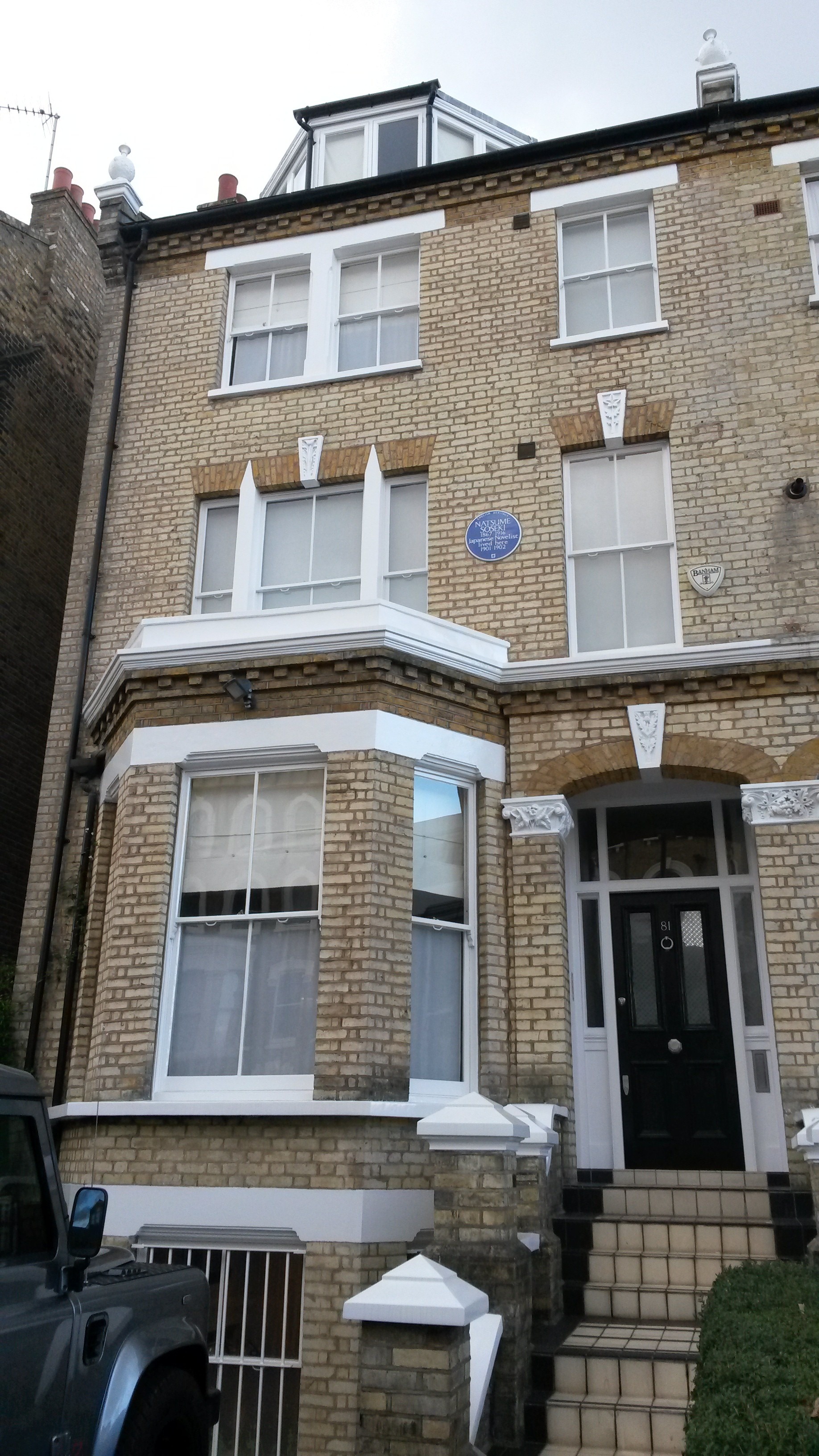
The museum, run by Ikuo Tsunematsu, was filled with books, prints and artefacts relating to the writer’s life. Last year it was announced that due to increasing costs and dwindling visitor numbers, the museum would be closing in the spring of this year. I made my way to Clapham today and had some trouble trying to identify the house: according to the Internet, the location was 80 The Chase, but the blue plaque was on the house opposite. Googling to discover more, I found out that owing to the financial uncertainties resulting from the Brexit vote, the museum actually closed at the end of September last year, meaning that I had a wasted journey and I now have yet another reason to curse Brexit – as if I didn’t have enough already. Anyway, here’s the picture of the house, with only the plaque remaining to show that Sōseki lived here.
Who knew Ealing had a dolls house museum? Not me, even though I’ve lived in the area for approaching six years. I found out about it via a blog post and decided to pop over this Saturday.
Located on Haven Green, just across from Ealing Broadway station, the museum is well signposted – you can’t miss the building with the bright yellow sign outside. Entry is £1 and while the museum is contained within just one room, a great deal is packed into it.
Immediately on the right as you enter are four dolls houses decorated for the seasons. If only it was possible to decorate real houses like that! This side also had examples of older and modern dolls, and I even spied a doll version of Jim from the Royle Family.
The most interesting bits for me were the dolls from different countries. I can’t pretend to be able to identify them all and I do wish there had been more detailed labels. I particularly liked the Japanese dolls that came with their own story from traditional folklore.
At the back I found more assorted dolls (maybe the Doll Museum would be be a more appropriate name than the Dolls House Museum). There were some china dolls very similar to ones I had as a child. I had one in particular called Georgina that I loved. She had long ringlets and a pink satin dress. I don’t know what happened to her. I suspect my parents threw her out, along with my other china doll with plaits and a floral dress – my mam always did find them a bit creepy (I don’t know why I didn’t, to be honest).
At the other side of the room were selections of doll house miniatures, which I loved. I just love really tiny things.The picture frames especially were adorable. To finish off there were some ornaments and other doll house miniatures, while in the centre of the room there was another doll house to admire.
This museum is pretty interesting if you like that sort of thing. It’s small, and I don’t know if it would be worth making a special visit to Ealing for, but if you’re in the area it’s certainly worth half an hour of your time.
Perhaps Barts Pathology Museum isn’t the best place for someone as squeamish as me to go. That said, the historical nature of the collections was enough of a draw for me. Originally opened in 1879, the museum consists of pathological specimens illustrating the incredible range of diseases that flesh is heir to. Following years of neglect, it’s only recently that the museum has received a grant to renovate the collection; it is used by students at St Bartholomew’s Hospital during the day so is currently only open for special events, such as talks: keep an eye on the website for details of future events. These events take place out of hours, as students at the hospital use the museum as a teaching aid during the day.
The building housing the museum is not particularly impressive, but the museum itself certainly is. Bones, organs and body parts, in various stages of decay, line the walls, with labels and information leaflets explaining what condition affected them. Most specimens come from the nineteenth century, as do the beautifully detailed drawings of individuals, and sometimes their body parts, that are dotted about the room. The most memorable, for me, was a picture of a sixteen-year-old girl with congenital syphilis.
I must admit that I felt a bit squeamish looking at many of the specimens, the organs more so than the bones. My favourite part, with which I was completely fascinated, was the section containing objects that have been removed from inside bodies. These included numerous needles and other foreign objects, such as a WW2 shell repeatedly inserted by one man in order to sort out his piles. My favourite story involved a six-inch electric torch, “removed from the rectum of an eccentric and uncouth-looking man, aged 68, who stated that he had been assaulted by two drunken Irishmen who had pushed some object into his rectum.”
Getting to the museum can be tricky as it’s not easy to find. Enter the grounds of Barts Hospital. Ignore the signs warning you that this is a private area, and only staff are allowed: so long as you’re here for an event, you’re fine. Follow the signs to the Robin Brook Centre and take the lift to the third floor.
FACTS
Address: 3rd Floor, Robin Brook Centre, West Smithfield, London, EC1A 7BE
The Natural History Museum is one of London’s famous museums, located, like so many of the others, in South Kensington. I rarely go, simply because it’s so popular: the queue to get in is always massive and full of kids. I had a day off work at a time when I knew the schools would be back, and decided to use it to enjoy the museum, but it was still pretty crowded. Oh well.
Trying to get a picture with Dippy and Albert (my Tatty Devine dino)
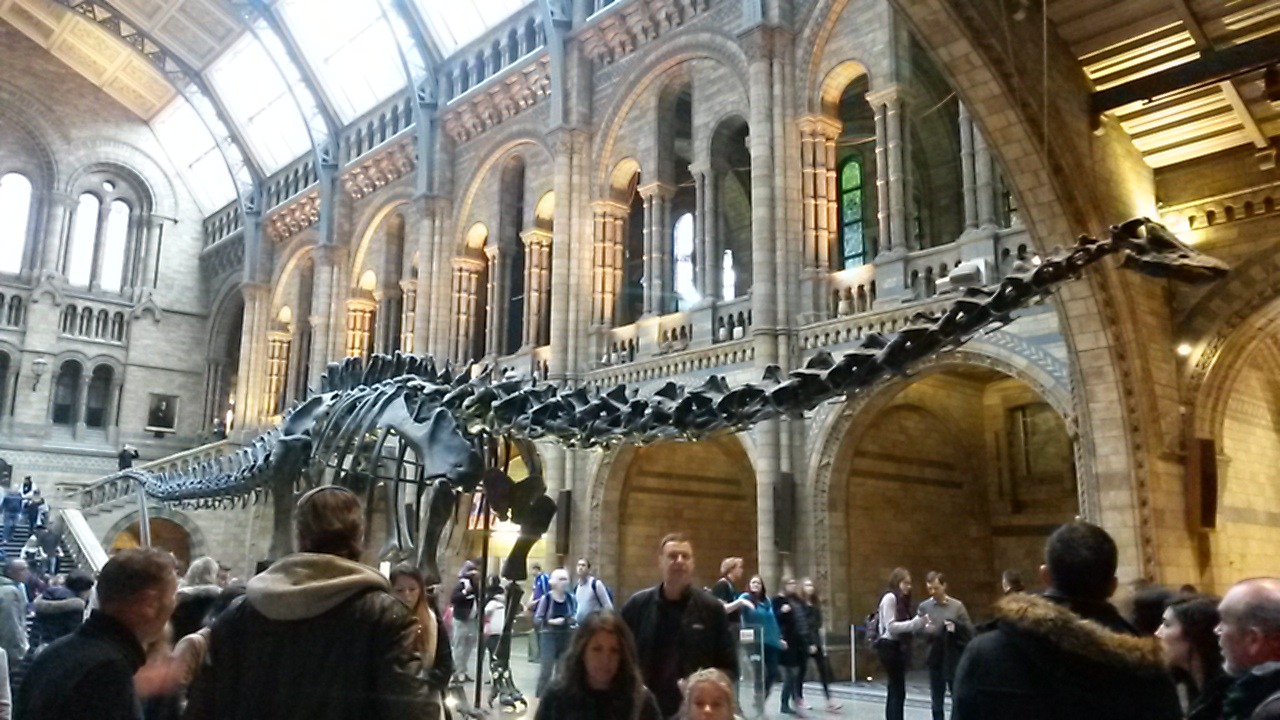
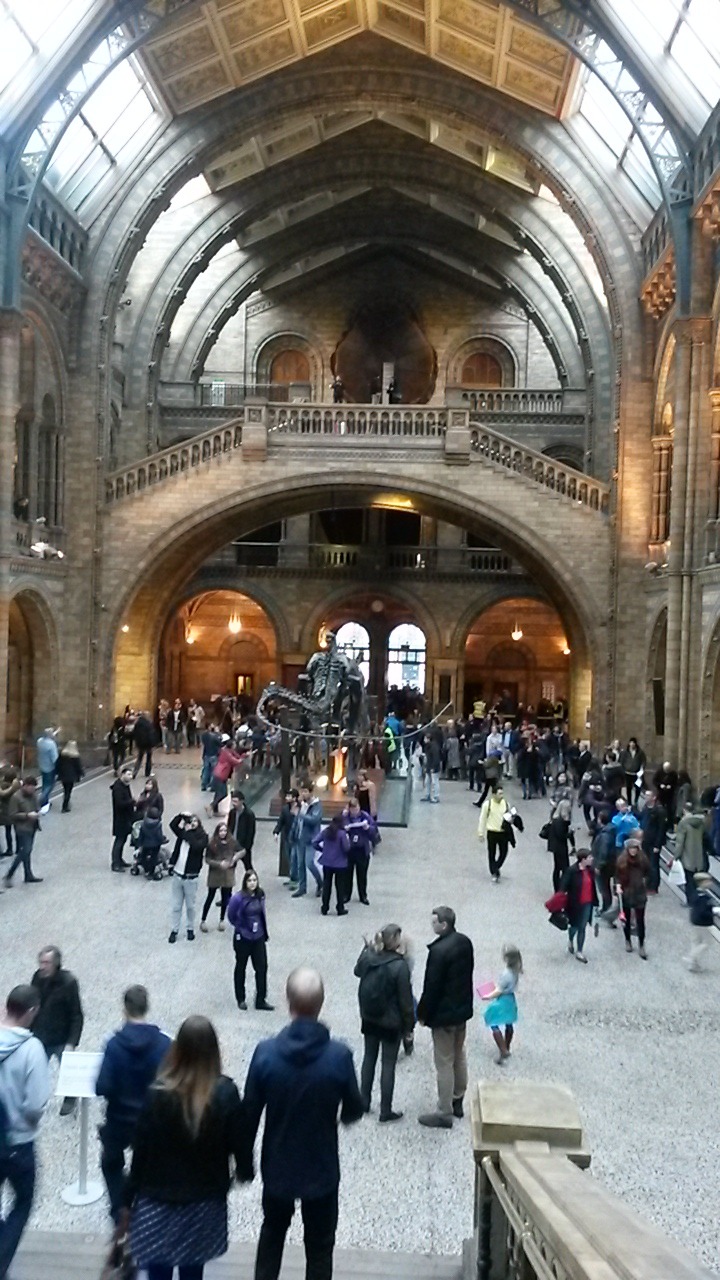
Undaunted, I headed in anyway. I was greeted by Dippy the Dino: due to be removed at the end of 2016, I was glad to see him for the last time. The hall is possibly the most beautiful part of the museum, decorated with carvings of many different animals, flanked with arches, and ending in an imposing staircase.
History
The origins of the collection lie in the specimens of the Ulster doctor Sir Hans Sloane, who allowed the British Government to purchase the collection in the mid-eighteenth century. The collection was initially housed in Montagu House, Bloomsbury, in 1756, the home of the British Museum. Over the years, much of the Sloane collection disappeared, many specimens having been sold to the Royal College of Surgeons.
The palaeontologist Richard Owen was appointed Superintendent of the natural history departments of the British Museum in 1856. Seeing that these departments needed more space, he arranged for land in South Kensington to be purchased. The civil engineer Captain Francis Fowke won a 1864 competition to design the new museum, but he died shortly afterwards and the job was taken on by Alfred Waterhouse, who revised the plans considerably. Work began in 1873, the building was completed in 1880, and the museum opened the following year.
The museum still remained, legally, part of the British Museum, using the name British Museum (Natural History). A petition to the Chancellor of the Exchequer was made in 1866 requesting independence, but it wasn’t until 1963 and the passing of the British Museum Act that this was granted, and the museum retained the original name until 1992 (though it was informally rebranded as the Natural History Museum four years earlier).
Today, the museum is free to enter (except for special events and exhibitions) and is a thriving destination for Londoners and tourists alike. It has a special appeal for children, but there is plenty of interest for adults too.
The museum is divided into zones, which helps with navigation. There are plenty of maps around the place to help you find your way.
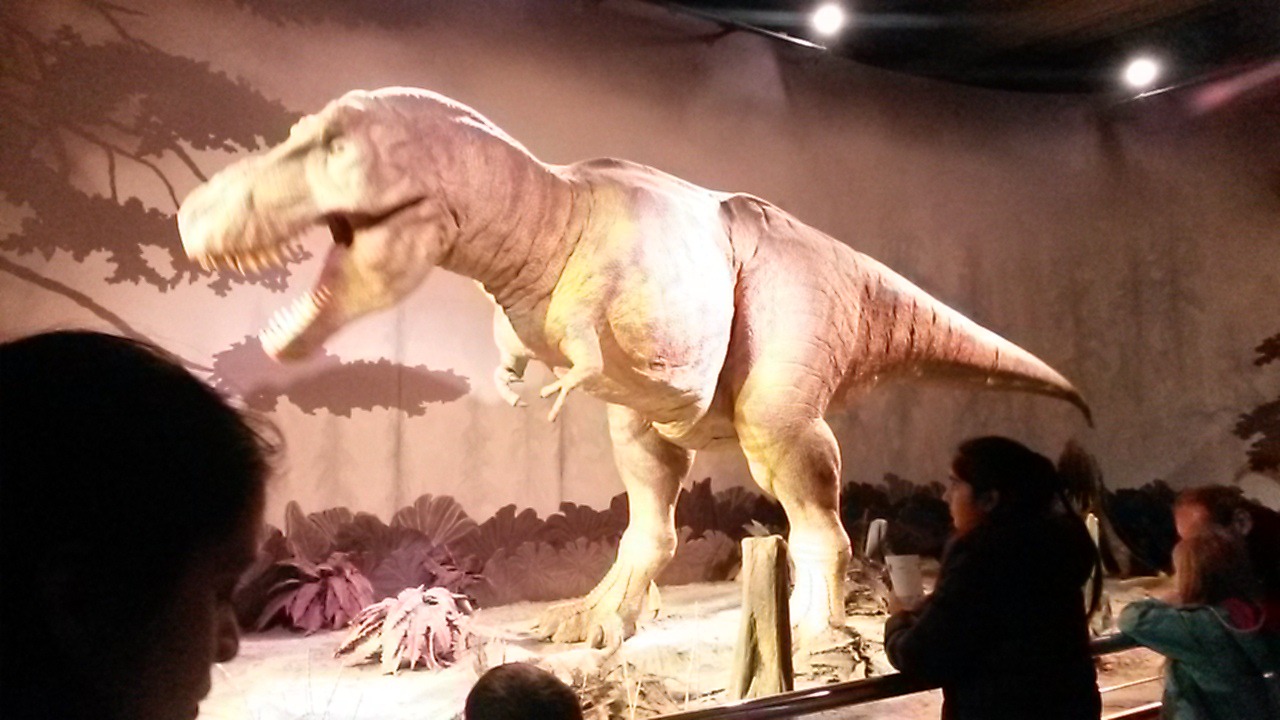
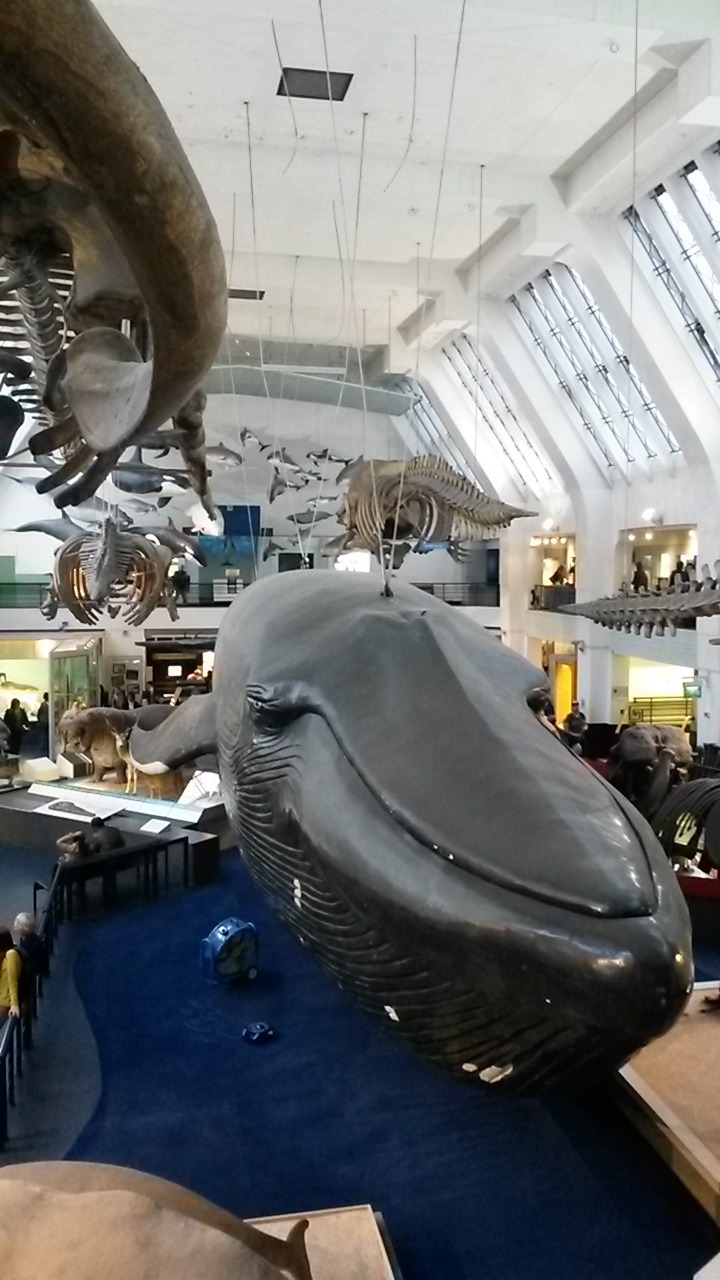
Blue Zone The highlight of the Blue Zone is the Dinosaurs Gallery – the most popular gallery in the museum – which has plenty of interest including the first fossil ever found from a Tyrannosaurus Rex, an Iguanodon, the skull of a plant-eating Triceratops, and more. This zone also contains skeletons, models and stuffed animals, encompassing the natural world including fish, amphibians, mammals and reptiles. Many of the stuffed animals look rather old and tired now, but this is understandable considering the museum no longer wants to kill and stuff animals for display. I thought the section on human biology also looked a bit dated, but it was certainly very informative.
Green Zone
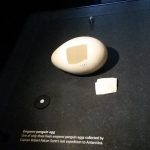
This zone rather randomly brings together fossils, minerals, birds and “creepy crawlies”. My favourites were the dodo (now sadly extinct) and the giant plesiosaur skeleton on the wall. I’m not a huge fan of insects and other crawling things, but I have a particular love for leaf-cutter ants and can happily spend ages watching them march along bearing their huge leaf fragments triumphantly. This zone also includes the Treasures Gallery, containing an exciting assortment of special and unique items including an emperor penguin egg collected during Robert Falcon Scott’s Antarctic expedition, and Guy the gorilla.
Red Zone
This zone encompasses the former Geological Museum of the British Geological Survey, which became part of the museum in 1986. The impressive Earth Hall features an exciting entrance that takes visitors up an escalator and through a giant model of the earth. This zone looks at the history of human evolution, rocks and gems, and natural phenomena such as earthquakes and volcanoes. I particularly liked the earthquake simulator.
Orange Zone
This zone contains the peaceful Wildlife Garden and the Darwin Centre, in which you can attend live shows and talks with scientists, although I didn’t attend any during my visit.
The museum has frequent special exhibitions, including the annual Wildlife Photographer of the Year exhibition and the summer staple Sensational Butterflies. There is also a branch of the museum at Tring in Hertfordshire. Other special events include monthly lates and popular sleepovers (“Dino Snores”), with separate events for both children and adults. This is on my bucket list!
The Natural History Museum is a hugely impressive and educational free museum. Some of it is looking a bit dated and tired now, but that’s understandable given its sheer size and the number of visitors it sees through its doors. In 2017 a project will revitalise the Hintze Hall, former home of Dippy the Dino, and the Treasures Gallery; maybe after that’s done they’ll get on to the rest of it. It’s still a valuable resource, and superb special exhibitions keep me going back.
I visited the Cartoon Museum one lunchtime to check out their temporary exhibition, The Great British Graphic Novel. Running from 20 April to 24 July, the exhibition examined the development of the graphic novel in the UK over the last few decades, while also looking back to the beginning of graphic storytelling, which dates from the eighteenth century. For instance, Hogarth’s A Harlot’s Progress, a series of illustrations demonstrating the downfall of a young woman in sinful London, was created in 1732.
In the nineteenth century, magazines such as Punch and Ally Sloper’s Half-Holiday became the forerunners of graphic novels, telling stories via panels. In the twentieth century, many graphic tales appeared in newspapers and several were serialised before being combined in book form. Some of the graphic novels examined in the exhibition included Watchmen, Gemma Bovery and From Hell.
I’ve heard graphic novels labelled as “inferior” to standard novels, but this has always struck me as ridiculous. For one thing, I don’t think they can be directly compared to written novels: they are a different medium. For another, I love reading but I actually find reading graphic novels much more difficult than reading written novels: my instinct is to just read the words, but graphic novels need to be read taking into account the illustrations and the text. I can’t imagine the skill needed to be able to create a good graphic novel.
Previously, I’ve only read a very few graphic novels: Alice in Sunderland by Bryan Talbot, Maus by Art Spiegelman, and I’ve got Neil Gaiman’s Sandman at home although I haven’t begun it yet. The exhibition gave me lots of ideas about what I might like to read next.
The Cartoon Museum itself was formed in 1988 when a group of cartoonists, collectors and lovers of the art form came together as The Cartoon Art Trust with the aim of founding a museum dedicated to collecting, exhibiting, promoting and preserving the best of British cartoon art. The current central London home was opened in 2006.
In 1988 a group of cartoonists, collectors and lovers of the art form came together as The Cartoon Art Trust with the aim of founding a museum dedicated to collecting, exhibiting, promoting and preserving the best of British cartoon art. After a decade of exhibiting in smaller venues, in February 2006 the Cartoon Museum opened to the public at its current home in central London, very near the British Museum. As well as regular temporary exhibitions, the museum has a range of permanent displays encompassing the history of British cartoons and comics. There is work by James Gillray and Thomas Rowlandson, who are supposed to have founded the British cartoon tradition, and art by Victorian cartoonists including George Cruikshank, George Du Maurier and John Tenniel. Twentieth-century cartoonists such as William Heath Robinson and H.M. Bateman are also present in the permanent collection, while the upstairs gallery has cartoons by artists such as David Law (Dennis the Menace, Beryl the Peril), Leo Baxendale (Bash St. Kids, Minnie the Minx), Posy Simmonds and Sarah MacIntyre.
The Cartoon Museum is well worth a visit: it’s very close to the British Museum, so you could pop in after visiting the more famous attraction.
FACTS
Address: 35 Little Russell Street, London, WC1A 2HH
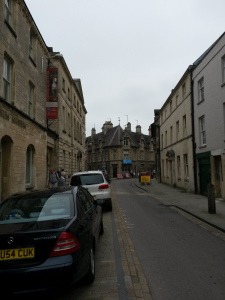
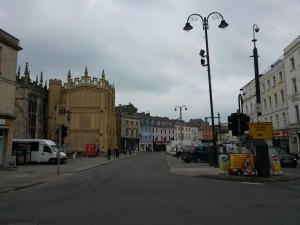
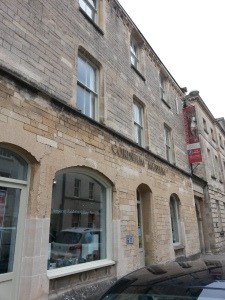
On the way home to the North East, I took the train to Cirencester, where my parents were due to arrive and pick me up. Actually, Cirencester doesn’t have a railway station any more so I ended up at nearby Kemble and had to get the bus. I arrived in the town a couple of hours before my parents, so decided to go and check out the Corinium Museum.
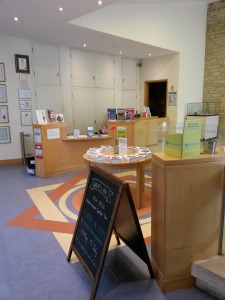
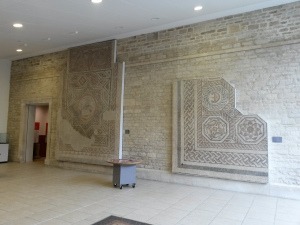
The Corinium MuseumMuseum foyer
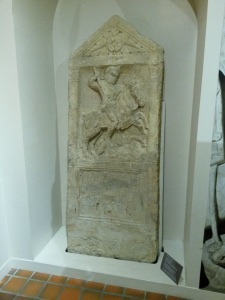
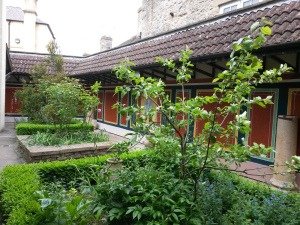
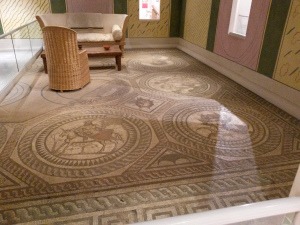
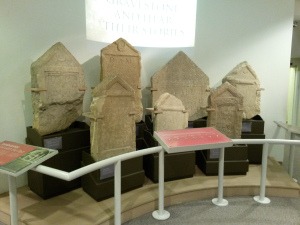
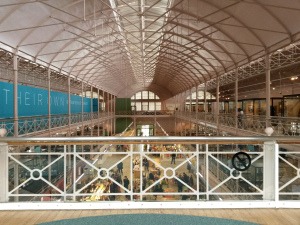
The museum is named after Roman Cirencester, which was known as Corinium. The museum tells the story of the town from earliest times to the modern day, and much of it is concerned with the area’s rich Roman heritage. The Roman section of the museum is full of mosaics, gravestones and even a Roman garden that has been reconstructed outside. The mosaics are beautiful and surprisingly well-preserved, and displayed to their greatest advantage within the airy space of the museum.
The museum eventually moves on to look at Corinium/Cirencester life after the Romans left, moving through the medieval period and the Civil War and winding up with the Victorians.
The museum helped me to pass the time waiting for my parents by learning more about the town I was visiting. It’s definitely worth popping in if you’re in the area.
It’s a long time since I visited Sir John Soane’s Museum, so I decided to pop in on Saturday. As usual there was a bit of a queue to get in, but considering it’s free, I was happy to wait – I only had to hang around for a few minutes, anyway.
Sir John Soane was a distinguished 19th century architect who turned his Lincoln’s Inn Fields townhouse into a museum full of famous artworks, sculptures, artefacts and furniture, most of it relating to the classical world. It was fairly famous during Soane’s lifetime, and has remained largely untouched since his death almost two centuries ago.
You start in the library, then head to the back of the house, which is covered from head to foot with classical artefacts. The basement is possibly the most exciting space, particularly the Monks’ Parlour and the huge sarcophagus. Back upstairs, there are more beautiful eighteenth century rooms to look around. Whatever your level of interest in history, there is something to see and enthuse over here.
A temporary exhibition, Charlotte Brontë at the Soane, is currently taking place. Though the museum existed when the writer of Jane Eyre visited London, there is no evidence that she ever went. Curator Charlotte Cory has decided to bring her to the Soane for her 200th birthday, and on display are some of Brontë’s possessions, including the beautiful blue and white dress she wore to attend a dinner with Thackeray, as well as some less authentic artefacts.
Another temporary exhibition refers to Soane’s relationship to the works of Shakespeare, and displays, among other things, the first four folios: it’s incredibly rare to see all four displayed together.
The Museum is open for occasional evening tours, and every so often the top floor – Soane’s private apartments – opens for tours (the latter do charge for entry). It’s a lovely, unique little museum that is well worth visiting.
FACTS
Address: 13 Lincoln’s Inn Fields, London, WC2A 3BP
While I was at the Museum of Childhood to see the exhibition about Bagpuss and The Clangers, I took the opportunity to look around the museum as a whole. Though it is based in Bethnal Green, it is part of west London’s Victoria & Albert Museum: the building was opened as the Bethnal Green Museum in 1872 and in 1922, then-Head Curator Arthur Sabin decided to try and make it more child-friendly. The move was a popular one, and following this the Museum re-opened in 1974 as the Museum of Childhood. A refurbishment occurred in 2005-06 and the Museum continues to thrive.
The Museum is neither just for children nor solely for adults, but manages to successfully cater to both groups. Fun and educational events take place regularly for children, and adults can also get in on the act – for instance, there is a nostalgic children’s’ TV quiz taking place on the 21st of April. The Museum examines the history of childhood, which is interesting for people of all ages: adults can reminisce about their own childhoods, children can learn about how young people of the past occupied their time, and everyone can develop a greater understanding of the history of childhood as a concept.
The section devoted to the history of childhood was particularly interesting to me: it looked at how babies and young children were cared for from the sixteenth century onwards, with examples of clothing, cots and feeding equipment as well as toys. There was also a section on clothes, which showed how children went from wearing miniature versions of adult outfits to their own specially designed fashions.
There were special sections devoted to kinetic and electronic toys, and there were some cases devoted to particular themes, such as magic, with a 1950s magic set being displayed alongside Harry Potter merchandise from recent years. I enjoyed seeing some of the toys I used to play with myself, including Sylvanian Families and the original PlayStation. I have to admit I do feel rather old knowing that toys I played with as a child are now in a museum!
The Museum is currently showing a temporary exhibition called On Their Own: Britain’s Child Migrants. This is definitely aimed at adults rather than children as it explores the sensitive and distressing topic of the children who were sent to various British colonies from 1869-1970. These children were sent away with the promise of a better life, but for many this did not materialise, and several never saw their families again.
The Museum of Childhood is definitely worth a visit. It’s fascinating, and it’s free: though be warned, you may come out with a desire to relive your childhood.
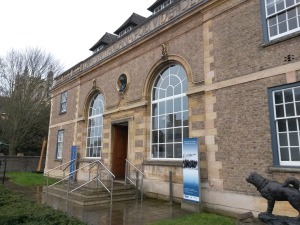
Just before Easter I went to Cambridge for work-related reasons. While I was there, I had some spare time so decided to visit the Polar Museum. This is located in the Scott Polar Research Institute, which is a centre for the study of the polar regions and is of international importance. The SPRI was founded in 1920 as a memorial to Scott and his men, who died on their return from the South Pole. It is the oldest international centre for Polar Research within a university.
I originally visited the SPRI several years ago when I was living in Cambridge. In fact, it originally inspired my interest in polar history, as I found the stories of exploration fascinating. I vividly remember viewing the original letters penned by Scott and his companions as they lay in their tent, surrounded by a blizzard, knowing they were going to die. Back then, I was on a work visit and we had a tour of the extensive library, but today I was here as a normal visitor, and stuck to the free Polar Museum.
The Museum contains information about both the Arctic and Antarctic. It encompasses the history of exploration in both regions, including the quests for the North and South Poles. My personal interests have always leaned towards Antarctica, and there is a great deal of interest here, including the history of Scott’s last expedition on the Terra Nova. However, I also enjoyed reading about the search for the North West Passage, including Franklin’s infamous expedition of the mid-nineteenth century in which he and all his crew disappeared; despite several search parties being dispatched to look for him, the mystery was never solved. The Museum also contains information about survival in these cold regions of the earth, and displays about the people who live in the Arctic (the Antarctic does not have an indigenous population).
By Endurance We Conquer
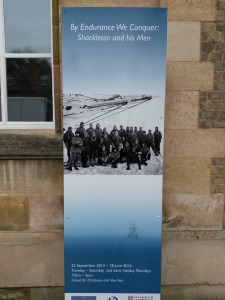
The current temporary exhibition is By Endurance We Conquer: Shackleton and His Men, and it is the major centenary exhibition commemorating Sir Ernest Shackleton’s Imperial Trans-Antarctic Expedition 1914–17. I’ve written about this expedition on this blog before, including my post about the recent Royal Geographical Society exhibition, so I won’t repeat the same facts. This expedition makes use of diaries and artefacts in the SPRI’s collections, including navigation instruments used on the JamesCaird on the voyage to South Georgia, the cooking pot used by the three men on the overland crossing of South Georgia, and Ernest Shackleton’s pannikin marked with his initials. There are also archival materials including letters, diaries, and a memory map drawn by Frank Worsley showing the route taken during the South Georgia crossing. What I liked about the exhibition was its focus on the 28 individuals of the Weddell Sea Party (not to mention Mrs Chippy the cat), with written summaries describing each person, whether they went with Shackleton to South Georgia or remained behind awaiting rescue.
This free exhibition runs until 18 June, and will be followed by a display on the Ross Sea party, commemorating the centenary of Shackleton’s arrival at Cape Evans to rescue the survivors in January 1917. It’s well worth a visit, especially as it’s free, and the museum as a whole is a superb resource for the study of polar history.
I visited the A.G. Leventis Gallery at the Institute of Archaeology, part of UCL Museums & Collections. The A.G. Leventis Gallery of Cypriot and Eastern Mediterranean Archaeology displays the IoA’s rich collection of objects from ancient Cyprus, Greece, Crete, Egypt and the Levant. It is fascinating to explore the resources and learn about how diverse the region has been during five thousand years of history.
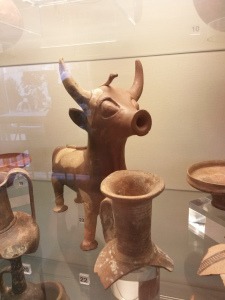
My favourite object in the Gallery
There is also a temporary exhibition, We Need To Talk: Connecting Through Technology, which has been created by students on the MA Museum Studies to explore the different technologies we have used to communicate in different periods of time. The exhibition contains such varied items as typewriters, coins, papyrus and computers, and it’s highly informative.
A visit to this interesting gallery doesn’t take long, but it’s certainly worthwhile.
FACTS
Address: Institute of Archaeology, 31-34 Gordon Square, London, WC1H 0PY