Elizabeth I And Her People – National Portrait Gallery

The National Portrait Gallery‘s current exhibition is Elizabeth I And Her People, which explores Elizabeth’s reign alongside the lives of other important people of the late Tudor age. The exhibition uses portraits to explore how explorers, artists, soldiers, writers and merchants portrayed themselves and displayed their wealth and achievements.

I am fairly familiar with this period, having studied history at sixth form and university, and I thought the exhibition did a great job of looking at the sixteenth century and the kind of people who inhabited it, particularly the growing middle classes.

Manet: Portraying Life – Royal Academy of Arts

Manet: Portraying Life at the Royal Academy of Arts was the last exhibition I saw on Sunday. I had originally planned to visit on Friday night a couple of weeks ago, but like so many exhibitions recently, it was sold out so I decided to book in advance for a later date.

2013 0310 Royal Academy

This is the first major exhibition in the UK dedicated to the work of Eduoard Manet (1832-1883). It focuses on his career as a portrait painter. Although I was aware of Manet before the exhibition, I always imagined him as a landscape painter, so this aspect was interesting to me.

Manet came from a wealthy family and didn’t have to live by his art, but he still sought approval from the Paris Salon, which was, however, often rejected. He used elements of the Old Masters and the new Impressionists, creating an art that was different from both with an unique style. Though photographic portraits were growing in popularity during the time in which he worked, Manet still believed that painting offered opportunities that photographs didn’t in evoking the personality of the individuals painted.

Manet painted several portraits, including pictures of his friends and family: his wife, Suzanne Leenhoff, and stepson, Léon, appear frequently, as do a number of studies of friends including Antonin Proust (no relation to Marcel). Some of his pictures are status portraits of political or other celebrity figures; several of these are unfinished as their sitters could not offer the time that Manet required to model for them. Some of my favourite pictures are those of the writers and artists who were Manet’s friends, including Stéphane Mallarmé and Emile Zola.

My favourite Manet pictures, however, were those which included models rather than important or celebrity figures, particularly those of Victorine Meurent, who appears in the fascinating painting The Railway (1873), in which a red-haired woman gazes at the viewer while the child beside her stands facing the other way, watching the approaching steam train whose presence is indicated by a cloud of smoke. Manet’s style is modern but influenced by older painters, striking and memorable.

Manet: Portraying Life is on until the 14th of April.

Gaiety is the Most Outstanding Feature of the Soviet Union – Saatchi Gallery

The bizarre title of this exhibition drew me to the Saatchi Gallery on Sunday, as did the fact that it consists of new art from Russia – I am fascinated by anything Russian so Gaiety is the Most Outstanding Feature of the Soviet Union was on my must-see list.

This despite the fact that modern art is certainly not my forte. Still, I enjoyed my previous visit to the Gallery – rather to my surprise – and resolved to keep an open mind. Some of the exhibitions were lost on me, such as odd sculptures; some weren’t to my taste, but I could appreciate the thought that went into them and the humanity that lay behind them, such as Sergei Vasiliev’s photographs of tattooed prisoners and Boris Mikhailov’s pictures of the homeless in Ukraine, illustrating the disintegration of society in a post-Soviet world.

One of my favourite displays was this piece by Daria Krotova, bringing to mind the works of Dostoyevsky and Gogol and seemingly concerned with the recession and the culpability of those in positions of power.

2013 0303 Saatchi Gallery 02

2013 0303 Saatchi Gallery 01
2013 0303 Saatchi Gallery 03

I also loved these pictures by Valery Koshlyakov – made from cardboard and roughly-applied paint, they are striking and beautiful.

2013 0303 Saatchi Gallery 04

Grand Opera, Paris
2013 0303 Saatchi Gallery 06

Notre Dame, Paris and High-rise on Raushskaya Embankment

The exhibition is running until the 9th of June.

Breaking the Ice: Moscow Art, 1960-80s
While I was at the Gallery I also dropped in on the exhibition upstairs, which continued the Russian theme by displaying Moscow art from an earlier period. I found this harder to get into, but I did like this image which juxtaposed Lenin’s face with an easily recognisable advertising logo.

2013 0303 Saatchi Gallery 08

This exhibition is on until the 28th of March.

Constable, Gainsborough, Turner and the Making of Landscape – Royal Academy of Arts

On Friday night I paid a visit to the Royal Academy of Arts to see the Constable, Gainsborough, Turner and the Making of Landscape exhibition. I love Turner and this was the main reason for my visit. In the end there wasn’t a great deal of his work on display, or that of the other named artists. A lot of the space was devoted to artists who paved the way or who were inspired by these three giants, so I felt the title of the exhibition was slightly misleading. Still, the paintings and artefacts displayed were well-chosen and the exhibition as a whole was small enough to be enjoyed without fatigue. Highlights for me included Turner’s Dolbadern Castle, while paintings by Gainsborough and Constable, artists I’d never paid much attention to in the past, appeared in a new light for me and I think I’d like to find out more about their work.

Valentino, Tim Walker and Peter Lely at Somerset House

I had the day off on Friday and spent the afternoon checking out the exhibitions at Somerset House. This place, on the north bank of the Thames near Temple station, has a lot going on, most famously – at this time of year – the ice rink. I’ve never been ice skating in my life, but it does look fun, and the surroundings are beautiful.

2012 1207 Somersethouse 03

I arrived via the Embankment and the first exhibition I came across was Valentino: Master of Couture, in the Embankment Galleries. This exhibition displayed personal letters and other items from the designer’s personal archives, as well as outfits spanning over fifty years. These were interesting and extremely varied: I had my own favourites, which were generally the fifties-style outfits, but there should be something here to appeal to everyone. The exhibition concluded with  the wedding dress of Princess Marie Chantal of Greece, which was beautiful, but not as nice as Kate Middleton’s wedding dress as far as I am concerned. There was also a small section looking at how different design effects are achieved, including the famous Valentino rose.
2012 1207 Somersethouse 02

I enjoyed the exhibition, but I think it was quite expensive (£12.50) and would be of greatest interest to design students or those with a strong interest in fashion. I would have liked to learn more about the context of the items on display. However, I did enjoy looking at them.

The next exhibition was free, and I actually enjoyed this one more. Tim Walker: Storyteller displayed the photographer’s unusual, fantastical and dreamlike pictures, many of which are fashion photographs taken to promote a specific brand. There were also celebrity pictures including striking images of Helena Bonham Carter, the Pythons and Tilda Swinton. Props used in several of the photographs, including a giant skeleton, an enormous and rather creepy doll and jelly-mould hats, are shown alongside the images in which they appear. I thought the photographs were beautiful and unusual, often with narrative, nightmarish or bizarre undertones.

Finally, I revisited the Courtauld Gallery (for free, with my National Art Pass) to look at the small one-room exhibition Peter Lely: A Lyrical Vision. Lely is most famous for his portraits of the beauties of the court of Charles II, so it was interesting to see landscapes and paintings on Biblical and classical themes, completed before he began to concentrate entirely on portraits.

After visiting all of the exhibitions I popped into the Christmas shopping gallery, but I didn’t buy anything as it was all a bit expensive.

The Northern Renaissance: Dürer to Holbein – The Queen’s Gallery

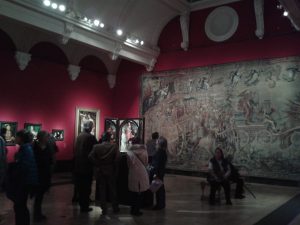
I really like the Queen’s Gallery at Buckingham Palace. It has rotating exhibitions which change every few months or so, and when you buy a ticket you can get it converted into a 1-year pass enabling you to go back as many times as you want over the course of the year. I had the day off on Wednesday and visited the Gallery for the third time this year, in order to see the exhibition The Northern Renaissance: Dürer to Holbein.

I studied the Reformation in Europe as part of my History A Level and many of the pictures in this exhibition were of figures I am familiar with. One painting, which appeared in the first room, was of Desiderius Erasmus, a hugely important intellectual figure and inspiration to Martin Luther who kickstarted the Reformation. In our class he was known as ‘Daddy Rasmus’.

2012 1205 Durertoholbein 01

‘Daddy Rasmus’

This painting, and many others at the beginning of the exhibition, was by Albrecht Dürer, a German painter and printmaker who is commonly regarded as one of the greatest artists of the period. I recognised several of his engravings, including the Knight, Death and the Devil, from A Level textbooks. Much of his work has a strong Gothic feel, and he utilised classical imagery in his work. He drew and painted many of the prominent figures in the Northern Renaissance.

2012 1205 Durertoholbein 02

Hans Holbein the Younger is known for his work at the Tudor court; he came to England from Germany where he first developed as an artist. Sketches, drawings and paintings by him show his ability to capture in detail the expressions and personalities of the figures of the period.

2012 1205 Durertoholbein 03

The work of other artists was also represented in the exhibition: tapestries, altarpieces and paintings all capture the important themes of the period, reflecting the turbulent age in which they were created. The fifteenth and sixteenth centuries were a time of dramatic change in Europe, with intellectual exploration, religious questioning and a shifting of the balance of power. The works of art portrayed here are interesting in their own right, but are also emblematic of the wider issues of their age.