Sculpture Victorious – Tate Britain

During my day out at Tate Britain, I visited a great many exhibitions including Sculpture Victorious. This exhibition looks at the development of the art form during the Victorian era. Victoria and Albert encouraged and commissioned work, as did the state, and this helped to encourage a “golden age” of sculpture.

The first section explores images of Queen Victoria herself, from Francis Chantrey’s 1839 young and sensual marble bust to Alfred Gilbert’s 1887-9 marble bust and Edward Onslow Ford’s 1897 bronze bust, made only a few years before Victoria died. Her image was familiar to all her subjects as it was dispersed throughout the country on cameos, medals and coins – some of which are displayed here, including Canadian and Indian coins, a Crimea medal and a Great Exhibition medal – as well as large and small busts. The item I found particularly interesting was Benjamin Cheverton’s 1842 bust, a copy of Chantrey’s made using Cheverton’s ingenious “reducing machine”.

The nineteenth century saw a growth of interest in Britain’s history, particularly its medieval past. This was evident in the Houses of Parliament, designed in a Gothic style, and the fascination with the “Age of Chivalry” and church history. The House of Lords was decorated with models of the Magna Carta barons by James Sherwood Westmacott, including the Earl of Winchester (d. 1219), whose model has been loaned to this exhibition. Edmund Cotterill’s Eglinton Trophy is a beautiful and intricate example of medieval-inspired design, while many medieval tombs were conserved and their casts displayed at the Crystal Palace, including that of Eleanor of Aquitaine.

The classical world also inspired the Victorians, particularly the Parthenon marbles, casts and miniatures of which were sold and toured the country. Hamo Thornycroft’s bronze sculpture of Teucer (1881), a Greek archer named in the Iliad, was well received while John Gibson, a leading British neoclassicist, created Hylas surprised by the Naiades (1826-c.36) in marble. The Devonshire Parure (1856), a glorious collection of jewels, was inspired by classical style while Frederic Leighton’s bronze An Athlete Wrestling with a Python (1877) is particularly impressive.

The Great Exhibition showcased fine examples of sculpture from Britain and abroad. Minto & Co.’s Peacock (1873) and Elephant (1889) are attractive and bright; made of lead and tin-glazed earthenware, they exemplify the link between sculpture and manufacturing. Mid-19th century ivory sculptures from Barhampur in India are ornate and beautiful, while Thomas Wilkinson Wallis’s Partridges and Ivy (1871), made of limewood, is breathtakingly delicate and stunning. Sculptures of a Greek slave and an American slave helped to fuel the anti-slavery campaign. I was particularly impressed by Raffaele Monti’s Veiled Vestal (1847), a marble sculpture with remarkably realistic drapes veiling a young woman’s face.

The Victorian era saw the construction of more public statues than any other, designed largely for commemorative purposes. Still famous to this day is Alfred Gilbert’s 1893 Shaftesbury monument, a memorial to Lord Shaftesbury, most commonly known as the Statue of Eros in Piccadilly Circus. A statue of King Alfred by Hamo Thornycroft was erected in Winchester in 1901, accompanied by a carefully choreographed unveiling, and Alfred Stevens won the Wellington Commission to create a memorial to the Duke of Wellington in St Paul’s Cathedral.

The final section of the exhibition looks at individual craftsmanship, with examples including A Royal Game (1906-11) by William Reynolds-Stephens, an impressive piece of bronze, wood and stone showing Elizabeth I and Philip II of Spain playing chess. Another piece that caught my eye was Perseus and the Graiae (1877-88) by Edward Burne-Jones.

I have an interest in the Victorian period and this exhibition allowed me to learn about an area of Victorian art that I hadn’t really thought about before. Definitely recommended.

Nick Waplington/Alexander McQueen: Working Process – Tate Britain

At Tate Britain in order to attend some exhibitions, I came across a photography exhibition called Nick Waplington/Alexander McQueen: Working Process. The exhibition consists of a selection of photos taken by Waplington at McQueen’s invitation, concerning the latter’s final ready-to-wear collection for A/W 2009 known as The Horn of Plenty! Everything But the Kitchen Sink. As I have a ticket for the McQueen exhibition at the V&A later this year, I thought it would be a good idea to visit this one too.

The exhibition documents the process of creating the collection from start to finish, beginning with pictures of rubbish tips and ending with images of the catwalk. In between you see McQueen and his assistants designing, creating and constructing the costumes. The collection acted as a satirical and provocative retrospective of his career, with costumes made from fine silks designed to look like rubbish bags and an exaggerated emphasis on the models’ features. I found the exhibition interesting and it whetted my appetite for the larger exhibition at the V&A later on.

The Darks – Tate Britain

The Darks is an installation/exhibition by Ruth Ewan and Astrid Johnson based at Tate Britain. I had read about it on the website, and when I went to the Tate to see some exhibitions on Easter Monday, I decided to give this tour a go.

The Darks plays on the format of a museum audio guide, and was inspired – if that is the right word – by the Millbank Prison which used to occupy the Tate site. Jeremy Bentham’s original 1816 plan was for a Panopticon, a system which would enable just one watchman to keep an eye on all the prisoners, but the end result was somewhat different. The triangle of Mercy, Justice and Vigilance was supposed to inform prison design. The guide features both real and fictional accounts from the likes of Dickens as well as prisoners transported to Australia from just outside the prison. The tour starts at the Tate’s Millbank entrance, then moves onto the steps; you cross the road and walk by the river until you reach the Morpeth Arms and Ponsonby Place, then head back to the Manton Entrance in Atterbury Street, finishing up in the Tate’s Lower Rotunda.

2015_0406TheDarks01
The Darks audio guide collection point
2015_0406TheDarks02
Tate Britain Millbank entrance
2015_0406TheDarks03
Looking out onto the river
2015_0406TheDarks04
The Rotunda
2015_0406TheDarks05
Looking west along the riverbank
2015_0406TheDarks06
The Thames
2015_0406TheDarks07
The Thames
2015_0406TheDarks08
Prisoners departed London here for transportation to Australia
2015_0406TheDarks09
The Morpeth Arms, where prison workers used to drink
2015_0406TheDarks10
Part of the octagon that used to mark the prison boundary
2015_0406TheDarks11
Another view of the boundary
2015_0406TheDarks12
Manton Entrance
2015_0406TheDarks13
Back inside Tate Britain

The Darks is a fascinating tour and I learned a lot about Millbank Prison and the site itself. I love anything that allows me to explore more of London, so this was ideal.

Late Turner: Painting Set Free – Tate Britain

I was supposed to be meeting a friend on Sunday, but she couldn’t make it, so I decided to go to a couple of exhibitions instead. The first was Late Turner: Painting Set Free at Tate Britain.

The exhibition covers J.M.W. Turner’s work between 1835 and his death in 1851. I adore Turner and thoroughly enjoyed looking at his later works, which give the lie to the concept that old age automatically has to mean settling down into a reactionary retirement. Turner continued to experiment and push the boundaries well into his last years, despite derision and misunderstanding from his contemporaries.

One of my favourite paintings is Rain, Steam and Speed: The Great Western Railway (1844), which is just incredible, with the train rushing towards you, the sense of movement clear within the picture. I loved seeing it here. I also loved the Roman and classical-inspired pictures with their beautiful landscapes, as well as the watercolours of the burning of the Houses of Lords and Commons. Another favourite was Peace: Burial at Sea (1842) – I thought the light on the water was beautiful.

This exhibition is brilliant, and strongly recommended – but it can get crowded, so I would suggest trying to go at a quiet time if possible.

British Folk Art – Tate Britain

After visiting the Kenneth Clark exhibition, I went along to the British Folk Art museum, also at Tate Britain. This exhibition comprises collections from across Britain which have been described as folk art, a term generally used in connection to social history or folklore studies. It is the first major exhibition of its kind in the country, and covers work from the seventeenth century to the middle of the 20th, which is when folk art supposedly began to become more commodified.

The first section of the exhibition consisted of a selection of painted, carved or constructed signs outside buildings which were used to denote the kind of business and as an early form of advertising. Some of these signs are obvious, such as a boot or a shoe to denote a cobbler, and a padlock or key for a locksmith. Others are less so: a bear was often used outside a barber’s (as bear grease was commonly used on the hair), and the three golden balls outside a pawn shop represent the family crest of the Medicis, wealthy Italian bankers. The detail and craftsmanship evident on some of these signs is incredible.

In early 19th century Frant, a village near Tunbridge Wells, a tailor named George Smart created and sold pictures made from textile  scraps, which he then sold to tourists. “Smart’s Repository” produced some amazing pictures of fascinating village figures, including the policeman and an old woman in a red coat. Many folk artists painted pictures relating to rural life and landscapes, including images of the sea and sky. One notable such artist was Alfred Wallis (1855-1942), a rag and bone merchant and self-taught painter from St Ives, who created paintings based on his early career at sea.

Some folk arts were classed as crafts, including the mysterious “god in a bottle” sculptures (wood and liquid in glass bottles), straw crafts and leatherwork. Some were carved figures, such as the Highlander which was kept outside a tobacconists, and ship figureheads such as the huge HMS Calcutta, made in Mumbai 1831 of Indian hardwood.

I was hugely fascinated by the work of Mary Linwood (1755-1845), a woman who imitated the Old Masters and British artists to recreate their work in needlepoint. Her fantastically detailed works showed an incredible amount of talent, yet how to categorise an artist who, while incredibly able, does not create original works?

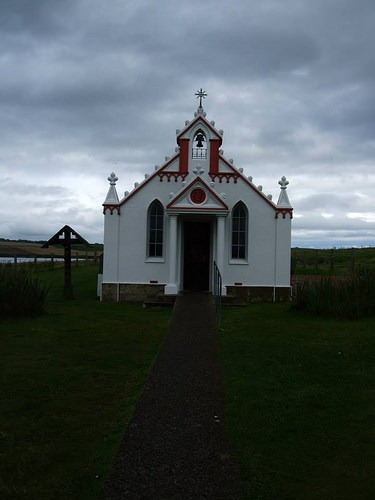
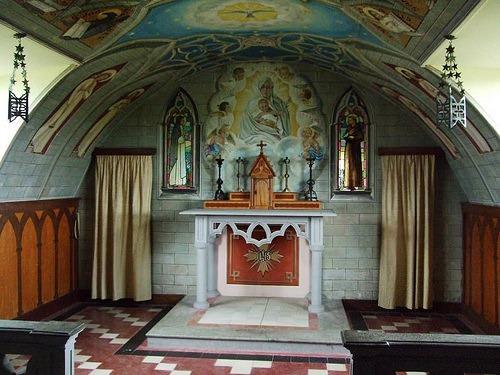
Towards the end of the exhibition there were displayed assorted sculptures, artefacts and textiles, from places such as Beamish Museum in County Durham. These reveal the wide-ranging skills and talents of folk art practitioners. At the end, archival photographs displayed some other examples of folk art, including one man who transformed his back garden into a wonderland, and the chapel built in Orkney by Italian prisoners during the Second World War.

Overall this was a fascinating exhibition, and one which I thoroughly enjoyed. It is on until the end of August, so do try to catch it if you can.

1174530_10100105106923904_31112506_n
The Italian Chapel in Orkney (taken by me on holiday last year)
1233498_10100105106968814_1082326885_n
The interior of the Italian Chapel

Kenneth Clark: Looking for Civilisation – Tate Britain

On Saturday I visited Tate Britain to see two exhibitions which were due to end shortly. In fact, one of them, Kenneth Clark: Looking for Civilisation, has now ended – the last day was Sunday. I was originally in two minds whether to go to see this, but I’m really glad I did.

Kenneth Clark is not someone I had ever heard of before this exhibition, but it seems that he made a significant contribution to the study and appreciation of art during the 20th century. Born into a wealthy family, he used his fortune to collect art and to assist struggling artists. He had wide-ranging tastes: in contemporary terms he had particular preference for the Bloomsbury Group and artists such as Henry Moore, Graham Bell and Victor Passmore. Clark believed that the lack of patronage in the art world was causing artists to be removed from “real life”, and he sought to rectify this.

Clark had no formal art training, and while he produced some excellent books about art, including a fine study of Leonardo da Vinci’s drawings, he also made several mistakes, including quite a number of misattributions. Aged thirty, he became director of the National Gallery – one of his first acts was to install electric lights, so that viewers could actually see the artworks when there was not enough natural light. During the Second World War he ensured the safety of the artworks by evacuating them to Wales.

Towards the end of his life Kenneth Clark presented the groundbreaking series Civilisation, which proved a landmark arts documentary in the 1960s. I left the exhibition with a great deal of admiration for this man who was clearly so passionate about art.

Ruin Lust – Tate Britain

Last weekend marked the final weekend of the Ruin Lust exhibition at Tate Britain, so I decided to pop along. I am glad I did – it was fascinating, looking at the obsession with ruins that has plagued and surrounded artists for hundreds of years. There was an interesting mix of modern and older artists.

I love ruins myself, and when I think of obsession with ruins I tend to think of the Romantic love of crumbling abbeys, as evidenced in, for example, Wordsworth’s ‘Tintern Abbey’. There is a Turner watercolour of that selfsame abbey in the exhibition, as well as moonlit views of other ruins, which I thought were beautiful. I also loved John Martin’s ‘The Destruction of Pompeii and Herculaneum’ of 1822, which I had seen before, but which has lost none of its impact. Gustave Doré’s engraving ‘The New Zealander’ of 1872 shows an imaginary ruined London.

However, I also liked some of the more modern works, particularly Laura Oldfield Ford’s images of postwar council housing, both outside and inside, covered with graffiti-like marks. The exhibition seemed very quiet, which was a shame – I think it deserved to have been seen more widely.

Art Under Attack: Histories of British Iconoclasm – Tate Britain

After visiting the Lowry exhibition at Tate Britain, I hung around to explore the newest exhibition in the gallery, Art Under Attack: Histories of British Iconoclasm. In the end I thought it was one of the most interesting and thought-provoking exhibitions I’ve seen in a while.

Tate Britain bill the exhibition as “the first exhibition exploring the history of physical attacks on art in Britain from the 16th century to the present day”. Iconoclasm – deliberate destruction of works – has been around in various forms for centuries, and perpetrators have acted from widely varying motives, whether religious, political or aesthetic.

The exhibition begins with the Reformation and the destruction of stained glass windows and statues in churches and monasteries, the result of Henry VIII’s break with Rome and later the influence of the Puritans. Decapitated statues of Christ, smashed stained glass and fragments of Winchester Cathedral’s rood screen are displayed. However, the room that really made me think was the ‘suffragette’ room. Several suffragettes used to go to art galleries and deface paintings, such as Edward Burne-Jones’ Sibylla Delphica (1898), often in protest at the way women in art were idealised while real women were being denied basic rights. While I am in complete sympathy with the sentiment behind what they did, I can’t stand the idea of art being destroyed.

What surprised me was that I felt the same about the modern art in the next room. A random member of the public threw blue paint on Carl Andre’s Equivalent III (1966) in protest at the fact that ‘such rubbish’ was being revered as art. And he had a point – the ‘artwork’ in question was a group of bricks arranged in three layers. Frankly you could see the same thing on any building site. And yet – I couldn’t help feeling that this was wrong, that vandalising something that another person spent time and energy and care on creating just isn’t right. After all, however little time it might have taken to put the work together (and however much it might look like it was thrown together in five minutes, we don’t know that, it could have taken ages), it would have taken even less time to throw a tin of paint over it. Also, by damaging the artwork so that it had to be removed from public view and repaired, he was depriving other people from seeing it for themselves and forming their own opinion – even if said opinion was simply “this is shite”.

I would love to know what other people think.

Lowry and the Painting of Modern Life – Tate Britain

I know of L.S. Lowry, and I’m aware of his work in painting scenes of working class life in the north. My grandparents had a print of his on their living room wall. However, until I visited Tate Britain‘s fantastic exhibition Lowry and the Painting of Modern Life, I didn’t appreciate just how good an artist he was.

Lowry (1887-1976) specialised in painting the England of the Industrial Revolution, mainly around the urban centres of Salford and Manchester. His paintings are vivid and distinct, giving a unique impression of people going about their lives. Often he portrays the rituals of the working-class life – going to and from the factory, attending a football match, visiting the market. He doesn’t shy away from brutality – one picture shows a family being evicted, another the ‘fever van’ which took sick children to the infirmary (often never to return) – but there is a stark beauty in his work, which is full of life.

Pre-Raphaelites: Victorian Avant-Garde – Tate Britain

The new exhibition recently opened at Tate Britain, and it was one I knew I absolutely had to see. The exhibition was entitled Pre-Raphaelites: Victorian Avant-Garde, and as a huge fan of this particular band of artists, has been on my must-see list for months.

I arrived at the Tate on Saturday morning about an hour after the exhibition opened, and was shocked at the sheer number  of people there. I knew it would be popular, but I hadn’t realised just how popular until I got inside the first room. Though entry to the exhibition was timed, I felt that there were far too many people there: I had trouble getting close to the things I really wanted to see, and was repeatedly annoyed by people pushing in front.

Anyway, as far as the exhibition was concerned, I thought it was excellent. I know very little about art, but the Pre-Raphaelites have always appealed to me; perhaps my fascination was inherited from my mother, who studied art at college and who also likes their work. I’m also attracted by their pivotal role in Victorian culture, and the fact that they were influenced greatly by literature: some of my favourite writers, including Shakespeare and Tennyson, inspired the movement, and several members, including Dante Gabriel Rosetti, wrote poetry (his sister, who was not part of the group but who modelled for some of their pictures, was the famous poet Christina Rosetti).

The exhibition aims to emphasise the revolutionary nature of the Pre-Raphaelite brotherhood, whose members – as well as several followers – made a conscious effort to break with tradition and seek new ways of making art. While their works remain popular to this day, it is not always apparent just how radical their approach was; in fact, the Pre-Raphaelite movement has been described as the first modern art movement.

The exhibition was displayed over several rooms, each exploring a different aspect of the movement. The first room looked at the origins of the PRB and their influences. The movement was founded in 1848, and sought to recapture beauty and spirituality in a world undergoing industrial and social upheaval. Members were inspired by early Italian painters whose works were displayed in the National Gallery (painters who worked before the time of Raphael; hence the name of the brotherhood). Other influences included William Blake, whose works combining poetry and art inspired similar creations in PRB members, and other contemporary artists of the time.

Secrecy surrounded the brotherhood at first: early works were signed with the secret initials ‘PRB’; an example of this is Isabella by John Everett Millais, on display in this room.

The second room explored how the Pre-Raphaelites explored history in their work. Their style was realist, almost photographic in its detail, thus illustrating a historical subject with a modern sensibility. One of my favourite pictures in this room was painted by Millais, and shows a Highland woman welcoming her husband, who has just been released from prison where he was kept by the English after the Battle of Culloden. Another was William Holman Hunt’s impression of the scene in The Two Gentlemen of Verona (the group was frequently inspired by Shakespearean scenes) in which Valentine rescues Sylvia from Proteus. I also liked the fact that some of Elizabeth (‘Lizzie’) Siddall’s watercolours were shown here. Most often remembered for her tempestuous and doomed relationship with Dante Gabriel Rosetti, and for being the model for Ophelia in Millais’ painting, her pictures showed that she was a talented artist in her own right.

Sir John Everett Millais,

The ‘Nature’ room contained many beautiful paintings, including Ophelia, mentioned above, which is one of my favourites; the colours are so lustrous and the water and the greenery captured so perfectly. Lizzie Siddall spent days lying in a bath of water in order to model for the doomed heroine. Other pictures were of landscape scenes, bright and summery or bleak and bare. I don’t normally associate the Pre-Raphaelites with landscapes so this section was a revelation for me. A particular highlight was Ford Madox Brown’s An English Autumn Afternoon showing the view from Hampstead towards London. I’ve seen this view myself but it looks very different nowadays: I enjoyed seeing what it was like a hundred and fifty years ago.

The photographic quality of many of the Pre-Raphaelites’ works is perhaps most evident here. Some critics accused them of working from photographs but in fact this was not the case: they would generally paint the landscapes outside during the summer (years before the Impressionists began to do the same thing) and retreat to their studios in the colder months to add figures and finish off the works. Their accurate, realist style was hugely modern and different from anything which had gone before.

The next section explored salvation, religion and social attitudes. The nineteenth century was a time of great change, with the publication of Charles Darwin’s theories, social conflict and division. The Pre-Raphaelite brotherhood sought to make Christianity accessible to all, portraying religious figures with naturalism and compassion. Millais’ Christ in the House of His Parents was a revolutionary work, showing the Holy Family as ordinary working people: he made studies for the painting in a real carpenter’s shop. Hunt, one of the more religious of the Pre-Raphaelites, made the pilgrimage to the Holy Land so that his work would be more authentic: he completed several important works based on his experiences there, including The Scapegoat, which illustrated an old Biblical legend in which a goat, bearing the sins of the population, is expelled from a village. The group’s portrayal of women was in some ways radical for the period, but in others encompassed Victorian ideals – unsurprising considering that all its members were male. In Hunt’s The Awakening Conscience, a woman comes to the realisation that her way of life – she is a kept woman – is wrong. On the one hand, Hunt does not judge her for her lifestyle; on the other, there doesn’t seem to be any issue with the morality of her lover’s chosen way of life.

Sir John Everett Millais,
Sir John Everett Millais, ‘Christ in the House of His Parents’

Another room explores the representation of beauty in Pre-Raphaelite works. In around 1860, some members of the movement began to explore the idea of ‘art for art’s sake’, presaging the Aesthetic Movement. Dante Gabriel Rosetti in particular embraced this theme, painting numerous images of beautiful women gazing out of their pictures and wearing rich robes of varying hues. This was probably my least favourite room of the lot: I like pictures to have a bit of meaning behind them, and the cynic in me believes that Rosetti’s desire to paint nothing but beautiful women stemmed from more than an artistic theory.

The Paradise section explores other art forms rather than painting: tapestries, furniture and textiles are among the pieces shown here. William Morris, inspired by the Pre-Raphaelites, set up a firm to produce items such as textiles, furniture, stained glass and tiles that were both beautiful and functional. Several members of the PRB were involved in this enterprise in the early stages. I found these items interesting to look at although I must confess that I prefer the paintings.

The final section explored mythologies and their role in inspiring Pre-Raphaelite painters. Greek and Roman myths as well as legends and stories from literature were covered here. Edward Burne-Jones’ picture King Cophetua and the Beggar Maid is a striking example of this, dramatic and detailed.

Sir Edward Coley Burne-Jones,
Sir Edward Coley Burne-Jones, ‘King Cophetua and the Beggar Maid’

I spent two hours in the exhibition, and felt slightly exhausted by the end. However, I thoroughly enjoyed myself and really appreciated the chance to learn more about a movement in which I am very interested.