
Ming: 50 years that changed China is an exhibition at the British Museum which explores the years between 1400 and 1450 and how, during this time, China’s Ming dynasty established Beijing as the country’s capital and encouraged developments in culture and trade. It began by exploring the five emperors to rule in this period, and went on to look at the innovations of the period including architecture (the famous Forbidden City was constructed during this time), painting, sculpture and travel. I was amazed at the beautiful objects on display, particularly the stunning Cloisonné jar that has appeared on all the promotional material, and the hanging scroll with a picture of the Imperial palace.
Author: Laura
Blood Swept Lands and Seas of Red
As today, 11 November, is Remembrance Day, I thought this post would be appropriate.

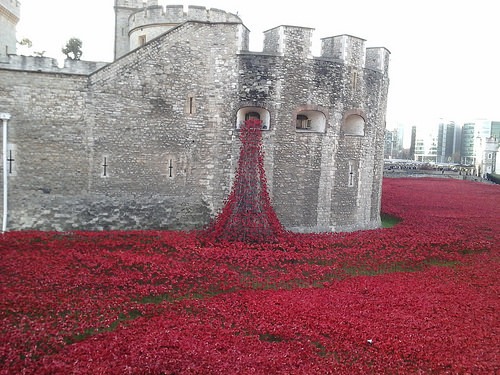
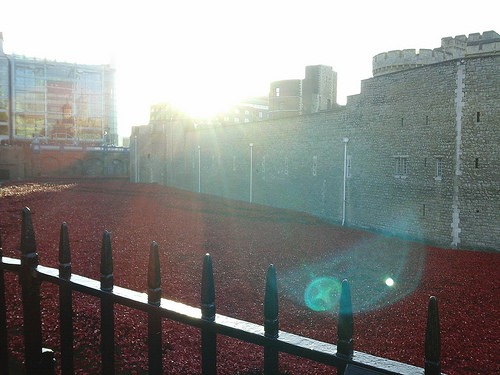
Blood Swept Lands and Seas of Red is the now-famous installation in the Tower of London’s moat. It has been created by ceramic artist Paul Cummins, with setting by stage designer Tom Piper, and consists of 888, 246 ceramic poppies, each of which has been individually hand made, which have been planted in the moat by volunteers over the last couple of months. The first poppy was planted on 17 July and the installation officially opened on 5 August – the date of Britain’s entry into World War I. The last was planted this morning – Armistice Day. The number of poppies is significant – each one represents the death of a British or Commonwealth soldier during the war.

In an attempt to avoid the crowds, I got up super early on Monday morning and headed to the Tower before work. A surprising number of people had had the same idea, though things had apparently much improved from the weekend, when, so my friend told me, there were queues to get down to the walkway and some footpaths had to be closed. Though it was far from quiet, I still managed to get to the front and see everything I wanted to.
Though I had seen many photographs of the installation, pictures are no substitute for seeing it in real life – it makes even more of an impact. Looking at the sea of poppies and knowing that every single one represents a person, each with their own life and with family and friends who were left behind to mourn, is breathtakingly sad.
The installation is beautiful, but I don’t think this detracts from the seriousness of the subject. In many respects it is a very simple idea, but it works wonderfully: the poppy is a well-known symbol of Remembrance Day and is widely associated with the First World War, while the arrangement of poppies “spilling” out of the tower and into the moat represents the blood that was shed by those who died.
There have been criticisms levelled at the installation, notably this Guardian piece by Jonathan Jones. I think it makes some good points – for instance, he asks why we should only memorialise our own dead and not the casualties of all countries, and suggests that the poppy has become a political symbol rather than a focus on the dead of World War I. However, I think it’s understandable that a British commemoration based at the Tower of London would focus on national casualties, just as a village or town might choose to focus on the local dead. In practical terms, the moat is pretty full – there wouldn’t be any room for more poppies to represent the horrendously high number of the dead beyond Britain. I also think that by focusing on a precise number of World War I dead, the installation brings the focus of the poppy back to the 1914-18 conflict.
From today, the installation will slowly begin to be taken down. I highly recommend trying to visit before it goes – it’s an unforgettable experience. However, go early in the morning if you can, to avoid the crowds!
Burning News: recent art from Russia – Hayward Gallery
Burning News: recent art from Russia is an exhibition in the Hayward Gallery‘s Project Space. It actually closed on Sunday, but I managed to pay it a visit before then.
The exhibition consisted of sculpture and photography by Aslan Gaisumov and Tim Parchikov, as well as videos by Evgeny Granilshchikov, Mikhail Maksimov, Sasha Pirogova and Dimitri Venkov. There was an interesting variety of work on show, and I’m not sure it was really my thing (except for the burning of the newspapers), but it was a thought-provoking way to pass some time.
The Big Reunion Boy Band Tour
Another year, another Big Reunion concert, this time the Boy Band Tour. I went to see this at Newcastle Arena with some friends and we had a great time, although sadly the venue was not full.
It was great to see 911, Blue and 5ive again (although 5ive are sadly now down to “3hree”) – 911 in particular were great, and I can’t believe Jimmy and Spike can still handle those dance moves. I was particularly excited about seeing A1, who were not in the last tour. ‘Same Old Brand New You’ is a BRILLIANT pop song and my friend and I have been humming it for a year solid, so it was great to finally see it live.
I wasn’t too bothered about Damage or 3T – the guys seemed lovely and they can certainly sing, but I didn’t recognise any of their songs (except for Damage’s final track) and they were all dull ballads in any case. 5th Story, on the other hand, were a treat – a “supergroup” made up of solo singers and band members, all of who were one- or two-hit wonders and who were brought together for the second series of BR. Kenzie from Blazin’ Squad, Dane Bowers from Another Level, Gareth Gates of Pop Idol fame, singer Kavana, and teen heartthrob Adam Rickitt made up the quintet – the group’s rendition of former Corrie star Adam Rickitt’s hit ‘I Breathe Again’ was a particular highlight. The gig ended with all of the bands coming on stage to sing Gates’ hit, a cover of ‘Spirit in the Sky’, which I always thought was an odd choice (British pop star singing about Jesus?!) but it proved a cheering finish.

Man With a Movie Camera – Barbican Cinema
Shown as part of the City Visions series at the Barbican, Man with a Movie Camera is a 1929 experimental silent film with no story or dialogue, directed by Dziga Vertov and made in the then USSR. This showing was accompanied by Paul Robinson’s HarmonieBand, and preceded by a 3-minute showing of Hungerford: Symphony of a London Bridge, a pilot for a projected London Symphony film.
I went to see this because I am interested in Russia and Russian culture, and I really enjoyed it. The film is full of life and interest, filmed in different Russian towns and including lots of different people. Unusual angles and quirky happenings made it a fascinating watch.
Constructing Worlds: Photography and Architecture in the Modern Age – Barbican Art Gallery
Constructing Worlds: Photography and Architecture in the Modern Age is an exhibition taking place in the Barbican Art Gallery until 11 January 2015. It contains work by eighteen photographers from the 1930s until the present day, such as Berenice Abbott and Hiroshi Sugimoto, and features the work of architects such as Le Corbusier and Frank Lloyd Wright.
I found the sheer variety of the exhibition particularly interesting – the photographs cover many different kinds of buildings in lots of different countries. These include 1930s New York, glamorous Hollywood, South American favelas and modern Chinese riverside buildings. The exhibition is definitely worth seeing, even if you don;t think you are interested in architecture.
Bridge – Museum of London Docklands
Bridge is a free exhibition at the Museum of London Docklands, exploring the history of London’s bridges in art and photography. I loved looking at the black and white Victorian photos, the Sixties images full of miniskirts and retro cars, and the more modern video in which an artist travelled by boat right down the Thames, going under each bridge in turn.
Katy B at the Roundhouse
The other night I went to see singer Katy B at the Roundhouse in north London. I booked my ticket ages ago and I nearly didn’t make it – I’d arranged to meet a friend I hadn’t seen for ages on the same night and had decided to miss the gig, but as it happened our evening ended earlier than I’d anticipated, and I had time to get to Chalk Farm before Katy was on stage at 9.
Now although I do like Katy’s music (or else there wouldn’t have been much point in me booking this show at all), I wasn’t really expecting great things. The ticket was cheap (under £20 for a gig – I’m not used to these prices!) and I thought it might be a nice night out. However, I really enjoyed myself. Katy has a great voice and gave an impressively good performance, singing loads of her hits and really playing to the crowd.
I was also pleasantly surprised by how good the view from my seat was. I got the last ticket remaining, and the seat was in the circle, right at the end. However I could see everything really well and the atmosphere was still great. I also found myself admiring the architecture in the building – the Roundhouse is a former railway shed and many of the original features are still present and visible.

Dylan Thomas in Fitzrovia
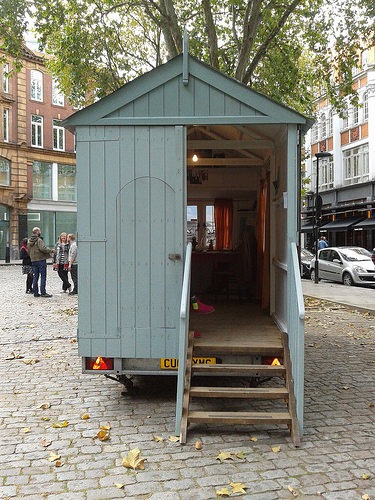
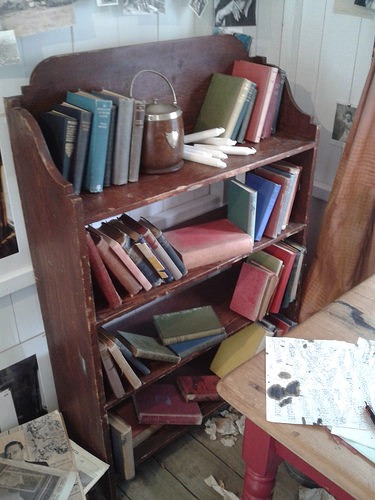
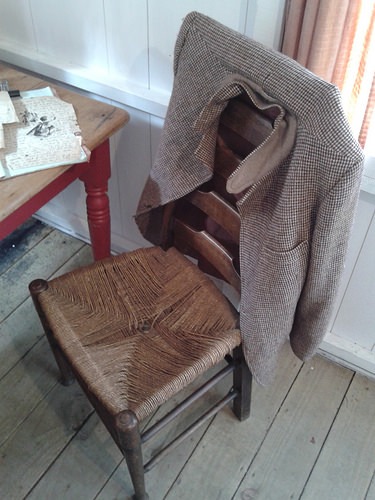
This week has seen the Dylan Thomas in Fitzrovia festival happening in central London, based around the part of Bloomsbury where the writer used to hang out in the middle of the century. Talks, readings and performances have all been taking place, and I have booked to see Clown in the Moon, a performance about Dylan, tomorrow. Yesterday I took advantage of the fact that I work incredibly close to the area where the festival is taking place, and popped out to see Dylan’s writing shed, which is on tour around the country.
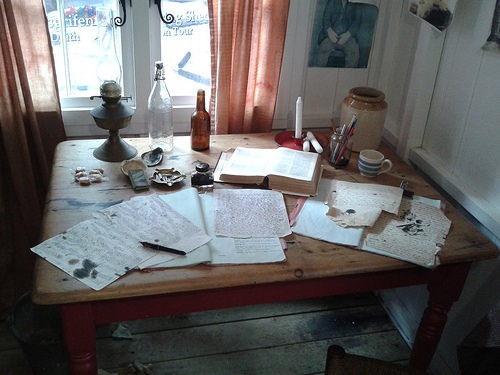
The shed is a near-exact replica (it has been scaled down slightly to allow it to be transported around the country on a trailer) of Thomas’ real writing shed in Laugharne. It is full of bookshelves, papers and other odds and ends, with Dylan’s coat draped over the back of the chair – just as if the poet himself could come inside at any moment.

Tudor World / The Falstaff Experience
The Stratford upon Avon museum known as Tudor World and The Falstaff Experience is an “interactive museum” all about the town where Shakespeare grew up. It explores life in the Tudor era and looks at where Will may have got some of his inspiration. I popped in last time I was in Stratford to pass some time in between seeing some plays.
The museum is hosted in a Grade 2 listed building on Sheep Street, in the centre of the town. Known as the Shrieve’s House and Barn, it is the oldest lived-in house in Stratford, and used to be home to an inn run by William Rogers who was supposedly the inspiration for Shakespeare’s Falstaff.


Tudor World is great fun and very child-friendly, with plenty of grim and gruesome exhibits and a “guide” in the form of a young pickpocket who pops up on information boards as you go around. The museum contains a lot of wax figures and other props which I found pretty atmospheric and creepy. There are even “smell-boxes” that let you smell what the deck of a ship or the inside of a pub would have been like! The “Falstaff Experience” part of the museum is a room with a very detailed inn replicated: it is possible that Shakespeare visited the inn and gained inspiration for his character of Falstaff.
As well as being open every day of the week (except Christmas Day) between 10.30 and 5.30, the museum is often open in the evening for ghost tours or ghost hunts (including overnight ones). Occasionally plays are performed in the Courtyard. Admission costs £5.50 for adults and £3 for children, with a family ticket and discounts for concessions available. Well worth a visit on a rainy day, with or without children.