The Lost Prince: The Life & Death of Henry Stuart – National Portrait Gallery

As the National Portrait Gallery is open late on Thursdays and Fridays, I sometimes like to walk down after work to have a wander around. On Friday night I decided to pay a visit – although I took the tube to Leicester Square, as it was pouring down.

My plan was to see the new exhibition The Lost Prince: The Life & Death of Henry Stuart. As someone with a strong interest in history, and who has studied the period immediately preceding the Stuart accession (the Elizabethan era), I was very excited about this.

Henry (1594-1612) was the elder son of James VI of Scotland and I of England, who succeeded to the English throne on the death of Elizabeth I in 1603. Elizabeth had reigned for so long that the last time an entire family inhabited the royal household was beyond living memory. As the eldest, Henry was the heir to the throne and the hopes and dreams of the nation were invested in him: his princely nature, air of nobility, youth and exuberance promised a positive future.

The exhibition displays portraits of Henry, his royal parents and siblings, as well as those around him responsible for teaching, caring for or advising him. The pictures give some indication of the personality of the royal Prince, as well as the impression he and his advisers wished to convey. Miniatures by Nicholas Hilliard and  Isaac Oliver and full-size portraits by Robert Peake show Henry wearing armour, demonstrating the noble values of bravery and chivalry, or handsome, richly costumed and showcasing his extensive collections of jewels and other riches. Henry and his court helped to inspire a renaissance in the arts, and some of the items he collected are on display.

By modern standards I am not sure if Henry was the most likeable person. It was reported in the exhibition that when Henry received a gift of a number of brass statuettes, he was asked if he would like to give one of them – a horse, on display here – to his little brother Charles. Henry’s response was to say no: he wanted to keep them all for himself!

Perhaps it is unfair of me to condemn this attitude: the Prince of Wales, as he was created in 1610, had to bear the weight of a nation’s expectations and this was a lot to take for one so young. Some of the earlier portraits show the young boy dressed in lavish royal costumes that seem to swamp him. This is echoed in the two small suits of armour belonging to the Prince which are on display, worn by him during lavish court tournaments and masques.

Though clever, Henry apparently did not enjoy book-learning to the same extent as his younger brother. Some of his school books are displayed here, one of which in particular made me smile: one of his tutors wrote a couple of sentences below his own writing which are very disparaging towards Henry’s handwriting skills! However, the Prince possessed an extensive library and a number of works of art – many of which are now scattered all over the world in the hands of public galleries and private collectors – and he was interested in gardens, authorising a lavish project to redevelop the gardens of Richmond Palace, though he sadly died before the work could take place.

The final room of the exhibition explores Henry’s death and the reactions it provoked among his family, the nobility and the rest of the country. While helping to prepare for his sister Margaret’s wedding, Henry caught a fever (now thought to be typhoid fever) and, despite the best efforts of several doctors, died a few weeks later. His family and the nation were distraught: writers and composers registered their sorrow in poetry and music; printed books had pages with black borders and one of the dirges composed on his death is playing in the room. A portrait of Queen Anne, Henry’s mother, is displayed and shows her wearing black clothes for mourning: I found this interesting as I had thought the fashion for wearing black for mourning only came in with Queen Victoria.

At Henry’s funeral, weeping crowds lined the streets and the effigy on top of the hearse was reportedly so lifelike that it provoked fresh storms of grief. What remains of this effigy – namely the wooden torso and limbs, the wax head and hands having been stolen or rotted away years ago – is on display in this room, looking poignantly small in the plain glass case.

Charles Stuart was devastated by his brother’s death and treasured his memory all his life. During his reign as Charles I he commissioned an enlargement of a miniature of Henry which hung in his rooms at Whitehall, and is now on display here, the final portrait of a Prince who was never to fulfill his potential.

The exhibition got me thinking about how the course of history can change. What if Henry hadn’t died? He would have become King Henry IX, and the events which resulted in the English Civil War might never have happened – although, given Henry’s somewhat imperious personality, this is not certain. His life and death reminded me of another, very similar situation a hundred years before: the premature death of Arthur, eldest son of Henry VII. Named for the legendary English king, hopes and expectations surrounded young Arthur as they would encircle Henry a century later, but Arthur’s premature death ended them, paving the way for his younger brother Henry to inherit the throne. In both cases, the death of the much loved and admired heir led to the accession of a ruler who would change the course of English history – albeit more successfully in Henry VIII’s case, at least for him.

I definitely recommend this exhibition to anyone with an interest in Stuart England, seventeenth-century art and the history of royalty in Britain. The curators have chosen their objects well and they are presented with thought and care. Unlike some exhibitions and galleries, which contain an overwhelming number of items, this exhibition at the National Portrait Gallery takes the ‘less is more’ approach, meaning that you can examine each individual item in more detail, finding out more about it.

Osterley Park and House

2012-10-14-14-33-13

Last year, I visited Osterley Park which is situated in between Ealing and Heathrow Airport in south-west London. At the time of my visit, the Long Gallery in the house was closed for filming purposes. I asked one of the volunteers what was going on, and she said that it was top secret – not even they were allowed to know. All she could tell me was that it was a major production.

I got on with my life and thought no more of it, until earlier this year when I found out what the production was – no less than the new Batman film, The Dark Knight Rises! The Long Gallery, main staircase and a number of other rooms stood in for various rooms in Wayne Manor, while the Library served as the entrance to the Batcave via a door in one corner disguised as part of the bookcase.

The National Trust are capitalising on this and have put on an exhibition (Real to Reel) about filming at Osterley over the last half-century. The house’s location inside the M25 and within easy reach of central London, Heathrow Airport and Ealing Studios has made it the ideal location for filming and it has appeared in many productions including The Grass is Greener, BBC titles and – I’m sure – the recent BBC production of Parade’s End (it wasn’t mentioned in the exhibition but I could swear I recognised the entrance hall masquerading as a hospital!).

The house itself has a long and distinguished history, described by Horace Walpole as ‘the palace of palaces’. Robert Adam, architect and designer, created the house in the late eighteenth century for the Child family. Today, the house is presented as it would have been in the 1780s, and it is very beautiful, with gorgeous furniture and impressive artworks.

I enjoyed the exhibition, as well as my visit to the house, and was glad to be able to see the Long Gallery for the first time. Osterley Park is aptly named as the grounds are vast and beautiful, ideal for talking a walk on a crisp autumn day.

FACTS

Address: Jersey Road, Isleworth, Middlesex, TW7 4RB

Website: nationaltrust.org.uk/osterley-park

Opening Hours: Wed-Sun 11am-5pm during the summer (house), extended opening times for the park. Check the website for winter opening times.

Prices: £11 adults, £5.50 children (house); National Trust members free.

Cecil Beaton: Theatre of War – Imperial War Museum

At the weekend I paid a visit to the Imperial War Museum, again using my trusty National Art Pass to visit the exhibition of photography, Cecil Beaton: Theatre of War. As I mentioned in a previous blog post, I was responsible for cataloguing Beaton’s letters in a previous job, so am always interested in taking a look at his work.

Beaton is most famous for his society photographs and his work designing costumes and sets for films such as My Fair Lady, but he also acted as an official war photographer during the Second World War. His appointment by the Ministry of Information came at an opportune time, as his career was foundering after an ill-advised anti-Semitic cartoon published in New York. Beaton’s wartime work helped to restore his reputation and became, according to him, his most important body of work.

The exhibition was bookended by displays examining his work before and after the war. Early in his career, he photographed society figures such as the Sitwells and moved in exalted circles. After the war, his reputation established, he was able to rely less on photography as his career as a set and costume designer for theatre and film productions took off. However, he still remained a popular and cutting-edge photographer, taking pictures of Twiggy and Mick Jagger towards the end of his career.

During the war, Beaton’s photographic lens reached from  Blitz-torn London and the Tyneside dockyards to as far away as India, the Middle East, Burma and China. His photographs still have the slightly posed, theatrical quality of his society pictures, but exported to a war setting. This makes for a series of photographs that are immensely different from any other war pictures that I have seen. RAF pilots being debriefed after a bombing raid; London’s churches lying in ruins; soldiers relaxing off-duty in Burma – the pictures are a record of life at the time, but also have considerable artistic merit. They also made a clear contribution to the war effort: Beaton’s picture of three-year-old Eileen Dunne, sitting up in her hospital bed after being bombed out of her London home, appeared on the cover of Time magazine in America and, by evoking the sympathy of the American people, influenced their entry into the war. I wish I could show some of his photographs here, but they are all under copyright; however, if you search Google Images for ‘Cecil Beaton’, you will be able to find many of his pictures. Alternatively you can click here to view some of his war images on the Guardian website.

Complementing the exhibition were displays of magazines to which Beaton contributed, as well as some of his diaries and letters relating to his photographic assignments. I was pleased and proud to see that some of the letters on display were the very same letters that I catalogued three years ago.

POP! Design Culture Fashion – Fashion & Textile Museum

I have a National Art Pass, which means I get discounted or free entry to lots of museums and galleries in and around London. I also make the most of the handy website, http://www.artfund.org/, which lists all the places at which you can get a discount, in order to plan where to go next. The website was the place I learned about the Fashion & Textile Museum in Bermondsey, south London. It is a small museum and only open when there is an exhibition on, which is probably why I’d never come across it before.

2012 1013 Fashiontextilemuseum 01

Museum entrance on Bermondsey Street

I visited the museum on Saturday and only paid £3.50 to get in with my Art Pass. One of the first things I saw when I entered the museum was this utterly stunning Dior dress. It looks like something that would have been worn by Grace Kelly.

2012 1013 Fashiontextilemuseum 02

The current exhibition is entitled POP! Design Culture Fashion, and explores the impact of music and art on fashion in the fifties, sixties and seventies. It begins with the rock n’ roll culture of the 1950s, the world of Elvis Presley and circle skirts. This was the era that appealed to me the most; I was lusting after several of the items on display.

2012 1013 Fashiontextilemuseum 03

I loved this circle skirt

The exhibition then moved on to look at ‘Swinging London’ and the mods and rockers culture, with displays of Mary Quant fashion and the short dresses of the time. These clothes didn’t appeal to me so much (I don’t have the figure for a minidress) but I liked this monochrome maxi:

2012 1013 Fashiontextilemuseum 04

Subsequently, the exhibition examined the hippy styles of the late sixties and seventies, with bright colours and dramatic accessories. There was something of a Fifties revival around this time, and this dress in particular caught my eye.

2012 1013 Fashiontextilemuseum 05

Finally, POP explored the punk era, with clothing designed by Vivienne Westwood and worn by the punk rockers of the day. These clothes weren’t particularly to my taste, but I could imagine the dramatic impact they would have had at the time.

Alongside the outfits, accessories and other items from the relevant periods were shown to further illustrate the styles of the times. A Fifties jukebox, a clothes hanger with Jimi Hendrix’s face on it and an original still from the Beatles’ movie Yellow Submarine were just some of the articles on display, along with several household items. My favourites were a set of three cushions which together made an Edwardian-inspired, Mucha-esque picture of a woman.

POP! Design Culture Fashion is on until the 27th of October. The museum is open Tuesday to Saturday, 11am – 6pm. The next exhibition, which opens on 16 November and runs until 23 February 2013, is about London fashion by designers to the Queen and is called Hartnell to Amies: Couture by Royal Appointment.

FACTS

Address: 83 Bermondsey Street, London, SE1 3XF

Website: ftmlondon.org

Opening Hours: Open Tuesdays to Saturdays, 11am–6pm; Sundays, 11am-5pm; late night Thursdays until 8pm.

Prices: Approx. £8-£9 adults, £7-£8 concessions; under 12s free

Harrow Old Speech Room Gallery and Museum

Harrow School is one of the most famous schools in the UK, and possibly the world. Its alumni include several writers, artists, politicians and even actors – the lovely Benedict Cumberbatch is an Old Harrovian.

The school has an art gallery and museum – the Old Speech Room Gallery – which is open to the public, though only on certain days of the week during term time. I took the opportunity to visit when I had a day off work.

The Old Speech Room was built in 1819-21 as a chamber in which to encourage public speaking. It was converted into a gallery by Alan Irvine in 1976 as a repository for the School’s distinguished collection of antiquities and fine art.

The main reason I wanted to visit at this particular time was the Cecil Beaton exhibition. Beaton was a photographer and artists who was popular in the mid-20th century. He photographed film stars such as Audrey Hepburn and Marilyn Monroe and also gained prominence as a war photographer. In my old job at Cambridge I was responsible for cataloguing his letters, so I was interested to see this exhibition of his portrait photographs. I really like his work – I’m no photographer but I can tell that his use of light and composition is brilliant.

The gallery has an interesting collection of Egyptian and Greek antiquities, and also contains artworks, including a painting by the former Prime Minister Winston Churchill. What I was most excited about, however, was the exhibition of artefacts relating to Lord Byron, including his swords and other possessions. Some of his letters were on display, and I spent a while trying to decipher his handwriting, which is surprisingly readable considering the time at which it was written. I’ve read Byron’s collected letters – they are fabulously lively and engaging, and his personality leaps off the page with every sentence. Seeing the pieces of paper on which he actually wrote was amazing.

The gallery is a bit out of the way, and the opening times aren’t always ideal, but it’s well worth visiting if you can – there’s a surprising amount to see, and it’s very interesting, not to mention free.

FACTS

Address: Harrow School, 5 High Street, Harrow on the Hill, Middlesex, HA1 3HP

Website: harrowschool.org.uk/1574/public-facilities/visit-the-old-speech-room-gallery

Opening Hours: Weekdays during term time between 2.30pm and 5.00pm.

Prices: Free

Buckingham Palace

Buckingham Palace

I paid my first visit to Buckingham Palace in 2011, but for some reason never published my thoughts until now. The Palace is probably one of London’s most famous visitor attractions and is hugely popular with tourists. The State Rooms are open for visitors during the summer months only, and any ticket you buy is valid for a year provided you get it stamped before leaving. It is recommended that you buy your ticket online before you go as it does get very busy.

The entrance to the Palace is on Buckingham Palace Road, just past the entrance to the Queen’s Gallery if you are coming up from Victoria Station. After queuing to buy/collect your tickets, you pass through security, but this isn’t too much of a hassle as every single member of staff is really friendly.

Originally known as Buckingham House, the building became a palace in the early nineteenth century when King George IV decided to modify and improve it. The work was concluded by his brother William IV, but it wasn’t until Victoria came to the throne in 1837 that Buckingham Palace became the official residence of the monarchy.

During Victoria’s reign, further building work was carried out: the new East Wing, now the “front” of the Palace, was built to close off the quadrangle, and the façade was given an overhaul in 1913. Today, Buckingham Palace has over 800 rooms, and 240 bedrooms for the Royal Family and their live-in staff. It is still the home of the Queen, but is owned by the state and paid for by the Government, helped by the income from visitors each summer since 1993, when it was first opened to help pay for the rebuilding of the fire-damaged Windsor Castle. As well as acting as a Royal residence, the Palace hosts numerous state and diplomatic functions, and the “Changing of the Guard” takes place each day just outside.

Once inside the Palace, it’s best to use the audio guide to help you get around, as it is packed with interesting information about what you are seeing. The State Rooms are very impressive, with gorgeous gilt decorations and incredible artwork. The Picture Gallery in particular has paintings by Vermeer, Rembrandt and Rubens. I liked seeing the Throne Room, familiar from official pictures of the Royal Family, and the back of the famous balcony.

The Royal Wedding was the theme when I visited, and there were some interesting exhibits about William and Kate’s nuptials. The highlight for me was Kate’s wedding dress, designed by Sarah Burton for Alexander McQueen. Close-up, it was possible to appreciate the detail and thought that had gone into creating the dress.

After exiting the house, you walk through the garden with impressive views of the back of the Palace. You leave the grounds via the gift shop, which has plenty of tasteful and not-so-tasteful Royal-themed memorabilia.

It’s expensive, but a visit to Buckingham Palace is worthwhile, and if you live in London it’s good to make the effort at least once. Even better, get your ticket stamped and go back the following year for free.

FACTS

Address: London, SW1A 1AA

Website: royalcollection.org.uk/visit/the-state-rooms-buckingham-palace

Opening Hours: Approx. 9.30am-7.30pm during summer opening

Prices: £20.50 Adult,, £18.80 Concession, £11.80 Child; under 5s free; combined “Royal Day Out” ticket available

Southwark Cathedral

I’ve wanted to visit Southwark Cathedral for quite a while, and finally got my chance the other week. I was hanging around the London Bridge area one Sunday waiting until the right time to take the train to New Cross (I was going to the theatre) and decided to pop in.

2012 0916 Southwarkcathedral 43

Southwark Cathedral

Southwark Cathedral has a long and distinguished history. There has been a church on this site since (probably) the first millennium, and it is recorded that it was refounded as a priory in 1106. Parts of the current building date from this time, although the church was restored in the 19th century and new extensions were added in 2000. The church became a cathedral in 1905 on the creation of the area’s diocese.

2012 0916 Southwarkcathedral 40

Plaque at Southwark Cathedral

While the building itself is worthy of a visit, there are other aspects of the cathedral which mark it out. It was probably Shakespeare’s place of worship, as he lived and worked nearby, and is in fact the burial place of one of his brothers. It also contains the tomb of Bishop Lancelot Andrewes, one of the translators of the King James Bible, and the founder of Harvard University was baptised here in 1607. Of particular interest to me was the tomb of John Gower, Poet Laureate to King Richard II and King Henry IV, and author of the Confessio Amantis, of which a manuscript exists in my old workplace in Cambridge (hence my interest). You can see the title of the book engraved on the volume carved in his tomb effigy.

2012 0916 Southwarkcathedral 27

Tomb of John Gower

It is requested that £4 is donated to the cathedral to contribute towards its upkeep, which I was happy to pay. Even without the noteworthy individuals associated with the place, the cathedral is still a stunning building that is well worth a visit.

2012 0916 Southwarkcathedral 34

Ceiling of the cathedral

Saatchi Gallery

I had a bit of time left on Saturday morning and decided to pay a visit to the Saatchi Gallery, which is fairly close to Buckingham Palace. I’m not the greatest fan of modern art, and I must confess that one of the main reasons I went was so that I would have an excuse to tick Sloane Square station off my list.

Founded in 1985 by advertising behemoth Charles Saatchi in order to display his collection of contemporary art, the Gallery occupied several premises before finally settling in the Duke of York HQ building on King’s Road, Chelsea with an exhibition dedicated to new art from China. It has been there since 2008, and Saatchi gifted the Gallery and more than 200 works to the state in 2010. The Gallery aims “to provide an innovative forum for contemporary art”.

2012 0915 Saatchigallery

Entrance to the Saatchi Gallery

The Saatchi Gallery is pretty famous for holding regularly changing exhibitions of modern art, and the current exhibition is called Korean Eye 2012. Having been to Korea before, I was interested in seeing what Korean art was all about and this curiosity partially overcame my aversion to modern art, which I don’t understand and rarely like.

Many pieces displayed as part of the exhibition were odd to say the least. The first exhibits I came across were the apparent result of smashing up a pile of crockery and sticking it back together to produce something resembling a termite nest. A giant ball of wood dominated one room. I came across some pictures which appeared fairly normal until I walked past them and realised they were hologram pictures: the stylishly clad ladies viewing works of art miraculously appeared to shed their clothes when viewed from a different angle. This technique is undoubtedly clever, but also a bit voyeuristic.

Still, the display exceeded my expectations and I was genuinely impressed by some of the work. In one room I came across a round side table on which rested a cup of tea. Initially scornful, I peered at it more closely and observed a little whirlpool disturbing the surface of the tea. The exhibit was accurately titled ‘Storm in a Teacup’ and I really liked it, partly because I genuinely don’t know how the whirlpool got in there.

Another artist had produced models from cardboard, which were well designed and carefully put together, except for the fact that they were unfinished. A cardboard dog with perfectly constructed and finished hind legs and an abstract box-shaped head was particularly eerie. In another room, photographs of women posing in white dresses took on a life of their own with the addition of white fabric attached to the bottom of the frames, extending the dresses beyond the boundaries of the photographs and adding an extra dimension to the work.

In addition to the Korean art on show, there was an exhibition of chess sets, each the work of a different artist. There were some pretty unusual sets on display: I especially liked the ‘picnic’ set with slices of pizza as pawns. There was also a great set with one team made up of characters like Superman, WonderWoman and Jesus and the other consisting of such figures as Voldemort, Dracula and Saruman.

The Saatchi Gallery itself is well laid out with a clean white design and logically labelled exhibition rooms. It is free to enter and doesn’t have the pretentious atmosphere I had expected: there were all kinds of people there, including Korean (I presumed) holidaymakers and families with small children. I never thought I’d say this about a modern art gallery, but I actually quite enjoyed my visit, and I’d consider going back.

FACTS

Address: Duke of York’s HQ, King’s Road, London, SW3 4RY

Website: saatchigallery.com

Opening Hours: 10am-6pm 7 days a week

Prices: Free

Diamonds: A Jubilee Celebration – Buckingham Palace

As the summer opening of Buckingham Palace is drawing to an end, I decided to pay a visit and make the most of my ticket from last year (I visited in 2011 as I wanted to see Kate’s wedding dress, and your ticket is valid for a year after purchase). To celebrate the Diamond Jubilee, there is an exhibition of diamonds at the Palace and I wanted to see this. After all, diamonds are a girl’s best friend.

Diamonds are a girl's best friend

There was some beautiful jewellery on display, some of it from the time of Queen Victoria, and I liked seeing paintings and photographs of kings and queens wearing the items displayed. Sword hilts, crowns and tiaras were among the pieces shown, and sparkled beautifully in the low-lit room.  I liked the Coronation Earrings and Necklace from 1858, so called because Queen Elizabeth II wore them on her coronation day. The exhibition also displayed seven of the nine major stones cut from the Cullinan Diamond (the other two are part of the Crown Jewels). This famous diamond – the largest ever found – was discovered in South Africa in 1905 and named after the chairman of the mining company which owned the mine in which it was found. It was formally presented to King Edward VII in 1907. Too big to be much use, it was cut up into a number of stones. I also loved the diamond crown made for Queen Victoria in 1870: it was so small and delicate.

Queen Victoria's Small Diamond Crown

I walked through the grounds afterwards; it was a beautiful autumn day, sunny but with a refreshing nip in the air. It was so early that the streets weren’t particularly busy. It was almost worth setting my alarm for seven thirty.

2012 0915 Buckinghampalace

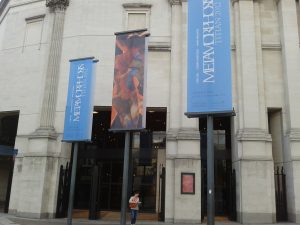
Metamorphosis: Titian 2012 – National Gallery

2012-09-14-18-07-45

A sunny autumn afternoon; the perfect time to take advantage of the National Gallery’s late night Friday opening and check out the small exhibition Metamorphosis: Titian 2012 in the Sainsbury Wing. Basically, three Titian paintings –  Diana and Actaeon, The Death of Actaeon and the recently acquired Diana and Callisto – have been displayed alongside modern ‘responses’ to them.  Chris Ofili, Conrad Shawcross and Mark Wallinger have created pieces of art inspired by the paintings, with varied results. I wasn’t sure what to make of the metal crane, and the costumes were rather odd, but I liked the sets (works inspired by the paintings were performed at the Royal Ballet). I’m not the biggest fan of modern art, but I enjoyed the original Titian paintings.