Alphonse Mucha: In Quest of Beauty – Walker Art Gallery

Walker Art Gallery

I know in London we’re spoilt for choice when it comes to exhibitions but I still get cross when one that I want to see doesn’t make it to the capital. A case in point is Alphonse Mucha: In Quest of Beauty, which stopped at Bournemouth, Norwich and Glasgow before finally ending up at the Walker Art Gallery in Liverpool. Mucha is my favourite artist, so there was no question of me missing out. To Liverpool I would have to go.

One coach trip later, and I was at the gallery in time for its opening at ten.

Exhibition entrance

The exhibition explored how “Mucha’s idea of beauty influenced his work. Mucha believed that beauty was the essence of art and was achieved by striking a balance between the internal, spiritual world and the external, material world. This principle informed his entire oeuvre, from his Art Nouveau posters and commercial works to his later works on the history of the Czech and Slavonic people.” [Mucha Foundation]

The exhibition contained posters, sketches and artefacts relating to Mucha and his career, which came to define Art Nouveau and the fin de siècle. It began with some examples of posters he designed for the actress Sarah Bernhardt (their friendship and artistic partnership lasted many years), including the earliest, Gismonda, followed by Hamlet and La Dame Aux Camélias (one of my earliest memories of Mucha’s work is a mirror with this poster on top displayed on the landing in my childhood home).

Examples of Mucha’s advertising posters follow: some of the earliest examples of the use of art in advertising. Most of the posters include familiar Mucha tropes: the stylised women, the long flowing hair, the ‘halo’ and the use of motifs from nature. Later Mucha created designs without a particular advertising focus: the seasons, the muses, the flowers. He also began to work on his Slav Epic, a work dedicated to his homeland which was seeking independence (and gained it in 1918).

It was incredible being able to see some of these original posters on display, especially bearing in mind that they were not designed to last: they were temporary adverts only, but their impact has endured. I was also fascinated by the photographs of Mucha in his studio, surrounded by his work.

This is a fairly small exhibition, and perhaps not worth travelling from London and back in a day unless you’re a really big fan. I absolutely love Mucha, though, and for me it was totally worth it to see these beautiful designs.

Harry Potter: A History Of Magic – British Library

I booked my exhibition ticket for Harry Potter: A History of Magic back in April, and it’s just as well, as many dates for this groundbreaking exhibition are already sold out. It’s the first British Library exhibition to focus on the work of a living author, and I couldn’t imagine a better subject. The exhibition will fascinate any Harry Potter fan, but there’s much here to interest those who have never read a word about the famous boy wizard.

J.K. Rowling took inspiration from myths, legends and history to write about the magic in her books, and the exhibition looks at how magic as it has been seen in our world helped to inspire her. It’s divided up into sections based on the subjects Harry studies at Hogwarts: Potions, Divination, Charms, Care of Magical Creatures, and so on, and there is also a section on alchemy, relating to the Philosopher’s Stone which is so important in the first book.

We see many rare books and historical artefacts: the Ripley Scroll, purporting to explain how to make the philosopher’s stone, alongside Nicholas Flamel’s gravestone (apparently discovered being used as a chopping board in Paris). The Potions section has rare books describing the various potions and their antidotes – there is also a bezoar displayed – and Herbology displays a copy of Culpeper’s Herbal, of which Rowling had her own copy that she used to refer to when writing the books. We see a cauldron and a broomstick from the Museum of Witchcraft in Boscastle, and possibly my favourite exhibit of all: the ‘Invisibility Cloak’.

Throughout the exhibition, illustrations by Jim Kay bring the characters to life, and we also see sketches by Rowling, which are fascinating as they show the characters as she originally imagined them. My favourite parts were the handwritten or typed early drafts of various chapters, showing the Harry Potter stories as they might have existed, and offering insights into how Rowling changed and adapted her stories.

I loved this exhibition – it runs until February, so there’s plenty of time to see it, but I definitely recommend booking in advance.

Scythians: Warriors of Ancient Siberia – British Museum

This exhibition at the British Museum intrigued me: I’d never heard of the Scythians, but I’ve always been interested in Siberia. Scythians: Warriors of Ancient Siberia is a co-exhibition with the Hermitage Museum, St Petersburg, and many of the artefacts in the exhibition are on loan from that museum.

The Scythians were a nomadic group of tribes who endured for about 600 years, around 600BC, herding cattle and goats on the steppe, and the exhibition sheds light on their lives and culture. There is an abundance of beautiful jewellery, including belt buckles and neck ornaments depicting scenes mixing real animals with mythical ones which, experts have theorised, point to their religion and culture. Their warrior culture is alluded to by the prevalence of helmets and head ornaments, hugely elaborate and detailed. The Scythians spanned southern Siberia from west to east and evidence suggests they had contact with other groups from Africa, Europe and China. For several centuries, the only record of the Scythians came from the writings of Herodotus, who travelled in the area around 440BC. Many of these artefacts were later dug up by archaeologists sponsored by Peter the Great, who ordered them to be sent to St Petersburg for his new museum. As a result, they are well organised and well-catalogued, and some of the original eighteenth-century drawings of the ornaments are on display beside the originals. On the walls of the exhibition are quotations from contemporaries, including Herodotus, about the Scythians: their fearsomeness in battle, their wild drinking. As the Scythians themselves did not have a written culture, these ornaments and other excavated artefacts take on an even greater significance.

What really took my breath away were the wonderfully preserved things that by rights should have disintegrated long ago, saved by their preservation in Siberia’s permafrost. These include fleeces, squirrel fur coats, even a pair of boots, as well as the tattooed skin of a Scythian warrior on which the marks still show up clearly. A giant coffin, constructed of wood, looks as though it was built yesterday, and one bag, containing food to accompany a deceased chief to the afterlife, has yielded lumps of preserved cheese.

Most of the artefacts on display are from wealthier people, which is not surprising since these are more likely to have been preserved. However, there are some objects relating to more ordinary Scythians, including weapons, ornaments and cooking equipment. Several preserved heads have been found, enabling scientists to try and reconstruct the face of a Scythian.

What could have been another run-of-the-mill exhibition about an ancient people is brought to vivid life by the beauty of the incredibly well-preserved objects on display. I was fascinated by it and loved learning more about this ancient society.

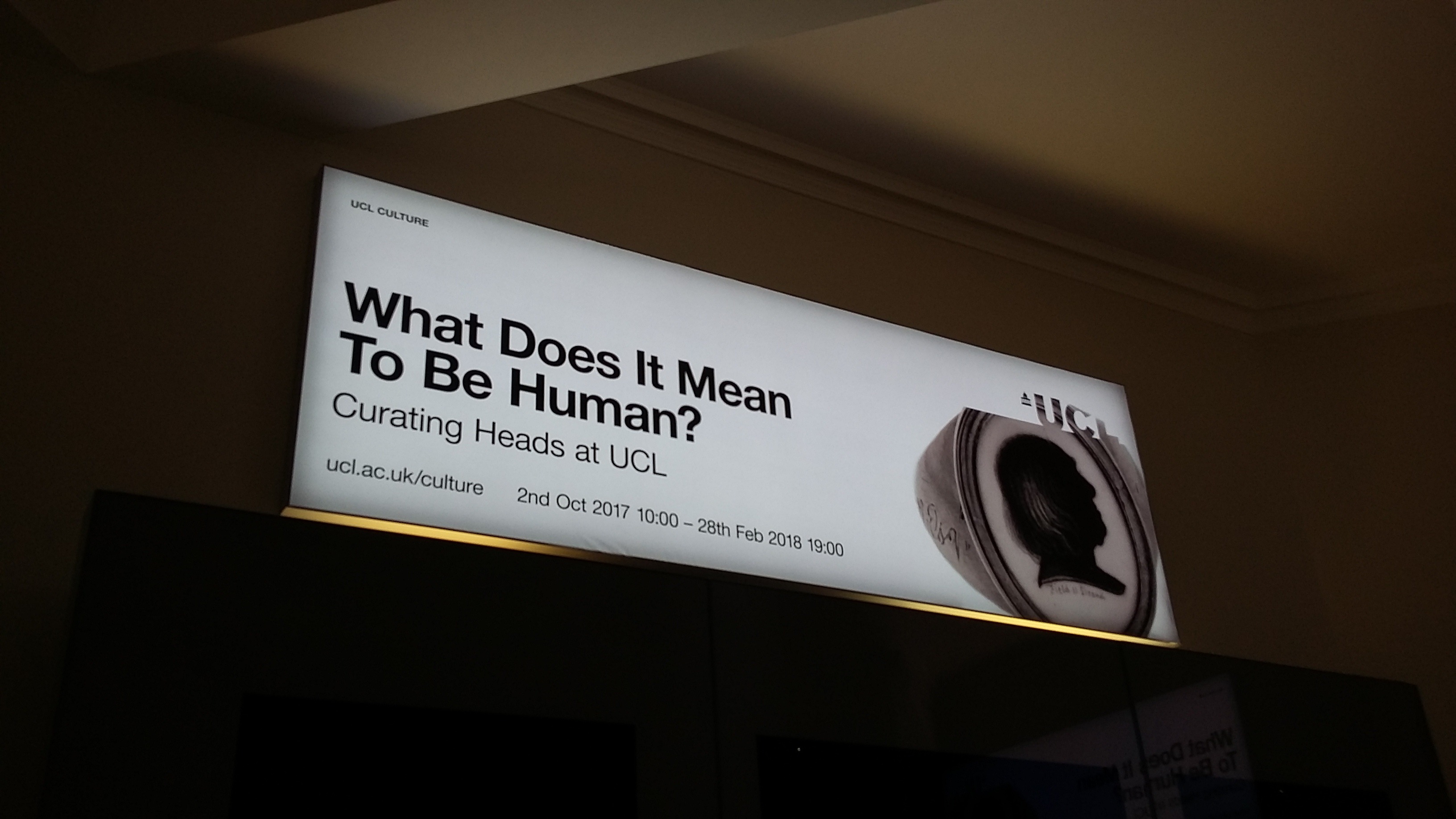
What Does It Mean To Be Human? Curating Heads at UCL – Octagon Gallery, University College London

I read about What Does It Mean To Be Human? Curating Heads at UCL online and went to check it out after work; it’s a tiny exhibition, covering the walls in the Octagon space within UCL’s Wilkins Building (entrance via Gower Street).

For several decades, the preserved heads of Jeremy Bentham and Flinders Petrie – two intellectuals related to UCL – have been hidden from view. Following on from a project to extract their DNA, this exhibition asks: what does the scientific interrogation of our dead bodies tell us about how we think about ourselves?

There are four cases: one concerning the archaeologist Flinders Petrie, one on cultural views on death and commemoration, one focusing on Jeremy Bentham, and the last case focused on DNA sequencing.

It’s a rather brief exhibition, but worth glancing at if you’re in the area.

I didn’t take any pictures of the preserved heads, feeling that this would somehow be inappropriate. I did, however, walk down the corridor and take a picture of Jeremy Bentham’s auto-icon. (Yes, that is his actual, preserved body; the head, however, is wax).

Bentham auto-icon

Opera: Passion, Power and Politics – V&A

As soon as I found out about the Opera: Passion, Power and Politics exhibition at the V&A I knew I wanted to go. So did my auntie, who loves opera, so I booked tickets for her visit in October – not long after the exhibition opened in the new Sainsbury Wing.

Rather than covering every single thing to do with the history of opera, the exhibition organisers have selected seven key dates and places in the history of this comparatively modern art form, and used them as pegs on which to hang a broad history of opera.

Venice 1642
Venice is traditionally regarded as the home of opera. During the seventeenth century, the importance of the city in international trade was in decline, but it was still a key centre for culture. With no Royal Court and a relatively lax attitude, the new art form was able to grow. The key work of this section was Claude Monteverdi’s L’incoronazione Di Poppea, the first public opera (I’ve seen his earlier L’Orfeo, but that was privately performed). It was based on historical events.

London 1711
By this time London was important on the world stage, having recently been rebuilt after the Great Fire of 1666. In 1689, Henry Purcell composed Dido and Aeneas, while Handel later wrote Rinaldo. A theatre opened in the Haymarket, specifically showing opera, though this blatant display of Italian influences on the English stage did not impress many critics. The Royal Opera House in Covent Garden opened in 1732.

Vienna 1786
Like the other cities, Vienna was enjoying a golden era of creativity during this period, when Mozart penned Le Nozze di Figaro. His opera was revolutionary in the sense that it brought servants to the fore.

Milan 1842
The opera house La Scala opened in Milan around this time, when Verdi composed Nabucco. Based on a biblical story, it nevertheless struck a chord with many Italians who sought to see their country united (which happened in 1861). ‘Va, pensiero’ became an unofficial Italian anthem and is still sung as such today.

Paris 1861
It seems to be a pattern that the upsurgence of opera in a particular city leads to the building of a new opera house: this did happen in Paris. This section focused on Wagner and his revolutionary opera Tannhauser. Wagner believed in the idea of opera as total work of art, and wrote all his libretti himself. He believed that the music should form one continuous melody, rather than being made up of separate arias and works.

Dresden 1905
This period is exemplified by Richard Strauss’ Salome, a one-act opera inspired by Oscar Wilde’s play. It tapped into contemporary ideas around the changing role of women.

Leningrad 1934
Shostakovich’s Lady Macbeth of Mtsensk shocked contemporary audiences with its depiction of female sexuality. At first acclaimed as a composer for ordinary people, Shostakovich was later accused of anti-Soviet behaviour, and Lady Macbeth was banned. 1934 was an important year in Russia because it marked the end of artistic freedom and the imposition of Socialist Realism.

The exhibition ends with a ‘world’ section in which you can see video clips from all over the world.

The exhibition has some fascinating artefacts on display: tableware used by Venetian nobility, busts of notable composers, original drawings by Aubrey Beardsley, Soviet posters advertising Shostakovich’s work. I would have liked to see more costumes, but the ones they had were impressive, including a dress covered in stars. There was a beautiful selection of items that would have been worn by fashionable Parisian opera goers, including a lace mantilla, opera glasses, and a collapsible top hat for the gentleman opera goer.

The exhibition does miss quite a bit out: I was sorry not to see more about my own favourite, Puccini. However, with such a big subject to cover, it does do a good job of exploring the history in an accessible way without overwhelming with information.

House of MinaLima

House of MinaLima

House of MinaLima in Soho is a must-see for Harry Potter fans. MinaLima, the company that designed the graphic props for the Harry Potter films as well as the recent Fantastic Beasts movie, have displayed examples of their work. You don’t have to buy anything – it’s still worth a visit just to look at the incredible designs.

House of MinaLima

The ground floor has a shop full of prints and other souvenirs, but if you want to look at the exhibition, head upstairs. The first two floors have art from the Harry Potter films, including the famous ‘Wanted’ posters from Prisoner of Azkaban and the artwork of the Weasley twins’ shop.

House of MinaLima

The top floor has artwork from Fantastic Beasts, taking inspiration from 1920s New York. My absolute favourite picture is the poster for the Blind Pig bar in the movie, which to me is more of an Art Nouveau design, but hey, it’s still gorgeous.

House of MinaLima

House of MinaLima

Do not miss this exhibition if you’re a Harry Potter fan. It’s not scheduled to close any time soon, so hopefully there should be time to check it out.

House of MinaLima

House of MinaLima

FACTS

Address: 26 Greek Street, Soho, London, W1D 5DE

Website: minalima.com/house-of-minalima

Opening Hours: 12pm-7pm daily

Prices: Free

Imagine Moscow – Design Museum

Design Museum

I’ve always had an interest in Russia, so when I visited the Design Museum recently I made sure to check out their exhibition Imagine Moscow. The exhibition, like so many this year, marks the centenary of the Russian Revolution, and explores Moscow as it was imagined by a new generation of architects and designers in the 1920s and early 1930s. The projects envisaged by them never materialised, but they remain testaments to the ambition and vision of the new regime.

Imagine Moscow exhibition

The projects explored include aviation, communication and industrialisation, using artwork, propaganda and architectural drawings. I was particularly struck by the vision of communal living, with its strict timetables laid out for each worker of the Soviet state. I was torn between admiration for the desire to ensure every person had ample time for recreation and exercise, and horror at the tightly regulated nature of every minute of the day.

One of the most fascinating projects, for me, is the Palace of the Soviets. This, the proposed centre of Soviet administration in Moscow, was imagined as a colossal edifice in the centre of the city, with a gigantic statue of Lenin on top. The nineteenth-century Cathedral of Christ the Saviour on the proposed site was demolished in preparation for work to begin, but the building never got off the ground (literally). Eventually the site became a public swimming pool before a replacement cathedral in the original design was built.

I found the exhibition to be an interesting exploration of what might have been, and a positive introduction to the Design Museum’s new site.

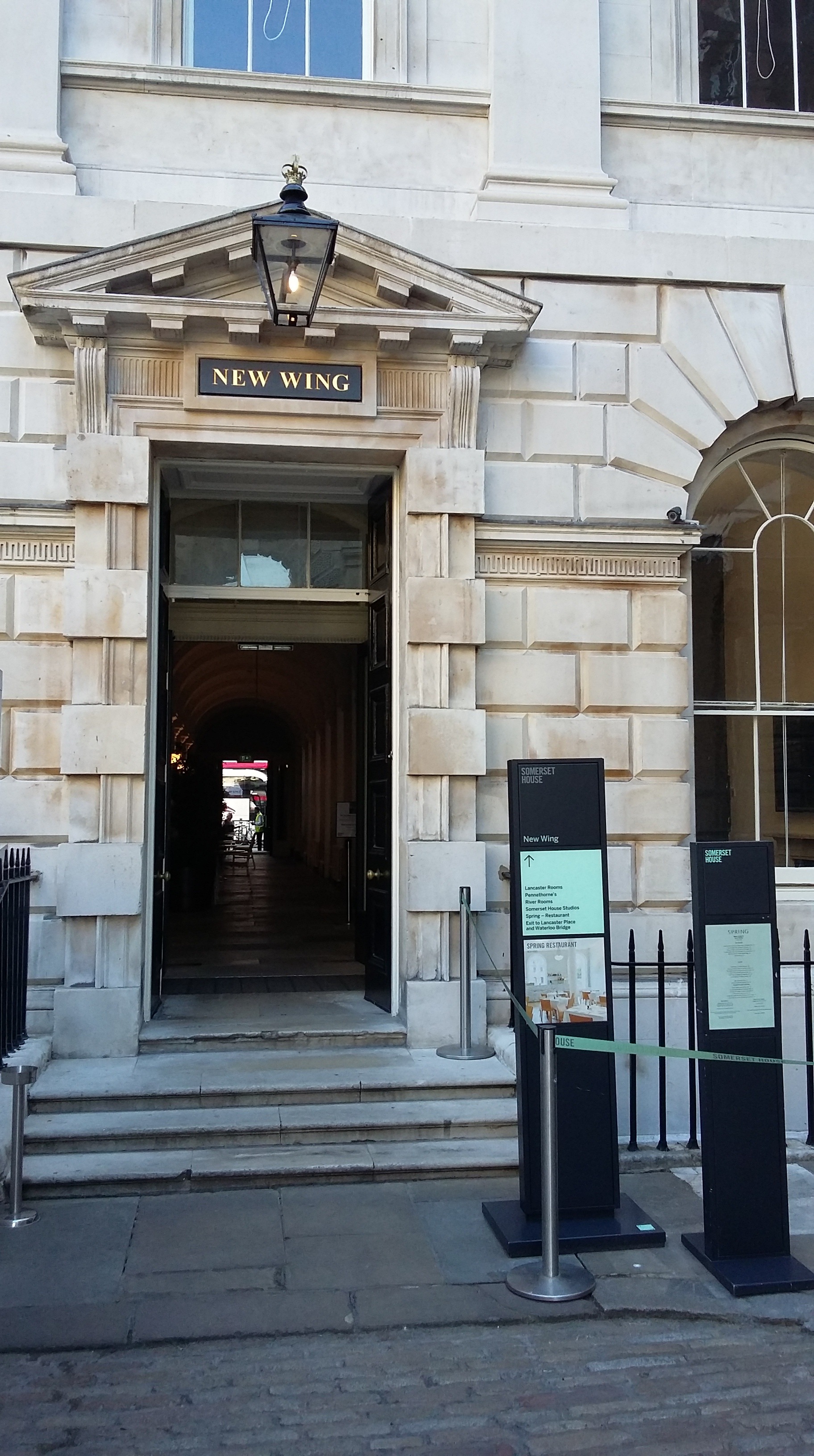
Mat Collishaw: Thresholds – New Wing, Somerset House

When I read about this exhibition, I knew I wanted to check it out. Mat Collishaw: Thresholds is a unique recreation of William Henry Fox Talbot’s first exhibition of photographs in Birmingham in 1839. But instead of plonking down the original photos and inviting audiences to view them again, the exhibition is more daring: it uses virtual reality technology to take you back to the original exhibition.

The actual room you enter, in a corner of the New Wing at Somerset House, is stark white and filled with plain white cases. When you put on the special backpack, with glasses and headphones, however, the space is transformed. Around you is a recreation of the original exhibition space. In front of you, cases showcase the impressive photographs that were originally displayed, and you can pick them up to take a closer look. Mice run along the floor, spiders creep over the paintings, and a fire burns in the corner. Outside, you can see guards policing the streets, and towards the end of the experience you can even see and hear the Chartist protesters who rioted in 1839 on the streets of Birmingham.

The actual experience lasts six minutes, though you need to allow time for the introduction and to get your equipment set up. Though short, it’s unforgettable, and its use of very modern technology reminds you of how cutting-edge the science of photography would have seemed to exhibition attendees in the mid-nineteenth century. The exhibition isn’t on for very long, but I’d urge you to catch it before 11 June.

Russian Revolution: Hope, Tragedy, Myths – British Library

These days I always seem to go to exhibitions towards the end of their run, but I ended up seeing Russian Revolution: Hope, Tragedy, Myths at the British Library fairly early, owing to the fact that some friends wanted to go too. We booked for Saturday afternoon and were surprised to find the exhibition so quiet. Marking the centenary of the Russian Revolution, it uses documents, books, letters, photographs and film footage to explore how the revolution began and developed and the impact it made.

I’m vaguely familiar with what happened, as I am very interested in Russian history anyway, but the exhibition helped to clarify events for me, and I think I left with a greater understanding of what was going on. The exhibition followed a largely chronological path, which I personally found very helpful. It looked at the structure of Russian society at the time of the Tsars before examining how and why the revolution was sparked.

My favourite section was actually the final one, ‘Writing the Revolution’, as it looked at some books which are my favourites, including Boris Pasternak’s Dr Zhivago. I also enjoyed the look at film at the end, including clips from famous Soviet films.

The exhibition runs until 29 August and it’s definitely worth taking some time out to see it this summer.

Revolution: Russian Art 1917-1932 – Royal Academy of Arts

2017_0329Revolution01

My longstanding interest in Russia meant that the Revolution: Russian Art 1917-1932 exhibition at the Royal Academy of Arts was right up my street. The exhibition covered the period between 1917 and 1932, when Russia was settling into life post-revolution and artists were first excited by the opportunities the new world presented, then dismayed at the restrictions imposed by Stalin.

During this first fifteen years, artists enjoyed considerable freedom, and revelled in the new possibilities that the new regime offered. However, in 1932 Stalin decreed that Socialist Realism was the only acceptable style for the Soviet Union, ending this burst of creativity.

The exhibition features work by many acclaimed artists, including Kandinsky, Malevich, Chagall and Rodchenko. Interestingly it also features film clips of life in Russia, from both films and documentaries about the Soviet regime.

One of the most powerful things about the exhibition had nothing at all to do with art. In the last room, there was a video booth showing photographs of people who had been arrested and sent to gulags by Stalin and his cronies. The faces staring out of the screen are still haunting me.