Scholar, courtier, magician: the lost library of John Dee – Royal College of Physicians

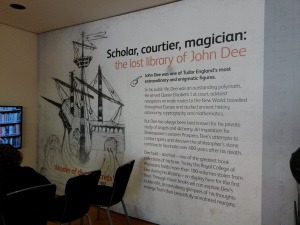
On my day off this week I visited the most recent exhibition at the Royal College of Physicians: Scholar, courtier, magician: the lost library of John Dee. John Dee, or Dr Dee as he is often known (though he was not a doctor in the commonly understood sense of the word, and had no formal medical training), was an Elizabethan polymath, a lover of learning who collected a huge library of books, travelled throughout Europe and was rumoured to have been a spy for Queen Elizabeth I.
2016_0525Dee

Dee was born in London to Rowland Dee and Johanna Wild. He studied at St John’s College, Cambridge, and became an Original Fellow of the newly-founded Trinity College, but he spent most of his adult life at Mortlake, just south of London, where his mother owned property. The way in which the Royal College of Physicians ended up with Dee’s books is rather sad. While Dee was on a trip to Europe, he entrusted his library to his brother-in-law Nicholas Fromond, who sold it off. Many of the books ended up in the possession of Nicholas Saunder, a former pupil of Dee’s, who tried to remove Dee’s name from the front of the books by repeatedly overwriting it with his own. Saunders’ books later passed to Henry Pierrepont, the 1st Marquis of Dorchester, and ended up at the RCP via a family bequest in 1680.

The exhibition explores different facets of Dee’s life: his role as a scholar, his experience as a courtier, his travels abroad and his life as a mathematician. Within each section, books from the Royal College’s collections that used to or were believed to belong to Dee are displayed, to illustrate the different aspects of his life. Dee annotated his books throughout his life with his signature and other notes about the contents of the books. He also had a habit of doodling in his books: the pages are littered with small bearded faces, and in one case a ship.

I liked the anecdotes relating to Dee: in Cambridge he devised a moving dung beetle for a theatrical production, which led some who saw it to claim that it was done by magic. On a more serious note, Dee’s alchemical experiments and attempts to converse with angels got him in trouble throughout his life: he was arrested for casting Mary I’s horoscope, though he was later approached by the Earl of Leicester on Elizabeth I’s accession in order to determine the most favourable day for her coronation. There are several items used by Dee on display, including a scrying glass and a crystal ball. There is also a painting by Henry Gillard Glindoni in which it is just possible to make out a ring of skulls around Dee that has been painted over.

Upstairs, the exhibition continues with a display exploring the way Dee and his story have been represented over the years, in literature, graphic novel and, most recently, opera. There are also books exploring his attempts to contact angels. The exhibition runs until July and is well worth seeing, a fascinating exploration of the life of one of Elizabethan England’s most enigmatic figures.
Delacroix and the Rise of Modern Art – National Gallery

IMG_20160522_111707

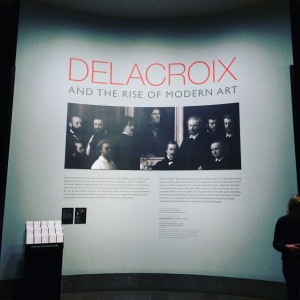
I quite fancied the Delacroix exhibition at the National Gallery, as though I can’t claim to know a great deal about the artist, what I do know I generally like. The exhibition, entitled Delacroix and the Rise of Modern Art, ended on 22 May so I only just managed to catch it.

The exhibition looked at the art of Eugène Delacroix in the context of his influence on later artists. Paintings of his were displayed alongside works by other artists, including Paul Cézanne, Vincent van Gogh and Henri Matisse, to show how he influenced them; these works included landscapes, still lives and portraiture. Interestingly, one of Cézanne’s works directly references Delacroix’ heroic status among artists: his The Apotheosis of Delacroix (1890-1904) shows artists praying to Delacroix, who is being transported heavenwards. Other works displayed included Henri Fantin-Latour’s Immortality, which also paid homage to Delacroix. Some impressive Delacroix paintings were included, such as his 1858 Tangier from the Shore, but sadly his greatest paintings were absent, so I didn’t get the full sense of how impressive he was.

While I did enjoy the exhibition and found it illuminating, I would have liked to see more of Delacroix’ own work, and was slightly disappointed that it was not more closely concerned with him. Apart from that though, it was obviously well planned and thoughtfully organised.

Painting Norway: Nikolai Astrup (1880-1928) – Dulwich Picture Gallery

The Dulwich Picture Gallery in leafy south London does have some interesting exhibitions, and the most recent was Painting Norway by the Norwegian artist Nikolai Astrup (1880-1928). Many of these paintings are being shown for the first time outside Scandinavia.

Astrup grew up in Ålhus in Jølster, where his father was a priest. A sickly child, Astrup spent a lot of time indoors but most of his pictures are concerned with the landscape outside, though he also painted places and buildings that were important to him, such as the parsonage where he grew up and his farmstead at Sandalstrand (later named Astruptunet after him).

I was drawn to the unusual, almost mystical landscapes, the colours and the representations of Norwegian culture. My favourite pictures were Astrup’s depictions of Midsummer’s Eve bonfires, the fires bright and almost otherworldly amid the landscape of the fjords. He painted many scenes of his home town in south west Norway, in all seasons and weathers, fields covered in marsh marigolds, midnight skies glowing purple, mountains which take on human qualities.

Astrup is little-known outside his native Norway, but this really needs to change: his work is superb, unusual and really worth exploring.

Alice in Wonderland – British Library

2016_0412Alice01

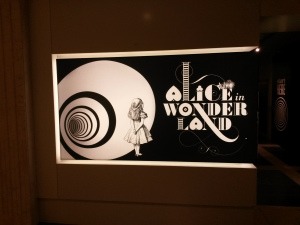
I’m a huge fan of Alice in Wonderland, and 2015 marks the 150th anniversary of the first publication of Lewis Carroll’s classic Alice’s Adventures in Wonderland. To celebrate, the British Library is holding an exhibition all about Alice.

Starting from Carroll’s initial conception of the tale – as a story told to while away the hours on an Oxford river jaunt one warm June – the exhibition covers the initial manuscript version, Alice Under Ground (which he wrote for Alice Liddell), followed by the full published version complete with John Tenniel’s illustrations. Over the next century and a half, various editions of Alice and its sequel, Alice Through the Looking Glass, have been produced, with illustrations from the likes of Arthur Rackham, Mervyn Peake and Salvador Dali. The exhibition focuses mainly on illustrated editions of the books, but it also includes merchandise produced at the time (Carroll was pretty savvy about such things) and more recently. A must-see for all Alice fans.

2016_0412Alice02

Clangers, Bagpuss & Co. – Museum of Childhood

2016_0409MoC04

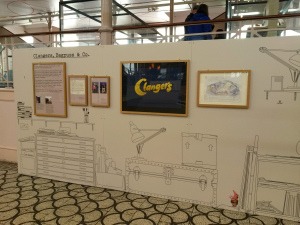
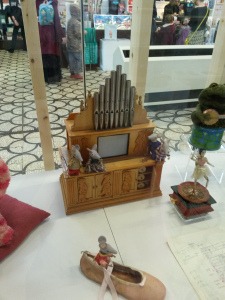
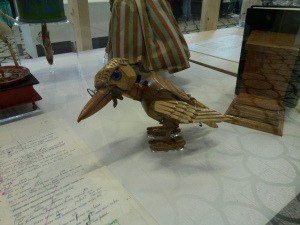
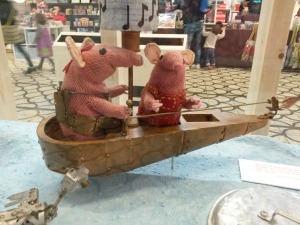
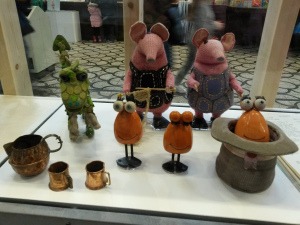
I loved Bagpuss and The Clangers as a child, so I was excited when I found out that there was going to be a free exhibition about Oliver Postgate and Peter Firmin’s work with Smallfilms at the Museum of Childhood, exploring the creation of these shows as well as others including Noggin the Nog and Ivor the Engine.

2016_0409MoC05 2016_0409MoC06 2016_0409MoC07

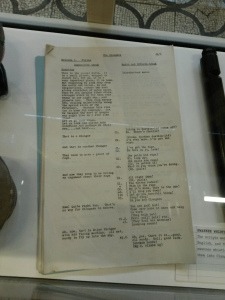
Clangers, Bagpuss & Co is small, but extremely worthwhile for fans, with original puppets, filming equipment and other documents on display. I particularly enjoyed seeing a script from The Clangers, which confirmed what I have always suspected: that the high-pitched squeaks of the characters are reflections of actual speech.

2016_0409MoC09 2016_0409MoC13 2016_0409MoC14

The exhibition runs until 9 October, so there is plenty of time to see it.

Artist and Empire – Tate Britain

2016_0402TateBritain

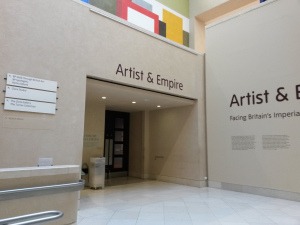
On Saturday I had a bit of time to spare so I popped into Tate Britain to check out their latest exhibition, Artist and Empire. The exhibition encompasses art from the past five hundred years or so, concerned with the British Empire. It includes works by diverse artists, both oppressors and oppressed, conquerors and the conquered, from different perspectives.

The exhibition acknowledges that the issue of ’empire’ is a difficult one to explore and come to terms with these days. However, remnants of the British Empire are all around us, and the exhibition attempts to face these head on in order to explore the issues they raise. I really like the way exhibitions at Tate Britain tend to mix old and new works and all different kinds of art, and this one is no exception.

The exhibition is divided into themes, with one room containing maps, one about heroics, one focused on costume and portraiture, and so on. Maps in particular were often used to denote conquest, while naming places implied ownership over that place. Portraits were often used as symbols of power, and the clothes worn by the sitter were often suggestive: Western dress worn by Indian royalty and Native American dress worn by the British, for example, implied a receptivity to other cultures. Having said that, the power balance was hardly equal: many works painted (pun intended) the British as morally correct, honourable conquerors. One section of the exhibition looked at trophies: collections of plants, animals and birds, drawings and paintings of them, and artefacts created by humans.

The latter part of the exhibition looks at the work of modern artists examining the legacy of empire in often-provocative ways. The exhibition is a thought-provoking one: for me, it wasn’t so much about viewing and enjoying art for its own sake, but using it as a lens through which to view beliefs and attitudes concerning empire.

Crime Museum Uncovered – Museum of London

The infamous ‘Black Museum‘ of Scotland Yard, officially known as the Crime Museum, is a collection of criminal memorabilia kept at the headquarters of the Metropolitan Police Service at New Scotland Yard. Founded in around 1874, it has been used for over a century to help the police in their study of crime and criminals. While the existence of the museum is widely known, it is not generally open to the public.

2016_0313CrimeMuseum

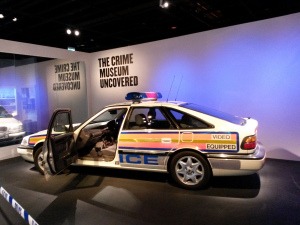
This all changed a few months ago when the Crime Museum Uncovered exhibition opened at the Museum of London. The exhibition was instigated by the Crime Museum itself, which has wanted to open up to the public for a while, but was concerned about the sensitive nature of the exhibits. Throughout the exhibition we are invited to question the ethics of putting such items on display, and to think about what they can teach us. As part of this sensitivity, the series of displays about specific crimes only go back as far as the 1970s.

The exhibition begins with a room which has been reconstructed from the original museum. It contains court sketches, Victorian-era mugshots and death masks, reflecting the nineteenth century obsession with phrenology – the belief that the shape of a person’s head could reveal their personality and character. This room is fascinating as it reveals how the Victorians thought about crime. There is also a disturbing selection of hangman’s nooses which were used on famous criminals.

The major part of the exhibition is laid out chronologically, with each case devoted to a different crime. Some of these cases are famous – Crippen, Christie, Ellis – others, less so. This section could easily be sensationalist, but instead it is informative and well-presented. The descriptions on the cases give prominence to the victims, not just the criminals, and the role of detectives and the police is emphasised: many of the cases have been chosen because of their significance in the history of detection and evidence, such as the first case in which a conviction was secured thanks to the use of fingerprints.

Sure, some of the exhibits are a bit gruesome: Crippen’s spade, the acid bath murderer’s gloves, a selection of masks made from stockings to hide the wearer’s face. However, all of them are informative, and some are even funny – such as the “false footprint makers” used by a would-be burglar to leave footprints around the crime scene. His cunning plan failed after he left his own footprints alongside the fake ones.

As well as displays focusing on individual crimes, there are themed displays containing fascinating artefacts, such as weapons confiscated from criminals, concealed weapons (including a pair of binoculars containing concealed eye spikes), and abortion pills and implements (from the days when abortion was illegal). Some items relate to modern-day crimes. These include the fake jewel used by the police in the attempted theft of the Millennium Star diamond from the Dome in 2000, and a selection of IRA mortars fired on Downing Street and MI6. There is also an unexploded nail bomb.

At the end of the exhibition there is the opportunity to watch a short video exploring how appropriate it is to open up these collections to the public. My friend and I spent a good couple of hours in here, in this informative and fascinating exhibition. It is thoughtfully put together, sensitively curated and hugely worthwhile – one of the best exhibitions I have ever seen.

Samuel Pepys: Plague, Fire, Revolution – National Maritime Museum

Samuel Pepys (1633-1703) lived through some of the most dramatic events of the seventeenth century. He witnessed at a young age the beheading of a king, followed by a republic, then the Restoration and two coronations; not to mention the Great Plague of 1665 and the Fire of London in 1666. A republican who served under the monarchy, a lover of wine, women and song who nevertheless condemned the licentiousness of the royal court, a President of the Royal Society who admitted that he often did not understand science, and a naval administrator who, when he joined, knew nothing about the sea, Pepys strikes me as a sympathetic character, an ordinary man who to a large extent made it up as he went along and was able to succeed by adapting himself to circumstance and making an effort to learn.

The Samuel Pepys: Plague, Fire, Revolution exhibition, which uses the witty hashtag #PepysShow, explores the history of Pepys’ time in his own words, alongside artefacts and records from the period. He has been called the greatest diarist in the English language; his diary is notable for recording everyday details as well as major events, which have allowed historians to understand what daily life in the seventeenth century was like. Pepys actually kept his diary for ten years only, between 1660 and 1669; he stopped because he feared his eyesight was being affected. However, we have other ways of learning about his life, such as his letters.

The exhibition follows a largely chronological format, beginning with the beheading of King Charles I, witnessed by a young Pepys. We learn about the life-threatening and excruciatingly painful operation he underwent to remove a bladder stone, and his marriage to Elisabeth de St Michel. Pepys’ everyday life is explored in displays relating to music and theatre, both of which he enjoyed, especially after the Restoration when theatre was once again permitted and encouraged.

2016_0312PepysShow
Representation of the Restoration theatre

We learn about the Great Fire from Pepys’ detailed account, as well as his wife’s illness and death. Later, Pepys was active in the Royal Society and became its President; interestingly, I learned here that Newton’s seminal Principia Mathematica was only published thanks to a donation from Edmund Halley, as the Royal Society had just spent its entire book budget on a History of Fishes.

One of the most impressive items in the exhibition is the eighteenth century court dress, which is in fantastic condition especially given its age. I also enjoyed looking at other artefacts from the period, including early editions of books. The last part of the exhibition explores the publication history of Pepy’s diary: several individuals transcribed them into plain English (from the shorthand in which they were written) during the nineteenth century but it wasn’t until the 1970s that the full, unexpurgated edition – containing references to Pepys’ various liaisons – was published.

The exhibition runs at the National Maritime Museum until 28 March, and it is well worth visiting if you are at all interested in this period of history.

Ada Lovelace – Science Museum

2016_0228AdaLovelace01

Ada Lovelace is having a bit of a moment right now. The daughter of Romantic poet Lord Byron, she was brought up by her mother Annabella Milbanke to focus firmly on science and mathematics. However, it would be a combination of mathematical ability and the ability to make profound imaginative leaps that would ensure her place in scientific history.

2016_0228AdaLovelace032016_0228AdaLovelace06

This small free exhibition at the Science Museum marks the bicentenary of Lovelace’s birth. It contains portraits, letters and notes as well as some of the calculating machines that she worked with. The exhibition demonstrates how her collaboration with Charles Babbage (who called her “The Enchantress of Numbers”), creator of the Difference Engine and Analytical Engine, led her to explore the potential of these machines, suggesting that in the future they would be able to manipulate symbols, not just numbers. Her work, which anticipated modern computing a century before Alan Turing’s work at Bletchley Park, has led her to be labelled the first computer programmer.

2016_0228AdaLovelace07 2016_0228AdaLovelace04

I admit that the science of these machines goes right over my head, but I am definitely an admirer of Lovelace and her incredible achievements, particularly in an age when women were hardly ever able to study scientific subjects. She definitely deserves to be better known, and hopefully this exhibition will go some way to ensuring this.

2016_0228AdaLovelace05


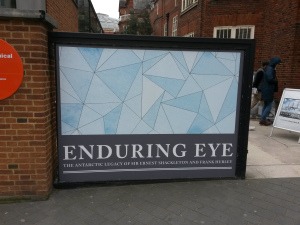
Enduring Eye: The Antarctic Legacy of Sir Ernest Shackleton and Frank Hurley – Royal Geographical Society

2016_0227RGS01

I only found out about this exhibition a couple of weeks ago, after reading an article in Londonist. Luckily I was in time to visit, though as it was the final weekend the display was pretty crowded. I braved the hordes anyway, as I am a bit obsessed by Antarctica and the Imperial Trans-Antarctic Expedition, which this exhibition commemorates, is one of the most important and memorable expeditions in history. Enduring Eye: The Antarctic Legacy of Sir Ernest Shackleton and Frank Hurley marks the 100th anniversary of the conclusion of the expedition: it did not achieve its stated aims, but it is deservedly admired nevertheless.

2016_0227RGS02

The Royal Geographical Society has a collection of original glass plate and celluloid negatives created by Frank Hurley, the official photographer and cinematographer on the expedition. This collection has been ditigised as part of the centenary celebrations, and much of it is presented here.

The Imperial Trans-Antarctic Expedition was established by Ernest Shackleton, who aimed to be the first to cross Antarctica. On the ship Endurance, which left Britain on 1 August 1914, he and his crew headed south. After stops in Buenos Aires and South Georgia, the ship made it to the Weddell Sea, where it was trapped in the pack ice.

Despite the best efforts of the entire crew, and after several months of entrapment, the Endurance was eventually crushed by the ice and destroyed. What followed was one of the greatest feats in the history of Antarctic exploration. I’ve read a great deal about the expedition, I’ve seen more than one exhibition about it, but I never tire of hearing more. The crew sailed in the lifeboats to Elephant Island, from where Shackleton, Worsley and four others departed in one of the lifeboats, the James Caird, to fetch help. In a hugely impressive feat of navigation, they safely reached South Georgia, only to be faced with a further trek over mountains and glaciers to reach the whaling station on the other side.

A rescue ship finally arrived at Elephant Island on 30 August. Every single one of the men from the Endurance survived (the men on the other ship, the Aurora, which had the job of laying supplies for the expected trans-Antarctic party on the other side of the continent, did not fare so well, losing three of the ten men left on the ice over the winter). Some of the artefacts from the expedition survived, and are on display here, including the Union flag presented to Shackleton by King George V, a knife carved from a tent peg by ship’s carpenter Harry McNish, and sketches and notes made by Reginald James, one of the men marooned on Elephant Island.

The exhibition covers the history of the exhibition from the first departure of the Endurance, following everyday life on board the ship as the crew get used to their routine. As the ship became trapped in the pack ice, photographer Frank Hurley took the opportunity to take detailed shots of the ship and of the region, by all accounts completely dedicated to getting the perfect shot, even willing to risk his own life by climbing up to the top of the ship’s rigging to take pictures from up high. Hurley was able to develop the photographs despite the incredibly cold temperatures and less than perfect conditions, so it is extremely impressive that his pictures are as wonderful as they are. In particular, I love his shots of the ship Endurance, trapped in the ice; the famous night-time shot with the ship looming out of the dark, the rigging glowing in a ghostly manner, is a masterpiece by any standards.

When the decision was made to abandon ship, Hurley had to leave behind many of his beloved negatives, selecting only the best to take with him to Elephant Island. On the way he managed to take more photographs, capturing the dramatic journey as well as life on the island as the crew waited for Shackleton’s return.

Hurley’s pictures helped to popularise the expedition both immediately after it took place and well into the future. These pictures are magnificent: even a century later they still have incredible power. The achievements of Shackleton, leading the expedition, and Hurley, capturing it on film, are still awe inspiring today.

2016_0227RGS03
Statue of Shackleton on the side of the RGS building