The Joseph Cornell: Wanderlust exhibition at the Royal Academy of Arts explores the life’s work of a New York-based eccentric who rarely left his home state but travelled widely in his mind. In later life, once his art had brought him success, he was offered the chance to visit Europe but declined, on the basis that he would lose the state of yearning that had helped him to produce the thoughtful, delicate works that he put together in the basement of the house he shared with his mother and brother.
The exhibition encompasses the works he created over a decades-long career. He collected photos, archives and other bits and bobs and used them to make collages and boxes, many built around particular themes. Tiny drawings and maps, place names, cutout pictures, and delicate pieces of wood and fabric are all used in his works. Some of my favourites included the box of parrots and the case in which a picture of a Victorian girl floats into the air, attached to an unseen balloon by tiny strings. The works have the air of cabinets of curiosities; they reflect Cornell’s wide interests (space, travel, history, stories of all kinds) and each one is unique.
This art is unlike any I’ve seen before, and I’m glad I made the effort to go and see the exhibition before it closed.
The St Bride Foundation was established in 1891 as the social and educational hub of printing and publishing on Fleet Street. These days it contains a library of artefacts and books, much of it relating to the history of print and graphic design. This exhibition in the Layton Gallery, St Bride Unveiled, showcases highlights from the collection which have not been seen together before.
The collection is extremely varied, containing fragments from an edition of the Book of the Dead, a Kelmscott Bible, and a road sign among other things.
The exhibition is free to visit and runs until the 25th of September. The Bridewell building, where the Foundation is based, is also home to a bar, a theatre and a library, as well as various other events.
Even if you’re not a history lover like me, you’d be hard pressed to have missed the publicity surrounding the 800th anniversary of Magna Carta this year. The British Library, naturally enough, have installed an exhibition celebrating this document and its impact on the world, entitled Magna Carta: Law, Liberty, Legacy.
The exhibition explores how the Magna Carta came about, the context in which it was designed, and its immediate impact, as well as looking at the ways in which it has inspired campaigners throughout the centuries and impacted on political events. Linked to this, it examines how it has been exploited and perceived by the media and by people in general.
The treaty came about after King John, who had lost much territory in Northern France, imposed huge taxes on his wealthy subjects. The barons, angry, forced him into a negotiation, resulting in the “Carta de Ronemede”. Though much of it is now obsolete – one clause, for instance, covered fishing in the Thames – it still had a significant impact, as the exhibition shows. In addition, clauses 39 and 40 – guaranteeing the right to a fair and speedy trial – are still in force today.
The exhibition was very busy when I visited, but that was probably my own fault as I chose to go at the weekend. I did find that it was incredibly interesting and much more thorough than I had imagined. Partly this was because of the quality of the artefacts on display: two of the four original Magna Carta documents from 1215, plus Jefferson’s handwritten copy of the Declaration of Independence and an original copy of the US Bill of Rights, which both owe a debt to the Magna Carta. Statues, paintings and an assortment of manuscripts also added to the exhibition.
British judge Lord Bingham wrote that: “The significance of Magna Carta lay not only in what it actually said, but in what later generations claimed and believed it has said.” This exhibition brilliantly demonstrates this.
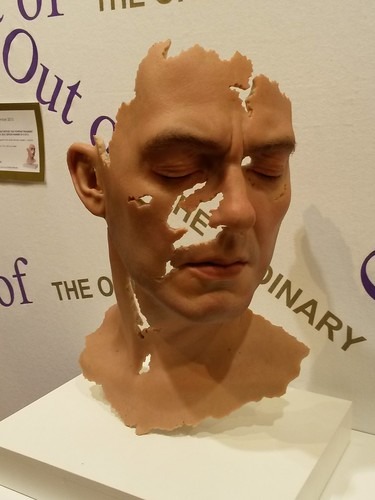
To celebrate the 40th anniversary of Christie’s in South Kensington, the auction house is holding a series of regular late-night openings. These are free events designed for interested viewers to come along, view some of their items and listen to specialist talks about the collection. I attended one such event called Out of the Ordinary, exploring some of the more unusual items they have up for sale. Unusual, they certainly were.
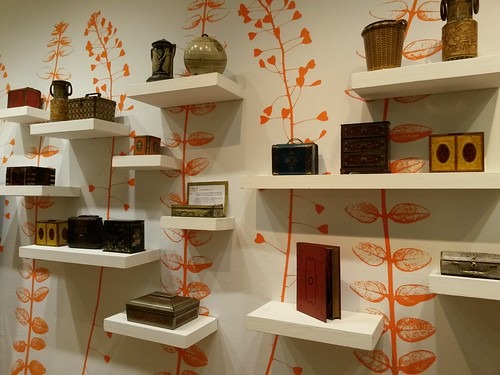
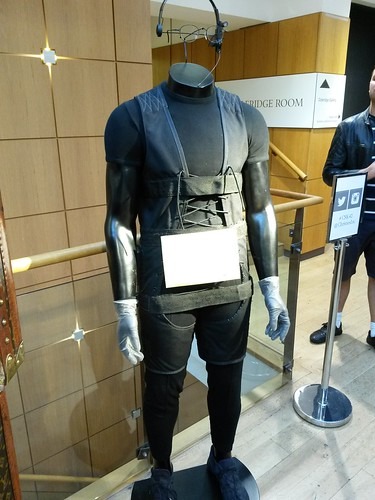
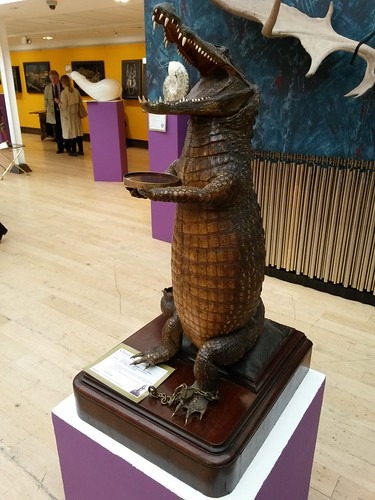
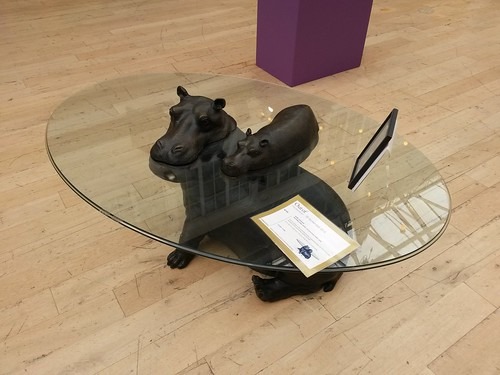
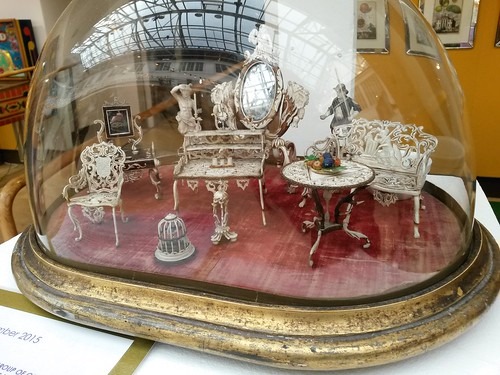
Creepy mask/modelCrown from a then 15-year-old Kate Moss’s first ever modelling shootUnusual biscuit tinsVintage Louis Vuitton travelling caseTom Cruise’s suit from Mission ImpossibleCrocodile ornamentHippo coffee tableMiniature ivory furnitureRoger Bannister’s four-minute-mile shoes
Bannister’s shoes eventually fetched 220k when they went to auction. All of the items here were available for sale: not being a millionaire, I was unable to bid (though I was rather tempted by the hippo coffee table) but it was still fun to be able to see this unusual collection of objects.
Carsten Höller: Decisionis this summer’s blockbuster at the Hayward Gallery, an experimental and interactive exhibition with slides – slides! – coming out of the gallery’s roof. Intrigued, I booked a ticket for the Bank Holiday weekend.
The show is structured around the theme of “decisions”, allowing the participant the chance to choose for themselves how they will approach a particular work, and experience mind-altering sensations.
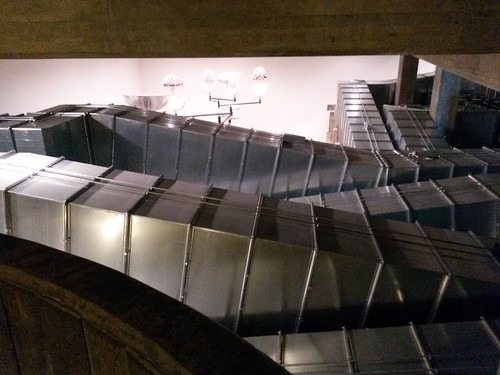
The first work, Decision Corridors, apparently had different entrances but I didn’t notice, being too concerned with getting inside. It was formed of numerous tunnels, pitch-dark inside with only occasional pinpricks of light to show the way. The photo I took later on shows just how winding these corridors are. Walking through them, with no way of seeing where I was going, was incredibly surreal.
Decision Corridors, seen from above
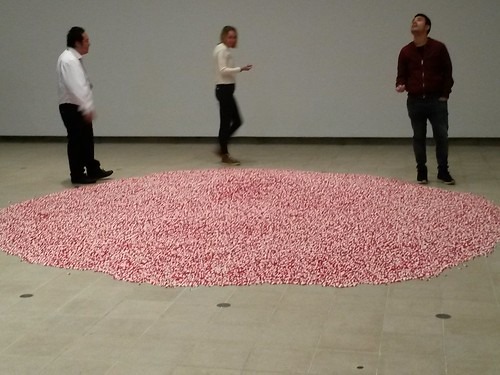
Later works included Half Clock, “the most complicated clock in existence”, and the Pill Clock, which drops a single red and white capsule onto the gallery floor every three seconds. As you can imagine, a considerable pile has sprung up by now. You are offered the chance to swallow your pill and I did so, Alice-in-Wonderland style, not really expecting anything to happen (it didn’t).
Pill Clock
Another work, Flying Mushrooms, incorporated models of Amanita muscaria (fly agaric mushrooms) which are red and white hallucinogenic mushrooms, famous in folklore. Here, the models have been halved and placed back together the wrong way round, and you have to push the sculpture around to move it.
Flying Mushrooms
The Forests was a dual-screen video with a 3D headseat and earphones, with which you could experience a snow-covered forest at night. It was surprisingly calming. In the same room were Two Roaming Beds (Grey), which sounded brilliant: “These robotic twin beds roam the lower floor of the exhibition like a pair of restless, insomniac twins.” However, hiring them for the night costs £500, so I think I’ll give them a miss.
Two Roaming Beds
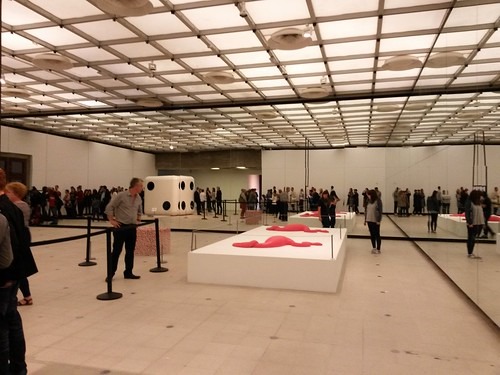
Upstairs, The Pinocchio Effect was something I didn’t look at but as it seemed to involve two people at a time, and Two Flying Machines looked like the most fun exhibition but as the queue was an hour and a half long, I didn’t bother. The Half Mirror Room and giant dice (or die) was disorientating.
Half Mirror Room
The Upside Down Goggles in the same room were bizarre to say the least. Without a friend to hold on to I felt odd walking around.
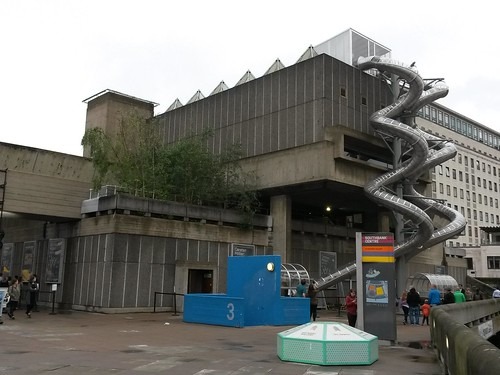
The final part of the exhibition – and the highlight for me – were the Isomeric Slides, “a sculpture you can travel inside and a device for experiencing a condition somewhere between delight and madness” according to Höller. Whatever the theory, it was a lot of fun to slide down to the bottom of the gallery.
I had a great time here, although I was disappointed at the number of exhibits where it seemed to be expected that you had someone else with you – what about us solo exhibition-goers? Nevertheless, it was good fun.
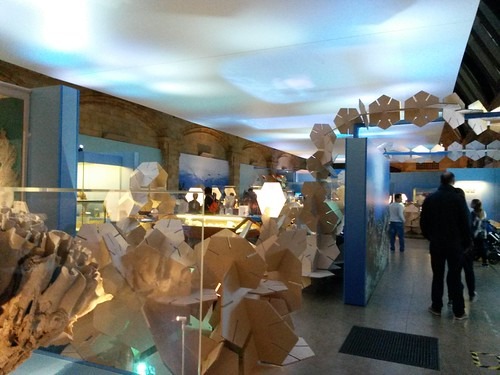
Recently I visited the exhibition Coral Reefs: Secret Cities of the Sea at the Natural History Museum. The exhibition aims to explore the world of coral reefs, the variety of life that exists within them, their history and the threats they are under today.
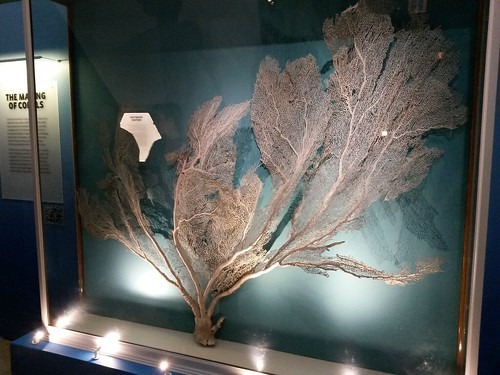
Coral specimen
The exhibition was interesting and informative, particularly when examining Charles Darwin’s theories of how coral reefs form, something I hadn’t previously been aware of.
Terrifyingly large fish
Unfortunately, the exhibition wasn’t as rich and colourful as I had hoped. Obviously the NHM can’t very well transplant the entire Great Barrier Reef to London, but most of the specimens on display are dead and subsequently rather grey and dull to look at.
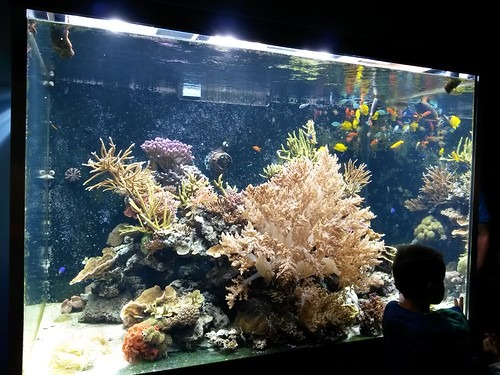
Living coral
It’s only at the end of the exhibition that we get to see a tank of living coral – a mesmerising spectacle. This exhibition was always going to be a difficult one to pull off, and while it was worthwhile, it wasn’t as fascinating as I’d hoped.
Revelations: Experiments in Photography is an exhibition at the Science Museum which looks at photography with a science theme over the last two centuries. Scientific photography influenced art, but was also valuable in its own right, as it was able to capture images and phenomena invisible to the naked eye.
My favourite work was Ori Gersht’s Blow Up (2007), which captured a still life in the act of exploding, a magnificent and beautiful work. However, the one with the best title was undoubtedly Chickens, scared by a torpedo (c. 1878), a picture by the photography of movement pioneer Eadweard Muybridge. Early images by photographers such as William Henry Fox Talbot were shown, alongside works by modern artists such as Harold Edgerton and Hiroshi Sugimoto; I particularly liked the former’s dynamic Bullet Through Lemon (c. 1955). However, overall I preferred the older photographs, and was sorry to see that most of the pictures in the exhibition were comparatively modern. Admittedly this is a personal preference, and the exhibition is certainly worth seeing if you have an interest in the subject matter.
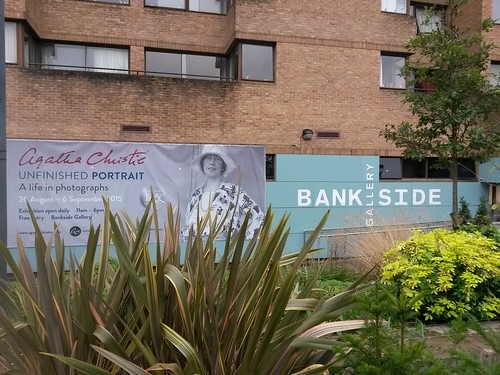
Agatha Christie: Unfinished Portrait, subtitled A Life in Photographs, is an exhibition of pictures from the popular author’s life on show at Bankside Gallery. As a fairly recent but enthusiastic fan of her work, I went along to the free exhibition.
The collections cover Christie’s life from her early childhood and adolescence to her first and second marriages and the birth of her daughter, as well as her burgeoning literary career. It was really interesting to see her life in pictures, and the images were accompanied by Christie’s own words which really brought her to life. The exhibition also featured the portrait of Agatha Christie by expressionist painter Oscar Kokoschka, painted in 1969 for Christie’s 80th birthday.
The exhibition Out of Chaos – Ben Uri: 100 Years in London is currently running at the Inigo Rooms in Somerset House‘s East Wing (part of King’s College London). Marking the 100th anniversary of the foundation of the Ben Uri Gallery, it brings together many of the treasures of the collection.
The exhibition explores the history of the Gallery, which began as a London-based art society founded in Whitechapel in 1915. After a rocky start and a turbulent history, covering two World Wars and multiple venue changes, it is still going strong.
The rooms cover the historical timeline, the Ben Uri archives and the theme of immigration, with different rooms devoted to identity, conflict and the postwar world. Early works include those by Simeon Solomon, Solomon Hart and Lily Delissa Joseph, while the later “Whitechapel Boys” include figures such as David Bomberg and Isaac Rosenberg. One room “Forced Journeys”, looks at the impact of the Holocaust, while other displays examine art after World War II.
The final section of the exhibition is focused on the present, displaying works by artists working now and laying out the plans for the Ben Uri Gallery to be a space for all migrants, not just Jews.
I really enjoyed the exhibition, which was fascinating and contained lots of different styles of artwork. The idea of transforming the Gallery into a space for migrants of all kinds is a brilliant one, too, and I wish them the best of luck with their endeavour. Hopefully I can get to the Ben Uri Gallery itself before this happens.
The free exhibition runs until 13 December and is open 12pm-6pm Monday to Sunday, and until 8.30pm on Thursday.
With an afternoon off, I went to Somerset House to check out some of their exhibitions. Beneath the Surface is presented by the Victoria & Albert Museum, Photo London and Somerset House and includes works from the V&A that are rarely displayed.
Commissioned by Photo London, the exhibition contains a huge breadth of works, ranging from Charles Thurston Thompson’s (1816-68) early photographs of paintings for conservation purposes to Nigel Shafran’s (b. 1964) unusual images taken for the 2012/13 V&A Annual Report. Because of Somerset House’s location by the river, the pictures selected largely focus on the water, too. They have been chosen by the V&A’s Senior Curator of Photographs, Martin Barnes.
Among my favourites were William Strudwick’s (1834-1910) photos from the Old London series, taken in the 1860s: these captured the riverside shortly before the construction of the Embankment, and include scenes of Lambeth, Westminster and nearby areas, as well as several medieval coaching inns shortly before they were demolished to make way for the railways. I also liked Thurston Hopkins’ (1913-2014) scenes of underground London life in the 50s; the street scenes in particular were full of energy.
Some of the pictures were more abstract: John Gay (Hans Göhler (1909-99) took pictures of lots of different manhole covers in the 1960s, revealing a wealth of different patterns. Robert Brownjohn (1925-70) took interesting pictures of street signs at around the same time, while Naoya Hatakeyama’s (b. 1958) image of a darkened sewage tunnel in Japan, from his series “Underground 1999”, is atmospheric and haunting.
Other works were particularly unusual: Benjamin Stone (1838-1914) and George Scamell (active 1900s) photographed Newgate Prison before its demolition in 1900-1902, resulting in some truly eerie images of immense historic significance. As part of the National Photographic Record Association, their job was to record a variety of subjects, many more sinister than those typically captured on film. I really liked Pedro Meyer’s (b. 1935) work, in which he set a digitally-manipulated photograph of himself as a young boy with his father alongside a picture of his adult self with his own son.
The exhibition runs until 24 August and is fascinating viewing for anyone enraptured by old photographs.