Julia Margaret Cameron: Influence and Intimacy – Science Museum

The Science Museum‘s Media Space is currently home to two exhibitions, one of which focuses on one of my favourite Victorian photographers. Julia Margaret Cameron: Influence and Intimacy, which is free to visit, contains pictures from the National Photography Collection, taken largely from the Herschel Album (1864), 94 images which Cameron compiled into a book, feeling that they were her finest. Originally a gift to the scientist Sir John Herschel, Cameron’s friend and mentor, the works still have a great deal of power even after all these years.

I first came across Julia Margaret Cameron’s work during a holiday on the Isle of Wight. She took up photography relatively late in life, when she was living in Dimbola Lodge on the island. I was fascinated by her work, and this exhibition, which also includes her camera lens – the only surviving piece of her photographic equipment – and handwritten autobiographical notes, reminded me why. The photographs from the Herschel Album, and those Cameron took later in life in Sri Lanka, are beautiful, artistic and imaginative, taking inspiration from fairytales and Biblical stories.

Open until 28 March next year, this is the first of two exhibitions in South Kensington mounted to mark the 200th anniversary of Cameron’s birth. The second opens at the V&A on 28 November.


Cosmonauts: Birth of the Space Age – Science Museum

2015_1030Cosmonauts

One of my most anticipated exhibitions of the year was the Science Museum’s Cosmonauts: Birth of the Space Age. When we think of space travel, we often think of the USA’s feat of landing on the moon, and Neil Armstrong’s status as the first human to step on to the moon. However, it was the Russians that led the way in terms of space exploration.

After the Russian Revolution, many Russians dreamed about space travel and I enjoyed looking at the pictures and models from the early 20th century. For instance, Georgy Krutikov’s drawings of capsules and space cities date from 1928, well before space travel became a reality. The exhibition charts how the dream became a reality: the first satellite in space (1957), the first animal in orbit (1957), the first man in space (1961), the first spacewalk (1965), and the first on Mars and Venus (1970s).

Models and diagrams help to bring home the enormous complexity of the task, and souvenirs, statues and posters emphasise how individuals such as Yuri Gagarin and Valentina Tereshkova became lauded as national – and international – heroes. Even in the context of the Cold War, Gagarin’s visit to London in 1961 was a huge success. My favourite aspects of the exhibition were the inclusion of personal items such as cosmonauts’ space suits and the tiny capsules that transported these pioneers around the earth, now charred and blackened after shooting through the atmosphere. It was sobering to look at these compact capsules, which now seem almost retro, and to think that they were responsible for successfully keeping their inhabitants safe as they orbited.

Later in the exhibition, the technology of space travel at the time is explored, with items on display including different clothes for different situations, food sachets, and even a shower. As space travel was such a new concept, the designers made use of feedback from the cosmonauts as to what worked and what didn’t. The shower was not particularly popular.

I loved this exhibition – it was absolutely fascinating. It runs until 13 March next year, so don’t miss your chance to visit.

The Alice Look – Museum of Childhood

2015_1031AliceLook01
The Alice Look

I’d been meaning to visit the Museum of Childhood’s exhibition to commemorate the 150th anniversary of Alice in Wonderland, The Alice Look, since it opened on 2nd May, and I finally got round to going on its last weekend. To be honest, it was more of a display than an exhibition, consisting of five or six display cases, but in fairness, like the main museum, it was free to visit. I did find it interesting.

2015_1031AliceLook02
Modern, Victorian-style “Alice” dress, made from fabric printed with the book’s text

The exhibition is divided into four categories, looking at Alice’s beginnings, her role as a follower of fashion, the inspiration her image has had on successive generations, and global Alice. I was interested to note that Lewis Carroll, who created the original illustrations in his handwritten manuscript of Alice’s Adventures Under Ground (the early version of Alice’s Adventures in Wonderland), purposely gave his Alice long blonde hair to differentiate her from the real-life Alice Liddell, his inspiration, who had black bobbed hair. The early coloured images of Alice showed her wearing a yellow Victorian-style frock, and she didn’t have a hairband and stockings until the release of the sequel, Alice Through the Looking Glass. Surprisingly, it wasn’t until the 1951 Disney movie that she was given a blue dress, the colour now most associated with her. It was interesting to look at the illustrations from early 20th century editions of Alice: they largely matched the fashions of the time, with Twenties editions, for instance, showing Alice wearing a drop-waist dress.

2015_1031AliceLook03
Japanese “Lolita” style Alice costume

I enjoyed seeing how Alice’s look has inspired popular culture around the world: particularly interesting to me were a Japanese “Lolita” style Alice costume and a Swahili Alice in a kanga dress. I also remembered Gwen Stefani’s video for “What You Waiting For” which was strongly inspired by Alice. I’m glad I made the effort to go, even though the exhibition was small.

Penny Black 175 – British Postal Museum and Archive

I had some free time during my day off yesterday so nipped in to the British Postal Museum and Archive, now preparing for its move to larger premises next year, to take a look at the Penny Black 175 exhibition. This celebrates the 175th anniversary of the introduction of this iconic postage stamp, the world’s first.

The exhibition is small, but informative, exploring how the Penny Black (and its lesser-known counterpart for slightly heavier mail, the Twopenny Blue) was introduced in 1840 as a way of simplifying the postal system and enabling more people than ever before to send letters. A sheet of these stamps was displayed, which was interesting to see for someone like me who is very interested in Victorian history.

v0_medium
The Penny Black Copyright: Culture24

Goya: The Portraits – National Gallery

I’d heard of the Spanish artist Francisco José de Goya y Lucientes, more commonly known as Goya, because of his powerful war paintings, but this new exhibition at the National Gallery shows another side to him. Goya: The Portraits encompasses the artist’s career in portraiture, from his earliest work to his final years. The exhibition contains 70 works, made up of paintings, drawings and miniatures.

I enjoyed the exhibition: I thought some works were better than others, but they all had Goya’s unique style and power. I was particularly interested in the self-portraits, most notably the “Self Portrait with Doctor Arrieta” (1820) in which Goya pays tribute to the medical man who saved his life when he was stricken with a serious illness. The picture shows an ill-looking Goya prostrate in bed, attended by the doctor, while shadowy figures – possibly harbingers of death, or waiting to give the last rites – lurk in the shadows. I also thought that the artist’s family pictures, including the sensitive portrait of his wife, Josefa Bayeu de Goya and his final portrait, an image of his beloved grandson Mariano Goya y Goicoechea, were rather touching.

I thought it very impressive how Goya managed to stay in favour for so much of his life, given the tumults within Spanish society. From an established portrait painter to the Spanish aristocracy, he became the official portrait painter to the Spanish court, and yet when the 1808 popular uprising led to conflict between the existing royal family and the French emperor Napoleon, he managed to keep his position, painting all sorts of powerful figures. I hadn’t previously known that a serious illness in his mid-40s left him almost totally deaf: his portraits became a way for him to communicate with his sitters.

I sometimes find looking at portraits to be a bit boring – there’s only so many times you can gaze with interest at powerful figures posing in beautiful outfits – but Goya’s grasp of psychology and his unusual style made these pictures genuinely fascinating for me. The exhibition runs in the Sainsbury Wing until 10 January.

Ai Weiwei – Royal Academy of Arts

2015_1023AiWeiwei01

I was interested to see the Ai Weiwei exhibition at the Royal Academy of Arts: despite not being the biggest fan of modern art in general, this particular artist is well known for his commentary on censorship, the Chinese government and human rights. He first became well-known in Britain in 2010 when his sunflower seeds installation was present in Tate Modern’s Turbine Hall, but this is the first major survey in the UK.

The exhibition was curated in collaboration with Weiwei, and covers the period from 1993, when he returned to China, until the present day. Some works have been created specifically for the RA.

I genuinely wasn’t sure what I would make of this exhibition, but I found it a worthwhile experience, getting me to think about the issues Weiwei raises in his work. I liked the way that contemporary Chinese society was juxtaposed with ancient culture.

Consisting largely of big installation pieces, on a first glance there isn’t a whole lot to look at in the exhibition, but in fact I thought the works had a surprising depth. The free audio guide definitely helped me find my way through the pieces. This n represents a map of China.

2015_1023AiWeiwei02

Another consisted of leftover wood arranged incredibly neatly, with pieces of ancient temple buried among the pile.
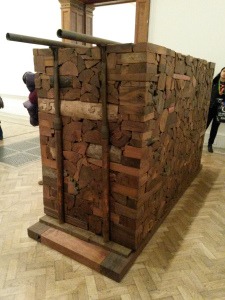
2015_1023AiWeiwei03

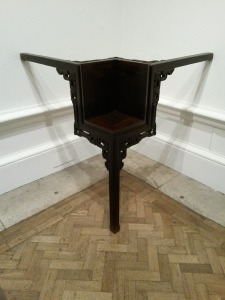
I was impressed by this stool sculpture. These works are apparently useful objects intentionally made useless, ancient artefacts modified by modern craftsmen, commenting on China’s past and present.
2015_1023AiWeiwei04

These tables were bizarre – quirky, but interesting. The craftsmanship is clearly evident, both in the pieces themselves and in the way they have been reshaped.
2015_1023AiWeiwei05
2015_1023AiWeiwei06

This work, consisting of material from collapsed buildings, represents the Szechuan earthquake of 2008, and the panels on the wall bear the names of those who died. Many of these were children, the details suppressed by the authorities as they did not want to admit that the materials for building schools had been skimped on.
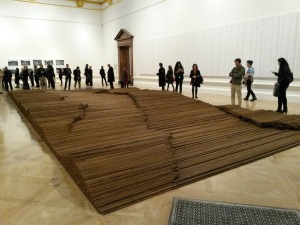
2015_1023AiWeiwei08

This sculpture is made from material taken from an arts centre that Weiwei built, and that was forcibly demolished shortly afterwards.
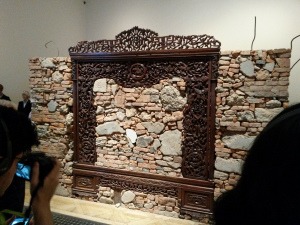
2015_1023AiWeiwei10

This impressive sculpture also represents China.
2015_1023AiWeiwei11

This field is made of marble.
2015_1023AiWeiwei12

The marble buggy was created after Weiwei had an unpleasant experience of surveillance while he was out walking his son in his buggy.
2015_1023AiWeiwei13

I liked the room of cubes. This crystal one took a long time to create.
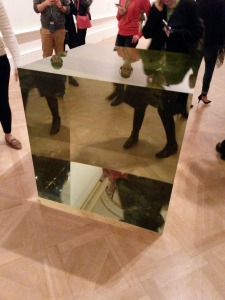
2015_1023AiWeiwei14

This one was based on a traditional kind of Chinese box.
2015_1023AiWeiwei15

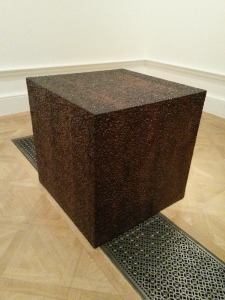
This cube is made entirely of tea leaves.
2015_1023AiWeiwei16

This one is solid metal.
2015_1023AiWeiwei17

This map of China is made of porcelain.
2015_1023AiWeiwei18

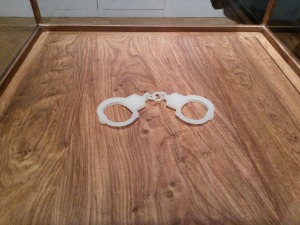
These handcuffs are made of jade.
2015_1023AiWeiwei19

These bones might look real, but they are actually porcelain.
2015_1023AiWeiwei20

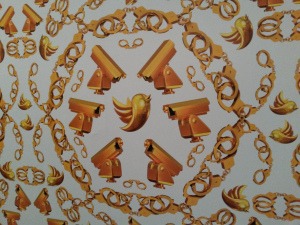
I really liked this wallpaper, which looks ornate and pretty but actually consists of handcuffs, CCTV cameras and the Twitter logo.
2015_1023AiWeiwei21

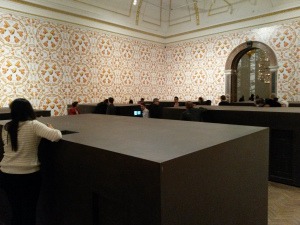
This set of boxes contain scale models of Ai Weiwei’s rooms while he was under house arrest and being watched constantly by two soldiers. Each has a window in the side and an opening on the top.
2015_1023AiWeiwei22

Weiwei has modelled himself and two soldiers in each model.
2015_1023AiWeiwei23

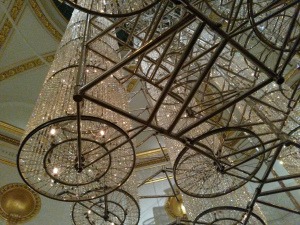
Finally, this chandelier looks fairly traditional from a distance, but close up you realise that it is, in fact, made of bicycles.
2015_1023AiWeiwei24

As I said, I wasn’t sure if I would be impressed by this exhibition but I really was. In all honesty, I was probably swayed by the knowledge that Weiwei had been placed under house arrest and come under scrutiny from the Chinese authorities – his art must be important for them to act in this way. Wrong or right, I did find myself thinking seriously about all of these works and they are still on my mind now.

The exhibition runs until 13 December. The Royal Academy is open every day, including late opening on Friday.

Victorian London in Photographs – London Metropolitan Archives

The LMA

I wanted to visit the Victorian London in Photographs exhibition at the London Metropolitan Archives, which I became aware of thanks to The Exhibitionologist’s excellent review. The LMA is open late several nights a week, so I headed down after work.

The exhibition consists of selected images from the LMA collections, photographs taken in the nineteenth century from 1839, when photography first arrived in London. Though small, it is a rich collection, consisting of portraits and street scenes, people at work and at leisure. One of my favourite sections consisted of actors and actresses, including Henry Irving and William Terriss, the latter murdered outside the Adelphi stage door by a disgruntled actor. Another was a collection of images of orphan boys, taken before they left for Canada to start new lives. Yet another poignant collection was made up of inmates of the Colney Hatch Lunatic Asylum.

Less personal, but equally interesting, pictures covered the Crystal Palace, the construction of the Metropolitan Railway, and the Blackwall Tunnel. The earliest images captured ancient inns, roadways and other buildings which had grown up since the Great Fire, and which are no longer around. We have the Society for Photographing Old Relics of London to thank for this: founded in 1875, they could not stop the demolition of these beautiful old buildings in the name of “progress”, but they could, and did, capture them on camera.

Many buildings from the Victorian period were destroyed in the Blitz, and new construction means that modern-day London looks very different from its Victorian counterpart, as two contrasting images taken from the same spot demonstrate. However, there are still recognisable elements to be seen in the pictures, and these clear, crisp images seem to bring the past even closer. A fantastic, free exhibition that is well worth a visit.

The LMA

London Metropolitan Archives
40 Northampton Road
Clerkenwell
London
EC1R 0HB

Audrey Hepburn: Portraits of an Icon – National Portrait Gallery

2015_1003AudreyHepburn

I visited the National Portrait Gallery at the weekend to see the exhibition Audrey Hepburn: Portraits of an Icon. It covered the life of the actress and fashion icon Audrey Hepburn (1929-1993) from her early years training for the ballet through her film career and ending with her humanitarian work.

The exhibition was interesting and comprised images by photographers such as Richard Avedon, Cecil Beaton, Terry O’Neill, Norman Parkinson and Irving Penn. The pictures conveyed Hepburn’s beauty, charm and style over several decades. I was surprised, however, that it was so small – there were only a couple of rooms and it didn’t take me long to go through it.

Painting Paradise: The Art of the Garden – Queen’s Gallery

2015_1003PaintingParadise01
The Queen’s Gallery

This weekend I visited the Queen’s Gallery at Buckingham Palace in order to see the exhibition Painting Paradise: The Art of the Garden. Described in the introduction as “where man and nature meet”, gardens have existed in many different forms over the years: public and private, open and closed, reflecting the owner’s status and approach to life. The exhibition looks at the many different ways in which artists have looked at gardens between 1500 and the early 20th century.

The very first picture on display was an example of a garden as paradise: Mir ‘Ali Sir Neva’i’s Seven couples in a garden (c. 1510). From then on, the exhibition was divided into themes, following a roughly chronological order.

The Sacred Garden explored the use of gardens to represent symbolic meaning, for instance in Rembrandt’s Christ and St Mary Magdalene at the Tomb (1638). These pictures often show religious scenes and include objects such as the fountain of life. It was only in the 16th century when real gardens started to appear in art: Jan Brueghel the Elder’s Adam and Eve in the Garden of Eden (1615) includes lots of different animals, including parrots, horses and lions. I enjoyed trying to spot all the different animals in this picture.

The Renaissance Garden shows how from the late fifteenth century, formal, classical and literary-influenced gardens were common, with such features as mazes and topiary. Pozzoserrato’s Pleasure Garden with a Maze (1579-84) features a Venetian setting and is a very grand garden. Around this time, books about gardens by figures such as John Evelyn and Gervase Markham were common. On display is Henry VIII’s copy of the first and most important garden manual of the Renaissance, the Ruralia Commoda (c. 1490-95) by Petrus de Crescentiis.

From the 16th and 17th centuries, new kinds of flowers and plants were brought over from Africa, Asia and the New World and cultivated in Europe: The Botanic Garden looks at the growth of the science of botany and the ‘florilegium’ or flower book during this period. Still lives became more common: I particularly liked Maria van Oosterwyck’s Still Life with Flowers and Butterflies (1686), a beautiful picture. Some of Da Vinci’s drawings of plants are on display, as well as a painting from around 1677 showing Charles II being presented with a pineapple cultivated in England – impossible as pineapples were not grown in this country at that time.

2015_1003PaintingParadise02
Still Life with Flowers and Butterflies (1686), Maria van Oosterwyck

The small room between two of the gallery rooms is given over to elaborate china and some exquisite Fabergé flowers from around 1900. The next section, The Baroque Garden, explores how water features, aviaries and urns became popular in ever more elaborate gardens. Large scale, aerial views were common in art as people wanted to show off their gardens. This section includes pictures of London palaces, including Kensington and Buckingham, as well as Windsor Castle’s garden and William III’s gardens at Hampton Court, shown in Leonard Knyff’s painting from around 1703. Other works include Jacob Wauters’ A pergola (c. 1650) and Jakob Bogdani’s Birds in a landscape (c. 1691-1714).

The Landscape Garden looks at what was apparently England’s greatest cultural export of the eighteenth century, in which nature and rolling views were seen as ideal. William Hogarth’s The Family of George III (c. 1731-2) shows the royal family in the beautiful Richmond palace gardens. Other pictures show St James’s Park and the Mall as well as Kew Gardens, emphasising the people walking around enjoying them. This section also includes the beautiful Sunflower Clock (c. 1752), made by the Vincennes Porcelain Factory.

2015_1003PaintingParadise03
The Sunflower Clock

The Horticultural Garden examines the growth of horticultural expertise, the emphasis of nurture over nature and the language of flowers, showing how plants were moved indoors and cultivated. The royal family were increasingly seen in a garden setting in both real life and art: Laurits Regner Tuxen’s The Garden Party at Buckingham Palace 28 June 1897 (1897-1900) illustrates the party that took place to celebrate Queen Victoria’s diamond jubilee. The exhibition ends with a display of some beautiful fans decorated with flowers, as well as some garden-inspired jewellery given by Prince Albert to Queen Victoria.

I really enjoyed this exhibition: it was interesting to see how the representation of gardens in art has evolved through time. I would recommend it to anyone interested in art, and also to those fascinated by gardening.

Daniel Maclise: The Waterloo Cartoon – Royal Academy of Arts

When I visited the Royal Academy in order to see the Joseph Cornell exhibition, I also popped into Burlington House’s Weston Rooms to see the smaller exhibition entitled Daniel Maclise: The Waterloo Cartoon. This exhibition, which runs until 3 January, marks the 200th anniversary of the Battle of Waterloo and is free with a ticket to one of the other major exhibitions at the RA.

The cartoon was made by Daniel Maclise, an Irish painter and illustrator, in 1858-59 in preparation for a commission at the Houses of Parliament (the finished wall art is still there), The Meeting of Wellington and Blücher After the Battle of Waterloo. The cartoon, which has recently undergone conservation treatment, is one of the largest surviving cartoons in the UK and shows the meeting of the two generals after their victory over Napoleon. Accompanied by staff and soldiers, the work showcases the intensive research Maclise undertook during his preparation, which included eyewitness accounts of the battle. The result is not always 100% accurate but is fairly close nevertheless. The size of the drawing makes an impact, as does the representation of soldiers in all states, including severely injured. The work seems to be trying to evoke an awareness of the heroism of the soldiers involved in the battle, even as it celebrates victory.

Alongside the cartoon, there are a selection of French and Italian prints representing the battle as viewed from the “other side”. Including satirical prints of British soldiers and less flattering images of the generals, they provide an interesting contrast. The exhibition is certainly worth popping into if you’re visiting the RA for Joseph Cornell or Ai Weiwei