Ancient lives, new discoveries: eight mummies, eight lives, eight stories – British Museum

The Ancient lives, new discoveries exhibition at the British Museum is a brilliant exploration of eight different mummies, each with their own story. It uses the latest technology to show how we can learn from these individuals and find out more about their lives.

These people were found in ancient Egypt and Sudan, and between them they span 4,000 years of history. Some were embalmed deliberately, others were preserved naturally.

A young man preserved in the sand (Gebelein Man B)

This mummy dates from about 3500 BC and was discovered in Gebelein, Egypt, along with several other individuals. He died as a relatively young man (20-35) and was preserved naturally in the sand. What I found amazing about this individual was that the contents of his stomach were preserved too!

A man embalmed for the afterlife (Linen man)

This older man was discovered in Thebes and dates from around 600 BC. He was bound in linen and had suffered dental abscesses, tooth loss and tooth decay, which would have caused him a great deal of pain. Intriguingly, he was found in a woman’s coffin, though whether this happened at the time of his death or at the time of his discovery in the 19th century is unclear. My personal, rather outlandish theory is that he was put in the wrong coffin on purpose, perhaps to cover up his death – this is probably ridiculous but I think it sounds rather exciting!

Tamut: a high-ranking priest’s daughter

Tayesmutengebtiu, or Tamut, was the daughter of a priest, known as Lady of the House or the Chantress of Amun. Found in Thebes, she was aged at least thirty-five when she died, and as well as dental abscesses (common among the ancient Egyptians because of their consumption of sugar) she suffered from atheroscleriosis (plaque in the arteries). Dating from around 900 BC, the hieroglyphic inscriptions on her mummy case show that she was married when she died, and as a lady of high status she was mummified very carefully. CT scans have identified many amulets on her body beneath the bandages. Incredibly, 3D printing has been used to turn the CT scans into three-dimensional models, meaning that we can see the amulets without unwrapping the bandages.

Padiamenet: a Temple Doorkeeper

Padiamenet was discovered in Thebes and his mummy dates from around 700 BC. He was middle-aged when he died, and also suffered from dental abscesses and atherosclerosis during his life. Padiamenet was a temple doorkeeper, responsible for deciding who was able to enter the most sacred parts of the temple. He also worked as a barber, as all the priests had to have all their body hair removed before going into the temple. There were mistakes made during his mummification: his head came off and had to be fixed back on, and when his mummified body was laid in his case it was found to be too short so the embalmers had to improvise an extension! Padiamenet was buried with his family, and his wife and son were found with him; after his death, his post had passed to his son.

Tjayasetimu: a young temple singer

I found Tjayasetimu one of the most poignant mummies in the exhibition simply because she was only around seven when she died. Again, she was discovered in Thebes, and lived around 800 BC. Her case is small, but scans have shown that her body inside was even smaller. The case shows her as a grown woman, perhaps suggesting her anticipated status in the next life.

In general, few child mummies have been discovered: death in childhood was very common, and it was probably too expensive to have all your children mummified. Tjayasetimu probably had the honour because of her status as a temple singer.

An unusual mummy from the Roman period

This mummy, dating from after 30 BC (though also from Thebes), was one I found a bit spooky. He is wrapped up so that all his limbs are wrapped separately, and his painted face makes him look quite lifelike. Experts aren’t sure why this is – he even has a beard painted, but he also has breasts painted on.

During the early Roman period, Egyptian customs were still common, and the practice of embalming was used by Romans as well as Egyptians.

A young child from the Roman period

This young male child, approximately 2 years old, dates from AD 40-60 and was found in Hawara, Egypt. His tiny body is contained in an elaborate case. He has been treated like an adult mummy in many respects, so perhaps there was more of a focus on treating children like adults in terms of mummification during this later period. I found this really sad – the whole exhibition was brilliant in terms of getting me to see the mummies as real people who actually lived, but this makes the deaths of the young children in particular seem so much more tragic.

A Christian woman from Sudan

The final mummy was a Christian woman found in Sudan, dating from around 700 AD – she is the youngest mummy in the exhibition. She was found when the Sudanese government decided to build a dam near the Fourth Cataract: a number of museums including the British Museum were invited to carry out archaeological work, and this body was found naturally preserved in a small cemetery. Amazingly, the body has a tattoo which is still visible – it is a tattoo signifying the Archangel Michael, the patron saint of her area.

This exhibition has just been extended until the 19th of April 2015 and I’m not surprised. It really is wonderful and allows you to learn so much about these individuals and the times in which they lived. I highly recommend visiting.

Witches and Wicked Bodies – British Museum

Witches and Wicked Bodies is a free exhibition at the British Museum (Room 90, Prints and Drawings Gallery) until 11 January. I visited one Friday to attend a special event – a free performance exploring the weird sisters by RIFT theatre company, who were responsible for the amazing immersive Macbeth at the Balfron Tower during the summer.

The performance was a chilling exploration of the witches from Macbeth and their entrapment by witch-hunters. It was fairly short though and I enjoyed the exhibition itself more – an examination of how witches and witchcraft have been portrayed in art from the Renaissance to the end of the 19th century. Beginning with Dürer and Goya, the exhibition moved on to consider artists such as Burne-Jones and Rossetti, inspired by Biblical and classical portrayals of witches.

The Queen’s Gallery

The Queen’s Gallery, an art gallery I have visited many times over the years, is part of Buckingham Palace and can be visited in conjunction with the State Rooms and the Royal Mews (stables). However you can also choose to visit the Gallery alone. It puts on around three exhibitions a year and is open all year round unlike the State Rooms and the Royal Mews which are open during the summer season only.

If you buy your ticket direct (either online or in person) you can get it stamped at the end of your visit which makes it valid for a whole year. This is great value as it means you can go back to subsequent exhibitions at the Gallery. It’s worth noting that the summer months are very crowded and it might be difficult to visit with your ticket at these times, as timed tickets are normally on sale for this period.

This year-long validation does not apply if you buy your ticket from a third party. This may not matter to you if, for instance, you are coming from a different part of the country on a trip as you may not be able to return within a year. For someone like me, however, who lives in London, this is ideal.

*Location*

The Queen’s Gallery is located on Buckingham Palace Road next to Buckingham Palace itself. If visiting by tube, Green Park station (near Piccadilly Circus) is a short walk away and the route through the park is very scenic. If you are coming from the other direction, Victoria Underground and National Rail station is almost directly south from the Gallery. Tour buses and normal red buses also stop outside. The Gallery is clearly signposted and is next to the Royal Mews.

*Security*

As might be expected, security is very tight here owing to its proximity to Buckingham Palace. You have to undergo a bag search and walk through an airport-style scanner. However all the staff are very friendly and cheerful and didn’t make me feel uncomfortable during this process. The gift shop is right next to the ticket desk so you can visit without paying for admission. After buying your ticket and walking through security you get to the gallery itself. There is a free cloakroom where coats and heavy bags can be left – we took full advantage of this. Toilets are available too and these are clean and smart.

Audio guides are available, but I didn’t bother with one. Photography for non-commercial purposes is permitted, but not flash photography.

*Gift Shop*

The shop is well-stocked and sells the usual Royal memorabilia, some of it tat and some of it in rather better taste. A number of items relating to this particular exhibition were available, ranging from cuddly penguins to a glossy photography book. I bought some postcards, which I rather regret as they were quite expensive – £5.95 for a pack of ten – but then I was very interested in the subject matter and I have a mind to frame them and put them on my wall!

*The First Georgians*

The exhibition I visited on this occasion was The First Georgians: Art and Monarchy 1714-1760, marking 300 years since the accession of George Ludwig, Elector of Hanover in Germany, to the British throne as George I. He was the first constitutional monarch, and began a long-enduring dynasty which lent its name to the Georgian era. The first room of the exhibition puts faces to names with paintings of the key players in the royal family, such as the three Georges and Queen Caroline.

The exhibition goes on to look at some of the things for which the age was noted, such as the art of William Hogarth, china, silverware and trinkets from “toy-shops”, as well as furniture, sculpture and paintings by the Old Masters. There were plenty of architectural designs and plans for royal residences including St James’s Palace, Windsor Castle, Kensington Palace and Hampton Court, as well as artefacts from less savoury aspects of the age, including military maps and items to do with Culloden and other Jacobite risings.

FACTS

Address: Buckingham Palace, London, SW1A 1AA

Website: royalcollection.org.uk/visit/the-queens-gallery-buckingham-palace

Opening Hours: Approx 10am-5.30pm during exhibitions

Prices: £10 adult, £5.20 child

Horst: Photographer of Style – V&A

Horst P. Horst (1906-99) has been described as “one of the twentieth century’s master photographers”, and the new exhibition at the V&A, Horst: Photographer of Style, explores his life and work. Horst was born in Germany in 1906, but joined Vogue in 1931 and became a US citizen in 1943.

His work encompasses much of the 20th century, ranging from 1930s haute couture, with beautiful, glamorous black and white prints with stunning models and atmospheric shadows, to Dali-inspired surrealism, pictures of nature and travel photographs. It’s an interesting and varied exhibition, a snapshot of a more glamorous time.

Constable: The Making of a Master – V&A

Constable: The Making of a Master is the new exhibition looking at how the great artist created his works. The exhibition, which is held at the V&A, examines his influences, inspirations and work processes. Much of this would, I think, be particularly interesting to those with an art background; however, there is still plenty for the non-expert to appreciate.

The perception of Constable is of a solely “natural painter”, however this interpretation does not stand up in his later paintings which mark more of a retreat from naturalism. The artist had a reverence for the Old Masters and was strongly influenced by them; artists he revered included Raphael, Reubens and Claude Lorrain. He made copies of their paintings, some of which are almost indistinguishable from the originals, and collected prints of other artists’ work throughout his life.

Constable’s most famous works such as The Hay Wain (1821), The Leaping Horse (1825) and my personal favourite Salisbury Cathedral From the Meadows (1831) are displayed, and it is fascinating to see how he worked on and developed these pictures. He would start with small black and white sketches, followed by large, full-size colour sketches, before attempting the finished painting.

Before I saw this exhibition I vaguely thought of John Constable as someone who painted slightly dull, traditional English landscapes. After seeing this exhibition I realise I need to revise my assessment somewhat.


Anselm Kiefer – Royal Academy of Arts

At the weekend I attended the Anselm Kiefer exhibition at the Royal Academy of Arts. The German artist has been described as a “colossus of contemporary art”, and I decided to go and see for myself.

The exhibition really begins before you even enter the RA, with “Velimir Khlebnikov: Fates of Nations: The New Theory of War” on display in the courtyard. It consists of two large glass vitrines containing model submarines. It’s a melancholy, imposing work, inspired by the Russian Futurist figure Khlebnikov, who came to the somewhat bizarre conclusion that a major sea battle took place every 317 years (or multiples thereof).

2014_0928AnselmKiefer02

2014_0928AnselmKiefer01

Inside, another of Kiefer’s sculptures is on display before you reach the exhibition: “Language of the Birds” (2013) is made up of books, folder chairs and a pair of wings. It looks like it is about to take off. The sculptures (including “Ages of the World” in the exhibition itself) were in fact my favourite thing about the exhibition: they have an impressive looming quality about them.

The rest of the work I wasn’t so sure about. I admired Kiefer’s attempt to confront the reality of Germany’s history; his early work involved painting himself wearing his father’s German army uniform in a series ironically entitled “Heroic symbols”. He aimed to reclaim the idea of the artist from the Nazis, a concept which had been tainted by the emphasis on Hitler as an artist. I also liked a painting which re-enacted a Nazi naval attack inside a standard-issue tin bath, a commentary of the ludicrousness of the war.

Other works included watercolours, books, three-dimensional pictures and installations, using materials as diverse as greenery, lead, diamonds and wood. Paintings made use of myths, symbols, landscapes and architecture. The exhibition was varied in subject, but there was a recognisable style running through all of Kiefer’s work.

Overall I don’t think that this art is really for me, however I feel I learned something from it – I certainly wouldn’t call it a wasted experience.

Digital Revolution – Barbican

Described as “the most comprehensive presentation of digital creativity ever to be staged in the UK”, Digital Revolution, an immersive exhibition of art, design, film, music and videogames at the Barbican, is one of the big exhibitions of the summer. I visited on Saturday afternoon, and thankfully my Barbican membership allowed me free entry without having to wait for an available timeslot – a definite perk of membership!

There were three main sections to the exhibition. The first, which took up the whole of the Curve and several feet outside of it, was by far the largest. The second was a small, fenced-off area in which participants could play some indie computer games. The third was Umbrellium’s Assemblance, a laser room installed in the Pit Theatre. There were other little bits dotted around the Barbican too, such as electronic “pet snakes” as part of Minimaform’s Petting Zoo, and another installation off-site in the Bloomberg Space which I didn’t get round to visiting.

The first bit was great fun, and I think my dad and brother would have loved it. It contained lots of retro computer games, including those I remember, such as Tomb Raider, Super Mario Bros and The Sims, and those that were before my time, like Pong and Tetris. I was sad not to see the NES classic Blades of Steel there, however!*

2014_0823DigitalRevolution01
The Sims

This nostalgic section was followed by some more modern developments in the field of technology, including some “birds” made from old mobile phones, and an installation by pop star will.i.am. There was also a selection of cutting-edge fashion, including a 3D-printed dress worn by – who else? – Lady Gaga.

2014_0823DigitalRevolution02
Birds of the future
2014_0823DigitalRevolution09
Lady Gaga’s printed dress
2014_0823DigitalRevolution04
will.i.am

If I have a criticism of this part of the exhibition, it would be that it was just so crowded. I understand that it was timed, and the Barbican have genuinely made an effort to control numbers. However, in an interactive exhibition such as this it can be very difficult to play that game or experience that technology without queuing for a while.

2014_0823DigitalRevolution05
Magically transformed into angels
2014_0823DigitalRevolution07
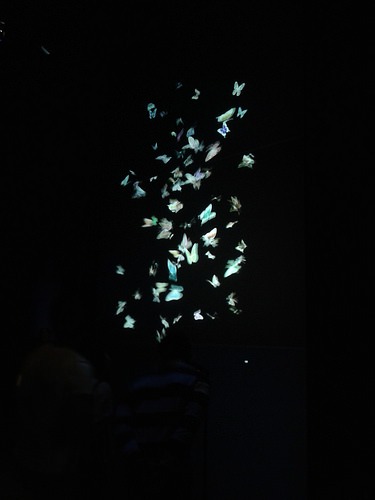
Pretty butterflies

The indie-gaming section would probably be of most interest to serious gamers. I had a go, and recognised one of the games – my housemates have been talking about it for ages. You play an official on the immigration desk of a totalitarian East European state, and you have to decide whether to let people into the country or not. It’s a brilliant idea, but I couldn’t play it for too long as it traumatised me!

The laser room was fun, but I got bored after a few minutes. The exhibition took me around an hour and a half to explore in total. However, I didn’t spend too long in any one place. I am sure that someone who was really passionate about gaming and technology would be able to easily spend half a day or more here.


*Amazing graphics. Awesome music. All your friends will want it!

The Human Factor: The Figure in Contemporary Sculpture – Hayward Gallery

When I came out of the Tate Modern, I decided that as it was such a nice day I would walk along the Thames Path to the Southbank Centre. After a frozen yogurt from the pink Snog bus, I headed into the Hayward Gallery to see The Human Factor: The Figure in Contemporary Sculpture.

In general, I find that I tend to prefer older art (from the nineteenth century and earlier) to modern paintings and the like. However, I feel rather differently about sculpture. In my (completely uneducated) opinion, it gets a bit dull looking at yet another white marble figure, so the way in which modern sculptors use different materials to create imaginative and radical art is much more appealing to me. For this reason, I was looking forward to The Human Factor, which brings together new work from 25 international artists who use the human form in new and exciting ways.

There was an incredible array of sculpture on display, from Thomas Schütte Krieger’s huge statues, made of wood which has been coloured and oiled, battle scarred and contorted, to Paloma Varga Weisz’s double-headed “Falling Woman”. Cathy Wilkes’ untitled sculpture of 2011 shows a disturbing tableau of contorted figures surrounded by battle equipment, while Maurizio Cattelan has created a frighteningly lifelike representation of John F. Kennedy in his coffin. Figures have been cast from wax, formed from mannequins with added material, sculpted from bronze and given a beehive for a head (the latter is Pierre Huyghe’s 2012 creation – the first and, probably, only time I will ever see a sign warning that “The following exhibition contains live bees”). Jeff Hoons’ “Bear and Policeman” of 1988 shows a giant teddy bear towering over a rotund policeman, while Martin Honert’s unsettling sculpture of his former English teacher recreates the shadows of the black and white photo from which the image was taken. Other sculptures evoke living statues, of the kind you see in Covent Garden surrounded by tourists – it is surreal to view statues of people pretending to be statues. Mark Wallinger’s “Ecce Homo” of 1999 displays a man with a shorn head and a crown of thorns – an allegory of persecution.

Even with the breadth of sculpture on offer, I still managed to find favourites. One, entitled “Tell my mother not to worry”, is a marble sculpture of the artist’s four-year-old daughter disguised as a ghost. This is achieved by the sculpting of a white sheet which trails along the ground, with extremely realistic folds; it suggests that there really is something underneath.

This piece was by Ryan Gander, as was another of my favourites, a “re-imagining” of Degas’ Little Dancer. You see an empty plinth ahead, then turn to the right to see the dancer on tiptoe, staring out of the window. The sculpture is easily recognisable as the Degas character, and I liked the attempt to suggest that she had her own autonomy and views.

My final favourite piece probably made the strongest impact on me. Located in a small room by itself, Maurizio Cattelan’s “Him” is a kneeling schoolboy figure with his back to the entrance, hands clasped in an attitude of prayer. As you approach and turn to see the boy’s face, however, you see he is not a boy at all, but Hitler. This discovery raises more questions – what is Hitler praying for? Is he seeking forgiveness for his past actions? Or is he asking for help to continue his evil plans?

I loved this exhibition and I think there is something for everyone here. The Hayward Gallery always tries to show something different; it doesn’t always succeed, but it has done so here.

2014_0823HaywardGallery
This is Kev. He is at the entrance to the Hayward Gallery and his clothes are changed every day of the exhibition!

Malevich: Revolutionary of Russian Art – Tate Modern

2014_0823Tate01
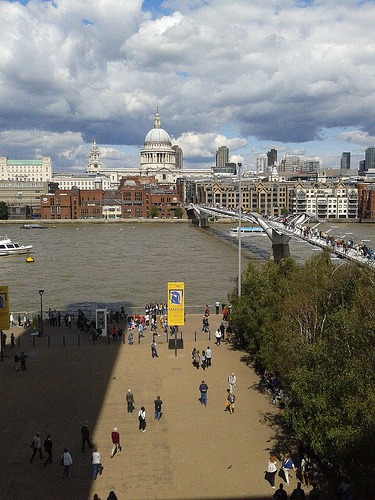
View of the Thames from the Tate Modern

On Saturday I attended a performance of Muse of Fire at the Globe. Afterwards I decided that, as I was right next to the Tate Modern, I would go in and see their new exhibition, Malevich: Revolutionary of Russian Art.

Kazimir Malevich (1879–1935) was an influential and radical artist whose work spanned one of the most eventful periods of Russian, and world, history. This retrospective examines his life’s work, which culminated in his most famous example of suprematism, the Black Square. I must admit I might not have seen the significance of this work, if I hadn’t discovered that it had been banned by the Soviet authorities. Anything deemed worthy of banning surely has some merit. In fact, when I actually saw the picture, I found it strangely compelling and unsettling, like a black tunnel, or a void. I could never have anticipated reacting like this to such a painting.

Suprematist work was, however, only one facet of Malevich’s work as an artist. Over the course of his life he explored landscape, religious painting and images of Russian workers, in both figurative and abstract styles. His range and versatility is clearly on show in this rich exhibition.

The exhibition runs until 26 October.

2014_0823Tate02
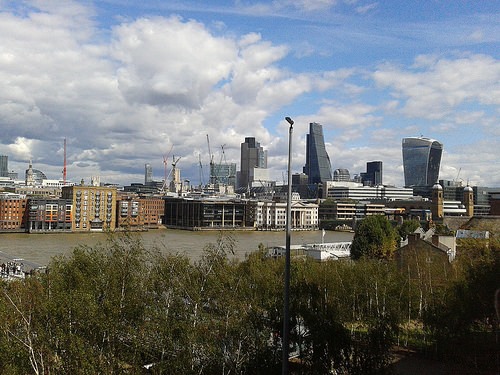
View of the Thames from the Tate Modern

Virginia Woolf: Art, Life and Vision – National Portrait Gallery

I took advantage of the National Portrait Gallery‘s late opening on Fridays to visit the Virginia Woolf: Art, Life and Vision exhibition. The exhibition, which runs until 26 October, looks at the acclaimed 20th century writer’s life and work through the mediums of photography, painting, illustration and archival material.

The exhibition begins with a display of Woolf’s diaries, rescued from her bombed-out house. They are shown alongside images of Woolf in the house at Tavistock Square before it was destroyed in the Blitz. There are several pictures of family members, many of them photographs by Julia Margaret Cameron, and many images of eminent men of art and letters who were family friends when Virginia was young.

Other pictures show the writer in the early days of her marriage to Leonard Woolf, as well as the other members of the Bloomsbury Group, including the artists Roger Fry and Vanessa Bell. The exhibition also explores the founding of the Hogarth Press in Hogarth House, Richmond, and Woolf’s relationship with Vita Sackville-West, as well as her suicide in 1941.

This is an interesting exhibition that explores not just the life of Virginia Woolf but the life of those around her, whether family, friends or other significant figures. A definite must-see for fans of her work.