Jewellery brand of the month: Baccurelli

For a while now I’ve been thinking about writing a monthly blog post, “Jewellery brand of the month”, as I love shiny sparkly pretty things and it would give me an excuse to post loads of amazing pictures. I figured January was a good time to start, so without any more ado, I would like to present my first brand:

BACCURELLI

Baccurelli is a relatively new jewellery brand based in LA, operated by wife and husband team Meli and Hugo. I first became aware of the brand after seeing Instagram posts from several Tatty Devine fans I follow: the two brands are similar in that they both focus on acrylic jewellery, but they have a very different aesthetic. Baccurelli designs, created by Meli, are original, unique and lots of fun.

The name “Baccurelli” comes from the Roman god Bacchus and the famous designer Elsa Schiaparelli. The Baccurelli slogan is “Be your alter ego”, and their longer manifesto emphasises the fun nature of their jewellery:

You are gorgeous exactly as you are. There’s nothing you need to change or be. That’s what Baccurelli is all about. When you wear a Baccurelli piece you feel playful, happy and most of all FEARLESS. We make jewelry and accessories that bring out your alter ego and inspire you to dream big and not take life too seriously.

As I mentioned, the brand has only been around for a couple of years, but they have already built up an impressive array of jewellery. Early pieces include this unusual phone necklace…

rotary phone necklace
Rotary Phone Necklace

…and this amazing flamingo necklace, which is top of my wishlist.

flamingo necklace
Croquet Anyone? Flamingo Necklace

The Valley of the Dolls collection was brought out last year (I don’t know about anyone else, but when I see “Valley of the Dolls” I immediately start humming the Marina and the Diamonds song from the Electra Heart album) and became a firm favourite among Baccurelli fans. It features real-life and fictional characters who are very different, but have one thing in common – they are all strong women.

bettie page brooch
Bettie Page Brooch
frida kahlo brooch
Frida Kahlo Brooch

The above are just two examples – other “Dolls” in the collection include Marilyn Monroe and Rosie the Riveter. They are available in both necklace and brooch form. You can also get charm necklaces featuring some of the dolls, which include other beautifully detailed charms, such as this one starring Louise Brooks:

Louise
Louise’s 7 Treasures Charm Necklace

The Costume Party collection was launched late last year and it’s probably my favourite. The collection features favourite fictional superstars, including Morticia and Gomez, Superman and Wonder Woman, Glinda and Elphaba, and Jareth the Goblin King. These pieces are available in pairs or singly, as brooches or necklaces.

il_fullxfull.846002892_8yrt_1024x1024
“Witch Besties” Brooch Set
image_a271bbaf-f583-48a2-84b1-2ae9eb7886a0_1024x1024
Goblin King Brooch

Baccurelli are still selling on Etsy, but they have recently launched a website, as well as a brand new collection, Silkworms and Satire. I have my eye on a couple of pieces from this collection, especially this brooch:

image_4435d734-0dc4-40d9-9829-b1932dca9ea3_1024x1024
Victorian Lady “Eff You” Brooch

If you’re interested in finding out more, you can follow them in a variety of ways:

Website: baccurelli.com

Etsy: etsy.com/uk/shop/Baccurelli

Instagram: instagram.com/baccurelli

Facebook: facebook.com/baccurelli

Twitter: twitter.com/baccurelli

The Alice Look – Museum of Childhood

2015_1031AliceLook01
The Alice Look

I’d been meaning to visit the Museum of Childhood’s exhibition to commemorate the 150th anniversary of Alice in Wonderland, The Alice Look, since it opened on 2nd May, and I finally got round to going on its last weekend. To be honest, it was more of a display than an exhibition, consisting of five or six display cases, but in fairness, like the main museum, it was free to visit. I did find it interesting.

2015_1031AliceLook02
Modern, Victorian-style “Alice” dress, made from fabric printed with the book’s text

The exhibition is divided into four categories, looking at Alice’s beginnings, her role as a follower of fashion, the inspiration her image has had on successive generations, and global Alice. I was interested to note that Lewis Carroll, who created the original illustrations in his handwritten manuscript of Alice’s Adventures Under Ground (the early version of Alice’s Adventures in Wonderland), purposely gave his Alice long blonde hair to differentiate her from the real-life Alice Liddell, his inspiration, who had black bobbed hair. The early coloured images of Alice showed her wearing a yellow Victorian-style frock, and she didn’t have a hairband and stockings until the release of the sequel, Alice Through the Looking Glass. Surprisingly, it wasn’t until the 1951 Disney movie that she was given a blue dress, the colour now most associated with her. It was interesting to look at the illustrations from early 20th century editions of Alice: they largely matched the fashions of the time, with Twenties editions, for instance, showing Alice wearing a drop-waist dress.

2015_1031AliceLook03
Japanese “Lolita” style Alice costume

I enjoyed seeing how Alice’s look has inspired popular culture around the world: particularly interesting to me were a Japanese “Lolita” style Alice costume and a Swahili Alice in a kanga dress. I also remembered Gwen Stefani’s video for “What You Waiting For” which was strongly inspired by Alice. I’m glad I made the effort to go, even though the exhibition was small.

Shoes: Pleasure and Pain – V&A

My auntie and my cousin love shoes even more than I do, so when they came down to London for a few days they were determined to visit the new Shoes: Pleasure and Pain exhibition at the V&A. They invited me along too, and I was happy to accept.

The exhibition contains weird and wonderful shoes from history, fashion and everyday life, spanning the globe and a period of centuries. It displays around 200 pairs of shoes, exhibited largely on boxes with mirrrors behind to showcase the entire shoe. The shoes belonged to both men and women and were worn for all sorts of different occasions, encompassing Seventies platform heels, eighteenth century Indian wedding shoes, Fifties stilettos, tiny shoes for bound or “lotus” feet in China and moccasins from Canada. It was interesting to see how historical styles influenced more modern designers and how shoes reflected wealth and social status: for instance, fragile shoes with high heels were generally worn by the rich who lived idle lifestyles. There was a section on fetish shoes and another one for famous shoes, including David Beckham’s football boots and the ballet shoes worn by Moira Shearer in The Red Shoes.

The second level of the exhibition contained information about how shoes are made, including some very modern 3D-printed sandals. This exhibition is an absolute must-see for anyone who loves shoes.

The Red Shoes. Image courtesy of quitecontinental.net

Alexander McQueen: Savage Beauty – V&A

I visited the long-awaited Alexander McQueen: Savage Beauty exhibition at the V&A on Sunday, having luckily booked in advance for a late afternoon slot. The exhibition has sold very well, and in fact weekends have been sold out for a while, so I considered myself lucky to be able to get in.

Despite the popularity of the exhibition, I was impressed with how well it had been organised. I only had to queue for a couple of minutes, getting into the exhibition at the appointed time. The space was not too crowded: sometimes there is a tendency to cram as many people as possible into a space, even when an exhibition has limited entry, but that wasn’t the case here.

The exhibition was well set-up with strong design and themed rooms, reflecting the aesthetic of the clothes, which were displayed thematically and showcased to great effect. For instance, there was a darker mirrored room showing off the Gothic-influenced clothing, and a wood-panelled eighteenth century drawing room to display the Scottish-influenced garments.

I thought the exhibition provided a strong overview of McQueen’s work, with items from his significant collections including Widows of Culloden and Jack the Ripper Stalks His Victims, as well as his final fully-formed collection before his untimely death, Plato’s Atlantis. It explored how he used a variety of influences, including flowers, animals, other cultures and history, and emphasised the importance of tailoring in his garments. Looking at items such as the “bumster” trousers, the tailored suits and the dresses incorporating lace or tartan it’s possible to appreciate the thought and craftsmanship that went into each piece, even it’s something you wouldn’t necessarily wear yourself. Over time I’ve come to look at high fashion more as a form of art than as a representation of clothes you’d actually go out in, and this has led me to appreciate it much more. Alexander McQueen’s work is a particularly strong example of fashion-as-art as the designer used his clothes and catwalk shows to make political and cultural statements.

If you can still get a ticket, this is one exhibition which is a must see if you appreciate good design, whether or not you are into fashion.


Nick Waplington/Alexander McQueen: Working Process – Tate Britain

At Tate Britain in order to attend some exhibitions, I came across a photography exhibition called Nick Waplington/Alexander McQueen: Working Process. The exhibition consists of a selection of photos taken by Waplington at McQueen’s invitation, concerning the latter’s final ready-to-wear collection for A/W 2009 known as The Horn of Plenty! Everything But the Kitchen Sink. As I have a ticket for the McQueen exhibition at the V&A later this year, I thought it would be a good idea to visit this one too.

The exhibition documents the process of creating the collection from start to finish, beginning with pictures of rubbish tips and ending with images of the catwalk. In between you see McQueen and his assistants designing, creating and constructing the costumes. The collection acted as a satirical and provocative retrospective of his career, with costumes made from fine silks designed to look like rubbish bags and an exaggerated emphasis on the models’ features. I found the exhibition interesting and it whetted my appetite for the larger exhibition at the V&A later on.

Wedding Dresses 1775–2014 – V&A

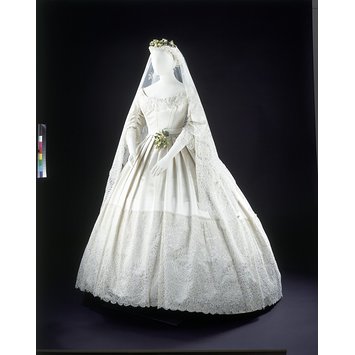
I’ve always said I never want to get married, but that didn’t stop me from visiting the V&A‘s exhibition Wedding Dresses 1775–2014. Firstly, it was historical. Secondly, I do have a thing for gorgeous dresses.

Silk-satin wedding dress from 1865
Silk-satin wedding dress from 1865 (Picture credit: V&A Collections)

There were plenty of those in the exhibition, but what really fascinated me was the history. From Georgian dresses that weren’t always white, but which tended to be “best” dresses then worn again later, through to Victorian white gowns with sprigs of orange blossom, to the development of the modern one-off white dress tradition during the twentieth century, the wedding dress has a rich and varied history. Upstairs, there were examples of more modern dresses from ordinary people and celebrities – I especially liked Dita Von Teese’s beautiful purple gown.

Horst: Photographer of Style – V&A

Horst P. Horst (1906-99) has been described as “one of the twentieth century’s master photographers”, and the new exhibition at the V&A, Horst: Photographer of Style, explores his life and work. Horst was born in Germany in 1906, but joined Vogue in 1931 and became a US citizen in 1943.

His work encompasses much of the 20th century, ranging from 1930s haute couture, with beautiful, glamorous black and white prints with stunning models and atmospheric shadows, to Dali-inspired surrealism, pictures of nature and travel photographs. It’s an interesting and varied exhibition, a snapshot of a more glamorous time.

Jean Paul Gaultier: Be My Guest – Fashion Space Gallery

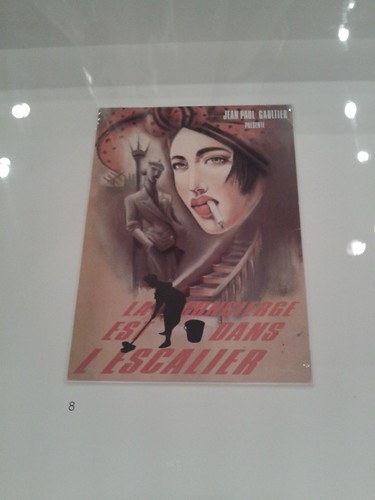
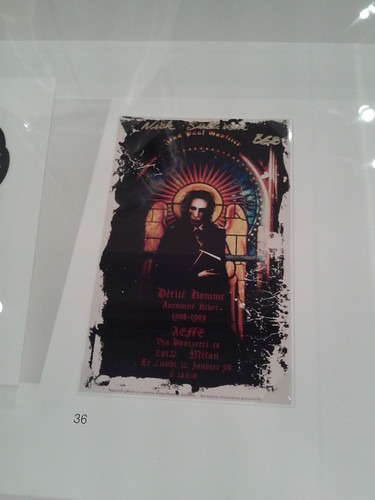
After visiting, and loving, the Jean Paul Gaultier exhibition at the Barbican, I decided to visit the satellite exhibition, Jean Paul Gaultier: Be My Guest, which is being held in the London College of Fashion‘s Fashion Space Gallery until the end of May. The Gallery is near Oxford Street and I popped in one weekday lunchtime (the exhibition is open every day except Sunday).

This small but interesting exhibition showcases Gaultier’s graphic design work, which dates from the early 1980s to the present day. It includes invitations to his shows as well as advertising campaigns.The exhibition really complements the Barbican’s exhibition and further shows how Gaultier’s unique style developed over the years.2014_0428BeMyGuest05 2014_0428BeMyGuest06 2014_0428BeMyGuest07 2014_0428BeMyGuest08 2014_0428BeMyGuest09

The Glamour of Italian Fashion 1945-2014 – V&A

One of the V&A‘s latest exhibitions is The Glamour of Italian Fashion 1945-2014. It is a look at the history of Italian fashion from the end of the Second World War to the present day. Over time Italian fashion has increased in popularity; the country already had a strong heritage of making clothes and leather goods, and individuals and organisations were able to capitalise on this, with help from postwar funds from the USA, to establish and enhance the growth of the fashion industry.

My favourite part was the stunning array of gorgeous ball dresses at the beginning, but I found it interesting to learn how fashions evolved and how dressmaking techniques were managed.

The Fashion World of Jean Paul Gaultier – Barbican Art Gallery

The Barbican‘s latest exhibition, The Fashion World of Jean Paul Gaultier, opened recently and I went along for a visit. I only knew of Gaultier from his famous corsets, but there is so much more to his work, which I loved. There were some amazing outfits on display, and what impressed me was that most of them were wearable – a bit dramatic and OTT, maybe, but you could wear them on a night out without worrying about whether you can actually move or see.

The exhibition started off quite gently with a display of Gallic-themed striped clothes and a selection of stunning dresses from one of Gaultier’s ranges, and moved on to look at the influence of British as well as Parisian culture and the rise of the punk movement. His corsets were looked at in detail as were several of the celebrities, including Madonna, Kylie and Lily Cole, who have worn his clothes.

I liked how Gaultier has played with traditional concepts of femininity and masculinity throughout his career, putting men in skirts and women in men’s tailored suits. His outfits do work really well; it’s hard to tell with mannequins but they seem like they would really flatter whoever was wearing them.

The mannequins rather freaked me out: their faces move and some of them talk! I found them rather creepy to be quite honest.

The exhibition runs until 25 August and if you have even the slightest interest in clothes or fashion then do go.

2014_0417Gaultier01
Entrance to the exhibition
2014_0417Gaultier09
Stunning dresses
2014_0417Gaultier07
My favourite outfit
2014_0417Gaultier06
Mermaid
2014_0417Gaultier13
British Punk influence
2014_0417Gaultier18
Gorgeous lace dress
2014_0417Gaultier33
Amazing movie reel-inspired dress
2014_0417Gaultier25
Corset
2014_0417Gaultier28
Jean Paul Gaultier’s ACTUAL teddy bear wearing the first ever pointy bra!
2014_0417Gaultier39
Not a real leopard. I hope.