I paid a visit to the Jean Etienne Liotard exhibition at the Royal Academy of Arts, which is on until 31 January in the Sackler Wing, Burlington House. Liotard (1702-89) worked largely as a portraitist across Enlightenment Europe. Born in Geneva, he travelled widely, working at times for the British, French and Austrian royal families. More unusually, his exploration of the Near East and the Ottoman Empire gave him a fascination with Oriental costume and a nickname, “the Turk”. This is the first sole exhibition of Liotard’s work in the UK, and includes over 70 works.
Liotard worked largely in pastels, which makes him very different from other artists that I am familiar with. His portraits have fantastic detail and he was clearly a very accomplished artist, but to my eye there is something slightly flat about them: I missed the depth that oil paintings have. The exceptions are Liotard’s self-portraits and the pictures of his family and friends, which reveal sensitivity and depth. I particularly liked the unusual Self-Portrait Laughing from c. 1770.
I did notice that the pictures included a lot of blue, and I wondered why. Perhaps blue was just a common colour of the clothes of the period, or perhaps Liotard wanted to make the pictures look expensive: I know that in terms of oil paint, blue shades were particularly expensive, so perhaps using pastel was a way to get this effect without the cost. However, this is just conjecture.
This was an interesting and unusual exhibition, well worth seeing, and rather enlightening.
I recently visited a new exhibition, White: a project by Edmund de Waal, at the Royal Academy of Arts. This exhibition, which runs until 3 January, is unusual as it takes place in the RA Library and Print Room. As a librarian, I was really interested to see inside this space.
The project is curated by artist Edmund de Waal, and is an exploration of the colour white, its meaning and impact and its role in different contexts. De Waal has collected a number of white objects for display, each of which is very different. The objects include books, sculptures, paintings and photographs.
Edmund de Waal, who has written a forthcoming book relating to this topic – The White Road – is best known for his memoir The Hare with Amber Eyes. That very same hare is on display in this exhibition: created around 1880, and attributed to Sawaki Rizo Masatoshi.
Some of de Waal’s own white sculptures are visible here, and other varied pieces are also displayed, including a bust of a woman from the late fifteenth century, sculpted after Francesco Laurana. My favourite, however, was the South Arabian calcite alabaster anthropormorphic stele, carved in the first century BC or AD.
Images included Garry Fabian Miller’s It’s Open Clear Light from2014–15, as well as Horatio Ross’ Fir trees on the banks of Dornoch Firth between Ardgay and Fearn of around 1850. In terms of the written word, the manuscript of John Cage’s 4’33” and the white page from Laurence Sterne’s Tristram Shandy were also displayed.
The exhibition explored what the colour white might mean, revealing its lack of neutrality, its blankness, purity and spirituality. It got me thinking about what the colour white means to me, what it represents. When I think of white I think of clouds, of blank paper, but most of all of the icy landscapes of the Arctic and Antarctic. What does white mean to you?
I recently visited The Foundling Museum near Russell Square. I had originally visited a few years ago, but the museum has been refurbished since, and I fancied going again.
The Foundling Hospital was founded in 1741 by Thomas Coram, a statue of whom can be seen outside the museum. He campaigned for seventeen years before being granted a royal charter by George II in 1739. The hospital cared for children until 1954, when the last pupil was placed in foster care. In total, around 25,000 children were cared for by the hospital, which was Britain’s first children’s charity.
The museum, which occupies one of the hospital’s original buildings, covers four floors. The ground floor has an exhibition on the history of the Foundling Hospital, explaining that most of the children arrived here because their mothers couldn’t care for them, either because they had been widowed or because they had “got into trouble” while unmarried. As more and more babies were in need of a home, a lottery system was introduced: mothers had to take a ball out of a cloth bag; a white ball meant that their baby would be accepted, while a black ball meant that they would be turned away. The women had to prove that they were of previous good character: later in the museum there were letters from parents and statements from employers, confirming the character of girls who wanted the hospital to care for their children.
Mothers were allowed to leave tokens with their children, on the off chance that they were able to return and reclaim them if their circumstances improved. This did happen occasionally, but most women would never see their children again. The display of tokens is incredibly poignant and moving: they range from jewellery to buttons to any small item that was reasonably unique.
Life in the hospital was strict: children were kept to a regimented timetable, had to obey many rules, and were made to wear a uniform. In fairness, they were well-treated and given enough to eat: compared to many poor children they were well off. The children were educated and trained for service; later, many foundlings went into the armed forces, where they tended to adapt to the life very well given their upbringing. The later part of the exhibition looks at some of the last orphans to belong to the hospital, many of whom are still alive, and who have shared their experiences.
Nowadays, Coram still has a role, helping children and young people to develop their skills and emotional health, finding adoptive parents and upholding the rights of children. The museum, though, focuses on the past. The rest of the rooms on the ground floor and the first floor are laid out as they would have been several centuries ago: the ground floor room the very same in which women had to take part in the heartbreaking lottery, the upstairs rooms richly furnished and ornamented with paintings. The hospital was the first public art gallery, Coram having cajoled and persuaded several artists, including William Hogarth, to donate their work.
Thomas Coram
The top floor of the museum is home to the Gerald Coke Handel Collection, an internationally-important collection relating to the composer, including manuscripts, printed music and books. Handel left the score of the Messiah to the Foundling Hospital in his will.
The museum has a programme of temporary exhibitions. The current exhibition is The Fallen Woman, which runs until 3 January. It looks at the representation in art of “the fallen woman”, particularly in the nineteenth century, including the work of Dante Gabriel Rossetti, Richard Redgrave, George Frederic Watts and Thomas Faed. The exhibition is certainly interesting and explores the myth in a compelling way.
I enjoyed my visit to the Foundling Museum: it’s well worth exploring and does tell a fascinating story.
At the end of the ghost walk around Southwark, we ended up at the Cross Bones Graveyard and were able to go inside. Cross Bones may have been a burial ground for medieval prostitutes, who could not be buried in consecrated ground. Later it was used as a burial ground for the poor. The graveyard was “rediscovered” a few years ago and hosts a vigil every month to remember “the outcast dead”. Currently a memorial garden is in the process of being constructed.
Gates of Cross BonesEntrance to the gardenThe gardenGardens under constructionMemorial shrineMemorial shrine
I signed up for a Christmas ghost walk to explore Southwark, run by poet John Constable who wrote The Southwark Mysteries. The walk began near Borough Station and ended at Cross Bones Graveyard.
There was a Dickensian element to much of the walk: it began at the St George the Martyr Church, where Little Dorrit once fell asleep in Dickens’ novel of the same name.
St George the Martyr
Nearby was the site of the Marshalsea prison, in which Little Dorrit’s father lived: Dickens’ own father was imprisoned here for debt when Dickens was a child. The wall used to be the original wall from the prison, but it has been rebuilt recently.
Wall of the Marshalsea prison
We were shown a pub nearby that is supposedly haunted by the ghost of a woman murdered by her husband. The ghost of a crying baby has also been heard there, although no one is quite sure what connection the baby has to events.
Haunted pub
On the same street that Dickens lived when he was a young boy and his father was in prison, we saw the National Trust houses established by Octavia Hill.
National Trust houses
Travelling towards London Bridge, we passed the location of the inn at which Chaucer’s pilgrims set off on their travels.
Chaucer plaque
We then popped into the George Inn, London’s only surviving galleried inn, and heard a few more ghost stories.
The George Inn
We stopped off by Southwark Cathedral after walking through Borough Market.
Southwark Cathedral
By the Golden Hind, we heard a story about the land surrounding Southwark.
The Golden Hind
We stopped to admire the remains of Winchester Palace.
Although I’ve worked close to The Wiener Library for the Study of the Holocaust and Genocide for several years now, I’d never actually visited. It wasn’t until a colleague told me about the weekly library tours, which take place every Tuesday lunchtime, that I thought to visit. We ended up making it a bit of a work thing: three of us went one lunchtime, to be followed by the other two a week later.
The Library, formed in 1933 by Alfred Wiener, is Britain’s Holocaust library and the oldest collection of its kind in the world. It holds over one million items, including illustrated and rare books, press cuttings, photographs and eyewitness testimonies.
Our tour included the main Library reading room, with considerable collections available on open access for the use of readers. Items stored elsewhere in the building, including photographs and fragile items, can be requested. Members of the public can use the Library, open on weekdays, free of charge, though first-time visitors do need to bring some ID. You need to become a member if you want to borrow books.
We were taken downstairs to view the stacks, and were able to see several fascinating items which our guide brought out to show us. One was a Nazi colouring book and another was a book of photographs of Hitler and assorted small children: both were bizarre and rather chilling. There were also some documents relating to Jewish refugees who came to the UK.
The Library runs a programme of temporary exhibitions on the ground floor. The current exhibition is Fragments of a Lost Homeland: Remembering the Armenian Genocide which is on until 25 February. This exhibition focuses on one particular family around 1915 who recorded their experiences before, during and after the genocide in letters, diaries and photographs.
The Wiener Library is well worth a visit, even if you don’t need to use the research facilities. Tours run on Tuesdays at 1pm, and you can visit the temporary exhibitions during regular opening hours.
I went to this discussion with Alex von Tunzelmann, inspired by the Guardian column and the newly-released book which looks like it would be an interesting read. It was lots of fun: as someone who studied history at university I thoroughly enjoyed this look at the historical accuracy – or otherwise – of movies.
I visited the British Library for a tour recently and while I was there I decided to visit the new exhibition, West Africa: Word, Symbol, Song. Running until 16 February next year, the exhibition looks at the history of the region’s 17 nations and their use of words: spoken, written and sung.
I’m afraid to say I knew very little about West African culture and history before I visited the exhibition, and I found it very enlightening. The exhibition began with an examination of the myth of the founding of ancient Mali and went on to explore the myths and legends of the various peoples of the area, the history of the various nations and the effects of colonialism. In the modern day, it looked at writers, artists and human rights activists.
The exhibition consisted of manuscripts, film and sound recordings, clothes and textiles, books and photographs. It was very different from the exhibitions I usually go and see but I really enjoyed it.
I’m a librarian, and recently I went on a visit to the British Library organised by a group I’m a member of. The visit comprised a library tour, which really interested me because although I have visited the BL several times, it’s always been as a visitor to the exhibitions: I’m not a member and I’ve never been in the reading rooms or behind the scenes.
The British Library Piazza. Source: Jack1956 on Wikipedia
The British Library, which is a relatively new institution that only came into being during the second half of the twentieth century, is the national library of the UK and the largest library in the world in terms of items catalogued. The building holds around 170 million items from numerous countries and in every language in the world. Information is held in multiple formats: print books and ebooks, manuscripts, journals, newspapers, magazines, audiovisual recordings, playscripts, patents, databases, maps, prints and drawings. The collections include around 14 million books, and the Library holds ancient historical items dating back as far as 2000 BC.
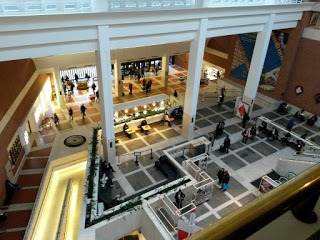
British Library Foyer
Our tour, which was delivered by a very knowledgeable and entertaining guide, began in the foyer where we learned about the library’s beginnings. The BL originally started out at the British Museum: the famous Round Reading Room is where people including Marx used to study. The British Library Act of 1972 enabled the BL to be established in 1973, although materials were dispersed around London and around the country for several years. When deciding upon a location for the eventual library site, there wasn’t much choice available: it would have to be within walking distance of the British Museum in Bloomsbury, so that the rarest and most valuable books could be carried there by hand, as they were not permitted to be transported on vehicles. Eventually the site at Euston Road was decided upon: located next to St Pancras Station, it used to be a goods yard.
The Library is a Legal Deposit Library (the others are the Bodleian at Oxford, the University Library at Cambridge, the Trinity College Library in Dublin and the National Libraries of Scotland and Wales), meaning that it receives a copy of each book produced in the United Kingdom and Ireland, including several overseas books distributed in the UK.
The Library was designed by Colin St John Wilson, and the building has met with a mixed reception (apparently Prince Charles hates it, but the Queen is a fan). Looked at from the right angle, it resembles a ship. It was made a Grade I listed building earlier this year, so it is now recognised as a landmark of design: however it is not without its problems. Wilson spent so much of the Library budget on expensive marble, containing fossils, to be laid outside on the piazza (meaning that it is extremely slippery in the rain) that there wasn’t enough left for decent shelving, resulting in some collapses as the second-hand shelves couldn’t bear the huge weight of the books.
It is impressive, however, that most of the books are stored underground: the stacks run several storeys beneath the ground, stopped only by the tube that is even further down. The Fleet River also runs nearby, so that the lowest floor does flood on occasion.
From the foyer we were taken to the Members’ Area in which you can register to become a member of the Library. Anyone can register so long as they have the appropriate ID: you don’t have to be an academic. Near here, there is a book handling system which delivers books users have ordered to the surface by means of a conveyor belt. Staff collect book requests, remove them from the shelves and send them up to the Library.
The book handling system
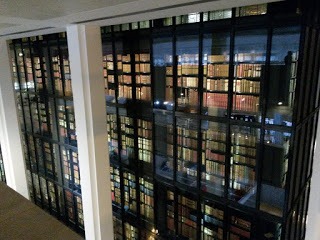
We went upstairs and were able to get a brilliant view of the King’s Library, made up of 65,000 printed volumes and numerous pamphlets, manuscripts and maps collected by George III between 1763 and 1820. The glass tower was inspired by a similar structure in the Beinecke Library in New Haven, Connecticut.
The King’s Library
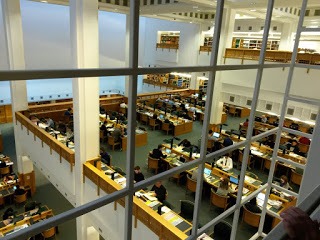
From the old to the new: our next stop was the news room where readers can view newspapers and watch a live news feed. We explored the Library considerably, taking a look at the many busy – but extremely quiet – reading rooms.
Reading Room
Before leaving, we had a quick look at a Library video in one of the quietest corners of the building – left “unfinished” to show off the brickwork.I really loved my tour: I learned a great deal about the British Library that I hadn’t known before. Public tours are available and I do recommend signing up.
The Julia Margaret Cameron exhibition at the V&A opened yesterday, and since I was meeting up with a friend in the museum café, I suggested that we pay it a visit, as she is also interested in Cameron’s work. The first thing we noticed on approaching the entrance to the free exhibition was the installation outside allowing you to take Victorian-style pictures. I’m not convinced my photo looks particularly authentic – the glittery pink bag strap is a bit of a giveaway – but I think this will be really popular with exhibition-goers. You can share your pictures on social media using the hashtag #VictorianMe.
#VictorianMe
The free exhibition, held in one room on the first floor, marks the bicentenary of Cameron’s birth, and is made up of over 100 photographs from the Museum’s collection. The V&A, then the South Kensington Museum, was the only museum to exhibit Cameron’s work during her lifetime: the founding director, Sir Henry Cole, presented her work in 1865. In 1868, the Museum offered Cameron the use of two rooms as a studio.
The photographs exhibited include portraits of the great and the good – among them Alfred, Lord Tennyson, and Charles Darwin – and Cameron’s own servants and family members, many of whom were posed as biblical, historical or allegorical characters.
Julia Margaret Cameron’s style was unique for the time, and wasn’t always appreciated. I personally love the out-of-focus technique she employed, which give her pictures an ethereal, dreamlike quality, which is unique in Victorian photography. Many contemporary critics were less than complimentary. One of the things that surprised me was seeing how confident Cameron grew as her career developed: in her letters she describes her own work as innovative and groundbreaking. On reflection, this lack of modesty probably helped her promote and establish herself in an industry dominated by men.
The most interesting thing about the exhibition, for me, was the inclusion of some “imperfect” works that Cameron herself did not want exhibited or sold. These show the issues that Cameron had in creating her work, including cracks in the images and damage to the negatives. Critics may have seen Cameron’s work as clumsy and flawed, but she had high standards of her own, knew what she wanted and how to achieve it, and was able to turn her mistakes to her advantage.