Like HMS Belfast, which I visited earlier the same day, the Churchill War Rooms are part of the IWM, and I visited one Sunday to take advantage of my Tesco Clubcard free ticket. Located beneath the streets of Westminster, these are the original Cabinet War Rooms used to protect the Government from attack during the Second World War. Initially I was just thankful to get out of the heat (the rooms were lovely and cool), but I thoroughly enjoyed my visit for its own sake.
The first important room I came to was the Cabinet meeting room. Not all meetings during the war were held here, but over 100 were.
The War Cabinet meeting room
I then came across the weather guide, designed to let those underground know what it was like outdoors. Famously, the guide was changed to ‘windy’ during air raids.
Weather information
There were a surprising amount of corridors, with random doors leading off them at various points.
Corridor
About halfway through the tour there was a Churchill Museum, examining the wartime Prime Minister’s life and career. I learnt several interesting things – I was surprised to hear that he was so radical early in his career.
Door to 10 Downing Street
After the Cabinet and a number of staff began to use the underground War Rooms, the ceiling was reinforced to provide protection in case of air raids. However, the bunker was still not completely secure and a direct hit would have destroyed it. Luckily, this never happened.
Reinforced ceiling
Members of staff worked day and night underground, sometimes even sleeping here.
One of the Cabinet rooms
Churchill had his own room in the bunker, complete with wall maps. He didn’t often sleep here, however.
Churchill’s room
The Churchill War Rooms are open seven days a week (except 24-26 December inclusive). I definitely recommend a visit – there is a surprising amount to see and take in, and the War Rooms are crucially important to the history of 20th century Britain.
FACTS
Address: Clive Steps, King Charles Street, London, SW1A 2AQ
A couple of weeks ago, I decided to visit HMS Belfast, the WW2 ship moored on the Thames near London Bridge station. I’d got a Tesco Clubcard voucher which was about to expire, and thought I should use it up sharpish! Unfortunately the Sunday I visited was one of the hottest days of the year, and I can tell you it got pretty warm inside the ship. Nevertheless, I enjoyed my visit.
HMS Belfast
HMS Belfast is run by the Imperial War Museums, and information can be found on the same website. The ship was built in Belfast and launched in 1936. Hit by a mine in 1939, she had to undergo thorough repairs before returning to service in 1942, helping to protect Arctic convoys (Russia’s wartime supplies) and playing a crucial role in the Battle of North Cape. She also played a key role during the D-Day landings. HMS Belfast is the last remaining ship of her type in existence, and has been in position on the Thames for over 40 years.
Ship’s bell
Outside the ship it was hot, but inside it was even worse – hot and stuffy. The filmed ‘battle’ on the gun deck was highly entertaining, though. When I reached the ship proper, I was amused to find this sign:
Amusing sign
I found the waxworks on the ship rather creepy, particularly this grim-looking fellow. Others could be found baking in the kitchen, manning the controls and lying in hammocks.
Creepy waxwork
I ventured down to the bowels of the ship to explore, which involved a good deal of climbing up and down ladders (and is not recommended for young children). This would have been more fun if it had been less warm. I wasn’t entirely comfortable with being below the waterline, and was rather glad to be back on deck.
Front of the shipProw of the shipProw of the ship
Even if you’re not really into naval history, HMS Belfast is a good place to visit, as there is lots to see (including a number of small exhibitions inside the ship). I enjoyed it – especially as I got in for free!
I’d never heard of the Cinema Museum until I saw it appear on Groupon. I mentioned this to the very knowledgeable and informative guide who conducted my tour, and he said, “If I had a pound for every time I heard that…” I think the museum deserves to be better known, as it is fascinating.
The Cinema Museum
The address of the Cinema Museum is The Master’s House, 2 Dugard Way, London SE11 4TH. It is near Elephant & Castle tube station, surprisingly near to where one of my friends used to live. Other than organised events, it is only possible to visit the museum via a conducted tour, and this was how I got to look round on Saturday.
I’d booked in advance, but was disconcerted to find the place so quiet – I wondered if I’d turned up at the wrong time, but luckily someone opened the door for me. The first part of the tour involved watching a couple of short films while sitting in original theatre seats. One was a rather abstract promotion for the Post Office while the other was about the last tram in London – which fitted in well with my London Transport obsession. We joined up with the previous tour to visit the display of cinema uniforms, which came from a variety of different periods and cities and which varied considerably in colour, style and appeal.
Exhibition of cinema uniforms
After the first group left, their tour completed, our guide took us around the rest of the museum, which holds a wide and varied collection based around the concept of going to the pictures. Fixtures and fittings (e.g. carpets and signage), marketing materials, photographic images and publications such as fan magazines, films (e.g. B-movies, ads, trailers), equipment (e.g. projectors, sound systems and uniforms) and other random items. I was surprised at the number of items which seemed to be from Cumbria: when I asked the guide at the end he said that this was because one of the major contributors to the museum lived in a nearby town, and always made a point of turning up at cinema closures to get hold of bits and bobs. A piece of carpet from Workington and a sign from Egremont were just two of the items I spotted.
Old cinema signage
As a librarian by profession, I was pleasantly surprised to see that the museum has a library, which has been sorted by a volunteer (from what I could work out, the vast majority, perhaps even all, of the people associated with the museum are volunteers). There is also a room devoted to pictures of different kinds, such as stills from film sets.
Library
On the first floor, there is a room devoted to Charlie Chaplin. Fittingly, the man actually spent time here: the building used to be the Master’s House of the former Lambeth Workhouse, where Chaplin entered alongside his mother when he was a child. The room we ended up in, the former workhouse chapel, was beautiful and the ideal place to rest and have a cup of tea.
Collection of Charlie Chaplin postcardsFormer workhouse chapel (complete with giant Charlie Chaplin sculpture!)
I definitely recommend a visit to the Cinema Museum. It’s a hidden gem and well worth a look if you’re remotely interested in cinema. Get in touch on 0207 840 2200 or email info@cinemamuseum.org.uk to arrange a tour, which costs £10 for adults and £7 for children and concessions.
FACTS
Address: 2 Dugard Way (off Renfrew Road), London, SE11 4TH
This strange exhibition at the V&A, Memory Palace, asks what would happen if memory was forbidden. Conceived by the author Hari Kunzru, who has written a book to go alongside it, the installation takes us into a world some time in the future where all information infrastructure has been wiped out, and those in power demand that everyone follows a simple life, without remembering the past, creating art or recording history or stories.
The narrator is in prison, accused of reviving the ‘art of memory’. He has turned his prison cell into a ‘memory palace’, and stores fragments and details of recollections here as best he can.
Walking through the exhibition was a surreal experience. It made me think about the role of and importance of memory, and also the way in which memory and evidence can be interpreted in future generations. For instance, in this ‘memory palace’ the practice of recycling has been interpreted as a religion and an illegal gathering of people is called the Internet.
At the end of the exhibition, viewers are invited to submit a memory to the V&A which will be preserved on one of their posters. The poster to which I contributed mine is below: can you guess which is my memory?
We were let out of the office early on Friday afternoon, so I took the opportunity to visit the latest exhibition at the National Gallery, Vermeer and Music: The Art of Love and Leisure. I don’t know much about Vermeer apart from ‘Girl With A Pearl Earring’, so I was looking forward to this.
The relatively small exhibition explored the role of music in the seventeenth-century Netherlands. In the art of the time, music often represented harmony, temperance and moderation, as well as transience – still lives showed how death meant the stilling of music. Gatherings of families and friends often revolved around music – but so did entertainment at establishments such as brothels. Some of the pictures on display deliver ambiguous meanings, for instance by using close-ups of musicians to explore emotions. In a restricted society, making music was one way in which young courting couples could spend time together and explore their emotions.
Paintings weren’t the only things on display: there was also a selection of early printed music books, which were often shared by lovers and carried around in secret. Several instruments of the kind seen in the pictures were also on show, some of which were quite different to modern instruments. For example, there was a lute, a clavischord and a virginial. Some of these instruments were seen as particularly suitable for women, while others were seen as rather dubious, often because of the positions a player needed to adopt while making music.
The highlight of the exhibition was the room in which three of Vermeer’s paintings – A Young Woman standing at a Virginal, A Young Woman seated at a Virginal (from the National Gallery) and Guitar Player (on loan from Kenwood House) – were displayed alongside each other, exploring the role of music in different ways. My favourite painting, though, was The Music Lesson, in which a young woman and her music tutor share a supposedly innocent music-making experience – until you see the reflection in the mirror and notice their positions and the expressions in their faces.
The last section of the exhibition looked at Vermeer’s use of colour in his work, including his unprecedented use of expensive ultramarine and decision to use green earth when painting skin tones. This was an interesting way to round off the exhibition.
My parents came down to London to visit me a couple of weeks ago. They left around midday on the Friday and as I had an afternoon free, I decided to visit the Cutty Sark.
The Cutty Sark is a tea clipper, the last one to survive. She was named from the poem ‘Tam O’ Shanter’ by Robert Burns, in which the character of Nannie the witch wears a ‘cutty sark’ – an old Scottish term for a short nightdress. Launched in 1869, she enjoyed a varied career transporting tea from China, wool from Australia and various cargoes to and from Portugal and the Americas before being severely damaged in 1916. In 1922 a retired windjammer skipper, Wilfred Dowman, set out to buy her and brought her back to the UK where she was restored. The ship was towed into a dry dock in Greenwich in 1954, where she has remained ever since.
When I was a child, I visited Cutty Sark with my family although we didn’t actually look round the ship: there are, however, several photos of us standing outside it. At the time it was rather run down, so I was pleased to hear that a refurbishment programme was planned (this began in 2006). Though severely hampered by a fire partway through the restoration, the programme was completed and the Cutty Sark reopened to the public just over a year ago, on 25 April 2012.
I was astounded when I walked up to the ship from the DLR station that shares its name. It is exactly where it always was, but the ship and its setting have been transformed. The ship rests on a raised glass canopy, beautifully restored.
The Cutty Sark seen from the front
I paid my entry fee and headed to the centre of the ship. I sat and watched a short video surrounded by a number of boxes and the smell of tea. It was very atmospheric. Next I headed to a higher floor with more exhibits. My favourite thing was the seat designed to mimic the movement of the waves: sitting on it was so relaxing!
Inside the ship
I went on deck and explored further: the outside has clearly been just as painstakingly restored as the inside.
On deck
Here, I stopped to look round the captain’s quarters, which were fairly swanky, a clear improvement on the narrow bunks used by the crew. Still, I don’t suppose it makes a great deal of difference where you are when the ship is swaying every which way.
Inside the Captain’s quarters
I went down in the lift to the lower ground floor, which has been cleverly designed to fit under the ship while still letting through plenty of natural light. I enjoyed looking at the motley collection of figureheads.
Figureheads
The view of the ship from underneath is pretty impressive.
Underneath the ship
Visiting the Cutty Sark is pretty expensive, but it’s worth it just to marvel at the brilliant job the restorers have done with it. I was hugely impressed.
FACTS
Address: Cutty Sark Clipper Ship, King William Walk, Greenwich, London, SE10 9HT
I visited the London Transport Museum as a child, but I imagine a lot will have changed since then; also, I can’t remember most of it. So I decided to visit again on Wednesday, after a visit to the Library (which I had arranged on behalf of one of the library groups I am a member of).
The Museum underwent a complete refurbishment a few years ago, and looks very smart. Housed in the old Covent Garden Flower Market, the old and the new fit together very well. The Museum is set out in such a way that you travel through time over two hundred years of history. This is great fun – you get into the lift and as it takes you up to the second floor, you can see the years counting down!
The first part of the Museum looks at the methods of transport available before the railway. London had a much lower population than it does now, and most got about by walking, except for the rich, who ventured out in contraptions like these:
I feel sorry for the guys having to carry this
As far as the river was concerned, most people crossed via boat: London Bridge was the only bridge for several years. Back on land, different kinds of carriages monopolised the roads, and horse-drawn buses became popular:
Horse-drawn tram
The Museum then covers the history of the London Underground, starting with the steam-powered Metropolitan Railway and following with the electrical trains of the Tube.
Early steam train on the Metropolitan LineTube carriage
From then, the museum’s scope widens further: it continues to explore the role of railway transport – including the Underground – but also encompasses trams, buses, taxis and – to an extent – cars.
Buses, trams and taxis
Towards the end, mention is made of cycling, and there is a reference to the forthcoming CrossRail line.
I also took the opportunity to visit the exhibition Poster Art 150 – London Underground’s Greatest Designs. Curated to celebrate the 150th anniversary of the London Underground network, it displays 150 of the best posters created to promote the Tube. Viewers are invited to inspect them all and vote on their favourite.
I’m not really a tennis fan at all, but I thought it would be really interesting to visit Wimbledon, as it has such a long history. I went there on Sunday to look round the museum and partake in a tour, and ended up being infected by some of the enthusiasm clearly felt by tennis fans.
Wimbledon Lawn Tennis Club is located in south west London, and can be reached by bus 493 which goes through Tooting and encompasses both Southfields and Wimbledon stations. I actually got off at Wimbledon Park station and walked through the park, which was a lovely experience on what turned out to be a rather pleasant day. To get to the museum you enter the site at Gate 4, and the entrance is nearby.
Entrance to the Museum and Shop
Entrance to the Museum and a tour of the site costs £22. This sounds expensive but I actually found it to be well worth it. I looked around the Museum first, which took about an hour. The Museum was renovated in 2006 and tells the story of lawn tennis and Wimbledon from the early days of the game and the first Championship in 1877 to more recent 21st-century developments. I found it to be interesting, well laid-out and informative, with fascinating items displayed including early tennis rackets, tennis-related memorabilia and outfits through the decades. I was appalled by the female outfits from the Victorian era, which included full corsets and long skirts. Frankly I’m amazed women were able to play the game at all in those clothes. There is also a hologram of player John McEnroe projected into a model of a dressing room, as well as videos and other interactive exhibits. Finally, the famous Wimbledon trophies are displayed in all their glory. These remain permanently on-site and winners get small copies to keep.
After looking around the Museum, it was time for the tour. This took an hour and a half and was a really good experience. Our guide was a Blue Badge guide and very knowledgeable. I was amazed at all the different nationalities of those on the tour – there were people from the USA, Australia, the Netherlands, India, Mexico and Thailand. It just goes to show how famous Wimbledon is the world over. We met at the statue of F. J. Perry, Britain’s last ever Gentlemen’s Singles Wimbledon Champion. His ashes are contained alongside.
Statue of F.J. Perry
On the tour we were shown a number of the courts, and introduced to the famous Wimbledon grass which we were ordered not to touch on pain of death (not quite!). One of the courts was the location of the nail-biting 2010 match between John Isner (USA) and Nicolas Mahut (France), which at over eleven hours turned out to be the longest ever Championship match. Our guide had been there at the match, and her recollections made me – who has never watched more than five minutes of tennis in my life – wish I had been there too.
Plaque recording the longest match in 2010
Near the beginning of the tour, we were shown the large board showing the results of all the Singles matches from Wimbledon 2012. Our guide explained that even the best players can be beaten by up-and-coming stars, and this is part of what makes tennis such an exciting game.
Boards showing the 2012 Wimbledon results
After a look around No. 1 Court (not to be confused with Centre Court), we were shown and given the chance to climb up Aorangi Park, so called because it was constructed on land previously leased to the New Zealand Sports and Social Club. It is a popular place for visitors to sit during the Championships because a giant screen is placed above the stairs by No. 1 Court showing all the matches that take place in that court. The area has been known informally as ‘Henman Hill’ and ‘Murray Mound’ as it has been commonly used by fans of these two British players.
Aorangi ParkWimbledon logoView of No. 1 Court, showing where the large television screen is placed during the Championships
Later we were shown the players’ reception, where they are required to sign in each day during Wimbledon. We also visited the press room, where players are required to give interviews to the media if requested to do so. We were offered, and a lot of my fellow tourists took the opportunity, the chance to sit in the seats ourselves and get our photos taken! I chickened out, partly because I would have been on my own, and it would have been a bit weird.
The players’ receptionThe Press Room
Our guide took us past an old-fashioned roller, originally pulled by horses to ensure the grass was smooth enough for tennis. She explained that the roller played an important part in the history of Wimbledon – if it wasn’t for it breaking, the club officials would never have come up with the idea of holding a tennis tournament to raise money for another. After the success of the first tournament, a second was held the following year, and the year after that… the rest, as they say, is history.
The Pony Roller
Finally we headed to Centre Court. On the way, we passed the boards on which are engraved the names of all the Wimbledon Champions dating back to 1877.
Championship Winners’ Boards
Centre Court itself looks rather similar to No. 1 Court, but there are several important differences: it is the only court to have a Royal Box, and is currently the only court to have a roof (though one is planned for No. 1 Court in the next few years). If it should start to rain, the roof can be activated; normally folded like a concertina at either end of the court, it folds out and is ready for play within 40 minutes, which is very good news given the unpredictability of British weather.
Centre Court
There the tour ended, leaving me, as I mentioned earlier, with a new-found appreciation of the game of tennis. Unfortunately, the ballot for tickets for the 2013 Championships closed at the end of last year, and I don’t think I am quite dedicated enough to get up early at a ridiculous hour and queue for day tickets. However, I intend to register for the 2014 ballot when it opens in August, and see what happens.
FACTS
Address: The All England Lawn Tennis Club, Church Road, Wimbledon, London, SW19 5AE
On Saturday, I visited Hatfield House with some friends. We had been meaning to go there for ages as it’s only twenty minutes out of London, but these things always end up taking a long time to organise. We weren’t sure about the weather as there were some ominous black clouds hanging in the sky. However, we luckily managed to avoid the rain, if not the wind.
Hatfield House is famous as the place where Elizabeth I grew up. In fact she was told that she was the Queen of England beneath an oak tree in the grounds. The house she lived in, however, is in fact the Old Palace; the current house was built by Robert Cecil, the first Earl of Salisbury, in 1611. The whole estate remains in the hands of the Cecil family.
Hatfield House
We arrived at eleven and the house didn’t open until midday, so we went for a walk in the gardens. We wandered through the formal mazes and planned gardens, peeped in at the window of the Old Palace, and walked through the meadow. Round the back of the house, we could see a herd of deer.
The house itself was magnificent and imposing. It is finely decorated in the Jacobean style with dark wood – I loved the richly detailed staircase. As we all studied the Tudors for A Level History, we were excited to find several original paintings of Elizabeth I, including the famous Rainbow Portrait. My favourite room was the Library, which was filled with books from floor to ceiling. It had stairs and a balcony, and a comfortable-looking window seat. At the end of the tour, we visited the kitchen which proudly displayed lots of random utensils.
The tour took a lot less time than we thought – it was only half past one when we came out – so we decided to go to the pub. The pub we found seems to be a notable one in the literary world.
The Eight BellsDickens plaque
Hatfield House was fun, but I don’t know if it’s worth the full price (around £15). I took Tesco vouchers which made it much more reasonable. I think they should open more rooms, as the tour didn’t really take that long. However, the rooms that were on display were beautiful. I’m pleased, anyway, to have finally visited this place.
The other weekend I visited 7 Hammersmith Terrace, former home of Emery Walker and boasting an original Arts & Crafts interior. The house is only open at certain times via guided tour, so I booked my visit online and turned up at the house just before eleven. 7 Hammersmith Terrace is on the north bank of the Thames, near Stamford Brook tube station on the District line.
Emery Walker (1851-1933) was a printer and was a great friend to William Morris, who lived nearby at Kelmscott House. He also had contact with many of the other leading cultural and political figures of the period, including Philip Webb and George Bernard Shaw. His house is filled with authentic furniture and decorations from the period: William Morris wallpaper, furniture left to Walker by Webb, photographs, artefacts and personal items such as a lock of hair, as well as items he and his daughter Dorothy picked up on their travels.
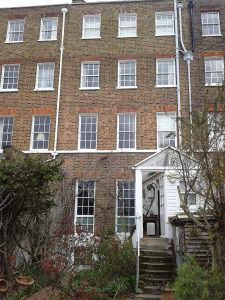
Back of the house, seen from the garden
This is a beautiful house and well worth a visit – I definitely recommend booking a tour.