RIFT Macbeth

2014_0717BalfronTower
The Balfron Tower was designed by Erno Goldfinger in 1963

I’m going to write a proper review of RIFT’s Macbeth, but in the meantime I want to write something about the experience itself, as it was one of the craziest, most intense things I’ve ever done. I booked it for myself for a birthday treat, and I tried to get some friends to come along, but none of them were particularly keen on the idea. Despite initial apprehensiveness about going on my own, I needn’t have worried. I talked to loads of really interesting people, about the show and about our shared interest in immersive theatre (practically everyone there had already been to Punchdrunk’s The Drowned Man). In any case, most of our time was spent taking in the show, and we didn’t have to worry too much about chatting.

Webcowgirl and Playhouse Pickings have already written really helpful guides to the experience, so all I will do is emphasise the importance of following their tips – they came in very handy for me. Having said that, there were no super-hot peppers at our banquet – only perfectly innocuous, not at all spicy ones. I felt rather smug that I’d heeded the warnings about eating beforehand and going to the loo (I spent a couple of hours at Westfield Stratford before heading to Langdon Park DLR) as many of my fellow audience members were dying for the toilet almost immediately and when we were finally allowed to go there was a huge queue.

I stayed overnight and slept very well in my bunk bed – a bit TOO well, to my disappointment, as I slept right through the whopping thunderstorm that occurred on Thursday night, and missed out on the chance of watching the action from my flat’s 18th floor balcony. The flat itself – the hall and bathroom, at least – was still covered in blood from the performance, which was somewhat disconcerting. I was able to wash my face and brush my teeth, but after much-appreciated coffee and croissants in the morning I was very happy to get home and finally have a shower.

Still, this performance will go down as one of my favourite London experiences, and it was definitely one of the best birthdays ever!

2014_0718BalfronTower03
Amazing views from my 18th floor balcony
2014_0718BalfronTower02
Amazing views from my 18th floor balcony

On this day I complete my twenty-ninth year

This poem pretty much sums up how I feel as I get older.

Indian Summer

In youth, it was a way I had
To do my best to please,
And change, with every passing lad,
To suit his theories.

But now I know the things I know,
And do the things I do;
And if you do not like me so,
To hell, my love, with you!

Dorothy Parker

Once: The Musical

When my auntie was in London we went to see Once: The Musical at the Phoenix Theatre. We had stalls seats so we were able to go on stage and look around / buy drinks before the show started, as well as watch the cast jamming before it began. I was very happy to get my Once souvenir plastic glass!

2014_0712Once01
The on-stage bar
2014_0712Once03
Me, happy with my souvenir glass!

(Photos taken by my auntie with her phone, as my battery died!)

London Aquarium

The London Aquarium, located near the London Eye in the old London County Hall building, is somewhere I’ve been meaning to visit for a while. I used to love going to Sea Life centres as a child – I have vivid memories of taking the cable car from the top of the cliff at Scarborough towards the white, pyramid-shaped Sea Life building by the sea. It’s been years since I visited one, however.

My auntie visited at the weekend and although we had a couple of theatre visits planned, it was a bit of a struggle to think of things we could do to fill the rest of the time. We’ve both done things like go on an open top bus and visit Buckingham Palace, and she isn’t that keen on history, so the exhibitions and museums that would normally be my first port of call were out. However, when I mentioned the London Aquarium, my auntie said she thought it sounded like a good idea, so off we went.

As it was such a hot day, we had hoped that everyone would be too busy enjoying the sun to visit indoor tourist attractions. However, this sadly proved not to be the case. We had to wait around an hour to get in, but luckily we were able to stand in the shade until then. Despite the huge queue, everyone seemed to spread out once inside, so it wasn’t as full as we were expecting, luckily.

The Aquarium is, I think, very expensive: over £20 for one adult. My auntie very kindly paid for me, but if I was to go again I would look for a special offer – for instance, the London Days Out offer which gives you 2 for 1 tickets when you travel in by rail. A child ticket is only £5 less than an adult. There are various ticket packages available: if you book online you save a couple of pounds (25% if you go for a special After-3pm ticket) and you can buy ticket packages for other attractions including the London Eye and the London Dungeon.

Inside the Aquarium, you follow a path taking you through all of the zoned areas. There are toilets at various points on the route and a buggy park at the beginning. The centrepiece of the Aquarium is the huge tank which is home to several black tip reef sharks. The Shark Reef Encounter, as it is known, begins as you walk over a glass floor looking at the sharks below, and continues as you walk through a glass tunnel, seeing these amazing creatures swimming over your head. There are various points within the Aquarium where you can stand or sit beside the tank and look at the creatures inside.

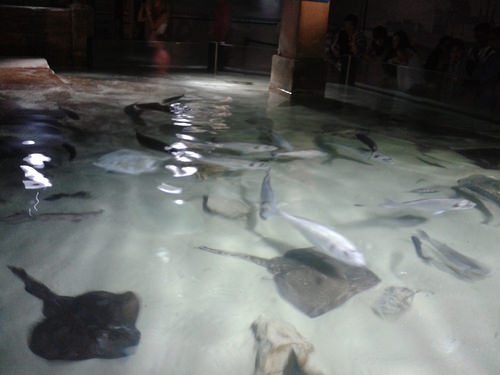
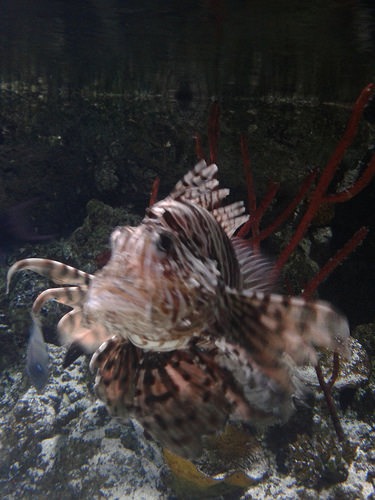
Other zones included Pacific Wreck, Atlantic Depths, Tidal Reach and the River Thames Story, to name just a few. Each zone showcased sea creatures native to that particular area, with information about each fish or other creature that you would find there. It was really fascinating to see so many sea creatures. I particularly liked the brightly-coloured tropical fish, and I loved the ray tank, with friendly rays showing off at the surface of the water.

One theme running through the whole Aquarium was that of conservation. There were regular notices explaining which creatures were endangered and how we can help to save them, from conserving energy to help prevent global warming to giving up eating certain types of fish (such as cod) to help their numbers recover. The Aquarium is doing its best to research, care for and breed the creatures in its care in order to ensure their survival. I really liked learning about this side of the Aquarium’s work, and it made me think about how I could make changes in my own life to help ensure the survival of endangered species.

I’ve left the best until last, as my favourite part of the whole experience was, of course, the penguins! The Ice Adventure section has a number of Gentoo penguins in a specially-built enclosure designed to cater for their needs, including a much lower temperature than you would get naturally in this country. I was particularly excited to meet the newest penguin, a baby who only hatched in June. It (they don’t know if it is male or female yet) still has some fluffy feathers, and we were told that they aren’t waterproof yet, so if the baby falls in the water someone has to go and towel-dry it!

Our visit took a couple of hours, and I’m sure we could have spent longer in there. I would definitely go again, but only if I could get some sort of special offer!

2014_0712LondonAquarium04

2014_0712LondonAquarium05

2014_0712LondonAquarium06

2014_0712LondonAquarium07

2014_0712LondonAquarium08


2014_0712LondonAquarium14

2014_0712LondonAquarium17

2014_0712LondonAquarium18

Bob Mazzer: Underground – Howard Griffin Gallery

2014_0709HGGallery
Highly appropriate seating in the Gallery

I headed to Shoreditch to catch the Bob Mazzer – Underground exhibition at the Howard Griffin Gallery, on from 12 June-13 July. The Gallery was decorated in a basic style but as a nice touch had seating from old Tube trains. The photographs themselves were taken across a 40-year period, during which Mazzer explored the London Underground and captured intimate, humorous pictures. Among my favourites were the man standing on a ladder whose face was obscured by a clock on a platform at Stockwell, and the couple embracing while round the corner a man urinated against the wall – quite a contrast!

Creaky Cauldron – Stratford upon Avon

2014_0703CreakyCauldron
Entrance to the Creaky Cauldron & Magic Alley

After visiting the MAD Museum, I still had some time left so I also visited the Creaky Cauldron and Magic Alley, just up the road. This place is billed as a shop and museum and it looks as though it was inspired by Harry Potter, with Butterbeer, wands and magical-themed toys for sale. The building is also home to the Enchanted Manor Museum, which I decided to visit.

I had expected a traditional museum with magical artefacts, but I realised quickly that this was not to be, once I was handed a clipboard, a pen and a worksheet. This reminded me of school trips when I was a child, when I had to fill in the answers while exploring the museum. The idea is that you answer questions and solve puzzles as you go around the museum, which covers two floors above the shop and cafe.

The museum was very atmospheric, with a dark and spooky atmosphere. In fact, at some points when I was alone on the top floor, I genuinely felt rather scared! The museum takes inspiration from magical lore, Harry Potter, His Dark Materials and other magical stories and is full of fascinating tales and interesting facts. I think children in particular would really enjoy this – I felt a great sense of achievement when I received my certificate at the end!

MAD Museum – Stratford upon Avon

2014_0703MADMuseum
Entrance to the MAD Museum on Henley Street

Yesterday I went on one of my many day trips to Stratford upon Avon. The show I was there to see didn’t start until 3 pm, which left me a few hours to kill. I’d wandered past the MAD Museum on Henley Street a few times, and thought the time was right for me to pay it a visit.

I walked in at the right time, as a huge school party was just leaving. There were only a couple of other visitors remaining, so I had most of the exhibitions to myself.

The museum has only been in existence since 2011 (it originally occupied premises on Sheep Street) but has already won several awards, including the TripAdvisor Certificate of Excellence for 2014. MAD is short for Mechanical Art and Design and the museum showcases kinetic sculptures and art. Think marble runs, but much more varied and elaborate!

The museum is full of delights, most of which are interactive: press a button and see what happens. My favourites were the typewriter converted to a music-making machine, thanks to wires connecting each key with a glass filled with water, and the large-scale ‘marble-run’ style sculpture set in a kitchen. Several of the works are available to buy, and all display remarkable ingenuity. This museum is an ideal place to visit no matter what your age or level of interest in mechanics – though I think someone interested in how things work would get the most out of it.

Making Colour – National Gallery

I had some time to kill last Sunday, so I popped into the National Gallery to visit their Making Colour exhibition. It proved to be one of the most interesting exhibitions I’ve seen for a very long time. The exhibition took a rather different focus, looking at the ways in which artists have used colour over the centuries and the difficulties they have faced in finding the right shade. I’m not an artist, although I enjoy looking at art, so I’ve never really thought about the restrictions artists face when it comes to paint.

Concerning Colour

The first room was about the early use of colour, and made the point that the modern theory of primary colours was only developed around 1600. However, earlier artists such as Annibale Carracci instinctively used colour to emphasise and contrast. Colour wheels were developed, in which colours lying opposite one another produced the most effective contrasts. This can be seen in later paintings by Renoir and Van Gogh: Renoir painted an orange boat against blue water while Van Gogh depicted orange crabs against a blue-green background.

Despite the conventional representation of an artist’s palette as neat with distinctly marked colours, in reality palettes were incredibly messy owing to the need to mix colours together to provide an accurate shade. J.M.W. Turner’s paintbox on display shows that relatively few colours were available to him, and his palette was hugely messy. Later on, paints were produced in tubes, making them more convenient and easier to transport; the Impressionists were among those artists who benefited from this development.

The Quest for Blue

The history of blue in art is a fascinating one. The second room explored the various kinds of blue available to artists, and the benefits and drawbacks of each. For centuries natural ultramarine, made with the rare and precious mineral lapis lazuli (mined in Badakhstan, now part of Afghanistan), was the highest quality blue available: it was more expensive than gold, and figures and amulets made with this mineral have been discovered in Middle Eastern graves. This is the reason why, in Western art, Mary (mother of Jesus) is often portrayed in blue robes – painting her robes with the most expensive shade available was seen as a sign of devotion. I found this really interesting, as I had wondered in the past why Mary was always depicted in blue. Ultramarine is stable and long-lasting: this is shown in Pierre Mignard’s painting “The Marquise de Seignelay and Two of her Sons” (1691) in which the colours are as fresh today as they would have been at the time.

Other, cheaper blues were available, but these came with their own problems. Azurite has a tendency to go green over time: the contrast between the greenish robes of Saint Peter (painted with azurite) and the rich blue robes of Christ (painted with ultramarine) in the painting “The Betrayal of Christ” (1324-5) by Ugolinodi Nerio is clear to see. Another option was smalt, but this is also unstable. In Jan Jansz Treck’s “Still Life” (1651), smalt was used and the blue has now faded to grey.

In the eighteenth century a synthetic blue, Prussian Blue, was created and manufactured in bulk. Though it did not have the quality of ultramarine, it was an improvement on what had gone before. Gainsborough’s portrait of Sarah Siddons (1785) shows that while the Prussian Blue has faded, it still looks better than either azurite or smalt.

A synthetic ultramarine, known as French ultramarine, was developed in the nineteenth century, and is still used to this day. Finally, an artificial shade was available that matched the results of natural ultramarine. It was used in such works as Monet’s “Lavacourt Under Snow” (c. 1878-81).

Painting Green

The story of green is another fascinating one. The need for green became more marked as landscape painting grew in popularity, with artists struggling to replicate the colours of the landscape in pigment. Two of the most common early greens were verdigris – taken from the surface of copper and bronze – and green earth, producing more muted greens. In Renaissance Italy, green earth was used as a base for faces: this is why they often appear to us to have a greenish tinge. In the nineteenth century, emerald green and viridian replaced earlier greens. Rousseau’s “Valley” (c. 1860) and Cézanne’s “Hillside in Provence” (c. 1890-2) are examples of paintings that made use of artificial greens.

Fashionably Yellow

Muted yellow shades – ochres – were available for many years, with artificial yellows becoming available during the Renaissance: relatively early compared to some other shades. Lead-tin yellow and Naples yellow were among the shades which came into the world of painting via ceramics: there are some interesting porcelain colour test plates on display. Anthony Van Dyck’s “Lady Elizabeth Thimbelby and Dorothy, Viscountess Andover” (c. 1637) and Thomas Gainsborough’s painting of his daughters chasing a butterfly (c. 1756) are examples of the use of these yellow glazes.

Orange could be created by mixing red and yellow, and red lead was also used until around the fourteenth century. Realgar, an orange mineral, was also used on occasion, but this was problematic as it contained arsenic, and was therefore poisonous.

Seeing Red

There were two main ways of creating red pigments. Vermilion was produced from the mineral cinnabar, and was also made artificially from the nineteenth century onwards. In addition, plant and insect dyes could be processed to create red lakes. Vermilion was a much brighter and more stable option, as shown in Masaccio’s painting of the saints Jerome and John the Baptist (c. 1428-9). Jerome’s robes, which were painted with vermilion, are still bright but John’s, which were coloured with red lakes, have faded to pink.

Royal Purple

Creating purple was less problematic than many other colours, as it could be mixed from blue and red. Paris Bordone’s “A Pair of Lovers” (1555-60) is an example of a painting that incorporates purple to give the illusion of rich silk. However, there were other ways of making this colour. The Romans used Tyrian purple made from shellfish, while in 1856 mauveine was patented by William Perkin, although the latter colour was chiefly used as a fabric dye. Queen Victoria and her family are pictured wearing purple in her cartes de visite, while paintings such as Arthur Hughes’ “April Love” (1855-60) capitalised on the popularity of the colour.

Gold and Silver

I found this section to be one of the most interesting in the exhibition. It appears that when real gold leaf is used in art, it is candlelight in which it appears to best effect: modern lighting makes it look flat and dull. Paint, which was increasingly used instead of gold leaf, actually looks better and more realistic to modern eyes. In terms of silver, paint effects were used to create the impression of this metallic shade. In Salvoldo’s “Mary Magdalene” (1535-40), the silver cloak was created using a mixture of lead white and lamp black.

I was really impressed with this exhibition. It was really different, and made me think about what goes into creating works of art. I have the utmost respect for artists in the past who had to make the best of the limited materials they had.

First Aid at Work

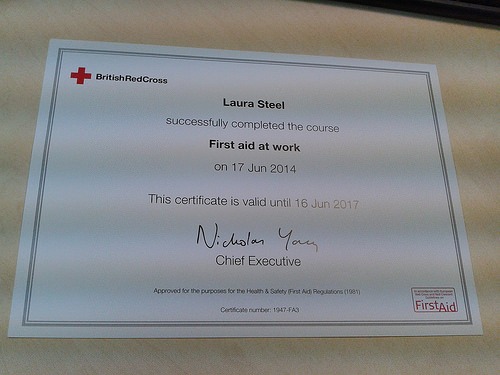
I recently completed a First Aid course at work with the British Red Cross. Work paid for the course, which was handy! We learned about the recovery position, CPR, bandages, and how to recognise and initially treat conditions like heart attack, stroke, anaphylactic shock and poisoning. There was a lot to learn, but our instructors were really good and there was a great mix of theory and practical material.

A few weeks later, I got my certificate!

2014_0707FirstAid

Windsor Castle

I finally got around to visiting Windsor Castle. About time, too, since I live in West London, so it’s really easy to get to. I had the day off work to go on a visit to the Royal Library; this wasn’t until the afternoon so I thought I might as well go round the Castle in the morning.

It’s impossible to miss Windsor Castle when you arrive in Windsor (I got the shuttle from Slough after the train from Paddington, which goes into Windsor & Eton Central; there’s also a train from Waterloo which arrives at Windsor & Eton Riverside). It towers over the small town, and there is only a short walk up a hill to the Visitor Centre. I was initially taken aback at the size of the queue, which extended all the way down the road; however, I soon discovered that this was the queue for groups, and individual visitors could go straight through. I paid and got inside within ten minutes.

2014_0626WindsorCastle05
The Castle, seen from just outside the Visitor Centre

The area covered by the Castle and the grounds is large, and I had a map and an audio guide to help me. The guides are full of information and very interesting, so I didn’t feel the need to go on one of the half-hourly Precinct Tours up to the State Rooms. I spent some time wandering about the grounds, learning about the history of the place, which has been home to English and later British royalty for hundreds of years.

2014_0626WindsorCastle17
Windsor Castle
Changing of the Guard

It was around eleven by this time, so I decided to go and see the Changing of the Guard, which happens every day at this time. There was quite a crowd, but the sloping bank ensured a good view for everyone. I last saw this ceremony years ago at Buckingham Palace. It is a very bizarre event and I am not sure why so much shouting is needed. It must be quite embarrassing for the soldiers having crowds of gawping tourists standing around, but I suppose they get used to it.

2014_0626WindsorCastle18
Changing of the Guard
St George’s Chapel

Afterwards, I decided to go and see inside St George’s Chapel, as I was right next to it. The chapel is beautiful and I think it was my favourite part of the whole experience. Sadly photos were not allowed, so you’ll have to take my word for it how stunning it was. Famous monarchs including Henry VIII and Charles I, as well as the current Queen’s parents and sister, are buried here, and the chapel is the spiritual home of the Order of the Garter, with ceremonial helmets – some of the most outlandish of which wouldn’t look out of place on Lady Gaga – on display inside. However, my favourite part was the small corner chapel in which Princess Charlotte is buried. This little-known Princess was the only (legitimate) child of George IV, much loved by the public, but she sadly died in childbirth in 1828; on her death, Princess Victoria – later one of our most famous monarchs – became heir to the throne. Her white marble tomb is a monument of sentimental Romanticism, with her dead body shrouded in a beautifully sculptured sheet, and angels lifting her and her stillborn child up to heaven.

2014_0626WindsorCastle24
St George’s Chapel
Queen Mary’s Dolls’ House

After coming out of the chapel, I wandered further into the grounds and made my way towards the State Rooms. There are two entrances here: you can go straight to the State Rooms, or stand in a queue to see Queen Mary’s Dolls’ House. In my opinion this is not to be missed. An exquisite replica of a stately home, it was built for Queen Mary by the leading British architect Sir Edwin Lutyens between 1921 and 1924. The amount of detail is striking: you could look at it all day and still not see everything. My favourite part was the library, with tiny miniature books (later, during my Royal Library visit, I was able to see some of these books close-up!). This area also has two larger, almost child-size dolls on display: called France and Marianne, they were presented to King George VI and Queen Elizabeth for their daughters, the Princesses Elizabeth and Margaret Rose, by the French Government during the 1938 State Visit to France. I have to say I was pretty envious of the dolls’ designer wardrobe!

Treasures From the Royal Archive

This area of the Castle is home to a series of temporary exhibitions. The current exhibition is called Treasures From the Royal Archive and I couldn’t imagine a better exhibition to catch my interest. The Royal Archive is made up of the official and private papers of the Sovereign and other members of the British Royal Family, together with the records of the Royal Household and the private Royal estates. Some of the exciting artefacts on display include Princess Elizabeth’s (the Tudor Princess Elizabeth, who later became Elizabeth I) account book from the mid-sixteenth century, the title deed for the purchase of Buckingham House (later Buckingham Palace) dated 1763, and a letter of condolence to Queen Victoria from US President Abraham Lincoln on the death of Prince Albert. Some of the items I found rather touching, such as Princess Elizabeth’s (the current Queen) written account of her parents’ coronation in 1937, and the telegram she sent to her own mother on her 100th birthday.

The State Apartments

The next stop was the State Apartments themselves. You may remember the fire of 1992, which destroyed much of this part of the Castle: I don’t, since I was only seven at the time, but the rooms have been rebuilt and refurbished, and the effect is impressive. There is a plaque marking the place where the fire began, near St George’s Hall and the Grand Reception Room.

I found my audio guide very helpful in this part of the castle, as there was a great deal of information to impart. The Castle has been the home of 39 monarchs over the years, but it is the influence of Charles II (r.1660-85) and George IV (r.1820-30) which is most marked. Artists whose work adorn the Castle walls include Grinling Gibbons, Rembrandt and Reubens. The Apartments are still used today on special occasions.

Facilities

There are toilets at various locations, and places to sit; there are a number of souvenir shops, and you can buy drinks and ice cream, but there are no cafes or restaurants. However, you can get your ticket stamped if you want to leave the Castle for a meal and then come back. My visit took me half a day, so it would certainly be possible to see everything you want to before having to leave to get food.

In common with other Royal Collection sites, your ticket – so long as it is not bought from a third party – is valid for a year after first entry, providing you get it stamped and signed by a member of staff. There is a desk for this down some stairs to the left as you leave the State Apartments. I fully intend to make the most of this, as I live within easy travelling distance of Windsor. I would also like to have the chance to visit the Semi-State Rooms, which are only open from October to March.

Windsor Castle is definitely worth a visit: with nearly 1000 years of history, and lots to see and do, it’s a really enjoyable day out.

2014_0626WindsorCastle19
The Castle, seen looking up from near the exit