Samuel Pepys: Plague, Fire, Revolution – National Maritime Museum

Samuel Pepys (1633-1703) lived through some of the most dramatic events of the seventeenth century. He witnessed at a young age the beheading of a king, followed by a republic, then the Restoration and two coronations; not to mention the Great Plague of 1665 and the Fire of London in 1666. A republican who served under the monarchy, a lover of wine, women and song who nevertheless condemned the licentiousness of the royal court, a President of the Royal Society who admitted that he often did not understand science, and a naval administrator who, when he joined, knew nothing about the sea, Pepys strikes me as a sympathetic character, an ordinary man who to a large extent made it up as he went along and was able to succeed by adapting himself to circumstance and making an effort to learn.

The Samuel Pepys: Plague, Fire, Revolution exhibition, which uses the witty hashtag #PepysShow, explores the history of Pepys’ time in his own words, alongside artefacts and records from the period. He has been called the greatest diarist in the English language; his diary is notable for recording everyday details as well as major events, which have allowed historians to understand what daily life in the seventeenth century was like. Pepys actually kept his diary for ten years only, between 1660 and 1669; he stopped because he feared his eyesight was being affected. However, we have other ways of learning about his life, such as his letters.

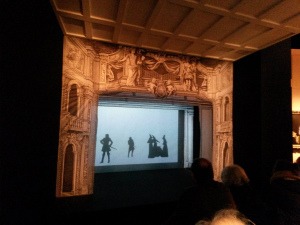
The exhibition follows a largely chronological format, beginning with the beheading of King Charles I, witnessed by a young Pepys. We learn about the life-threatening and excruciatingly painful operation he underwent to remove a bladder stone, and his marriage to Elisabeth de St Michel. Pepys’ everyday life is explored in displays relating to music and theatre, both of which he enjoyed, especially after the Restoration when theatre was once again permitted and encouraged.
2016_0312PepysShow
Representation of the Restoration theatre

We learn about the Great Fire from Pepys’ detailed account, as well as his wife’s illness and death. Later, Pepys was active in the Royal Society and became its President; interestingly, I learned here that Newton’s seminal Principia Mathematica was only published thanks to a donation from Edmund Halley, as the Royal Society had just spent its entire book budget on a History of Fishes.

One of the most impressive items in the exhibition is the eighteenth century court dress, which is in fantastic condition especially given its age. I also enjoyed looking at other artefacts from the period, including early editions of books. The last part of the exhibition explores the publication history of Pepy’s diary: several individuals transcribed them into plain English (from the shorthand in which they were written) during the nineteenth century but it wasn’t until the 1970s that the full, unexpurgated edition – containing references to Pepys’ various liaisons – was published.

The exhibition runs at the National Maritime Museum until 28 March, and it is well worth visiting if you are at all interested in this period of history.

Ada Lovelace – Science Museum

2016_0228AdaLovelace01

Ada Lovelace is having a bit of a moment right now. The daughter of Romantic poet Lord Byron, she was brought up by her mother Annabella Milbanke to focus firmly on science and mathematics. However, it would be a combination of mathematical ability and the ability to make profound imaginative leaps that would ensure her place in scientific history.

2016_0228AdaLovelace032016_0228AdaLovelace06

This small free exhibition at the Science Museum marks the bicentenary of Lovelace’s birth. It contains portraits, letters and notes as well as some of the calculating machines that she worked with. The exhibition demonstrates how her collaboration with Charles Babbage (who called her “The Enchantress of Numbers”), creator of the Difference Engine and Analytical Engine, led her to explore the potential of these machines, suggesting that in the future they would be able to manipulate symbols, not just numbers. Her work, which anticipated modern computing a century before Alan Turing’s work at Bletchley Park, has led her to be labelled the first computer programmer.

2016_0228AdaLovelace07 2016_0228AdaLovelace04

I admit that the science of these machines goes right over my head, but I am definitely an admirer of Lovelace and her incredible achievements, particularly in an age when women were hardly ever able to study scientific subjects. She definitely deserves to be better known, and hopefully this exhibition will go some way to ensuring this.

2016_0228AdaLovelace05


Black Georgians: The Shock of the Familiar – Black Cultural Archives

2016_0227BCA01 2016_0227BCA02

The Black Cultural Archives were founded in 1981 and a dedicated heritage centre in Brixton was opened in 2014. I visited in order to attend the latest exhibition, Black Georgians: The Shock of the Familiar.

This free exhibition looks at the lives of black people during the Georgian period (1714-1830). I have to admit that although I love history, and have a history degree, I don’t really have any knowledge or understanding of the lives of black people in Britain. The exhibition shows that people of African origin, who had lived in Britain for centuries, were growing in number and were starting to establish a distinct presence in society.

The exhibition looks at the lives of black people who lived in Britain under different circumstances: some were enslaved and worked as servants, others were free and were either born in Britain or chose to settle here. A few even had private incomes, and became the first black bourgeois. In many ways their circumstances mirrored those of white Britons, with members of all social classes carving out lives for themselves, although black people had to contend with racism and oppression in addition to any other problems they might face. The picture is much more complex than my limited knowledge had previously led me to understand.

Evidence for these lives comes from various documentation, including pictures, letters and other writings. Phillis Wheatley is one individual whose life is explored in the exhibition: sold as a servant in Boston aged seven, she was recognised as having particular intelligence and given an education; she subsequently became the first African-American woman to publish poetry, and was treated as a celebrity when she first visited London in 1773. Ignatius Sancho was a writer and composer, the first known black Briton to vote in an election, while Tom ‘The Moor’ Molineaux was a famous sportsman. Evidence for the existence of “ordinary” black people is found in census records, on gravestones, even in art: the inclusion of a black man in one of Hogarth’s pictures suggests that the presence of black people on London’s streets was a normal occurrence.

This is an important exhibition for anyone wanting to understand the lives of black people in Britain during the Georgian period, and anyone interested in social history as a whole.

FACTS

Address: Windrush Square, Brixton, London, SW2 1EF

Website: bcaheritage.org.uk

Opening Hours: Tues-Sat, 10am-6pm. Late opening until 7pm, every second Thursday of the month.

Prices: Free

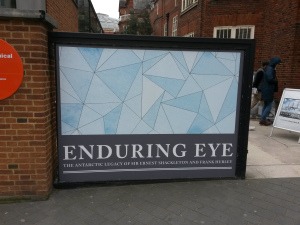
Enduring Eye: The Antarctic Legacy of Sir Ernest Shackleton and Frank Hurley – Royal Geographical Society

2016_0227RGS01

I only found out about this exhibition a couple of weeks ago, after reading an article in Londonist. Luckily I was in time to visit, though as it was the final weekend the display was pretty crowded. I braved the hordes anyway, as I am a bit obsessed by Antarctica and the Imperial Trans-Antarctic Expedition, which this exhibition commemorates, is one of the most important and memorable expeditions in history. Enduring Eye: The Antarctic Legacy of Sir Ernest Shackleton and Frank Hurley marks the 100th anniversary of the conclusion of the expedition: it did not achieve its stated aims, but it is deservedly admired nevertheless.

2016_0227RGS02

The Royal Geographical Society has a collection of original glass plate and celluloid negatives created by Frank Hurley, the official photographer and cinematographer on the expedition. This collection has been ditigised as part of the centenary celebrations, and much of it is presented here.

The Imperial Trans-Antarctic Expedition was established by Ernest Shackleton, who aimed to be the first to cross Antarctica. On the ship Endurance, which left Britain on 1 August 1914, he and his crew headed south. After stops in Buenos Aires and South Georgia, the ship made it to the Weddell Sea, where it was trapped in the pack ice.

Despite the best efforts of the entire crew, and after several months of entrapment, the Endurance was eventually crushed by the ice and destroyed. What followed was one of the greatest feats in the history of Antarctic exploration. I’ve read a great deal about the expedition, I’ve seen more than one exhibition about it, but I never tire of hearing more. The crew sailed in the lifeboats to Elephant Island, from where Shackleton, Worsley and four others departed in one of the lifeboats, the James Caird, to fetch help. In a hugely impressive feat of navigation, they safely reached South Georgia, only to be faced with a further trek over mountains and glaciers to reach the whaling station on the other side.

A rescue ship finally arrived at Elephant Island on 30 August. Every single one of the men from the Endurance survived (the men on the other ship, the Aurora, which had the job of laying supplies for the expected trans-Antarctic party on the other side of the continent, did not fare so well, losing three of the ten men left on the ice over the winter). Some of the artefacts from the expedition survived, and are on display here, including the Union flag presented to Shackleton by King George V, a knife carved from a tent peg by ship’s carpenter Harry McNish, and sketches and notes made by Reginald James, one of the men marooned on Elephant Island.

The exhibition covers the history of the exhibition from the first departure of the Endurance, following everyday life on board the ship as the crew get used to their routine. As the ship became trapped in the pack ice, photographer Frank Hurley took the opportunity to take detailed shots of the ship and of the region, by all accounts completely dedicated to getting the perfect shot, even willing to risk his own life by climbing up to the top of the ship’s rigging to take pictures from up high. Hurley was able to develop the photographs despite the incredibly cold temperatures and less than perfect conditions, so it is extremely impressive that his pictures are as wonderful as they are. In particular, I love his shots of the ship Endurance, trapped in the ice; the famous night-time shot with the ship looming out of the dark, the rigging glowing in a ghostly manner, is a masterpiece by any standards.

When the decision was made to abandon ship, Hurley had to leave behind many of his beloved negatives, selecting only the best to take with him to Elephant Island. On the way he managed to take more photographs, capturing the dramatic journey as well as life on the island as the crew waited for Shackleton’s return.

Hurley’s pictures helped to popularise the expedition both immediately after it took place and well into the future. These pictures are magnificent: even a century later they still have incredible power. The achievements of Shackleton, leading the expedition, and Hurley, capturing it on film, are still awe inspiring today.

2016_0227RGS03
Statue of Shackleton on the side of the RGS building

Liberty in Fashion – Fashion & Textile Museum

2016_0219Liberty01

I love Liberty prints, so I was obviously going to find the time to visit the Fashion & Textile Museum‘s most recent exhibition, Liberty in Fashion. The exhibition marks 140 years since the company was founded by Arthur Lasenby Liberty, originally a warehouse supplying goods from the Far East which grew to become one of the most distinctive British companies in history, and which is still going strong today.

2016_0219Liberty02

Arthur Liberty aimed to create new fashion, and his work became so distinctive that softly draping silk was known in France as soie Liberty and the entire Art Nouveau movement was known in Italy as Stile Liberty. He ensured distinction and high quality by establishing Liberty “Art Colours” and producing fabric in Great Britain. His original “Arthur Liberty’s Oriental Bazaar” sold imported silks from the Far East, as well as other items such as fans, china and enamel wares. It later branched out to source fabrics from other locations, and began to establish original collections, including garments such as dressing gowns and wraps, inspired by the kimono. Liberty’s original business was established on Regent Street: it wasn’t until 1925 that the now-famous Tudor Building was opened.

2016_0219Liberty03

2016_0219Liberty04

Liberty influenced, and was influenced by, the Aesthetic movement which aimed to free women from restrictive corsets and promote a more romantic, flowing way of dressing. The name “Liberty” seems particularly apt for this kind of style! The company also focused on reviving traditional skills including smocking (common on the clothes of agricultural labourers in the eighteenth and nineteenth centuries), which allowed for free-flowing, comfortable and stylish garments.

2016_0219Liberty08

2016_0219Liberty06

As the twentieth century developed, Liberty began to produce delicate floral prints which even today are seen as the hallmark of the brand. Prints on a darker background during the 1920s gave way to softer, more romantic, lighter prints in the 1930s. The Art Nouveau revival in the 1950s allowed Liberty to innovate, establishing the Liberty Design Studio, as well as reviving their original designs.

2016_0219Liberty13

In the 1960s, Liberty fabrics provided the basis for many original designs by fresh new designers including Mary Quant and Marion Donaldson. By the 1970s, a new nostalgia had surfaced, and Liberty prints, which suited the period perfectly, were common in clothes of the period, including the archetypal maxi dresses.

2016_0219Liberty15

From the 1990s onwards, Liberty began to collaborate with other brands, with fascinating results. Today, Vivienne Westwood, Anna Sui and Dr Marten are just some of the brands whose collaborations have proved popular.

2016_0219Liberty18

As a lover of the Liberty aesthetic I thoroughly enjoyed this exhibition, and as a history fan I enjoyed learning about the company’s past. This is an excellent exhibition for anyone interested in how Liberty evolved.

Masters of the Everyday/High Spirits – Queen’s Gallery

As I have an annual ticket to the Queen’s Gallery at Buckingham Palace, I made sure to use it to visit the most recent exhibition before it closed. In fact, there were two exhibitions: Masters of the Everyday: Dutch Artists in the Age of Vermeer and High Spirits: The Comic Art of Thomas Rowlandson.

2016_0131QueensGallery01
Masters of the Everyday

I began by visiting Masters of the Everyday, which looked at Dutch art of the seventeenth century, mainly focused on everyday life: families, children, music, food. One of the highlights was Vermeer’s ‘A Lady at the Virginal with a Gentleman’, but my personal favourites were the Rembrandts: seemingly simple but demonstrating incredible skill – I almost felt as if the figures in the paintings were going to step out of the frames and speak to me.

2016_0131QueensGallery02
High Spirits

The second exhibition, High Spirits, focused on the work of Thomas Rowlandson (1757–1827), the English caricaturist, whose satirical work was popular in his time and remains significant today. His cartoons offer political commentary and observations on contemporary society. I liked this exhibition too: the crisp colours and sharp lines belied the age of the works, and their content was a fascinating and often amusing look into the life of the era.

Both exhibitions close on 14 February, so there’s still time to see them if you want to.

Havering Museum

2016_0123HaveringMuseum02

On the same day as I visited Redbridge Museum, I headed further east along the TfL Rail line (soon to be Crossrail) and ended up in Romford, where I popped into Havering Museum. This museum opened in 2010, on the site of the old Romford Brewery, and seems to be popular: a map in the foyer shows the location of various visitors, some of whom have visited from all over the world, including Russia and Indonesia.

The museum explores the history of the London borough of Havering, with the main exhibition spread across two rooms. Rather than being arranged in chronological order, the displays are divided by town: so Romford, Havering-atte-Bower, Rainham, Hornchurch and Upminster all get their own section. This is a different but interesting way to arrange the displays. Each section also has its own information sheet, so rather than being overwhelmed with information during your visit, you can take home the sheet and read it at your leisure.

I learned some interesting things during my visit: Romford was originally a Roman staging post called Durolitum, on the road from London to Colchester. The Golden Lion pub by the marketplace has existed since 1440, and is said to have been visited by Dick Turpin. The museum has an interesting selection of artefacts associated with the town.

When I visited, the temporary exhibition room was hosting paintings by a local artist, and there was also a travelling exhibition, Pop It In the Post by the National Postal Museum, including two examples of early pillar boxes.

I was very impressed with my visit to Havering Museum, which struck me as being a cut above most local museums, well laid out and with very friendly and enthusiastic staff. Definitely worth a visit if you’re in the area.

FACTS

Address: 19-21 High Street, Romford, RM1 1JU

Website: haveringmuseum.org.uk

Opening Hours: 11-5 Wed-Sat

Prices: £2.50 adults, £2 senior citizens; children free

Redbridge Museum

2016_0123RedbridgeMuseum

As part of my Tube jaunt to the east, I decided to check out a few of the small museums on my list. Redbridge Museum is the local museum for the town of Redbridge: it opened in 2000 and is located above the library near the town centre.

In common with many local museums, the main collection is displayed in chronological order, looking at the history of the town through the ages. It does this in reverse, beginning with recent history and going back through the centuries via two World Wars and the Industrial Revolution. There are two reconstructed rooms to show what life would have been like in different periods of the town’s history.

What I really liked about the museum was the effort they make to include the community in the displays. A changing display at the entrance explores different significant figures from the town. The current celebrated resident is Fauja Singh, who is (as far as is known) the oldest marathon runner in the world. He ran his first marathon aged 89 and only retired from long-distance running aged 101!

Redbridge Museum is currently hosting a temporary exhibition called Ice Age Ilford, which includes a life-size replica of the skull of a mammoth found in Ilford, as well as several fossilised bones uncovered during the Victorian era. Many of these bones are now cared for by the Natural History Museum and the British Geological Survey, and this is a rare chance to see them in their original home. There is also information about what the area would have looked like over 200,000 years ago, and a little about the Victorians responsible for the fossil discoveries.

Redbridge Museum is a nice little local museum and is well worth visiting if you’re in the area.

FACTS

Address: 2nd Floor Central Library, Clements Road, Ilford, Essex, IG1 1EA

Website: www2.redbridge.gov.uk/cms/leisure_and_libraries/culture/redbridge_museum

Opening Hours: 10-5 Tues-Fri, 10-4 Sat

Prices: Free

Celts: Art and Identity – British Museum

The Celts: Art and Identity exhibition at the British Museum looked at the history of the Celtic identity and what it means to be Celtic today. I was interested to learn that the name “Celts” was originally used by the ancient Greeks to refer to the “barbarians” in the north: it was a cultural label rather than an ethnic identity, and was adopted by the people of the modern Celtic nations.

The exhibition has been organised in partnership with National Museums Scotland, and traces the history of the Celts from 2,500 years ago to the present day. I was interested in the art and culture of the early Celts: helmets, shields and other artefacts are decorated with distinctive patterns, stylised as opposed to the increasingly realistic artworks of the Greeks and Romans. Many of the artefacts uncovered (some of which have come from the Thames, while others have been excavated from mainland Europe) have patterns relating to possibly mythical figures, though what they symbolise exactly is sadly lost to history. This is particularly apparent in the gorgeous Gundestrup cauldron, a breathtakingly detailed item on loan from the National Museum of Denmark.

Celtic culture survived throughout the Iron Age and the Roman conquest. Celtic art was influenced by Roman traditions, although it remained distinctive. As Christianity spread throughout Europe and Britain, Irish, Welsh and Scottish monasteries adopted many Celtic styles, in particular leading to the Celtic crosses that have become such a strong emblem for Celtic culture.

By the Victorian era, the Industrial Revolution made the lives of the Celts seem like very long ago indeed. Victorians were fascinated by Celtic culture, and reinvented it in literature and art: the poems of the supposed Celtic bard Ossian, and the Celtic-influenced designs of Rennie Mackintosh and the Glasgow School of Art, were particularly popular. I especially liked the statue meant to represent a noble Celtic warrior, standing proud in a kilt, but sporting a suspiciously Victorian moustache!

The exhibition ended in the modern day, looking at how Celtic culture is celebrated today, with clips from parades, football shirts and comic books. I really enjoyed this comprehensive and interesting exhibition.


Clockmakers’ Museum

2016_0116ClockmakersMuseum01

Originally assembled by the Worshipful Company of Clockmakers, the Clockmakers’ Museum is the world’s oldest clock and watch collection. Once located at the Guildhall, it can now be seen on the second floor of the Science Museum in South Kensington. It looks good in its new home, with chronological (naturally) displays of the history of clock and watch-making in London.

The Clockmakers’ Company (a Guild) was founded in London in 1620, with a Royal Charter granted in 1631. The museum contains many beautiful clocks and watches, demonstrating the fine workmanship and beautiful design that helped to make London the centre of the timepiece-making world for several centuries, until it lost out to the cheaper countries of continental Europe.

2016_0116ClockmakersMuseum02
One of the museum’s stunning clocks

I liked looking at the beautiful watches and clocks, still working after hundreds of years, and was impressed with the earliest examples of the clockmaker’s craft. There were even sundials! I was particularly fond of the eighteenth and nineteenth century ladies’ pocket watches, beautifully decorated, and was also very interested to see a clock which belonged to the Discovery and was taken to Antarctica.

2016_0116ClockmakersMuseum03
One of the earliest examples of clockmaking

It was interesting to see how timepieces developed over time, starting out as rather large objects but gradually becoming smaller and smaller, eventually leading to the wristwatch that we know today, although larger clocks have not yet gone out of fashion. The museum ended with a look at current cutting-edge watch technology and design – despite the proliferation of smartphones it doesn’t look as though more traditional timepieces are going to die out any time soon.

FACTS

Address: Science Museum, Exhibition Road, London, SW7 2DD

Website: sciencemuseum.org.uk/visitmuseum/plan_your_visit/exhibitions/clockmakers-museum

Opening Hours: 10-6 Mon-Sat

Prices: Free