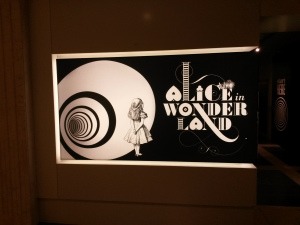
I’m a huge fan of Alice in Wonderland, and 2015 marks the 150th anniversary of the first publication of Lewis Carroll’s classic Alice’s Adventures in Wonderland. To celebrate, the British Library is holding an exhibition all about Alice.
Starting from Carroll’s initial conception of the tale – as a story told to while away the hours on an Oxford river jaunt one warm June – the exhibition covers the initial manuscript version, Alice Under Ground (which he wrote for Alice Liddell), followed by the full published version complete with John Tenniel’s illustrations. Over the next century and a half, various editions of Alice and its sequel, Alice Through the Looking Glass, have been produced, with illustrations from the likes of Arthur Rackham, Mervyn Peake and Salvador Dali. The exhibition focuses mainly on illustrated editions of the books, but it also includes merchandise produced at the time (Carroll was pretty savvy about such things) and more recently. A must-see for all Alice fans.
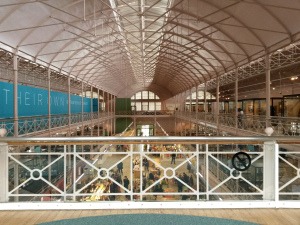
While I was at the Museum of Childhood to see the exhibition about Bagpuss and The Clangers, I took the opportunity to look around the museum as a whole. Though it is based in Bethnal Green, it is part of west London’s Victoria & Albert Museum: the building was opened as the Bethnal Green Museum in 1872 and in 1922, then-Head Curator Arthur Sabin decided to try and make it more child-friendly. The move was a popular one, and following this the Museum re-opened in 1974 as the Museum of Childhood. A refurbishment occurred in 2005-06 and the Museum continues to thrive.
The Museum is neither just for children nor solely for adults, but manages to successfully cater to both groups. Fun and educational events take place regularly for children, and adults can also get in on the act – for instance, there is a nostalgic children’s’ TV quiz taking place on the 21st of April. The Museum examines the history of childhood, which is interesting for people of all ages: adults can reminisce about their own childhoods, children can learn about how young people of the past occupied their time, and everyone can develop a greater understanding of the history of childhood as a concept.
The section devoted to the history of childhood was particularly interesting to me: it looked at how babies and young children were cared for from the sixteenth century onwards, with examples of clothing, cots and feeding equipment as well as toys. There was also a section on clothes, which showed how children went from wearing miniature versions of adult outfits to their own specially designed fashions.
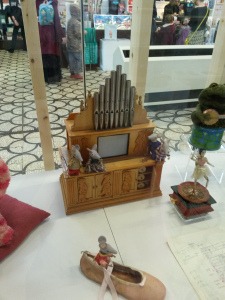
There were special sections devoted to kinetic and electronic toys, and there were some cases devoted to particular themes, such as magic, with a 1950s magic set being displayed alongside Harry Potter merchandise from recent years. I enjoyed seeing some of the toys I used to play with myself, including Sylvanian Families and the original PlayStation. I have to admit I do feel rather old knowing that toys I played with as a child are now in a museum!
The Museum is currently showing a temporary exhibition called On Their Own: Britain’s Child Migrants. This is definitely aimed at adults rather than children as it explores the sensitive and distressing topic of the children who were sent to various British colonies from 1869-1970. These children were sent away with the promise of a better life, but for many this did not materialise, and several never saw their families again.
The Museum of Childhood is definitely worth a visit. It’s fascinating, and it’s free: though be warned, you may come out with a desire to relive your childhood.
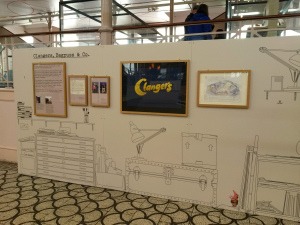
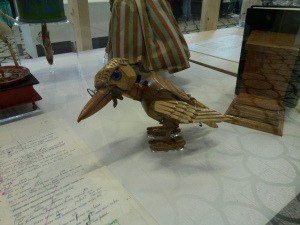
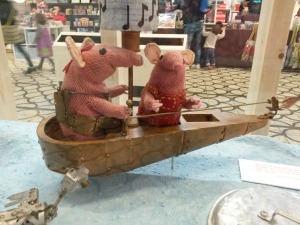
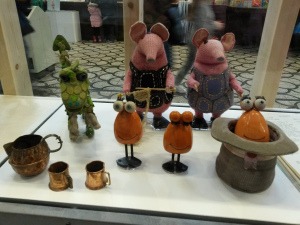
I loved Bagpuss and The Clangers as a child, so I was excited when I found out that there was going to be a free exhibition about Oliver Postgate and Peter Firmin’s work with Smallfilms at the Museum of Childhood, exploring the creation of these shows as well as others including Noggin the Nog and Ivor the Engine.
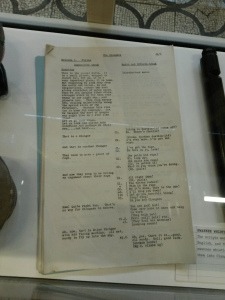
Clangers, Bagpuss & Co is small, but extremely worthwhile for fans, with original puppets, filming equipment and other documents on display. I particularly enjoyed seeing a script from The Clangers, which confirmed what I have always suspected: that the high-pitched squeaks of the characters are reflections of actual speech.
The exhibition runs until 9 October, so there is plenty of time to see it.
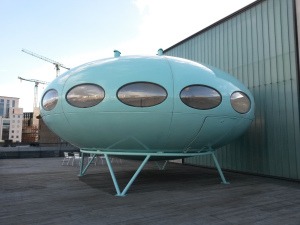
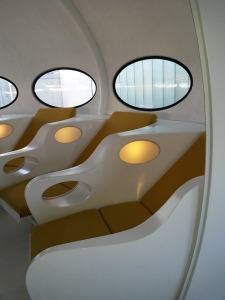
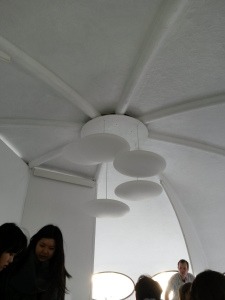
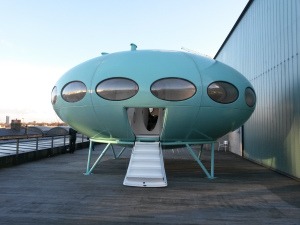
I had an interesting experience yesterday evening: I took part in a tour of the Futuro House, located at Central Saint Martins near King’s Cross. The house, which is on loan to CSM for the summer, is located on a upper terrace of the Granary Building. We met at the ground floor reception and were taken upstairs to view the house; once inside, we were treated to a talk by the owner, Craig Barnes, who explained the story behind these houses, told us how he ended up with this one, and gave us a potted history of what has happened to it since he took it over.
The Futuro House was designed in the 1960s by Finnish architect Matti Suuronen. It was last seen in London sailing down the Thames on a ferry, as part of the houses’ launch at a FinnFocus trade exhibition. It was designed to be a skiing lodge or weekend retreat: personally, I feel that the oval windows that go all the way around the house make it ideal for making the most of stunning views, while the lack of curtains mean that it only really works when placed in a reasonably remote location.
Described as “the holiday home of the future”, the house was one of several prefabricated designs made in the 1950s and 60s. Unfortunately, despite the initial popularity of such designs, the Futuro was not a commercial success: possibly because of the growing price of oil, which made it much more expensive to produce.
Today, only around 65 Futuro Houses are known to exist. Craig Barnes found this one in South Africa: he used to love visiting the “spaceship house” as a child, and when he grew older managed to buy it, disassemble it and ship it back to the UK. Over the course of many months he worked on it, with the assistance of friends, family and colleagues, until it once again became a viable piece of architecture. He has tried as far as possible to restore the original design, but there is much still to do.
The house is on loan to CSM for the summer, and as well as public tours, which take place every month, it is freely bookable by CSM staff and students for meetings and other activities. Barnes is glad that it is being used and enjoyed, but admits there are no firm plans for the house beyond September – it may go back into storage, at least temporarily, but he hopes that it will have a future life (and so do I).
If you would like to visit this incredible house, you can book a tour on the first Wednesday of every month, which costs £5.
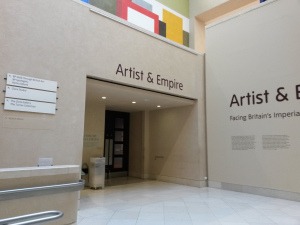
On Saturday I had a bit of time to spare so I popped into Tate Britain to check out their latest exhibition, Artist and Empire. The exhibition encompasses art from the past five hundred years or so, concerned with the British Empire. It includes works by diverse artists, both oppressors and oppressed, conquerors and the conquered, from different perspectives.
The exhibition acknowledges that the issue of ’empire’ is a difficult one to explore and come to terms with these days. However, remnants of the British Empire are all around us, and the exhibition attempts to face these head on in order to explore the issues they raise. I really like the way exhibitions at Tate Britain tend to mix old and new works and all different kinds of art, and this one is no exception.
The exhibition is divided into themes, with one room containing maps, one about heroics, one focused on costume and portraiture, and so on. Maps in particular were often used to denote conquest, while naming places implied ownership over that place. Portraits were often used as symbols of power, and the clothes worn by the sitter were often suggestive: Western dress worn by Indian royalty and Native American dress worn by the British, for example, implied a receptivity to other cultures. Having said that, the power balance was hardly equal: many works painted (pun intended) the British as morally correct, honourable conquerors. One section of the exhibition looked at trophies: collections of plants, animals and birds, drawings and paintings of them, and artefacts created by humans.
The latter part of the exhibition looks at the work of modern artists examining the legacy of empire in often-provocative ways. The exhibition is a thought-provoking one: for me, it wasn’t so much about viewing and enjoying art for its own sake, but using it as a lens through which to view beliefs and attitudes concerning empire.
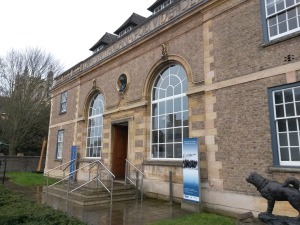
Just before Easter I went to Cambridge for work-related reasons. While I was there, I had some spare time so decided to visit the Polar Museum. This is located in the Scott Polar Research Institute, which is a centre for the study of the polar regions and is of international importance. The SPRI was founded in 1920 as a memorial to Scott and his men, who died on their return from the South Pole. It is the oldest international centre for Polar Research within a university.
I originally visited the SPRI several years ago when I was living in Cambridge. In fact, it originally inspired my interest in polar history, as I found the stories of exploration fascinating. I vividly remember viewing the original letters penned by Scott and his companions as they lay in their tent, surrounded by a blizzard, knowing they were going to die. Back then, I was on a work visit and we had a tour of the extensive library, but today I was here as a normal visitor, and stuck to the free Polar Museum.
The Museum contains information about both the Arctic and Antarctic. It encompasses the history of exploration in both regions, including the quests for the North and South Poles. My personal interests have always leaned towards Antarctica, and there is a great deal of interest here, including the history of Scott’s last expedition on the Terra Nova. However, I also enjoyed reading about the search for the North West Passage, including Franklin’s infamous expedition of the mid-nineteenth century in which he and all his crew disappeared; despite several search parties being dispatched to look for him, the mystery was never solved. The Museum also contains information about survival in these cold regions of the earth, and displays about the people who live in the Arctic (the Antarctic does not have an indigenous population).
By Endurance We Conquer
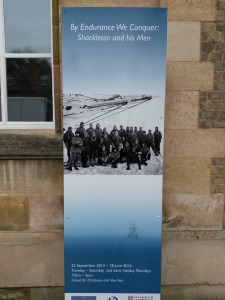
The current temporary exhibition is By Endurance We Conquer: Shackleton and His Men, and it is the major centenary exhibition commemorating Sir Ernest Shackleton’s Imperial Trans-Antarctic Expedition 1914–17. I’ve written about this expedition on this blog before, including my post about the recent Royal Geographical Society exhibition, so I won’t repeat the same facts. This expedition makes use of diaries and artefacts in the SPRI’s collections, including navigation instruments used on the JamesCaird on the voyage to South Georgia, the cooking pot used by the three men on the overland crossing of South Georgia, and Ernest Shackleton’s pannikin marked with his initials. There are also archival materials including letters, diaries, and a memory map drawn by Frank Worsley showing the route taken during the South Georgia crossing. What I liked about the exhibition was its focus on the 28 individuals of the Weddell Sea Party (not to mention Mrs Chippy the cat), with written summaries describing each person, whether they went with Shackleton to South Georgia or remained behind awaiting rescue.
This free exhibition runs until 18 June, and will be followed by a display on the Ross Sea party, commemorating the centenary of Shackleton’s arrival at Cape Evans to rescue the survivors in January 1917. It’s well worth a visit, especially as it’s free, and the museum as a whole is a superb resource for the study of polar history.
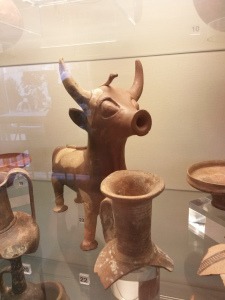
I visited the A.G. Leventis Gallery at the Institute of Archaeology, part of UCL Museums & Collections. The A.G. Leventis Gallery of Cypriot and Eastern Mediterranean Archaeology displays the IoA’s rich collection of objects from ancient Cyprus, Greece, Crete, Egypt and the Levant. It is fascinating to explore the resources and learn about how diverse the region has been during five thousand years of history.
My favourite object in the Gallery
There is also a temporary exhibition, We Need To Talk: Connecting Through Technology, which has been created by students on the MA Museum Studies to explore the different technologies we have used to communicate in different periods of time. The exhibition contains such varied items as typewriters, coins, papyrus and computers, and it’s highly informative.
A visit to this interesting gallery doesn’t take long, but it’s certainly worthwhile.
FACTS
Address: Institute of Archaeology, 31-34 Gordon Square, London, WC1H 0PY
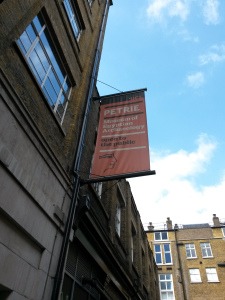
The Petrie Museum in London, which is part of UCL Museums & Collections, contains around 80,000 objects relating to Egyptian and Sudanese archaeology, making it one of the greatest such collections in the world. The museum looks at life in the Nile Valley from prehistoric times, through to the time of the Pharaohs, the Ptolemaic, Roman and Coptic periods, right up to the Islamic period.
The museum was originally set up in 1892 as a teaching museum for the Department of Egyptian Archaeology and Philology at University College London. It was created thanks to a bequest from the writer Amelia Edwards (1831-1892) who donated her large collection of Egyptian antiquities, but it was the work of Professor William Flinders Petrie (1853-1942) that propelled the museum into international significance.
It can be found hidden away behind several University buildings in central London: it’s difficult to find at first but once you get there, the entrance is apparent. Once inside, the compact museum contains a wealth of treasures: there are so many items it’s easy to be overwhelmed, but with patience it’s possible to track down some of the highlights, including the earliest ‘cylinder seal’ in Egypt, the oldest wills on papyrus, and even some incredibly rare and fragile Egyptian costumes.
The museum has the world’s largest collection of Roman period mummy portraits (first to second centuries AD), in which you can trace the development of a society caught between two cultures. In addition, it has many works of art from famous emperor Akhenaten’s city at Amarna, including tiles, carvings and frescoes. Also, the wider collection is largely taken from documented excavations, ensuring that it can offer profound insight into the everyday lives of people living at the time.
Whether you are an expert in Ancient Egypt or a casual visitor, there should be something to appeal to you in this small but rich museum. Special events regularly take place, so it’s worth checking the website regularly.
FACTS
Address: University College London, Malet Place, London, WC1E 6BT
The infamous ‘Black Museum‘ of Scotland Yard, officially known as the Crime Museum, is a collection of criminal memorabilia kept at the headquarters of the Metropolitan Police Service at New Scotland Yard. Founded in around 1874, it has been used for over a century to help the police in their study of crime and criminals. While the existence of the museum is widely known, it is not generally open to the public.
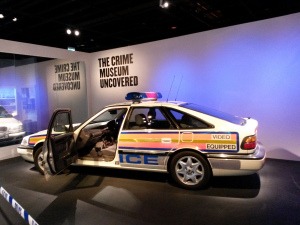
This all changed a few months ago when the Crime Museum Uncovered exhibition opened at the Museum of London. The exhibition was instigated by the Crime Museum itself, which has wanted to open up to the public for a while, but was concerned about the sensitive nature of the exhibits. Throughout the exhibition we are invited to question the ethics of putting such items on display, and to think about what they can teach us. As part of this sensitivity, the series of displays about specific crimes only go back as far as the 1970s.
The exhibition begins with a room which has been reconstructed from the original museum. It contains court sketches, Victorian-era mugshots and death masks, reflecting the nineteenth century obsession with phrenology – the belief that the shape of a person’s head could reveal their personality and character. This room is fascinating as it reveals how the Victorians thought about crime. There is also a disturbing selection of hangman’s nooses which were used on famous criminals.
The major part of the exhibition is laid out chronologically, with each case devoted to a different crime. Some of these cases are famous – Crippen, Christie, Ellis – others, less so. This section could easily be sensationalist, but instead it is informative and well-presented. The descriptions on the cases give prominence to the victims, not just the criminals, and the role of detectives and the police is emphasised: many of the cases have been chosen because of their significance in the history of detection and evidence, such as the first case in which a conviction was secured thanks to the use of fingerprints.
Sure, some of the exhibits are a bit gruesome: Crippen’s spade, the acid bath murderer’s gloves, a selection of masks made from stockings to hide the wearer’s face. However, all of them are informative, and some are even funny – such as the “false footprint makers” used by a would-be burglar to leave footprints around the crime scene. His cunning plan failed after he left his own footprints alongside the fake ones.
As well as displays focusing on individual crimes, there are themed displays containing fascinating artefacts, such as weapons confiscated from criminals, concealed weapons (including a pair of binoculars containing concealed eye spikes), and abortion pills and implements (from the days when abortion was illegal). Some items relate to modern-day crimes. These include the fake jewel used by the police in the attempted theft of the Millennium Star diamond from the Dome in 2000, and a selection of IRA mortars fired on Downing Street and MI6. There is also an unexploded nail bomb.
At the end of the exhibition there is the opportunity to watch a short video exploring how appropriate it is to open up these collections to the public. My friend and I spent a good couple of hours in here, in this informative and fascinating exhibition. It is thoughtfully put together, sensitively curated and hugely worthwhile – one of the best exhibitions I have ever seen.
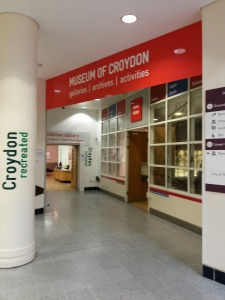
The Museum of Croydon is located in the former town hall, next to the library and other civic offices. There are two galleries on the ground floor. The Exhibition Gallery showcases temporary exhibitions of works from the Borough’s art collection; the current exhibition is Croydon Recreated, a collection of paintings by a local artist, E.A. Phipson. These pictures of Croydon from the turn of the 20th century are displayed alongside photographs and historic maps to explore how Croydon has changed. The gallery is situated alongside the Research Room, where genealogical researchers and others with cause to use Croydon’s local archives can work.
The other gallery is the Riesco Gallery, which showcases some of the original exhibits in the museum from the Riesco Collection. I thought that these exhibits were a cut above most similar displays in local museums, with some extremely impressive Chinese grave goods, beautiful small statues, fascinating Anglo-Saxon finds and others.
Riesco Gallery and Research Room
The main part of the museum is upstairs, and the entrance is designed so that you can start at either end: “Croydon Then” and “Croydon Now”, or vice versa. I chose to start “then” and work my way up to the present day.
The space is a bit dark, but generally well laid out. Rather than a junkyard of random exhibits, a selection of items has been carefully chosen to be on show in individual square cases. Judging by their names: “Mary’s doll”, “Ted’s train”, I would guess that they have been donated by Croydon residents. The items range from the personally significant – toys, sewing kits, tools – to those with wider significance, including a relic of the borough’s first mayor, who was initially respected but who was later found to be a fraudster, conning people out of their life savings with his insurance company.
Moving forward through history, the museum has the usual section on World War II, explaining that Croydon was a major target for German bombers. During the second half of the twentieth century, Croydon welcomed many immigrants and also became an important centre for art and design.
There is a section on current Croydon residents who have been invited to contribute something of their own to the exhibition. This was an interesting chance to see what different people hold significant and explores the culture of the town.
Moving to London
There is a small temporary exhibition called Moving to London, marking the 50th anniversary of the borough becoming a part of London. This also had items in various cases telling the story of this change.
Overall, the Museum of Croydon is a well put together exploration of the borough’s past. Definitely worth a visit if you’re in the area.