BDA Dental Museum

2015_0820BDA01
Entrance to the BDA

In London on a weekday with time to spare, I decided to head to the BDA Dental Museum, a small museum located in the headquarters of the British Dental Association not far from Oxford Street. The museum aims to explore the history of dental care in the UK, and has over 20,000 items, making it the largest collection of dentistry-related material in the UK.

I owe a great deal to dentists – I spent a great deal of time at the dentist’s and the orthodontist’s as a teenager, as I had an extremely awkward set of teeth that insisted on growing on top of each other in a mouth that was really too small for all of them – a bit like an Underground train during rush hour, except that Tube trains don’t tend to get random commuters popping out of the roof. I spent three years with a fixed brace but ended up with normal straight teeth, so it was worth it. After visiting this museum, I am even more thankful that I was not born a hundred or more years ago when dentistry was in its infancy.

The Museum began in 1919 with a collection of dental instruments donated by Lilian Lindsay, the first woman to qualify as a dentist in the UK. These days, the collections comprise photographs and archives, art, furniture and a variety of dental instruments and equipment. Originally designed specifically for BDA members, it was opened to the public in 1967 and redesigned in 2005.

The museum is small, consisting of one main room plus a handful of display cases in the foyer of the BDA itself and in the basement. When I visited, the basement display consisted of information about dentistry during World War I: dentistry was not classed as a reserved occupation, despite the fact that dental health was considered important for all-round health. Upstairs, the foyer displays were concerned with the 200th anniversary of the Battle of Waterloo, looking at the fact that many dentures were made from the teeth of soldiers who died in the battle.

2015_0820BDA02
The Museum

The permanent museum, which traces the history of dentistry as a distinct profession, can be found in the small room on the left as you enter the BDA building. It has interesting displays with accompanying information boards, exploring the treatments people used for dental ailments in centuries past and the eventual establishment of the BDA, which ensured recognition of the dental profession. During the nineteenth century in particular, anaesthetics were introduced, new instruments were invented (such as drills) and materials used to make dentures were improved. I was interested to see the different kinds of drills on display as well as the rather posh red upholstered dental chair, though I’d still rather have the stark, slightly boring decor of a modern dentist’s surgery with all the modern treatments that it entails! One particular character mentioned several times was John Tomes (1815–1895) – he was instrumental in transforming dentistry from a trade to a respected profession, and with James Smith Turner was responsible for the Dentists Act 1878, which ensured the registration of dental professionals.

There are a couple of screens on which you can view old, rather amusing dental videos. There is also a tiny gift shop, where you can buy things such as tooth-shaped push pins and toothpaste keyrings.

With its odd opening hours, small size and specialist collection, The BDA Dental Museum is unlikely to be anyone’s first choice for a museum visit, but if you are in the area at the right time I’d urge you to go. If nothing else it will give you an appreciation for modern dentistry!

FACTS

Address: British Dental Association, 64 Wimpole Street, London, W1G 8YS

Website: bda.org/museum

Opening Hours: Tuesdays and Thursdays 1pm-4pm

Prices: Free

Beneath the Surface – Embankment Galleries, Somerset House

With an afternoon off, I went to Somerset House to check out some of their exhibitions. Beneath the Surface is presented by the Victoria & Albert Museum, Photo London and Somerset House and includes works from the V&A that are rarely displayed.

Commissioned by Photo London, the exhibition contains a huge breadth of works, ranging from Charles Thurston Thompson’s (1816-68) early photographs of paintings for conservation purposes to Nigel Shafran’s (b. 1964) unusual images taken for the 2012/13 V&A Annual Report. Because of Somerset House’s location by the river, the pictures selected largely focus on the water, too. They have been chosen by the V&A’s Senior Curator of Photographs, Martin Barnes.

Among my favourites were William Strudwick’s (1834-1910) photos from the Old London series, taken in the 1860s: these captured the riverside shortly before the construction of the Embankment, and include scenes of Lambeth, Westminster and nearby areas, as well as several medieval coaching inns shortly before they were demolished to make way for the railways. I also liked Thurston Hopkins’ (1913-2014) scenes of underground London life in the 50s; the street scenes in particular were full of energy.

Some of the pictures were more abstract: John Gay (Hans Göhler (1909-99) took pictures of lots of different manhole covers in the 1960s, revealing a wealth of different patterns. Robert Brownjohn (1925-70) took interesting pictures of street signs at around the same time, while Naoya Hatakeyama’s (b. 1958) image of a darkened sewage tunnel in Japan, from his series “Underground 1999”, is atmospheric and haunting.

Other works were particularly unusual: Benjamin Stone (1838-1914) and George Scamell (active 1900s) photographed Newgate Prison before its demolition in 1900-1902, resulting in some truly eerie images of immense historic significance. As part of the National Photographic Record Association, their job was to record a variety of subjects, many more sinister than those typically captured on film. I really liked Pedro Meyer’s (b. 1935) work, in which he set a digitally-manipulated photograph of himself as a young boy with his father alongside a picture of his adult self with his own son.

The exhibition runs until 24 August and is fascinating viewing for anyone enraptured by old photographs.

Unseen Waterloo: The Conflict Revisited – Terrace Rooms, Somerset House

I spent some time during my day off at Somerset House, which always has plenty of exhibitions to see, and visited the Terrace Galleries to view the exhibition Unseen Waterloo: The Conflict Revisited. This is a collection of photographic portraits taken by Sam Faulkner to mark the 200th anniversary of the Battle of Waterloo.

Faulkner has taken pictures of participants in the annual re-enactment of the battle that takes place in Belgium. Those who take part dress in historically-accurate uniforms, paying close attention to detail. The portraits could have been taken at the time of the battle itself – if photography had been invented then. From teenage drummer-boys to old and grey-haired generals, the exhibition really emphasises the humanity of those who took part.

The pictures explore how we remember those who died in war before the invention of photography, and I thought they were very effective in bringing home the individuality and personality of each soldier. Sometimes it’s difficult to comprehend the humanity of the 54,000 soldiers who died at the Battle of Waterloo, the last major European battle which was not recorded in photography (the Crimean War of the 1850s marked the entrance of the war photographer, bringing home the human cost of battle. Seeing so many pictures alongside each other, each representing a dead soldier, was sobering.


The Old Operating Theatre Museum & Herb Garret

2015_0815OldOperatingTheatre01
Entrance to the museum on St. Thomas Street

After the slightly lurid experience of The Clink my friends and I headed to the other museum we were interested in, The Old Operating Theatre Museum & Herb Garret. This small museum, which was boarded up for years and only rediscovered 50 years ago, is located near London Bridge station – handily opposite the pub we found to have lunch in. As the oldest operating theatre in Europe, it is a unique little museum and I had been meaning to come for some time.

History

The operating theatre’s location in the roof of a church seems odd, until you consider that St Thomas’ Church was originally alongside St Thomas’ Hospital, now demolished. The wards of the South Wing were built directly around the church, with the operating room encroaching into the church roof. Before 1822, when the theatre was built, women (men had a different ward and operating theatre) were operated on in the ward itself, which must have been highly unpleasant for all involved. In 1815, the Apothecary’s Act stated that apprentice apothecaries must attend at public hospitals; this led to hundreds of students watching operations in this and other nearby theatres. Anaesthetics were only introduced in 1846, by which time this operating theatre had closed down. Therefore it is unique in representing a late stage in the history of surgery before anaesthetic. When St Thomas’ Hospital moved to Lambeth in 1862, the Operating Theatre was partly dismantled and the entrances were blocked up. Despite minor references in academic publications, it was largely forgotten until 1956 when a researcher, Raymond Russell, decided to investigate. Following his discovery, a fundraising plan was launched to restore the space, which was officially opened in 1962.

My Experience
2015_0815OldOperatingTheatre05
Inside the Operating Theatre

Entrance to the museum is not for the faint-hearted or the mobility-impaired. You have to climb up a spiral staircase, located in the church tower, to reach the tiny foyer and gift shop. We had arrived in time for the 2pm Saturday talk, Speed Surgery! – a demonstration of surgical techniques in the nineteenth century – which I’d booked in advance via email as advised on the website. It wasn’t as busy as we – or the staff – expected, possibly because the weather outside was lovely and everyone was out enjoying the sun. 2015_0815OldOperatingTheatre06The talk was fascinating, and covered many aspects of surgery before anaesthetic and germ theory. We learned that most surgeons did not wash their hands before operating, and wore aprons that were covered in blood from repeated use. We also examined the operating table, with grooves to catch the blood and boxes of sawdust underneath to absorb the gore. Trainee surgeons could watch and observe operations – in the absence of anaesthetic, a surgeon had to be fast in order to cause the minimum amount of pain possible. While surgery in general was dangerous and had a low survival rate, some minor operations, such as the removal of gallstones, were performed with good rates of success.

2015_0815OldOperatingTheatre09
Operating table

We were shown a variety of surgical instruments – these were fearsome-looking, though well-made: surgeons would often have a set of instruments made specially which they would carry around in a velvet-lined case. Beautiful, sure, but not particularly hygienic. I knew some of what we were told as I had studied the “Medicine Through Time” module way back in my GCSE days, but some of it I had forgotten, and I learned some new things too.

2015_0815OldOperatingTheatre10
The back of the theatre

During and after the talk we had the chance to admire the operating theatre itself, which was tiny and neat. Entrance was originally through the door at the back, now boarded up, which led to the hospital – not the spiral staircase, which is reassuring. This was the theatre for women – the men were operated on elsewhere. In the absence of electric light, this operating theatre, like many of the period, was located high up with large skylight windows, allowing for maximum natural light.

2015_0815OldOperatingTheatre11
The garret

The museum itself has many interesting exhibits to do with the history of surgery and of the building, including fascinating photos of the area in the 19th and 20th centuries, and pictures of similar surgeries. There are numerous surgical instruments on display, as well as anaesthetic equipment and a section on children’s medicine, including a record of deaths in the area.

The “Herb Garret” aspect of the museum refers to the fact that when St Thomas’ Church was rebuilt in 1703, the large garret in the roof space was used by the St Thomas’ Apothecary to store and cure herbs. When the building was being restored, numerous herbs were found, including four opium poppies packed into the rafters. The exhibition includes many and varied herbs, with notes on what they were used for. There are also some notes on old-fashioned medical remedies – the most bizarre thing I learned was that in “ye olden days”, pregnancy tests were carried out by injecting a frog with the expectant woman’s hormones. If she was pregnant, the frog would lay eggs. The Old Operating Theatre & Herb Garret is a fascinating small museum that is definitely worth visiting. As well as the talks during museum hours, there are occasional special events – see the website for more details. Please note, however, though the museum has a gift shop there is no refreshment area and there are no toilets – so maybe pay a visit to the pub across the road before you go in!

FACTS

Address: 9a St. Thomas Street, London, SE1 9RY Website: thegarret.org.uk Opening Hours: 10.30am-6pm Prices: £6.50 adults, £5 concessions, £3.50 children

The Clink Prison Museum

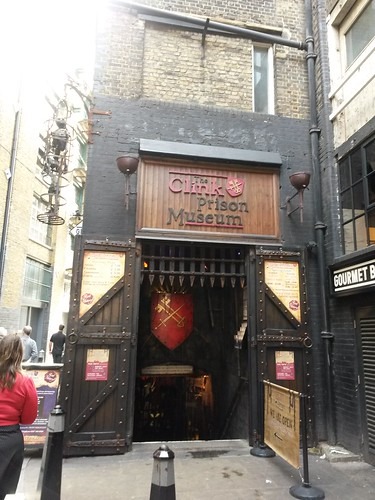
My friends Gemma and Elizabeth, like me, are history geeks and when we got together in London we decided to go to a couple of museums. The Clink Prison Museum had been on our radar for a while, so when we met on Bankside we decided to venture over to London Bridge to check it out.

2015_0815Clink01
The entrance to The Clink Prison Museum

The museum is built on the site of the original Clink Prison, which dates back to 1144. The prison supposedly got its name from the clinking sound the prisoners’ chains made as they jangled together, and the name became a nickname for prisons all over the country. For over 600 years the prison housed debtors, drunkards, heretics, prostitutes and other criminals within Southwark, an area notorious for being morally dubious – everything that was banned in the more staid City across the river took place here instead.

History

The prison was originally established as two separate prisons, one for men and one for women, in the grounds of Winchester Palace, the residence of the Bishop of Winchester. Henry of Blois, brother to King Stephen, became Bishop in 1129 and his palace, of which only the wall of the Great Hall containing the Rose Window is still visible today, was completed in 1144. Bankside was subject to the laws of “the Liberty of the Bishop of Winchester”, later “the Liberty of the Clink”.

2015_0815Clink03
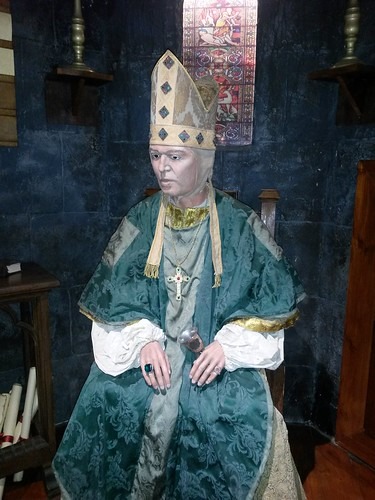
The Bishop of Winchester
2015_0815Clink04
Ring buddies!

Notable criminals housed within the Clink at various points include Sir Thomas Wyatt the Younger, who rebelled against Queen Mary I; Royalist supporters during the English Civil War; and Puritans who ended up settling in the New World as Pilgrim Fathers. However, hundreds of ordinary people were imprisoned here, though often the only record we have is a name. The museum website lists several examples, including the wonderfully named prostitute Prusanna Carnall (imprisoned 1661) and William Albaster, imprisoned in 1599 for refusing to attend church (!).

Attempts were made to destroy the prison during the Peasants’ Revolt in 1381 and Jack Cade’s rebellion in 1450; after each occasion the Clink was rebuilt, with the final two-storey prison occupying the current site of the museum. The end came during the Gordon Riots in 1780: Lord George Gordon, angry that Catholics had been granted favours in the new “Papists Act”, gathered together members of the Protestant Association and, among other things, broke into the Clink, burned it to the ground and released all the prisoners (none of whom, thankfully, were ever recaptured). Today, the remains of the Clink consist of the Winchester Palace stonework, the passage called Clink Street, and the structure preserved within the museum itself.

My Experience

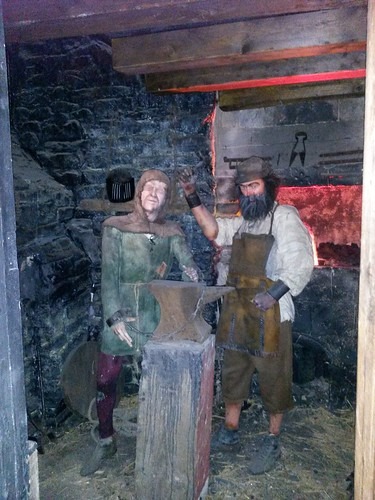
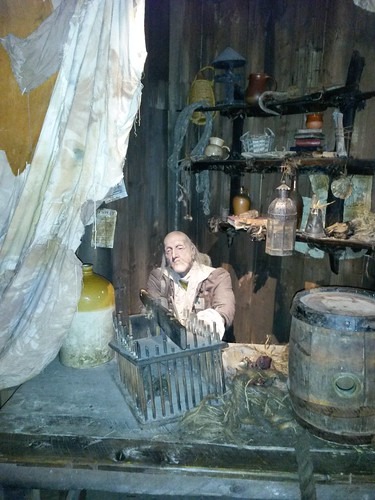
We arrived at the Clink at about eleven on a Saturday morning. We entered down the steps and were greeted cheerily by a costumed assistant (who, we found out later, was also manning the gift shop round the other side). We paid our entry fee and entered. The museum is atmospherically contained in a dingy basement; some of the structure was part of the original Clink. Evil-looking waxworks were dotted about, representing blacksmiths, gaolers and unfortunate prisoners.

2015_0815Clink02
An evil-looking blacksmith prepares to shackle a prisoner

Information boards displayed lots of interesting facts about the Clink, but in some cases they didn’t look very professional – there were some glaring spelling errors including, in one case, the misspelling of the word “prisoners”. Having said that, I learned a lot from them: the boards gave information about the history of the Clink, the prisoners kept here and the punishments used. As we went round the museum we noticed that the information was sometimes a little disjointed, although it did follow an approximate chronological order.

2015_0815Clink05
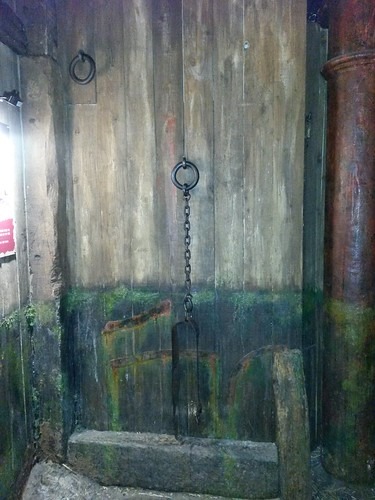
During high tide, the Thames would flood the Clink to this level – extremely unpleasant for the prisoners
2015_0815Clink06
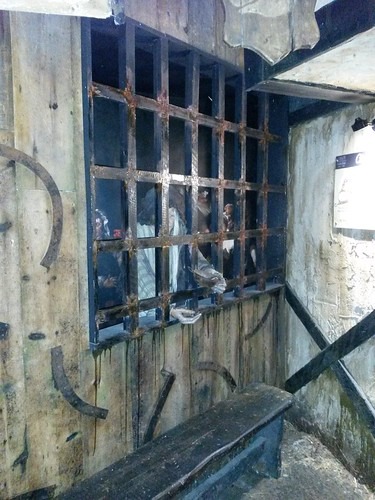
Prisoner begging through the gaol window
2015_0815Clink07
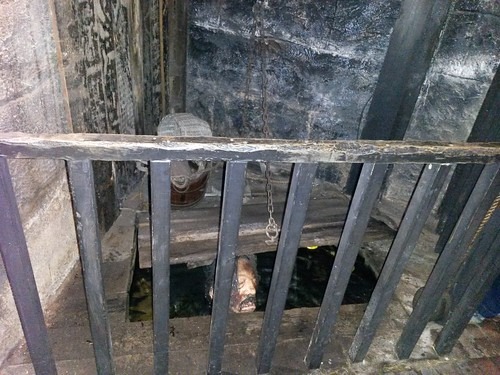
Prisoner trapped in the waterlogged oubliette

The museum concentrated on the kinds of punishments used – the oubliette, the stocks and other forms of torture – and I thought that this was rather a shame. It seemed as though the curators were trying to sensationalise the prison and turn the museum into something like the London Dungeon. I felt that they missed their chance to create a more “serious” but really worthwhile museum about the rich history of the Clink.

2015_0815Clink08
Infamous prisoner who would apparently fatten up rats and live off them…
2015_0815Clink09
During the English Civil War, several Royalists were imprisoned in the Clink

That said, I did enjoy my visit, and it was certainly an experience. I wouldn’t recommend going alone, though!

FACTS

Address: 1 Clink Street, London, SE1 9DG

Website: clink.co.uk

Opening Hours: 10am-6pm (winter)/9pm (summer), 7 days a week

Prices: £7.50 adults, £5.50 children/concessions

Indigenous Australia: Enduring Civilisation – British Museum

I visited the exhibition Indigenous Australia: Enduring Civilisation at the British Museum, an interesting look at the history of Indigenous Australia, the first major exhibition in the UK to do so through objects. I thought the exhibition struck a good balance between representing the Aboriginal peoples and Torres Strait Islanders, and the outrages heaped upon them by European invaders. It emphasised the different cultures of the peoples of the continent, with a fascinating array of objects on display including baskets, masks, statues and artwork.

Whitechapel Gallery

2015_0719WhitechapelGallery
The front of the Gallery

I visited the Whitechapel Gallery on the day of my Tower Hamlets Cemetery Park visit, as I had some time to kill. The Gallery, founded in 1901, is a public museum of modern and contemporary art, and hosts a number of changing exhibitions throughout the year. The current exhibitions are in place until 30 Aug, except for the London Open which runs until 6 September, and A Utopian Stage which is on until 4 October.

When I visited, the London Open 2015 was the major exhibition on display, a triennial open submission show including innovative and contemporary art in a number of formats. The exhibits were certainly varied and to be honest they didn’t really appeal to me, although I thought the brick sculpture built by artist Demelza Watts and her bricklayer father Brian was quite sweet, and I did quite like Eva Stenram’s strange altered photographs.

Following on from this, I entered the room containing the Children’s Commission 2015 by Rivane Neuenschwander, a Brazilian artist who has created outfits to explore childhood fears, collectively entitled The Name of Fear. I found some of these outfits fun to look at and rather enlightening; fears ranged from “heights” and “bees” to “nightmares” and “silence”.

In the next section, James Richards selects from the V-A-C collection, Richard’s presentation from the V-A-C collection in Moscow focuses on Francis Bacon’s Study for a Portrait (1953) and is entitled To Replace a Minute’s Silence With a Minute’s Applause. It is a rather bizarre sound installation, made up of “silences”, the gaps in between speech, suspenseful pauses in films, church bells and acts of mourning and remembrance. I wasn’t quite sure what to make of all this, but I did find it rather unsettling.

In the screening room, the Artists’ Film International: Summer 2015 includes film by Eduardo Basualdo, Tanya Busse & Emilija Ŝkarnulytė, Brigid McCaffrey & Pallavi Paul. I stayed in here for a few minutes, mainly I admit to have a rest, but I found the film on show engaging and oddly dreamy.

The Archive room was displaying an exhibition entitled A Utopian Stage: Festival of Arts Shiraz-Persepolis. For me this was probably the most interesting exhibition in the Gallery. It looked at the Festival of Arts held in Iran, against the backdrop of the ancient Persian ruins of Persepolis, between 1967 and 1997. It was described by Artforum as “one of the most adventurous and idiosyncratic festivals in the world”, featuring artists from both East and West, and the artefacts on display, including leaflets, posters, programmes and photographs, help to convey something of this.

It’s definitely impressive to have a gallery of this calibre in east London, and it’s an example of how it’s always worth looking beyond central London to get your art fix. The exhibits are thoughtfully curated and would certainly appeal to fans of modern art. Personally, I doubt I’ll be visiting again unless there’s an exhibition I really want to see: I prefer more “traditional” art if I’m honest.

By the way, the café is very nice; I had a very pleasant cup of tea there, and the cakes looked good too.

Facts

Address: 77-82 Whitechapel High Street, London, E1 7QX

Website: whitechapelgallery.org

Opening Hours: Tues-Sun 11am-6pm, late opening Thurs until 9pm, closed Mon.

The Power of Poison – Old Truman Brewery

2015_0712PowerofPoison01
Entrance to the exhibition

I visited The Power of Poison, a temporary exhibition located in the Old Truman Brewery in London. It took me a while to find it, as it is hidden away down a side street. Once inside the foyer, you descend into the basement, which is cloaked in black as a backdrop to this fascinating exhibition.

2015_0712PowerofPoison02
Cute, but deadly

The first section looks at poisons that occur in the natural world, created by animals and plants to protect themselves from danger. It is decked out like a Columbian jungle and is full of scary, larger-than-life models of spiders, ants and scorpions that can kill or maim with their poison. Monkeys, too, can be poisonous, and some birds wipe their wings in poison to protect themselves.

2015_0712PowerofPoison08
Magical spell book

I also learned about the distinction between poison and venom – snakes, for instance, are venomous because although they can bite and inject you with venom, they are safe to eat when cooked. A case of real Golden Poison Frogs is at the centre of the room.

2015_0712PowerofPoison04
The tea party from Alice’s Adventures in Wonderland

I then moved on to the second section, looking at the myths and legends surrounding poison. This space touched on the Mad Hatter (mercury used heavily by Victorian hatters was supposed to make them mad), the Witches of Macbeth (whose ingredients for spells could be interpreted as different kinds of poisonous plants) and Snow White (is there really a poison that could give the illusion of death?).

2015_0712PowerofPoison07
Snow White
2015_0712PowerofPoison10
Fascinating wall of books

A wall of books showcases the most famous tales that feature poison, including the Harry Potter series, the Sherlock Holmes stories and Agatha Christie’s detective novels.

I found it really interesting to see how the exhibition put these stories and fables into historical and scientific context, looking at the truth behind the tales. Antidotes and charms, real or supposed, are also included in this section.

2015_0712PowerofPoison06
This rabbit was supposedly evil and used poison to kill…

The final section is about detecting poisons, and you can test your own skill using one of the supplied iPads to solve poison-related mysteries. I really enjoyed this bit and took great pride in getting them all right first time (in fairness they are really designed for children!). The exhibition as a whole is really well thought-out and put together, and while I’m not convinced it is worth the full admission price, it’s certainly deserving of a visit if you can get hold of a cheaper ticket.

Defining Beauty: The Body in Ancient Greek Art – British Museum

On Sunday I headed to the British Museum to visit the Defining Beauty: The Body in Ancient Greek Art exhibition. I got to the front gate to find a massive queue of people waiting to have their bags checked before going into the museum, so I nipped round the back and went in through the Montague Place entrance instead. Ha.

The exhibition itself was fascinating. In an era when the definition of “beauty” is constantly being challenged and debated, it is interesting to see where our beauty ideals originally stemmed from, and to be reminded that these ideals are always subject to change.

The introduction to the exhibition examined the concept that the Greeks, unlike the Egyptians and the peoples of Mesopotamia, saw nudity as both beautiful and moral. Athens in the 5th century BC was the world’s first democracy, and there was a focus on the human self in art and thought that strongly influenced conceptions of beauty. The Greeks later influenced the Romans, who admired the Greeks and often copied them.

In early Greek society there was a strong focus on the young, athletic male as the chief personification of beauty. Three students training as sculptors in Argos represented these figures; the work of Myron, Polykleitos and Pheidias showed how beauty was exemplified by order and symmetry, balance and even the use of mathematics to calculate perfect ratios. The exhibition looked at the use of colour and other materials to adorn statues: contrary to the belief that Greek statues were stark white, many had elaborate decoration.

Greek society was unique in that its gods were portrayed in human form. This led to many representations of gods and demigods reflecting an ideal human body. Herakles was one example: the son of Zeus forced to complete twelve labours in penance after killing his family was often portrayed in Greek art and sculpture, and was seen to have an ideal physique.

What of women in all this? As in countless societies throughout history, women did not enjoy equality in Greek society and were seen as passionate and out of control: it was believed that their bodies had to be hidden as they threatened the stability of male society. Therefore, nude statues of women are rarer than those of men, and statues that do exist often show drapes covering the female form. Having said that, the drapes offered opportunities for talented sculptors to show off their abilities: the draped torsos on display were incredibly detailed and superbly carved. Sometimes statues did show off the nude female body, particularly statues of the goddess Aphrodite who was often shown as though bathing. Centuries later, Roman women were inspired by Greek statues of women to commission their own versions: on display here was a statue showing the head of a Roman woman – which was probably taken from the life – on an idealised Greek body, lending the statue a somewhat incongruous appearance. This statue was actually one of my favourites as it made the ancients appear really human – the classical equivalent of PhotoShop.

Other aspects of the exhibition looked at the representation of animals and creatures, such as the Sphinx, nymphs and satires, as well as how the portrayal of children evolved from the images of them as tiny adults to individuals with particular proportions. Famous literary and philosophical figures such as Homer and Sophokles were portrayed as similar “intellectual” types, while more individual portrayals increased in popularity, such as the detailed and memorable statue of a fisherman.

Later Greek society celebrated a wider diversity of body shapes: there were statues of the old, the young, “types” belonging to the theatre and “grotesque” characters. The influence of the Ancient Greeks was spread by Alexander the Great: it can be seen in contemporary statues of Buddha in the east, wearing typically Greek drapery. The Italian Renaissance revived interest in Greek depictions of the body, though Roman copies were by then more common than Greek originals. Two statues in particular helped to influence early modern ideas about the Greek body: the Belvedere Torso (thought to represent Herakles, or possibly Ajax) and the statue of Dionysos from the school of Pheidias.

The comprehensive exhibition is open until 5 July and is well worth a visit if you can catch it before it closes. Despite only having a layman’s knowledge of Ancient Greece I got a lot out of the exhibition – it is really well thought out and displayed.

Shoes: Pleasure and Pain – V&A

My auntie and my cousin love shoes even more than I do, so when they came down to London for a few days they were determined to visit the new Shoes: Pleasure and Pain exhibition at the V&A. They invited me along too, and I was happy to accept.

The exhibition contains weird and wonderful shoes from history, fashion and everyday life, spanning the globe and a period of centuries. It displays around 200 pairs of shoes, exhibited largely on boxes with mirrrors behind to showcase the entire shoe. The shoes belonged to both men and women and were worn for all sorts of different occasions, encompassing Seventies platform heels, eighteenth century Indian wedding shoes, Fifties stilettos, tiny shoes for bound or “lotus” feet in China and moccasins from Canada. It was interesting to see how historical styles influenced more modern designers and how shoes reflected wealth and social status: for instance, fragile shoes with high heels were generally worn by the rich who lived idle lifestyles. There was a section on fetish shoes and another one for famous shoes, including David Beckham’s football boots and the ballet shoes worn by Moira Shearer in The Red Shoes.

The second level of the exhibition contained information about how shoes are made, including some very modern 3D-printed sandals. This exhibition is an absolute must-see for anyone who loves shoes.

The Red Shoes. Image courtesy of quitecontinental.net