Reubens and His Legacy: Van Dyck to Cézanne – Royal Academy of Arts

My parents left London on Easter Sunday and I spent Easter Monday seeing some exhibitions. I began at the Royal Academy, with Reubens and His Legacy: Van Dyck to Cézanne.

The artist Peter Paul Reubens (1577-1640) was often called the “Homer of Painting”. He has been described as the most inimitable and influential painter of the Low Countries, influencing different generations and nationalities of painters over the years. The exhibition has been organised by theme.

Poetry
Natural Landscapes

The first section looks at the natural landscapes inherent in Reubens’ work and how it impacted other artists. Reubens studied natural landscapes on his estate, resulting in pictures including the Landscape with Rainbows (c. 1630) and the Evening Landscape with Timber Wagon (1630-40), which can be said to have influenced J.M.W. Turner’s The Forest of Bere (1808). Reuben also influenced British artists such as Thomas Gainsborough and John Constable.

Poetry
The Garden of Love

While landscapes inspired British artists, Reubens’ lyrical exoticism, evident in works such as The Garden of Love (c. 1635), struck a particular chord with early eighteenth century French artists. Jean-Antoine Watteau’s La Surprise (1718-19) drew inspiration from the earlier artist’s Château in a Park (c. 1632-35).

Elegance

Reubens’ portraits of Genoese high society in Italy, such as his Portrait of a Woman (c. 1625-30), impressed Anthony van Dyck and inspired painters such as Joshua Reynolds, Gainsborough and Sir Thomas Lawrence, whose Princess Mary, Duchess of Gloucester (1824) shows Reubens’ influence.

Power

Reubens worked as a propagandist and diplomat at courts through his art, including his Cycle for Marie de Médicis (1621): he painted two series of twenty-four paintings for the galleries at her new residence. He also worked on the ceiling of the Banqueting House in London. His work inspired The Triumph of Apollo, a ceiling decoration at the Louvre painted by Eugène Delacroix.

Compassion

Reubens is best known in Belgium as a religious painter, with altarpieces in Flemish and northern French churches. This aspect of his work was popular with Spanish painters, and some, which was displayed in the Louvre, inspired Romantic art such as the Sketch After Descent from the Cross (1766-69) and copies by the likes of Delacroix and Van Gogh. Claudio Coello’s Virgin and Child Adored by St Louis, King of France (1665-68) was influenced by Reubens’ Virgin and Child Enthroned with Saints. The earlier painter’s St Cecilia (1620), showing the saint playing an organ, inspired Gustav Klimt’s St Cecilia (1885).

Violence

A different side of Reubens can be seen in the works that demonstrate horror and atrocity, including some gruesome details, not least scenes of people descending into Hell and the abduction of women, which frequently inspired the Romantics. Reubens’ The Fall of the Damned (1620) inspired Charles Le Brun’s The Fall of the Angels (1685), while his The Battle of the Amazons (1617-18) inspired Arnold Böcklin’s The Battle on the Bridge (1892).

Lust

The final section of the exhibition was about lust. Reubens is probably best known for his buxom nudes, such as his work with Jan Breughel the Elder, Pan and Syrinx (c. 1617). While I can definitely see the point of those who say his pictures can be sexist, I can also appreciate the quality of his work, which influenced paintings such as Paul Cézanne’s The Bathers (c. 1875) and Auguste Renoir’s Bather with Long Hair (c. 1895).

Overall, I found this to be an interesting exhibition and I did learn a lot. It emphasised the extent of Reubens’ influence over other artists and left me more aware of his impact.

Sherlock Holmes: The Man Who Never Lived And Will Never Die – Museum of London

My parents and their friends came to London over Easter, and on Good Friday we went to the Sherlock Holmes exhibition at the Museum of London. We were excited by the entrance to the exhibition, which was in the form of a bookcase in which, so the assistant told us, we had to find the secret door. Unfortunately, we all felt that the exhibition itself failed to live up to this.

There were certainly many fascinating and relevant items on display, from film posters from the detective’s various incarnations over the years to original manuscripts, including Sir Arthur Conan Doyle’s 1886 A Study in Scarlet notebook, containing the first ever lines of a Sherlock Holmes story, and the manuscript of Edgar Allan Poe’s The Murders in the Rue Morgue. There were also a couple of costumes – including a traditional outfit from Holmes’s mid-20th century incarnation as well as the Belstaff coat worn by Benedict Cumberbatch in the most recent BBC series.

Overall, though, I thought that there was too little that was actually related to Sherlock Holmes, and too much context and setting the scene. For instance, there were many paintings and photographs of late nineteenth century London, which helped to put Doyle’s work in context and picture Holmes’s London, but which was not directly connected to Holmes. There were also objects on display that related to the novels and adaptations, such as Victorian ephemera like typewriters and costumes, not directly associated with Holmes.

It would be wrong to say that I did not enjoy the exhibition – I found it very interesting – but I thought it had been mis-advertised. If it had been marketed as an exhibition about nineteenth-century London, I would have been quite happy.

2015_0403SherlockHolmes03
Costume from the exhibition


2015_0403SherlockHolmes02
Benedict Cumberbatch’s coat from the modern Sherlock


Lines in the Ice: Seeking the Northwest Passage – British Library

I finally got around to seeing the free Lines in the Ice: Seeking the Northwest Passage exhibition at the British Library, after attending a talk last year about the finding of HMS Erebus near Canada. The exhibition was recently extended to 19 April, so you still have a few weeks to see it.

It tells the story of humanity’s interest in and travel to the Arctic from the earliest times onward, with a wealth of written and printed material relating to the subject including Inuit woodcuts, early printed books, Russian maps and, later, photographs. Interestingly, there is also information about Santa Claus and how his place of residence was “moved” from Finland to the North Pole as interest in the Pole grew.

Fiction, factual accounts, and evocative pictures combine to bring the story to life. Definitely worth popping in to see.

Windsor Castle Part III: Precinct Tour and Semi-State Rooms

I made my third visit to Windsor Castle at the weekend in order to get the most out of my 1-year pass. It was a lovely sunny day and the Round Tower was looking smart. The Royal Standard was flying to show that the Queen was in residence.

2015_0322WindsorCastle01

I went on one of the Precinct Tours which I hadn’t done before. Our guide was very interesting and told us lots of things, some of which I hadn’t known before. We stopped briefly to see this Order of the Garter symbol which I hadn’t noticed previously.

2015_0322WindsorCastle02

Inside the Castle, I visited the Semi-State Rooms which are only open during the winter months, between September and March. These were created for George IV, completed in 1830, and are decorated lavishly. They were almost destroyed during the 1992 fire but have been thoroughly restored; luckily, the objects inside the rooms had been moved elsewhere at the time.

Another interesting and relaxed visit. I wonder if I will get the chance to go again before my pass runs out in June.

2015_0322WindsorCastle03

Drawn by Light: The Royal Photographic Society Collection – Science Museum

Drawn By Light is an exhibition at the Science Museum‘s Media Space encompassing the collection of the Royal Photographic Society. It focuses chiefly on early photography, the invention of which was publicly announced in 1839, but also includes some later works of significance.

The Great Exhibition, coming soon after the invention of photography, acted as a catalyst for the formation of the Royal Photographic Society owing to the increasing popularity of the new medium. The inaugural meeting was held on 20 January 1853, with Sir Charles Eastlake as the chair and Roger Fenton as the honorary secretary. One of my favourite pictures in the exhibition is of members of the RPS Club on an outing to Hampton Court in 1856, looking dapper in suits and top hats. The Society began to collect photographs in 1892, and has gathered donations from the time as well as earlier periods and later works, including Steve McCurry’s iconic 1985 Afghan Girl, an image which has been in the news again recently.

The works are unusual, often experimental: this was a new medium, after all, and pioneers were still working out how best to use it. Abstract images sit alongside human expressions: the pictures of the inmates of Surrey County Asylum in the 1850s, taken by Hugh Welch Diamond, are fascinating, while Erna Lendvai-Dirksen’s images of blond-haired, blue-eyed children in 1930s Germany have sinister overtones considering the rise of Nazism. The poster image, a red-cloaked, windswept girl on a beach, was, extraordinarily, taken in 1913, by Lieutenant Colonel Mervyn O’Gorman. Very early photographic images from the early nineteenth century are included, as are beautiful images of familiar and exotic places. This is one exhibition for which I certainly want to buy the accompanying book.

The exhibition has now closed at the Science Museum but is moving to the National Media Museum in Bradford, where it can be viewed between the 20th of March and the 21st of June.

Cairo to Constantinople: Early Photographs of the Middle East and Gold – The Queen’s Gallery

I really like going to see exhibitions at the Queen’s Gallery at Buckingham Palace: they are always interesting and well-curated, and the one-year pass system – by which you buy a ticket on your first visit, get it stamped at the end, and gain free admission to the site for a year – means that you can see three different exhibitions for under £10. I visited on the last day of two smaller exhibitions that have been running since last autumn.

Cairo to Constantinople: Early Photographs of the Middle East

The first exhibition was Cairo to Constantinople: Early Photographs of the Middle East, which examined the Middle Eastern journey of the Prince of Wales (the later King Edward VII) in 1862, encompassing Egypt, Palestine, the Holy Land, Syria, Lebanon, Turkey and Greece. The exhibition mainly consisted of photographs taken by Francis Bedford (1815-94), which are evocative and beautiful. They had originally been exhibited immediately after the tour, when they fascinated Victorian audiences, particularly as many of the pictures were of sites it was very difficult to visit in person. I loved the pictures, although I was slightly concerned at the amount of heritage the Prince of Wales was seemingly allowed to keep for himself, like the statue of Queen Senet.

2015-02-22 11.35.16
Pyramids of Cheops and Cephrenes [The Great Pyramid and the Pyramid of Khafre, Giza], 1862
2015-02-22 11.34.32
Queen Senet, XII Dynasty (c.1985-1785 BC)
2015-02-22 11.33.06
View from the Seraskier Tower [The Golden Horn, Istanbul (then Constantinople)], 1862

 Gold

The second exhibition was Gold, which explored “the beauty and symbolism of gold, from the Early Bronze Age to the 20th century”. A fascinating range of items from the Royal Collection were displayed. I particularly liked the 18th-century tiger’s head from Mysore, India, and I also loved the painting The Misers which illustrated the evils of a love of gold and a miserly nature.

2015-02-22 11.36.27
Order of the Golden Fleece; Badge of Prince Albert. Might have belonged to George IV. c.1820
2015-02-22 11.39.09
Impressive tiger’s head
2015-02-22 11.41.12
The Misers, Follower of Marinus van Reymerswaele (c.1490/95-c.1567), 1548-51

Wallace Collection

2015_0214WallaceCollection01

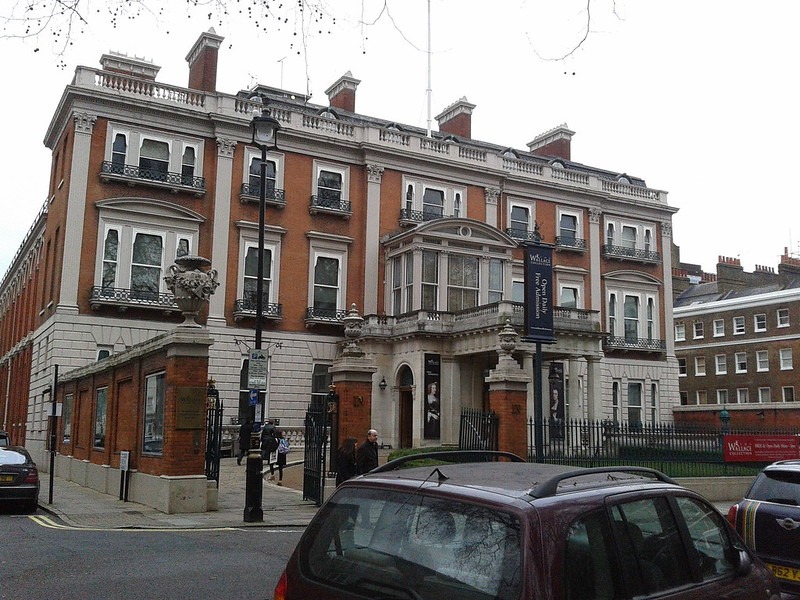
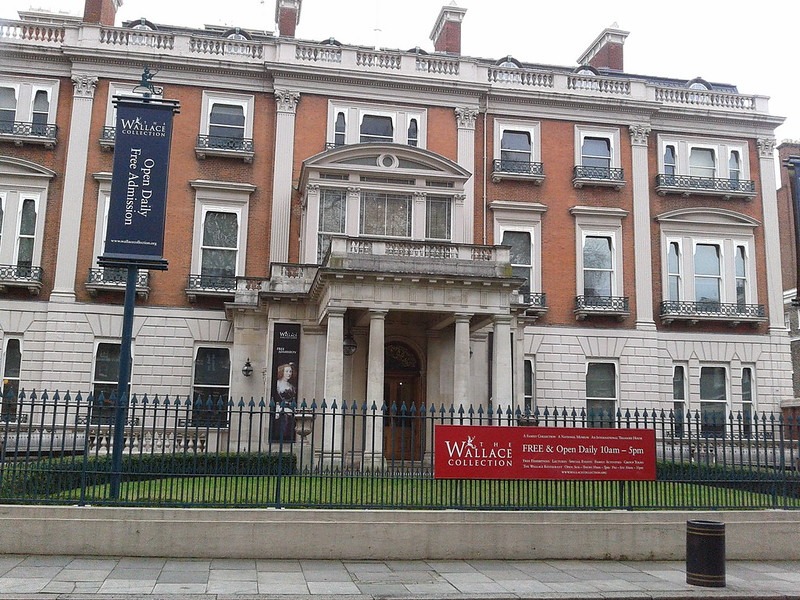
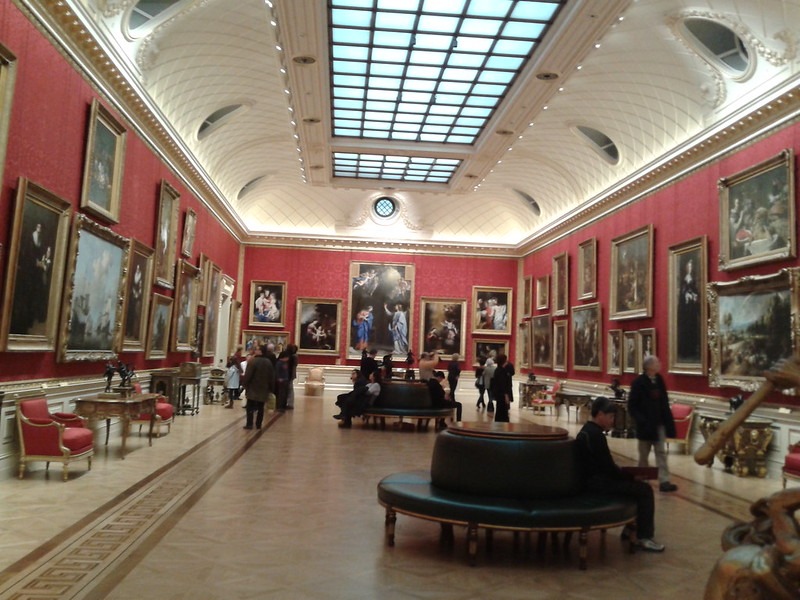
On Saturday I finally got round to visiting the Wallace Collection, a unique free museum based in Hertford House, Manchester Square near Oxford Street. The collection was accumulated in the 18th and 19th centuries by the first four Marquesses of Hertford and Sir Richard Wallace, the fourth Marquess’s son. Lady Wallace, Sir Richard’s widow, bequeathed the collection to the nation in 1897. Under the terms of the bequest the main collection cannot be added to, however museum staff do continue to seek out objects and archives relating to the family.

2015_0214WallaceCollection02

2015_0214WallaceCollection03

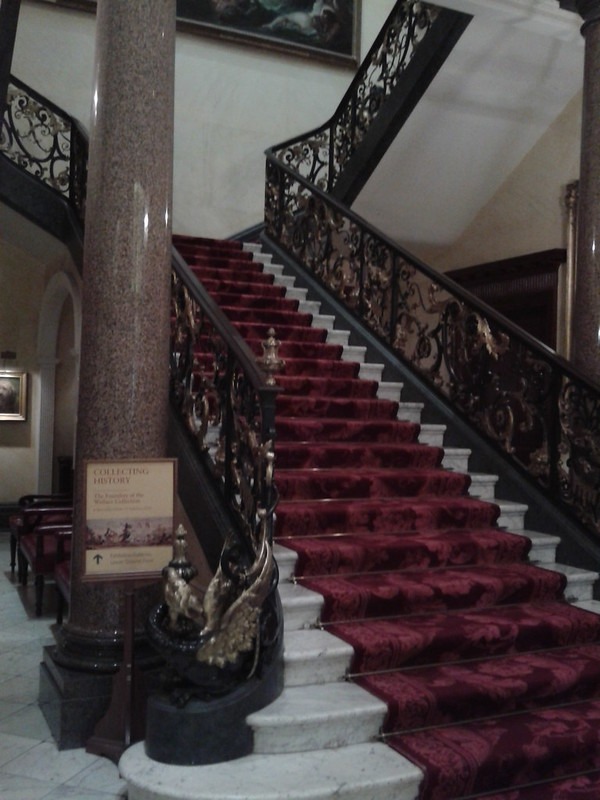
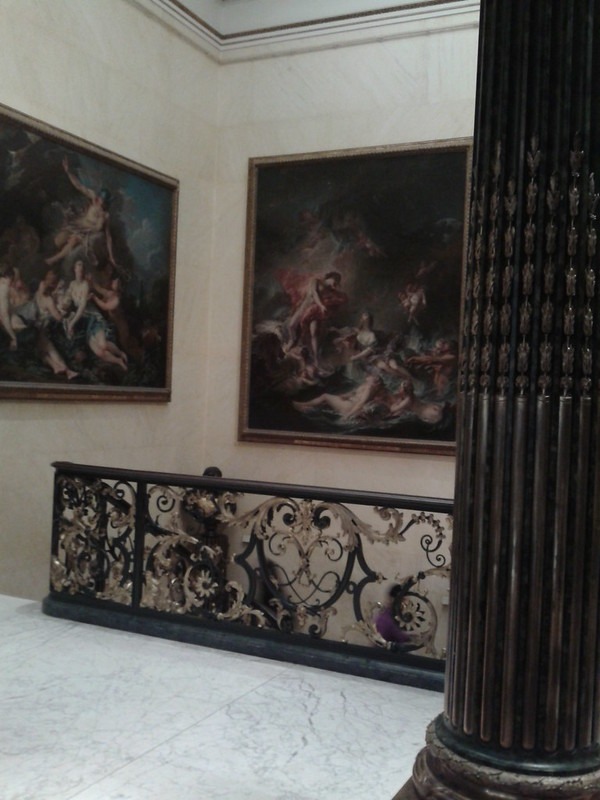
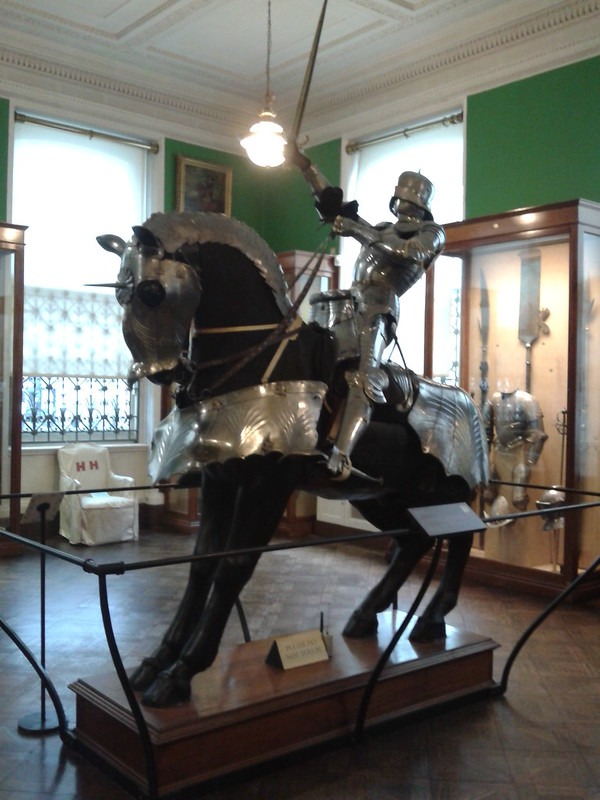
The house is situated in an impressive but quiet square, and opens into a lovely hallway. There is a posh-looking restaurant out the back (which I’d love to go to for Prosecco one day) and a gift shop, in addition to the 25 galleries. Eighteenth century French painting, works by the Old Masters and some rather famous works (including Frans Hals’ The Laughing Cavalier (1624)) sit alongside ancient furniture, small religious mementoes and an extensive armoury. I also saw the temporary exhibition, Collecting History: The Founders of the Wallace Collection.

2015_0214WallaceCollection04

2015_0214WallaceCollection05

I enjoyed looking around, although there was an overwhelming amount of art and I certainly couldn’t take it all in. I enjoyed the sumptuous interior of the house itself, however, and I would like to make a return journey or two to explore further.

2015_0214WallaceCollection06

2015_0214WallaceCollection07

FACTS

Address: Hertford House, Manchester Square, London, W1U 3BN

Website: wallacecollection.org

Opening Hours: 10am-5pm

Prices: Free

Wedding Dresses 1775–2014 – V&A

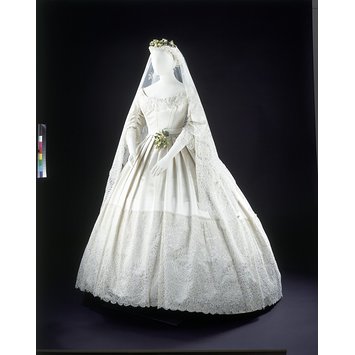
I’ve always said I never want to get married, but that didn’t stop me from visiting the V&A‘s exhibition Wedding Dresses 1775–2014. Firstly, it was historical. Secondly, I do have a thing for gorgeous dresses.

Silk-satin wedding dress from 1865
Silk-satin wedding dress from 1865 (Picture credit: V&A Collections)

There were plenty of those in the exhibition, but what really fascinated me was the history. From Georgian dresses that weren’t always white, but which tended to be “best” dresses then worn again later, through to Victorian white gowns with sprigs of orange blossom, to the development of the modern one-off white dress tradition during the twentieth century, the wedding dress has a rich and varied history. Upstairs, there were examples of more modern dresses from ordinary people and celebrities – I especially liked Dita Von Teese’s beautiful purple gown.

BOLT: Exhibition at GRAD London

I popped into GRAD (Gallery for Russian Art and Design), located near Oxford Street, last night. The current exhibition, BOLT, is about Dmitri Shostakovich’s 1931 ballet The Bolt, and includes rarely seen designs, photographs and costumes. The exhibition is organised in collaboration with the St Petersburg State Museum of Theatre and Music.

The ballet is described as the last Constructivist ballet, and judging by the costumes and photographs on display it is unique among ballets I have seen. The story, written by Victor Smirnov, is one of industrial sabotage and the innovative choreography by Fedor Lopukhov includes such pieces as the “Dance of the Cyclists” – a bit different from Sleeping Beauty!

The Bolt was pulled after its first performance at the Leningrad Academic Theatre of Opera and Ballet, after a backlash from critics and a perception that it was a threat to the Soviet authorities. It was not seen again until the Bolshoi Ballet performed it 74 years later. After seeing this exhibition, I am curious to see the ballet for myself.

A Victorian Obsession: The Perez Simon Collection at Leighton House

Last Thursday I went to the Leighton House Museum near Holland Park in order to visit the latest exhibition, A Victorian Obsession. Leighton House is the former home and studio of Frederic, Lord Leighton (1830-1896), a leading exponent of nineteenth-century classical art and one-time President of the Royal Academy. I’ve visited the house, designed and built to Leighton’s requirements by George Aitchison RA, before, and it’s beautiful: a Moroccan-style fountain court and a blue-tiled hallway are just two of the marvellous rooms inside.

Currently the house is home to part of the collection of Juan Antonio Pérez Simón, a Mexican businessman and art collector who holds the largest collection of Victorian and Edwardian art outside Britain. The pictures cover the period from around 1860 until the start of World War I, and the unifying theme is “representations of female beauty”. It’s easy to be somewhat cynical about this theme, but in fairness all of the artists represented were superb painters and their work encompasses a huge diversity in such representation, from the inspiration of the Greco-Roman period to Arthurian legend. The paintings are displayed throughout the main rooms of the house, which is a perfect setting considering that many of their artists knew this house and its owner well.

The paintings encompass late Victorian art in many forms, including historical painting and Pre-Raphaelite imagery. This kind of art is very much to my taste, so I greatly enjoyed the exhibition. There were paintings by artists with whom I am familiar, including Dante Gabriel Rossetti and Edward Burne-Jones. I particularly like the work of John Everett Millais: his The Crown of Love (1875) was on display here, and I also loved The Crystal Ball (1902), a magical work by another of my favourites, John William Waterhouse. Some of house owner Frederic Leighton’s work made an appearance, several paintings returning to the house for the first time since they were created. Leighton’s Antigone (1882) is impressive, as is Crenaia, The Nymph of the Dargle (1880), modelled by Leighton’s favourite muse Dorothy Dene.

Throughout the exhibition I was introduced to other artists I hadn’t previously been aware of, including Henry Arthur Payne, Arthur Hughes and John Melhuish Strudwick, whose Passing Days (1878) is an allegorical representation of the passage of time. His Elaine (c.1891) is a gorgeously detailed representation of the woman of Arthurian legend who pined away for love of Lancelot.

One artist seemed to dominate the exhibition – Lawrence Alma-Tadema. Famous for painting historical scenes, particularly those inspired by Ancient Rome, he painted several of the works on display, including An Earthly Paradise (1891), a rather sweet picture of a Roman woman with her young child. Alma-Tadema’s couch – the only object in the exhibition which is not a picture – sits underneath this painting. The artist designed the couch himself to use as a prop in his historical scenes, and it even has differently-designed legs – one side of the couch represents Egyptian style, the other, Roman. It’s rather fun to play “spot the couch” with Alma-Tadema’s pictures – it appears in several.

Alma-Tadema’s famous work The Roses of Heliogabalus (1888) is the highlight of the exhibition, presented in a room of its own which has been scented with roses courtesy of Jo Malone. The picture shows the young, wicked Emperor Heliogabalus suffocating his guests under a shower of rose petals, and it is beautifully detailed, although I can’t help but concur with the contemporary critics who felt that the victims hardly seemed frightened enough.

This superb exhibition is a must-see for any fans of late Victorian art. It runs until the 29th of March and normally costs £10, or £5 with a National Art Pass. Special late evening openings allow free entry for Art Pass holders between 5.30 and 8.30 on 19 February and 26 March.