I had some time left at the weekend so popped into the Science Museum to visit the exhibition Gathered Leaves: The Photographs of Alec Soth. The exhibition, which takes place in the Museum’s Media Space, showcases works by one of the world’s most famous documentary photographers, including pictures from four collections: Sleeping by the Mississippi (2004), Niagara (2006), Broken Manual (2010) and the most recent, Songbook (2014).
I’m no photography expert but I admired the poignant, intimate pictures, capturing the personalities of characters across America and the different, often vast landscapes. The collection of Mississippi images was my favourite, with its echoes of great American literature such as the work of Mark Twain. Definitely worth seeing.
The Julia Margaret Cameron exhibition at the V&A opened yesterday, and since I was meeting up with a friend in the museum café, I suggested that we pay it a visit, as she is also interested in Cameron’s work. The first thing we noticed on approaching the entrance to the free exhibition was the installation outside allowing you to take Victorian-style pictures. I’m not convinced my photo looks particularly authentic – the glittery pink bag strap is a bit of a giveaway – but I think this will be really popular with exhibition-goers. You can share your pictures on social media using the hashtag #VictorianMe.
#VictorianMe
The free exhibition, held in one room on the first floor, marks the bicentenary of Cameron’s birth, and is made up of over 100 photographs from the Museum’s collection. The V&A, then the South Kensington Museum, was the only museum to exhibit Cameron’s work during her lifetime: the founding director, Sir Henry Cole, presented her work in 1865. In 1868, the Museum offered Cameron the use of two rooms as a studio.
The photographs exhibited include portraits of the great and the good – among them Alfred, Lord Tennyson, and Charles Darwin – and Cameron’s own servants and family members, many of whom were posed as biblical, historical or allegorical characters.
Julia Margaret Cameron’s style was unique for the time, and wasn’t always appreciated. I personally love the out-of-focus technique she employed, which give her pictures an ethereal, dreamlike quality, which is unique in Victorian photography. Many contemporary critics were less than complimentary. One of the things that surprised me was seeing how confident Cameron grew as her career developed: in her letters she describes her own work as innovative and groundbreaking. On reflection, this lack of modesty probably helped her promote and establish herself in an industry dominated by men.
The most interesting thing about the exhibition, for me, was the inclusion of some “imperfect” works that Cameron herself did not want exhibited or sold. These show the issues that Cameron had in creating her work, including cracks in the images and damage to the negatives. Critics may have seen Cameron’s work as clumsy and flawed, but she had high standards of her own, knew what she wanted and how to achieve it, and was able to turn her mistakes to her advantage.
The Science Museum‘s Media Space is currently home to two exhibitions, one of which focuses on one of my favourite Victorian photographers. Julia Margaret Cameron: Influence and Intimacy, which is free to visit, contains pictures from the National Photography Collection, taken largely from the Herschel Album (1864), 94 images which Cameron compiled into a book, feeling that they were her finest. Originally a gift to the scientist Sir John Herschel, Cameron’s friend and mentor, the works still have a great deal of power even after all these years.
I first came across Julia Margaret Cameron’s work during a holiday on the Isle of Wight. She took up photography relatively late in life, when she was living in Dimbola Lodge on the island. I was fascinated by her work, and this exhibition, which also includes her camera lens – the only surviving piece of her photographic equipment – and handwritten autobiographical notes, reminded me why. The photographs from the Herschel Album, and those Cameron took later in life in Sri Lanka, are beautiful, artistic and imaginative, taking inspiration from fairytales and Biblical stories.
Open until 28 March next year, this is the first of two exhibitions in South Kensington mounted to mark the 200th anniversary of Cameron’s birth. The second opens at the V&A on 28 November.
The exhibition consists of selected images from the LMA collections, photographs taken in the nineteenth century from 1839, when photography first arrived in London. Though small, it is a rich collection, consisting of portraits and street scenes, people at work and at leisure. One of my favourite sections consisted of actors and actresses, including Henry Irving and William Terriss, the latter murdered outside the Adelphi stage door by a disgruntled actor. Another was a collection of images of orphan boys, taken before they left for Canada to start new lives. Yet another poignant collection was made up of inmates of the Colney Hatch Lunatic Asylum.
Less personal, but equally interesting, pictures covered the Crystal Palace, the construction of the Metropolitan Railway, and the Blackwall Tunnel. The earliest images captured ancient inns, roadways and other buildings which had grown up since the Great Fire, and which are no longer around. We have the Society for Photographing Old Relics of London to thank for this: founded in 1875, they could not stop the demolition of these beautiful old buildings in the name of “progress”, but they could, and did, capture them on camera.
Many buildings from the Victorian period were destroyed in the Blitz, and new construction means that modern-day London looks very different from its Victorian counterpart, as two contrasting images taken from the same spot demonstrate. However, there are still recognisable elements to be seen in the pictures, and these clear, crisp images seem to bring the past even closer. A fantastic, free exhibition that is well worth a visit.
The LMA
London Metropolitan Archives
40 Northampton Road
Clerkenwell
London
EC1R 0HB
I visited the National Portrait Gallery at the weekend to see the exhibition Audrey Hepburn: Portraits of an Icon. It covered the life of the actress and fashion icon Audrey Hepburn (1929-1993) from her early years training for the ballet through her film career and ending with her humanitarian work.
The exhibition was interesting and comprised images by photographers such as Richard Avedon, Cecil Beaton, Terry O’Neill, Norman Parkinson and Irving Penn. The pictures conveyed Hepburn’s beauty, charm and style over several decades. I was surprised, however, that it was so small – there were only a couple of rooms and it didn’t take me long to go through it.
Revelations: Experiments in Photography is an exhibition at the Science Museum which looks at photography with a science theme over the last two centuries. Scientific photography influenced art, but was also valuable in its own right, as it was able to capture images and phenomena invisible to the naked eye.
My favourite work was Ori Gersht’s Blow Up (2007), which captured a still life in the act of exploding, a magnificent and beautiful work. However, the one with the best title was undoubtedly Chickens, scared by a torpedo (c. 1878), a picture by the photography of movement pioneer Eadweard Muybridge. Early images by photographers such as William Henry Fox Talbot were shown, alongside works by modern artists such as Harold Edgerton and Hiroshi Sugimoto; I particularly liked the former’s dynamic Bullet Through Lemon (c. 1955). However, overall I preferred the older photographs, and was sorry to see that most of the pictures in the exhibition were comparatively modern. Admittedly this is a personal preference, and the exhibition is certainly worth seeing if you have an interest in the subject matter.
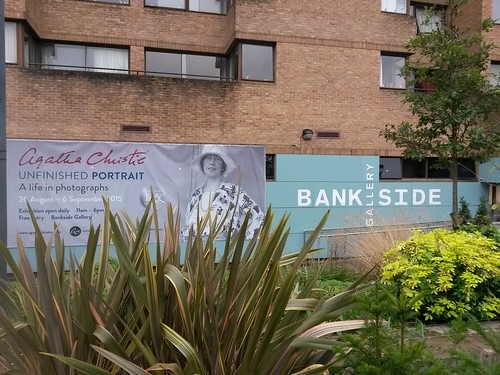
Agatha Christie: Unfinished Portrait, subtitled A Life in Photographs, is an exhibition of pictures from the popular author’s life on show at Bankside Gallery. As a fairly recent but enthusiastic fan of her work, I went along to the free exhibition.
The collections cover Christie’s life from her early childhood and adolescence to her first and second marriages and the birth of her daughter, as well as her burgeoning literary career. It was really interesting to see her life in pictures, and the images were accompanied by Christie’s own words which really brought her to life. The exhibition also featured the portrait of Agatha Christie by expressionist painter Oscar Kokoschka, painted in 1969 for Christie’s 80th birthday.
With an afternoon off, I went to Somerset House to check out some of their exhibitions. Beneath the Surface is presented by the Victoria & Albert Museum, Photo London and Somerset House and includes works from the V&A that are rarely displayed.
Commissioned by Photo London, the exhibition contains a huge breadth of works, ranging from Charles Thurston Thompson’s (1816-68) early photographs of paintings for conservation purposes to Nigel Shafran’s (b. 1964) unusual images taken for the 2012/13 V&A Annual Report. Because of Somerset House’s location by the river, the pictures selected largely focus on the water, too. They have been chosen by the V&A’s Senior Curator of Photographs, Martin Barnes.
Among my favourites were William Strudwick’s (1834-1910) photos from the Old London series, taken in the 1860s: these captured the riverside shortly before the construction of the Embankment, and include scenes of Lambeth, Westminster and nearby areas, as well as several medieval coaching inns shortly before they were demolished to make way for the railways. I also liked Thurston Hopkins’ (1913-2014) scenes of underground London life in the 50s; the street scenes in particular were full of energy.
Some of the pictures were more abstract: John Gay (Hans Göhler (1909-99) took pictures of lots of different manhole covers in the 1960s, revealing a wealth of different patterns. Robert Brownjohn (1925-70) took interesting pictures of street signs at around the same time, while Naoya Hatakeyama’s (b. 1958) image of a darkened sewage tunnel in Japan, from his series “Underground 1999”, is atmospheric and haunting.
Other works were particularly unusual: Benjamin Stone (1838-1914) and George Scamell (active 1900s) photographed Newgate Prison before its demolition in 1900-1902, resulting in some truly eerie images of immense historic significance. As part of the National Photographic Record Association, their job was to record a variety of subjects, many more sinister than those typically captured on film. I really liked Pedro Meyer’s (b. 1935) work, in which he set a digitally-manipulated photograph of himself as a young boy with his father alongside a picture of his adult self with his own son.
The exhibition runs until 24 August and is fascinating viewing for anyone enraptured by old photographs.
I spent some time during my day off at Somerset House, which always has plenty of exhibitions to see, and visited the Terrace Galleries to view the exhibition Unseen Waterloo: The Conflict Revisited. This is a collection of photographic portraits taken by Sam Faulkner to mark the 200th anniversary of the Battle of Waterloo.
Faulkner has taken pictures of participants in the annual re-enactment of the battle that takes place in Belgium. Those who take part dress in historically-accurate uniforms, paying close attention to detail. The portraits could have been taken at the time of the battle itself – if photography had been invented then. From teenage drummer-boys to old and grey-haired generals, the exhibition really emphasises the humanity of those who took part.
The pictures explore how we remember those who died in war before the invention of photography, and I thought they were very effective in bringing home the individuality and personality of each soldier. Sometimes it’s difficult to comprehend the humanity of the 54,000 soldiers who died at the Battle of Waterloo, the last major European battle which was not recorded in photography (the Crimean War of the 1850s marked the entrance of the war photographer, bringing home the human cost of battle. Seeing so many pictures alongside each other, each representing a dead soldier, was sobering.
The final exhibition I saw at Tate Britain was Salt and Silver: Early Photography 1840 – 1860. It was a fascinating exhibition with some of the earliest photographs ever taken on display. William Henry Fox Talbot pioneered a method of taking pictures with salted paper prints in 1839, the same year as Louis Daguerre invented the daguerrotype. Talbot’s images included pictures of china, glass, paper and people – including his daughter – as he explored the potential of the new medium. Other photographs on display include fascinating Paris landmarks including the Arc de Triomphe, images of India and the American Civil War, and the construction of Nelson’s Column in Trafalgar Square.
Later, Gustave Le Gray improved the salted paper print method by using waxed paper negative proofs. Further images displayed showcase the extra detail this method offered: the pyramids of Egypt, the Crimean war and ordinary life, in the shape of some Newhaven fishwives, are pictured. Early photography was inspired by portraiture when it came to pictures of people: pictures were often posed, but they were unique in being able to capture individuals, particularly children, at a specific moment in time. Most of the pictures are of ordinary people, but there is one notable image of French author Victor Hugo.
A fascinating exhibition, this is a must-see for anyone interested in photography or history.