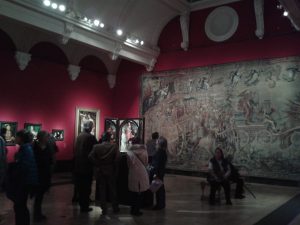
Having a National Art Pass, I hear about lots of places to visit that I wouldn’t otherwise have heard of. One of these is Two Temple Place. Located on the bank of the Thames near Temple Station, it is a little-known gem, a beautiful house that was originally built by William Waldorf Astor in the late nineteenth century.
The house hosts free exhibitions of publicly-owned art during the first quarter of each year. The current exhibition is called Amongst Heroes: the artist in working Cornwall, and is a significant exhibition exploring the themes and images represented in Cornish art of the late nineteenth and early twentieth centuries. There are some fascinating paintings in the exhibition: some of them are historically significant, showing the way people on the Cornish coast lived (with a strong focus on fishing, mining and other forms of work) and many of them are beautiful, showing the impressive nature of the Cornish landscape.
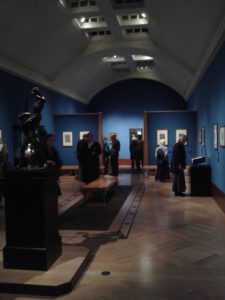
Even more than the exhibition, I loved the house itself. Though it was designed and built just over a hundred years ago, it has the look of a medieval mansion with lots of panelled wood and ornate fireplaces. Astor clearly loved literature – the staircase is dotted with figures from Alexander Dumas’ The Three Musketeers and scenes from Shakespeare decorate the panels along the top of the wall.
The house is open until 14 April for the duration of the exhibition, after which it will close until next year. I definitely recommend a visit – it’s an unusual and beautiful place.
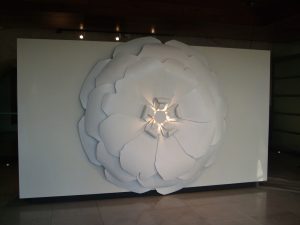
This despite the fact that modern art is certainly not my forte. Still, I enjoyed my previous visit to the Gallery – rather to my surprise – and resolved to keep an open mind. Some of the exhibitions were lost on me, such as odd sculptures; some weren’t to my taste, but I could appreciate the thought that went into them and the humanity that lay behind them, such as Sergei Vasiliev’s photographs of tattooed prisoners and Boris Mikhailov’s pictures of the homeless in Ukraine, illustrating the disintegration of society in a post-Soviet world.
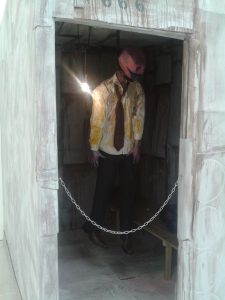
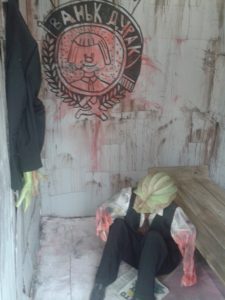
One of my favourite displays was this piece by Daria Krotova, bringing to mind the works of Dostoyevsky and Gogol and seemingly concerned with the recession and the culpability of those in positions of power.
I also loved these pictures by Valery Koshlyakov – made from cardboard and roughly-applied paint, they are striking and beautiful.
Grand Opera, Paris Notre Dame, Paris and High-rise on Raushskaya Embankment
The exhibition is running until the 9th of June.
Breaking the Ice: Moscow Art, 1960-80s
While I was at the Gallery I also dropped in on the exhibition upstairs, which continued the Russian theme by displaying Moscow art from an earlier period. I found this harder to get into, but I did like this image which juxtaposed Lenin’s face with an easily recognisable advertising logo.
I had a very busy and tiring Saturday. I visited 11 tube stations. Eleven! And they were all in east London, most of them on the Central Line.
My travels took me through Leyton and Leytonstone up to Woodford and Snaresbrook. The most notable part of my journey was seeing the Hitchcock mosaics at Leytonstone tube station. Director Alfred Hitchcock grew up in the area and a few years ago several mosaics picturing scenes from his films were installed in the corridor leading to the ticket hall. I had fun trying to guess which film each mosaic represented.
Hitchcock as a child, outside his father’s grocery shop Hitchcock, directing The Pleasure Garden Strangers on a Train Psycho Vertigo Suspicion Saboteur The Skin Game The Birds North By Northwest Hitchcock with Marlene Dietrich Rear Window Rebecca
On Friday night I paid a visit to the Royal Academy of Arts to see the Constable, Gainsborough, Turner and the Making of Landscape exhibition. I love Turner and this was the main reason for my visit. In the end there wasn’t a great deal of his work on display, or that of the other named artists. A lot of the space was devoted to artists who paved the way or who were inspired by these three giants, so I felt the title of the exhibition was slightly misleading. Still, the paintings and artefacts displayed were well-chosen and the exhibition as a whole was small enough to be enjoyed without fatigue. Highlights for me included Turner’s Dolbadern Castle, while paintings by Gainsborough and Constable, artists I’d never paid much attention to in the past, appeared in a new light for me and I think I’d like to find out more about their work.
I had the day off on Friday and spent the afternoon checking out the exhibitions at Somerset House. This place, on the north bank of the Thames near Temple station, has a lot going on, most famously – at this time of year – the ice rink. I’ve never been ice skating in my life, but it does look fun, and the surroundings are beautiful.
I arrived via the Embankment and the first exhibition I came across was Valentino: Master of Couture, in the Embankment Galleries. This exhibition displayed personal letters and other items from the designer’s personal archives, as well as outfits spanning over fifty years. These were interesting and extremely varied: I had my own favourites, which were generally the fifties-style outfits, but there should be something here to appeal to everyone. The exhibition concluded with the wedding dress of Princess Marie Chantal of Greece, which was beautiful, but not as nice as Kate Middleton’s wedding dress as far as I am concerned. There was also a small section looking at how different design effects are achieved, including the famous Valentino rose.
I enjoyed the exhibition, but I think it was quite expensive (£12.50) and would be of greatest interest to design students or those with a strong interest in fashion. I would have liked to learn more about the context of the items on display. However, I did enjoy looking at them.
The next exhibition was free, and I actually enjoyed this one more. Tim Walker: Storyteller displayed the photographer’s unusual, fantastical and dreamlike pictures, many of which are fashion photographs taken to promote a specific brand. There were also celebrity pictures including striking images of Helena Bonham Carter, the Pythons and Tilda Swinton. Props used in several of the photographs, including a giant skeleton, an enormous and rather creepy doll and jelly-mould hats, are shown alongside the images in which they appear. I thought the photographs were beautiful and unusual, often with narrative, nightmarish or bizarre undertones.
Finally, I revisited the Courtauld Gallery (for free, with my National Art Pass) to look at the small one-room exhibition Peter Lely: A Lyrical Vision. Lely is most famous for his portraits of the beauties of the court of Charles II, so it was interesting to see landscapes and paintings on Biblical and classical themes, completed before he began to concentrate entirely on portraits.
After visiting all of the exhibitions I popped into the Christmas shopping gallery, but I didn’t buy anything as it was all a bit expensive.
I really like the Queen’s Gallery at Buckingham Palace. It has rotating exhibitions which change every few months or so, and when you buy a ticket you can get it converted into a 1-year pass enabling you to go back as many times as you want over the course of the year. I had the day off on Wednesday and visited the Gallery for the third time this year, in order to see the exhibition The Northern Renaissance: Dürer to Holbein.
I studied the Reformation in Europe as part of my History A Level and many of the pictures in this exhibition were of figures I am familiar with. One painting, which appeared in the first room, was of Desiderius Erasmus, a hugely important intellectual figure and inspiration to Martin Luther who kickstarted the Reformation. In our class he was known as ‘Daddy Rasmus’.
‘Daddy Rasmus’
This painting, and many others at the beginning of the exhibition, was by Albrecht Dürer, a German painter and printmaker who is commonly regarded as one of the greatest artists of the period. I recognised several of his engravings, including the Knight, Death and the Devil, from A Level textbooks. Much of his work has a strong Gothic feel, and he utilised classical imagery in his work. He drew and painted many of the prominent figures in the Northern Renaissance.
Hans Holbein the Younger is known for his work at the Tudor court; he came to England from Germany where he first developed as an artist. Sketches, drawings and paintings by him show his ability to capture in detail the expressions and personalities of the figures of the period.
The work of other artists was also represented in the exhibition: tapestries, altarpieces and paintings all capture the important themes of the period, reflecting the turbulent age in which they were created. The fifteenth and sixteenth centuries were a time of dramatic change in Europe, with intellectual exploration, religious questioning and a shifting of the balance of power. The works of art portrayed here are interesting in their own right, but are also emblematic of the wider issues of their age.
The new exhibition recently opened at Tate Britain, and it was one I knew I absolutely had to see. The exhibition was entitled Pre-Raphaelites: Victorian Avant-Garde, and as a huge fan of this particular band of artists, has been on my must-see list for months.
I arrived at the Tate on Saturday morning about an hour after the exhibition opened, and was shocked at the sheer number of people there. I knew it would be popular, but I hadn’t realised just how popular until I got inside the first room. Though entry to the exhibition was timed, I felt that there were far too many people there: I had trouble getting close to the things I really wanted to see, and was repeatedly annoyed by people pushing in front.
Anyway, as far as the exhibition was concerned, I thought it was excellent. I know very little about art, but the Pre-Raphaelites have always appealed to me; perhaps my fascination was inherited from my mother, who studied art at college and who also likes their work. I’m also attracted by their pivotal role in Victorian culture, and the fact that they were influenced greatly by literature: some of my favourite writers, including Shakespeare and Tennyson, inspired the movement, and several members, including Dante Gabriel Rosetti, wrote poetry (his sister, who was not part of the group but who modelled for some of their pictures, was the famous poet Christina Rosetti).
The exhibition aims to emphasise the revolutionary nature of the Pre-Raphaelite brotherhood, whose members – as well as several followers – made a conscious effort to break with tradition and seek new ways of making art. While their works remain popular to this day, it is not always apparent just how radical their approach was; in fact, the Pre-Raphaelite movement has been described as the first modern art movement.
The exhibition was displayed over several rooms, each exploring a different aspect of the movement. The first room looked at the origins of the PRB and their influences. The movement was founded in 1848, and sought to recapture beauty and spirituality in a world undergoing industrial and social upheaval. Members were inspired by early Italian painters whose works were displayed in the National Gallery (painters who worked before the time of Raphael; hence the name of the brotherhood). Other influences included William Blake, whose works combining poetry and art inspired similar creations in PRB members, and other contemporary artists of the time.
Secrecy surrounded the brotherhood at first: early works were signed with the secret initials ‘PRB’; an example of this is Isabella by John Everett Millais, on display in this room.
The second room explored how the Pre-Raphaelites explored history in their work. Their style was realist, almost photographic in its detail, thus illustrating a historical subject with a modern sensibility. One of my favourite pictures in this room was painted by Millais, and shows a Highland woman welcoming her husband, who has just been released from prison where he was kept by the English after the Battle of Culloden. Another was William Holman Hunt’s impression of the scene in The Two Gentlemen of Verona (the group was frequently inspired by Shakespearean scenes) in which Valentine rescues Sylvia from Proteus. I also liked the fact that some of Elizabeth (‘Lizzie’) Siddall’s watercolours were shown here. Most often remembered for her tempestuous and doomed relationship with Dante Gabriel Rosetti, and for being the model for Ophelia in Millais’ painting, her pictures showed that she was a talented artist in her own right.
The ‘Nature’ room contained many beautiful paintings, including Ophelia, mentioned above, which is one of my favourites; the colours are so lustrous and the water and the greenery captured so perfectly. Lizzie Siddall spent days lying in a bath of water in order to model for the doomed heroine. Other pictures were of landscape scenes, bright and summery or bleak and bare. I don’t normally associate the Pre-Raphaelites with landscapes so this section was a revelation for me. A particular highlight was Ford Madox Brown’s An English Autumn Afternoon showing the view from Hampstead towards London. I’ve seen this view myself but it looks very different nowadays: I enjoyed seeing what it was like a hundred and fifty years ago.
The photographic quality of many of the Pre-Raphaelites’ works is perhaps most evident here. Some critics accused them of working from photographs but in fact this was not the case: they would generally paint the landscapes outside during the summer (years before the Impressionists began to do the same thing) and retreat to their studios in the colder months to add figures and finish off the works. Their accurate, realist style was hugely modern and different from anything which had gone before.
The next section explored salvation, religion and social attitudes. The nineteenth century was a time of great change, with the publication of Charles Darwin’s theories, social conflict and division. The Pre-Raphaelite brotherhood sought to make Christianity accessible to all, portraying religious figures with naturalism and compassion. Millais’ Christ in the House of His Parents was a revolutionary work, showing the Holy Family as ordinary working people: he made studies for the painting in a real carpenter’s shop. Hunt, one of the more religious of the Pre-Raphaelites, made the pilgrimage to the Holy Land so that his work would be more authentic: he completed several important works based on his experiences there, including The Scapegoat, which illustrated an old Biblical legend in which a goat, bearing the sins of the population, is expelled from a village. The group’s portrayal of women was in some ways radical for the period, but in others encompassed Victorian ideals – unsurprising considering that all its members were male. In Hunt’s The Awakening Conscience, a woman comes to the realisation that her way of life – she is a kept woman – is wrong. On the one hand, Hunt does not judge her for her lifestyle; on the other, there doesn’t seem to be any issue with the morality of her lover’s chosen way of life.
Sir John Everett Millais, ‘Christ in the House of His Parents’
Another room explores the representation of beauty in Pre-Raphaelite works. In around 1860, some members of the movement began to explore the idea of ‘art for art’s sake’, presaging the Aesthetic Movement. Dante Gabriel Rosetti in particular embraced this theme, painting numerous images of beautiful women gazing out of their pictures and wearing rich robes of varying hues. This was probably my least favourite room of the lot: I like pictures to have a bit of meaning behind them, and the cynic in me believes that Rosetti’s desire to paint nothing but beautiful women stemmed from more than an artistic theory.
The Paradise section explores other art forms rather than painting: tapestries, furniture and textiles are among the pieces shown here. William Morris, inspired by the Pre-Raphaelites, set up a firm to produce items such as textiles, furniture, stained glass and tiles that were both beautiful and functional. Several members of the PRB were involved in this enterprise in the early stages. I found these items interesting to look at although I must confess that I prefer the paintings.
The final section explored mythologies and their role in inspiring Pre-Raphaelite painters. Greek and Roman myths as well as legends and stories from literature were covered here. Edward Burne-Jones’ picture King Cophetua and the Beggar Maid is a striking example of this, dramatic and detailed.
Sir Edward Coley Burne-Jones, ‘King Cophetua and the Beggar Maid’
I spent two hours in the exhibition, and felt slightly exhausted by the end. However, I thoroughly enjoyed myself and really appreciated the chance to learn more about a movement in which I am very interested.
The National Gallery in London is currently hosting its first major exhibition of photography, Seduced by Art: Photography Past and Present. It explores how both early and modern photographers were influenced by the work of artists, particularly Old Masters, when exploring the possibilities of this relatively new art form.
The exhibition is divided into themes, with paintings and photographs displayed alongside each other. I found it interesting to look at how photographers were inspired by artists. Julia Margaret Cameron, for example, took inspiration from the Pre-Raphaelites to create her soft-focus pictures. Richard Learoyd’s photograph ‘Man with Octopus Tattoo’ was displayed alongside James Anderson’s traditional sculpture involving humans wrestling with an octopus. Gainsborough’s eighteenth-century painting of Mr and Mrs Andrews is juxtaposed with Martin Parr’s 1991 photograph which also shows a couple setting up their first home together.
In some ways I found the Still Life section the most interesting, despite viewing still life paintings as among the most boring. A video of fruit in a bowl decaying, speeded up so that the process lasts only a few minutes, comments on the decay inherent in life in the same way traditional still lives do. I recognised Fantin-Latour’s ‘The Rosy Wealth of June’, a rich and brightly coloured arrangement of stunning flowers spilling out from a vase, and really liked Ori Gersht’s 2007 interpretation: he blew up a similar arrangement of flowers, capturing the moment of explosion on film to create a hugely dramatic image.
Ignace-Henri-Théodore Fantin-Latour, ‘The Rosy Wealth of June’
Dramatic paintings of historical events were displayed alongside photographic tableaux of such events. I also liked Thomas Struth’s 1989 photograph of the National Gallery, which makes a centrepiece of one of the Gallery’s beautiful paintings but also recognises the importance of the Gallery’s visitors.
I’ve never had a major interest in photography and my knowledge of art has always been limited, but I really enjoyed this exhibition. I feel as though I learned something about both photography and art and gained a greater understanding of the possibilities of both mediums.
I was already at the National Portrait Gallery to see the exhibition on Henry Stuart, so I thought I might as well stick around to visit the exhibition installed to celebrate Elizabeth II’s Diamond Jubilee. Called The Queen: Art and Image, it explored images of the Queen throughout her sixty-year reign, starting with her arrival back on English soil after learning of the death of her father and her accession to the throne.
I thought the exhibition was very interesting from a cultural perspective as it showed how the Queen and the royal family were portrayed throughout the last half-century, reflecting the dramatic socio-cultural changes in British life. Earlier, formal paintings and photographs, such as the Coronation picture by Cecil Beaton, gradually gave way to more informal and radical images, including Andy Warhol’s colourful pop art images and the infamous Sex Pistols album cover. More recently, traditional yet modernised images such as the Queen relaxed and smiling sit alongside sculptured pictures such as the head of the Queen constructed of trinkets and an image of Elizabeth II made up of lots of little pictures of Princess Diana.
This sort of exhibition probably only has immediate appeal to royalists but I think it has a wider resonance too, reflecting changes in society as well as developments and fashions in the artistic world.
As the National Portrait Gallery is open late on Thursdays and Fridays, I sometimes like to walk down after work to have a wander around. On Friday night I decided to pay a visit – although I took the tube to Leicester Square, as it was pouring down.
My plan was to see the new exhibition The Lost Prince: The Life & Death of Henry Stuart. As someone with a strong interest in history, and who has studied the period immediately preceding the Stuart accession (the Elizabethan era), I was very excited about this.
Henry (1594-1612) was the elder son of James VI of Scotland and I of England, who succeeded to the English throne on the death of Elizabeth I in 1603. Elizabeth had reigned for so long that the last time an entire family inhabited the royal household was beyond living memory. As the eldest, Henry was the heir to the throne and the hopes and dreams of the nation were invested in him: his princely nature, air of nobility, youth and exuberance promised a positive future.
The exhibition displays portraits of Henry, his royal parents and siblings, as well as those around him responsible for teaching, caring for or advising him. The pictures give some indication of the personality of the royal Prince, as well as the impression he and his advisers wished to convey. Miniatures by Nicholas Hilliard and Isaac Oliver and full-size portraits by Robert Peake show Henry wearing armour, demonstrating the noble values of bravery and chivalry, or handsome, richly costumed and showcasing his extensive collections of jewels and other riches. Henry and his court helped to inspire a renaissance in the arts, and some of the items he collected are on display.
By modern standards I am not sure if Henry was the most likeable person. It was reported in the exhibition that when Henry received a gift of a number of brass statuettes, he was asked if he would like to give one of them – a horse, on display here – to his little brother Charles. Henry’s response was to say no: he wanted to keep them all for himself!
Perhaps it is unfair of me to condemn this attitude: the Prince of Wales, as he was created in 1610, had to bear the weight of a nation’s expectations and this was a lot to take for one so young. Some of the earlier portraits show the young boy dressed in lavish royal costumes that seem to swamp him. This is echoed in the two small suits of armour belonging to the Prince which are on display, worn by him during lavish court tournaments and masques.
Though clever, Henry apparently did not enjoy book-learning to the same extent as his younger brother. Some of his school books are displayed here, one of which in particular made me smile: one of his tutors wrote a couple of sentences below his own writing which are very disparaging towards Henry’s handwriting skills! However, the Prince possessed an extensive library and a number of works of art – many of which are now scattered all over the world in the hands of public galleries and private collectors – and he was interested in gardens, authorising a lavish project to redevelop the gardens of Richmond Palace, though he sadly died before the work could take place.
The final room of the exhibition explores Henry’s death and the reactions it provoked among his family, the nobility and the rest of the country. While helping to prepare for his sister Margaret’s wedding, Henry caught a fever (now thought to be typhoid fever) and, despite the best efforts of several doctors, died a few weeks later. His family and the nation were distraught: writers and composers registered their sorrow in poetry and music; printed books had pages with black borders and one of the dirges composed on his death is playing in the room. A portrait of Queen Anne, Henry’s mother, is displayed and shows her wearing black clothes for mourning: I found this interesting as I had thought the fashion for wearing black for mourning only came in with Queen Victoria.
At Henry’s funeral, weeping crowds lined the streets and the effigy on top of the hearse was reportedly so lifelike that it provoked fresh storms of grief. What remains of this effigy – namely the wooden torso and limbs, the wax head and hands having been stolen or rotted away years ago – is on display in this room, looking poignantly small in the plain glass case.
Charles Stuart was devastated by his brother’s death and treasured his memory all his life. During his reign as Charles I he commissioned an enlargement of a miniature of Henry which hung in his rooms at Whitehall, and is now on display here, the final portrait of a Prince who was never to fulfill his potential.
The exhibition got me thinking about how the course of history can change. What if Henry hadn’t died? He would have become King Henry IX, and the events which resulted in the English Civil War might never have happened – although, given Henry’s somewhat imperious personality, this is not certain. His life and death reminded me of another, very similar situation a hundred years before: the premature death of Arthur, eldest son of Henry VII. Named for the legendary English king, hopes and expectations surrounded young Arthur as they would encircle Henry a century later, but Arthur’s premature death ended them, paving the way for his younger brother Henry to inherit the throne. In both cases, the death of the much loved and admired heir led to the accession of a ruler who would change the course of English history – albeit more successfully in Henry VIII’s case, at least for him.
I definitely recommend this exhibition to anyone with an interest in Stuart England, seventeenth-century art and the history of royalty in Britain. The curators have chosen their objects well and they are presented with thought and care. Unlike some exhibitions and galleries, which contain an overwhelming number of items, this exhibition at the National Portrait Gallery takes the ‘less is more’ approach, meaning that you can examine each individual item in more detail, finding out more about it.