
The small display Shakespeare: Greatest Living Playwright is on in the Theatre & Performance area at the Victoria & Albert Museum until the 28th of September. It celebrates the 450th anniversary of Shakespeare’s birth, and consists of artefacts such as a copy of the First Folio and videos of several theatre practitioners currently involved with Shakespeare. These include Sinead Cusack, Cush Jumbo and Simon Russell Beale, and I really enjoyed hearing about their experiences, especially Cusack, as she played Cleopatra in the first ever RSC production I saw back in 2002.
Category: Museums, Galleries and Exhibitions
British Folk Art – Tate Britain
After visiting the Kenneth Clark exhibition, I went along to the British Folk Art museum, also at Tate Britain. This exhibition comprises collections from across Britain which have been described as folk art, a term generally used in connection to social history or folklore studies. It is the first major exhibition of its kind in the country, and covers work from the seventeenth century to the middle of the 20th, which is when folk art supposedly began to become more commodified.
The first section of the exhibition consisted of a selection of painted, carved or constructed signs outside buildings which were used to denote the kind of business and as an early form of advertising. Some of these signs are obvious, such as a boot or a shoe to denote a cobbler, and a padlock or key for a locksmith. Others are less so: a bear was often used outside a barber’s (as bear grease was commonly used on the hair), and the three golden balls outside a pawn shop represent the family crest of the Medicis, wealthy Italian bankers. The detail and craftsmanship evident on some of these signs is incredible.
In early 19th century Frant, a village near Tunbridge Wells, a tailor named George Smart created and sold pictures made from textile scraps, which he then sold to tourists. “Smart’s Repository” produced some amazing pictures of fascinating village figures, including the policeman and an old woman in a red coat. Many folk artists painted pictures relating to rural life and landscapes, including images of the sea and sky. One notable such artist was Alfred Wallis (1855-1942), a rag and bone merchant and self-taught painter from St Ives, who created paintings based on his early career at sea.
Some folk arts were classed as crafts, including the mysterious “god in a bottle” sculptures (wood and liquid in glass bottles), straw crafts and leatherwork. Some were carved figures, such as the Highlander which was kept outside a tobacconists, and ship figureheads such as the huge HMS Calcutta, made in Mumbai 1831 of Indian hardwood.
I was hugely fascinated by the work of Mary Linwood (1755-1845), a woman who imitated the Old Masters and British artists to recreate their work in needlepoint. Her fantastically detailed works showed an incredible amount of talent, yet how to categorise an artist who, while incredibly able, does not create original works?
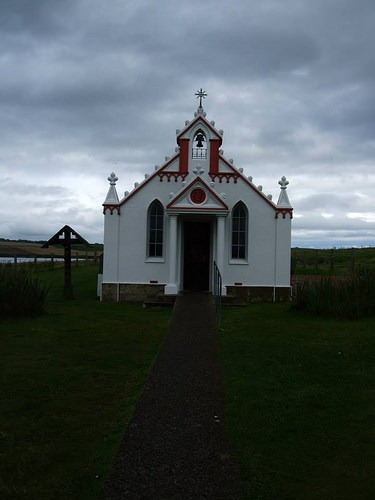
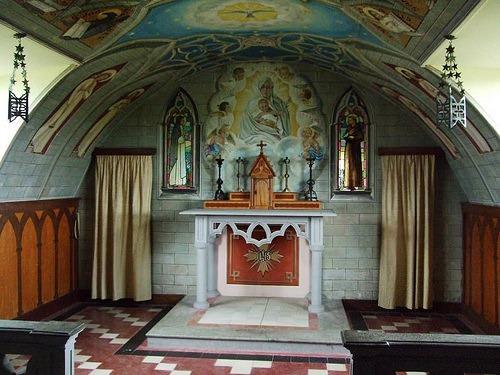
Towards the end of the exhibition there were displayed assorted sculptures, artefacts and textiles, from places such as Beamish Museum in County Durham. These reveal the wide-ranging skills and talents of folk art practitioners. At the end, archival photographs displayed some other examples of folk art, including one man who transformed his back garden into a wonderland, and the chapel built in Orkney by Italian prisoners during the Second World War.
Overall this was a fascinating exhibition, and one which I thoroughly enjoyed. It is on until the end of August, so do try to catch it if you can.
Kenneth Clark: Looking for Civilisation – Tate Britain
On Saturday I visited Tate Britain to see two exhibitions which were due to end shortly. In fact, one of them, Kenneth Clark: Looking for Civilisation, has now ended – the last day was Sunday. I was originally in two minds whether to go to see this, but I’m really glad I did.
Kenneth Clark is not someone I had ever heard of before this exhibition, but it seems that he made a significant contribution to the study and appreciation of art during the 20th century. Born into a wealthy family, he used his fortune to collect art and to assist struggling artists. He had wide-ranging tastes: in contemporary terms he had particular preference for the Bloomsbury Group and artists such as Henry Moore, Graham Bell and Victor Passmore. Clark believed that the lack of patronage in the art world was causing artists to be removed from “real life”, and he sought to rectify this.
Clark had no formal art training, and while he produced some excellent books about art, including a fine study of Leonardo da Vinci’s drawings, he also made several mistakes, including quite a number of misattributions. Aged thirty, he became director of the National Gallery – one of his first acts was to install electric lights, so that viewers could actually see the artworks when there was not enough natural light. During the Second World War he ensured the safety of the artworks by evacuating them to Wales.
Towards the end of his life Kenneth Clark presented the groundbreaking series Civilisation, which proved a landmark arts documentary in the 1960s. I left the exhibition with a great deal of admiration for this man who was clearly so passionate about art.
Enduring War: Grief, Grit and Humour – British Library
Until 12 October 2014, a free exhibition in the Folio Society Gallery of the British Library, Enduring War: Grief, Grit and Humour, is on display to mark the centenary of the start of the First World War. The exhibition uses posters, poetry, books and pamphlets to look at how soldiers from home and overseas, and civilians back in “Blighty”, coped with the conditions of the war. It is really interesting – and sobering – to look at diaries, letters and journals from the conflict. The range of responses is fascinating and I thought it made an interesting foil to the recent exhibition of First World War portraits at the National Portrait Gallery.
Comics Unmasked: Art and Anarchy in the UK – British Library
I went along to the Comics Unmasked: Art and Anarchy in the UK exhibition at the British Library recently. I’m not a particular fan of comics or graphic novels, but I’m always interested in learning more about anything to do with literature.
The exhibition displays both mainstream and underground comics, demonstrating the breadth of subjects they have addressed throughout the years, including politics, gender, violence and sexuality. I enjoyed reading about the history of comics, from their roots in medieval manuscripts and the “Punch” character through to modern comics and graphic novels. I was left with several ideas about graphic novels to try, including Neil Gaiman’s Sandman, Alan Moore’s Watchmen and V for Vendetta, and Posy Simmonds’ Tamara Drewe.
Close and Far: Russian Photography Now – Calvert 22 Gallery

The Calvert 22 Gallery in Shoreditch is currently hosting an exhibition called Close and Far: Russian Photography Now. Curated by Kate Bush, it is running until the 17th of August, and is a must-see for anyone interested in Russian culture over the past century.
The exhibition is made up of two contrasting parts, with a common thread of the representation of Russian society via the medium of colour photography. One part involves the display of work by Sergei Prokudin-Gorsky, an early pioneer of colour photography. His most famous image is a 1908 picture of Leo Tolstoy. Nicholas II, the last Tsar, commissioned him to document the vast Russian Empire; he aimed to create an encyclopaedic record of the whole of Russia. Prokudin-Gorsky travelled all over the vast Empire, via boat, train, horse-drawn carriage and a specially-equipped Pullman railroad coach fitted with a darkroom. Between 1909 and 1915, when the First World War forced him to stop travelling and give up his Pullman coach, he visited places as diverse as St Petersburg and Moscow, Murmansk and Perm, Yekaterinburg, Uzbekistan, Azerbajan and Georgia. At that time, little freedom of movement was permitted within Russia, and he was only able to travel so widely with the express permission of the Tsar. With the Revolution, Prokudin-Gorsky left Russia, emigrating in 1919.
During the Soviet era, travel and photography were both severely restricted, and it is only comparatively recently that photographers have been able to enjoy more freedom. The second part of the exhibition displays work by modern photographers. Max Sher’s Russian Palimpsest is a methodical record of forty cities, while Olya Ivanova recorded individuals living in Kich Gorodok, a village in northern Russia, over a long period of time. I particularly liked Alexander Gronsky’s Pastoral, a series of photographs taken at the edge of the city as people sunbathed, swam, socialised and picnicked against a backdrop of tower blocks. He also worked on Reconstruction, pictures of amateur war re-enactors.
Video works were also included, such as Taus Makhacheva’s Gamsutl, a reference to historical war paintings, and Dimitri Venkov’s Mad Mimes. However it was the photography, both early and modern, that really captured my imagination.
Radical Geometry: Modern Art of South America from the Patricia Phelps de Cisneros Collection – Royal Academy of Arts
I attended the new exhibition at the Royal Academy on the hottest day of the year. After sweltering in the heat, it was a relief to step into the cool, dark Sackler Wing of Galleries in Burlington House to see Radical Geometry: Modern Art of South America from the Patricia Phelps de Cisneros Collection.
Radical Geometry looks at the original and radical art of South America over the last 100 years. In the early to mid-20th century, artists from the region began to innovate and pioneer a new visual language to evoke their beliefs about art. In the beginning this coincided with a sense of optimism in the region, with a strong economy and progressive politics dominating. Cities across South America began to see themselves as an integral part of the world, not on the periphery. However, artists from these cities did vary as to their approaches to art.
In Buenos Aires, artists were often political, with strong left-wing leanings expressed in their art. In Brazil as a whole, many had an intellectual focus and also worked with poets, while Venezuelan artists integrated their work with buildings. In Montevido, capital of Uruguay, Joaquín Torres García blended pre-Colombian art with European avant-garde to create a unique style, though in Argentina he was seen as old-fashioned, with many artists rejecting traditional models (Rhod Rothfuss, for instance, rejected the traditional picture frame); several of these were Marxists. In Brazil, great changes during the 1950s and 1960s meant the creation of new wealth, and there was a rivalry between up-and-coming São Paulo and former capital Rio de Janeiro. The first Biennial Exhibition outside of Venice was held in São Paulo in 1951.
Abstract-style art isn’t normally my thing, but I found the clean lines and shapes really restful after coming in to the cool gallery from an extremely hot and sunny courtyard. I found a lot of the exhibition really thought-provoking – I had never considered, for instance, why paintings have square or rectangular frames (except for the odd round artwork), and that they could be framed differently. I also loved the sculptures, such as Sphere (1976) by Gego (Gertrude Goldschmidt). My favourite piece, though, was Physichromie No. 500 (1970) by Carlos Cruz-Diez, which seemed to change colour as I walked past it.
This wasn’t my usual sort of exhibition, but I really enjoyed learning about South American art and how it reflected the wider societal ambitions and beliefs of the artists. It is definitely worth visiting – it runs until 28 September.
Portraying the Past: Paintings from the Society of Antiquaries of London
The Society of Antiquaries of London originated in 1707, and was formally constituted in 1718. I recently attended their exhibition Portraying the Past, which showcased many of the Society’s collections, which largely originated in the 18th and 19th centuries before the establishment of national museums and galleries, when discerning collectors were looking for somewhere to safely leave their collections.
Based in Burlington House, near the Royal Academy, the exhibition takes place in the Meeting Room, Council Room and Main Staircase of the Society. These are worthwhile attractions in their own right, with their ornate furniture and sense of history. Of even greater interest, however, are the collections displayed on the walls. These include the famous Hans Eworth portrait of Mary I, well-known pictures of Edward IV, Richard III and other monarchs, important figures in the history of the Society and paintings of landmarks such as Stonehenge. Definitely worth a look around.
Bob Mazzer: Underground – Howard Griffin Gallery

I headed to Shoreditch to catch the Bob Mazzer – Underground exhibition at the Howard Griffin Gallery, on from 12 June-13 July. The Gallery was decorated in a basic style but as a nice touch had seating from old Tube trains. The photographs themselves were taken across a 40-year period, during which Mazzer explored the London Underground and captured intimate, humorous pictures. Among my favourites were the man standing on a ladder whose face was obscured by a clock on a platform at Stockwell, and the couple embracing while round the corner a man urinated against the wall – quite a contrast!
Creaky Cauldron – Stratford upon Avon

After visiting the MAD Museum, I still had some time left so I also visited the Creaky Cauldron and Magic Alley, just up the road. This place is billed as a shop and museum and it looks as though it was inspired by Harry Potter, with Butterbeer, wands and magical-themed toys for sale. The building is also home to the Enchanted Manor Museum, which I decided to visit.
I had expected a traditional museum with magical artefacts, but I realised quickly that this was not to be, once I was handed a clipboard, a pen and a worksheet. This reminded me of school trips when I was a child, when I had to fill in the answers while exploring the museum. The idea is that you answer questions and solve puzzles as you go around the museum, which covers two floors above the shop and cafe.
The museum was very atmospheric, with a dark and spooky atmosphere. In fact, at some points when I was alone on the top floor, I genuinely felt rather scared! The museum takes inspiration from magical lore, Harry Potter, His Dark Materials and other magical stories and is full of fascinating tales and interesting facts. I think children in particular would really enjoy this – I felt a great sense of achievement when I received my certificate at the end!