Kensal Green Cemetery (The “Magnificent Seven” Tour)

I began my tour of all seven garden cemeteries in London – the “Magnificent Seven” – with a trip to the first of them to be established, Kensal Green Cemetery. It was a lovely day: dry and warm, cloudy at first but the sun came out later.

2015_0215KensalGreen41
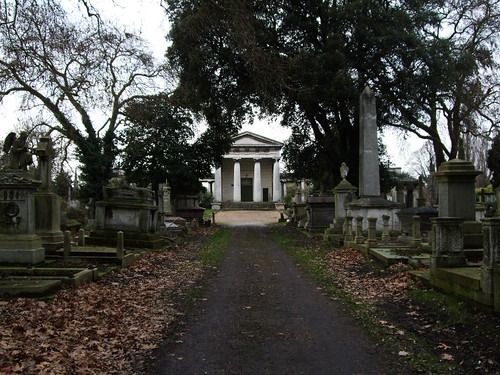
Inside the cemetery, with the Anglican Chapel in the distance

Getting There

The cemetery is located in North West London; the address is Harrow Road, London, W10 4RA. Nearby Kensal Green tube station is on the Bakerloo Line.

History

A rapidly increasing population in London meant that parish graveyards were becoming dangerously overcrowded, and new solutions were sought for the burial of the dead. In 1830 George Carden, a barrister, formed the General Cemetery Company (which still owns the cemetery); an Act of Parliament in 1832 enabled the company to establish a cemetery on land beside the Grand Union Canal. It was originally known as the General Cemetery of All Souls, Kensal Green.

An architectural competition was launched in 1831 to find a design for the Anglican Chapel in the centre of the cemetery. Henry Edward Kendall’s Gothic Revival design won the competition, but the owners – who preferred the classical style – overturned the decision (at least Kendall still got his prize money). The cemetery gateway and the two chapels were eventually completed to designs by John William Griffith, a company shareholder.

2015_0215KensalGreen01
Main entrance on Harrow Road

Originally there was a division between the Anglican section of the cemetery, comprising 39 acres, and the smaller Dissenters’ area of 15 acres. This distinction was very important at the time.
2015_0215KensalGreen02
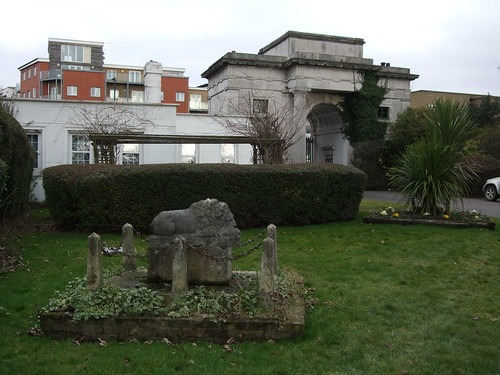
Looking towards the entrance from the inside, with the Anglican burial ground on the left and the Dissenters area on the right

Exploring

2015_0215KensalGreen10
Inside the cemetery
2015_0215KensalGreen11
View of the cemetery including the former gas towers, which are due to be demolished

I had been to Kensal Green cemetery before, but only for a quick look round. The place is so huge that I had only managed to see a relatively small part of it. I decided to go back for a proper tour, getting there a bit early to have another look round by myself. Completely by accident I came across the grave of John Cam Hobhouse, close friend of my favourite poet Lord Byron.
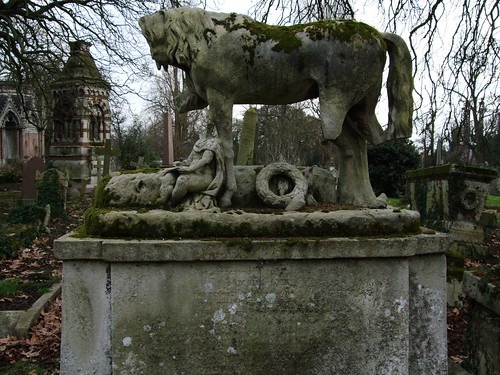
2015_0215KensalGreen07
Approaching the Anglican chapel
2015_0215KensalGreen04
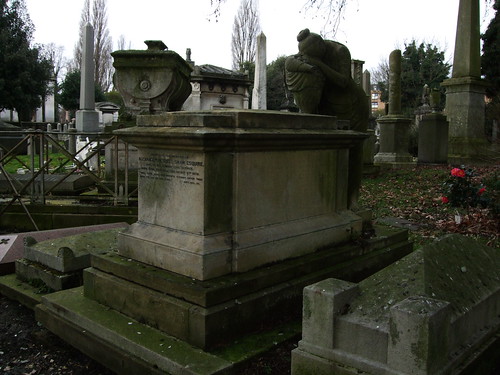
Interesting, if damaged, monument
2015_0215KensalGreen08
Weeping statue
2015_0215KensalGreen15
The way this woman has turned to look at you is quite creepy
2015_0215KensalGreen14
The Anglican Chapel from the back
2015_0215KensalGreen12
Memorial plaque commemorating the damage done in World War II
2015_0215KensalGreen03
The grave of John Cam Hobhouse

Tours, which are run by the cemetery’s Friends group, start at the steps of the Anglican Chapel.
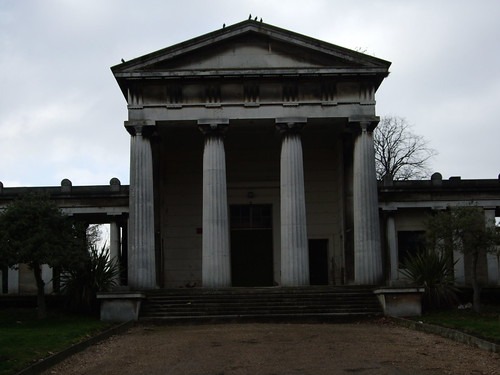
2015_0215KensalGreen09
The Anglican Chapel

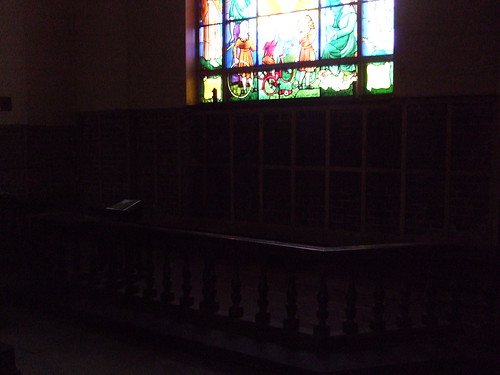
After a quick background introduction to the cemetery and London’s garden cemeteries in general, we got to go into the chapel, which is cold and in need of some repair. The ceiling is still beautiful, though.
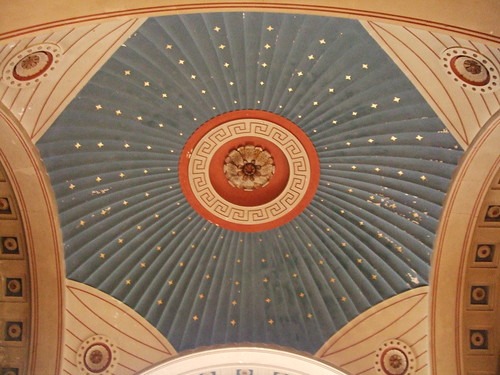
2015_0215KensalGreen19
Ceiling of the Anglican Chapel
2015_0215KensalGreen20
Inside the Anglican chapel
2015_0215KensalGreen18
Inside the Anglican chapel

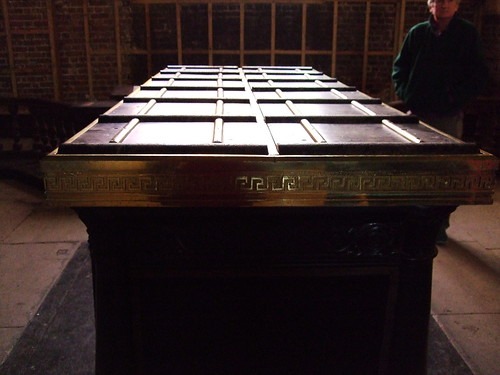
The raised platform is where the coffins are placed, and rollers help the bearers to slide it on. The platform turns around so that coffins can be taken out head first, as is custom.
2015_0215KensalGreen21
Catafalque with rollers

The raised structure also happens to be a hydraulic catafalque for lowering coffins into the catacombs. Sadly we couldn’t go into the catacombs because of Health & Safety risks (mould, apparently), but we could see the entrance from outside the chapel.

2015_0215KensalGreen22
Looking down into the catacombs

We had a comprehensive tour of the cemetery which took over two hours. The time went very quickly, however, and our guide was very knowledgeable. Even then, we didn’t see all of the notable tombs here: it is so big and there are so many significant people buried in Kensal Green.

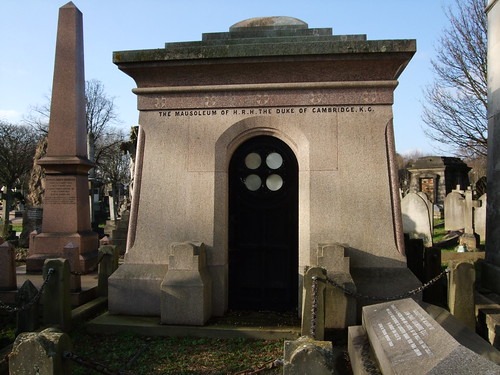
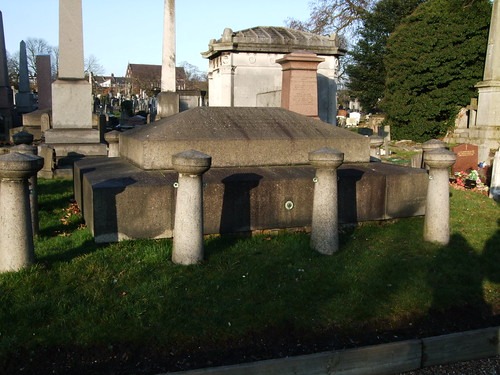
Uniquely for a public cemetery, three members of the Royal Family have been buried here: Prince Augustus Frederick and Princess Sophia, children of George III, and Prince George, Duke of Cambridge, grandson of George III and commander-in-chief of the British Army. Royal burials helped to make Kensal Green a popular and fashionable place to be buried.
2015_0215KensalGreen23
Mausoleum of Prince George, Duke of Cambridge
2015_0215KensalGreen33
Tomb of Prince Augustus Frederick
2015_0215KensalGreen34
Grave of Princess Sophia

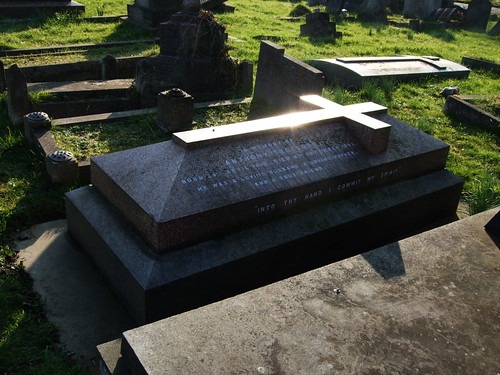
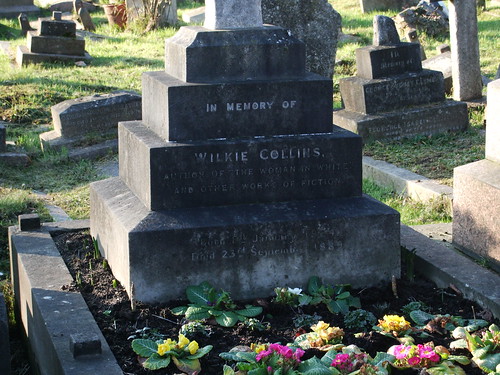
A significant number of important authors have been buried at Kensal Green, including Anthony Trollope, Wilkie Collins, Thomas Hood, Harold Pinter and William Makepeace Thackeray. As a lover of nineteenth-century literature (and twentieth-century theatre) I was thrilled to see these. My favourite was Anthony Trollope’s. I don’t know if he chose his inscription himself or if a family member selected it after his death, but either way it is astoundingly modest and deeply moving. It simply reads, “He was a loving husband, a loving father, and a true friend” – no mention of his (hugely underrated, in my opinion) forty-seven novels, written alongside his full-time job in the Post Office (he is credited with introducing the red pillar box to Great Britain).
2015_0215KensalGreen25
Grave of Anthony Trollope
2015_0215KensalGreen29
Grave of Wilkie Collins
2015_0215KensalGreen51
Burial place of Harold Pinter
2015_0215KensalGreen56
The grave with the flowers belongs to William Makepeace Thackeray

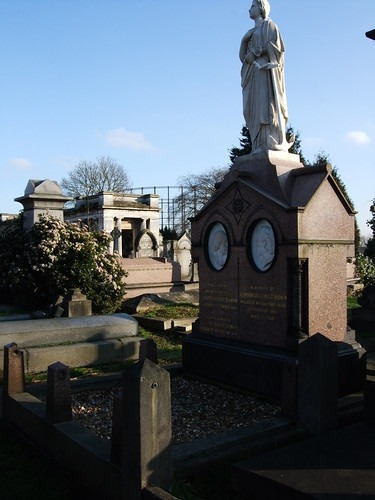
I’d already heard of many of the famous figures buried in Kensal Green, but one person new to me was Jean-François Gravelet Blondin. Blondin, who is buried with his wife, was a French tightrope walker and acrobat. His most famous and impressive feat was crossing the Niagara Falls, not once but repeatedly. On different occasions he crossed blindfolded; in a sack; and carrying a man on his back. Once, he even carried a small stove: halfway across, he stopped, lit the stove and proceeded to cook an omelette.
2015_0215KensalGreen26
Tomb of Blondin and his wife

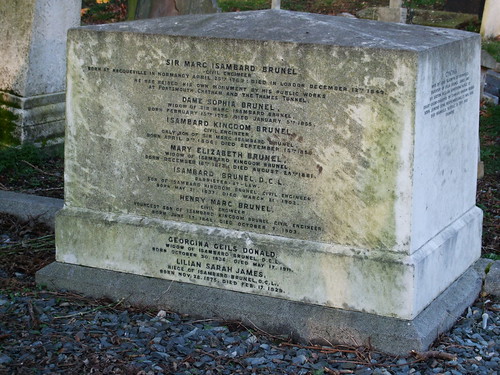
Charles Babbage, the polymath who created the concept of a programmable computer, is buried in the cemetery, as are Marc Brunel and his son Isambard, two of the most important and prolific engineers in British history. One of Marc’s great achievements was the Thames tunnel between Rotherhithe and Wapping, while Isambard’s accomplishments include the Great Western Railway and the designs for the Clifton Suspension Bridge in Bristol.

2015_0215KensalGreen40
Grave of Charles Babbage
2015_0215KensalGreen55
Burial place of Sir Marc Isambard Brunel, Isambard Kingdom Brunel, and other family members

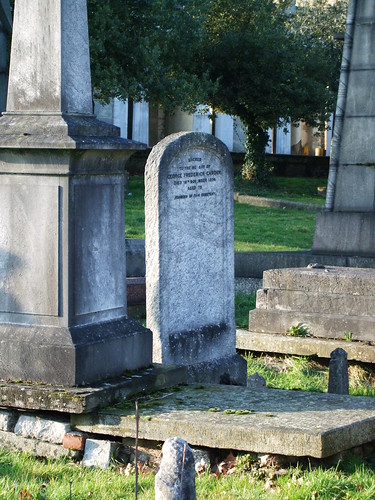
George Carden, founder of the cemetery, rests inside it.
2015_0215KensalGreen31
Grave of George Carden, founder of the cemetery

Architecture

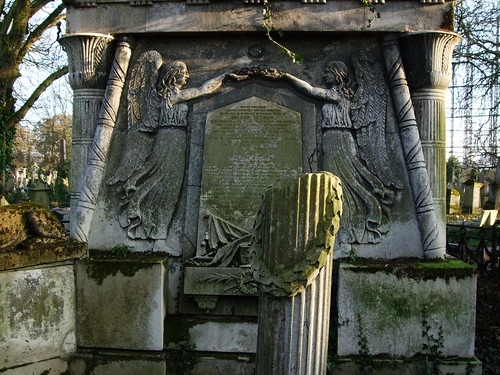
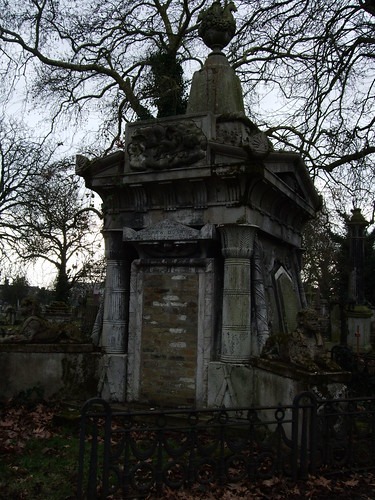
The cemetery is of interest not just because of the individuals buried here, but because of the varied and rich architecture of the different tombs and mausoleums. One of the most significant graves in this respect is that of circus performer Andrew Ducrow.
2015_0215KensalGreen46
Andrew Ducrow’s elaborate memorial
2015_0215KensalGreen47
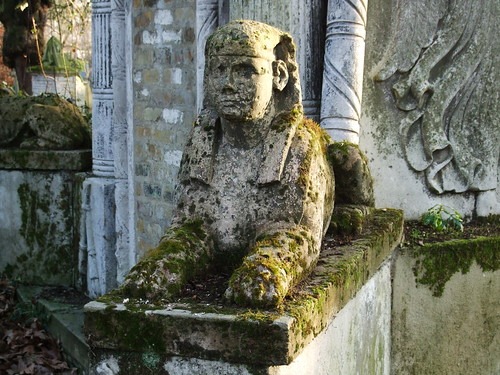
Egyptian symbolism, like this sphinx, was popular in the nineteenth century
2015_0215KensalGreen49
Angels and broken-off columns, symbolising life cut short, were also popular
2015_0215KensalGreen50
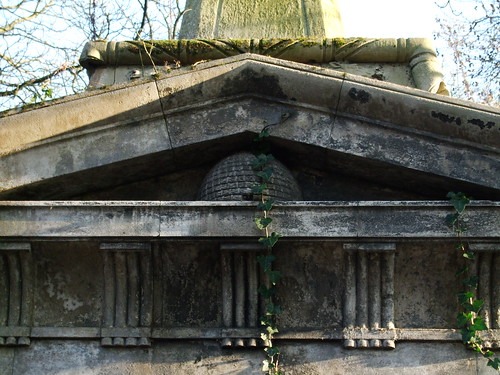
The beehive represents industriousness
2015_0215KensalGreen48
Beautifully carved hat and gloves

Dissenters’ Chapel

Our tour ended at the other end of the cemetery, with a visit to the Dissenters’ Chapel. We didn’t spend much time in this part of the graveyard, though it is interesting to me because my ancestors on my dad’s side, as Methodists, would have been classed as Dissenters, and if they had lived in London and been buried here, this is the area of the cemetery where they would have ended up. The chapel is similar in design to the larger Anglican chapel at the centre of the cemetery, but it has been restored more recently, with facilities for us to view displays and enjoy a hot cup of tea and some biscuits.

2015_0215KensalGreen58
The Dissenters’ Chapel
2015_0215KensalGreen59
Inside the chapel

Finally we were allowed to look inside the catacombs. They are smaller than those beneath the Anglican chapel, and the coffins there have been moved, but the space was still atmospheric. Plans are afoot to put on exhibitions and other events down here, which I think would be quite exciting.

We were let out of a side gate leading to Ladbroke Grove, and I made my way home.

A visit to Kensal Green cemetery is a must for anyone interested in cemeteries and the history of burials in London. It’s also a beautiful and peaceful space for a walk. Entry is free (unless you take a tour) and there is so much to see – it would be easy to go back again and again.

Would I go back?

Yes – it’s a lovely place for a relaxing walk, and I would particularly like to see Lady Byron’s grave and Terence Rattigan’s memorial stone, neither of which we had time to see on the tour. A booklet produced by the Friends, which I purchased for £2, has a map with the locations of significant graves, and this would be useful to take with me when I return.

Facts

Address: Harrow Road, London, W10 4RA
Founded: 1832
Size: 72 acres
Still in operation?: Yes
Official website: http://www.kensalgreencemetery.com
Owners: The General Cemetery Company
Friends group: Friends of Kensal Green Cemetery (http://www.kensalgreen.co.uk)
Tours: 2 pm every Sunday March to October and the first and third Sundays of the month November to February. Cost £7 (£5 for concessions/English Heritage members)
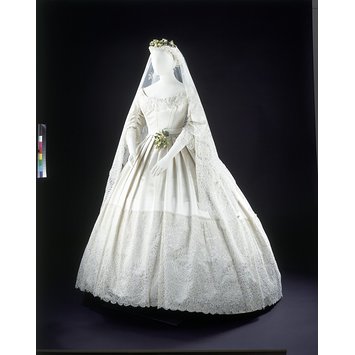
Wedding Dresses 1775–2014 – V&A

I’ve always said I never want to get married, but that didn’t stop me from visiting the V&A‘s exhibition Wedding Dresses 1775–2014. Firstly, it was historical. Secondly, I do have a thing for gorgeous dresses.

Silk-satin wedding dress from 1865
Silk-satin wedding dress from 1865 (Picture credit: V&A Collections)

There were plenty of those in the exhibition, but what really fascinated me was the history. From Georgian dresses that weren’t always white, but which tended to be “best” dresses then worn again later, through to Victorian white gowns with sprigs of orange blossom, to the development of the modern one-off white dress tradition during the twentieth century, the wedding dress has a rich and varied history. Upstairs, there were examples of more modern dresses from ordinary people and celebrities – I especially liked Dita Von Teese’s beautiful purple gown.

The Garden Cemeteries: London’s Magnificent Seven

Recently I’ve decided to visit the cemeteries in London known as the “Magnificent Seven”, the garden cemeteries established in the nineteenth century in order to alleviate overcrowding in parish cemeteries. The cemeteries were originally established on the edges of the city, but the expansion of London over the next two centuries ensured that they are now well and truly part of the city.

    The cemeteries are:

  • Kensal Green Cemetery (established in 1832)
  • West Norwood Cemetery (1837)
  • Highgate Cemetery (1839)
  • Abney Park Cemetery (1840)
  • Nunhead Cemetery (1840)
  • Brompton Cemetery (1840)
  • Tower Hamlets Cemetery (1841)

I hope to visit them in the order in which they were established, starting with Kensal Green.

The book I’m using as a reference and guide is Turpin, John and Knight, Derrick, The Magnificent Seven: London’s First Landscaped Cemeteries. Stroud: Amberley Publishing, 2011.

On with the adventure!

Germany: memories of a nation – British Museum

Germany: memories of a nation is another exhibition at the British Museum; I visited after I went to see the museum’s exhibition on China. The exhibition is billed as a 600-year history in objects, but it is more than that: each object reveals something about the culture and history of the nation that has only existed in its current form since the fall of the Berlin Wall 25 years ago. Germany has an incredibly complex political history – it used to be divided into regions under the umbrella of the Holy Roman Empire, and was not unified until 1870, after which two World Wars and the division between East and West further shaped the Germany we know today.

The exhibition began with a superb display of the contrast between England and Germany during the eighteenth century. When England was developing a standardised system of coinage – represented by the single coin bearing an image of Queen Anne – Germany had several different currencies and monetary systems. I was fascinated by the objects on display, including art by Dürer and Holbein, a beautiful and ornate model of a ship holding several Electors and the Holy Roman Emperor, and an amazing Bauhaus cradle. More poignantly, a (replica) gate from a World War II concentration camp was displayed, and no exhibition inspired by the fall of the Berlin Wall would be complete without a piece of the Wall itself. I really enjoyed this exhibition – it tells a fascinating and complex story through the medium of objects, and there should be something here to appeal to everybody.

Ming: 50 years that changed China – British Museum

Ming: 50 years that changed China is an exhibition at the British Museum which explores the years between 1400 and 1450 and how, during this time, China’s Ming dynasty established Beijing as the country’s capital and encouraged developments in culture and trade. It began by exploring the five emperors to rule in this period, and went on to look at the innovations of the period including architecture (the famous Forbidden City was constructed during this time), painting, sculpture and travel. I was amazed at the beautiful objects on display, particularly the stunning Cloisonné jar that has appeared on all the promotional material, and the hanging scroll with a picture of the Imperial palace.

Tudor World / The Falstaff Experience

The Stratford upon Avon museum known as Tudor World and The Falstaff Experience is an “interactive museum” all about the town where Shakespeare grew up. It explores life in the Tudor era and looks at where Will may have got some of his inspiration. I popped in last time I was in Stratford to pass some time in between seeing some plays.

The museum is hosted in a Grade 2 listed building on Sheep Street, in the centre of the town. Known as the Shrieve’s House and Barn, it is the oldest lived-in house in Stratford, and used to be home to an inn run by William Rogers who was supposedly the inspiration for Shakespeare’s Falstaff.

2014_1011TudorWorld01
The Shrieve’s House and Barn
2014_1011TudorWorld02
Informative plaque on the wall
2014_1011TudorWorld04
Entrance to Tudor World
2014_1011TudorWorld03
Visiting

Tudor World is great fun and very child-friendly, with plenty of grim and gruesome exhibits and a “guide” in the form of a young pickpocket who pops up on information boards as you go around. The museum contains a lot of wax figures and other props which I found pretty atmospheric and creepy. There are even “smell-boxes” that let you smell what the deck of a ship or the inside of a pub would have been like! The “Falstaff Experience” part of the museum is a room with a very detailed inn replicated: it is possible that Shakespeare visited the inn and gained inspiration for his character of Falstaff.

As well as being open every day of the week (except Christmas Day) between 10.30 and 5.30, the museum is often open in the evening for ghost tours or ghost hunts (including overnight ones). Occasionally plays are performed in the Courtyard. Admission costs £5.50 for adults and £3 for children, with a family ticket and discounts for concessions available. Well worth a visit on a rainy day, with or without children.

Ancient lives, new discoveries: eight mummies, eight lives, eight stories – British Museum

The Ancient lives, new discoveries exhibition at the British Museum is a brilliant exploration of eight different mummies, each with their own story. It uses the latest technology to show how we can learn from these individuals and find out more about their lives.

These people were found in ancient Egypt and Sudan, and between them they span 4,000 years of history. Some were embalmed deliberately, others were preserved naturally.

A young man preserved in the sand (Gebelein Man B)

This mummy dates from about 3500 BC and was discovered in Gebelein, Egypt, along with several other individuals. He died as a relatively young man (20-35) and was preserved naturally in the sand. What I found amazing about this individual was that the contents of his stomach were preserved too!

A man embalmed for the afterlife (Linen man)

This older man was discovered in Thebes and dates from around 600 BC. He was bound in linen and had suffered dental abscesses, tooth loss and tooth decay, which would have caused him a great deal of pain. Intriguingly, he was found in a woman’s coffin, though whether this happened at the time of his death or at the time of his discovery in the 19th century is unclear. My personal, rather outlandish theory is that he was put in the wrong coffin on purpose, perhaps to cover up his death – this is probably ridiculous but I think it sounds rather exciting!

Tamut: a high-ranking priest’s daughter

Tayesmutengebtiu, or Tamut, was the daughter of a priest, known as Lady of the House or the Chantress of Amun. Found in Thebes, she was aged at least thirty-five when she died, and as well as dental abscesses (common among the ancient Egyptians because of their consumption of sugar) she suffered from atheroscleriosis (plaque in the arteries). Dating from around 900 BC, the hieroglyphic inscriptions on her mummy case show that she was married when she died, and as a lady of high status she was mummified very carefully. CT scans have identified many amulets on her body beneath the bandages. Incredibly, 3D printing has been used to turn the CT scans into three-dimensional models, meaning that we can see the amulets without unwrapping the bandages.

Padiamenet: a Temple Doorkeeper

Padiamenet was discovered in Thebes and his mummy dates from around 700 BC. He was middle-aged when he died, and also suffered from dental abscesses and atherosclerosis during his life. Padiamenet was a temple doorkeeper, responsible for deciding who was able to enter the most sacred parts of the temple. He also worked as a barber, as all the priests had to have all their body hair removed before going into the temple. There were mistakes made during his mummification: his head came off and had to be fixed back on, and when his mummified body was laid in his case it was found to be too short so the embalmers had to improvise an extension! Padiamenet was buried with his family, and his wife and son were found with him; after his death, his post had passed to his son.

Tjayasetimu: a young temple singer

I found Tjayasetimu one of the most poignant mummies in the exhibition simply because she was only around seven when she died. Again, she was discovered in Thebes, and lived around 800 BC. Her case is small, but scans have shown that her body inside was even smaller. The case shows her as a grown woman, perhaps suggesting her anticipated status in the next life.

In general, few child mummies have been discovered: death in childhood was very common, and it was probably too expensive to have all your children mummified. Tjayasetimu probably had the honour because of her status as a temple singer.

An unusual mummy from the Roman period

This mummy, dating from after 30 BC (though also from Thebes), was one I found a bit spooky. He is wrapped up so that all his limbs are wrapped separately, and his painted face makes him look quite lifelike. Experts aren’t sure why this is – he even has a beard painted, but he also has breasts painted on.

During the early Roman period, Egyptian customs were still common, and the practice of embalming was used by Romans as well as Egyptians.

A young child from the Roman period

This young male child, approximately 2 years old, dates from AD 40-60 and was found in Hawara, Egypt. His tiny body is contained in an elaborate case. He has been treated like an adult mummy in many respects, so perhaps there was more of a focus on treating children like adults in terms of mummification during this later period. I found this really sad – the whole exhibition was brilliant in terms of getting me to see the mummies as real people who actually lived, but this makes the deaths of the young children in particular seem so much more tragic.

A Christian woman from Sudan

The final mummy was a Christian woman found in Sudan, dating from around 700 AD – she is the youngest mummy in the exhibition. She was found when the Sudanese government decided to build a dam near the Fourth Cataract: a number of museums including the British Museum were invited to carry out archaeological work, and this body was found naturally preserved in a small cemetery. Amazingly, the body has a tattoo which is still visible – it is a tattoo signifying the Archangel Michael, the patron saint of her area.

This exhibition has just been extended until the 19th of April 2015 and I’m not surprised. It really is wonderful and allows you to learn so much about these individuals and the times in which they lived. I highly recommend visiting.

Witches and Wicked Bodies – British Museum

Witches and Wicked Bodies is a free exhibition at the British Museum (Room 90, Prints and Drawings Gallery) until 11 January. I visited one Friday to attend a special event – a free performance exploring the weird sisters by RIFT theatre company, who were responsible for the amazing immersive Macbeth at the Balfron Tower during the summer.

The performance was a chilling exploration of the witches from Macbeth and their entrapment by witch-hunters. It was fairly short though and I enjoyed the exhibition itself more – an examination of how witches and witchcraft have been portrayed in art from the Renaissance to the end of the 19th century. Beginning with Dürer and Goya, the exhibition moved on to consider artists such as Burne-Jones and Rossetti, inspired by Biblical and classical portrayals of witches.

Primrose: Early Colour Photography in Russia – The Photographers’ Gallery

Primrose: Early Colour Photography in Russia is an exhibition currently taking place at the Photographers’ Gallery just off Oxford Street. Being fascinated by Russia, I visited the Gallery on Thursday evening when it opens late. I was pleasantly surprised to see that entry is free – I am sure I had to pay last time I visited, so this was nice to see.

The exhibition looks at the development of colour photography in Russia from the 1860s to the 1970s. As well as the history of photography in Russia it is also concerned with the history of Russia in photography. This period was a time of turbulent change and the photographs really showcase this.

Arranged in chronological order, the exhibition begins with early hand-tinted images, moving to more developed photographs and eventually to photomontage and colour film. Societ authorities restricted the use of photography during the mid-20th century and it wasn’t until the 1970s, when inexpensive colour film was available to the general public via unofficial routes, that ordinary people could really exercise free choice over their photographs – even then they normally had to be shown in secret.

I was fascinated by the early tinted colour photographs, making me think of characters from Anna Karenina. They were not unlike our Victorians, though many, particularly children, were dressed in traditional Russian costume. At the turn of the century, the pictures started to remind me of Chekhov characters, as the clothes worn by the subjects of the images were very like those I have seen on stage. One standout image for me was the photograph of Tolstoy – he looks like a grumpy old man (which, in a very basic way, I suppose he was). Colour photographs – even those which have been hand-coloured – bring their subjects to life like black and white pictures can’t, and make their subjects seem much closer to us today.

Images from the following century made the Soviet era seem much more “real”. They were so vivid and clear – I loved looking not only at the people themselves, but at their surroundings, how they lived and what their spaces looked like.

This exhibition is on until the 19th of October – even if you’re not particularly interested in Russian history, I recommend a visit.

The Queen’s Gallery

The Queen’s Gallery, an art gallery I have visited many times over the years, is part of Buckingham Palace and can be visited in conjunction with the State Rooms and the Royal Mews (stables). However you can also choose to visit the Gallery alone. It puts on around three exhibitions a year and is open all year round unlike the State Rooms and the Royal Mews which are open during the summer season only.

If you buy your ticket direct (either online or in person) you can get it stamped at the end of your visit which makes it valid for a whole year. This is great value as it means you can go back to subsequent exhibitions at the Gallery. It’s worth noting that the summer months are very crowded and it might be difficult to visit with your ticket at these times, as timed tickets are normally on sale for this period.

This year-long validation does not apply if you buy your ticket from a third party. This may not matter to you if, for instance, you are coming from a different part of the country on a trip as you may not be able to return within a year. For someone like me, however, who lives in London, this is ideal.

*Location*

The Queen’s Gallery is located on Buckingham Palace Road next to Buckingham Palace itself. If visiting by tube, Green Park station (near Piccadilly Circus) is a short walk away and the route through the park is very scenic. If you are coming from the other direction, Victoria Underground and National Rail station is almost directly south from the Gallery. Tour buses and normal red buses also stop outside. The Gallery is clearly signposted and is next to the Royal Mews.

*Security*

As might be expected, security is very tight here owing to its proximity to Buckingham Palace. You have to undergo a bag search and walk through an airport-style scanner. However all the staff are very friendly and cheerful and didn’t make me feel uncomfortable during this process. The gift shop is right next to the ticket desk so you can visit without paying for admission. After buying your ticket and walking through security you get to the gallery itself. There is a free cloakroom where coats and heavy bags can be left – we took full advantage of this. Toilets are available too and these are clean and smart.

Audio guides are available, but I didn’t bother with one. Photography for non-commercial purposes is permitted, but not flash photography.

*Gift Shop*

The shop is well-stocked and sells the usual Royal memorabilia, some of it tat and some of it in rather better taste. A number of items relating to this particular exhibition were available, ranging from cuddly penguins to a glossy photography book. I bought some postcards, which I rather regret as they were quite expensive – £5.95 for a pack of ten – but then I was very interested in the subject matter and I have a mind to frame them and put them on my wall!

*The First Georgians*

The exhibition I visited on this occasion was The First Georgians: Art and Monarchy 1714-1760, marking 300 years since the accession of George Ludwig, Elector of Hanover in Germany, to the British throne as George I. He was the first constitutional monarch, and began a long-enduring dynasty which lent its name to the Georgian era. The first room of the exhibition puts faces to names with paintings of the key players in the royal family, such as the three Georges and Queen Caroline.

The exhibition goes on to look at some of the things for which the age was noted, such as the art of William Hogarth, china, silverware and trinkets from “toy-shops”, as well as furniture, sculpture and paintings by the Old Masters. There were plenty of architectural designs and plans for royal residences including St James’s Palace, Windsor Castle, Kensington Palace and Hampton Court, as well as artefacts from less savoury aspects of the age, including military maps and items to do with Culloden and other Jacobite risings.

FACTS

Address: Buckingham Palace, London, SW1A 1AA

Website: royalcollection.org.uk/visit/the-queens-gallery-buckingham-palace

Opening Hours: Approx 10am-5.30pm during exhibitions

Prices: £10 adult, £5.20 child