Hidden London – Baker Street: The World’s First Underground

In recent years, Hidden London tours have expanded to encompass not only disused stations, but working stations with lots of history. Baker Street is one such station, and I attended a tour on a sunny Sunday.

Baker Street is one of the earliest Underground stations, and is Grade II* listed. Today, it has 10 platforms served by 5 different lines – more than any other on the network. It first opened in 1863 as part of the Metropolitan Railway: these original platforms are still in use by the Circle and Hammersmith & City lines and look a lot like they did back then.

The oldest platforms at Baker Street
Original Baker Street platforms

We got to go into some hidden corners of the station; in particular a space once used as a waiting room.
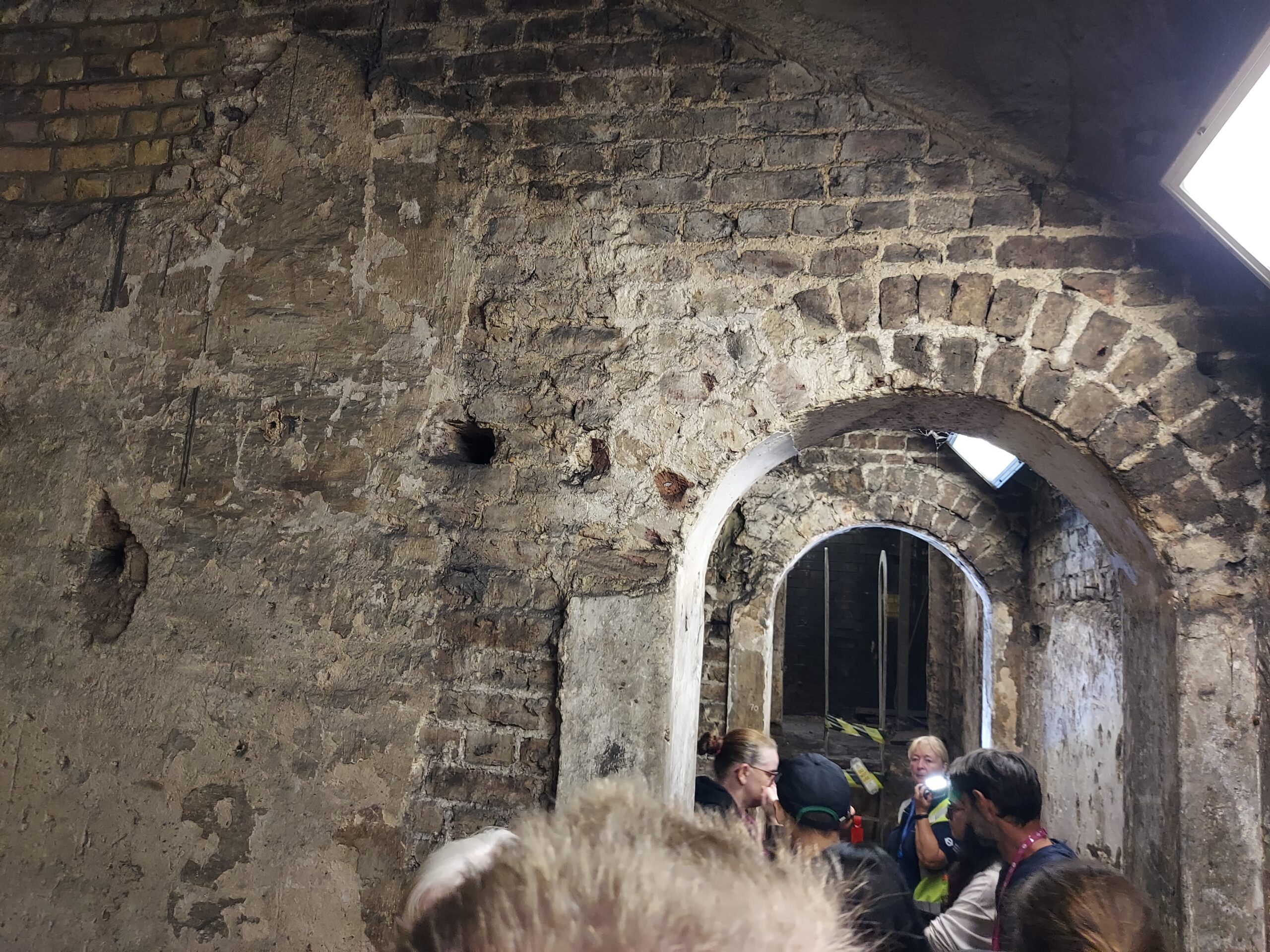
Former waiting room
Former waiting room

Later platforms were built in 1868 as part of the Metropolitan & St John’s Wood Railway. The platforms were rebuilt in 1892, but still struggled to cope with increased demand, so a decision was taken to rebuild the station and create a new headquarters for the Metropolitan Railway at the same time.

Jubilee line platforms
Metropolitan line platforms

The architect Charles Walter Clark replaced the original buildings and created a single sub-surface ticket hall, as well as a subway linking the Circle and Bakerloo lines (the latter had originally opened on a separate site with a Leslie Green station). Plans to build a hotel on top of the station were halted by the First World War, but similar plans were revived in the 1920s with the construction of Chiltern Court. This block of flats was highly prestigious and included such distinguished residents as H. G. Wells and Arnold Bennett.
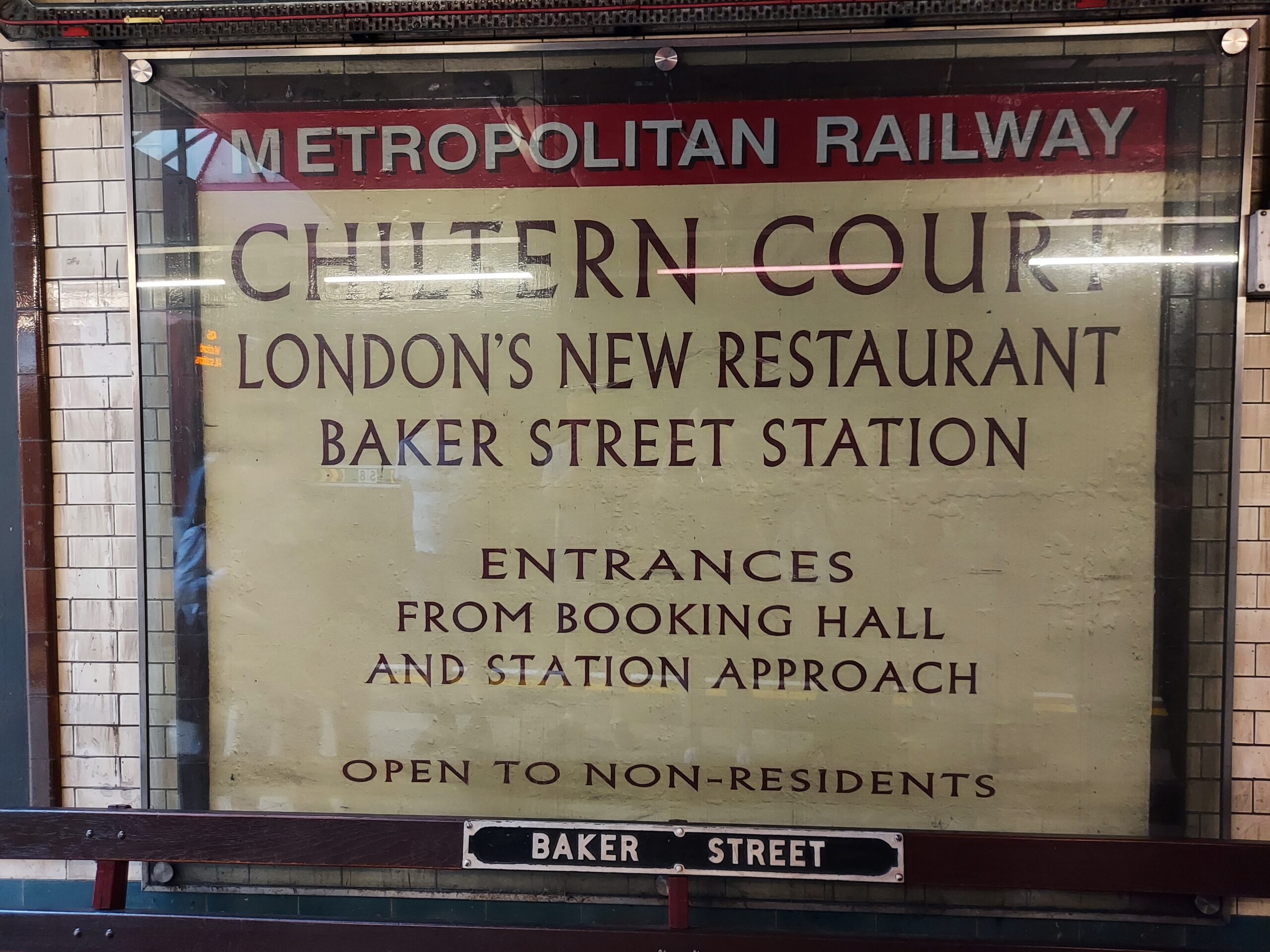
Poster advertising the Chiltern Court restaurant

One of the most exciting parts we got to see was the original underground Bakerloo station, including tiling and lift shafts. We also got to look down through gratings to see the trains pulling in to the platform (now the Jubilee line).

Original Bakerloo line tunnel
Original Bakerloo line tunnel, with tiling visible

As the home of the Metropolitan line, the station has been a headquarters for transport staff for many years. Its facilities have included the Central Control Rooms for the Bakerloo, Central, Jubilee and Metropolitan lines; one of the first operational sites of the British Transport Police; a canteen staff training school; and the Lost Property Office. The London Transport Rifle Club was also located here until the 1990s.
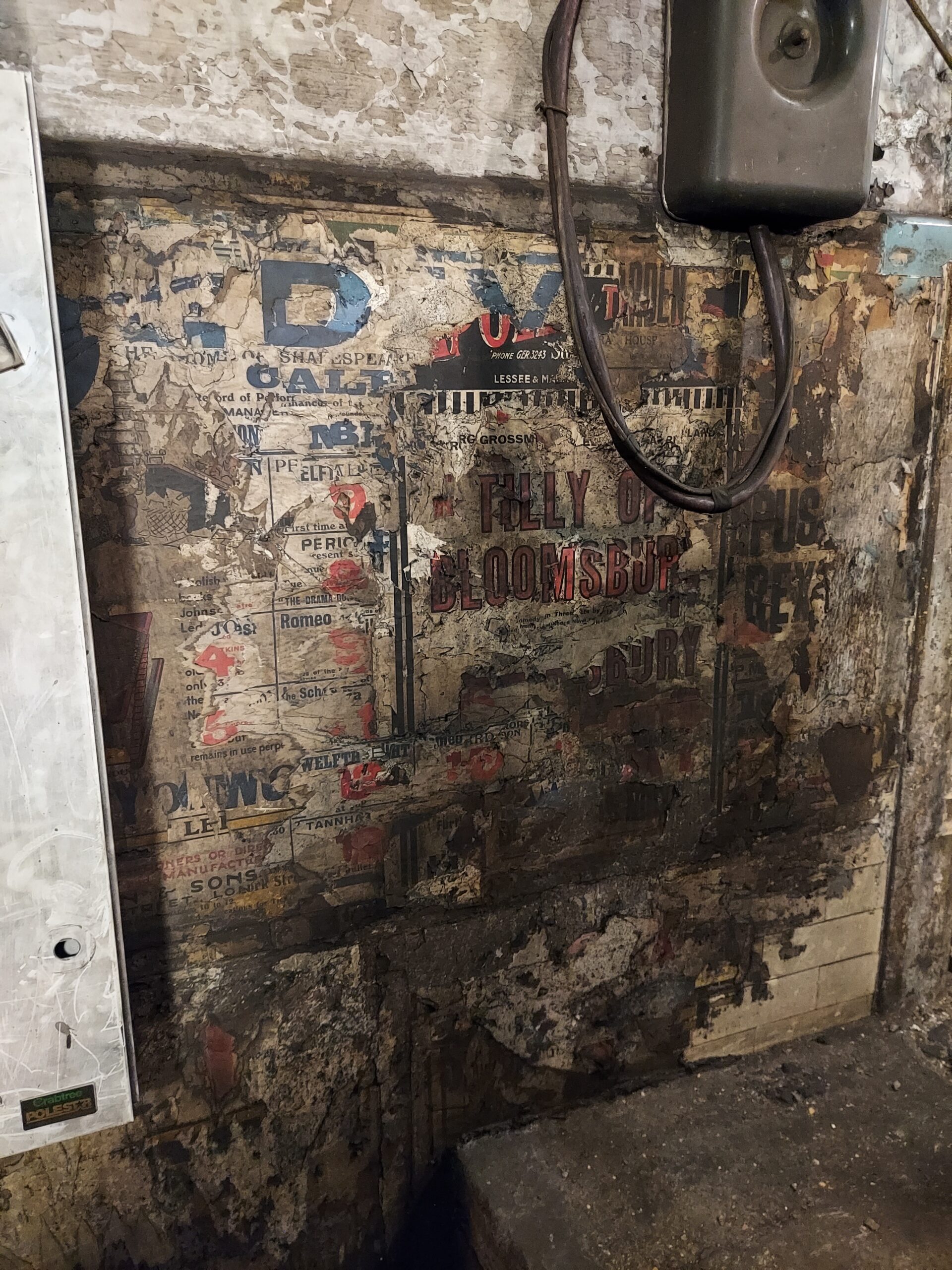
Original posters
Original posters

My tour of Baker Street proves that even current stations have a lot of history and hidden areas to explore. Definitely recommended, and I can’t wait to book another Hidden London tour.
Performing with Marionettes – Little Angel Theatre

For years now, I’ve been fascinated by puppets: how something made from dead or never-alive materials can be brought to life on the stage. I’ve attended several shows at London’s Little Angel Theatre, and decided to sign up for their Performing with Marionettes weekend course in August. I’m not a performer, but puppetry is different somehow: the focus is on the puppet, not the puppeteer, so I don’t feel as self-conscious as I otherwise might.

The course was run by the Little Angel’s Associate Artist Oliver Hymans, who has years of experience with puppetry and recently worked with Heritage Craft to have marionette making added to the Red List of Endangered Crafts. Oliver was a great teacher, and his enthusiasm was infectious. The other course participants were really lovely too, and great to work with.

Over the course of the weekend we learned how to operate short-string marionettes, beginning with cute little wooden worms and moving on to various different kinds of marionette character. We learned how to make them move in different ways, how to convey emotion, and how to bring them to life. Several times we got to perform in front of other course participants, including right at the end when we divided into small groups to create short sketches.

I loved the course and feel like I have only scratched the surface when it comes to marionettes – I definitely want to learn more!

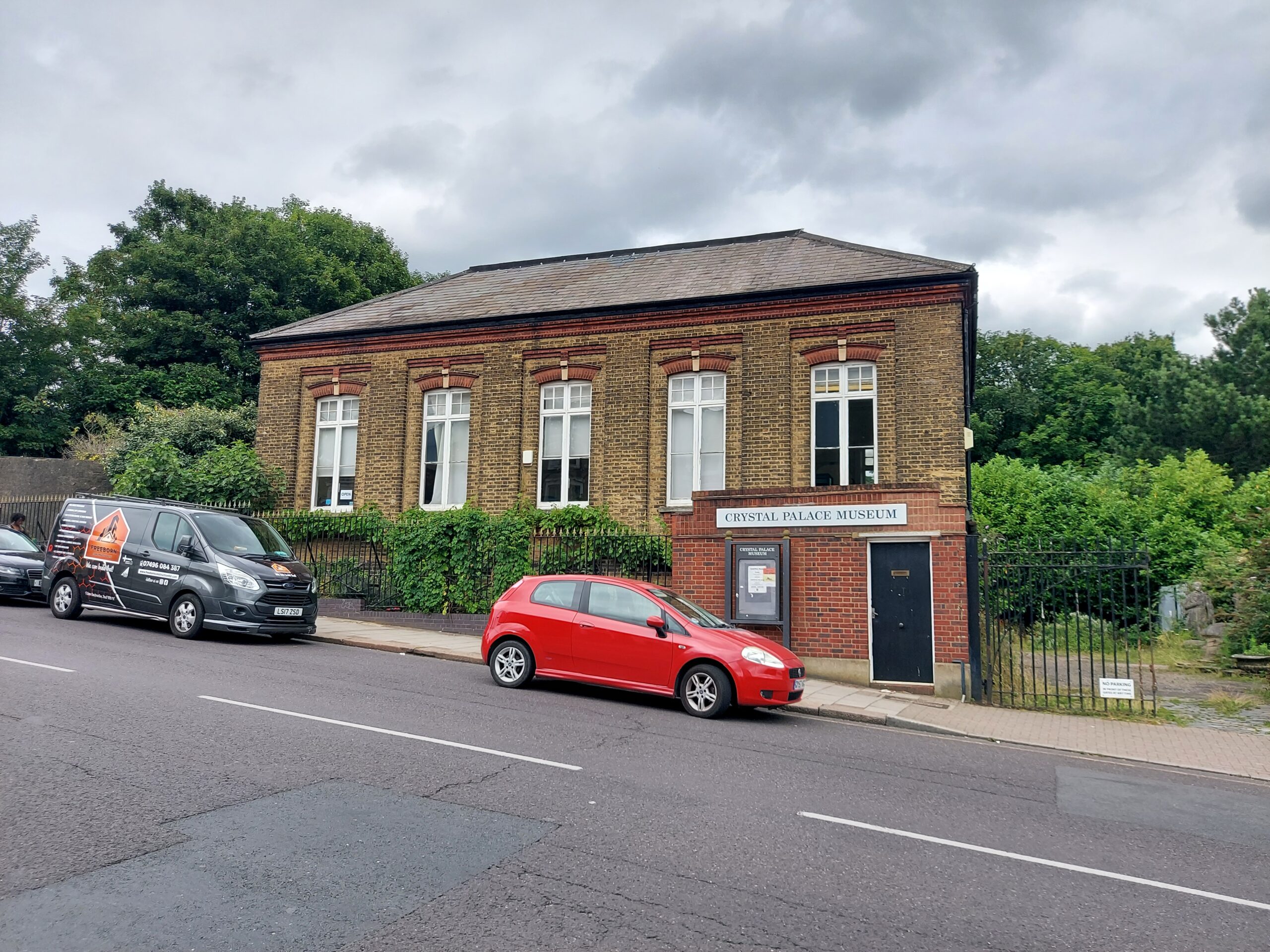
Crystal Palace Museum

Crystal Palace Museum

I’ve been meaning to visit the Crystal Palace Museum for years, but it only opens on Sundays so I never managed to get round to it, until I started walking the Capital Ring and began Section 4 at Crystal Palace railway station, just down the road from the museum.

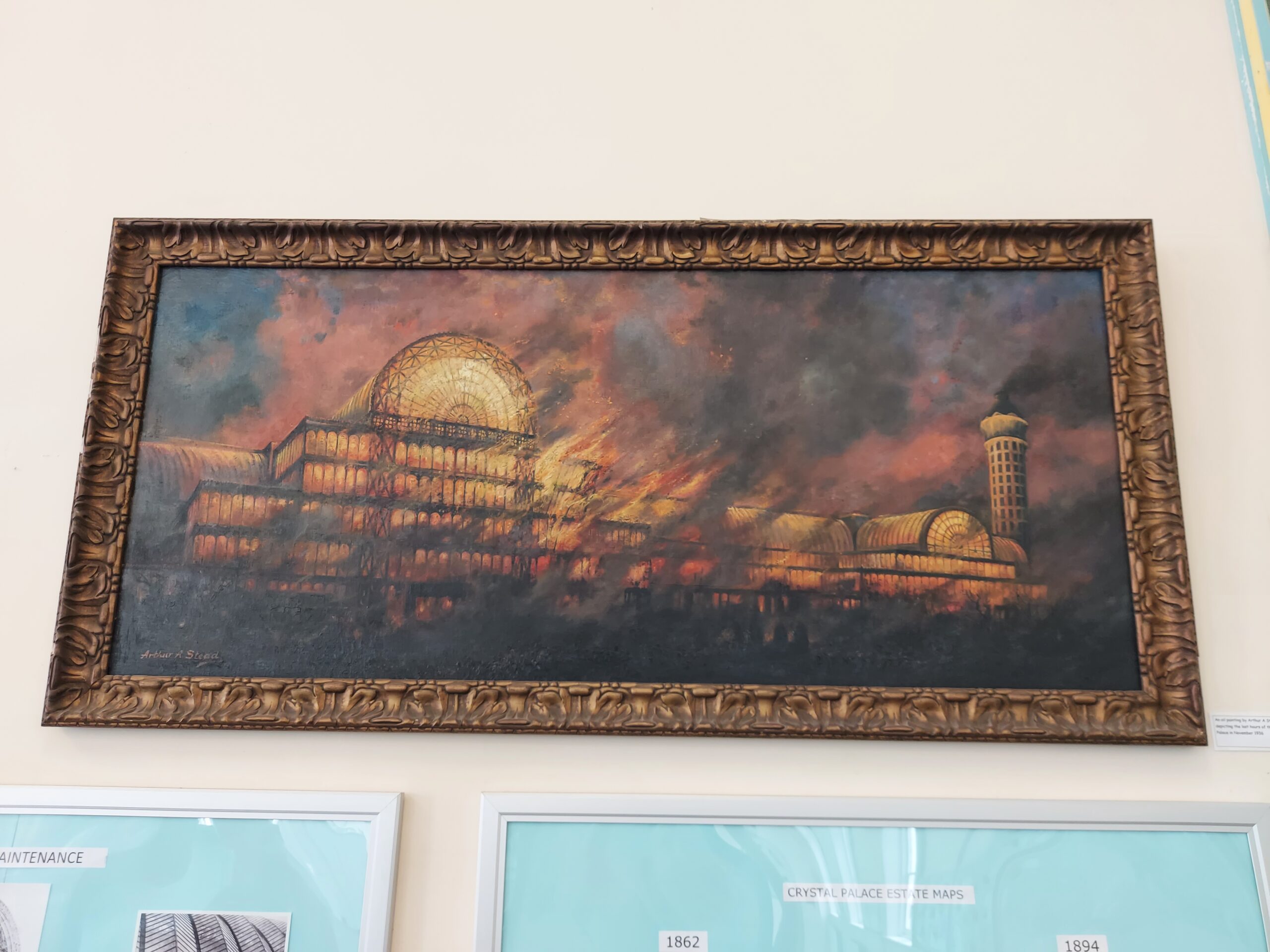
The museum tells the story of the Crystal Palace from its beginnings in Hyde Park to its eventual destruction in a fire in November 1936. The museum itself is housed in the only surviving building constructed by the Crystal Palace Company, built around 1880 as a lecture room for the Crystal Palace Company’s School of Practical Engineering. The museum was opened on 17 June 1990 by the Duke of Devonshire.

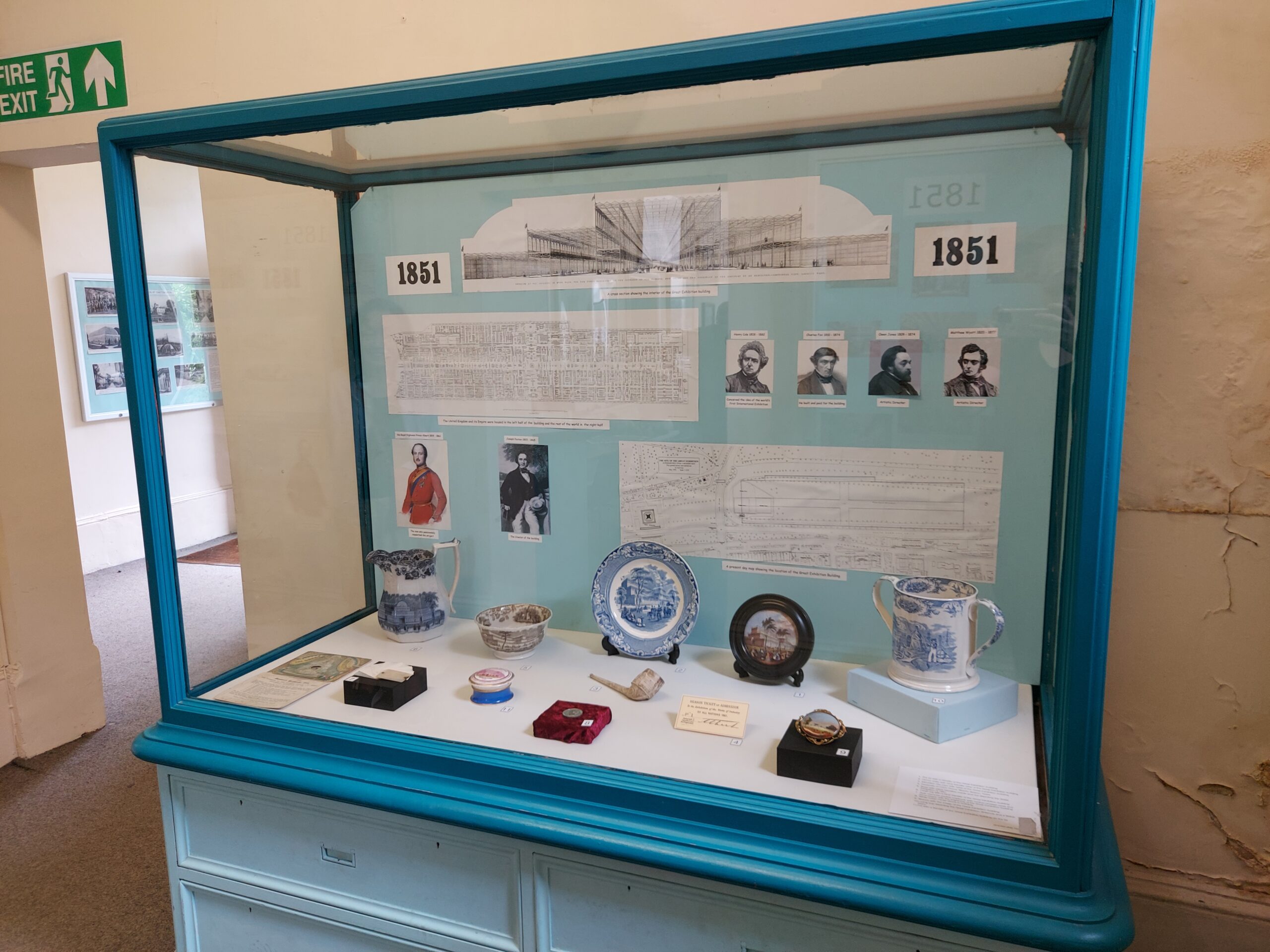
Artefacts from the opening of the Crystal Palace in 1851

Originally created by Joseph Paxton to house the Great Exhibition of 1851 (the ‘Exhibition of the Industry of All Nations’ staged in Hyde Park), the Crystal Palace was left empty after the exhibition closed. It had been a great success – Paxton was knighted – but it was not to be allowed to remain in Hyde Park. Luckily, nine businessmen came to the rescue, purchasing the building from the contractors and eventually resurrecting it on Sydenham Hill in south east London. Reopening in 1854, it became a focus of entertainment and education for the people, featuring courts of architecture, art and manufacture, beautiful fountains and statues, unusual trees and shrubs and full size models of prehistoric animals (many of which can still be seen today). In 1856, Brunel was commissioned to design magnificent water towers. In later decades, the Palace and its grounds hosted firework displays, ballooning, cycle racing, football, funfairs and motor racing. The Palace eventually gave its name to the entire area.

During the First World War the palace and grounds were taken over by the Admiralty and was renamed HMS Victory VI for the duration of the war. Sadly, it was destroyed by fire in 1936.

A painting showing fire engulfing the Palace

The museum tells the Palace’s story in roughly chronological fashion. I was interested to see how it changed over time when relocated to Sydenham – it did not remain static. The staff are friendly and knowledgeable and very willing to chat about the Palace and its history. Many artefacts linked to the Palace from every stage of its existence can be seen, from Great Exhibition souvenirs to pieces of the building recovered from the rubble. I hadn’t been aware that the Palace suffered several fires before the final, destructive one – I suppose it was only a matter of time before it went up in flames, but it still seems a shame that it is no longer in existence. I definitely recommend a visit to this free museum to learn more.

FACTS

Address: Anerley Hill, London, SE19 2BA

Website: crystalpalacemuseum.org.uk

Opening Hours: 11am-3pm Sundays

Price: Free

Hackney City Farm

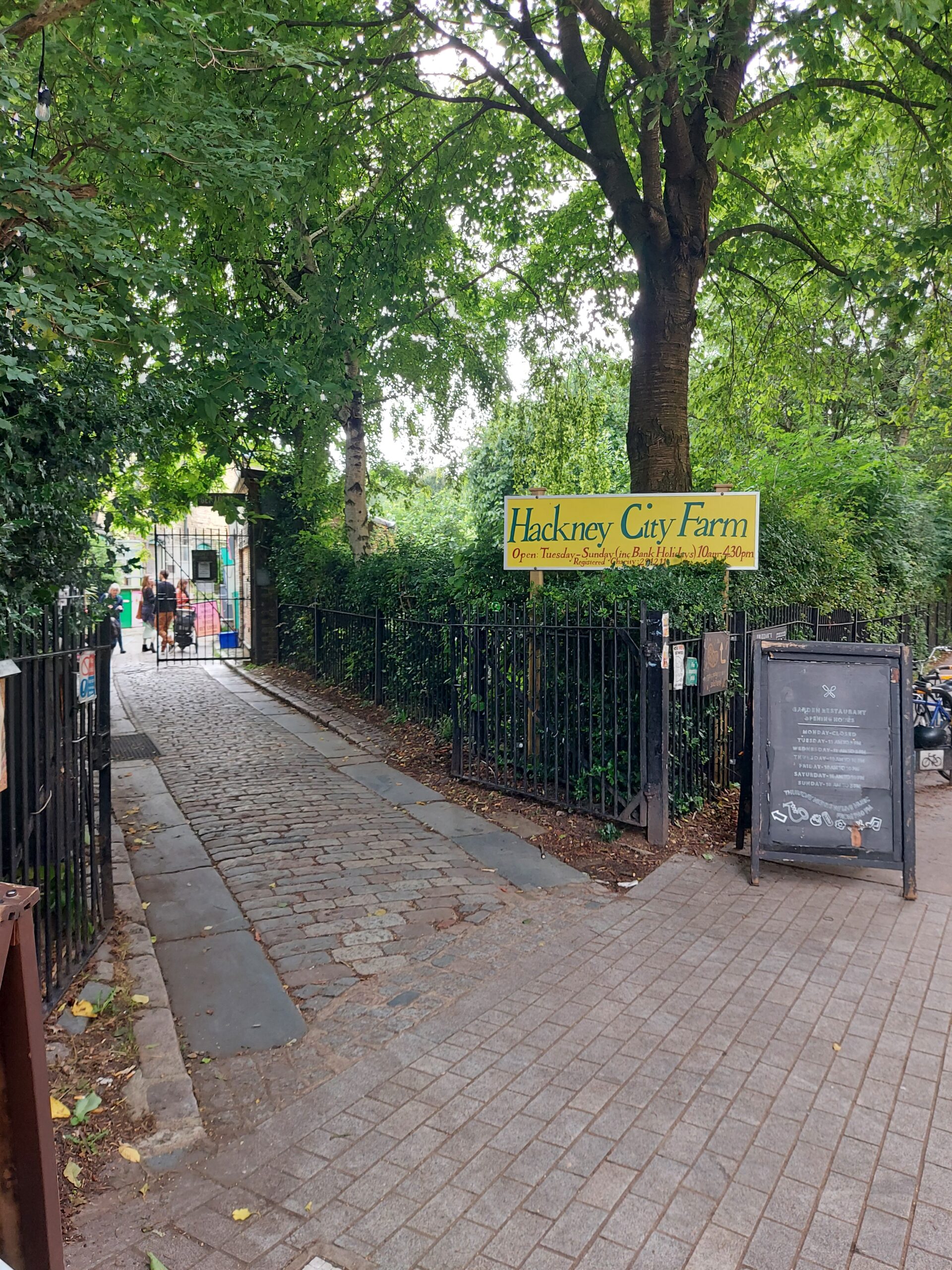
Hackney City Farm entrance

On Saturday I visited Hackney City Farm with some fellow Rebels so we could tick off a clause for Big Kid Summer. I’ve never visited any London city farms before but now I want to go to them all.

Hackney City Farm has been around for over 35 years. It’s free to visit and the farm often hosts school trips. It’s a superb resource for people living in cities to get some idea about animals more often found in the countryside.

We saw sheep, goats, donkeys, chickens, ducks, and baby piglets. The farm is small but there is plenty to see. There is also a garden which is very relaxing to wander round.

Goats

Pig and baby piglets

FACTS

Address: 1a Goldsmiths Row, London, E2 8QA

Website: hackneycityfarm.co.uk

Opening Hours: Tues-Sun 10am-4:30pm

Price: Free

Fortitude – Royal College of Physicians

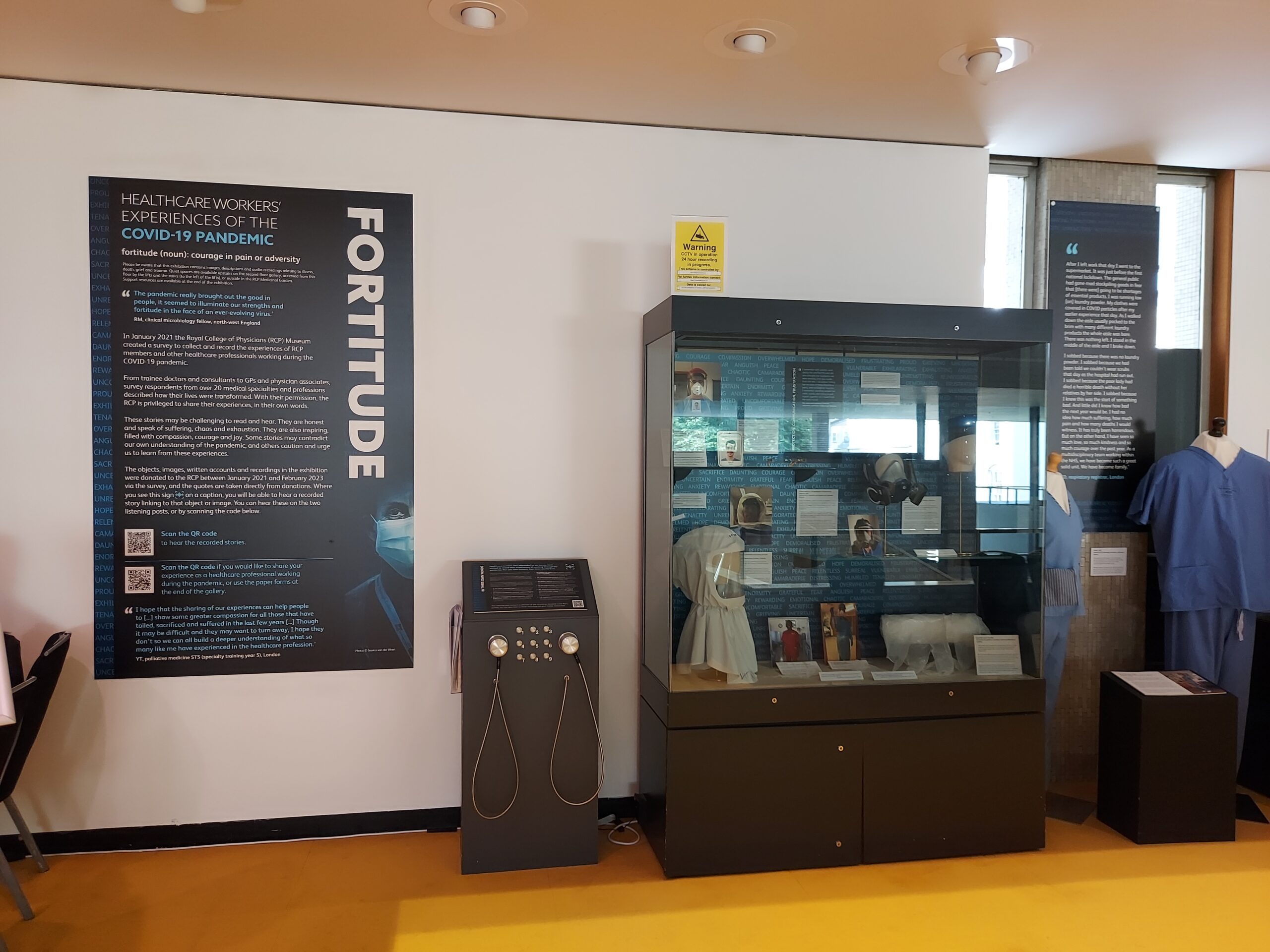
Display case at the Fortitude exhibition

On Thursday night after work I went to the Royal College of Physicians to see their latest exhibition Fortitude. The exhibition draws on real life stories to examine the impact of the Covid pandemic on healthcare workers.

The exhibition is divided into sections based on moods and feelings, such as togetherness, resilience, despair and, eventually, fortitude. I was more or less aware of the struggles endured by doctors and other medical staff during the pandemic, but the exhibition really brought it home. Many suffered themselves, worried for their families, and watched loved ones and their colleagues die. They struggled with the scale of the tragedy and lost innumerable patients, as well as having to contend with inadequate PPE and the difficulties associated with masking.

I didn’t expect to be so moved by the exhibition and I found myself in tears by the end. A very necessary reminder of what these individuals went through and how we need to learn from their experiences.

Now You See Us: Women Artists in Britain 1520-1920 – Tate Britain

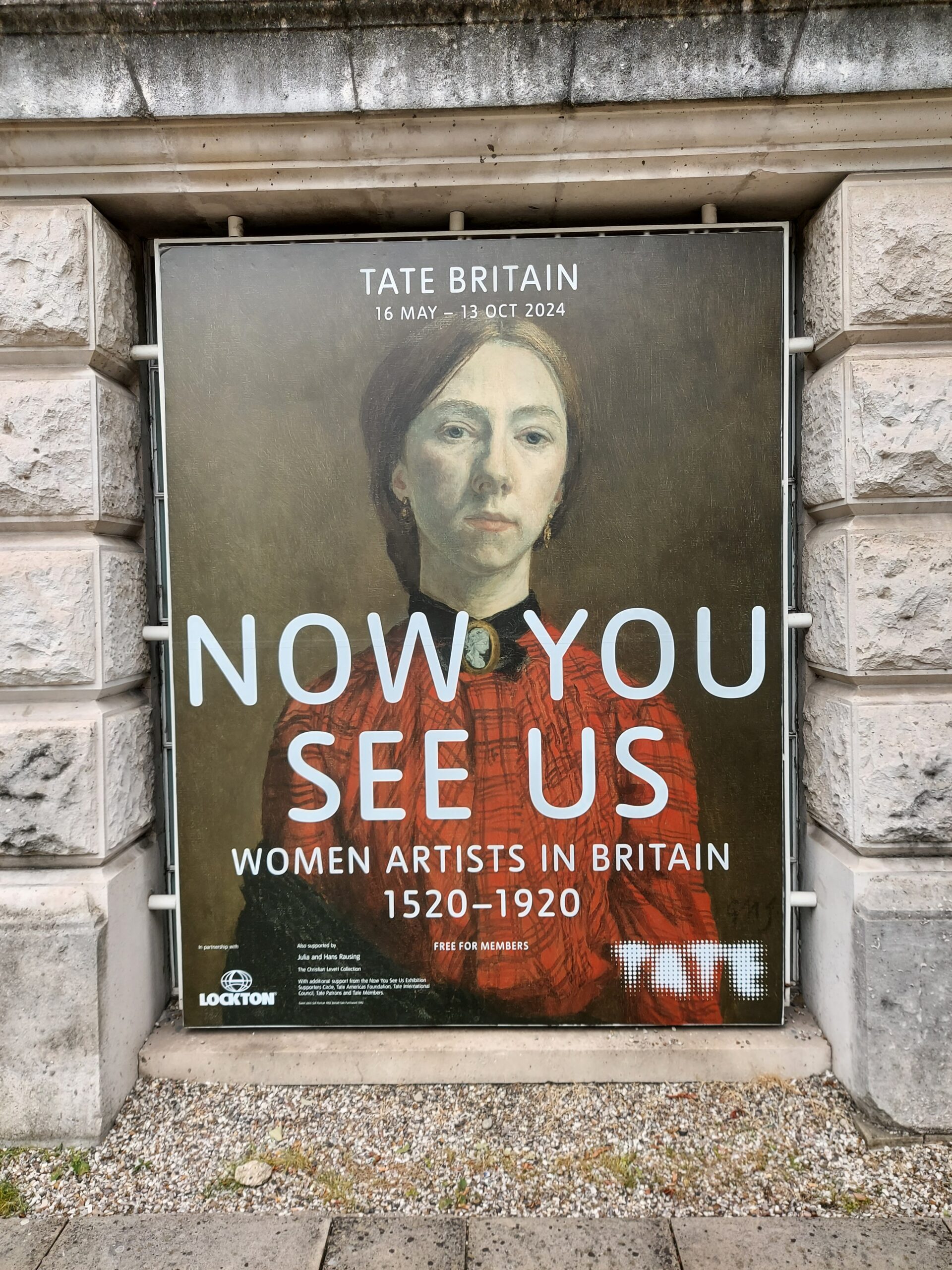
Poster for the exhibition

The second exhibition I went to see at Tate Britain was Now You See Us: Women Artists in Britain 1520-1920. This exhibition, spanning 400 years, features art by women through the centuries struggling to be taken seriously and be recognised as professional artists.

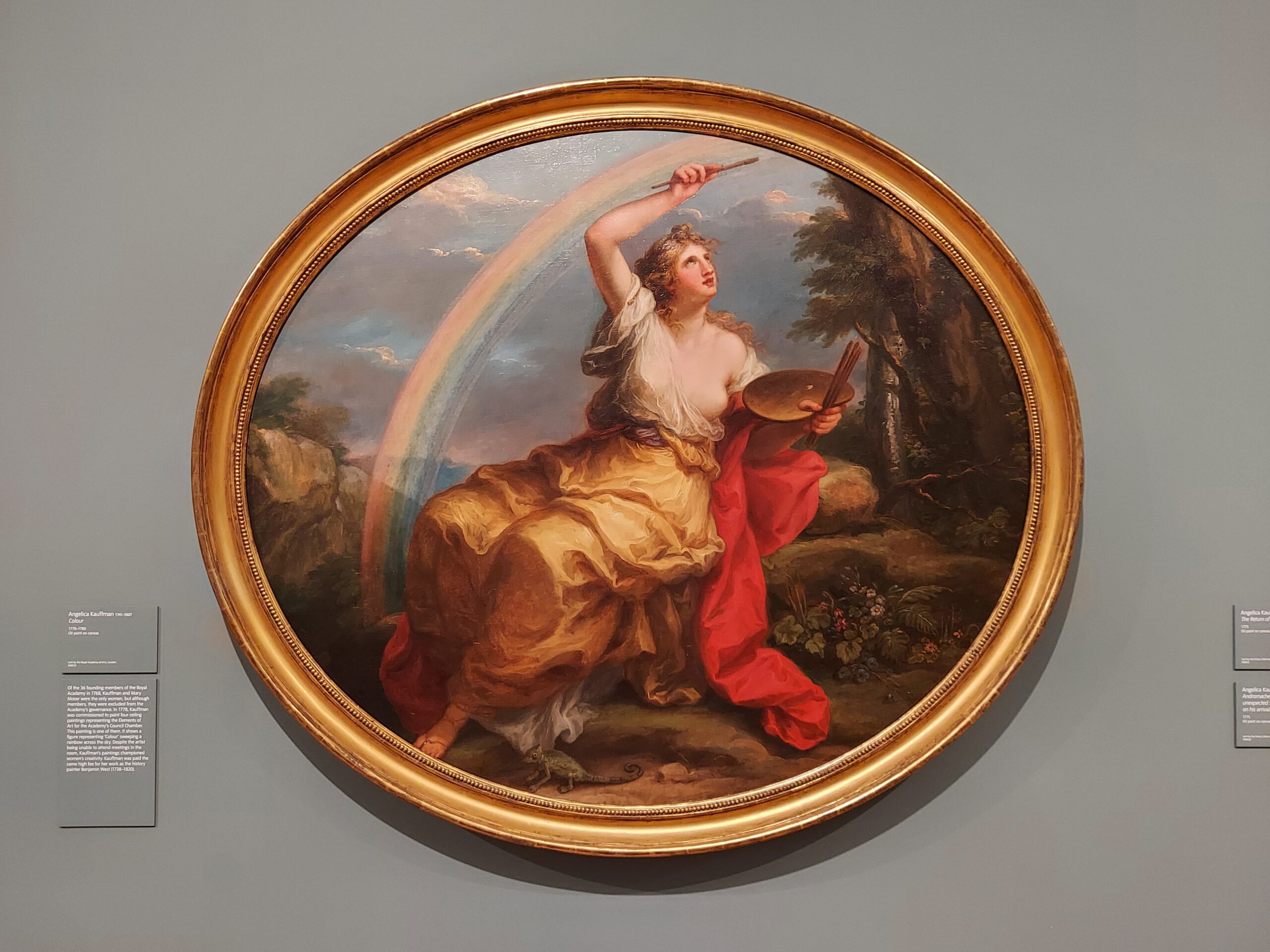
The art in the exhibition is displayed in a roughly chronological manner. It begins with artists like Mary Beale, one of Britain’s first professional women artists, and Angelica Kauffman, who was Swiss but who had a successful career in London and was one of the founder members of the Royal Academy.

painting of a woman and a rainbow
Colouring, Angelica Kauffman, 1788-80

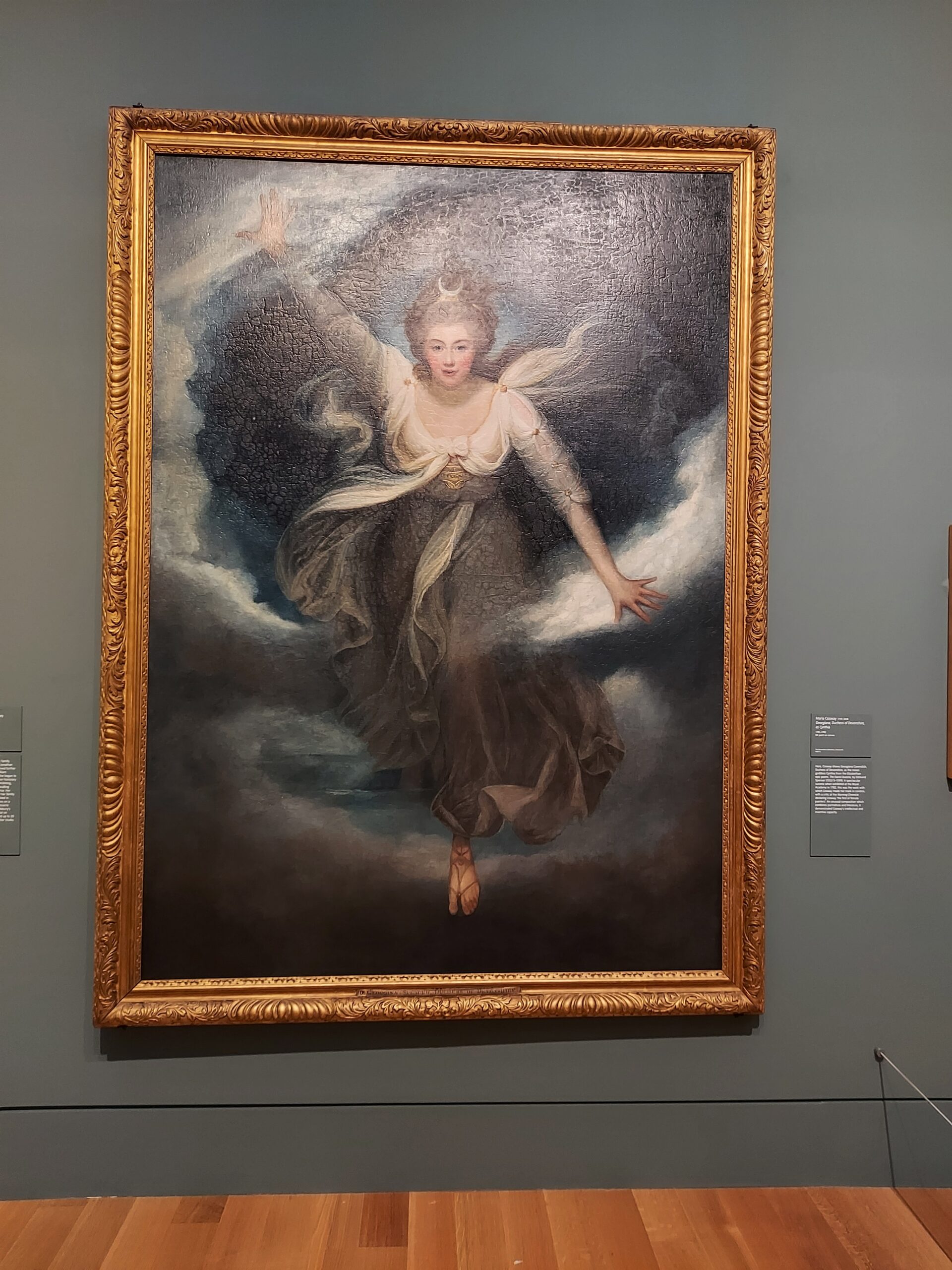
Female artists of the period often painted portraits, usually, though not exclusively, of women.

Painting of a woman
Maria Cosway, Georgiana as Cynthia from Spenser’s ‘Faerie Queene’, 1781-82

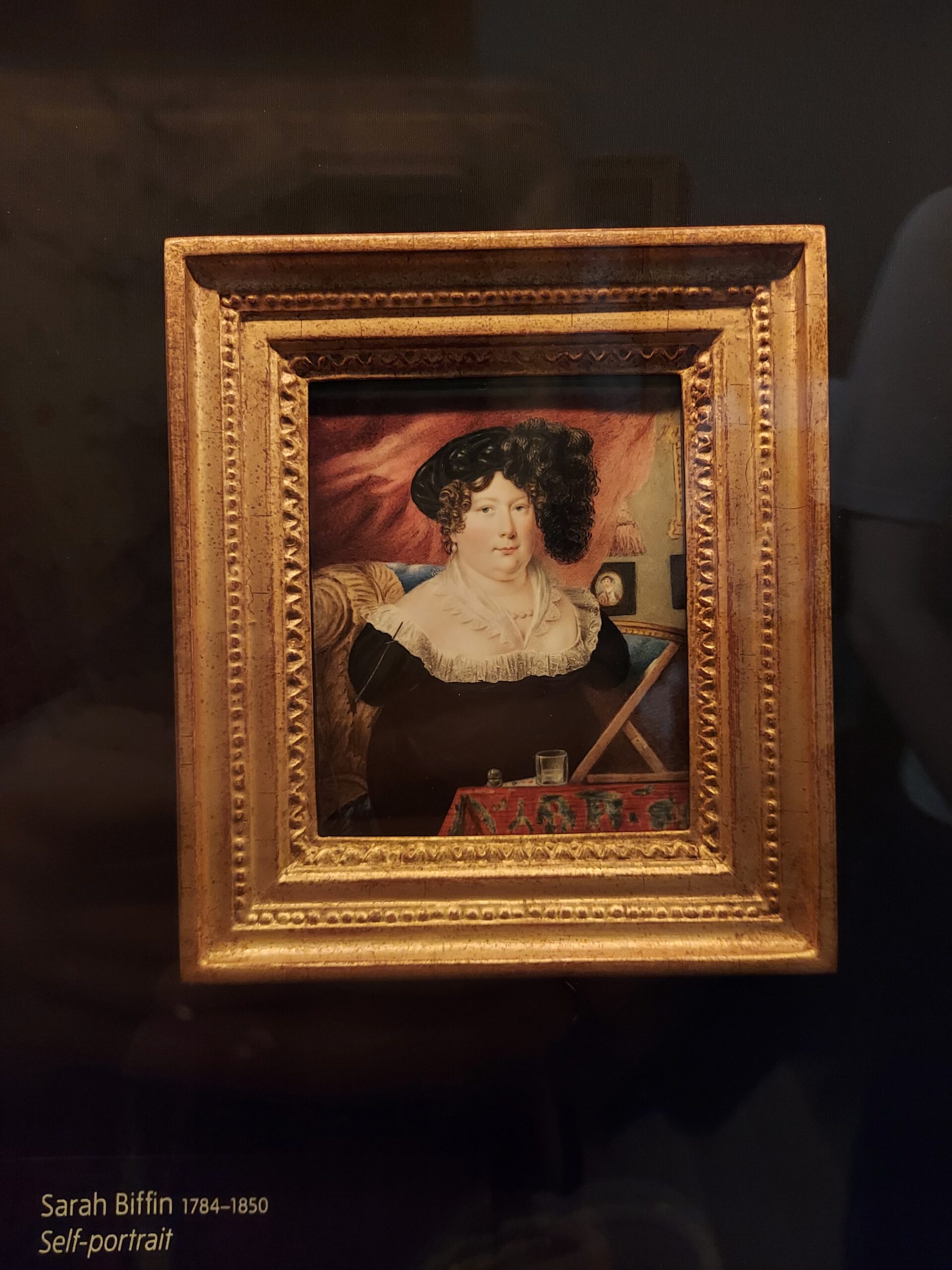
I was particularly impressed by the work of Sarah Biffin, who was born without legs or arms and learned to paint using her mouth.

Portrait of a woman
Sarah Biffin, Self-portrait, 1820s

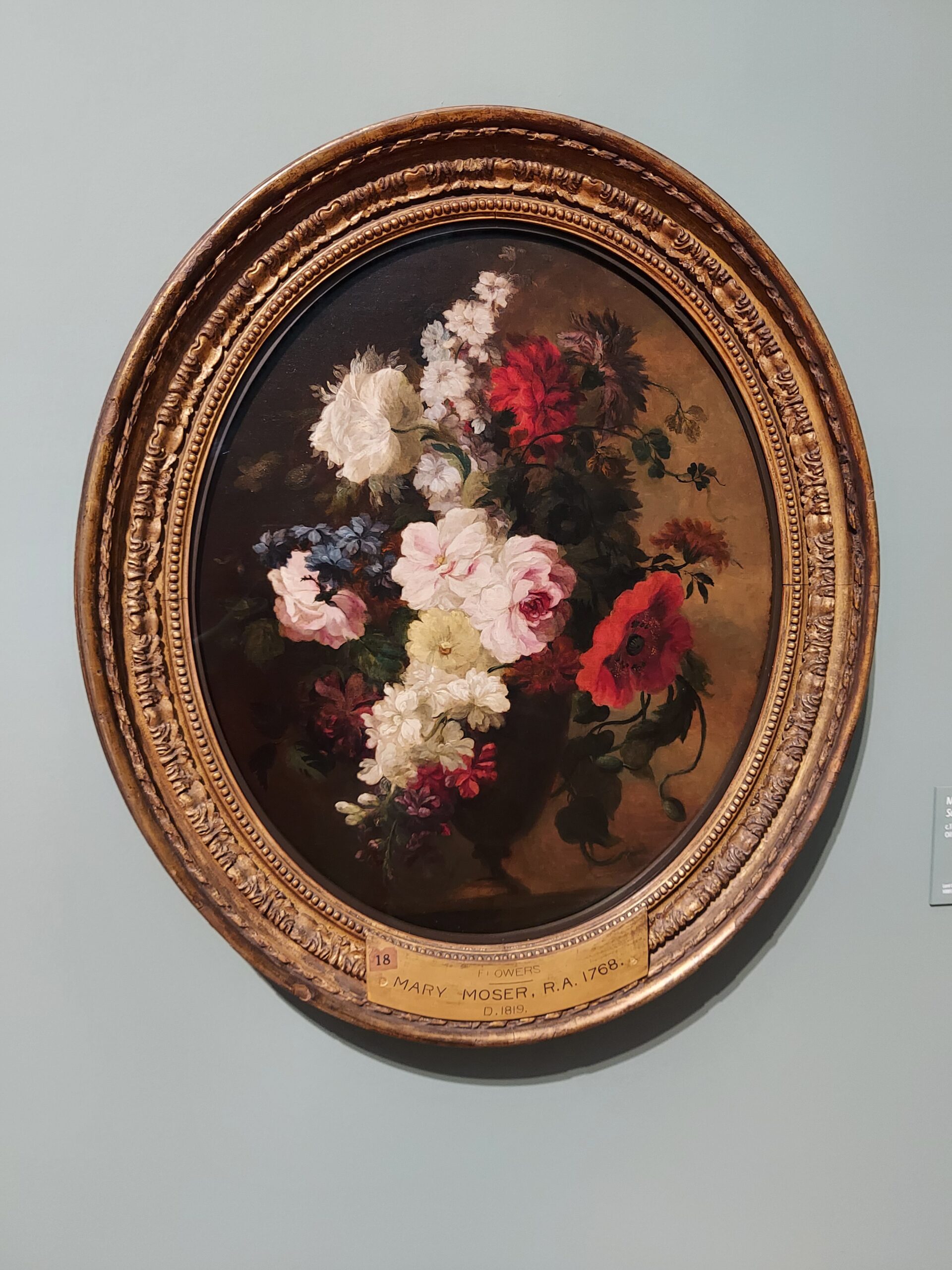
Still life paintings, especially flowers, were seen as an appropriate subject for women; while not groundbreaking, the floral works in the exhibition are technically as skilfully produced as any man’s. The only other female founder member of the Royal Academy, Mary Moser, was famous for her floral works.

Still life with flowers
Mary Moser, Summer, c. 1780

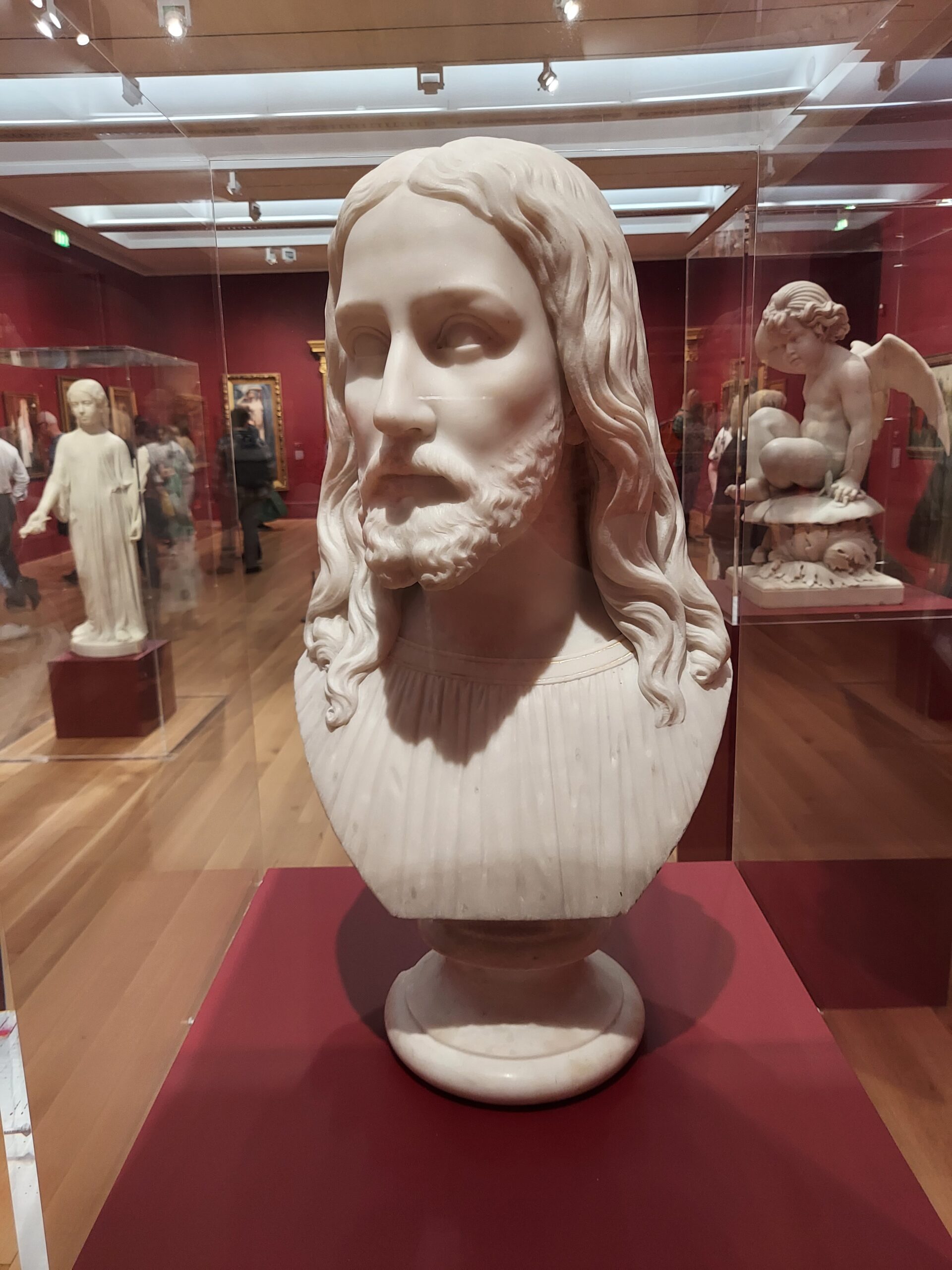
Not everything in the exhibition is a painting. Some sculptures are on display, including a bust of Christ by Edmonia Lewis, the first female black American to work as a professional sculptor.

Sculpture of the bust of Christ
Bust of Christ, Edmonia Lewis, 1870

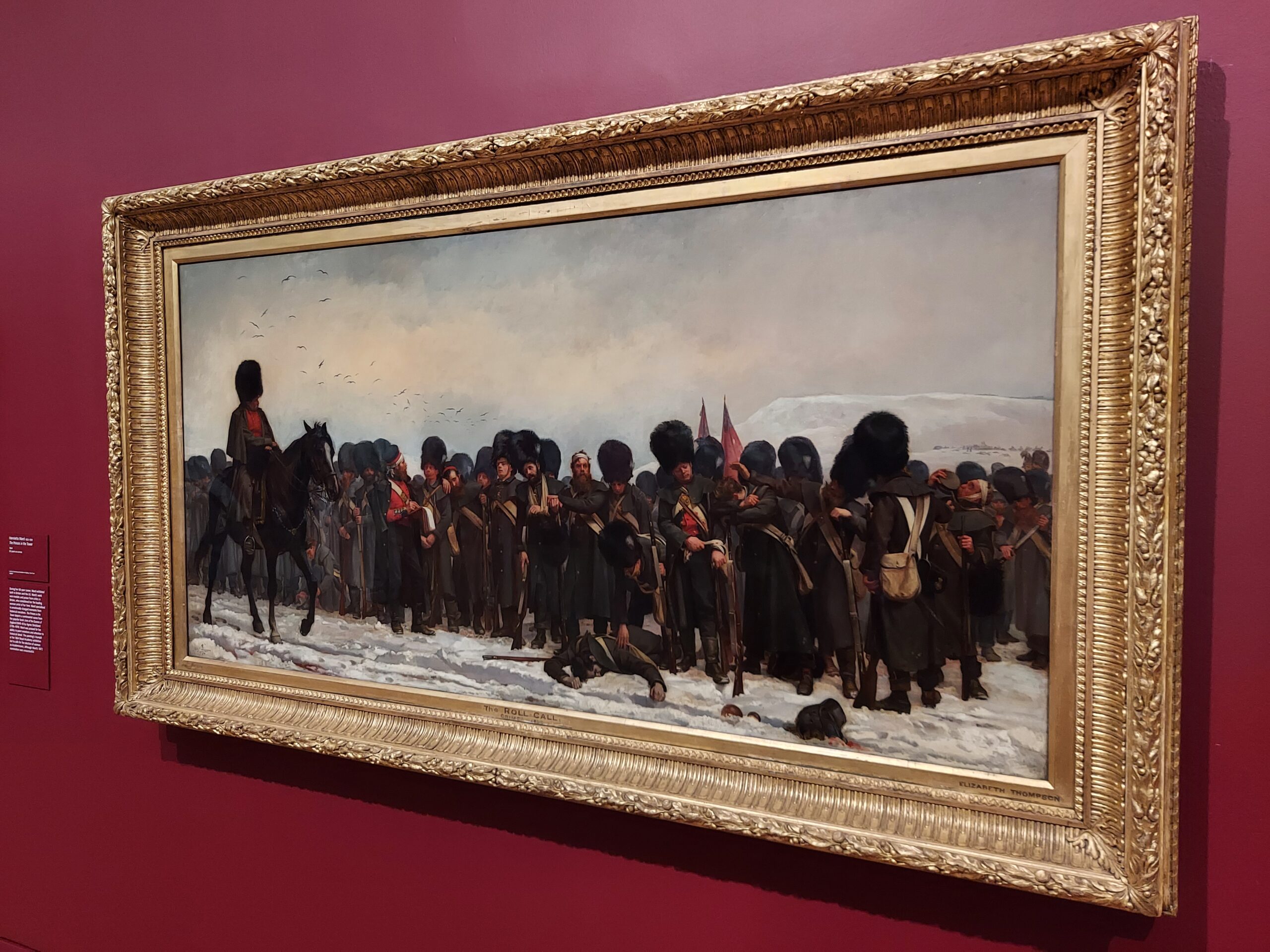
As time wore on, more and more women were able and willing to challenge the expectations laid down for them. For example, Elizabeth Butler (Lady Butler) painted works with the theme of war, usually thought of as a ‘male’ subject.

Soldiers in the snow
Lady Butler, The Roll Call, 1874

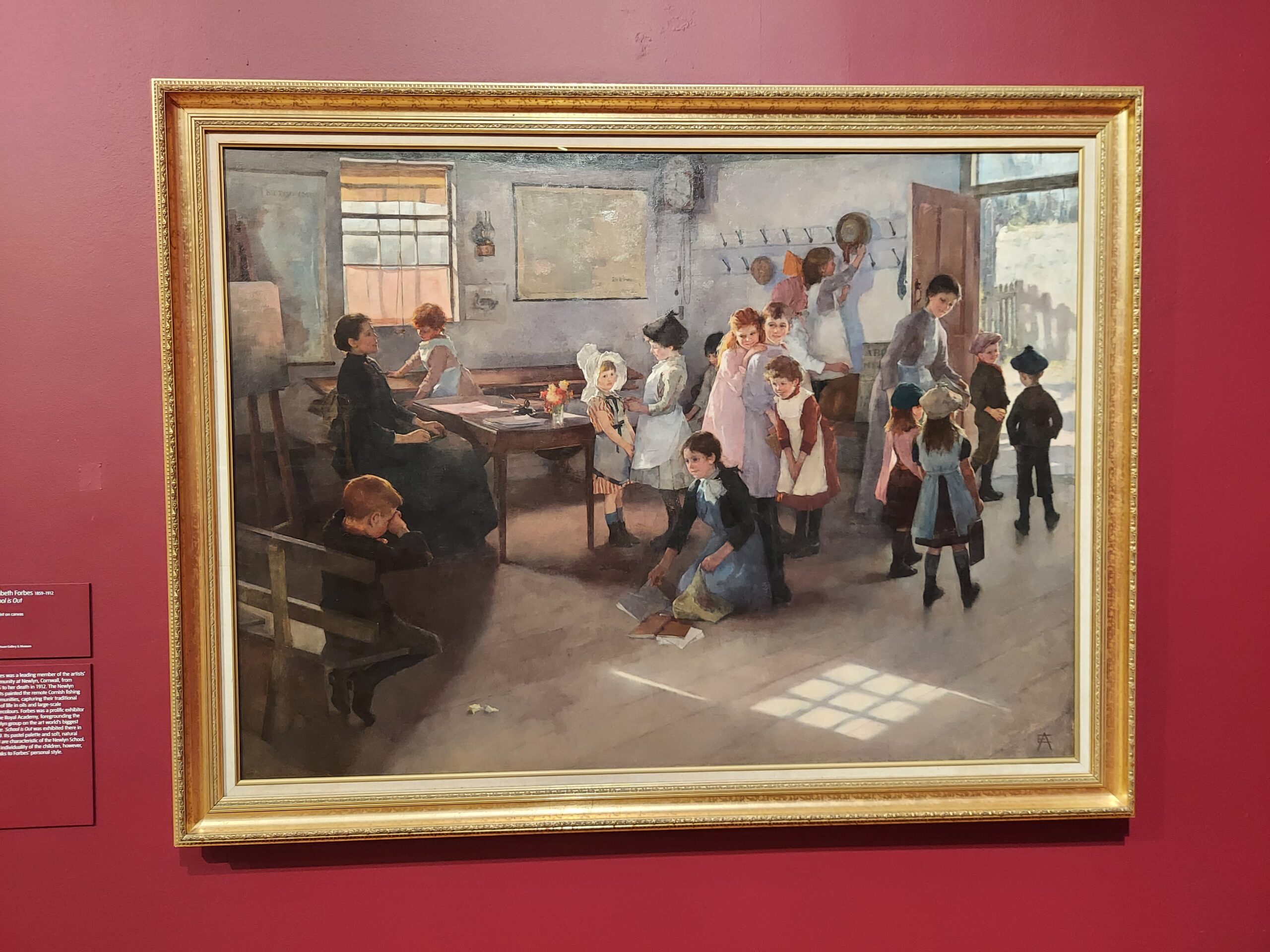
Other women ventured outside the confines of the studio and painted outdoor and social scenes.

Children in a classroom
Elizabeth Adela Stanhope Forbes, School Is Out, 1889

I was impressed with the exhibition, which introduced me to some superb artists I was unfamiliar with and who paved the way for gender equality in the art world. I understood more about their struggles and was grateful for their efforts as well as their wonderful creations.

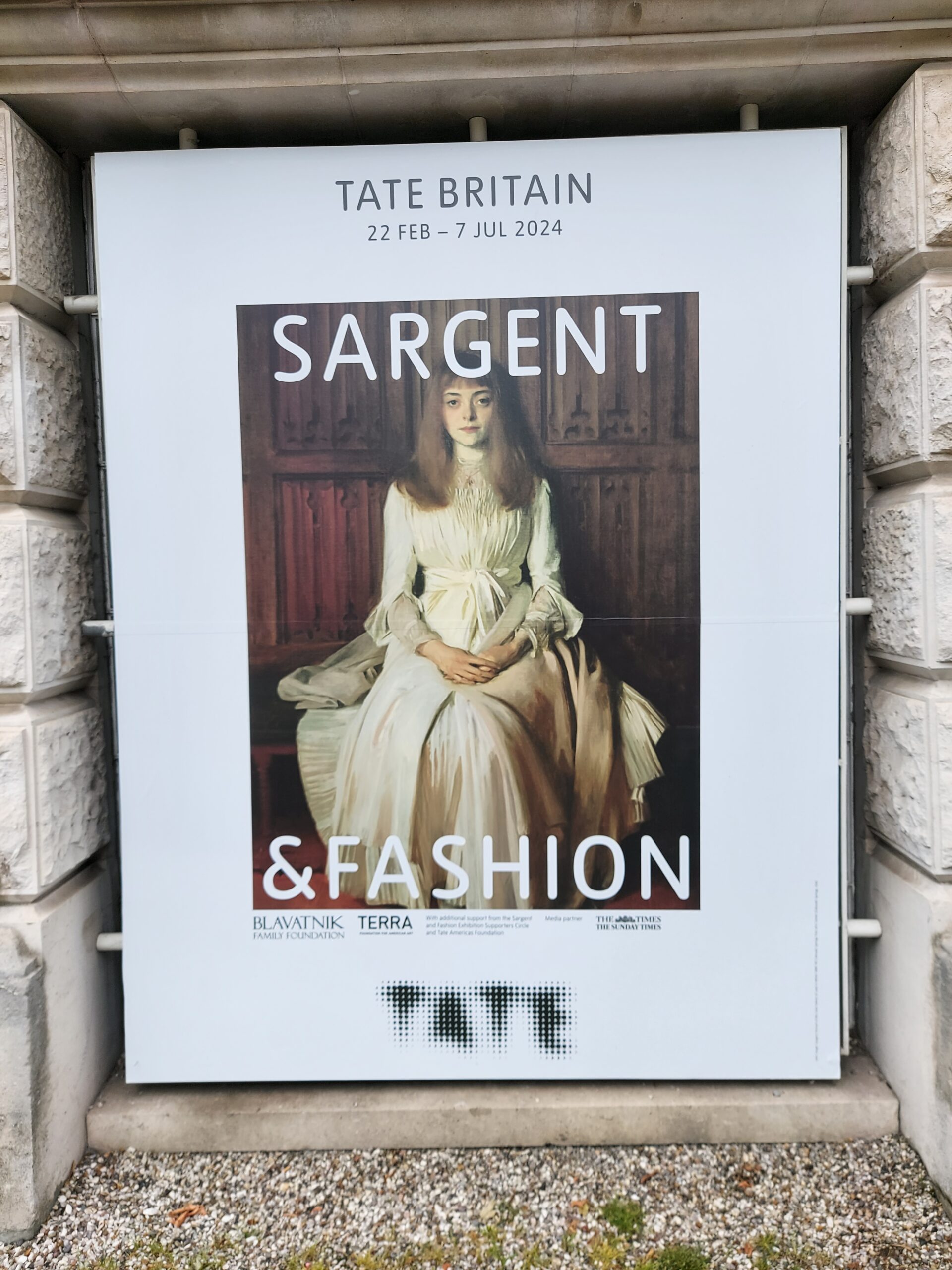
Sargent and Fashion – Tate Britain

Exhibition poster for Sargent and Fashion

At the weekend I visited Tate Britain to check out a couple of exhibitions. The first one I saw was Sargent and Fashion.

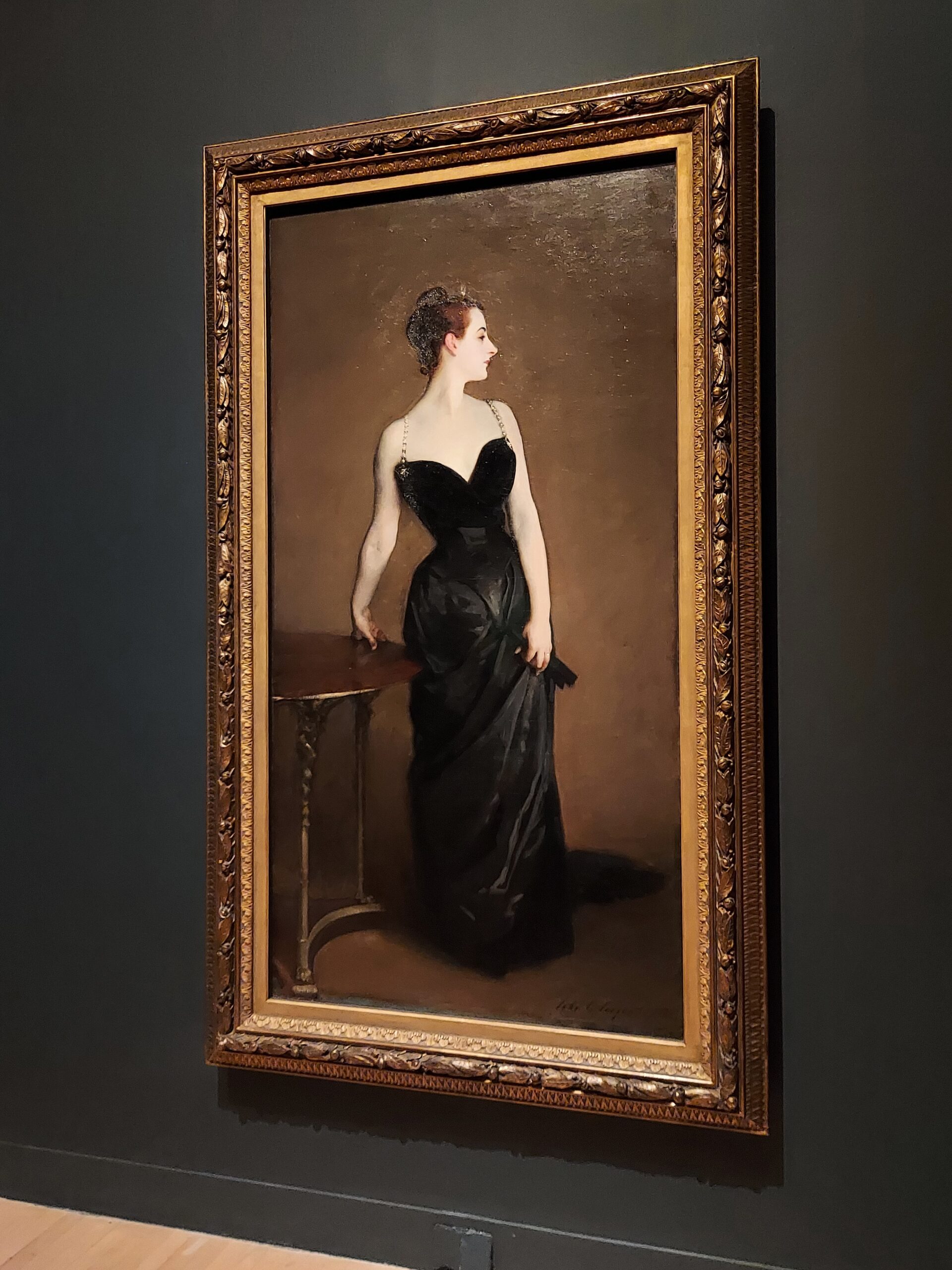
Painting of a pale white woman wearing long black evening dress
Portrait of Madame X, 1883-84

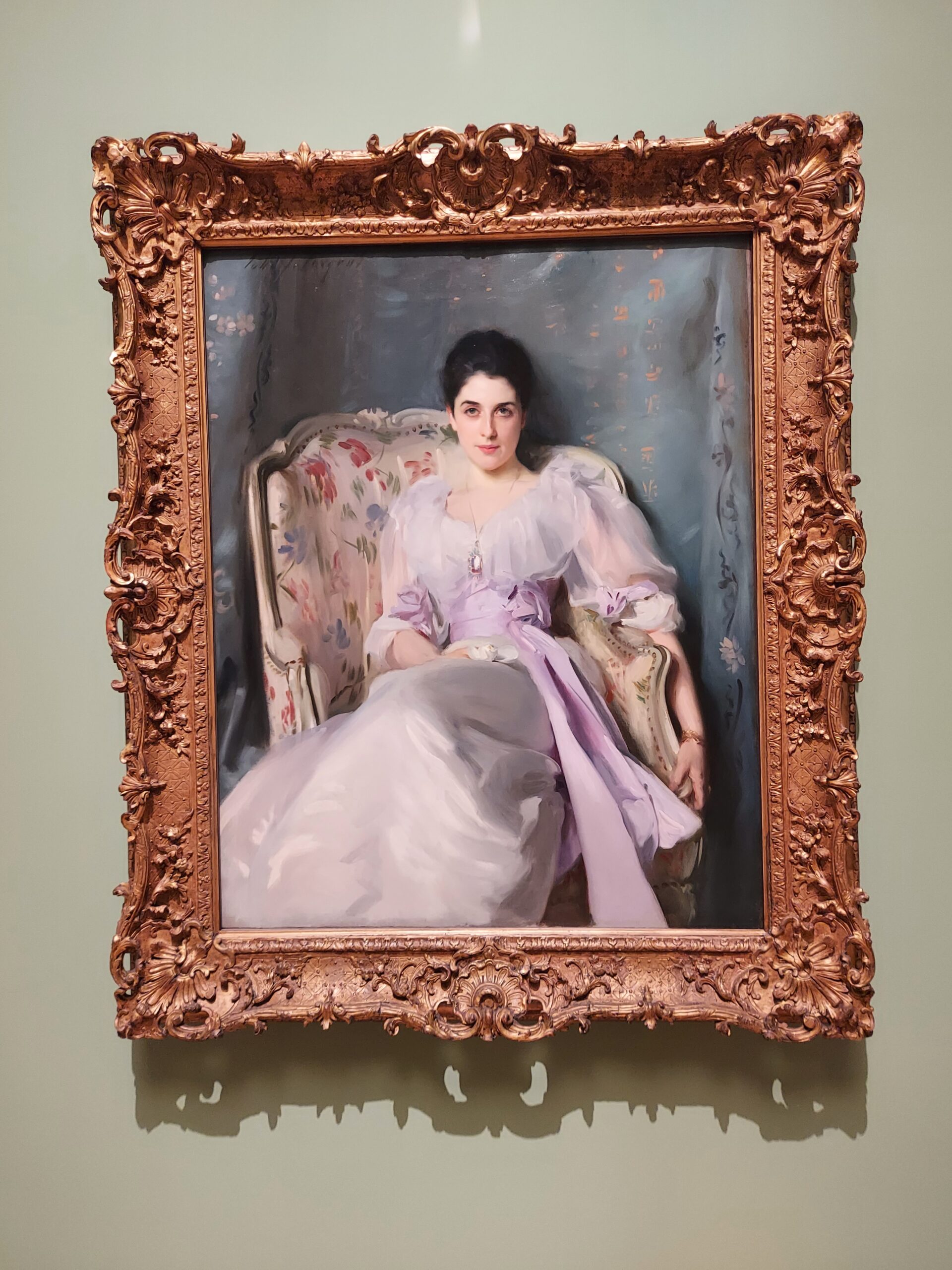
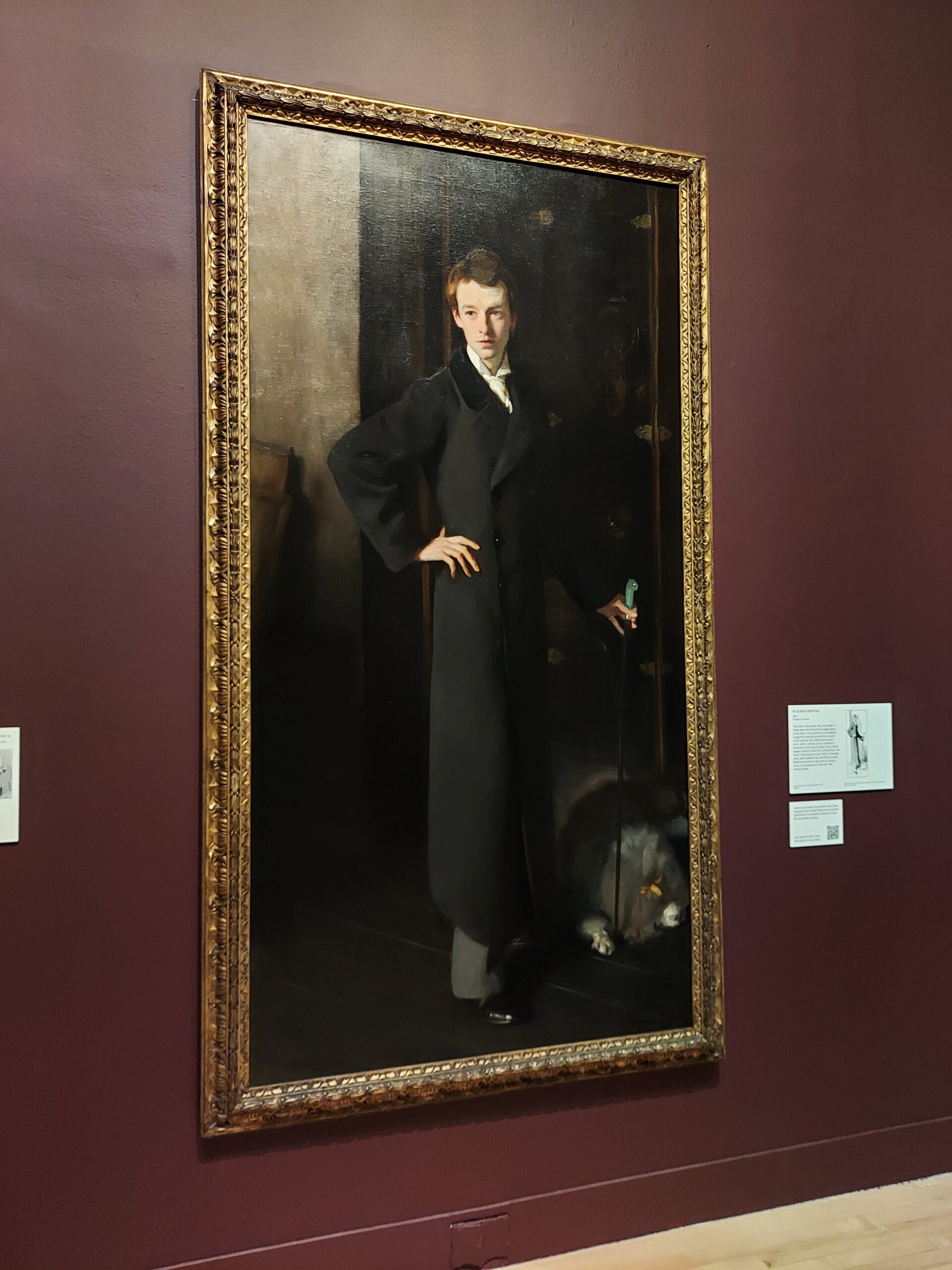
This exhibition explores the relationship between artist John Singer Sargent and the fashions of his day. The paintings in the exhibition emphasise focus on the clothes worn by his sitters: some of their choice, others at his suggestion. Sometimes these clothes caused controvery: Singer’s famous Portrait of Madame X was originally painted with one of Virginie Amélie Avegno Gautreau’s straps hanging from her shoulder, but this was seen as too risqué and he edited the painting.

The exhibition made me realise that he was really wonderful at painting clothes, capturing the ripples of the fabric and the different shades evoked. He used clothes to convey the personality of the sitter, whether long flowing gowns, delicate fabrics, or clean lines.

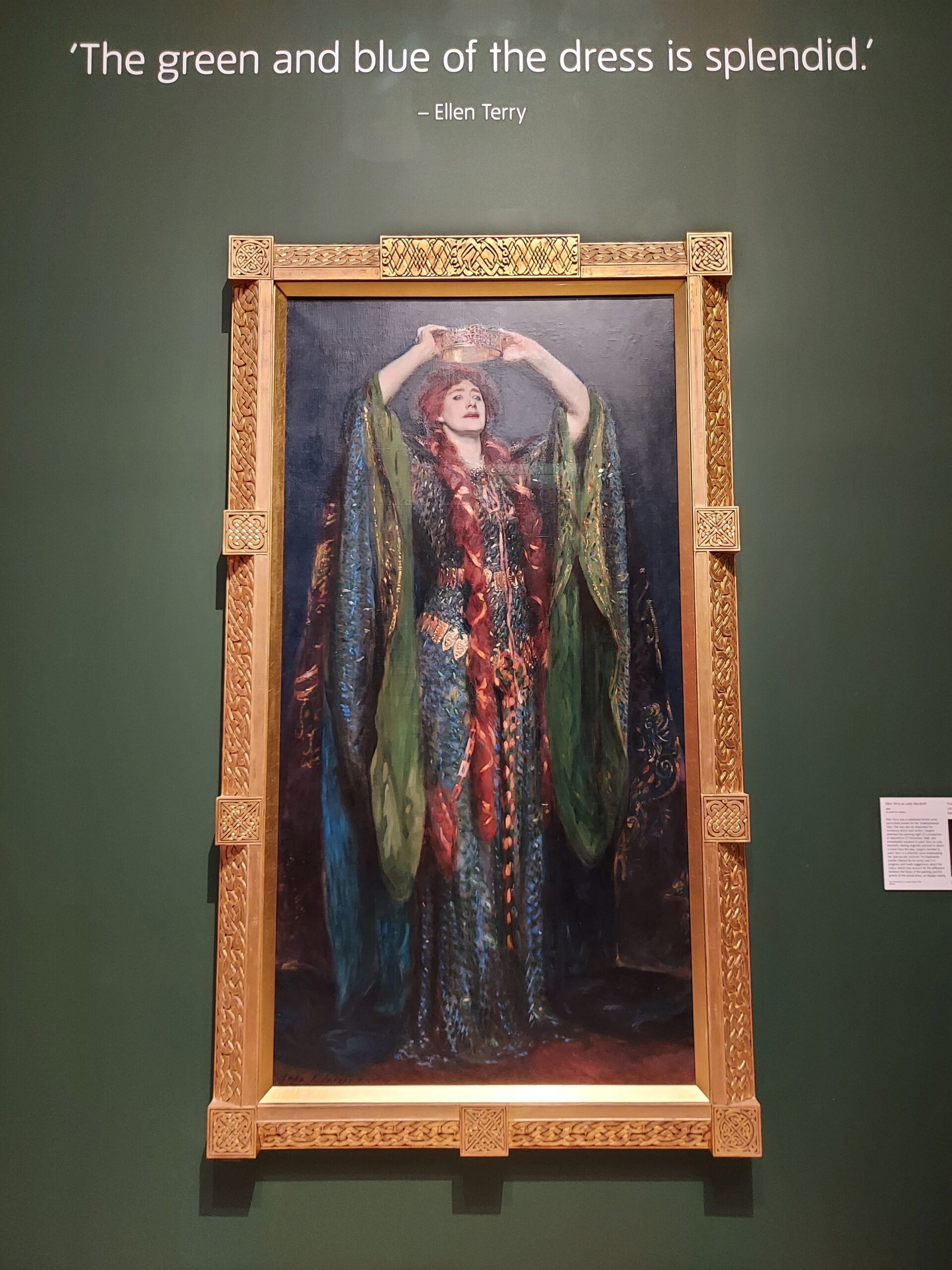
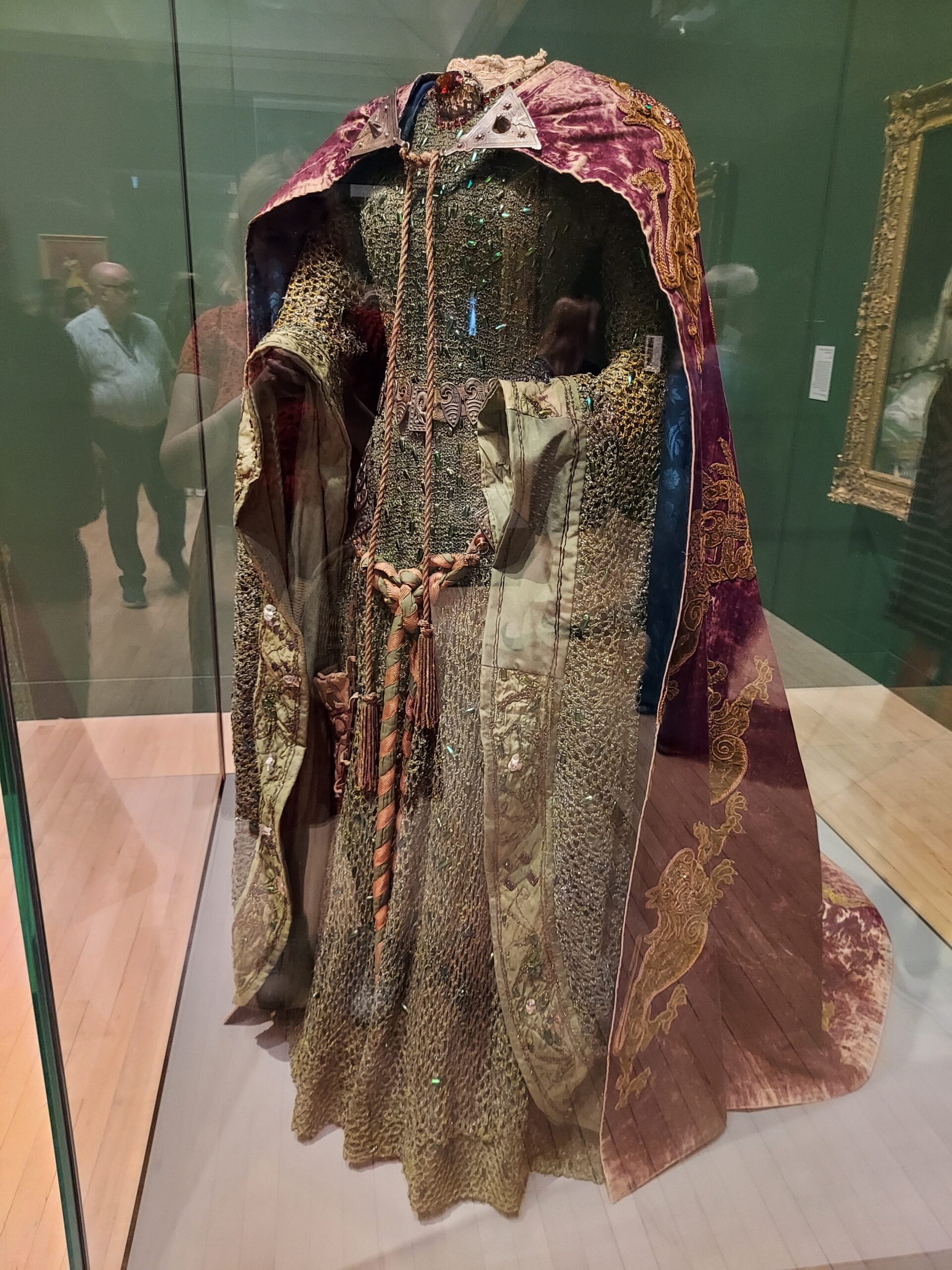
One thing I loved about the exhibition was the display of some of the costumes and clothes worn in the paintings, alongside the pictures. I especially loved seeing Sargent’s portrait of Ellen Terry as Lady Macbeth alongside the dress she wore in the production and the painting. Interestingly, the real life dress was green, whereas the painted version is blue – presumably for artistic reasons.

I found this exhibition hugely enjoyable, and appreciated seeing all this beautiful art. I left with a better understanding of how Sargent, art and fashion intertwined.

Mighty Hoopla

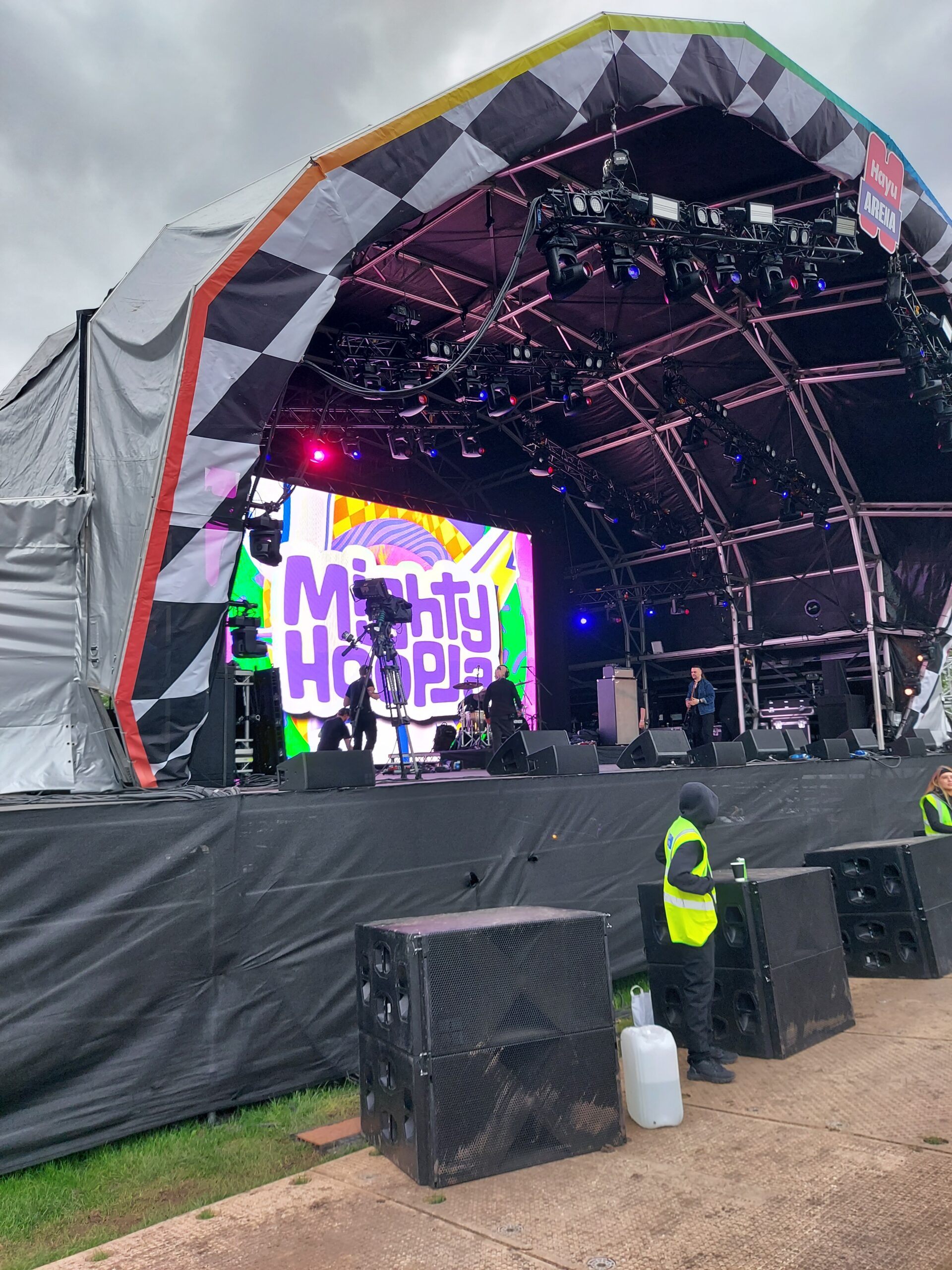
Hayu Arena stage at Mighty Hoopla

A few years ago, I started thinking about which artists I hadn’t seen live yet that I really wanted to, and Nelly Furtado was top of that list. Therefore, when she was announced for the Mighty Hoopla in June 2024, I knew I had to go – never mind that I would be there by myself. As it turned out, there were loads of other artists that I fancied seeing, too, so it was definitely worth the ticket price.

Mighty Hoopla was founded in 2016 by Jamie Tagg, Glyn Fussell, Sean Rowley and Ally Wolf. It started out at Butlins, before moving to Victoria Park then to Brockwell, south London, in 2018. It was started with the aim of being a safe and inclusive space for all music fans, particularly the LGBTQIA+ community. While not a member of that community, I felt incredibly safe during the festival, even as a solo woman: the atmosphere was brilliant and I got chatting to a few different people while I was there.

The weather prior to the festival had been incredibly wet, but the organisers did a fantastic job of securing and covering the ground to ensure the mud was kept to a minimum. There’s a bigger conversation to be had about the ethics of fencing off large portions of public parks for fee-paying customers and the inevitable noise pollution (plus the condition these parks are inevitably left in after the event), but that’s beyond the scope of this blog post. Luckily the festival itself stayed dry, though Saturday was freezing – more than once I found myself wishing I’d brought gloves!

On the Saturday, I got there just in time to catch the end of Michelle Gayle’s set on the Hayu Arena stage. I hadn’t heard her song ‘Sweetness’ in a long time! I then wandered over to the Main Stage to see Rebecca Black, who was unexpectedly good – her dancers also deserve some sort of award, because they were brilliant.

I hung around this area for a while, checking out the stalls and buying a couple of drinks, before watching Eve’s set. Turns out I knew more of her songs than I thought I did. I then wandered back to the Hayu Arena just in time for the end of Cher Lloyd’s set, which was a lot of fun. As people were leaving I managed to squeeze to the front in time for B*Witched, which I was chuffed about. They opened with ‘Rollercoaster’, ended with ‘C’est La Vie’ and in between performed several hits including my favourite, ‘Blame It On The Weatherman’.

I stayed in place to wait for the next act, Claire Richards from Steps, who performed a selection of Steps tracks as well as her own songs. There was an incredible moment when she brought out Delta Goodrem to duet on their track from Claire’s latest album.

Afterwards, I headed back to the Main Stage where I caught the end of En Vogue’s set, before getting as far to the front as I was able to catch Nelly Furtado’s performance. She was amazing, and I only wish her set had been longer, as she has a massive back catalogue which I would have loved to hear. She focused on her more mainstream club hits, whereas I would have loved to hear songs like ‘Turn Off The Light’ and ‘Try’. Still, I was just so happy to be able to see her live!

The next day, I got to Brockwell Park just as The Veronicas were finishing up. I headed to the Main Stage to see Rachel Stevens, who was great, and Bambie Thug, who made a bigger impact with their three songs than some other artists did with ten or more. They performed a song they’d written about Palestine and finished up with their Eurovision track ‘Doomsday Blue’, complete with crowdsurf.

I had a long time to wait before the next act I wanted to see, so found a shady spot and read a book for a while. I took my ereader with me on both days and it came in handy while waiting for bands to start!

I went over to the Hayu Arena in time to see Louise. She was absolutely brilliant and I feel like I’ve been underrating her all these years. Excitingly I’d managed to get to the front again, and stayed firmly put while waiting for Delta Goodrem to come on stage, chatting to a couple of other fans while I waited.

I was lucky enough to see Delta live on her tour last year, but I was so glad I was able to see her again here. She gave a brilliant performance and I hope she’s managed to gain some new fans so that she can play in the UK more often in the future!

I left the park after her performance in order to beat the rush. I had an absolutely fantastic weekend – buying a ticket to Mighty Hoopla was a great decision.

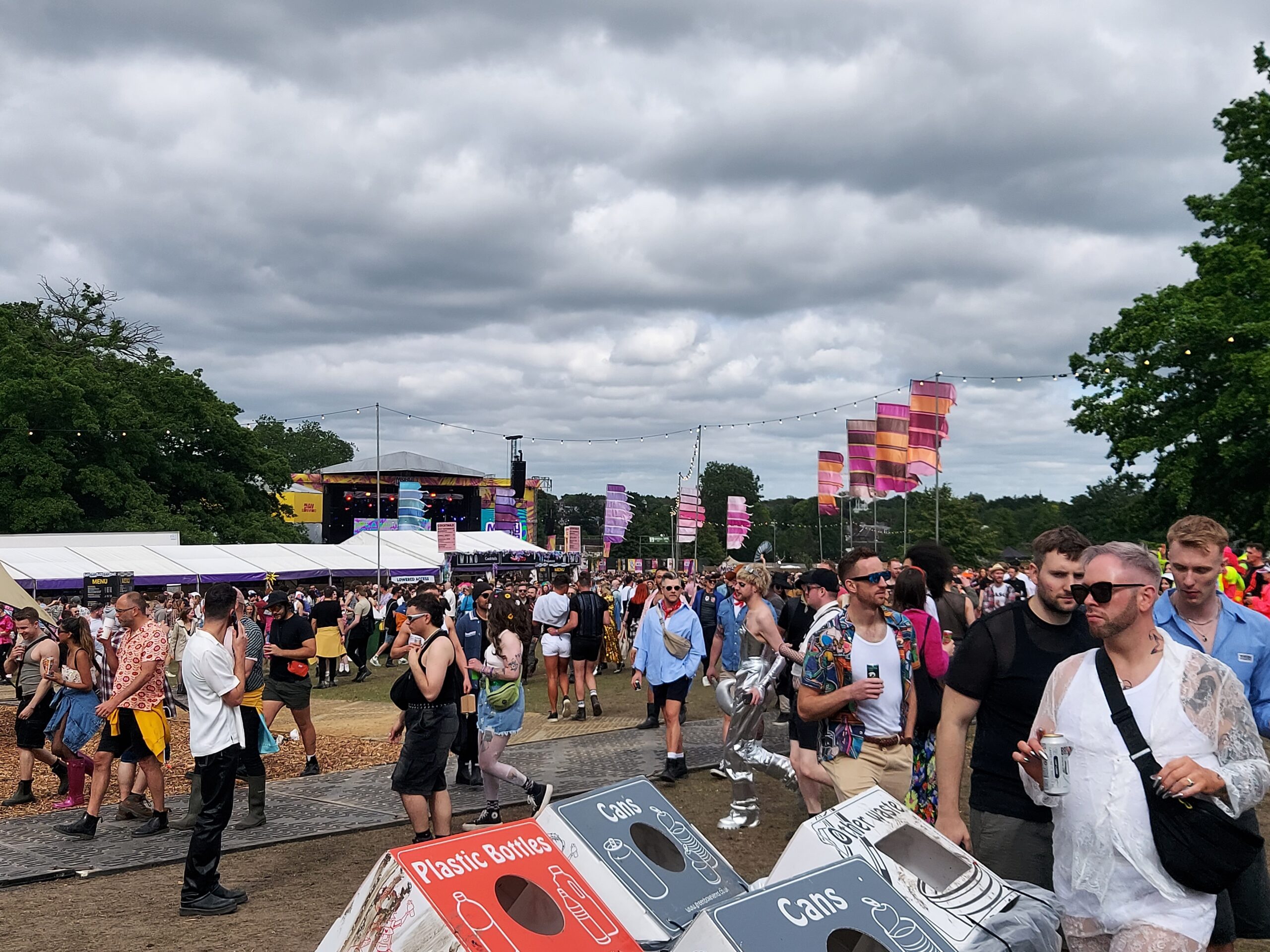
The crowds at Mighty Hoopla

Legion: life in the Roman army – British Museum

An exhibition I really wanted to see was Legion: life in the Roman army at the British Museum. I managed to visit over the Bank Holiday weekend.

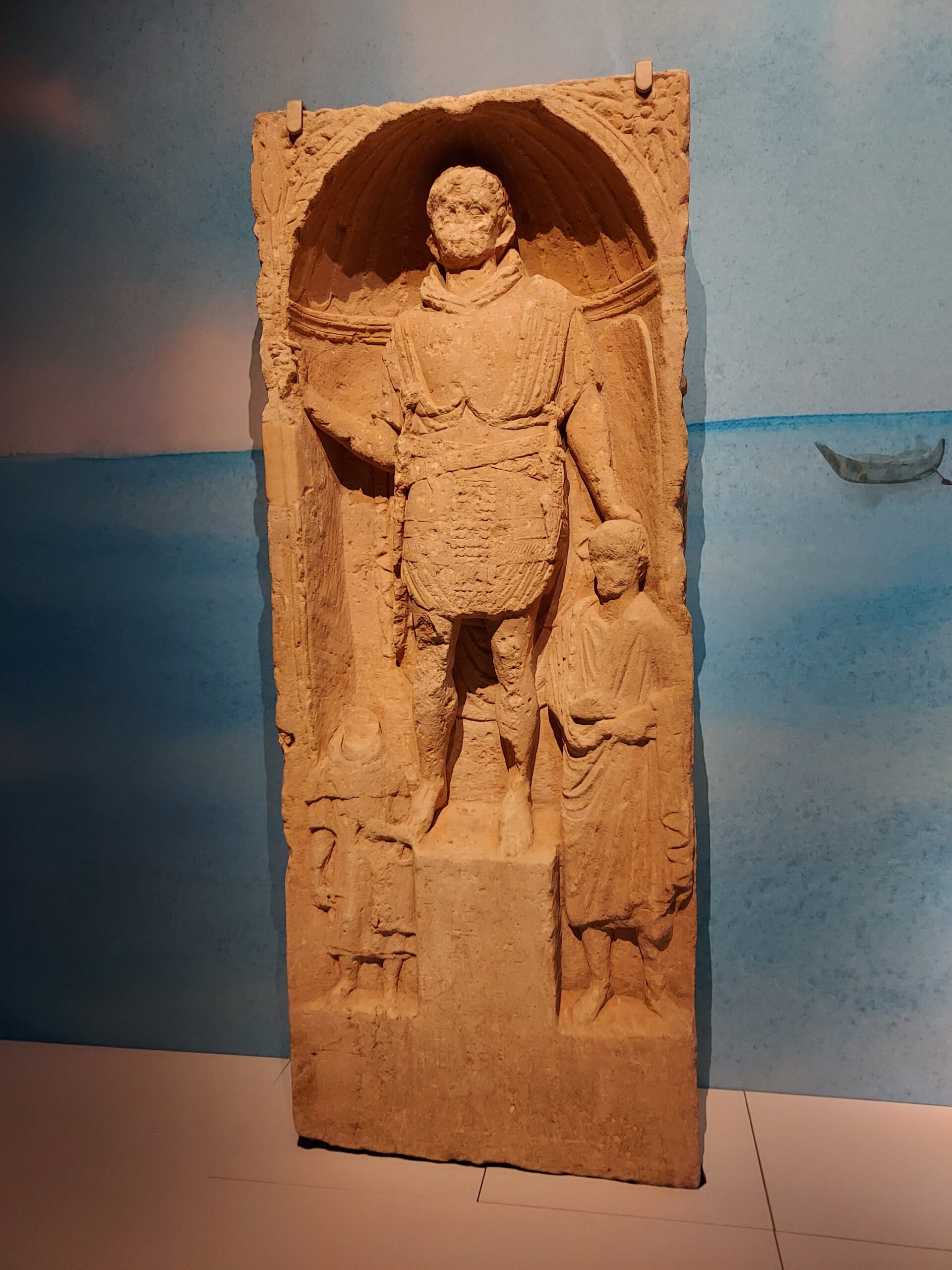
Statue of a Roman soldier

As the title suggests, the exhibition explores what life was like in the Roman army for the soldiers that served in it. Drawn from across the Empire, citizen soldiers were tempted by the prospect of monetary rewards on retirement, while non-citizens could look forward to citizenship for themselves and their families. However, lasting until retirement depended on surviving battles, illnesses and other hardships.

The exhibition focuses on one particular soldier, Claudius Terentianus, as an anchor throughout. We see his journey from enlistment through wars to eventual retirement. Rome was an empire bent on conquest, and required thousands of soldiers in order to conquer and maintain order throughout its territories. Civilians often viewed them with suspicion – the discovery of the skeletons of two soldiers in Canterbury suggests that they were murdered and buried in secret.

Roman longshield
Legionary longshield

The Roman Empire spanned countries and continents, and this is apparent in the objects on display, which include letters written on papyri by soldiers based in Egypt and tablets found at Vindolanda fort near Hadrian’s wall. Some of the most common objects are gravestones, a stark reminder that many soldiers and their family members died of various illnesses. One section in the exhibition focuses on the games and toys families amused themselves with while living at forts and encampments.

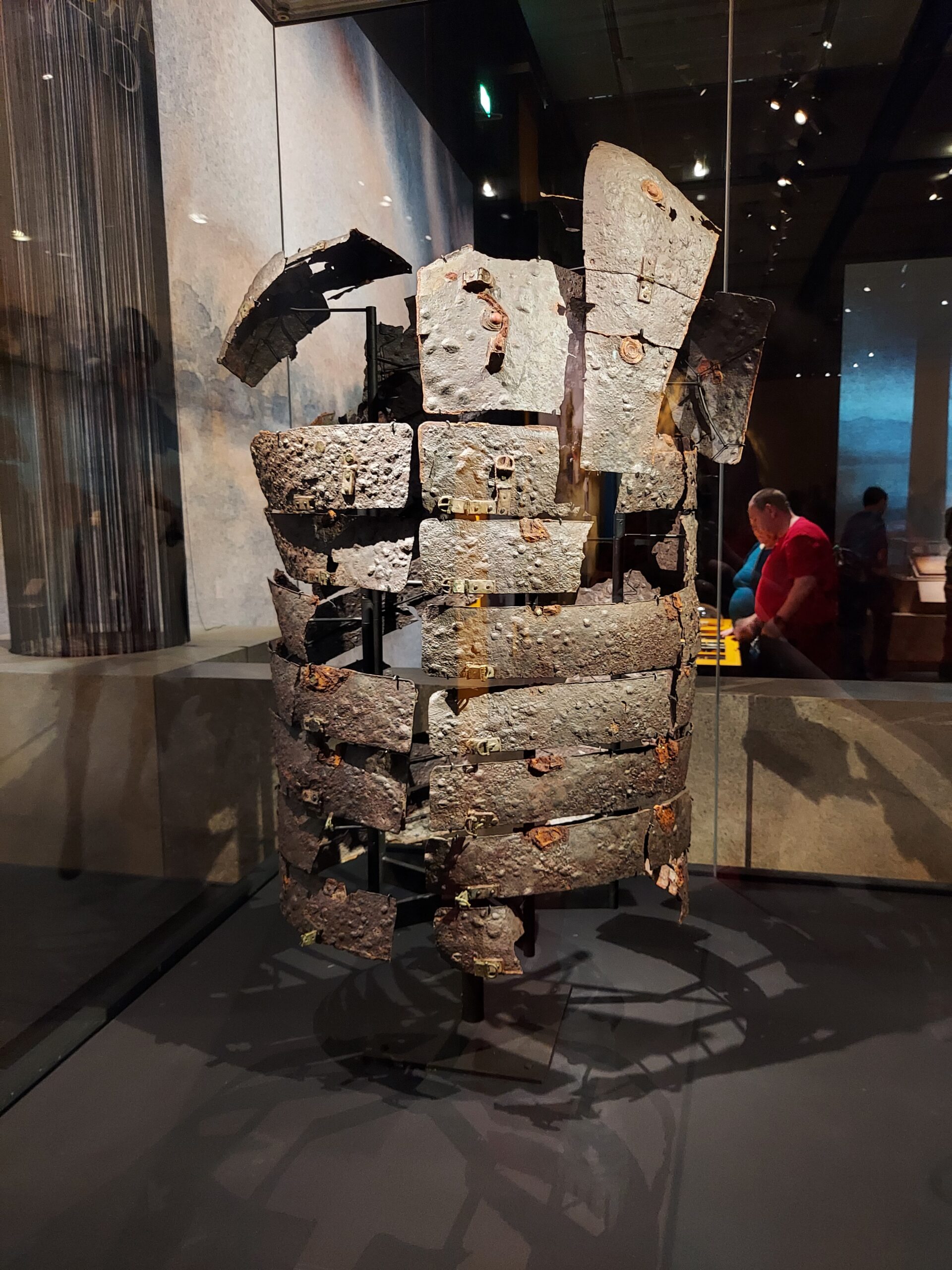
As is to be expected in an exhibition about soldiering, weapons and armour are prominent; one particularly impressive item is the only surviving legionary long shield. It’s incredible seeing this shield, which, owing to its prevalence in popular culture when it comes to the Romans, seems almost larger than life. One cuirass (a piece of torso-fitting armour) comes with a sad story: it was found on the battlefield in Lower Saxony after the Romans were resoundingly defeated by German warriors.

Roman armour
Roman armour

The exhibition is full of fascinating information, such as the structure of the Roman army, how one would go about becoming a soldier, and details of the various Emperors and the campaigns they waged. However, it is the human stories that speak to us the most. Terentianus detailing his troubles in a letter to his father; a Roman lady stationed in a fort sending an invitation to her friend; and most poignantly, a soldier killed by the Vesuvian eruption trying to help civilians escape from Herculaneum. His sword and dagger were with him, still sheathed, and are perfectly preserved.

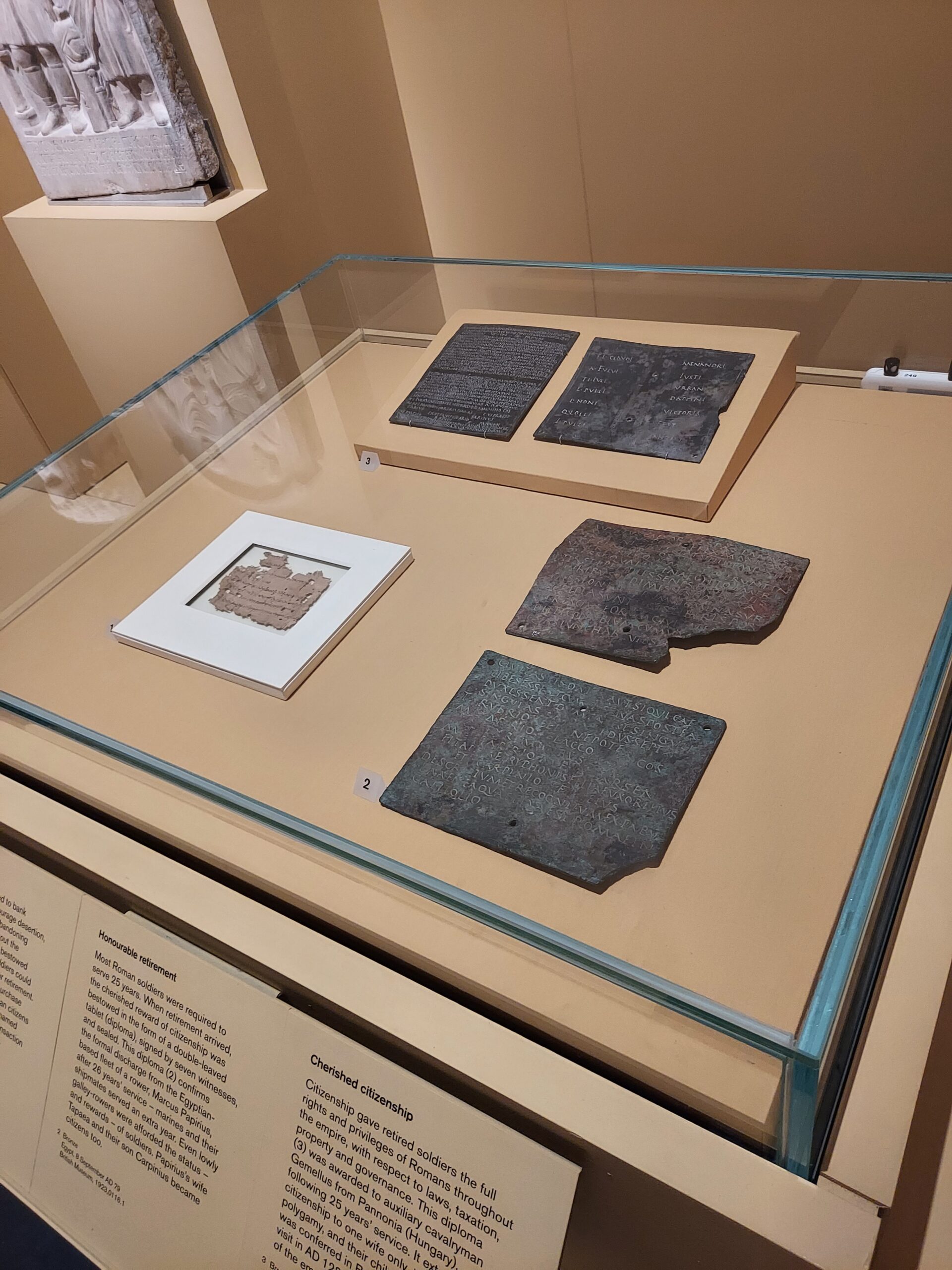
Tablets conferring Roman citizenship on retired soldiers

Disney100: The Exhibition – ExCel London

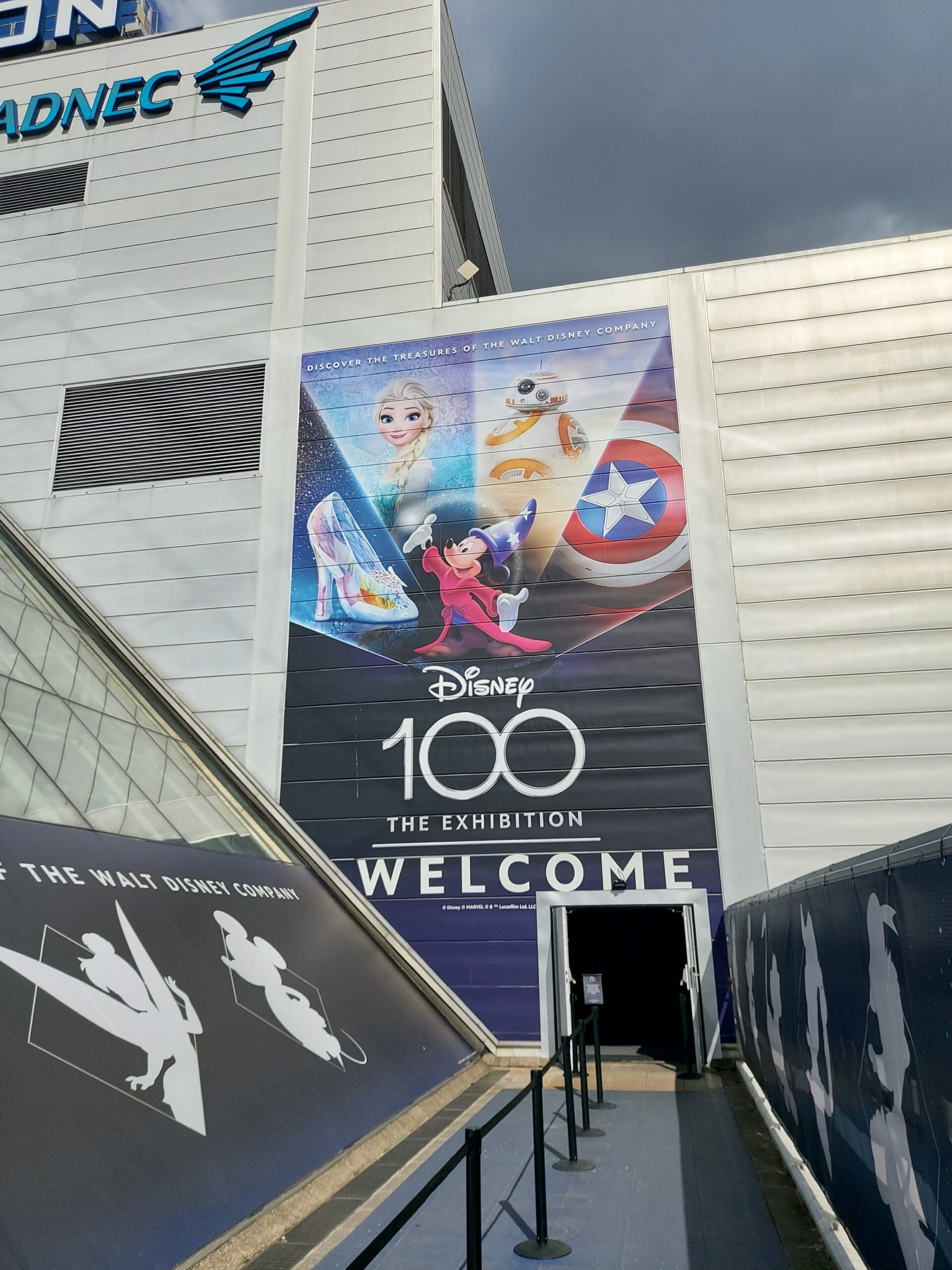
Entrance to the Disney100 exhibition

As someone who has enjoyed Disney movies for most of my life (although I don’t have the passion or obsession that many others have), I wanted to visit the Disney100 exhibition at the ExCel centre in London. The date I chose to visit was the same day as Comic Con, so I was a bit confused by all of the people in cosplay wandering around!

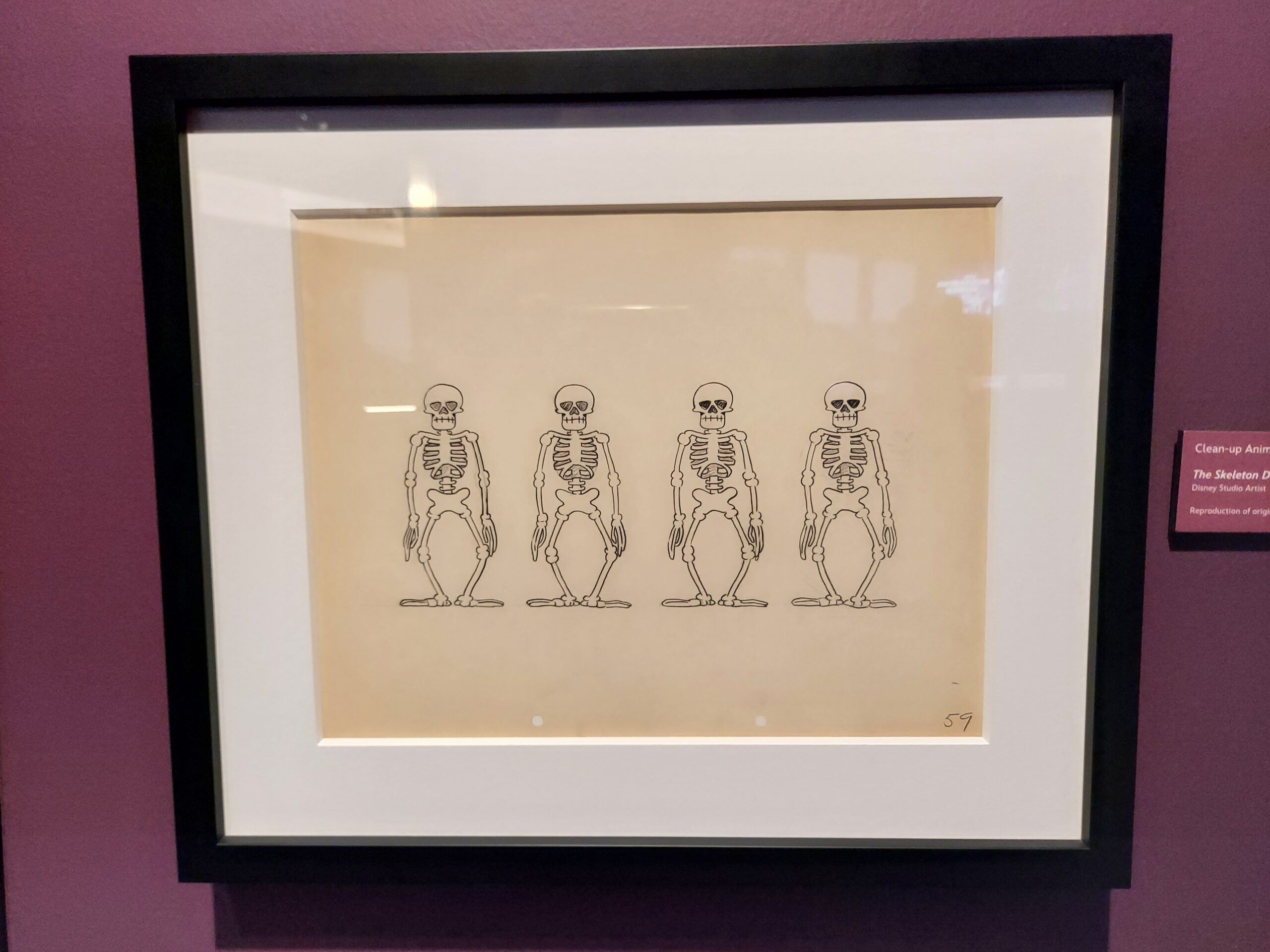
Still from the Skeleton Dance cartoon
Still from ‘The Skeleton Dance’, 1929

The exhibition marks the 100th anniversary of the Disney company and traces the story of its beginnings and development over the last century. Beginning with Walt Disney’s earliest animations, it follows the establishment of the company and features artefacts, works of art, costumes and props from the entirety of its history.

Exhibits are arranged within ten themed galleries, including the stories, sound and music, and innovation. I particularly enjoyed the early galleries telling the story of how Walt Disney developed his skills in animation and founded the company: a genuinely unique innovator with a creative vision who changed the future of animation.

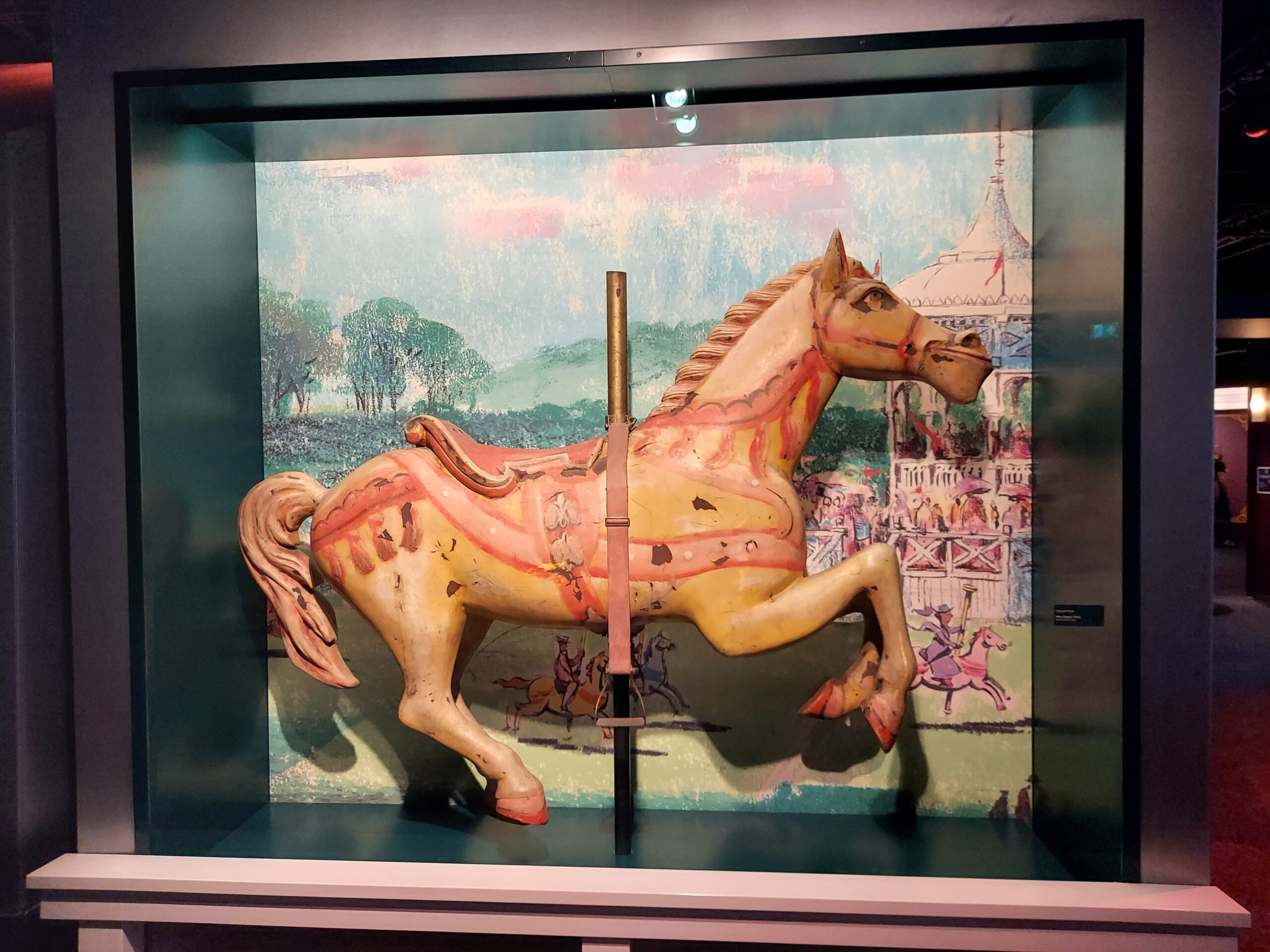
It was interesting to see props and stills from the early animated movies, especially the prop storybooks. Also, costumes and other items from live-action movies, such as a glass slipper from the live-action Cinderella and a carousel horse from Mary Poppins, were interesting to see.

Carousel horse
Carousel horse from ‘Mary Poppins’

I was personally less interested in the items relating to Star Wars and Marvel, partly because I’m not a particular fan of either, but mostly because I don’t feel they truly count as Disney, having been created outside of the company and brought under the corporation’s umbrella at a later date.

It was interesting to look at how music is incorporated into Disney films, and how innovations in technology influenced the movies – some of them developed within Disney itself.

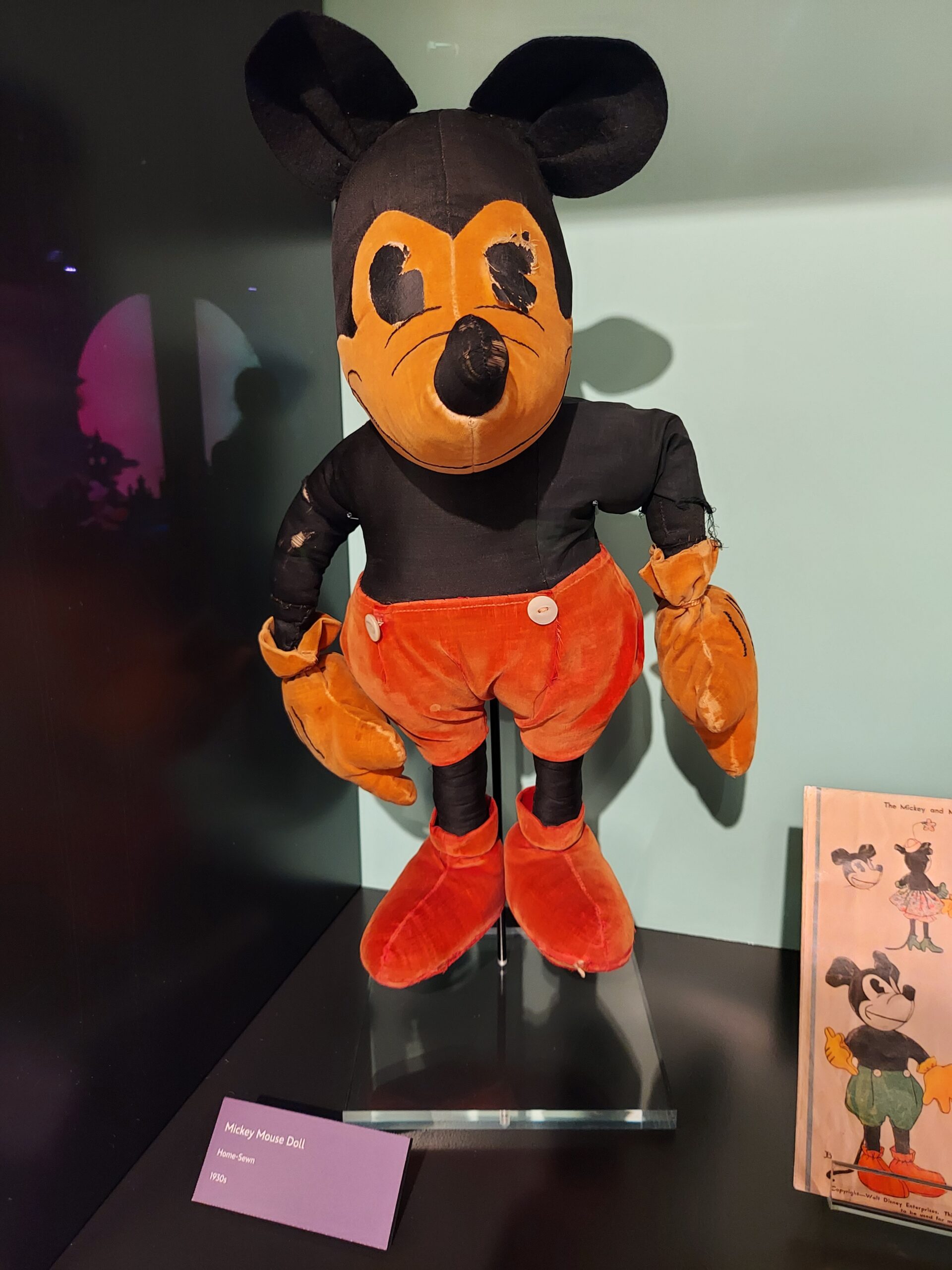
Mickey Mouse doll
Early Mickey Mouse toy

As might be expected from an exhibition created by the company itself, it is overwhelmingly positive about Disney, with nothing of any negativity to be seen. If you want a more rounded look at Disney and its impact on the world of animation and beyond, look elsewhere.

Nevertheless, this is a worthwhile and interesting exhibition about what is, at its best, a world-leading and history-making company, creator and adaptor of powerful stories that have captured the imaginations of generations of children.